

Enrow vs RampedUp: Email Finder vs Sales Database - Which Do You Need?
These two tools get compared because they both touch B2B contact data, but the comparison is misleading from the start. Enrow is an email finder - you feed it a name and company, it hands back a verified address. RampedUp is a sales intelligence database with 800M+ contacts, firmographics, technographics, and Salesforce-integrated enrichment. They're different product categories entirely.
What Is Enrow?
Enrow is a pay-per-success email finder. You input a first name, last name, and company - it returns a verified email and charges you only if it finds one. At $0.012 per valid email, it's one of the cheapest options in the space. Mobile numbers cost $0.60 each.
In the Dropcontact benchmark (updated February 2026, testing 15 tools against 20,000 real contacts), Enrow ranked #3 with a 40.9% enrichment rate and a 2.3% hard bounce rate. The benchmark is published by Dropcontact - a competing tool - but the methodology of sending real emails to 20,000 contacts is unusually transparent, which is why the sales community treats it as a credible source. There's a free tier with 50 credits, and paid plans start at $24/month with unused credits that roll over.
What Is RampedUp?
RampedUp is a full B2B sales intelligence platform. The database covers 800M+ contacts, 135M professional emails, 65M mobile numbers, 120M personal emails, and 75M companies with 8,000 technographics. It's built for teams that need firmographics, job-change detection, suppression lists, and up to 60 enrichment fields per record.
The Salesforce integration goes beyond a basic connector - RampedUp supports SSO through Salesforce, and the plugin sits directly on Account, Lead, and Opportunity tabs. You'll need Salesforce API access enabled to pull CRM data into RampedUp. Their appending engine flags outdated records and updates them with new employer data, even when email validation alone wouldn't catch the change.
On G2, RampedUp holds a 4.7/5 rating across just 24 reviews - some dating back to 2018 - which makes it harder to gauge current user satisfaction at scale. Users praise the UI and data cleanliness, but coverage gaps in niche verticals come up repeatedly.

Enrow gives you emails but no database. RampedUp gives you a database but charges $6K+ to start. Prospeo gives you 300M+ searchable profiles, 143M+ verified emails, and 125M+ verified mobiles - at ~$0.01 per email with no annual contract.
Get the database and the accuracy without the enterprise price tag.
Feature Comparison
| Feature | Enrow | RampedUp | Prospeo |
|---|---|---|---|
| Database size | No database | 800M+ contacts | 300M+ profiles |
| Pro emails | Find-on-demand | 135M | 143M+ verified |
| Mobile numbers | Limited ($0.60 ea) | 65M | 125M+ verified |
| Entry price | $24/mo | ~$6,000/yr | Free tier |
| Cost per email | $0.012 | ~$0.25 (Entry) | ~$0.01 |
| Free tier | 50 credits | 7-day trial | 75 emails/mo |
| CRM integrations | Zapier | Salesforce SSO | Salesforce, HubSpot |
| Data refresh | On-demand | Monthly updates | 7-day cycle |
| Verification | Built-in | Validation + timestamp | 5-step with catch-all handling |
| Best for | Solo email finding | Full sales intelligence | Accuracy + database |
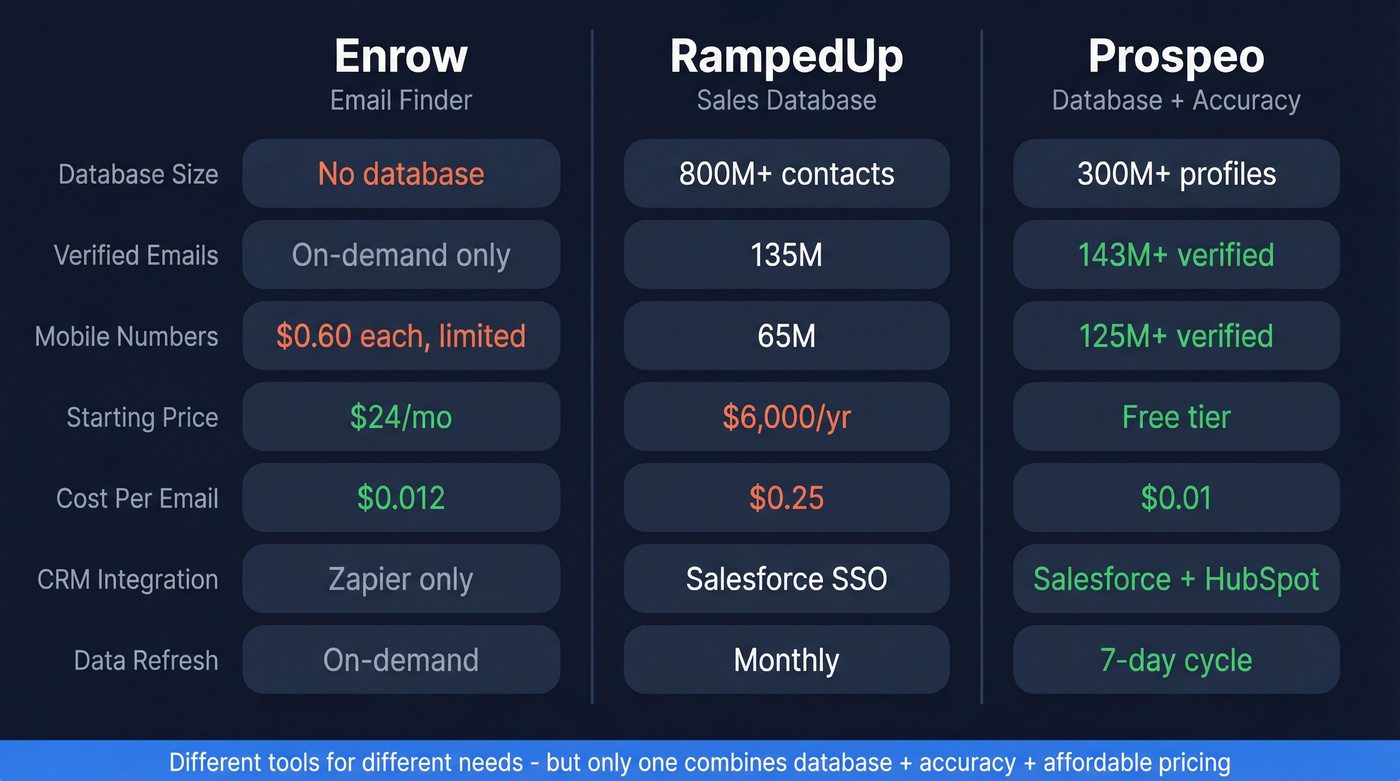
Here's the thing: these aren't competitors. Enrow finds emails one at a time and has no searchable database, no company data, no phone numbers at scale. RampedUp gives you a searchable database with enrichment workflows. They solve different problems.
Pricing Breakdown
Let's be honest - RampedUp's pricing is where most teams either commit or walk away.
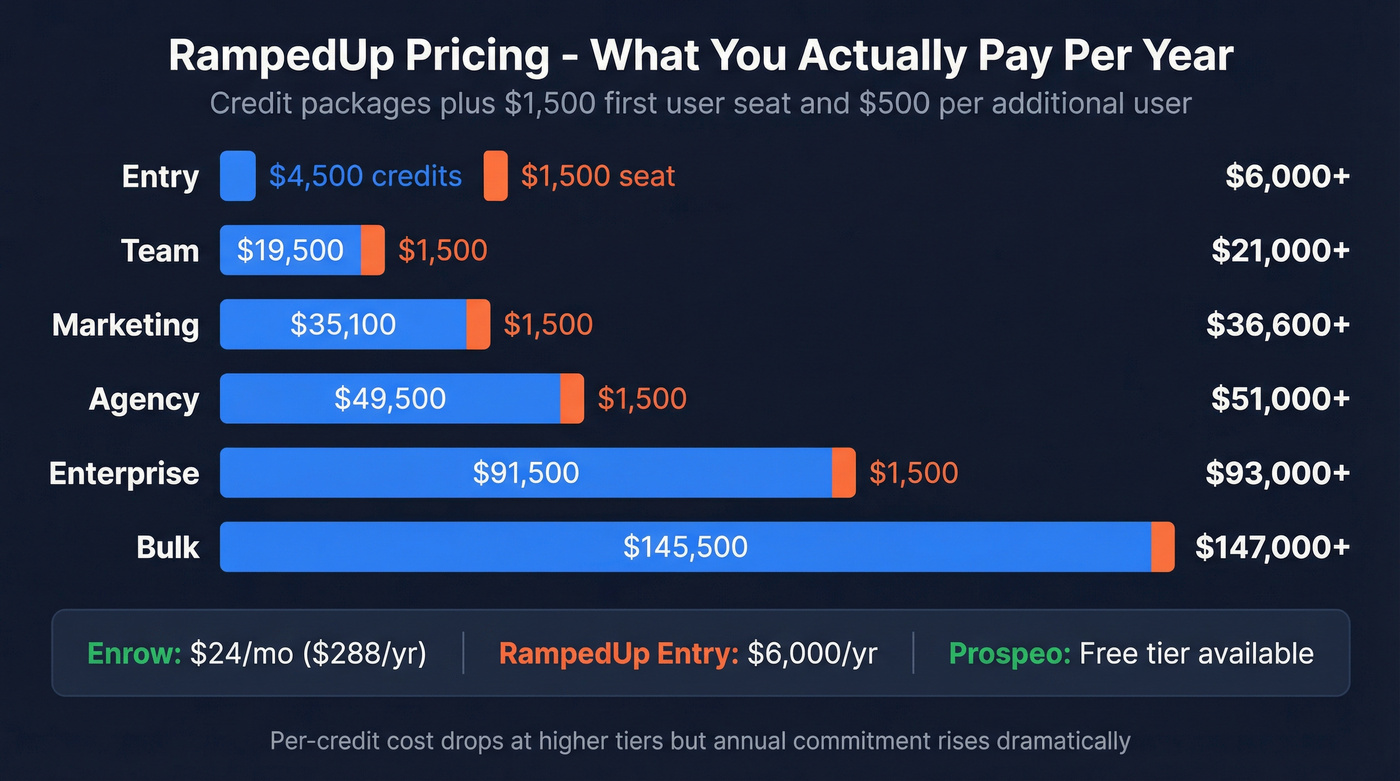
RampedUp tiered pricing:
| Tier | Credits/yr | Credit cost | Annual total |
|---|---|---|---|
| Entry | 12,000 | $0.25 | $4,500 + user fees |
| Team | 120,000 | $0.15 | $19,500 + user fees |
| Marketing | 480,000 | $0.07 | $35,100 + user fees |
| Agency | 1.2M | $0.04 | $49,500 + user fees |
| Enterprise | 3.6M | $0.025 | $91,500 + user fees |
| Bulk | 12M | $0.012 | $145,500 + user fees |
RampedUp charges $1,500 for your first user seat and $500 for each additional - on top of the credit package. Entry Level actually costs $6,000 before you've downloaded a single contact. For teams that want the entire database as a flat file, RampedUp charges $260,000/year for all US contacts or $468,000/year for global. This is an enterprise-grade platform, not a scrappy email finder.
Cost per 1,000 valid emails:
- Enrow: ~$12
- RampedUp Entry: ~$250
- Prospeo: ~$10
At Entry Level, RampedUp costs roughly 25x more per email than Enrow. The per-credit cost drops at higher tiers - Bulk Level hits $0.012/credit, matching Enrow - but you're committing $145,500/year to get there.
If your team needs fewer than 50,000 contacts per year, RampedUp's Entry and Team tiers are overpriced for what you get. The unit economics only make sense at Marketing tier and above, where you're pulling 40K+ contacts per month and actually using the firmographic and technographic data. We've talked to plenty of teams who signed an annual deal at Entry, used a fraction of their credits, and wished they'd gone with something lighter.
When to Choose Each Tool
Choose Enrow
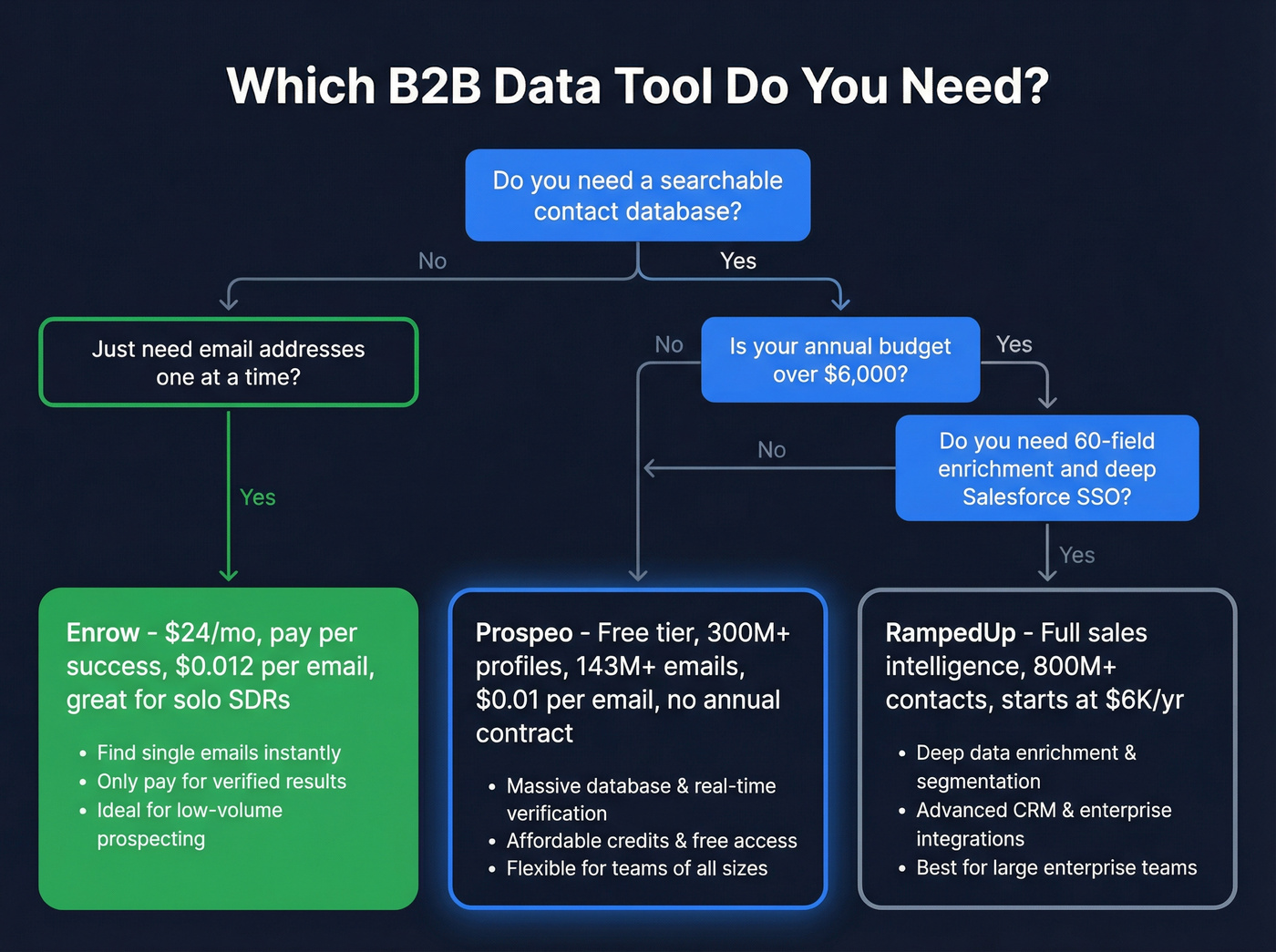
You only need email addresses and want pay-per-success fairness. It's ideal for solo SDRs or small teams running targeted outreach who don't need a searchable database or company intelligence. The $24/month entry and rolling credits make it low-risk. If you're comparing options, see more picks in our guide to email finder tools.
Choose RampedUp
You need a full B2B database with firmographics, technographics, and deep Salesforce integration. RampedUp makes sense for teams running suppression lists, job-change alerts, and enrichment workflows at scale - but your budget needs to support $6K+/year minimum, and you'll get the best unit economics at Team Level or above. If you're evaluating vendors, compare more options in our roundup of sales intelligence database tools.
Skip Both
Look, if you want accurate email finding and a searchable database with 125M+ verified mobiles, intent data across 15,000 topics, and native CRM integrations - without annual contracts or $6K minimums - that's exactly the gap Prospeo fills. We've tested dozens of tools in this space, and the combination of 98% email accuracy, a 7-day data refresh cycle, and self-serve pricing with no contract is hard to beat. The free tier gives you 75 verified emails per month with no credit card required. If deliverability is a priority, pair any data source with a solid email deliverability guide.

RampedUp refreshes monthly. Enrow has no database to refresh. Prospeo runs a 7-day data refresh cycle with 98% email accuracy and 5-step verification - including catch-all handling that neither tool matches.
75 free verified emails per month. No credit card, no sales call.
FAQ
Is RampedUp worth $6,000/year?
Only if you need 10K+ contacts per year with Salesforce integration and 60-field enrichment. At Entry Level, you're paying $0.25 per credit - expensive for pure email finding. The per-credit cost drops at higher tiers, but for teams under 50K contacts/year, lighter tools deliver better ROI. The consensus on r/sales threads about data tools is that you shouldn't pay for database features you won't use, and that's exactly the trap Entry-tier RampedUp sets.
Does Enrow have a contact database?
No. Enrow is strictly an email finder - you input a name and company, and it returns a verified email. There's no searchable database, no bulk list building, no phone numbers at scale, and no firmographic data.
What's the cheapest way to get verified B2B emails?
Prospeo's free tier gives you 75 verified emails per month with no credit card required. Paid plans run ~$0.01 per email - comparable to Enrow's $0.012 and dramatically cheaper than RampedUp's entry point of $0.25 per credit. For teams that also need mobile numbers and intent data, it's the strongest value we've found.
Can I use Enrow and RampedUp together?
You can, but there's rarely a reason to. RampedUp already includes email validation in its enrichment workflow. Stacking Enrow on top only makes sense if RampedUp's email coverage misses contacts you've already identified by name - and at that point, a single platform with broader coverage and higher accuracy is a simpler stack.