

Enterprise Revenue Ops: What Generic Guides Won't Tell You
73% of companies now have a C-suite role dedicated to revenue ops. Yet 89% of those same teams can't articulate clearly defined strategic goals. That's the enterprise revenue ops paradox: massive investment, minimal direction.
Gartner projects 75% of highest-growth companies will adopt RevOps by 2026, but adoption without architecture is just headcount inflation. Companies without RevOps alignment miss out on 19% higher revenue growth. The gap is real, and it's widening.
This isn't SMB RevOps with more headcount. It's a different discipline - one defined by governance, data architecture, M&A complexity, and cross-functional politics that would make a diplomat sweat.
What Separates Enterprise RevOps
Five dimensions separate enterprise from everything else:
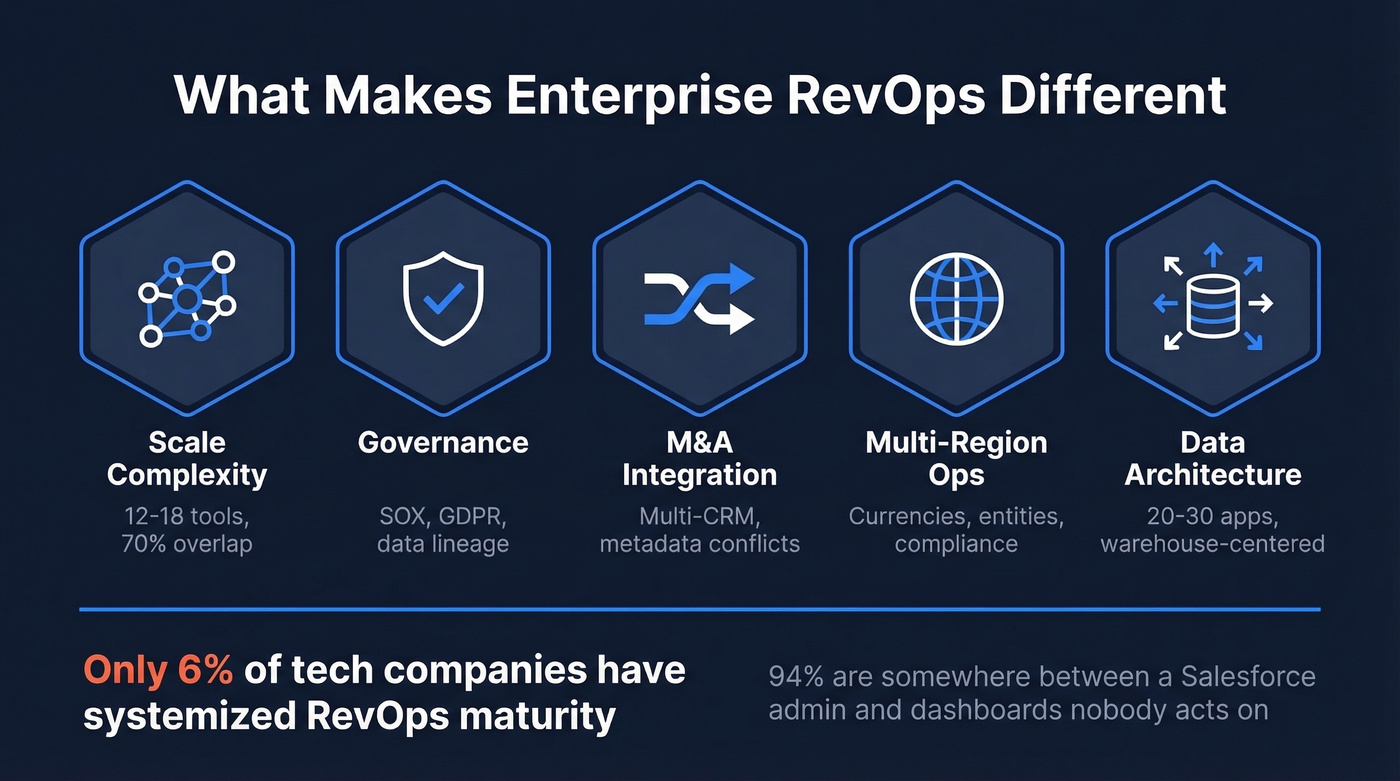
- Scale complexity. The average enterprise RevOps team manages 12-18 tools with roughly 70% overlap between providers, plus inconsistent usage across business units.
- Governance requirements. SOX, GDPR, data lineage - none optional. Only 12% of organizations report solid collaboration between Sales and Finance.
- M&A integration. Post-acquisition, you inherit CRM instances, conflicting field definitions, and broken automation. Multi-CRM governance becomes unavoidable the moment you're operating across acquired systems.
- Multi-region operations. Different currencies, entities, tax rules, and compliance regimes multiply every process decision.
- Data architecture. A typical B2B GTM org runs 20-30 applications. Without a warehouse-centered architecture, your "single source of truth" is 20 conflicting sources.
Only 6% of software and tech businesses have reached a systemized level of RevOps maturity. The other 94% are somewhere between "we have a Salesforce admin" and "we track metrics but nobody acts on them."
Org Models That Scale
Hub-and-spoke is the right choice for 100+ GTM headcount with multiple business units. A central hub owns systems, data, and analytics while embedded ops roles sit within Sales, Marketing, and CS. We've seen this model work most consistently at enterprise scale. Skip it if you're under 75 reps - the overhead isn't worth it.
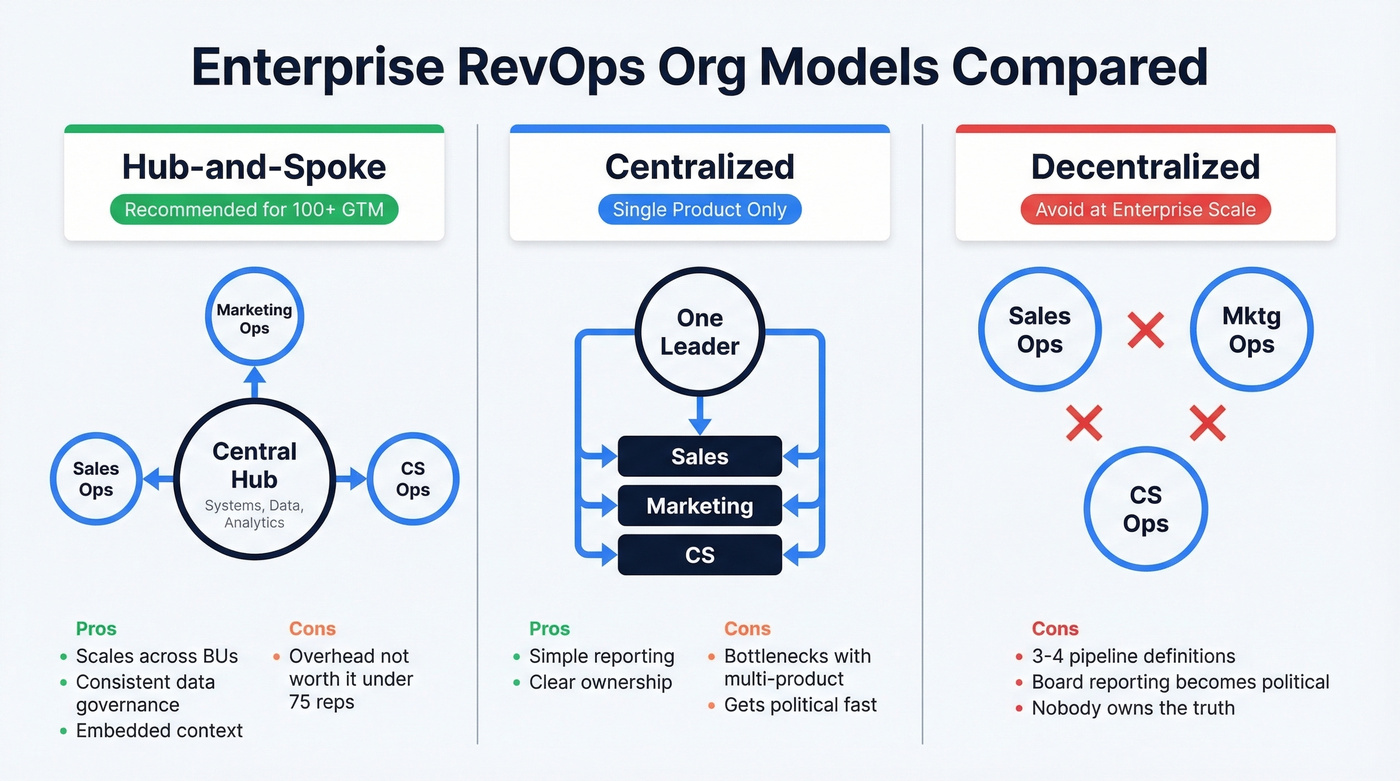
Centralized works for single-product companies with one GTM motion. Everything reports to one leader. But if you're multi-product or post-acquisition, centralized models create bottlenecks that get political fast when three VPs compete for ops resources.
Decentralized? Skip this entirely at enterprise scale. We've watched decentralized models produce three or four different pipeline definitions within the same company, turning board reporting into a political exercise rather than a data exercise. It's how you end up with three definitions of "MQL" and nobody who can produce a board-ready pipeline report.
Design around capabilities - systems, process, data, enablement - not job titles. And watch for the emerging GTM Engineer role: someone who bridges strategy and systems execution, building custom integrations that traditional ops analysts can't handle.
The Maturity Model
RevPartners' five-level framework is one of the most operational maturity models we've found:
| Level | Focus | Key Metrics | What It Looks Like |
|---|---|---|---|
| 1 | Foundation | Volume (V1-V6) | CRM adopted, data integrated |
| 2 | Measurement | Conversion (CR0-CR4) | Primary KPIs defined, tracked |
| 3 | Optimization | Supporting metrics | Review cadence, leaks fixed |
| 4 | Segmentation | Who/what/where/when | Forecast accuracy improves |
| 5 | Predictive | NRR, real-time visibility | Proactive leak detection |
The reality: 80%+ of businesses sit in developing or evolving maturity. 59% track metrics, but only 6% have systemized their approach. The gap between "we have dashboards" and "we act on what dashboards tell us" is where most teams stall - often because they lack a pipeline health scoring layer for customer success or a forecasting roll-up that forces accountability across the pipeline.

94% of enterprises haven't systemized RevOps - and stale enrichment data is the silent killer. Prospeo refreshes 300M+ profiles every 7 days with 98% email accuracy and a 92% API match rate, giving your waterfall enrichment stack a foundation that doesn't rot between refresh cycles.
Stop feeding your RevOps stack data that's already 6 weeks old.
Data Architecture That Works
The architecture pattern at enterprise scale rests on two principles. First, your warehouse is the system of record; your CRM is a system of action. Second, connecting them via reverse ETL eliminates the stale-data problem that makes 73% of GTM leaders find most reports useless.
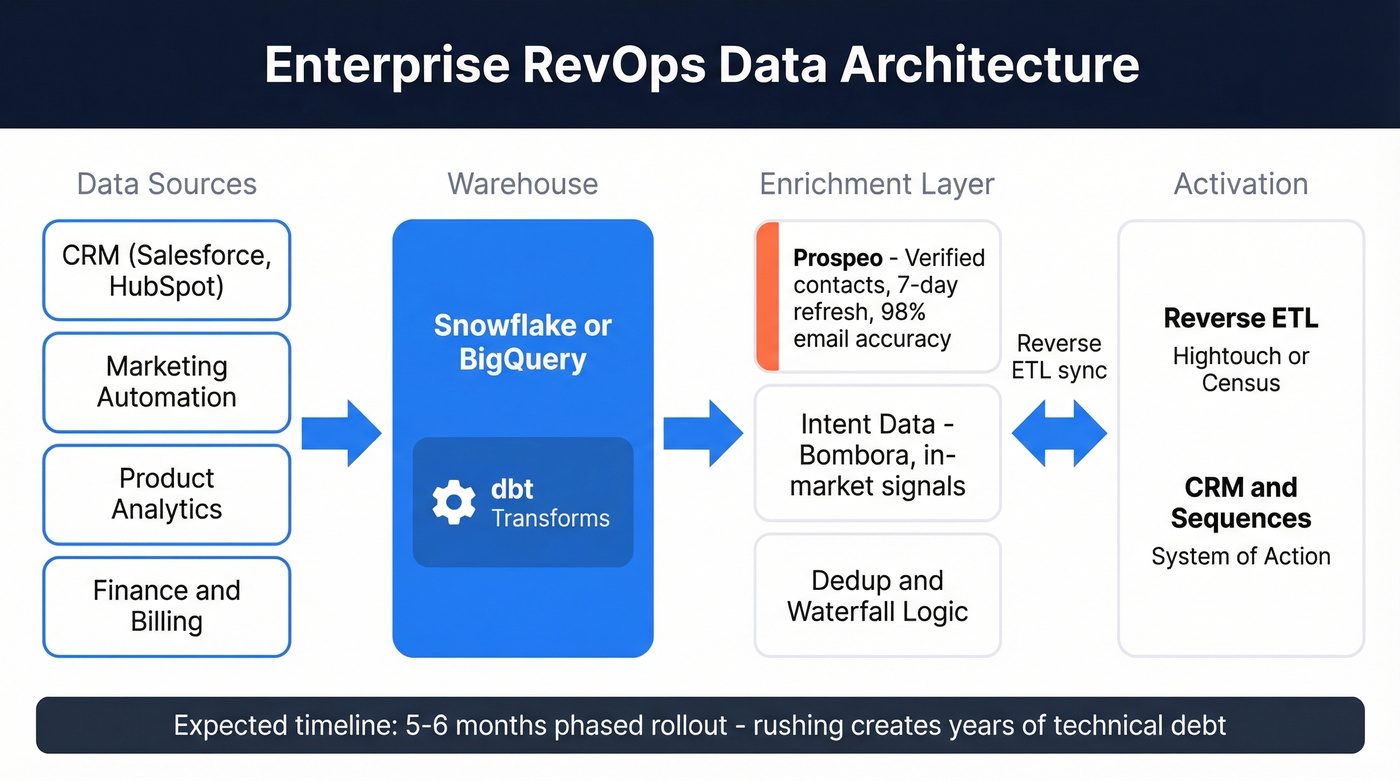
In practice, sources feed into a warehouse like Snowflake or BigQuery, get transformed via dbt, then activate back into your CRM through Hightouch or Census. Expect 5-6 months for a phased rollout. Rushing creates technical debt that takes years to unwind.
The Enrichment Layer
Here's where most enterprise stacks quietly fall apart.
The data enrichment layer is the highest-ROI consolidation opportunity because everything downstream - scoring, routing, sequencing, forecasting - depends on accurate contact and account data. Get this wrong and your AI forecasting model is just confidently hallucinating on dirty inputs.
The smart approach is waterfall enrichment: query multiple providers sequentially, deduplicate, and write one authoritative record. Prospeo anchors this layer well for teams that need verified contact data refreshed on a 7-day cycle with a 92% API match rate and 98% email accuracy. Layer Bombora-powered intent data on top to identify in-market accounts, then connect the activation layer - Workato, MuleSoft, or Clay - to your CRM.
Let's be honest: if your deal sizes sit below $25K, you don't need a $100K+ ZoomInfo contract. A waterfall enrichment approach with accurate, self-serve data will outperform an enterprise suite your team uses at 30% capacity.
Governance, Compliance, and M&A
SOX Sections 302 and 404 increase the burden of proof for ICFR, and column-level data lineage is a core requirement for audit-ready reporting. Only 17% of organizations have automated control testing, and the average SOX program budget hit $2.3M as of FY24. That's money RevOps teams increasingly co-own because revenue data flows through their systems.
On the M&A side, 70-90% of acquisitions fail to achieve intended outcomes, and CRM integration is a major driver. The failure mode isn't data migration - it's metadata conflict. "Account" means end customer in one org and channel partner in another. Legacy automation collides with newer workflows, creating silent overwrites that corrupt forecasting.
CRM migrations run $250K-$500K+ in external consulting, with dual-system license bleed of $150-$300 per user per month. A composable revenue architecture - decoupling revenue logic from CRM via a multi-CRM layer - can compress cross-sell timelines from 14-18 months to 30-90 days. That's not a marginal improvement. That's a different business.
AI in RevOps - Reality Check
Here's the stat that tells you everything: Salesloft's Wakefield survey says 97% report measurable AI ROI. A Default survey of 300+ RevOps leaders says fewer than 10% see real ROI.
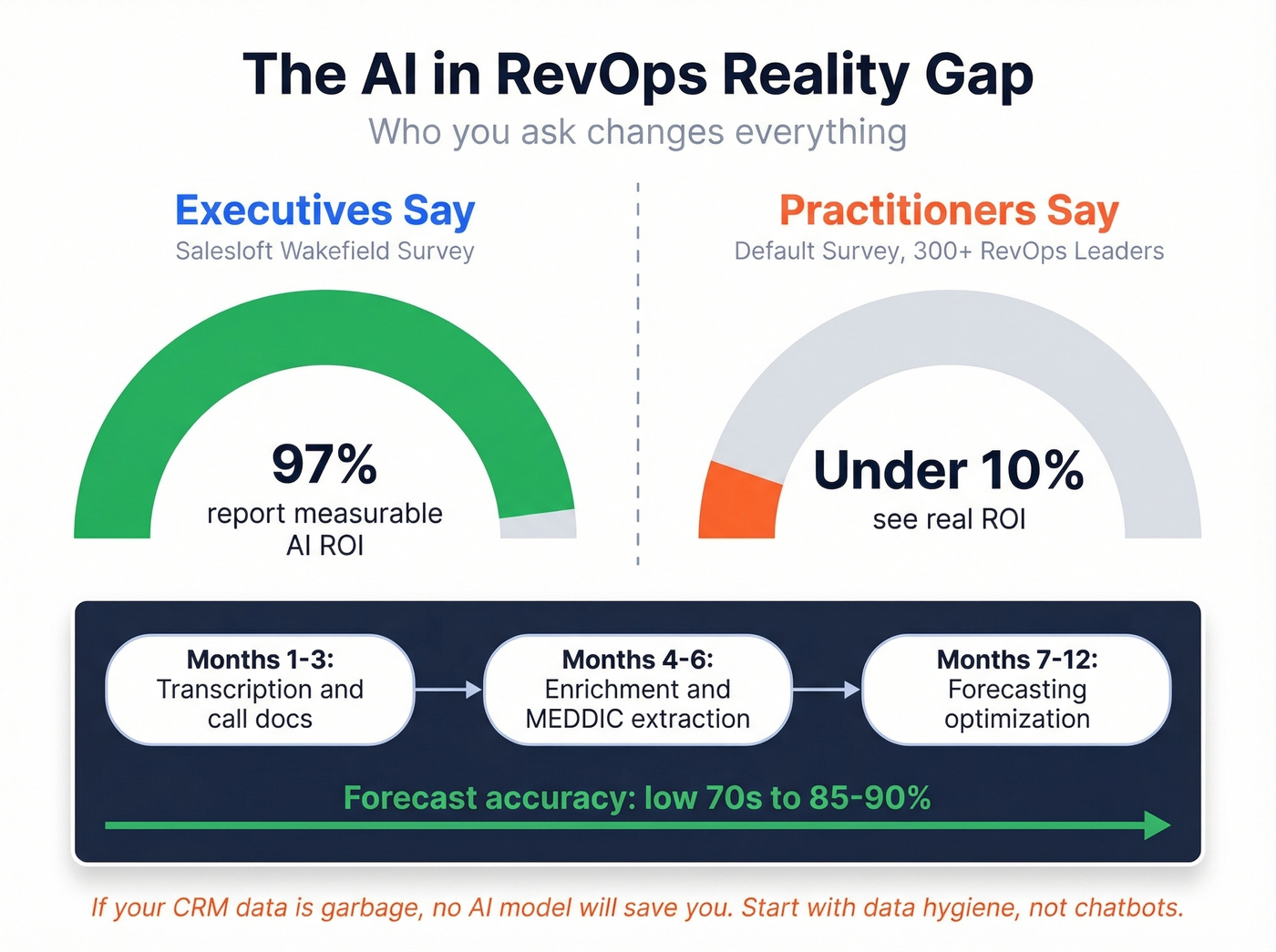
The difference? Salesloft surveyed executives. Default surveyed practitioners. The people buying AI tools think they're working. The people using them disagree.
Teams getting results follow a phased approach: start with transcription and call documentation in months 1-3, move to enrichment and MEDDIC extraction in months 4-6, then tackle forecasting optimization in months 7-12. Revenue leaders who've made this work report forecast accuracy moving from the low-70s to 85-90%. But if your CRM data is garbage, no AI model will save you. Start with data hygiene, not chatbots.
5-Step Implementation Playbook
Based on TechCXO's framework, adapted for enterprise:
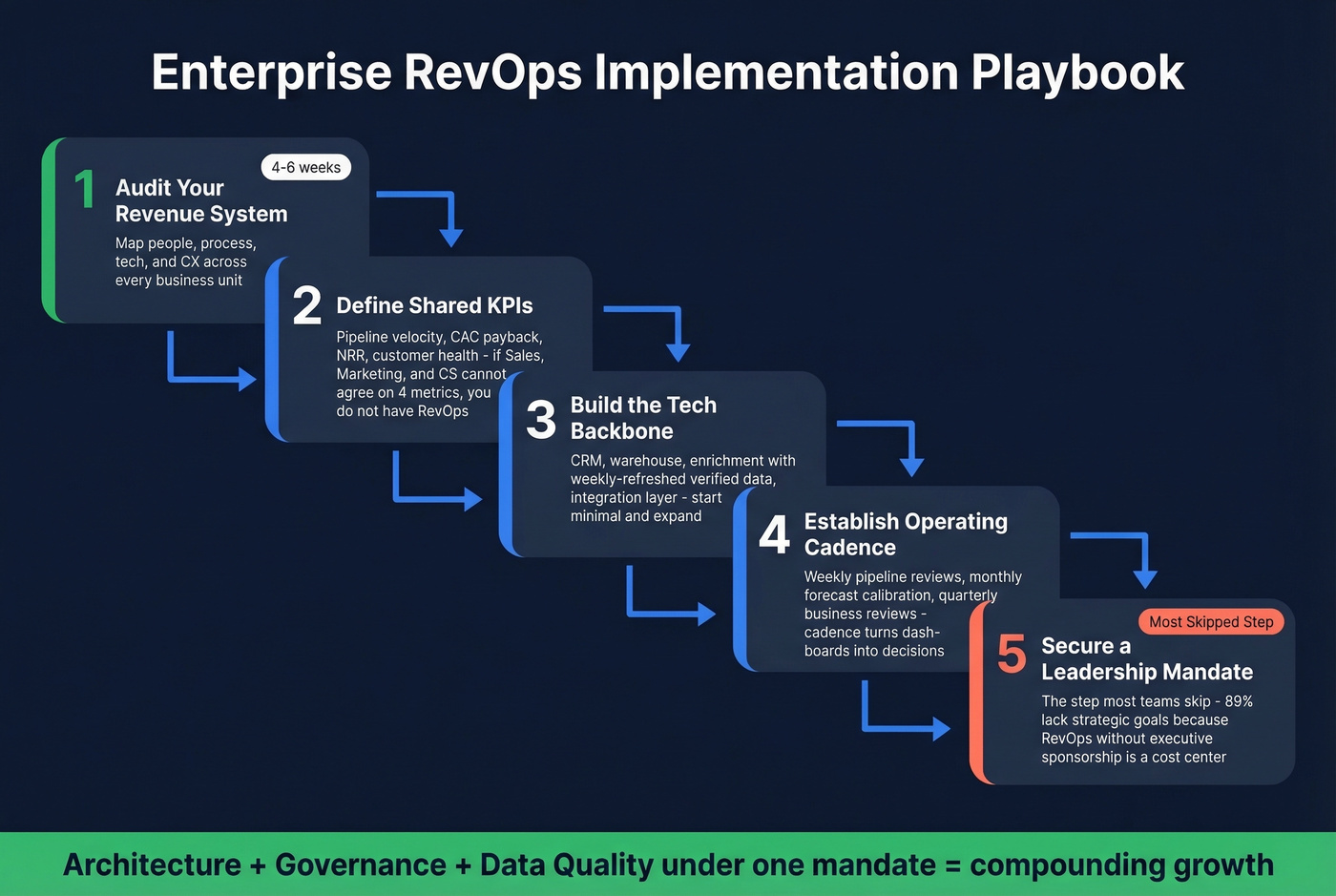
- Audit your revenue system. Map people, process, tech, and customer experience across every business unit. You can't fix what you haven't inventoried. This step alone takes 4-6 weeks at most enterprises, and it's worth every day because the audit surfaces the metadata conflicts, tool overlap, and process gaps that everything else depends on.
- Define shared KPIs. Pipeline velocity, CAC payback, NRR, customer health scores. If Sales, Marketing, and CS can't agree on four metrics, you don't have RevOps - you have three ops teams sharing a Slack channel.
- Build the tech backbone. CRM, warehouse, enrichment with verified contact data refreshed weekly, and an integration layer. Don't overbuild. Start with the minimum viable stack and expand.
- Establish an operating cadence. Weekly pipeline reviews, monthly forecast calibration, quarterly business reviews. The cadence turns dashboards into decisions.
- Secure a leadership mandate. This is the step most teams skip, and it's why 89% lack strategic goals. RevOps without executive sponsorship is a cost center. RevOps with a mandate is a growth engine. Sometimes that means fractional RevOps leadership to cut through politics and resistance before hiring full-time.
Enterprise revenue ops succeeds when architecture, governance, and data quality converge under a single mandate. Get those three right and the rest - AI, forecasting, cross-sell - compounds on a solid foundation.
Enterprise enrichment doesn't require a $100K+ contract. Prospeo delivers 98% verified emails at ~$0.01 each, 125M+ direct dials, and Bombora-powered intent data across 15,000 topics - all self-serve with native Salesforce, HubSpot, and Clay integrations your RevOps team can activate today.
Enterprise-grade data without the enterprise procurement nightmare.
FAQ
How does enterprise RevOps handle M&A integration?
Start with metadata alignment before data migration. Map field definitions, opportunity stages, and automation rules across both CRM instances. Budget $250K-$500K for external consulting and plan for 6-12 months of dual-system operation. Teams that move fastest decouple revenue logic from CRM early.
How large should an enterprise RevOps team be?
A common benchmark is 1 RevOps headcount per 20-30 GTM reps, scaling with complexity. Teams with M&A activity or multi-region operations typically need dedicated data architecture and governance roles beyond standard analyst and admin positions.
What's the difference between RevOps and Sales Ops?
Sales Ops focuses on one function - the sales team's tools, processes, and reporting. RevOps aligns sales, marketing, and customer success under shared metrics, tech, and processes, owning the full revenue lifecycle from lead to renewal.
What enrichment tools work best for enterprise RevOps stacks?
Waterfall enrichment outperforms single-vendor contracts at enterprise scale. Prospeo delivers 98% email accuracy with a 7-day refresh cycle and 92% API match rate, making it a strong primary enrichment layer. Pair it with intent data and a reverse ETL tool like Census or Hightouch for full activation.