

Enterprise Sales vs B2B Sales: What's Actually Different?
The enterprise sales vs B2B sales debate is everywhere - Reddit threads, sales forums, even job postings treat them like separate career tracks. They're not. Enterprise is a segment within B2B, defined by deal size, buyer complexity, and how long you'll wait to get paid.
Three operational differences matter most: cycle length (6.5 months on average, often stretching past 12), buying committee size (6-10 stakeholders in enterprise, sometimes far more), and compensation where enterprise AE OTE runs roughly 2x what SMB AEs earn.
How Enterprise Differs From Other B2B Segments
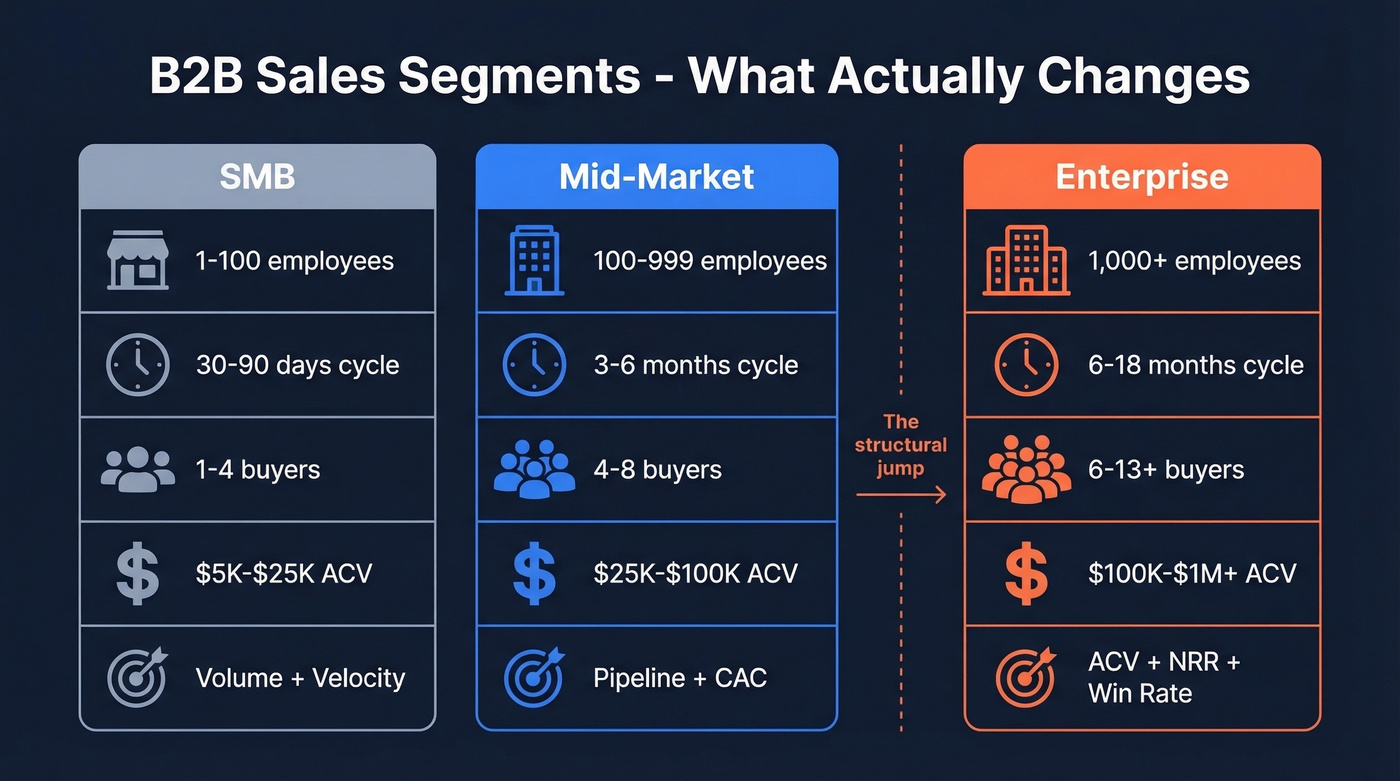
Enterprise targets are typically companies with 1,000+ employees and $1B+ in annual revenue. But the real differences show up in how deals move, not how big the logo is.
| SMB | Mid-Market | Enterprise | |
|---|---|---|---|
| Employees | 1-100 | 100-999 | 1,000+ |
| Revenue | <$50M | $50M-$1B | >$1B |
| Cycle length | 30-90 days | 3-6 months | 6-18 months |
| Buying committee | 1-4 people | 4-8 people | 6-13+ people |
| Typical ACV | $5K-$25K | $25K-$100K | $100K-$1M+ |
| Primary KPIs | Volume + velocity | Pipeline + CAC | ACV + NRR + win rate |
The jump from SMB to mid-market is noticeable. The jump from mid-market to enterprise is structural - it changes how you hire, how you forecast, and how you think about time.
What Actually Changes When You Sell Enterprise
Sales cycle length. The average B2B sales cycle now runs 6.5 months, up from 4.9 months in 2019. Enterprise deals sit at the long end - 6 to 18 months is standard. You're not closing in a quarter. You're managing a deal across multiple budget cycles, and that means your pipeline math looks completely different from a team closing SMB in two weeks.
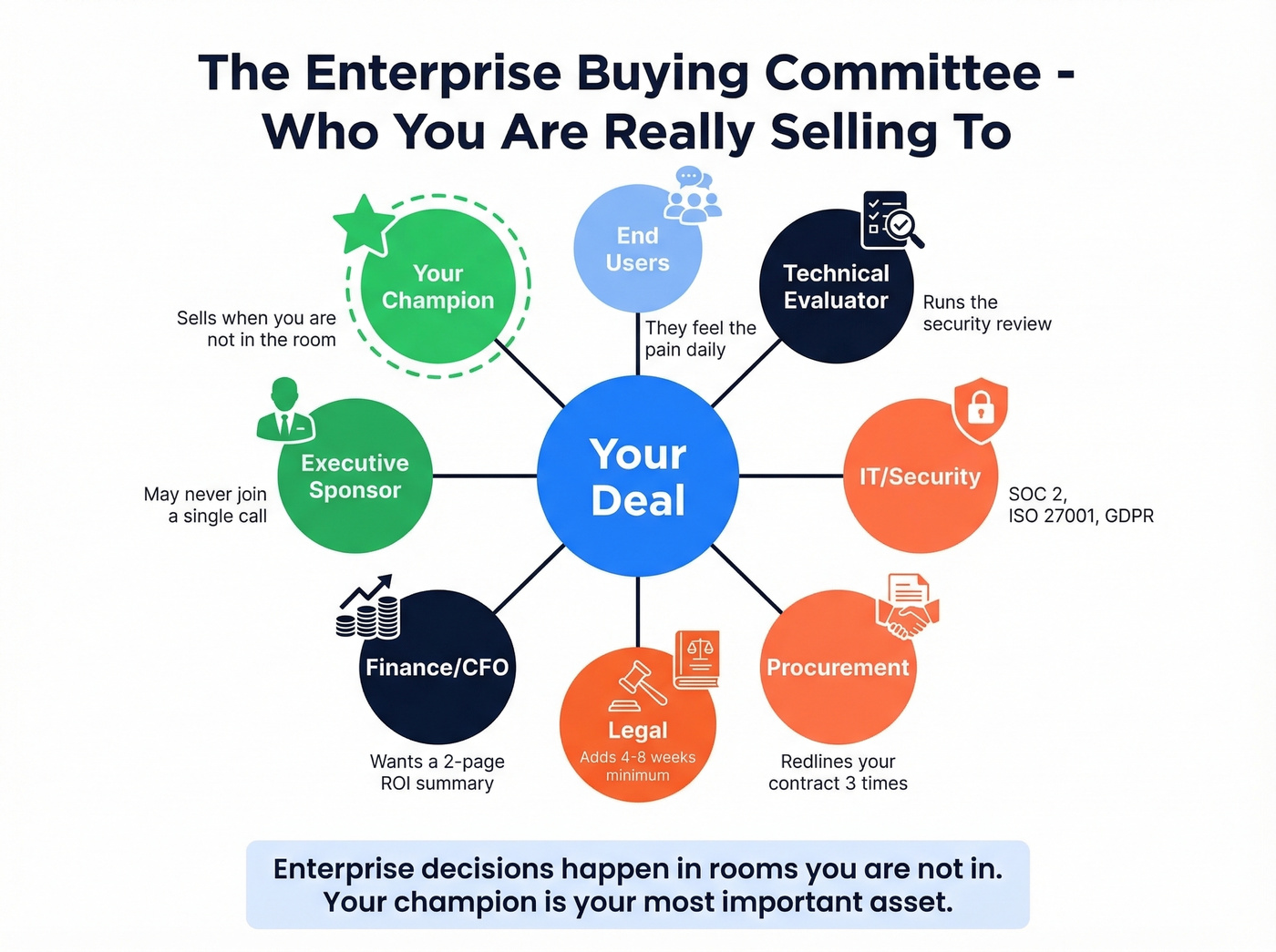
Buying committee size. Enterprise deals involve 6-10 stakeholders at minimum, and complex purchases across B2B can involve 25 or more. You're selling to end users, technical evaluators, procurement, legal, finance, and an executive sponsor who may never join a single call.
Procurement and security. Enterprise buyers often require SOC 2, ISO 27001, and GDPR compliance during evaluation before they'll even consider your platform. Security questionnaires and legal redlines add weeks or months. In SMB, you close on a credit card. In enterprise, you close through a procurement portal after three rounds of redlining.
Here's the thing: enterprise decisions happen in rooms you're not in. Your champion - the internal advocate - is the one actually selling when you're off the call. Equipping them with ROI calculators, one-pagers, and competitive comparisons is the single most important skill in enterprise selling. Everything else is table stakes.
KPIs shift completely. SMB teams optimize for volume and velocity. Enterprise teams track ACV, net revenue retention, and win rate. Ebsta's 2023 benchmarks put enterprise win rates around 42%, and the trend has been declining since - meaning the other 58%+ consumed months of selling time with nothing to show for it.
Data quality becomes non-negotiable. 73% of B2B buyers actively avoid suppliers who send irrelevant outreach. When you're mapping a large buying committee, every bounced email wastes the limited 28-30% of your week you actually spend selling. Prospeo verifies emails at 98% accuracy on a 7-day refresh cycle - exactly the kind of data hygiene that matters when each stakeholder contact is high-value.

Enterprise deals live or die by your ability to reach every stakeholder on the buying committee. Prospeo gives you 98% verified emails and 125M+ direct dials across 300M+ profiles - refreshed every 7 days, not every 6 weeks. When you're multi-threading a 6-to-18-month deal, stale data isn't an inconvenience. It's a lost quarter.
Stop single-threading enterprise deals because your data only covers one contact.
Commercial Sales vs Enterprise Sales: Comp and Quotas
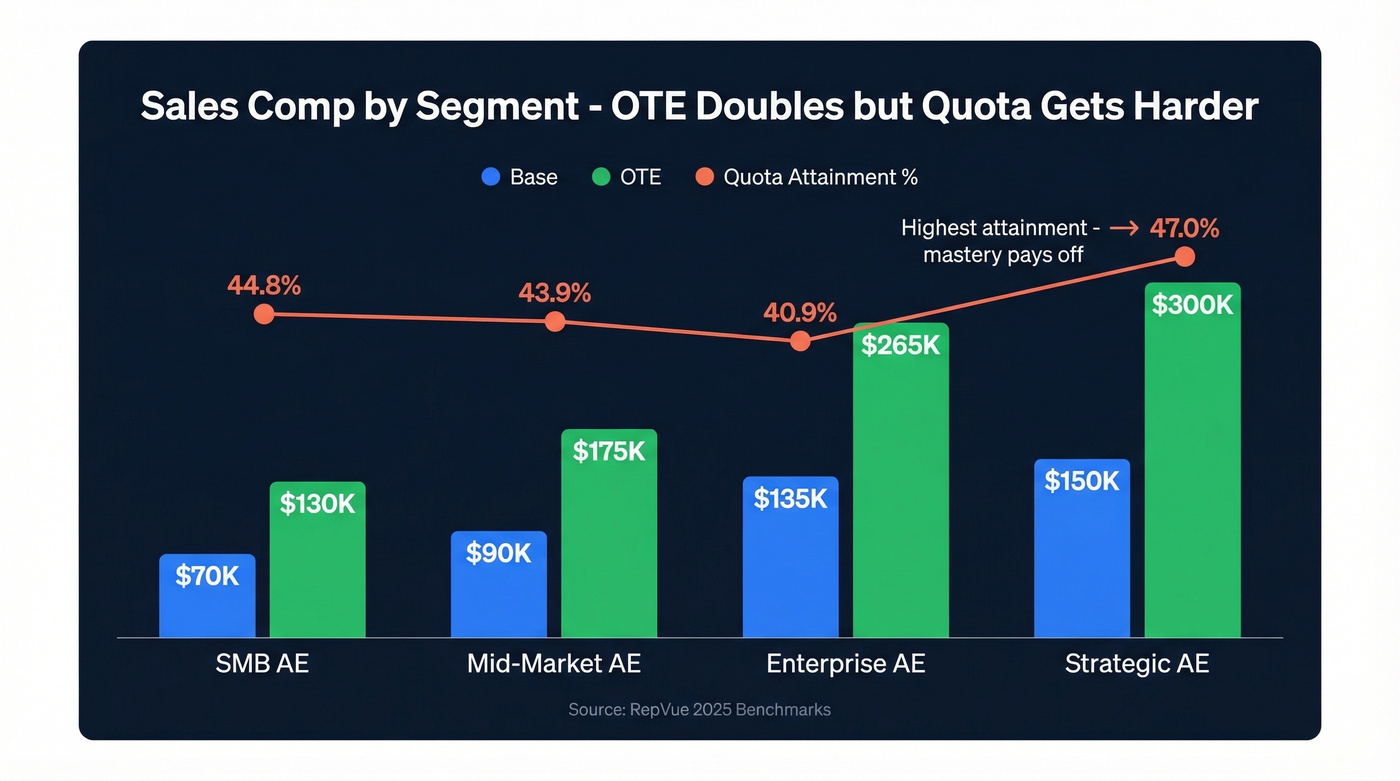
Enterprise pays more because fewer people succeed. The gap between commercial sales vs enterprise sales starts with comp - commercial roles offer faster ramp and more predictable quotas, while enterprise rewards patience with significantly higher OTE. Here are the RepVue benchmarks:
| Role | Base | OTE | % Hitting Quota |
|---|---|---|---|
| SMB AE | $70K | $130K | 44.8% |
| Mid-Market AE | $90K | $175K | 43.9% |
| Enterprise AE | $135K | $265K | 40.9% |
| Strategic AE | $150K | $300K | 47.0% |
OTE doubles from SMB to enterprise, but quota attainment drops. A common enterprise comp framework: base salary and variable each run about 10% of total quota, with accelerators kicking in above plan. The floor is higher, but the variable is harder to earn.
The strategic AE number tells the real story. 47% quota attainment is the highest in the table. We've seen this pattern repeatedly: once reps master enterprise selling, the biggest accounts become more predictable, not less. The consensus on r/sales backs this up - experienced enterprise reps rarely want to go back downmarket.
How Enterprise Buyers Actually Buy
61% of B2B buyers prefer a rep-free buying experience. That doesn't make enterprise sellers irrelevant - it means every rep interaction must be high-value. No feature dumps. No generic decks.
The same study found 69% of buyers report inconsistencies between a supplier's website and what the seller tells them. In enterprise, where multiple stakeholders cross-reference your materials independently, any mismatch erodes credibility fast. One VP sees a different number than the director who briefed them, and suddenly your deal is stalled for "internal alignment."
Let's be honest: if your ACV is under $50K, you probably don't need a dedicated enterprise motion. You need a tighter mid-market playbook. Most companies move upmarket too early and bleed cash running 9-month cycles on deals that don't justify the cost of sale. Skip the enterprise label until your product and market pull you there.
Mistakes That Kill Enterprise Deals
Model drift is the most expensive one. Applying SMB playbooks to enterprise accounts creates healthy-looking pipelines that don't convert. In our experience, this is where teams going upmarket lose the most money - they see activity and mistake it for progress. If you're building a more systematic motion, start with account-based selling fundamentals.
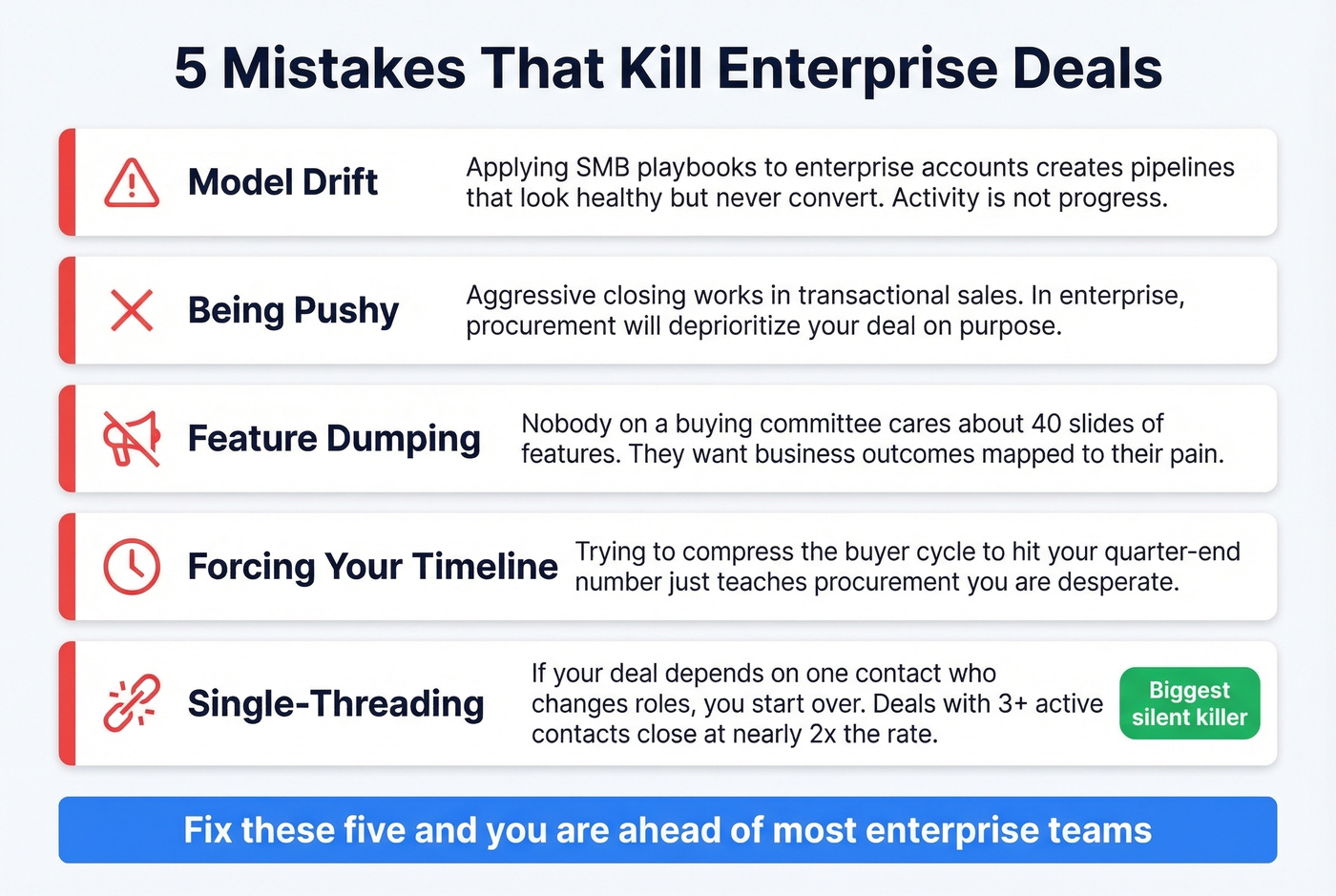
Being pushy guarantees procurement will deprioritize your deal. Aggressive closing works in transactional sales. In enterprise, it's a death sentence.
Feature-dumping kills deals because nobody on a buying committee cares about your feature list. They care about business outcomes mapped to their specific pain. A 40-slide product tour when the CFO wanted a 2-page ROI summary? That's how you get ghosted.
Forcing your timeline backfires every time. Enterprise buyers have their own buying cycle. Trying to compress it to hit your quarter-end number just teaches procurement you're desperate.
Single-threading is the silent killer. If your entire deal depends on one contact who changes roles or goes on leave, you're starting over from scratch. Map the full committee early - we've found that deals with three or more active contacts close at nearly double the rate of single-threaded ones. To operationalize this, use a clear ideal customer profile and stakeholder map.
Enterprise AEs spend 70% of their week on everything except selling. Every bounced email and wrong number compounds that waste. Prospeo's 98% email accuracy and 30% mobile pickup rate mean your limited selling hours connect you to real decision-makers - not dead ends. At $0.01 per email, the cost of bad data is the only thing you can't afford.
Reclaim selling time with contacts that actually connect.
FAQ
Is enterprise sales a type of B2B sales?
Yes. Enterprise sales is a segment within B2B, defined by deal complexity and target company size - typically 1,000+ employees and $1B+ revenue. It's not a separate discipline. The core selling skills overlap; the process, timeline, and stakeholder management don't.
How long is a typical enterprise sales cycle?
Enterprise deals range from 6 to 18 months. Procurement reviews, security questionnaires, and legal redlines routinely push cycles past 12 months, especially for net-new logos in regulated industries.
What's the difference between commercial and enterprise sales?
Commercial sales covers SMB and mid-market deals - shorter cycles, smaller buying committees, and ACVs under $100K. Enterprise involves longer timelines, 6-13+ stakeholders, and contract values often exceeding $100K. Many reps start in commercial roles before moving upmarket.
What tools help with enterprise prospecting?
Enterprise deals require verified contact data across large buying committees. Prospeo covers 300M+ professional profiles with 98% email accuracy and a 7-day data refresh - critical when you're mapping 10+ stakeholders per account. Pair it with your CRM and sequencer for a complete workflow.