

EspoCRM Review 2026: Pricing, Pros, Cons, and What "Free" Actually Costs
You found EspoCRM, got excited about "free and open-source," and now you're wondering what the catch is. Fair question. The self-hosted version costs nothing to download but plenty to run, and core features like reporting and workflow automation hide behind paid extensions. Here's the full picture so you can decide whether EspoCRM is worth your time and budget.
30-Second Verdict
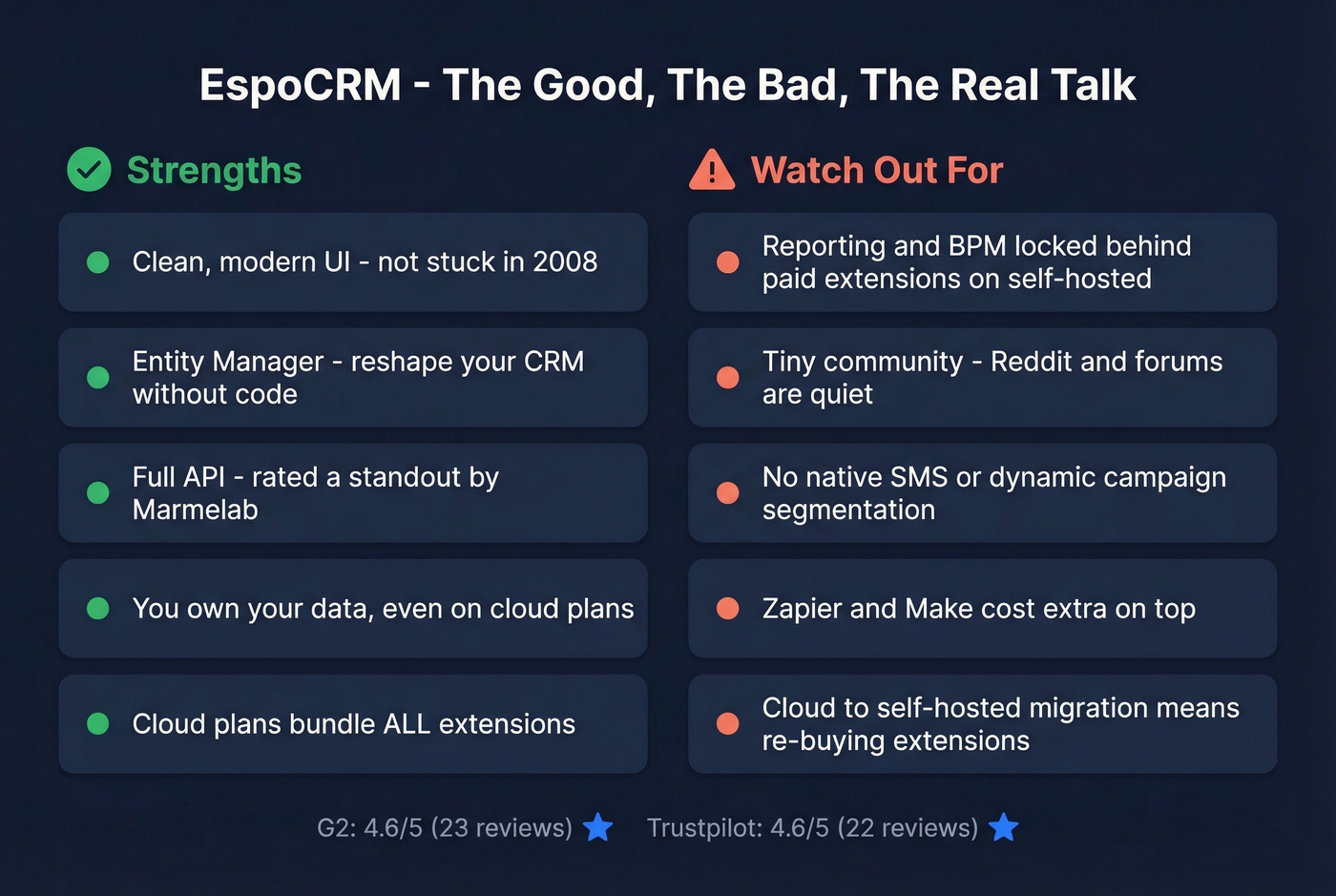
EspoCRM's cloud plans are genuinely competitive for small teams - $15-69/user/month with all extensions included is hard to beat. The self-hosted version is free to download but not free to operate. The biggest gotcha: reporting, invoicing, and BPM are locked behind paid extensions if you self-host. EspoCRM carries a 4.6/5 on G2 with 23 reviews and a 4.6 on Trustpilot with 22 reviews. Solid scores, though the review pool is small enough that a handful of outliers could shift the average.
What Is EspoCRM?
EspoCRM is an open-source, web-based CRM licensed under AGPLv3. It's been around for 11+ years, serves 50,000+ companies across 163 countries, and offers both cloud-hosted and self-hosted deployment. Think of it as a lightweight alternative to Salesforce or SuiteCRM - strong on customization, lean on bloat.
Two things set it apart. First, the Entity Manager lets non-developers build custom entities, fields, and relationships without touching code - that's its real party trick. Second, you own your data. EspoCRM explicitly states you own your database, data files, and custom files, even on cloud plans. For privacy-conscious teams, that matters more than most feature comparisons will tell you.
EspoCRM Pricing Breakdown
Cloud Plans
All cloud plans include every official extension and daily backups with 7-day retention.
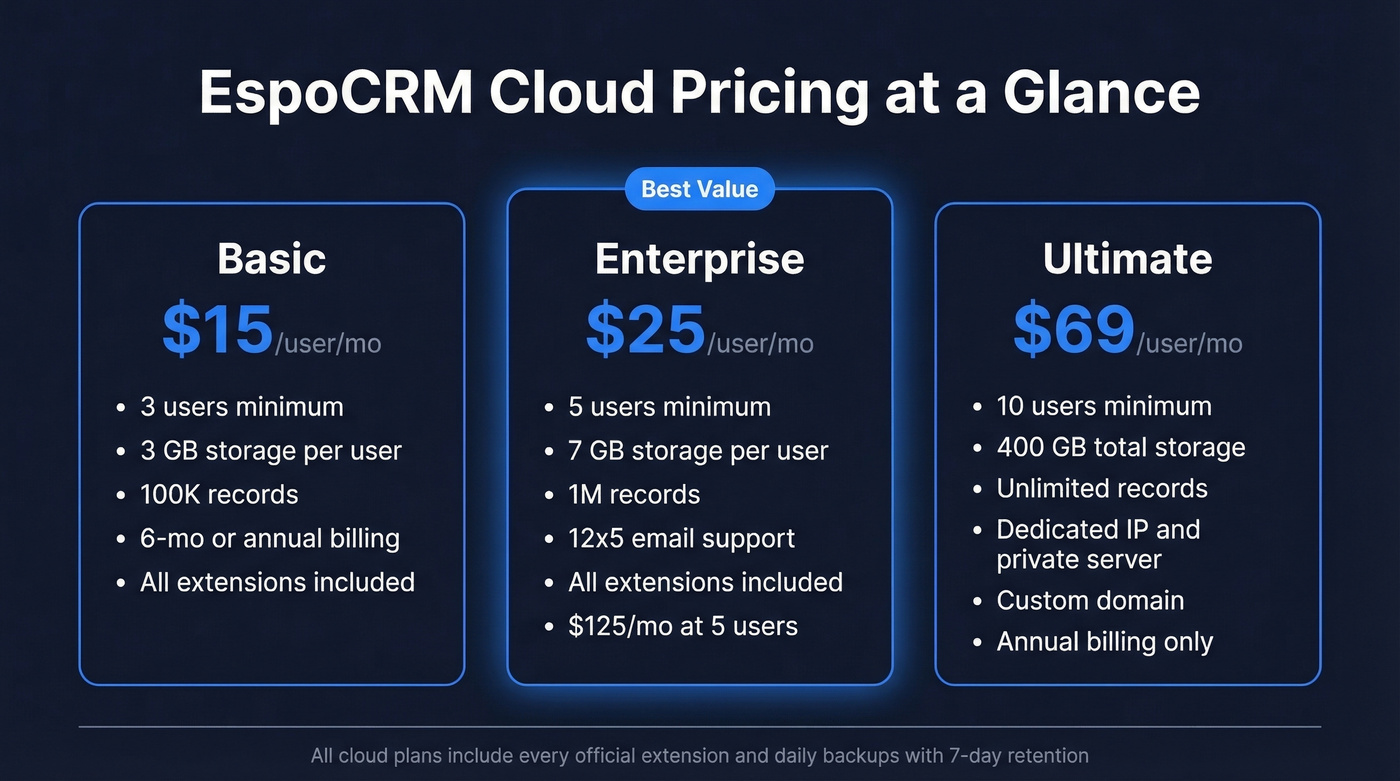
| Plan | Price | Min Users | Storage | Records | Billing |
|---|---|---|---|---|---|
| Basic | $15/user/mo | 3 | 3 GB/user | 100K | 6-mo or annual |
| Enterprise | $25/user/mo | 5 | 7 GB/user | 1M | 6-mo or annual |
| Ultimate | $69/user/mo | 10 | 400 GB total | Unlimited | Annual |
Enterprise is the sweet spot for most teams. You get a million records, 7 GB storage per user, 12x5 email support, and all extensions for $125/month at the five-user minimum. We've compared this against a dozen open-source CRM cloud plans, and the Enterprise tier delivers the best value-to-feature ratio at this price point (see more examples of a CRM if you're still comparing categories). Ultimate adds a dedicated IP, private server, and custom domain - overkill unless you're running a large operation or have strict compliance requirements that demand infrastructure isolation.
Record overages on Basic and Enterprise incur an additional fee, though EspoCRM doesn't publish the exact amount on their pricing page.
Self-Hosted Extension Costs
The download is free. Everything after that costs money or time.
| Item | Cost | Notes |
|---|---|---|
| EspoCRM Core | Free | AGPLv3 license |
| Advanced Pack | ~$395 one-time | Reports, workflows, BPM |
| Sales Pack | Paid add-on | Products, quotation & invoicing, purchases, inventory |
| Project Management | ~$230/year | Recurring annual fee |
| VoIP Integration | ~$388 | Per-instance license |
| VPS Hosting | ~$20-100/mo | Depends on provider and specs |
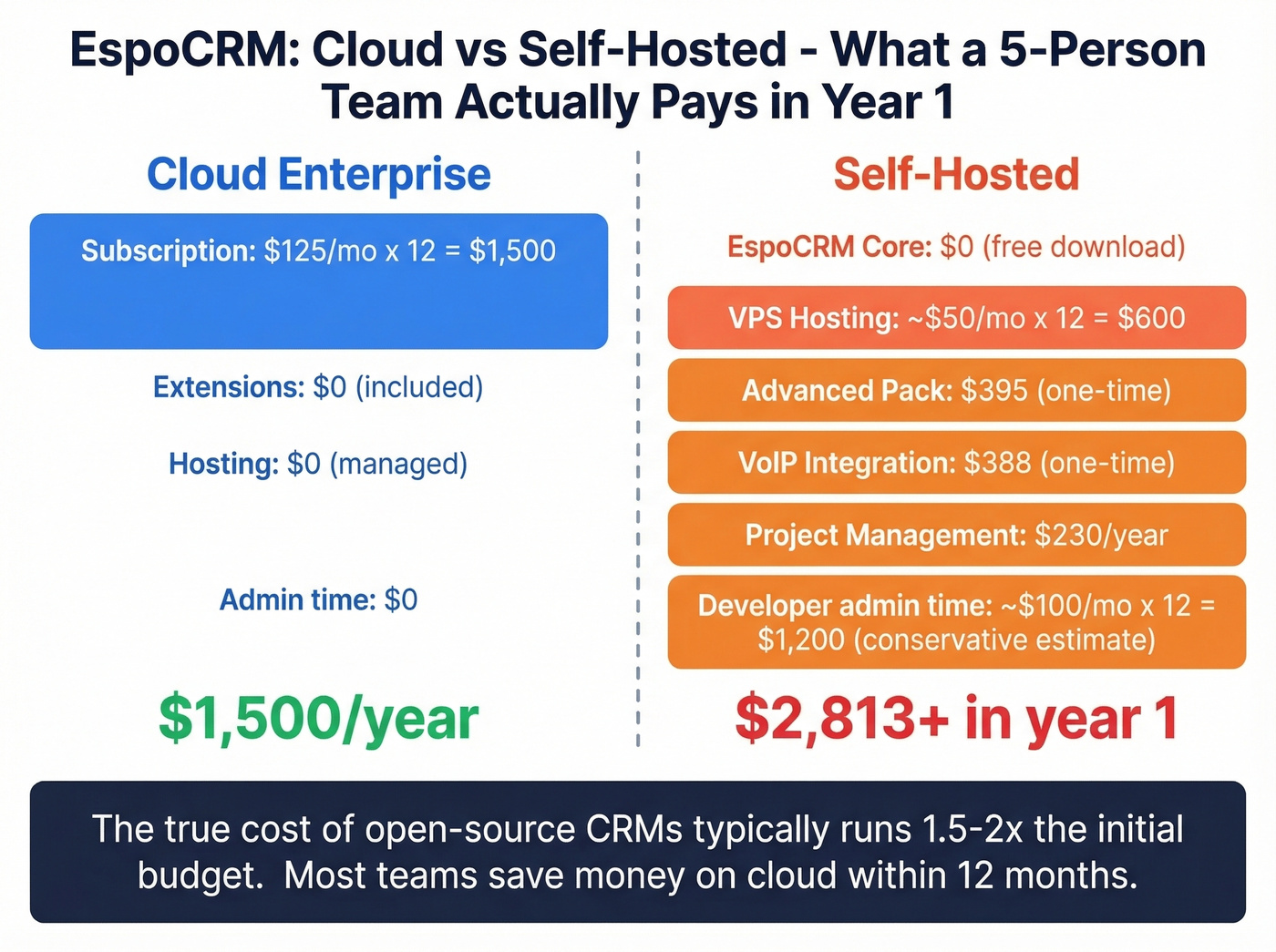
Extensions are licensed per instance. A five-person team on cloud Enterprise pays $125/month and gets everything. That same team self-hosting might pay ~$50/month for a decent VPS plus extension licenses - Advanced Pack at ~$395 one-time, VoIP Integration at ~$388, and Project Management at ~$230/year if needed - plus ongoing admin time. The true cost of ownership for open-source CRMs runs 1.5-2x the initial budget, and implementation typically takes 8-16 weeks.
Self-hosted only makes sense if you have a developer who can own the project (and if you're building a broader stack, it helps to understand connect outreach tool to CRM basics early).
Here's the thing: most teams evaluating EspoCRM self-hosted to "save money" end up spending more than the cloud plan within 12 months once you factor in extensions, hosting, and the hours your developer burns on maintenance instead of building product.

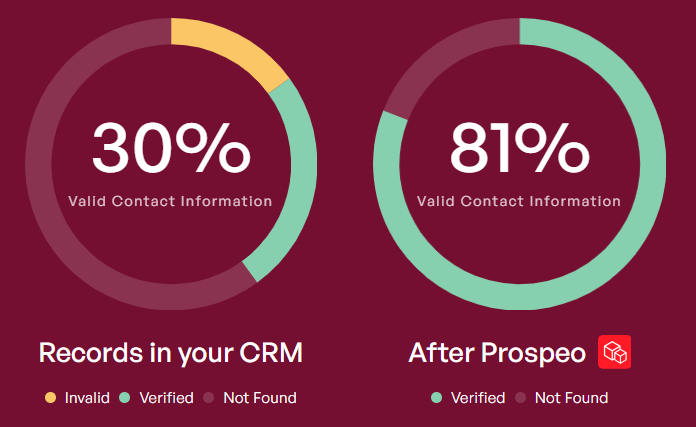
EspoCRM gives you the CRM. Prospeo fills it with contacts that actually convert. Enrich your EspoCRM database with 98% accurate emails, verified mobiles, and 50+ data points per contact - at $0.01 per email.
Stop paying for a CRM full of bad data. Start with verified contacts.
EspoCRM Pros and Cons
Pros
- Clean, intuitive UI. This comes up everywhere - G2, Trustpilot, Reddit. One self-hosted user said they were "surprised at how complete it feels." The interface doesn't look like it was designed in 2008, which puts it ahead of most open-source CRMs.
- Powerful code-free customization. Entity Manager, dynamic logic, formula fields, and layout customization let you reshape the CRM without writing a line of code. This is EspoCRM's strongest differentiator, and it's not close (if you're evaluating other tools in the same bucket, start with these examples of a CRM).
- Complete API. A Marmelab benchmark rated the API as a standout feature - useful if you're building integrations or syncing with other tools in your stack.
- You own your data. EspoCRM explicitly guarantees ownership of your database, data files, and custom files - even on cloud plans. Few SaaS CRMs make that promise.
- Cloud plans include all extensions. No nickel-and-diming. You get Advanced Pack, Sales Pack, VoIP, and everything else bundled in.
- Competitive pricing vs. enterprise CRMs. A five-seat Enterprise plan runs $125/month total, extensions included.
Cons
Core features gated behind paid extensions on self-hosted. Products/services, reporting, BPM, and workflow automation all require paid add-ons like the Advanced Pack or Sales Pack. One Reddit evaluator noted that EspoCRM "by default doesn't have product/services sales, nor reporting" without extensions. Trustpilot reviewers also flag the "high cost of additional packages" as a recurring frustration. That's a real gap if you chose self-hosted specifically to save money.
Small community and steep learning curve. The r/espocrm subreddit is basically a ghost town. Finding help outside official support channels is harder than with SuiteCRM or Odoo, and we've seen this pattern before - a solid product with thin community resources makes troubleshooting slower and lonelier. Multiple G2 reviewers flag the learning curve as steeper than expected. Marmelab's benchmark specifically criticizes EspoCRM for using homemade backend and frontend frameworks with limited documentation, which makes even simple code customizations challenging.
Campaign automation gaps. A G2 reviewer flagged that triggering SMS inside EspoCRM requires a third-party tool like Twilio and manual logging. Dynamic segmentation for campaigns also requires CSV export to an external email tool - there's no native way to build segments and push them to campaigns without leaving the platform (if this is a priority, compare sales funnel automation tools before you commit).
Zapier/Make aren't included. Integration with Zapier or Make is possible but isn't part of the EspoCRM subscription. You'll need paid plans on those platforms plus user-built logic to connect everything.
Cloud-to-self-hosted migration means re-buying extensions. Start on cloud and later move to self-hosted? You'll need to purchase extensions separately to keep that functionality. That's a frustrating lock-in mechanism for a product that markets itself on openness.
Who Should Use EspoCRM
It's a strong fit if:
- You're a small team of 3-10 people that wants deep customization without Salesforce pricing - the cloud Enterprise plan is the move
- You have a developer on staff and want full control via self-hosted deployment
- You need a CRM that adapts to unusual workflows through Entity Manager
- You're in real estate, education, or professional services where relationship tracking matters more than marketing automation (for that niche, see best contact management software)
Skip it if:
- You need a large ecosystem of plug-and-play integrations and active community support
- You want zero admin overhead - HubSpot Free or Odoo will get you running faster
- Your team doesn't have anyone comfortable managing a self-hosted application
How EspoCRM Compares
| Tool | Type | Starting Price | Best For |
|---|---|---|---|
| EspoCRM | Open-source CRM | $15/user/mo (cloud) | Customizable SMB CRM |
| SuiteCRM | Open-source CRM | Free (SuiteASSURED ~$1K/yr) | Self-hosted power users |
| Odoo CRM | Open-source modular | ~$7.25/user/mo | All-in-one business suite |
| HubSpot | Freemium CRM | $0 (paid from $15/user/mo) | Zero-friction onboarding |
| vTiger | Open-source CRM | Free (cloud from ~$20/user/mo) | Sales-focused open-source |
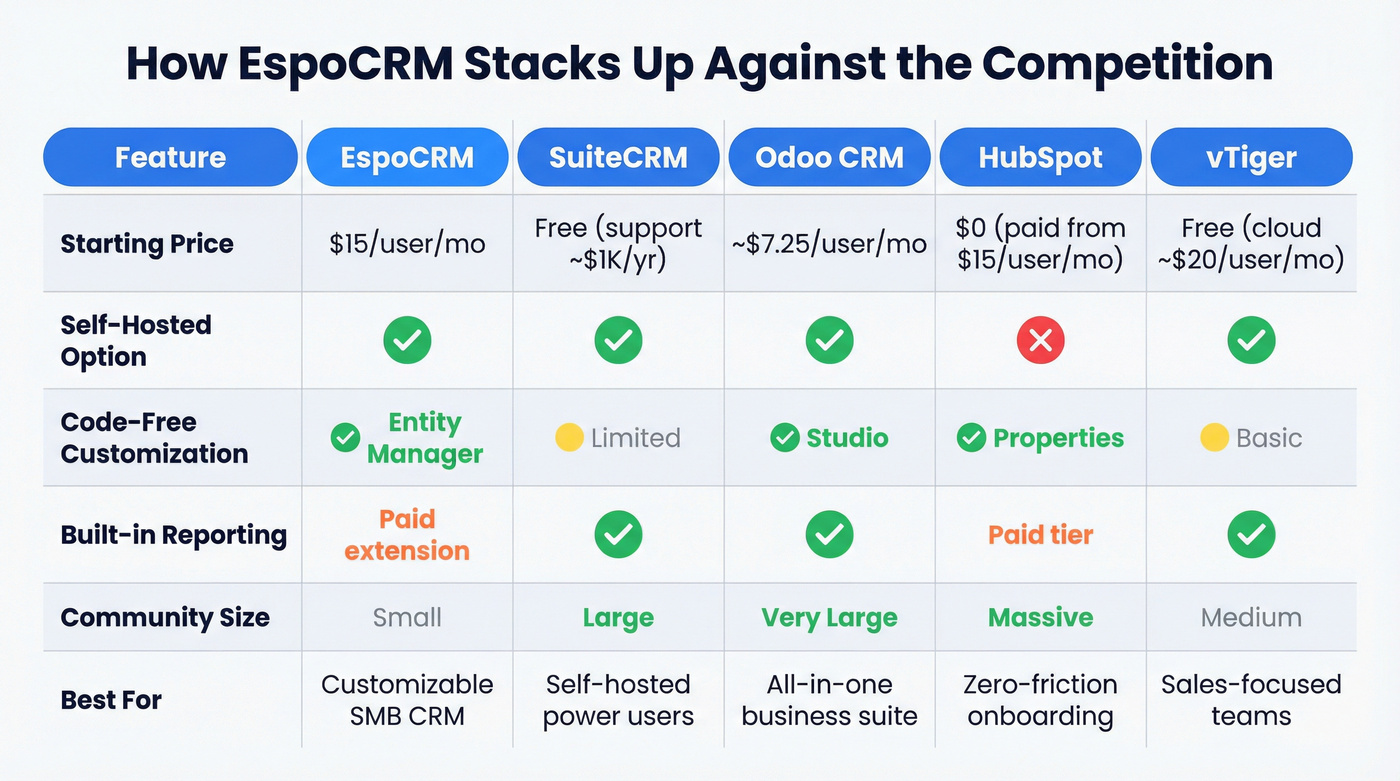
SuiteCRM offers more out-of-the-box features on self-hosted but has a steeper learning curve and notoriously painful upgrades. Odoo is the most modular option if you want CRM plus accounting, inventory, and HR in one stack. HubSpot Free is the easiest to start with but gets expensive fast once you need automation or reporting - we've seen teams hit $500+/month within six months of "free" onboarding. vTiger is the closest head-to-head competitor - Reddit threads frequently pit it against EspoCRM - but its UI feels dated and the cloud pricing climbs quickly past the free tier (if you're still shopping, these best sales forecasting tools can help you sanity-check reporting needs).
Whether you pick EspoCRM cloud or self-hosted, the biggest cost isn't the platform - it's wasted outreach on bad contact data. Prospeo's 7-day data refresh and 5-step verification keep your CRM clean so every email and call connects.
143M+ verified emails ready to import into any CRM you choose.
FAQ
Is EspoCRM really free?
The self-hosted core is free under AGPLv3, but essential features like reporting, BPM, and invoicing require paid extensions ($230-$395+). Cloud plans start at $15/user/month and bundle all extensions. Most teams find cloud cheaper within the first year once hosting and admin time are factored in.
How does EspoCRM compare to SuiteCRM?
EspoCRM has a cleaner UI and stronger code-free customization via Entity Manager. SuiteCRM ships more features out of the box - reporting, workflows - without paid add-ons, but has a steeper learning curve and a rougher upgrade path. For teams without a dedicated developer, EspoCRM cloud is simpler to manage.
Can I migrate from EspoCRM cloud to self-hosted?
Yes, but you'll need to re-purchase any extensions you were using - Advanced Pack, Sales Pack, VoIP, etc. - since cloud bundles them into the subscription. Budget $600-$1,000+ in extension licenses on top of your hosting costs before making the switch.
What's the best way to fill EspoCRM with contact data?
Prospeo integrates with CRMs via Zapier, Make, and direct API. You can search 300M+ profiles using 30+ filters, verify emails at 98% accuracy, and push enriched contacts into EspoCRM automatically. The free tier includes 75 email credits per month - enough to test the workflow before committing.
Final Verdict
After weighing EspoCRM's pricing, reviews, pros and cons, the cloud Enterprise plan at $25/user/month stands out as the sweet spot for small teams that want a customizable CRM without enterprise pricing. Go self-hosted only if you have dedicated dev resources and budget for extensions. And if customization isn't a priority and you just want to get moving, HubSpot Free or Odoo will cause less friction (and if your main goal is outbound, pair your CRM choice with a solid sales prospecting techniques playbook).