


7 Best EvaluAgent Alternatives in 2026 (Honest Picks)
Most "EvaluAgent alternatives" lists include Typeform, Pipedrive, and Deel. None of those are QA tools. We've spent weeks digging through G2 comparisons, Capterra reviews, Vendr negotiation data, and actual pricing pages to find seven alternatives that belong in the same category - because your QA team deserves better than a software directory that doesn't understand what you do.
Our Picks (TL;DR)
- MaestroQA - Best scorecards and calibration workflows. Starts around $15/agent/month on directory listings, but realistic spend climbs once you add AI and scale.
- Scorebuddy - Best value purpose-built QA with AI autoscoring included in the Accelerate tier. 14-day free trial, no credit card.
- Playvox - Best if you want QA paired with workforce management under one roof. Clear tier pricing at $15/$30/$40 per user/month.
Why Teams Switch From EvaluAgent
EvaluAgent isn't a bad product. It scores 4.7/5 on Capterra, starts at $15/user/month, and bundles Auto-QA with a built-in LMS for scoring, coaching, and learning in one platform.
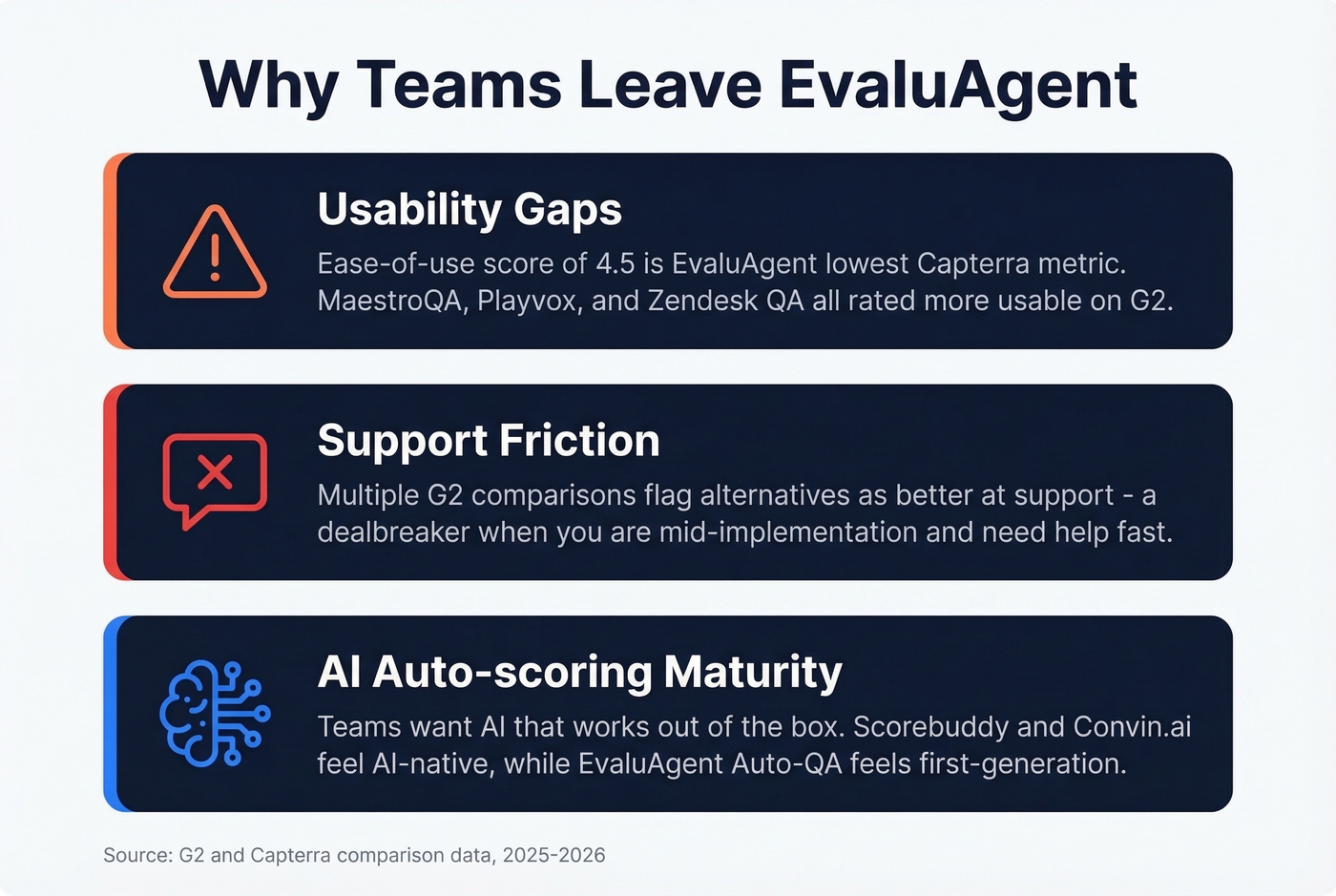
So why do teams leave?
Usability gaps. EvaluAgent's ease-of-use score (4.5) is its weakest Capterra metric. On G2, reviewers comparing alternatives frequently rate MaestroQA, Playvox, and Zendesk QA as more usable.
Support friction. On G2's comparison snippets, multiple alternatives show up as "better at support" - a pattern that's hard to ignore when you're mid-implementation and need help fast.
AI auto-scoring maturity. Teams want AI that works out of the box. Some prefer newer, AI-forward platforms like Scorebuddy and Convin.ai for heavier auto-scoring use cases where EvaluAgent's Auto-QA feels like a first-generation feature rather than a core capability.
Reddit has almost no threads specifically about EvaluAgent - the QA tool category is still niche enough that most switching conversations happen on review sites and in private Slack communities. One small annoyance: EvaluAgent's official pricing is presented as a starting point with a "tailored quote" buying motion, even though starting prices are published on review directories. That opacity adds friction to an already complex buying process.
Comparison at a Glance
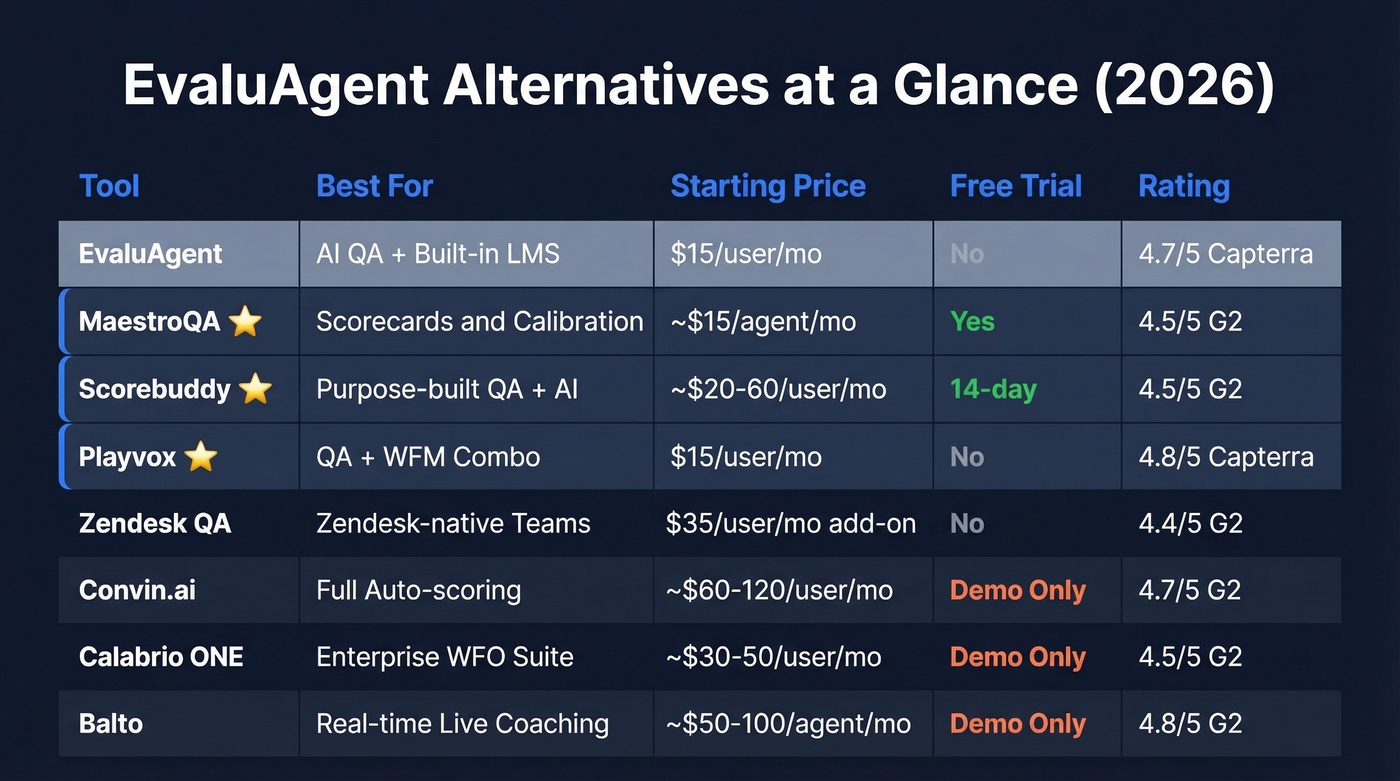
| Tool | Best For | Starting Price | Free Trial | Rating |
|---|---|---|---|---|
| MaestroQA ⭐ | Scorecards & calibration | ~$15/agent/mo | Yes | 4.5/5 G2 |
| Scorebuddy ⭐ | Purpose-built QA + AI | ~$20-60/user/mo | 14-day | 4.5/5 G2 |
| Playvox ⭐ | QA + WFM combo | $15/user/mo | No | 4.8/5 Capterra |
| Zendesk QA | Zendesk-native teams | $35/user/mo add-on | No | 4.4/5 G2 |
| Convin.ai | Full auto-scoring | ~$60-120/user/mo | Demo only | 4.7/5 G2 |
| Calabrio ONE | Enterprise WFO suite | ~$30-50/user/mo | Demo only | 4.5/5 G2 |
| Balto | Real-time live coaching | ~$50-100/agent/mo | Demo only | 4.8/5 G2 |

Better QA starts with better conversations - and better conversations start with reaching the right people. Prospeo gives your sales team 98% accurate emails and 125M+ verified mobile numbers so agents have real buyer calls worth scoring.
Fix the data before you fix the scorecard.
Top EvaluAgent Alternatives Reviewed
MaestroQA
Use it if you need the strongest scorecard builder and evaluator calibration workflows in the category. MaestroQA is G2's #1 rated competitor to EvaluAgent, and the QA workflow design - calibration sessions, check-the-checker workflows, granular scoring rubrics - is the best we've seen. On G2's comparison snippets, MaestroQA consistently shows up as more usable and better at support than EvaluAgent.
Skip it if your budget is tight and you need AI costs bundled in. MaestroQA's LLM credit packs typically run $15-25K/year per pack and are available only on Enterprise Plus. Per Vendr's negotiation benchmarks, the Teams tier lands around $220-270/agent/year after discounts, while Professional starts around $588/agent/year at 50 agents. Discount ranges are wide (21-56%), so negotiate hard. The "$15/agent/month" you'll see on directories reflects an entry package - real-world spend climbs fast once you add LLM credits and scale past a small team.
If you're also evaluating the broader buying motion (pricing, reviews, and what you actually get), see our breakdown of EvaluAgent pricing.
Scorebuddy
Use it if you want AI autoscoring included in your plan without paying five-figure add-ons. Scorebuddy's Accelerate tier includes 500 monthly AI scores; Elite bumps that to 1,000 plus AI voice transcription, AI translation, SSO, Open API integration, Salesforce integration, and EU/US/UK data region selection. The three tiers - Foundation, Accelerate, Elite - are quote-based, which is annoying for a tool in this price range. Expect $20-60/user/month depending on tier and seat count. The 14-day free trial lets you test before talking to sales.
Skip it if you need published pricing before engaging. Scorebuddy hiding prices behind a quote form in 2026 for a mid-market QA tool is frustrating. That said, it's one of the most underrated purpose-built QA platforms in the category - the end-to-end workflow from scoring through coaching to outcomes is tighter than most competitors, and the AI autoscoring inclusion at the mid-tier makes it genuinely cost-effective compared to MaestroQA's add-on model.
Playvox
Playvox is a rare QA tool with refreshingly transparent pricing: $15/user/month for Starter, $30 for Professional, $40 for Enterprise. The 4.8/5 Capterra rating across 109 reviews is strong, and it's well-known for pairing QA with workforce management so you're not stitching together two separate vendors.
The upside is obvious - QA and WFM under one roof at the cheapest entry point in the category, tied with MaestroQA at $15/user/month. No "request a quote" games.
The downside: no free trial, which makes the buying decision harder for test-first teams. And a Software Advice review from late 2024 describes Playvox "completely ghosting" a customer during onboarding for global schedules. That's a single review, not a pattern, but it's worth probing onboarding and support SLAs during your evaluation.
If your contact center needs QA and WFM under one roof without enterprise-suite pricing, Playvox is a strong choice.
Zendesk QA (Formerly Klaus)
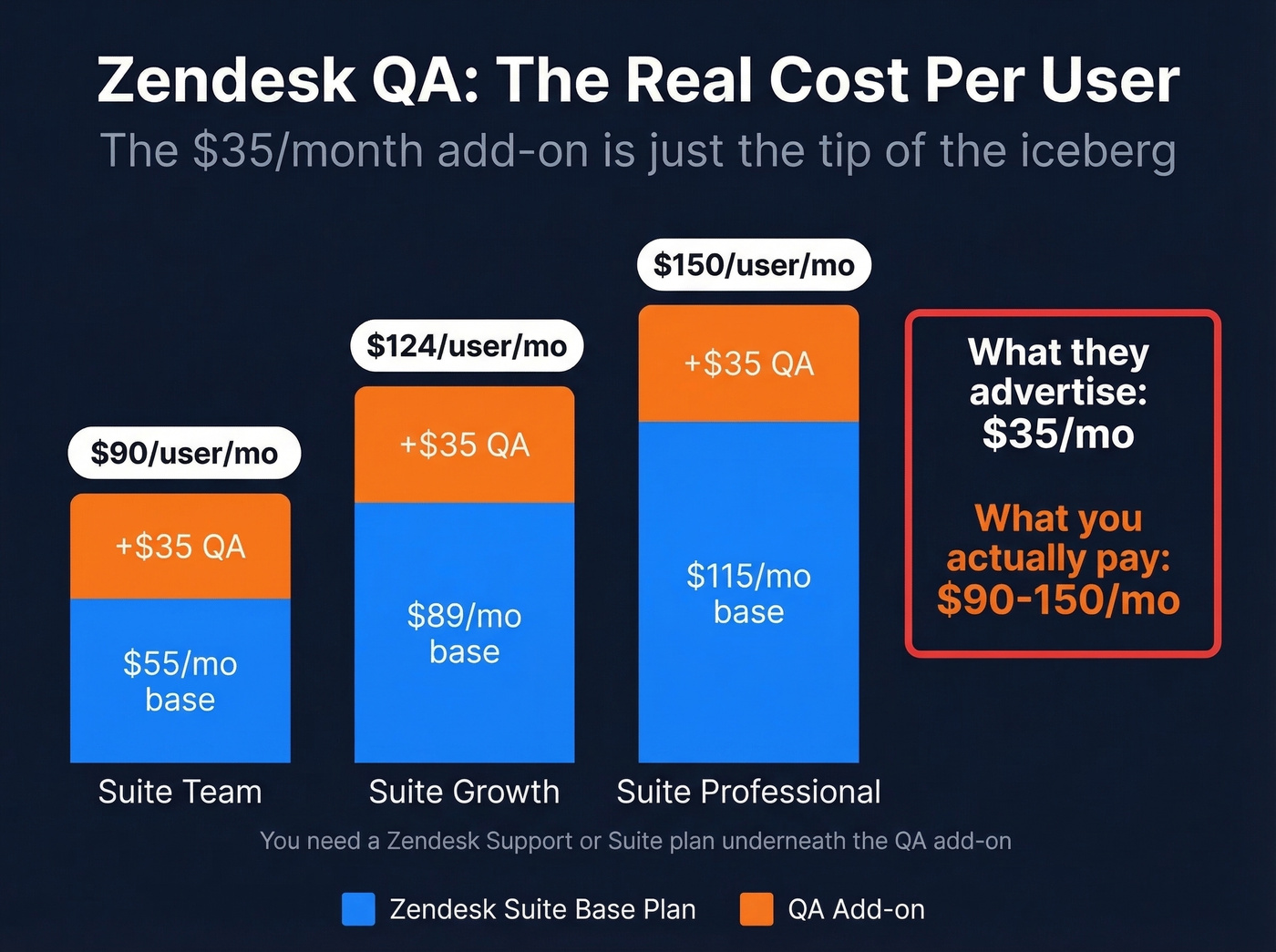
Here's the thing about Zendesk QA: it's a $35/user/month add-on, but you need a Zendesk Support or Suite plan underneath it. Suite Team starts at $55/user/month, Suite Growth at $89, Suite Professional at $115. So your real cost for QA is $90-150/user/month, not $35. That math matters a lot.
AutoQA analyzes every interaction and highlights churn risk, outliers, and escalation patterns. Zendesk markets quantified outcomes like a 2.5% CSAT boost and an 80% reduction in QA review time. If you're already running Zendesk for support, this is the path of least resistance - the native integration is genuinely seamless. If you're not on Zendesk, don't adopt an entire helpdesk platform just for QA.
Convin.ai
Convin.ai has one of the largest review datasets in this category - 4.7/5 on G2 with 548 reviews. Implementation averages about one month with an 8-month path to ROI. It's positioned as conversation intelligence with automated QA that monitors every conversation across calls, chats, and emails, plus automated coaching and an AI-powered LMS.
Full-suite pricing requires a custom quote - expect $60-120/user/month based on enterprise conversation intelligence norms. There's also a pay-as-you-go option starting at $0.006/interaction for limited use cases. One thing to note: the user base skews heavily toward Asia based on G2's review distribution, so North American and European teams should run a focused pilot before committing to a full rollout.
Calabrio ONE
Calabrio ONE is the enterprise play - a full workforce optimization suite with QA baked in. Calabrio positions its satisfaction at 91% versus NICE WFM's 51%, and claims it's typically 15-20% less expensive than comparable NICE deployments with a 17-month ROI timeline. Best for teams already evaluating full WFO suites who want QA, WFM, and analytics in one contract. Expect $30-50/user/month.
For most mid-market teams, this is overkill. But if you're already shopping NICE or Genesys, Calabrio deserves a seat at the table.
Balto
Balto does something fundamentally different: real-time agent guidance during live calls, not post-call QA. On G2 comparisons, Balto shows up as more usable than EvaluAgent, but it's a complement to a post-call QA tool, not a replacement. Think of it as the coaching layer that sits alongside MaestroQA or Scorebuddy, not instead of them. Budget $50-100/agent/month.
Purpose-Built QA vs. Suite QA
Let's be honest: most contact centers don't need a suite. The QA market is projected to grow from $2.25B to $4.09B by 2032, which explains why every WFO suite is bolting on QA features. But bolted-on QA rarely matches the depth of purpose-built tools.
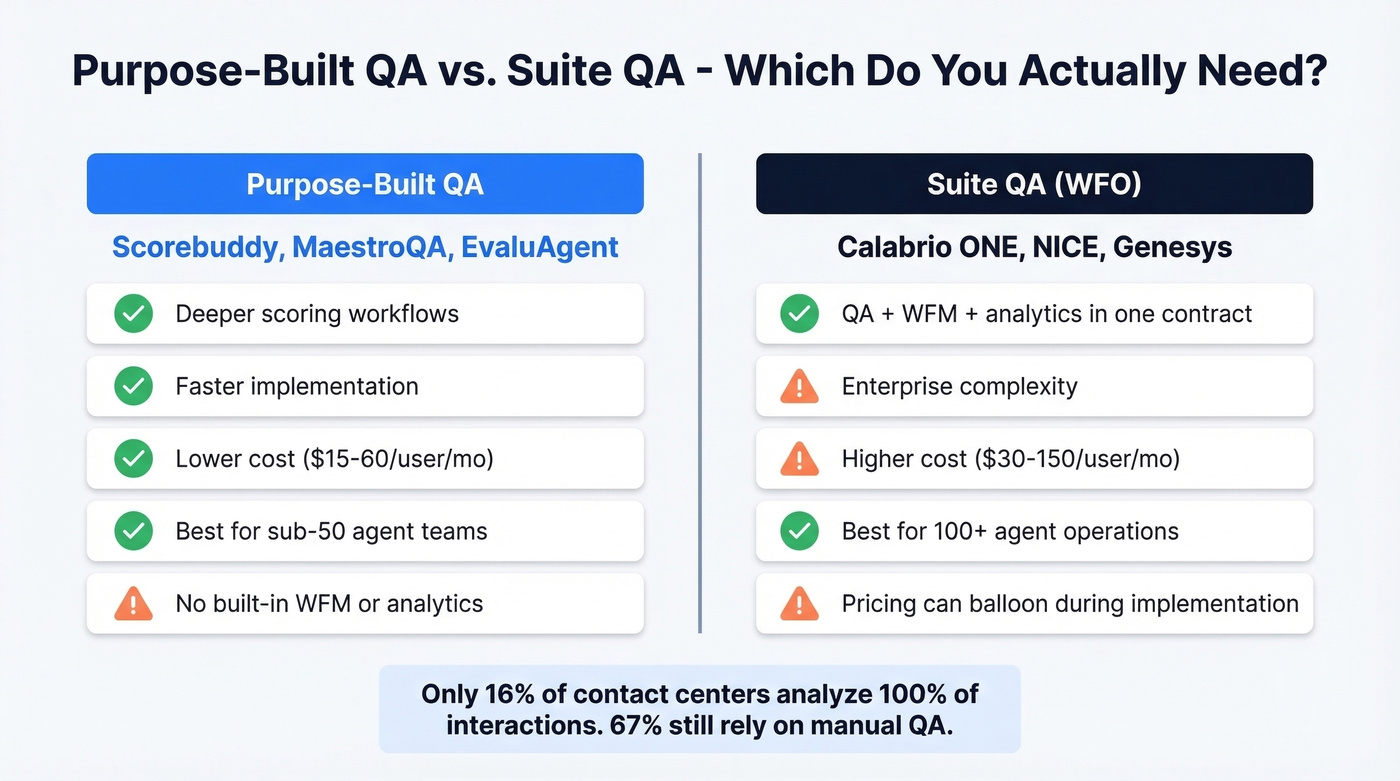
The category now spans seven distinct sub-types - from manual QA to real-time in-call guidance - so "EvaluAgent alternative" means different things depending on what you actually need.
Purpose-built tools like Scorebuddy, MaestroQA, and EvaluAgent tend to have deeper scoring workflows, faster implementation, and lower cost. Suites like NICE, Calabrio, and Genesys give you QA + WFM + analytics in one contract but come with enterprise complexity and pricing that can balloon during implementation. Only 16% of contact centers currently analyze 100% of interactions, and 67% still rely on manual QA. If you're running a sub-50-agent team trying to close that gap, you don't need Calabrio or NICE. A purpose-built QA platform paired with your existing telephony stack will get you to full interaction coverage faster and cheaper.
If you're building the outbound side in parallel, it helps to map QA to your sales process optimization and the sales activities you expect reps to execute.
The Data Quality Layer QA Buyers Miss
QA tools evaluate conversations that happen. But what about the conversations that never happen because your agents dialed wrong numbers or emailed dead addresses?
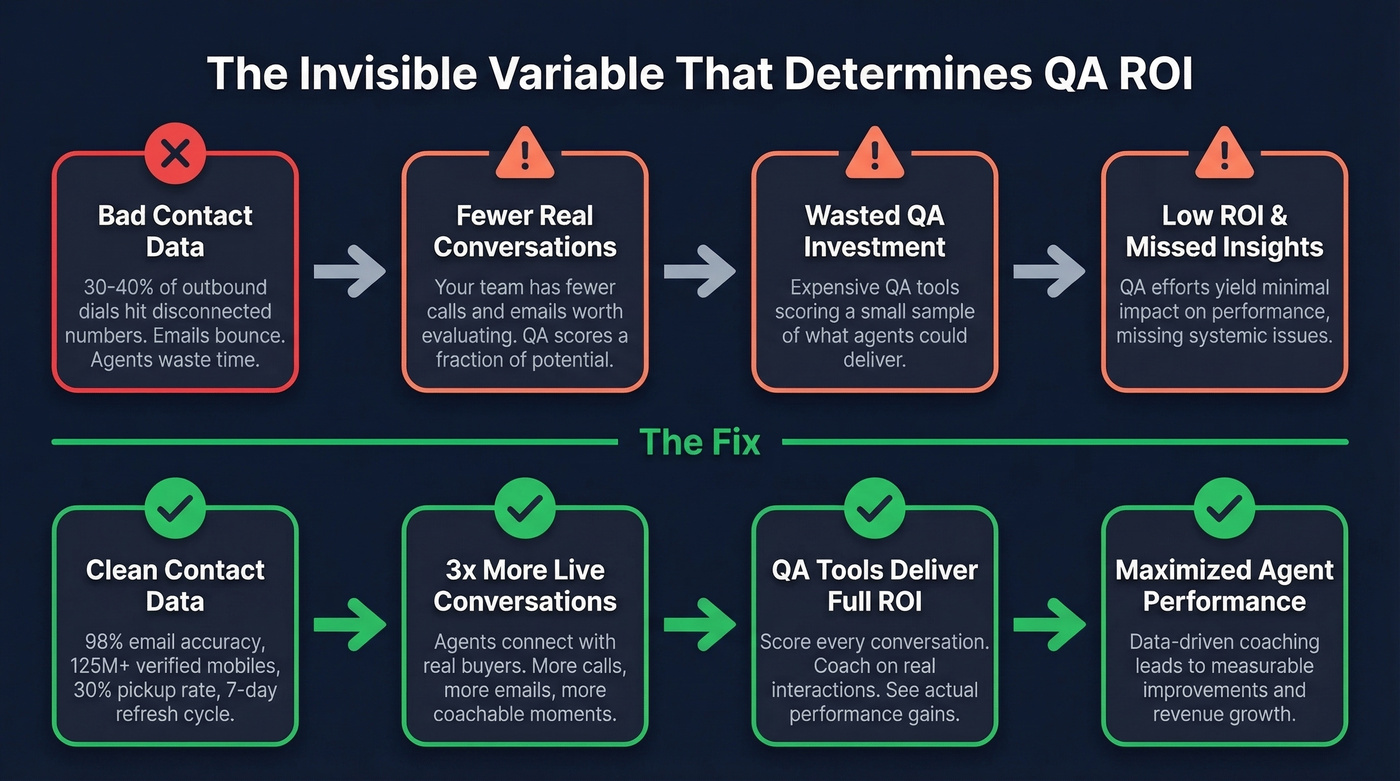
That's the invisible variable that determines whether your QA investment pays off. We've seen teams obsess over scorecard design while 30-40% of their outbound dials hit disconnected numbers. All that QA infrastructure is scoring a fraction of what the team could deliver.
Prospeo sits upstream of your QA stack - 98% email accuracy across 143M+ verified emails, 125M+ verified mobile numbers with a 30% pickup rate, and a 7-day data refresh cycle. When your contact data is clean, agents spend time on real conversations worth scoring instead of chasing bounced emails and disconnected numbers.
If you're trying to fix this systematically, start with data enrichment services and a clean sales prospecting database before you scale coaching.
You're upgrading your QA stack to improve agent performance. But if reps are dialing wrong numbers and bouncing emails, there's nothing to evaluate. Prospeo's 30% mobile pickup rate means 3x more live conversations to coach on - at $0.01 per email.
More connected calls means more coachable moments.
FAQ
What's the cheapest EvaluAgent alternative?
EvaluAgent, MaestroQA, and Playvox all start around $15/user/month. Scorebuddy offers a 14-day free trial so you can test before paying. Watch out for Zendesk QA - the $35/month add-on looks affordable until you add the required Suite base plan, pushing total cost to $90-150/user/month.
Which alternative has the best AI auto-scoring?
Scorebuddy packages AI autoscoring into its Accelerate and Elite tiers with 500-1,000 monthly AI scores included. MaestroQA offers LLM credit packs at $15-25K/year on Enterprise Plus only - powerful but expensive. Convin.ai is built around automated QA that monitors every conversation across calls, chats, and emails, making it the heaviest auto-scoring option if budget isn't a constraint.
Do any of these tools address contact data quality?
QA tools only evaluate conversations that actually happen. If agents are calling wrong numbers or emailing invalid addresses, you're scoring a fraction of what your team could deliver. Pair any QA tool on this list with a data verification layer like Prospeo - 98% email accuracy and 125M+ verified mobiles - to clean your contact database before agents pick up the phone.