

Executive Selling: What Actually Works (According to 400+ C-Suite Buyers)
Two hundred dials. Zero VPs reached. That was a Tuesday for one SDR team we worked with last year - and their executive selling approach wasn't broken in the obvious ways. They had the right ICP, decent messaging, and a solid product. The problem was structural: 25% of sales professionals cite getting direct access to decision-makers as their single biggest challenge, and that number climbs sharply when you're targeting the C-suite.
Here's the contrarian truth most people miss: the most popular advice for selling to executives - lead with ROI and reference their strategic initiatives - is the worst-performing approach according to the most rigorous study in this category. We'll break down exactly why, and what to do instead.
The Short Version
Lead with a provocative industry insight, not ROI. A study of 400+ C-level executives found that the classic "known initiative + ROI" email finished dead last in credibility, confidence, and meeting acceptance.
Frame everything as loss avoidance, not gain. "You're losing $2M annually to X" outperforms "you'll save $2M" by a wide margin - loss-aversion framing drives roughly a 70% increase in selection.
Verify your contact data before you send. A bounced email to a CFO burns your one shot at a first impression. Prospeo's 7-day refresh cycle and 98% email accuracy mean your carefully crafted message actually lands.
Why Executive Buyers Are Different
Executives don't buy the way directors or managers do. They're 4x more likely to want conversations about business challenges than about products - but they rate sellers 4x worse at having those business conversations. That gap is where most deals die before they start.
And 96% of prospects research your company before they'll engage with a rep. By the time a C-suite buyer takes your call, they already have opinions. Your job isn't to educate them on your product. It's to reframe how they see a problem they thought they understood.
Loss aversion is the most powerful lever you have. When identical options are framed as avoiding a loss versus achieving a gain, the loss-avoidance framing produces an ~70% increase in selection. That's not a marginal edge - it's a fundamental rewiring of how the conversation lands.
The buying process compounds the difficulty. According to Gartner data cited by RAIN Group, 83% of software purchases are team decisions, with C-level executives sitting on 36% of buying committees. You're not selling to one person. You're selling to a committee where the executive is the most skeptical, most time-constrained, and hardest-to-reach member.
How Hard the C-Suite Sales Cycle Actually Is
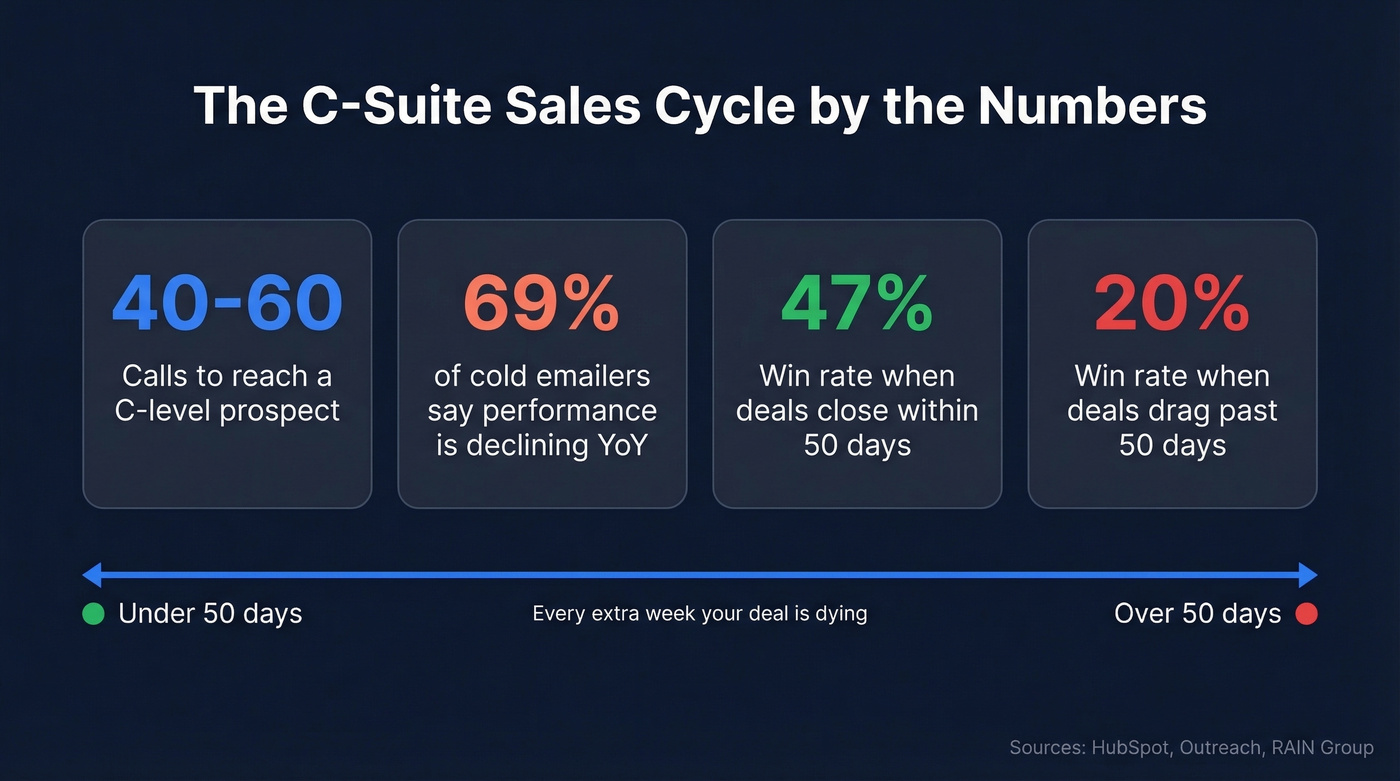
Reaching a C-level prospect typically takes 40-60 calls. Executives pick up the phone roughly once per 25-50 dials. Cold email isn't getting easier either: 69% of cold email senders report performance declining year over year, and 43% of sales leaders report increasing cycle lengths.
Outreach's data shows the largest win-rate group sitting in the 21-25% bracket, down from 31-40% the prior year. Their AI coaching data offers one bright spot: deals close 11 days faster with guided conversations, and on deals over $50K, win rates jump 10 points.
Speed matters enormously here. Opportunities closed within 50 days carry a 47% win rate. After 50 days, that drops to 20% or lower. Every week you spend trying to reach the wrong person at the wrong email address is a week your deal is dying.
Let's be honest: if your average deal size is under $25K, you probably can't afford the 40-60 dials it takes to reach a C-suite buyer through cold outreach alone. Multi-thread into the VP layer instead and let them pull you up.
How to Get the Meeting
This is where most advice gets it exactly wrong.
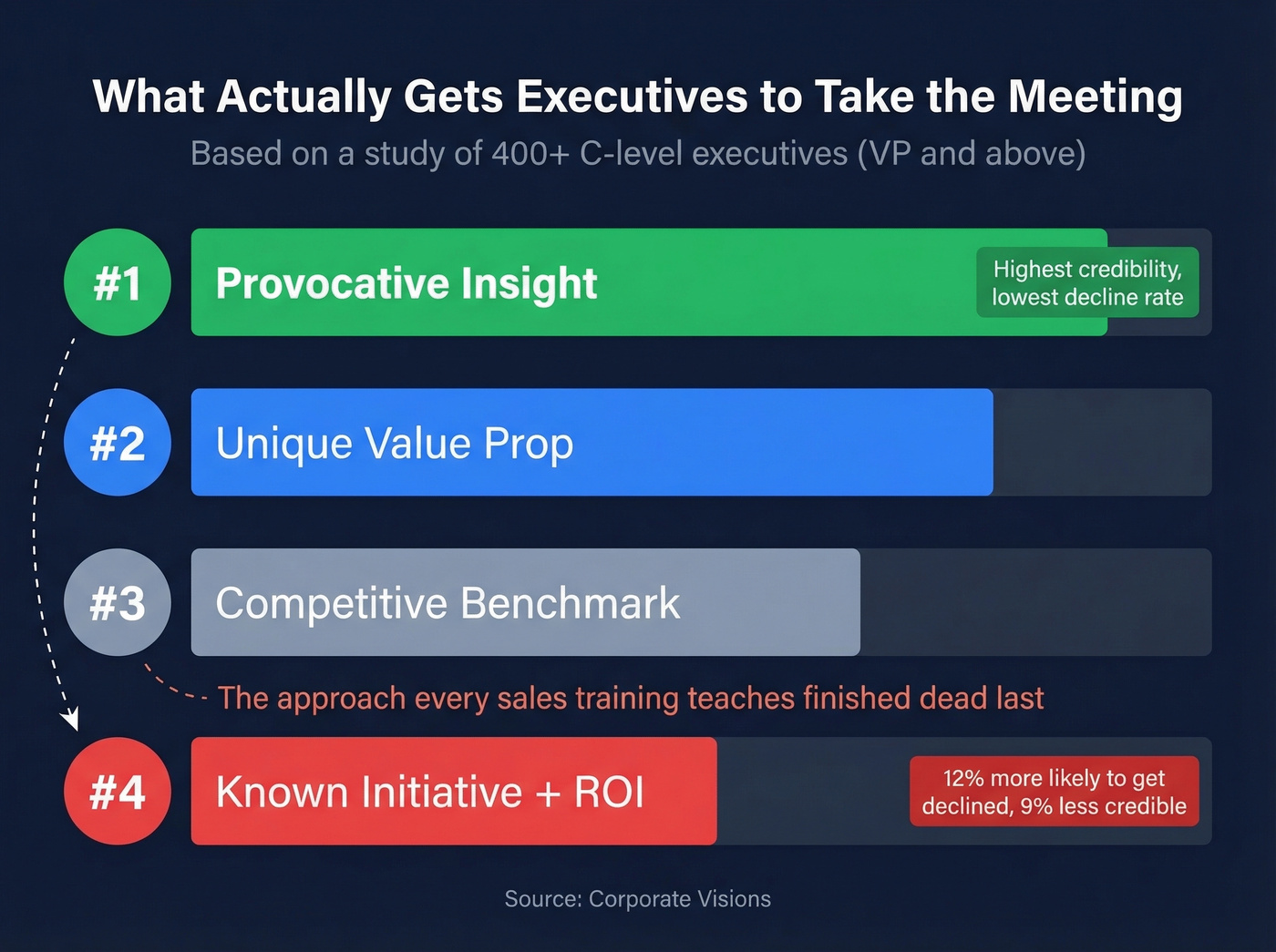
The conventional wisdom says: research the exec's strategic priorities, tie your pitch to a known initiative, and quantify the ROI. Sounds logical. It's also the worst-performing approach. Corporate Visions ran a simulation-based study with 400+ C-level executives (VP and above, companies over $50M revenue, multi-industry). Each exec read a cold email from an unknown vendor and chose to take the meeting, decline, or delegate. Four message types were tested:
| Rank | Message Type | Meeting Acceptance | Decline Rate | Credibility |
|---|---|---|---|---|
| #1 | Provocative Insight | Highest | Lowest | Highest |
| #2 | Unique Value Prop | Mid-high | Mid-low | Mid-high |
| #3 | Competitive Benchmark | Mid | Mid | Mid |
| #4 | Known Initiative + ROI | 10%+ lower than #1 | 12% higher | 9% lower |
The "Known Initiative + ROI" message - the one every sales training program teaches - made vendors look 9% less credible, gave execs 9.5% less confidence, and was 12% more likely to get a flat decline. The winner? A provocative industry insight that introduced an unconsidered need, something that disrupted the exec's preference stability rather than mirroring their existing priorities back at them.
The old VITO method of "reference their annual report and tie to ROI" isn't just outdated. It's actively counterproductive. Execs hear that pitch ten times a week.
Warm introductions from your own leadership team remain the most effective path. After that, a multi-channel cadence - phone, email, and social touches spread across 2-3 weeks - outperforms any single channel. Expect 8-12 touches before you break through.
But none of this matters if your message never arrives. We've seen reps spend three hours researching an account, craft a personalized email referencing a Q3 earnings call, and watch it bounce because the contact data was six months old. That's a data freshness problem, and it's solvable - Prospeo refreshes 300M+ professional profiles on a 7-day cycle versus the six-week industry average, with 98% email accuracy.


You spent 3 hours researching a CFO's priorities and crafting a provocative insight email. Don't let it bounce. Prospeo refreshes 300M+ profiles every 7 days - not every 6 weeks - with 98% verified email accuracy. At ~$0.01/email, protecting your executive outreach costs less than a wasted dial.
Verify every C-suite contact before you burn your one shot.
Executive deals die when you can't reach the buying committee. Prospeo gives you 125M+ verified mobile numbers with a 30% pickup rate and 143M+ verified emails - so your 8-12 touch cadence hits real people, not dead inboxes. Layer in buyer intent data across 15,000 topics to know which executives are actively in-market.
Stop dialing into the void. Reach the C-suite on the first try.
The 3-Minute Conversation Framework
You opened with your ROI slide. She checked her phone 90 seconds in. We've all been there.
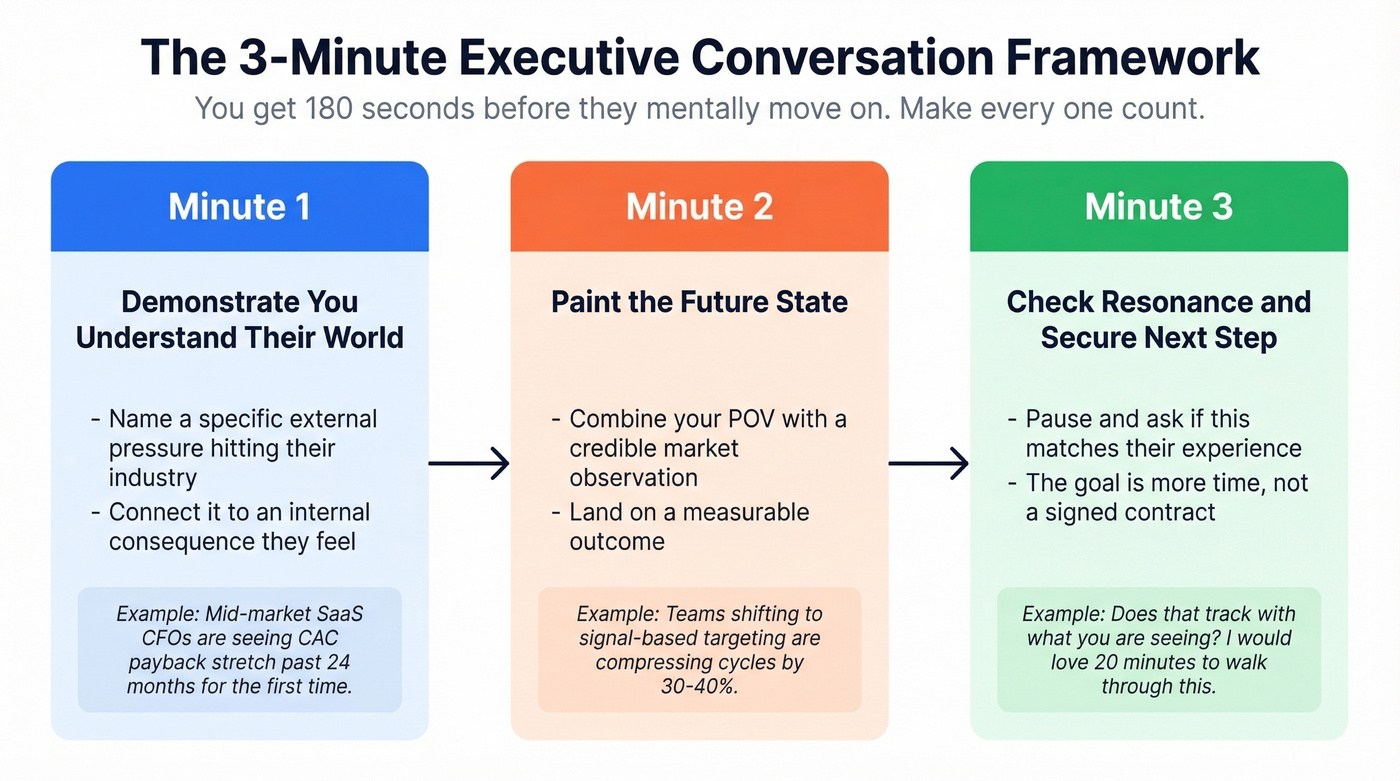
Executives give you about three minutes before they mentally move on. The LSA Global framework breaks those 180 seconds into a structure that holds attention:
Minute 1: Demonstrate you understand their world. Don't recap their company's mission statement. Name a specific external pressure hitting their industry and connect it to an internal consequence. "Mid-market SaaS CFOs are seeing CAC payback stretch past 24 months for the first time. That's putting pressure on every new headcount request."
Minute 2: Paint the future state. Combine your point of view with a credible market observation and land on a measurable outcome. "Teams that shift from volume-based outbound to signal-based targeting are compressing cycles by 30-40% and recovering that CAC gap within two quarters."
Minute 3: Check resonance and secure the next step. Pause. Ask if what you've described matches what they're seeing. The goal isn't a signed contract - it's more time. "Does that track with what you're experiencing? I'd love 20 minutes to walk through how we've seen this play out."
Scripts and Openers That Work
A cold call opener that consistently surfaces on r/sales for VP+ conversations: "Tell me about the risks and challenges you're facing over the next 3-6 months." This isn't your first question the moment they pick up - it's the deeper question you earn after a one-sentence context-setting intro.
For email, apply the loss-aversion reframe:
❌ "We help companies save $2M annually on infrastructure costs."
✅ "Companies in your space are losing $2M annually to [specific problem] - and most don't realize it until renewal season."
Same number, completely different psychological weight. And permanently retire "What keeps you up at night?" - it's become a signal that you don't have anything original to say.
Mistakes That Kill Deals
These are all fixable. But they're also the ones we see most often.
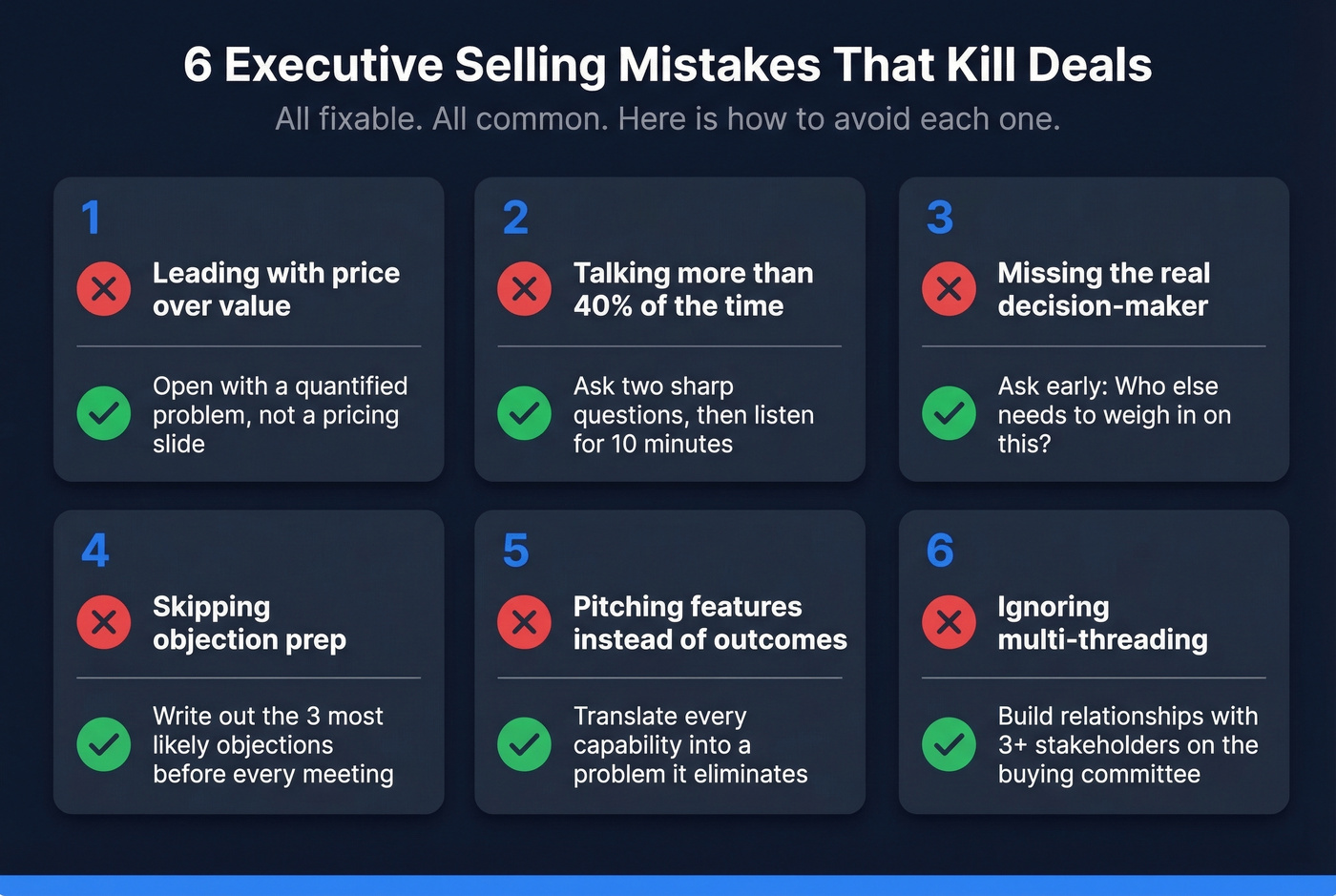
Leading with price over value. Execs don't care what it costs until they believe it matters. Open with a quantified problem, not a pricing slide. If you find yourself discussing cost before the 20-minute mark of a first meeting, you've already lost control of the conversation.
Talking more than listening. If you're talking more than 40% of the time in an exec meeting, you're losing. Ask one sharp question and let the silence work. The best sellers we've observed spend the first five minutes asking exactly two questions, then barely speak for the next ten.
Failing to identify the real decision-maker. With 85% of sales leaders reporting more decision-makers per deal, the person you're talking to may not sign. Ask early: "Who else needs to weigh in on this?" Identify the "domino" - the exec who can align the rest of the committee quickly.
Skipping objection prep. This will end you faster than a bad pitch. Write out the three most likely objections and your response to each before every exec meeting. Practice them out loud once. Executives test you deliberately, and stumbling on a predictable objection destroys credibility permanently.
Pitching features instead of outcomes. Technical language that impresses a director alienates a CEO. Executives are 4x more likely to engage on business challenges - translate every capability into a problem it eliminates, in plain language.
Ignoring multi-threading. Selling to one executive and hoping they champion internally is a losing strategy when 83% of purchases are team decisions. Map the buying committee early and build relationships across it. Frameworks like RAIN's STRATEGIC method or SBI's RAMP approach provide useful checklists, but the data shows your message type matters more than your framework adherence.
When to Bring in Your Own Executives
One of the most common timing mistakes is deploying your own leadership too early - or too late.
The data points to three high-leverage moments: during initial outreach to a peer-level buyer (CEO-to-CEO introductions carry the highest response rates), at the point where a deal stalls between evaluation and commitment, and during final negotiation when procurement pushes back on pricing. Outside of those windows, executive involvement can actually slow things down by adding unnecessary formality to a conversation that needs to stay tactical. Skip this tactic entirely for deals under $50K - the overhead rarely justifies itself.
Tools and Resources
The single best book on this topic is Selling to the C-Suite by Nicholas Read and Stephen Bistritz - based on interviews with executives across 500+ organizations. Pair it with The Challenger Sale for the insight-led messaging framework and SPIN Selling for discovery question architecture.
For broader sales benchmarks, Salesforce's annual State of Sales report and HubSpot's sales statistics roundup are both worth bookmarking.
If you're building a repeatable outbound motion, start with sales prospecting techniques and a clean cold email sequence before you go executive-heavy.
FAQ
What is executive selling?
It's the practice of selling directly to VP-level and above decision-makers by emphasizing business outcomes and strategic challenges over product features. The most effective approaches use insight-led messaging and loss-aversion framing rather than traditional ROI pitches.
How do you get a meeting with a C-suite executive?
Lead with a provocative industry insight rather than ROI - this approach scored highest in a 400+ executive study. Use multi-channel outreach across email, phone, and social over 2-3 weeks, and use warm introductions from your leadership team whenever possible.
What's the biggest mistake when selling to executives?
Pitching product features instead of framing business challenges. Executives are 4x more likely to engage on strategic challenges but rate sellers 4x worse at discussing them. Reframe every capability as a problem it eliminates.
How many touches does it take to reach a C-level prospect?
Expect 40-60 calls via phone alone, with executives picking up roughly once per 25-50 dials. Multi-channel cadences combining phone, email, and social compress this to 8-12 total touches over 2-3 weeks.
How do you make sure executive outreach reaches the right person?
Verify contact data before sending - executives change roles frequently, and a bounced email burns your first impression permanently. A 7-day data refresh cycle with 98% email accuracy is the difference between delivered and bounced when targeting someone who just changed titles.