

Expansion Revenue in SaaS: Formulas & Benchmarks (2026)
A RevOps lead ran the numbers last quarter and discovered her team was spending over a dollar to acquire every dollar of new-logo ACV - while expansion deals closed at a fraction of that cost. She'd been fighting for headcount on the new-business side for months. The real growth lever was sitting in her existing customer base the whole time.
That's the story of expansion revenue in SaaS: the most underinvested, highest-ROI motion most companies already have the ingredients for.
The Short Version
Expansion revenue is additional recurring revenue from existing customers - upsells, cross-sells, seat additions, usage growth, add-ons, and tier upgrades. It costs $0.20-$0.27 per $1 of ACV versus $1.16 for new logos. In Benchmarkit's 2026 data, the median company generates 40% of total new ARR from expansion. Target a 10-30% expansion MRR rate, make sure it exceeds your churn rate, and read on for the formulas, benchmarks, and a trigger-based playbook to move the number.
What Expansion Revenue Is (and Isn't)
Expansion revenue captures any incremental recurring revenue from customers already in your base. It's the opposite of contraction ARR. Six sources feed it:
- Upsells - moving a customer to a higher-value plan
- Cross-sells - selling an additional product line
- Add-ons - features or modules on top of the base plan
- Seat expansion - more users added to the account
- Usage-based growth - consumption exceeding prior thresholds
- Tier upgrades / price increases - contractual or list-price lifts
Renewals at the same contract value don't count. They're retention, not expansion.
Expansion MRR Formulas
Three formulas matter. Let's walk through all three with a single worked example.
Expansion MRR = Sum of all incremental MRR added by existing customers in the period
Expansion MRR Rate = Expansion MRR / Beginning MRR
Net Revenue Retention (NRR) = (Starting MRR + Expansion - Downgrades - Churn) / Starting MRR
Gross Revenue Retention excludes expansion entirely - it only measures how much existing revenue you kept. When NRR exceeds 100%, expansion is offsetting churn. That's negative net MRR churn, and it's the single best signal your customer base is a growth engine rather than a leaky bucket.
Worked example: You start the month with $500K MRR. You add $30K in expansion, lose $10K to downgrades, and $15K to churn. NRR = ($500K + $30K - $10K - $15K) / $500K = 101%. Your expansion MRR rate is $30K / $500K = 6%.

Expansion revenue dies when your CRM has stale contacts. New stakeholders join accounts, champions leave, and your upsell emails bounce. Prospeo's CRM enrichment returns 50+ data points per contact at an 83% match rate - refreshed every 7 days, not every 6 weeks.
Stop losing $0.20 upsells to bad data. Enrich your accounts now.
Benchmarks by Company Size
Most content on this topic gives you a single number and calls it a day. Benchmarks shift dramatically depending on where you sit.
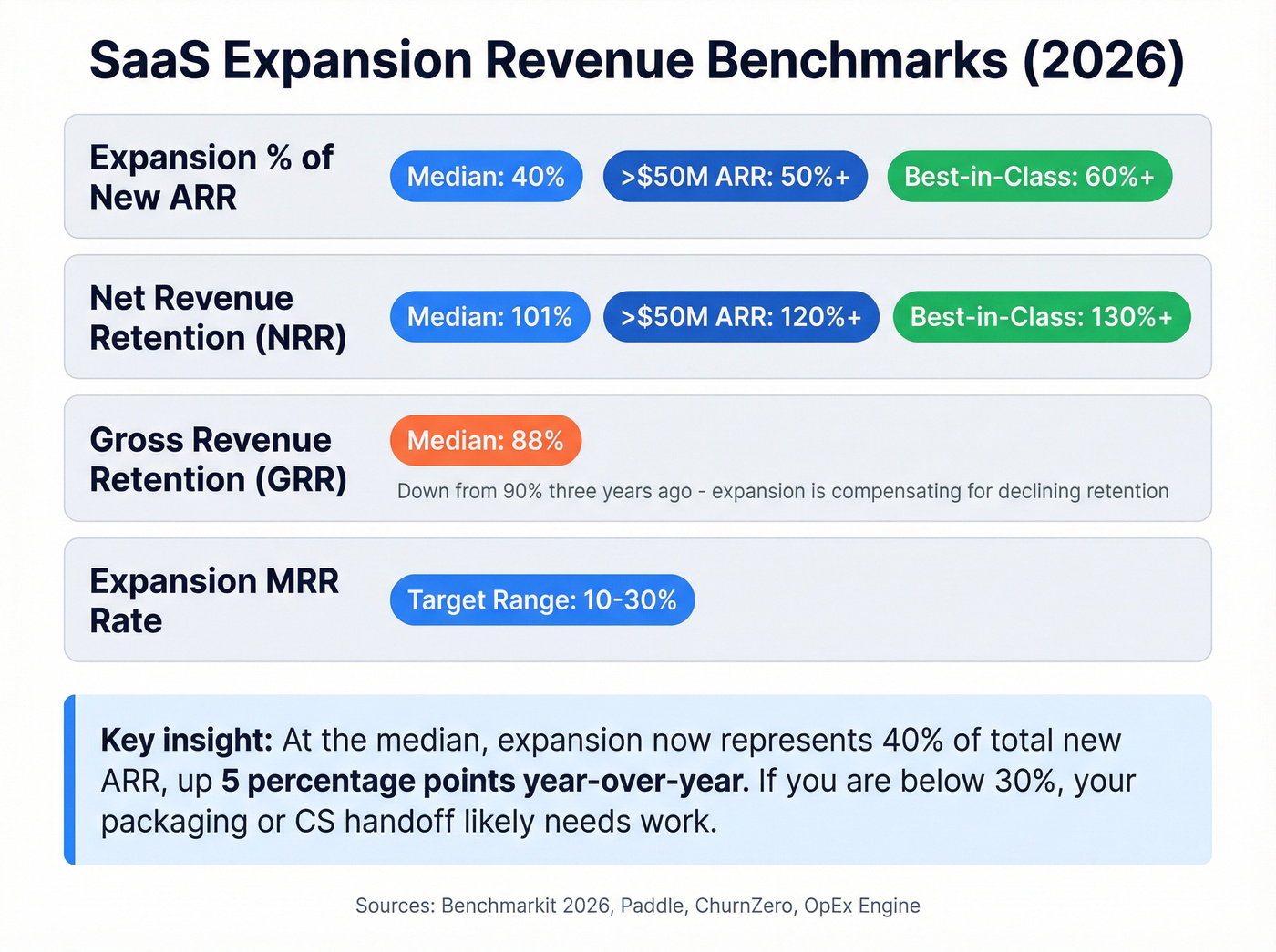
| Metric | Median (All) | >$50M ARR | Best-in-Class |
|---|---|---|---|
| Expansion % of New ARR | 40% | >50% | 60%+ |
| NRR | 101% | 120%+ | >130% |
| GRR | 88% | - | - |
| Expansion MRR Rate | 10-30% | - | - |
The Benchmarkit dataset tells the clearest story: expansion ARR now represents 40% of total new ARR at the median, up 5 percentage points year-over-year. For companies above $50M ARR, it's north of 50%. GRR has declined from 90% to 88% over three years, which means growing existing accounts isn't optional - it's compensating for a retention problem across the industry.
This tracks with what operators are saying on r/SaaS and r/sales: surviving CAC pressure increasingly requires generating 40-50%+ of new ARR from existing customers and building real lifecycle systems instead of relying on acquisition to backfill churn.
Paddle's guidance frames 20-30% of total revenue from expansion as a solid north star. Best-in-class NDR targets sit above 120%, and enterprise SaaS often exceeds 130%.
Why This Is the Highest-ROI Growth Lever
The unit economics aren't close.
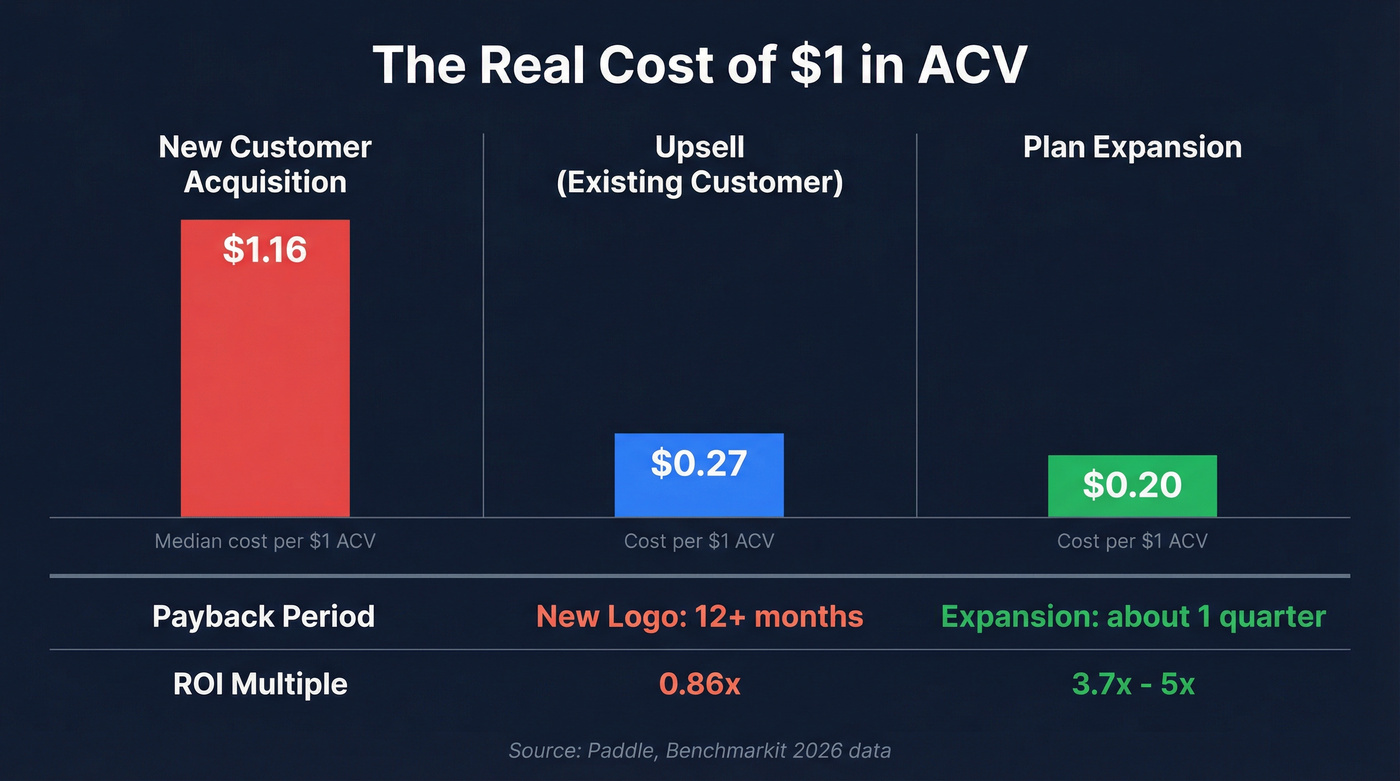
Acquiring $1 of new-customer ACV costs a median of $1.16. Upselling that same dollar costs $0.27. Plan expansions run just $0.20. New customer acquisition often takes more than a year to pay back; expansion often pays back in about one quarter.
Here's the thing: most companies underinvest in expansion because they're addicted to new-logo acquisition. The board deck looks better with a "new customers" slide than a "we grew ARPU 18%" slide. If your average deal size is under $25K and your NRR is below 105%, you probably don't need another SDR - you need an expansion playbook.
How to Grow Expansion Revenue
Trigger-Based Upsells
Timing is everything. Reach out too early and you're annoying. Too late - after the customer has already hit their limit and complained - and conversion craters. We've seen this pattern play out across dozens of accounts, and the data backs it up:
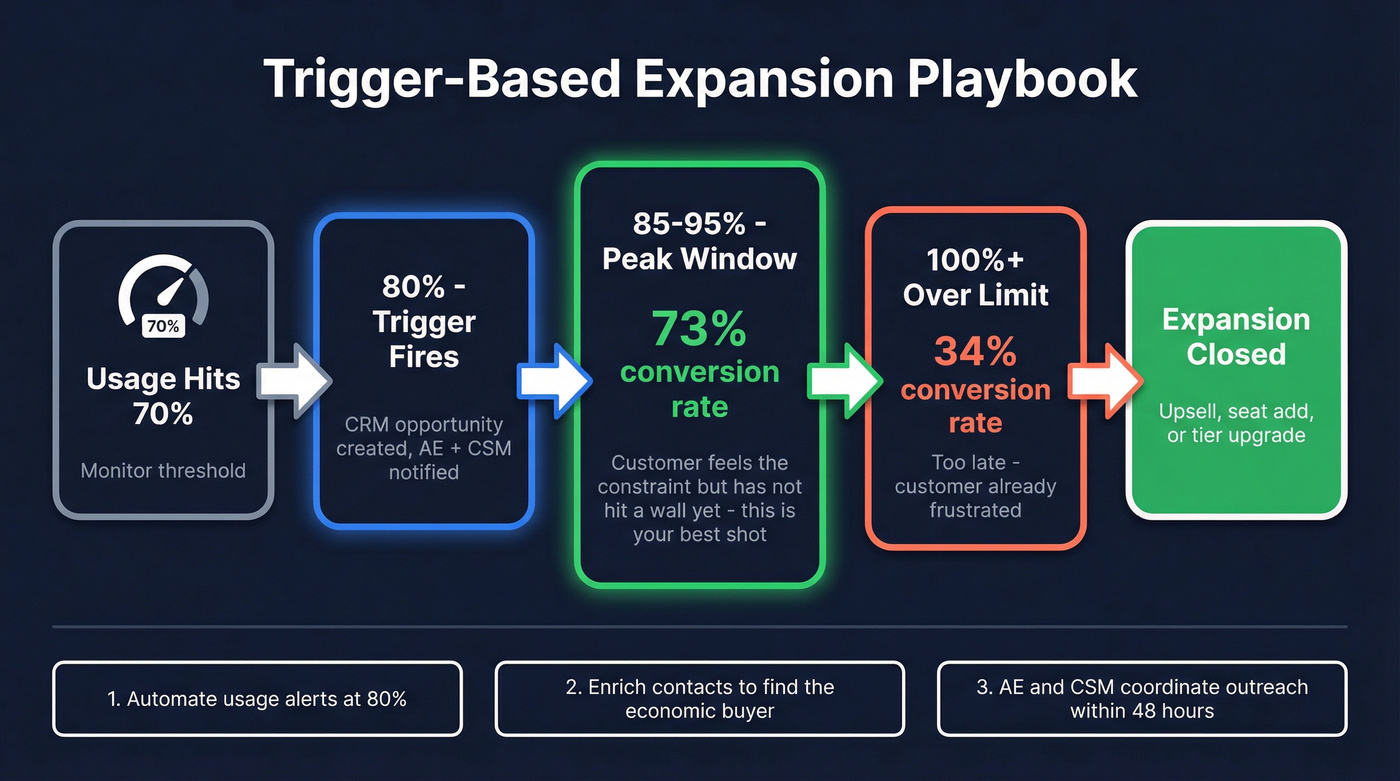
| Usage Level | Time to Limit | Conversion Rate |
|---|---|---|
| 70-85% | 15-30 days | 58% |
| 85-95% | 5-14 days | 73% |
| >100% (over limit) | Already hit | 34% |
Set 80% usage as the trigger threshold for outreach initiation. The 85-95% band is the peak conversion window - the customer feels the constraint but hasn't hit a wall yet. Automate usage alerts, create a CRM opportunity, and notify both the AE and CSM. Without reliable customer expansion tracking in your CRM, these signals get lost in Slack threads and never convert to pipeline.
Once you've identified accounts in that zone, you need verified contact data for the economic buyer or new stakeholders who've joined since the original deal closed. Prospeo's CRM enrichment returns 50+ data points per contact with an 83% match rate, refreshed every 7 days - so your expansion outreach reaches the right person, not a stale info@ address.
Intentional Packaging
Your free or entry-level plan should create natural upgrade pressure. A ProductLed study of 446 B2B SaaS companies found a 0.73 correlation between free model intentionality and overall performance. Companies with highly intentional upgrade paths reported 57% better free-to-paid conversion.
Deliberate value limitations - visible usage caps, feature gates with clear "unlock" messaging - create organic expansion without feeling punitive. Skip this if your product is purely enterprise with no self-serve motion; in that case, focus on multi-product cross-sell instead.
CS-Sales Alignment
Expansion dies in the gap between customer success and sales. We've seen teams double their expansion rate by making one structural change: putting CS and Sales on the same NRR number. When both teams own the metric, finger-pointing disappears.
Build stable AE+CSM pods so customers aren't getting duplicate outreach from two people who've never spoken. Document your top 3-5 expansion scenarios - usage spikes, stakeholder changes, new teams onboarding - and rehearse them. Run weekly syncs with a joint dashboard, and define a clear RACI: CS handles small seat bumps, Sales runs complex cross-sells. For teams that need to reach new decision-makers in expansion-ready accounts, a data enrichment tool with a fast refresh cycle makes the difference between a timely conversation and a bounced email.
Your trigger-based expansion playbook is only as good as the contact data behind it. When an account hits 85% usage, you need the economic buyer's verified email - not a stale alias from two years ago. Prospeo delivers 98% email accuracy at $0.01 per lead, so every expansion signal converts to real pipeline.
Verified contacts for every expansion trigger. No stale data, no bounces.
Measurement Mistakes to Avoid
Half the SaaS industry still can't tell you whether a mid-contract seat addition counts as expansion or new MRR. That's not a math problem - it's a policy problem.
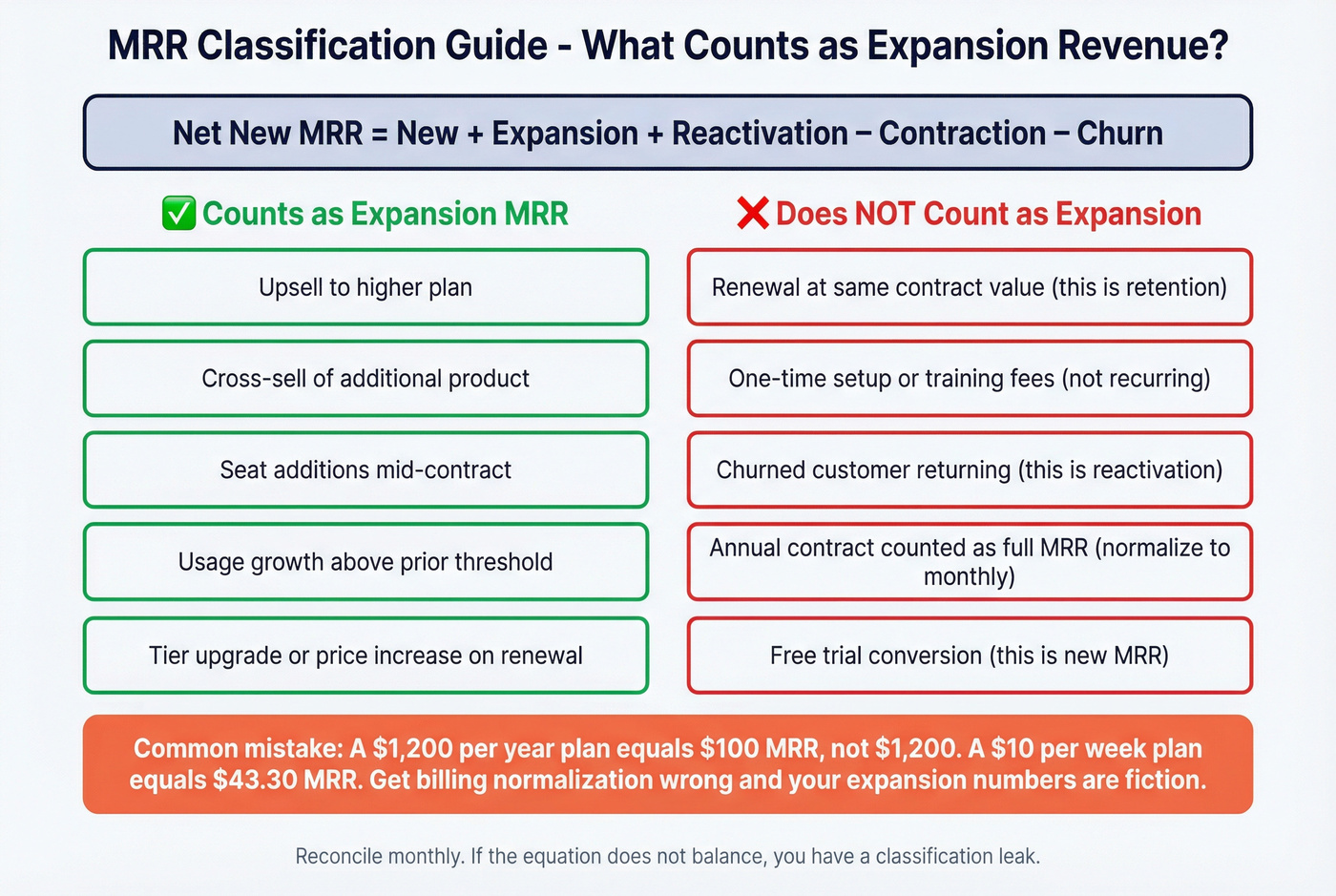
Normalize billing intervals. A $1,200/year plan = $100 MRR. A $10/week plan = $43.30 MRR. Get this wrong and your expansion numbers are fiction.
Exclude one-time fees. Setup charges and training packages aren't recurring. Don't let them inflate MRR.
Separate reactivation from expansion. A churned customer who returns isn't the same as an existing customer buying more. Track them in different buckets.
Reconcile monthly. Net New MRR should always equal New + Expansion + Reactivation - Contraction - Churn. If it doesn't balance, you've got a classification leak somewhere.
Look - none of this is glamorous work. But in our experience, companies that nail MRR hygiene find more revenue hiding in misclassified line items than they expected.
FAQ
Does renewal revenue count as expansion?
No. Renewals at the same contract value are retention, not expansion. Only incremental revenue above the prior contract - upsells, added seats, tier upgrades - qualifies as expansion MRR.
What's a good net revenue retention rate?
The median NRR is 101%. Best-in-class SaaS companies target NRR above 120%, and enterprise organizations with strong upsell and cross-sell motions often exceed 130%.
How do you reach new stakeholders in expansion-ready accounts?
Use a data enrichment tool like Prospeo to pull verified emails and direct dials for economic buyers and new hires at 98% email accuracy. Stale CRM data is the most common reason expansion outreach bounces - a 7-day refresh cycle keeps contacts current so your team connects on the first attempt.
What percentage of new ARR should come from existing customers?
At the median, 40% of new ARR comes from expansion. Companies above $50M ARR typically generate over 50% from existing accounts. If you're below 30%, your packaging or CS-to-Sales handoff likely needs work.