

Farmer Sales: What It Means, Why It Works, and How to Build the Role
A RevOps lead we know restructured her team last year - pulled two top-performing AEs off new-logo hunting and pointed them at the existing book. Pipeline from those accounts jumped 40% in one quarter. The hunters left behind? They panicked. But the math was clear: the farmer sales motion - growing what you've already sold - is cheaper, faster, and more predictable than chasing strangers.
Most companies either ignore it entirely or do it so badly they'd be better off not trying.
Not About Tractors
Quick detour for anyone who landed here looking for advice on selling to actual farmers or at farmers' markets: you're not in the wrong place, but most of this article covers the B2B sales methodology. If you're in ag sales, Greg Martinelli's field-selling framework is worth your time - anchor urgency in the producer's reality, stick to agreed meeting times, use one-page leave-behinds, and be hyper-responsive during planting and harvest windows.
If you're a farmer looking for USDA resources on production, grants, audits, and planning tools, farmers.gov is a solid starting point.
Now, back to the B2B world. When sales leaders talk about "farmers," they mean the reps responsible for growing revenue inside existing accounts. The role goes by many names - Account Manager, Customer Success Manager, Expansion AE - but the core job is the same: retain, expand, and deepen the accounts your hunters already won. This entire discipline is often called sales farming, and it's one of the most underleveraged growth motions in B2B.
The Short Version
- Farmer = the rep who grows existing accounts, not the one closing new logos
- Farming is 8-10x cheaper than hunting and wins 60-70% of the time vs. 5-20% for new business
- Start with full-cycle reps ("ranchers"); split into dedicated hunters and farmers once you hit 8-10 reps with consistent inbound
- Pay farmers 70-80% base / 20-30% variable; pay hunters 40-60% base / 40-60% variable
- Measure farmers on retention, NRR, CSAT, and expansion revenue - not new-logo metrics
- The handoff from hunter to farmer is where most orgs lose trust and revenue. Get it right or don't split at all.
What Is a Farmer in Sales?
The farmer archetype maps to several modern titles: Account Manager, Customer Success Manager, Expansion AE, or Strategic Account Director. What unites them is the mandate - grow revenue from accounts that already trust you. Farmers don't cold-call. They don't run discovery on strangers. They map org charts, spot expansion signals, and turn one-department deals into company-wide contracts.
A Forbes Council contributor published a widely-cited piece claiming businesses follow an "80/20 rule" where 80% of yearly sales come from existing clients. That number gets repeated constantly, but it's misleading. The actual split varies wildly by company stage, deal size, and go-to-market motion. A PLG company might see 90% from expansion. An outbound-heavy startup might be 80% new logos. The 80/20 framing sounds clean but doesn't hold up as a universal rule.
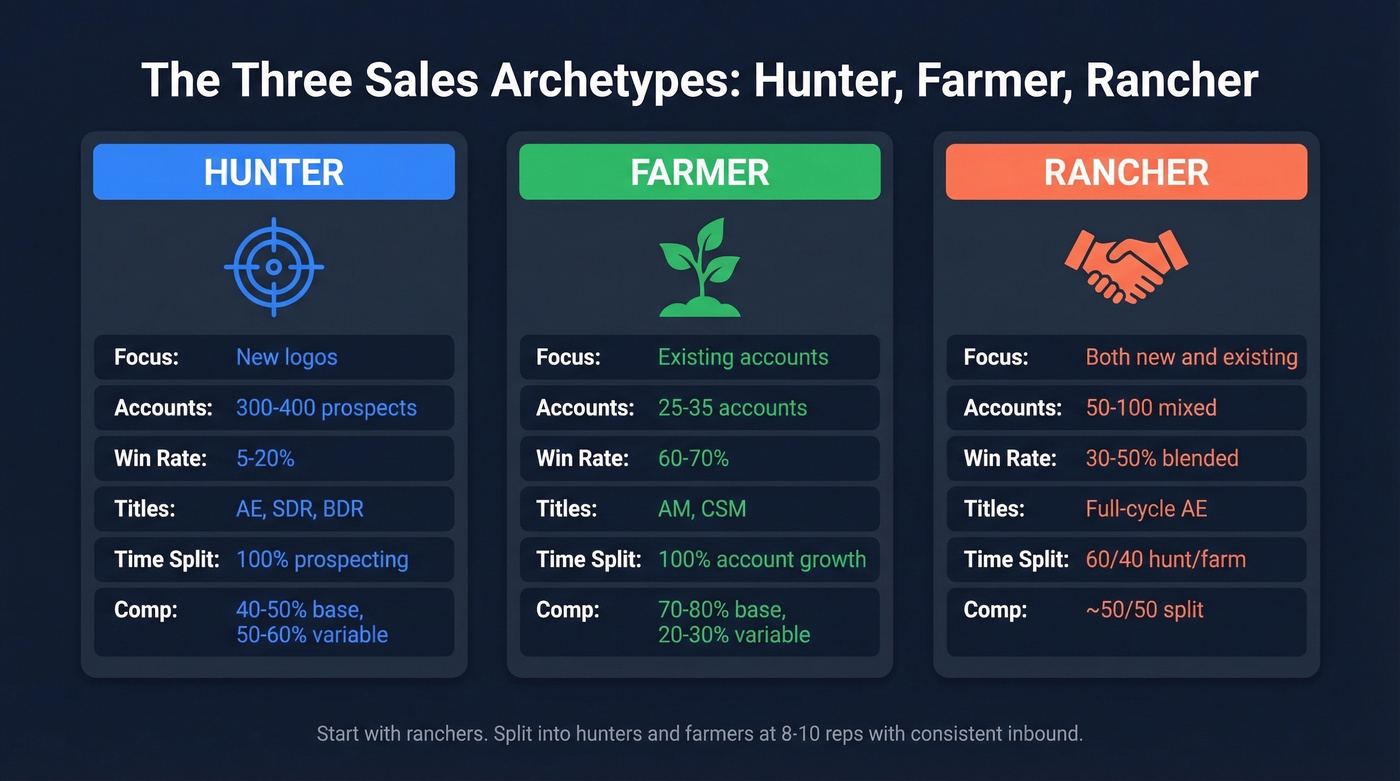
What's more useful is understanding the spectrum. There's a third archetype most articles skip: the rancher. This is the full-cycle rep who both hunts and farms - the default role at most companies under 10 reps. Ranchers are pragmatic. They close new deals and grow existing ones, typically splitting time roughly 60/40 between hunting and farming.
| Dimension | Hunter | Farmer | Rancher (Hybrid) |
|---|---|---|---|
| Focus | New logos | Existing accounts | Both |
| Account load | 300-400 prospects | 25-35 accounts | 50-100 mixed |
| Win rate | 5-20% | 60-70% | 30-50% blended |
| Typical titles | AE, SDR, BDR | AM, CSM | Full-cycle AE |
| Time split | 100% prospecting | 100% account growth | ~60/40 hunt/farm |
At the enterprise end, the role looks completely different. Pure enterprise farmers manage just 10 marquee accounts with $500K-$1M deal sizes and 9+ month expansion cycles. That's a different universe from the SMB farmer juggling 35 accounts. The role scales with deal complexity, not just headcount - and enterprise farmers often earn more than hunters at the same company because the revenue they protect and grow is so concentrated.
Why Farming Beats Hunting
The economics aren't subtle. Acquiring a new customer costs 8-10x more than retaining an existing one. TSIA's overall average puts new-business win rates around 1 in 3; in competitive multi-vendor deals, Venturise puts it at 5-20%.
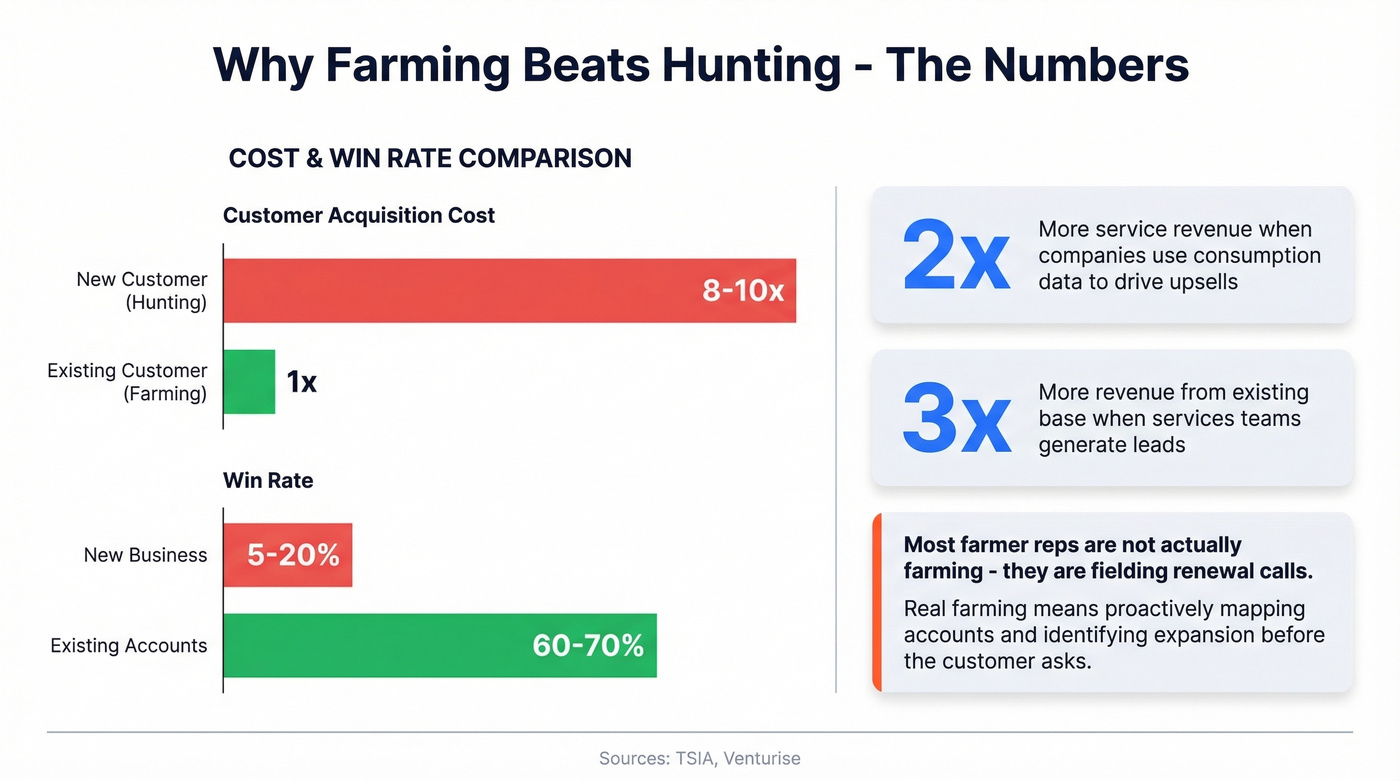
Existing-customer win rates land in the 60-70% range. That's not a marginal difference - it's a fundamentally different sales motion, one where trust already exists, switching costs work in your favor, and the buyer has firsthand evidence that your product delivers.
TSIA's research goes further: companies that use consumption and usage data to drive upsell and cross-sell motions see service revenue more than double compared to those that don't. Companies that use services teams for lead generation pull nearly 3x more revenue from their existing base.
Here's the contrarian take, though. Most "farmer" reps aren't actually farming. They're fielding renewal calls and responding to inbound requests. That's not farming - that's customer service with a quota. Real farming means proactively mapping accounts, identifying expansion opportunities before the customer asks, and building relationships two levels deep. The gap between reactive account management and genuine farming is where most of the revenue gets left on the table.
If your average deal size sits below $10K, you probably don't need a dedicated farmer role at all. The economics of specialization only work when the accounts are big enough to justify the overhead. Below that threshold, ranchers with clear time-split expectations will outperform a fragmented team every time.
When to Split vs. Blend
Split into hunters and farmers when:
- New-logo acquisition is your primary growth driver
- You have consistent, high-volume qualified lead flow
- Your sales cycle is long enough that post-sale relationships need dedicated attention
- You've hit 8-10 reps and can afford specialization without creating coverage gaps
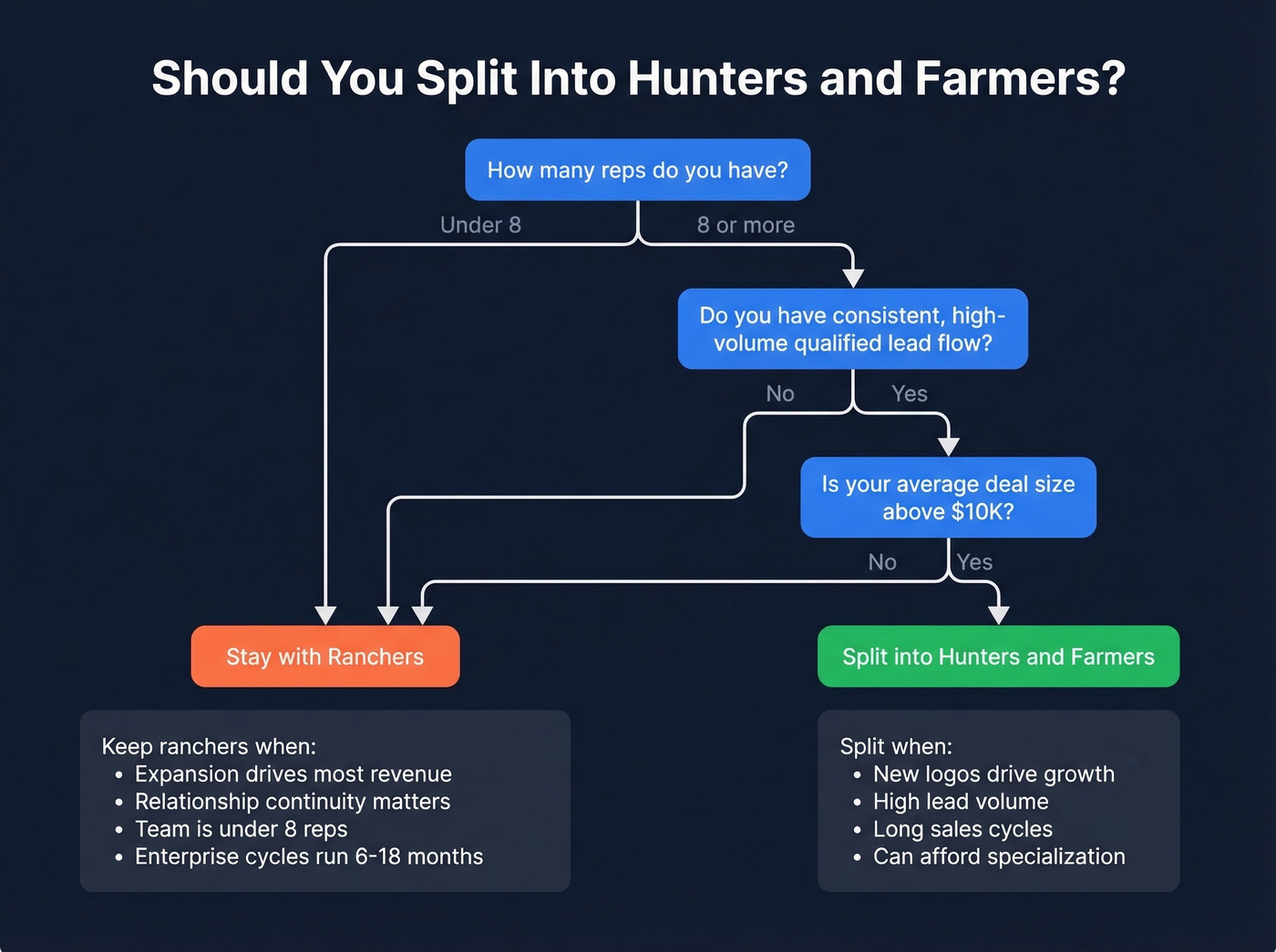
Keep ranchers when:
- Expansion and retention drive most of your revenue
- Relationship continuity matters more than specialization
- Your team is under 8 reps and can't afford role fragmentation
- Enterprise deal cycles run 6-18 months and splitting relationships mid-cycle would destroy trust
The Venturise framework nails the core tension: handoffs can diminish trust, especially early in the relationship. A "trust gap" becomes a "growth gap" when the farmer inherits an account before the hunter has fully delivered on the initial promise.
The practitioner pain point is real, too. We've seen hybrid reps default to whichever motion feels more comfortable. Hunters-turned-ranchers neglect their existing book. Farmers-turned-ranchers avoid cold outreach. The consensus on r/sales mirrors this - management pressure to move to "hybrid with a bias" is risky because reps chase low-hanging fruit aligned to their preference. If you're going to run hybrids, you need explicit time-split expectations and coaching that holds reps accountable to both motions.

Farming accounts means mapping org charts and spotting expansion signals before the customer asks. Prospeo's 300M+ profiles with 30+ filters - including department headcount, job changes, and buyer intent - let your farmers identify every stakeholder and growth opportunity inside their book.
Stop farming blind. See every buyer in every account.
Compensation for Hunters vs. Farmers
Compensation is where the hunter/farmer distinction gets real. Get the comp plan wrong and your farmers will sandbag renewals, your hunters will cherry-pick expansion deals, and everyone will be frustrated.
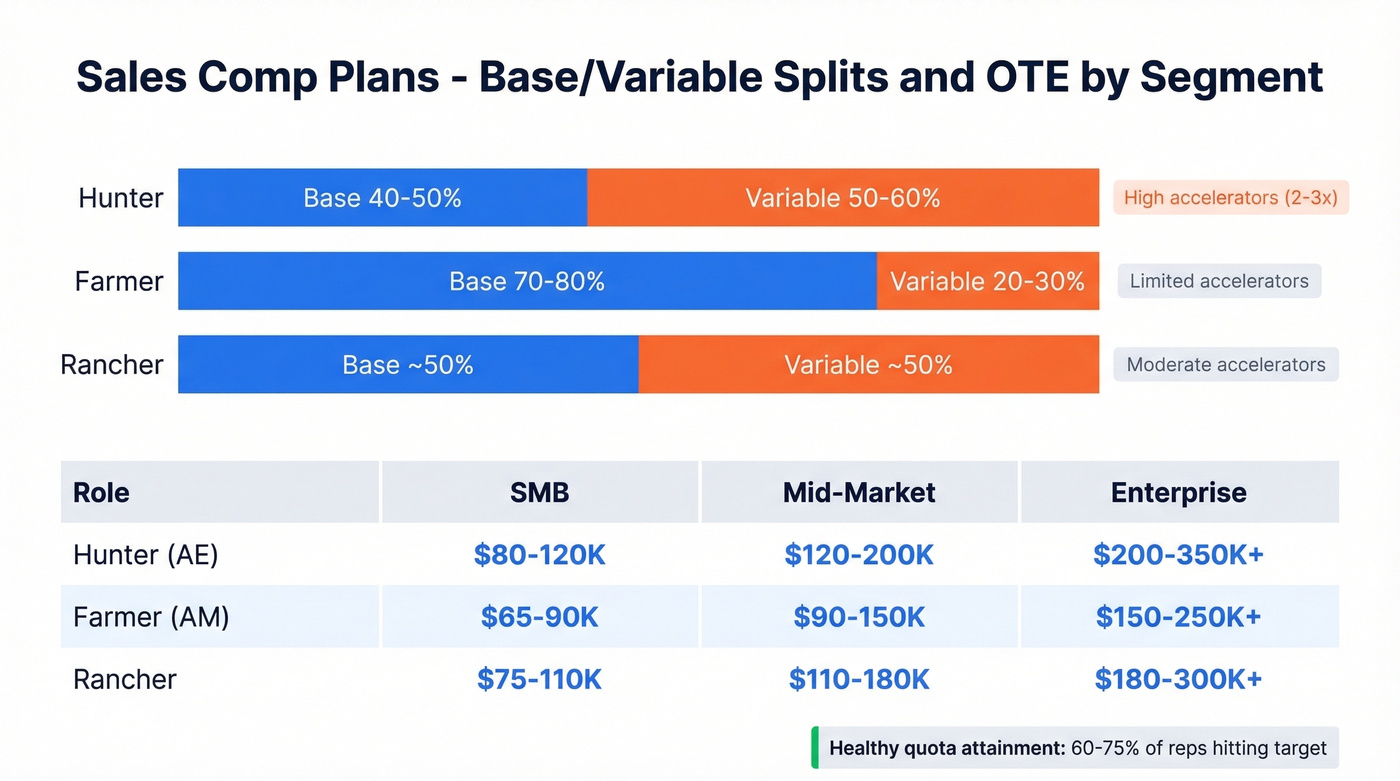
Wilson Group's guidance puts farmer comp at 80% base / 20% incentive with limited accelerators, while hunters sit at 40% base / 60% incentive with significant upside leverage. HR Professionals Magazine lands slightly differently - 70/30 for farmers, 50/50 for hunters - but the directional logic is the same: farmers get stability, hunters get upside.
| Role | Base/Variable Split | Accelerator Leverage |
|---|---|---|
| Hunter | 40-50% / 50-60% | High (2-3x target incentive) |
| Farmer | 70-80% / 20-30% | Limited |
| Rancher | ~50/50 | Moderate |
The rancher comp plan is trickier. One practitioner framework from a Substack deep-dive breaks it down: 15% commission on new business, 8% on expansions, 10% on renewals, plus a bonus for maintaining >90% retention. That layered structure forces ranchers to care about both motions instead of optimizing for whichever pays best.
OTE ranges vary by segment:
| Role | SMB | Mid-Market | Enterprise |
|---|---|---|---|
| Hunter (AE) | $80-120K | $120-200K | $200-350K+ |
| Farmer (AM) | $65-90K | $90-150K | $150-250K+ |
| Rancher | $75-110K | $110-180K | $180-300K+ |
A few comp design principles worth internalizing. First, 60-75% of reps should be hitting quota - fewer than 60% means quotas are too high, 100% means they're too low. Second, accelerators for hunters should be aggressive at 2x or 3x target incentive for overperformance. Farmers get more modest accelerators because the revenue is more predictable.
Here's the thing: the biggest comp mistake isn't getting the percentages wrong. It's using a one-size-fits-all plan for roles that have fundamentally different risk profiles. A hunter who misses quota might earn 40% of their OTE. A farmer who misses should still earn 70%+. If both roles carry the same downside risk, you'll never retain good farmers.
The Hunter-to-Farmer Handoff
Your best AE just closed a six-figure deal. The customer is excited. The champion is engaged. Now what?
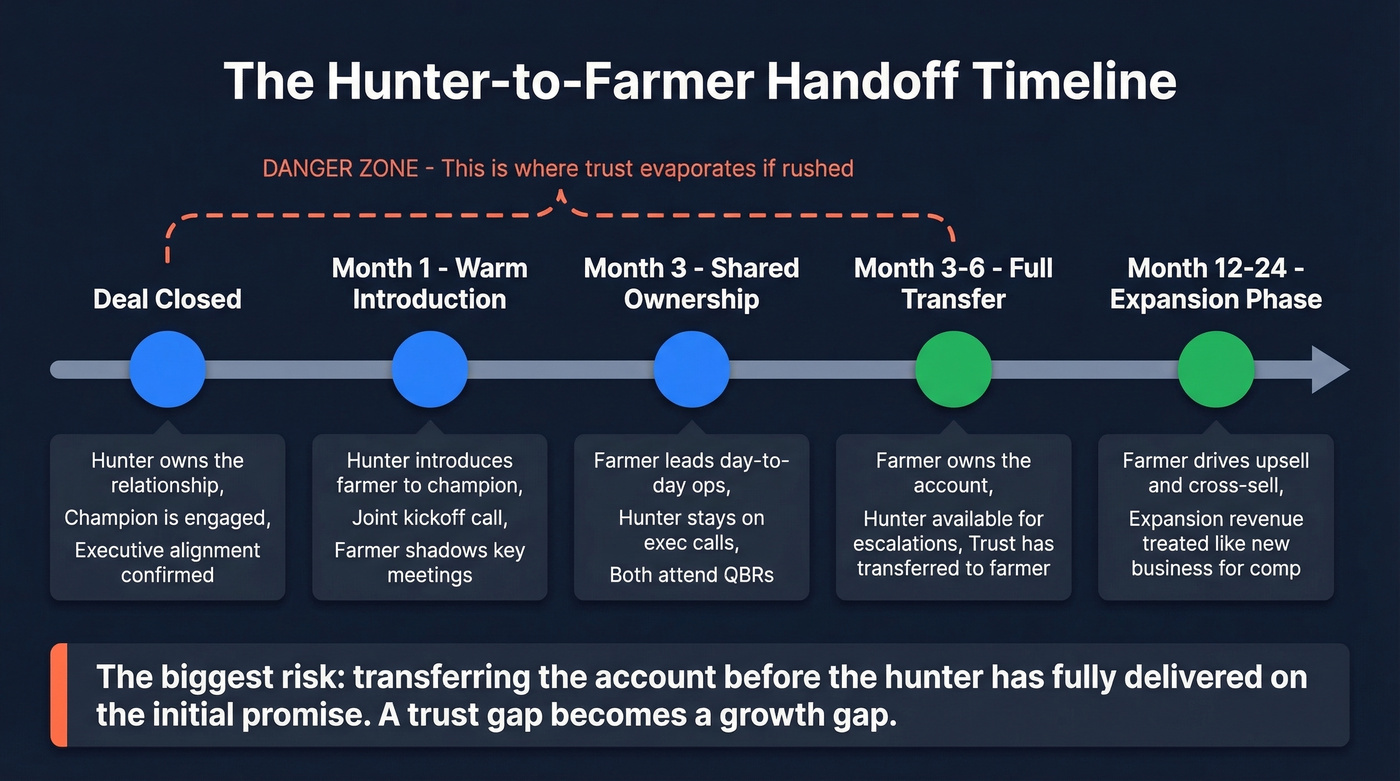
This is the moment most companies fumble. The handoff from hunter to farmer is where trust either transfers or evaporates. Wilson Group recommends the transition happen 3-6 months after contract signing, once the day-to-day relationship naturally shifts from executive-level conversations to operational implementation. In some models - especially when the first deal is small and expansion is expected - hunter and farmer share the account for 12-24 months, with expansion revenue valued and paid like new business during that period.
The trust gap mechanism is straightforward. The hunter built the relationship at the executive level. The farmer typically operates one level down. Wilson Group calls this the "two levels" principle - a seller can only span two levels in a client's hierarchy effectively. When the handoff happens too early, before the customer has seen real value, the farmer inherits skepticism instead of trust.
A handoff checklist that actually works:
- Warm introduction meeting with hunter, farmer, and customer champion - never a cold email handoff
- Shared document covering deal context, stakeholder map, promised outcomes, and known risks
- 30-day overlap where the hunter stays available for escalations
- Clear ownership date communicated to the customer in advance
- First farmer-led meeting focused on listening, not pitching expansion
- Hunter comp protection on the account for 3-6 months post-handoff
The worst version of this? An automated email that says "Hi, I'm your new Account Manager." We've watched that destroy six-figure relationships in a week.
The Farmer's Expansion Playbook
Your VP just told you to "farm your book" - but also gave you a new-logo quota. Welcome to the rancher's dilemma. Even dedicated farmers face a version of this: the pressure to grow accounts without a clear playbook for how.
Three habits separate top-performing farmers from the ones who just process renewals.
1. Prospect your own accounts. Most farmers only talk to their primary contact. Org mapping is the single highest-leverage activity in account expansion. Watch for executive changes, new department heads, and team restructures. Use targeted outreach that references your existing internal relationship - "I work with Sarah's team on X, and I noticed your group is tackling Y."
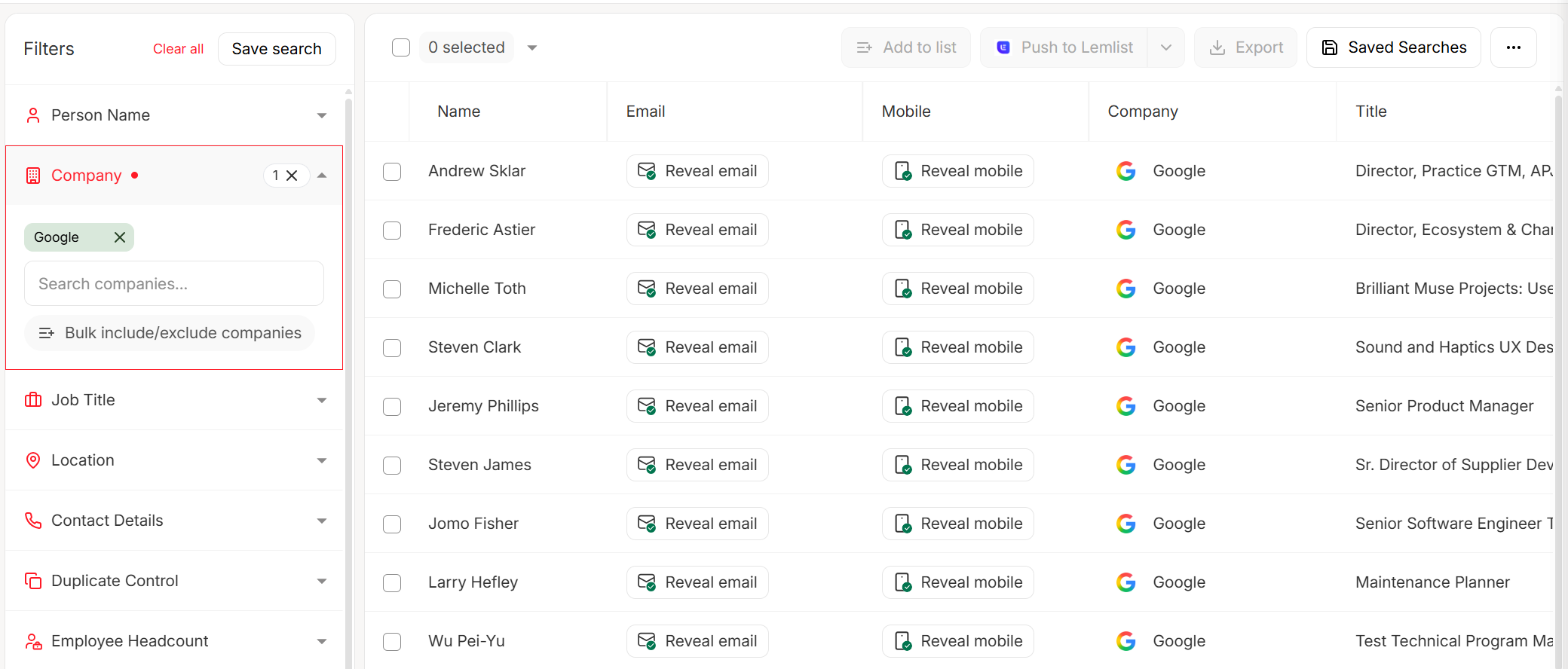
Stale CRM data kills this motion. If your contact records are two years old, you're mapping an org chart that doesn't exist anymore. Prospeo's 7-day refresh cycle fixes this - paste a company URL, get verified contacts in seconds, and see who's actually in the building today.
2. Run expansion discovery. Renewing at 100% isn't the target. The target is to grow the customer base. Ask about bottlenecks, upcoming initiatives, and quarterly pressure. Position expansion as measurable outcomes and risk reduction, not "would you like to buy more?"
3. Systematize referrals. Ask right after a measurable win - not during onboarding, not at renewal. Provide a draft intro message to make it easy. Most farmers ask for referrals zero times per quarter. Top performers ask after every success milestone.
Timing matters for all three plays. SolidGrowth's expansion framework identifies three natural trigger points: renewal periods, usage milestones, and moments when customers naturally need more. Build upsell ladders that map to these triggers rather than pushing expansion on an arbitrary quarterly cadence.
Measuring Farmer Performance
Measuring farmers with hunter metrics is like grading a goalkeeper on goals scored. The inputs and outputs are fundamentally different.
The Center for Sales Strategy breaks it down cleanly:
| Hunter KPIs | Farmer KPIs |
|---|---|
| New leads generated | Retention rate / GRR |
| Speed to initial contact | NRR / expansion revenue |
| Meetings scheduled | CSAT / NPS |
| Lead-to-discovery conversion | Upsell/cross-sell conversion |
| Closed-won rate | Referral rate |
| New pipeline created | Key account growth % |
The Brooks Group framework adds useful structure: organize farmer KPIs around four goals - retain customers, strengthen relationships, expand relationships, and grow revenue. Their operational guidance is sharp: if you set more than five KPIs, sellers won't know where to focus. Pick the five that matter most and ignore everything else.
For SaaS companies, NRR is the north star farmer metric. Top-performing SaaS companies run 110-130%+ NRR, meaning their existing customer base grows 10-30% annually before a single new logo is added. If your NRR is below 100%, your farmers aren't farming - they're just slowing down churn.
Pipeline coverage ratios for expansion should run 3-5x, lower than the 4-6x typical for new business because expansion deals are higher-probability and shorter-cycle. Upsell/cross-sell conversion rates typically land in the 20-35% range for well-run teams - significantly higher than new-business conversion but not automatic.
Mistakes That Kill Performance
Five patterns destroy farmer effectiveness, and most of them look like "doing the job" from the outside.
Communication overload. More touchpoints isn't better. Bombarding accounts with check-in emails and "just wanted to see how things are going" messages makes you look aimless, not attentive. Communicate when you have insight, value, or a genuine reason to connect.
Pushy upselling. If every conversation steers toward "have you considered our enterprise tier?", you're not creating value - you're selling. Tie upsell to customer benefit and natural expansion moments, not your quarterly quota deadline.
Short-term thinking. Great farmers plan around their customer's seasonality. If your biggest account does annual budgeting in October, your expansion pitch in November is dead on arrival.
Overpromising. Every unmet expectation erodes the trust your hunter worked months to build. Under-promise on timelines, over-deliver on outcomes.
Going silent. The opposite of communication overload - disappearing for weeks. If your farmers only talk to accounts when the customer initiates, they're not farming. They're waiting. Let's be honest: if your farmers are just fielding renewal calls, they're customer service reps with a fancier title.
Tools for the Farming Motion
Farmers don't need a massive tech stack. They need three categories of tools that work together.
CRM. Salesforce (from ~$25/user/mo) or HubSpot (free CRM, Sales Hub from ~$20/user/mo) as the system of record. Every account interaction, stakeholder map, and expansion opportunity lives here. Non-negotiable.
Data enrichment. Prospeo keeps account contact data fresh for multi-threading and expansion prospecting. CRM and CSV enrichment returns 50+ data points per contact with a 92% API match rate, so your org charts stay current without manual research. The free tier gives you 75 emails/month - enough to test on your top accounts before committing. If you're comparing vendors, start with a shortlist of data enrichment services.
Account intelligence and CS platforms. Gainsight (enterprise pricing, typically $30-100K+/year) or lighter alternatives like Vitally (~$20-80/user/mo) or Totango (free tier available, paid plans start around a few thousand per year) for tracking health scores, usage patterns, and expansion signals. These platforms turn reactive account management into proactive farming by surfacing the signals that matter.
The stack doesn't need to be expensive. A farmer with a well-maintained CRM, fresh contact data, and basic health scoring will outperform one drowning in a dozen tools they never log into. Skip the fancy stuff until your team is actually using the basics daily.
The hunter-to-farmer handoff fails when contact data is stale. Prospeo refreshes every record on a 7-day cycle - not the 6-week industry average - so your farmers inherit accurate emails (98% verified) and direct dials (125M+ mobiles) from day one. No trust gaps from bounced emails.
Give your farmers data that's never more than a week old.
FAQ
What is a farmer in sales?
A farmer is a sales rep focused on growing revenue from existing accounts through retention, upselling, cross-selling, and expansion - typically managing 25-35 accounts with 60-70% win rates on expansion deals. Common titles include Account Manager, CSM, and Expansion AE.
What's the difference between a hunter and a farmer?
Hunters prospect and close new logos with win rates of 5-20% and earn 40-50% base with high upside. Farmers manage existing accounts, win 60-70% of expansion deals, and earn 70-80% base with limited accelerators. Most teams under 10 reps use ranchers who do both.
Is farming or hunting more effective?
Farming is more efficient - 8-10x cheaper and 3-4x higher win rates. But most companies need both motions. Early-stage companies lean hunter-heavy; mature companies shift toward farming as their install base grows and NRR becomes the primary growth lever.
How much do farmer reps earn?
Farmer OTE ranges from $65-90K at SMB to $150-250K+ at enterprise. Comp mix is typically 70-80% base / 20-30% variable. Enterprise farmers managing $500K+ accounts often out-earn hunters at the same company because the revenue they protect is so concentrated.
What tools help farmers expand accounts?
Three categories matter: a CRM like Salesforce or HubSpot for account tracking, a data enrichment tool like Prospeo for keeping org charts current, and a CS platform like Gainsight or Vitally for health scores and expansion signals.