

How to Build a Feedback Culture in Sales That Actually Works
Your best rep quit last quarter. In the exit interview, she said nobody ever told her where she stood. Not once in fourteen months. That's not a management failure - it's a feedback culture failure, and it's everywhere. Gallup's engagement data tells the story: 31% of U.S. employees are engaged, 51% are actively looking or watching for new jobs, and disengagement costs roughly $2 trillion in lost productivity annually. Sales teams aren't immune. They're often the worst offenders.
What You Need (Quick Version)
Building a coaching-first environment comes down to three things:
- Psychological safety - so reps actually listen instead of bracing for a PIP.
- A weekly 1:1 template - so feedback has a recurring home, not a random ambush.
- Clean data - so coaching conversations start from reality, not phantom pipeline.
Why Sales Teams Get Feedback Wrong
B2B reps forget 70% of what they learn within one week** and 87% within a month. Annual reviews don't stand a chance against that forgetting curve. They're performance theater - a compliance exercise that tells reps nothing they can act on tomorrow.
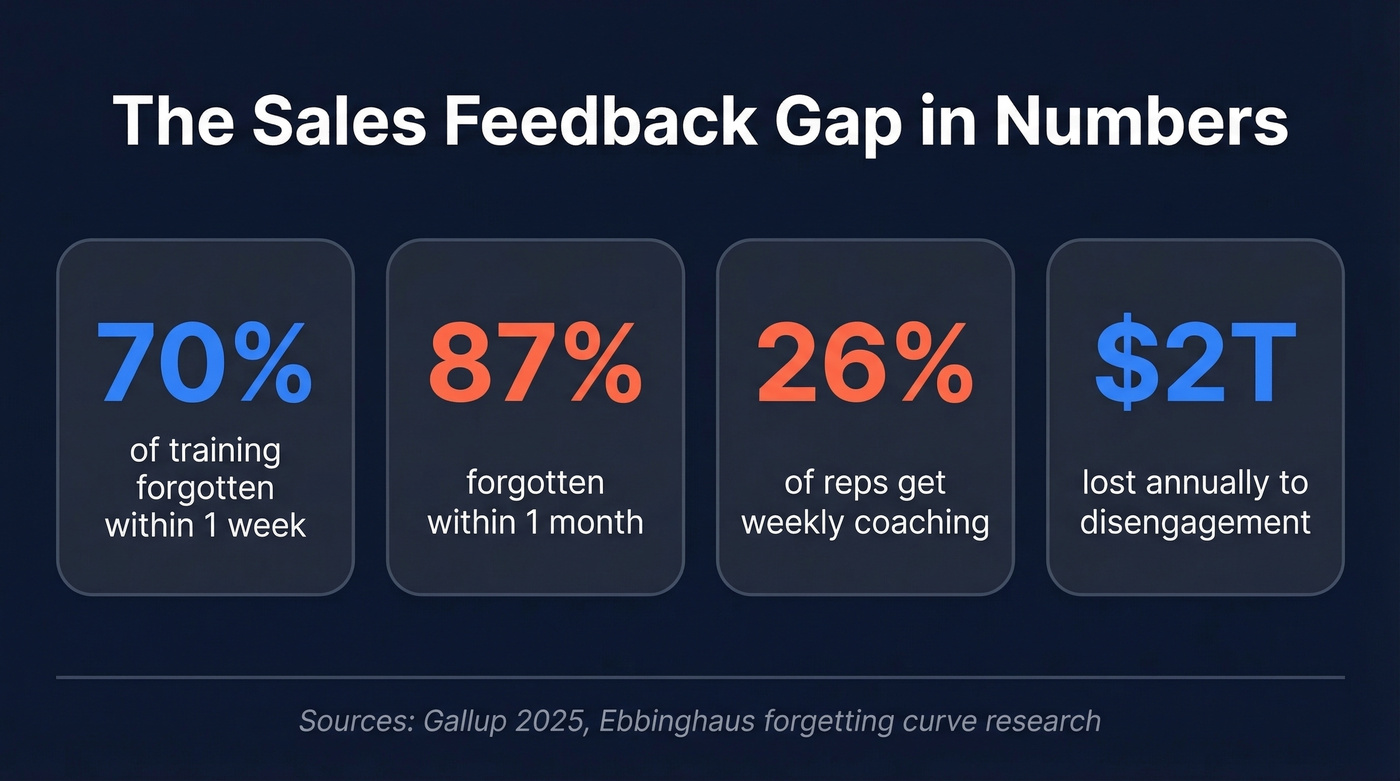
Only 26% of sales reps receive weekly coaching. The rest get sporadic drive-bys when a deal slips or a quarterly number looks ugly. That's crisis management, not a team feedback culture.
Here are the three anti-patterns we see most often:
Measuring activity over results. A rep making 80 calls a day with zero pipeline movement isn't productive - they're busy. Coaching on activity metrics alone misses the point entirely.
Assuming everyone works like you did. The manager who cold-called their way to President's Club in 2014 can't coach a rep running multi-threaded ABM sequences the same way. Different era, different playbook.
Tolerating toxic reps because they hit quota. One top performer who poisons team dynamics costs you more in attrition than their number is worth. We've watched this play out at three different companies we've worked with, and the math never favors keeping the brilliant jerk.
Here's the thing: if your team's average deal cycle is under 30 days, you probably don't need a $34K conversation intelligence platform. You need a manager who shows up to weekly 1:1s prepared. The cadence matters more than the tooling.
Stop Calling It "Feedback"
The word itself is broken. Most reps hear "feedback" and immediately brace for criticism. Keith Rosen argues persuasively that the entire concept triggers defensiveness before you've said a word. And skip the feedback sandwich - alternating praise-criticism-praise just teaches reps to tune out the middle.
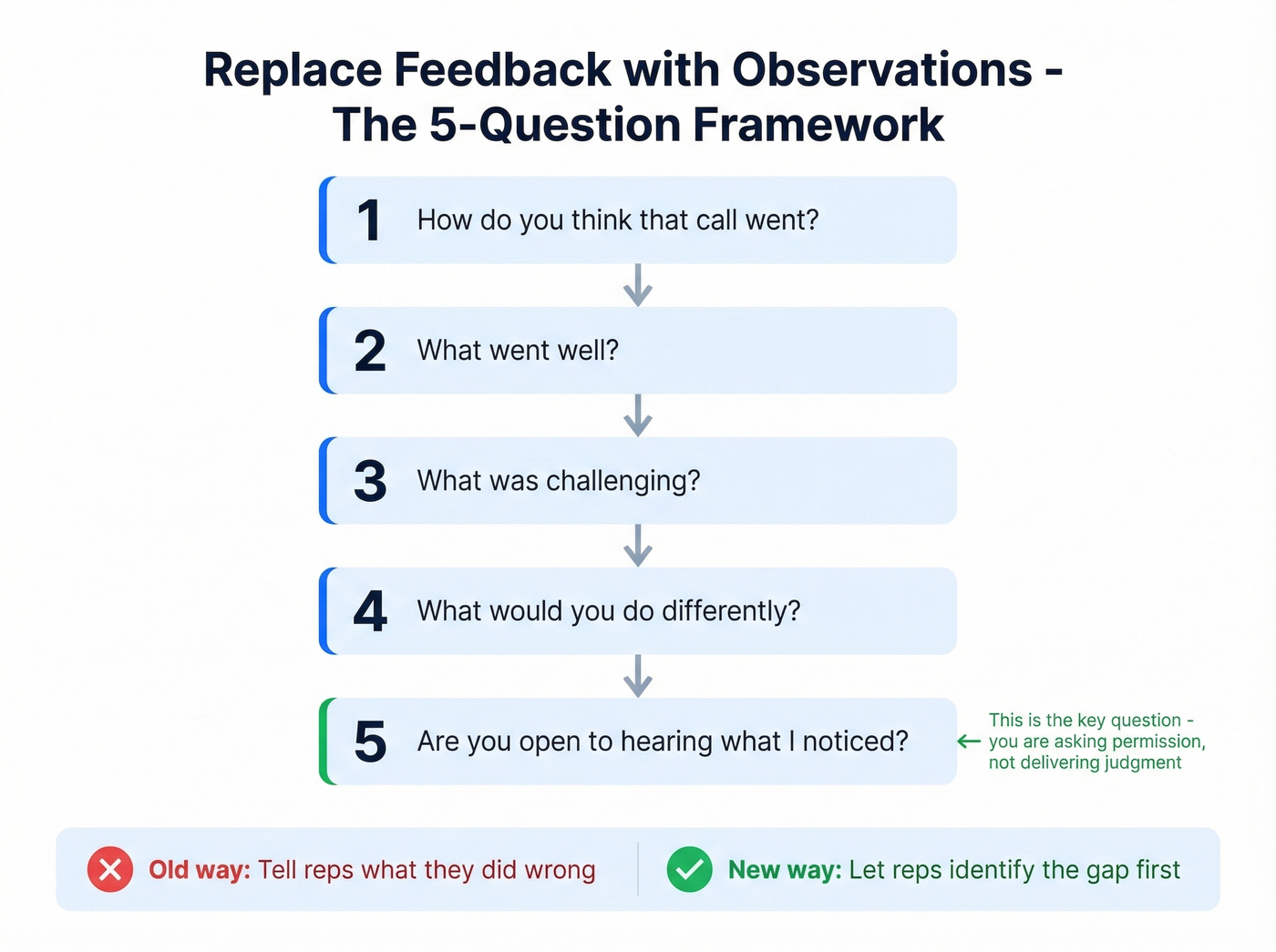
His reframe: replace "feedback" with "observations" or "things I noticed." Before you share anything, ask five questions:
- How do you think that call went?
- What went well?
- What was challenging?
- What would you do differently?
- Are you open to hearing what I noticed?
That last question does the heavy lifting. You're asking permission, stating positive intent, and letting the rep identify the gap first. Nine times out of ten, they'll name the same issue you were going to raise - and now it's their insight, not your criticism. This shift from telling to asking is the foundation of a coaching-first sales culture, and it costs nothing to implement.
Psychological Safety First
Amy Edmondson defined psychological safety as a shared belief that the team is safe for interpersonal risk-taking. Google's Project Aristotle identified it as the single most important factor in team effectiveness. Not talent. Not tools. Safety.
Run through this quick diagnostic:
- Reps go silent in pipeline reviews instead of flagging risk.
- Nobody volunteers for roleplay - ever.
- Post-mortems on lost deals turn into blame sessions or get skipped entirely.
- PIPs are perceived as a termination path, not a development tool.
- Reps who surface bad news get punished, so they stop surfacing it.
If three or more sound familiar, you don't have a feedback problem. You have a safety problem. No template fixes that - only consistent leadership behavior does. Model vulnerability. Admit your own mistakes publicly. Respond to bad news with curiosity, not frustration. I once watched a VP respond to a lost $400K deal by asking the rep, "What did we learn that changes how we run the next one?" - and the entire room exhaled. That's what safety looks like in practice.

Your weekly 1:1 is only as good as the data behind it. Coaching on stale contacts and phantom pipeline wastes everyone's time. Prospeo enriches your CRM with 50+ data points per contact at a 92% match rate - refreshed every 7 days, not every 6 weeks.
Stop coaching on dead leads. Start coaching on verified pipeline.
Your Weekly Coaching Cadence
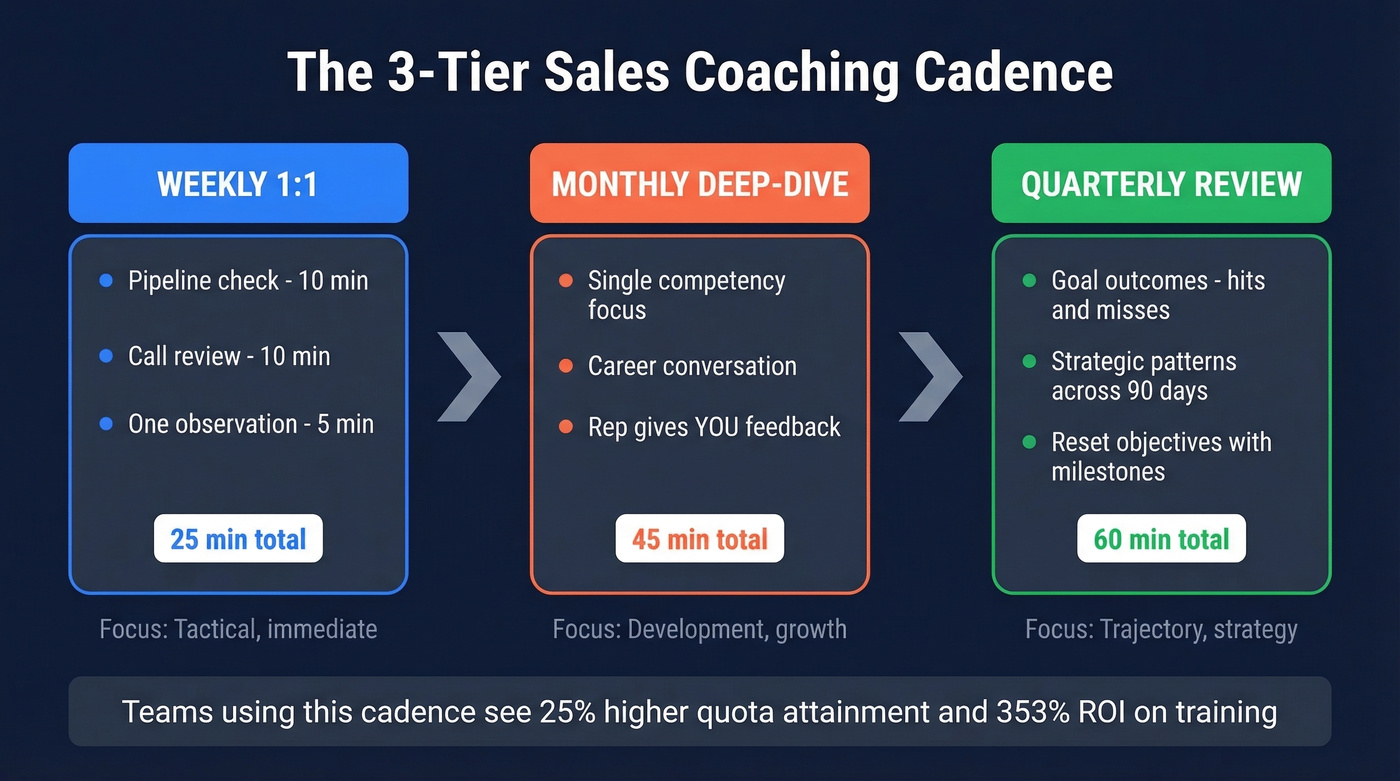
Consistency beats intensity. Teams that pair training with reinforcement and coaching see 25% higher quota attainment and a 353% ROI on training investment. The cadence below gives feedback a recurring home at three escalating levels of depth.
Weekly 1:1 Template
25 minutes. Every week. Non-negotiable.
Pipeline check (10 min): Pull the Salesforce dashboard before the meeting and link it in the calendar invite. Verify target account contacts through Prospeo's enrichment so you're coaching on live data, not stale records that expired three weeks ago.
Call review (10 min): Pick one call. Listen to a 2-minute clip together. Ask the self-assessment questions before sharing your observation.
One observation (5 min): One thing. Not three. One specific, actionable observation with an example. "On the Acme call, you jumped to pricing before confirming their timeline. Next time, anchor the budget conversation after you've mapped the decision process."
Monthly Deep-Dive
Once a month, replace the standard 1:1 with a 45-minute session focused on development. Pick one competency - discovery, objection handling, multi-threading - and review progress over the past four weeks. This is also where career conversations happen. Ask where the rep wants to be in 12 months and what skills bridge the gap. In our experience, the monthly deep-dive is where reps actually open up about their trajectory, because the longer format signals that you care about more than this quarter's number. End with a feedback exchange: the rep gives you feedback too. If they can't think of anything, safety is still too low.
Quarterly Review
| Element | Focus |
|---|---|
| Goal outcomes | What hit, what missed, and why |
| Strategic patterns | Themes across the quarter, not individual call notes |
| Forward objectives | Reset goals for the next 90 days with measurable milestones |
Duration: 60 minutes. The quarterly review zooms out - it's the only session where you discuss trajectory rather than tactics.
The key to making all three stick: assign prep ownership. Reps own their pipeline updates and self-assessments. Managers own the data pull and the observation. When both sides show up prepared, a 25-minute weekly 1:1 delivers more value than a 90-minute quarterly review ever could.
Peer and Upward Feedback
Manager-to-rep feedback is only one channel. Employees who receive meaningful peer feedback are 3.6x more likely to be engaged. That's too big a multiplier to ignore.
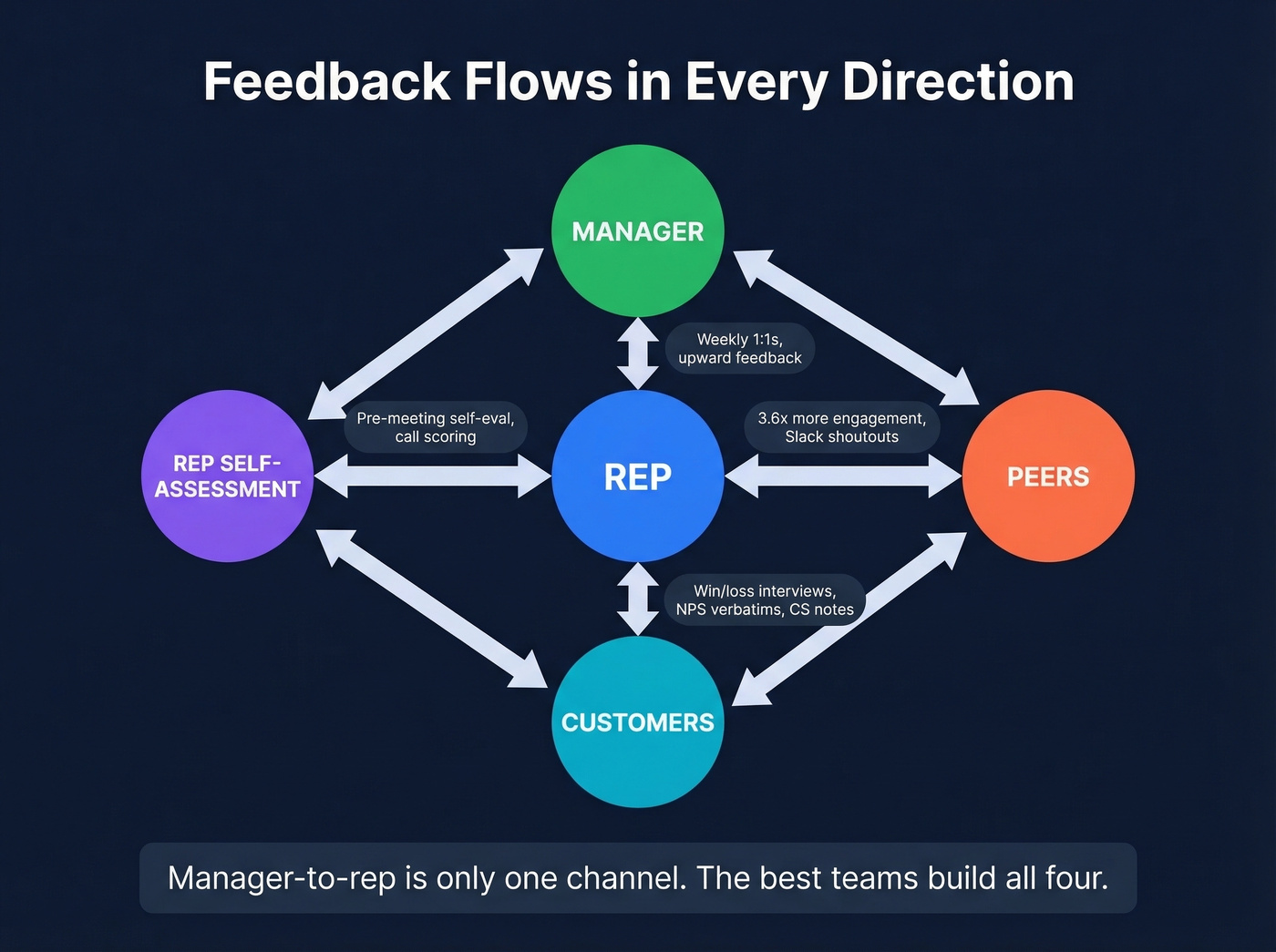
Don't overlook customer feedback either. Win/loss interviews, NPS verbatims, and CS escalation notes all contain coaching gold that never makes it into a 1:1. Route them there. One team we've worked with runs a Friday Slack channel where reps post peer shoutouts - specific, behavioral, tied to a moment. It took two weeks to catch on and now it's the most active channel on their workspace.
Ask any sales manager on r/sales what kills their coaching cadence and you'll hear the same answer: "Pipeline reviews eat the whole 1:1 and there's no time left for development." That's a design problem, not a time problem. The template above solves it by capping pipeline at 10 minutes.
A few peer feedback examples worth stealing:
- "Your discovery questions on the Datacom call surfaced a pain point none of us had mapped. That changed our positioning for the whole account."
- "I've noticed you tend to go quiet in team pipeline reviews. Your deals are strong - the team would benefit from hearing your approach."
- "The way you handled the pricing objection on Thursday was sharp. Would you walk through your framework in our next team meeting?"
Technology That Supports Coaching
Conversation intelligence started as call recording. Now tools like Gong call themselves "revenue intelligence platforms" - but the core value for coaching hasn't changed much: turn call data into insights, then act on those insights in 1:1s. Most teams hit an insight-to-action gap where the tool surfaces a pattern but nobody changes the coaching playbook to address it.
Conversation Intelligence Tools
| Tool | Annual Cost | Best For | Watch Out |
|---|---|---|---|
| Gong | ~$1,440/user + $5K platform | Mid-market+ teams with 20+ reps | ~$34K/yr for a 20-seat team |
| Clari | ~$1,200-1,500/user | Forecasting + CI combo | Custom quotes only |
| Chorus | ~$1,200-1,560/user | ZoomInfo ecosystem shops | Development has stagnated since the 2022 acquisition |
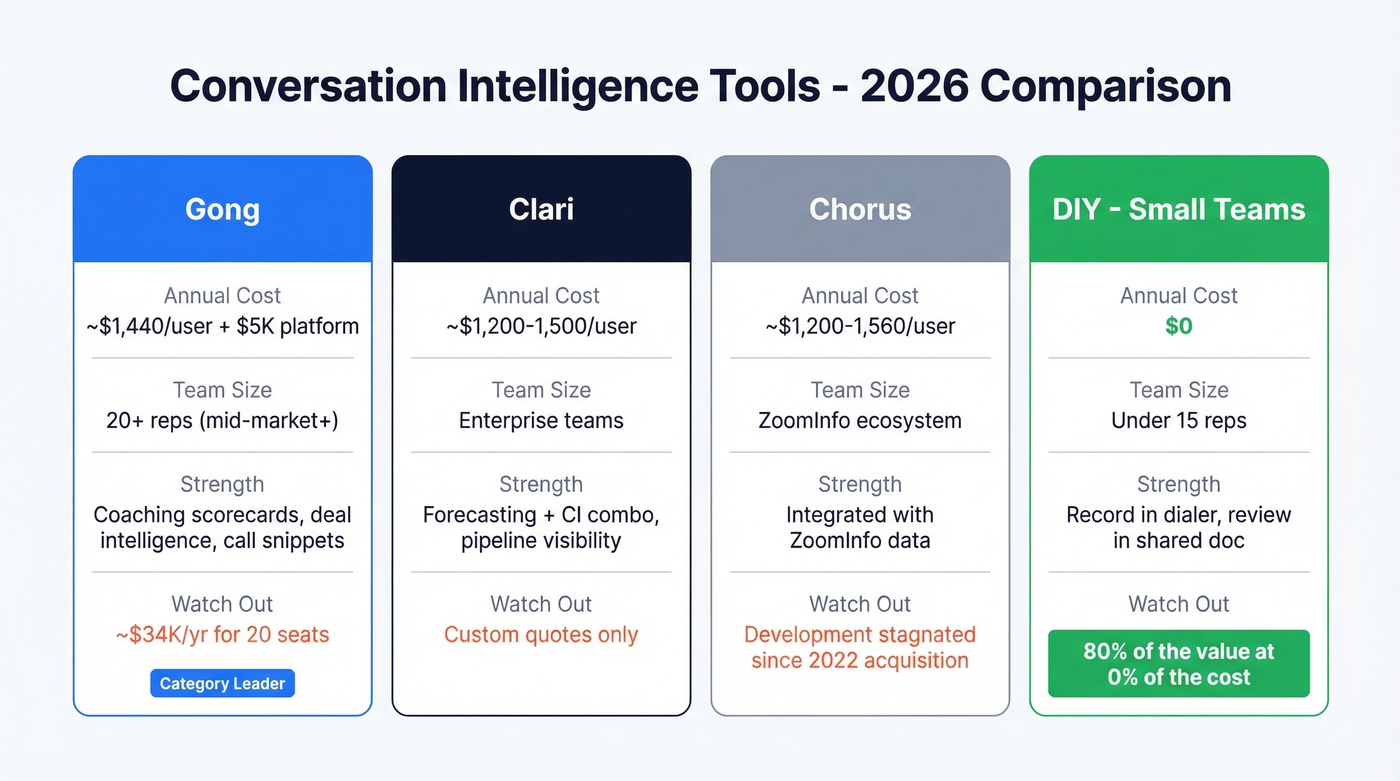
Gong is the category leader - its coaching scorecards and deal intelligence are genuinely useful for managers running weekly 1:1s, and the call snippet sharing makes it easy to prep observations before a meeting. Clari is stronger on forecasting than pure call coaching, making it a better fit if pipeline visibility is your bigger problem. Chorus is harder to recommend in 2026; development has visibly slowed since ZoomInfo acquired it.
For smaller teams, skip the five-figure contract. Record calls in your dialer and review them in a shared doc. You'll get 80% of the value at 0% of the cost.
The Data Quality Layer
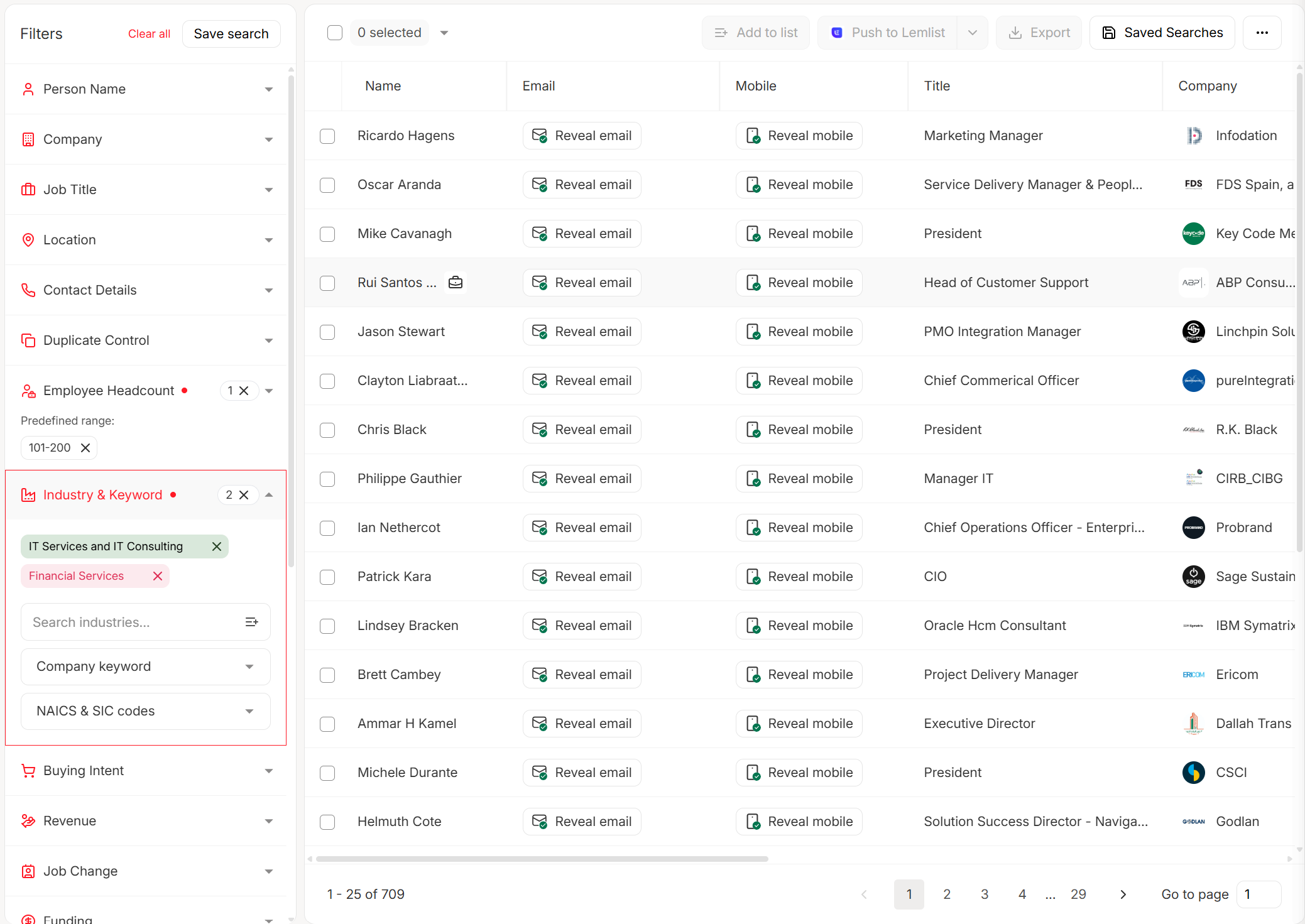
Let's be honest: the best coaching cadence in the world breaks down when reps are calling disconnected numbers and emailing bounced addresses. Data quality is the invisible foundation underneath every CI tool and CRM dashboard. Prospeo handles this with 98% email accuracy, a 7-day refresh cycle, and 125M+ verified mobile numbers. GreyScout cut rep ramp time from 8-10 weeks to 4 weeks after switching - partly because new reps weren't wasting their first month chasing dead contacts. At roughly $0.01 per email with a free tier of 75 emails/month, it's the cheapest layer in your coaching stack and the most foundational.
If you're trying to fix deliverability at the source, start by tracking your email bounce rate and cleaning lists before they hit sequences.
You just read that reps forget 87% of training within a month. Don't let bad data compound the problem. When managers prep 1:1s with 98% accurate emails and verified contacts, coaching conversations focus on skill gaps - not data cleanup.
Give your managers clean data so they can actually coach.
Is Your Feedback Culture Broken?
Answer honestly. If you check fewer than five, you've got work to do.
- Do reps hear genuinely new information in annual reviews? (If yes, your weekly cadence is failing.)
- Do reps volunteer for roleplay without being asked?
- Can every rep name one specific skill they're developing this quarter?
- Do 1:1s still happen when pipeline is healthy - or only when deals slip?
- Has a rep given you feedback in the last 30 days?
- Do you know your team's email bounce rate?
- Are post-mortems on lost deals blame-free?
- Could a new manager run your 1:1 from a documented template?
Most sales orgs check two or three. That's not a disaster - it's a starting point. Pick the weakest area, build the ritual, and protect it for 90 days before adding complexity. We've seen teams transform their feedback culture in a single quarter just by protecting the weekly 1:1.
FAQ
How often should sales managers give feedback?
Weekly at minimum. Weekly coaching drives 25% higher quota attainment compared to less frequent cadences. Monthly and quarterly sessions supplement the rhythm but don't replace it.
What's the difference between feedback and coaching?
A feedback-driven approach focuses on sharing observations - telling reps what you noticed. A coaching culture focuses on development through questioning and skill-building. The best teams blend both, using observations to spark coaching conversations rather than treating them as separate activities.
How do you coach a defensive rep?
Start with a self-assessment question: "How do you think that call went?" Let them identify the gap first. If they're consistently defensive after multiple attempts, psychological safety is the root issue - not your delivery technique.
What tools help build a feedback culture in sales?
Conversation intelligence tools like Gong and Clari provide call-level coaching data. CRM dashboards power data-driven 1:1s. For the data quality layer, tools like Prospeo keep pipeline contacts verified so coaching sessions start from real numbers. The tools matter less than the cadence - protect the weekly 1:1 first.
How long does it take to see results?
Expect 2-3 months before new rituals feel natural and 6+ months before you see measurable engagement shifts. Start with the weekly 1:1 template and protect it ruthlessly. A mediocre 1:1 that happens every week beats a brilliant one that gets canceled when pipeline looks healthy.