

How to Find Any Email Address - Free Methods, Best Tools, and the Truth About Accuracy
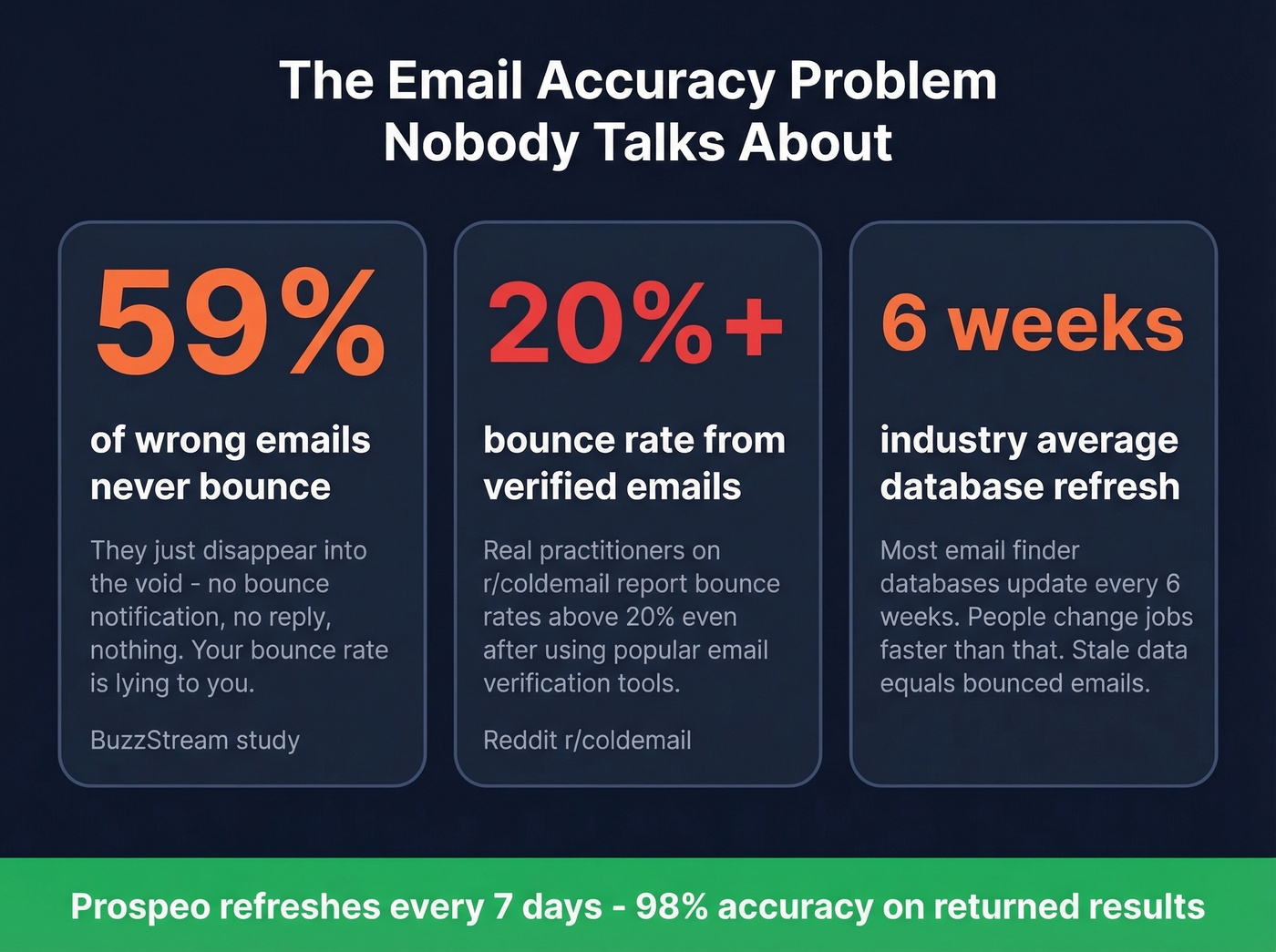
You just ran your first outbound sequence with 500 "verified" emails. Forty-seven bounced. Another hundred vanished into the void - no bounce, no reply, nothing. One practitioner on r/coldemail put it bluntly: their verified emails still produced a 20%+ bounce rate. The problem isn't that email finder tools don't work. It's that most of them define "work" very differently than you do.
What You Need (Quick Version)
Three paths, depending on your situation:
- Free and manual: Google search operators plus an email permutator will get you individual addresses without spending a dollar. Slow, but effective for one-off lookups.
- The stat to remember: 59% of wrong emails never bounce. They just disappear. Your bounce rate is lying to you.
If you're doing fewer than 25 lookups a month, start with free methods. If you're doing more, pay for a tool that verifies properly.
How Email Finders Actually Work
Every email finder runs roughly the same pipeline, regardless of how they market it.
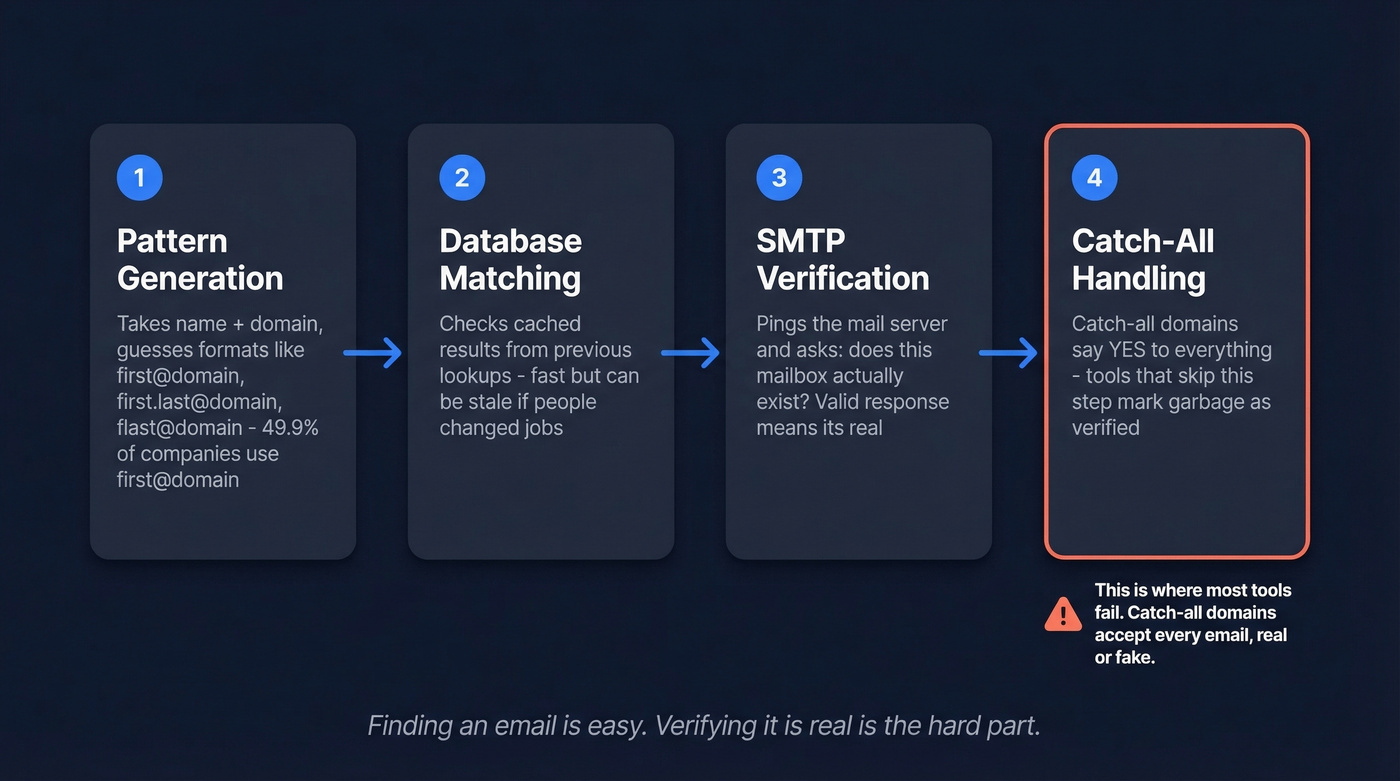
Step one: pattern generation. The tool takes a name and domain, then guesses the most likely format. Hunter analyzed 12M+ email addresses and found that 49.9% of companies use the first@domain pattern. So jane@acme.com is always the first guess. From there, it tries jane.doe@, jdoe@, j.doe@, and a dozen other permutations.
Step two: database matching. Most tools maintain a database of previously found emails. If someone already looked up Jane Doe at Acme, the cached result comes back instantly. Fast, but stale - people change jobs, companies change domains.
Step three: SMTP verification. The tool pings the mail server and asks, essentially, "Does this mailbox exist?" A valid server response means the address is real. An invalid response means it's dead.
Step four: catch-all handling. Here's where things break down. Catch-all domains accept every email sent to them, regardless of whether the specific mailbox exists. The server says "yes" to everything. Tools that don't handle catch-all domains will mark garbage addresses as "verified" - and you won't know until your deliverability tanks.
Finding an email is easy. Verifying it's real is the hard part.
5 Free Ways to Find an Email Address
Before you pay for anything, try these.
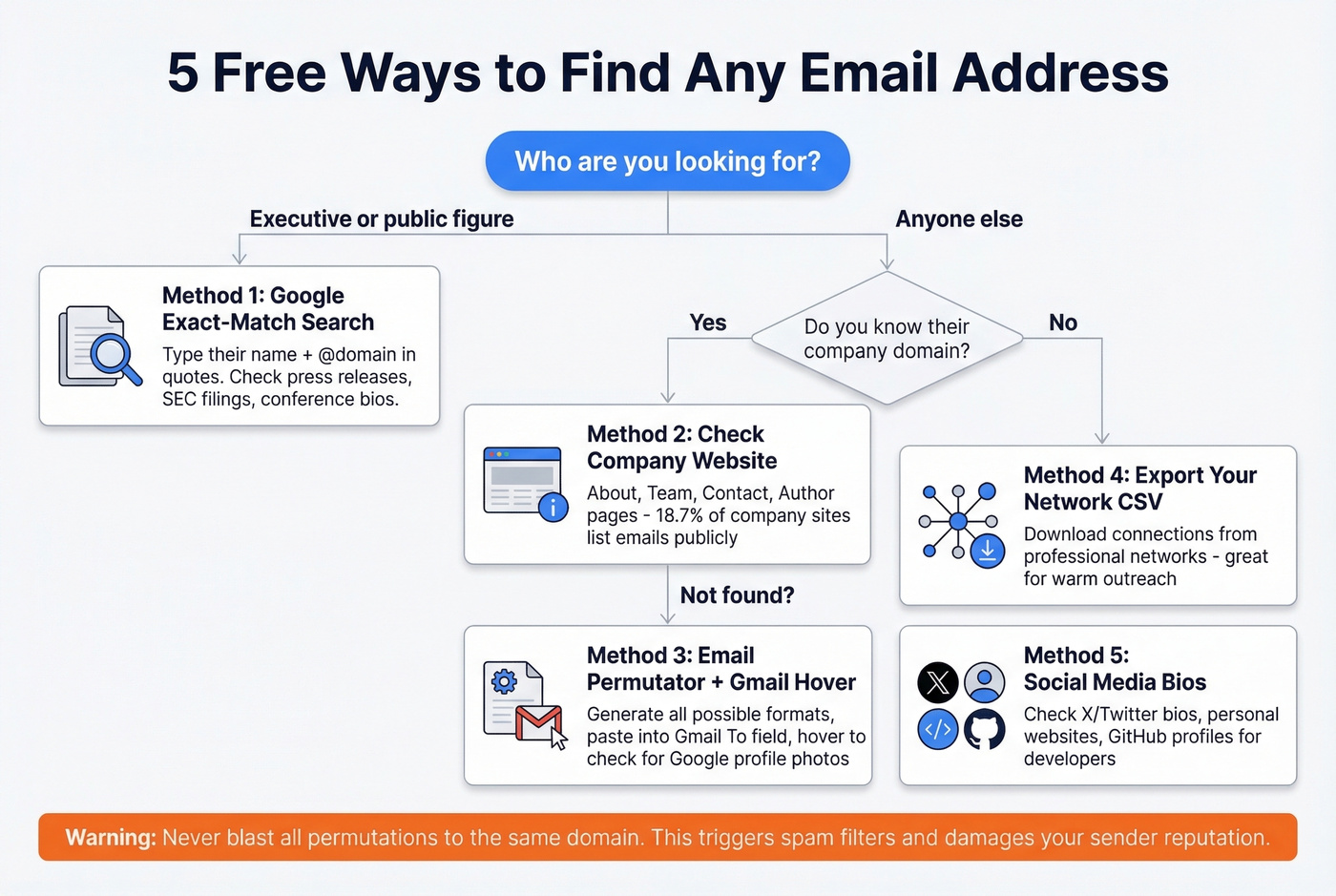
1. Google Exact-Match Search Operators
Type "jane doe" "@acme.com" into Google. Add site:acme.com to narrow results. You'd be surprised how often email addresses appear in press releases, SEC filings, conference speaker bios, and PDF documents indexed by Google. This works best for executives and public-facing roles.
2. Company Website About and Contact Pages
Hunter's analysis of 905,000 company websites found that 18.7% list at least one email address publicly. Check About, Team, Contact, and Author pages. Smaller companies are more likely to list direct emails than enterprise orgs.
3. Email Permutator + Gmail Hover Trick
Use a free permutator tool to generate every possible format for a name and domain. Then paste the top candidates into Gmail's "To" field and hover over each one. If a Google profile picture appears, that address is active. This only works reliably for Google Workspace accounts, but it's a solid free signal.
4. Export Your Professional Network Connections
Most professional networking platforms let you download your connections as a CSV, which often includes email addresses. This only works for people already in your network, but it's a goldmine for warm outreach - an easy way to surface addresses you already have implicit permission to use.
5. Social Media Bios and Contact Info
Check X/Twitter bios, personal websites linked from social profiles, and GitHub profiles for developers. Technical founders and creators often list their email publicly. If you're trying to track down a specific prospect, their personal site is often the fastest path.
One warning: don't blast all permutations to see what sticks. Sending to multiple guesses at the same domain will trigger spam filters and damage your sender reputation.

59% of wrong emails never bounce - they just vanish. Prospeo's 5-step verification with catch-all handling, spam-trap removal, and honeypot filtering ensures the emails you send actually reach real inboxes. 143M+ verified emails, 98% accuracy, refreshed every 7 days.
Start with 75 free verified emails and see the difference yourself.
Best Email Finder Tools in 2026
| Tool | Starting Price | Free Tier | Accuracy Signal | Best For |
|---|---|---|---|---|
| Hunter | $24/mo | 50 searches/mo | 89.6% quality | Simple lookups |
| Anymail Finder | $14/mo | 100 free credits | 77.5% verified | Pay-per-valid |
| Apollo | $49/user/mo | ~250/day | ~65-70% real | Free tier volume |
| RocketReach | $80/user/mo | 5 lookups/mo | 83% tested | Accuracy + phones |
| Snov.io | $30/mo | 50/mo | 20.1% verified | Budget workflows |
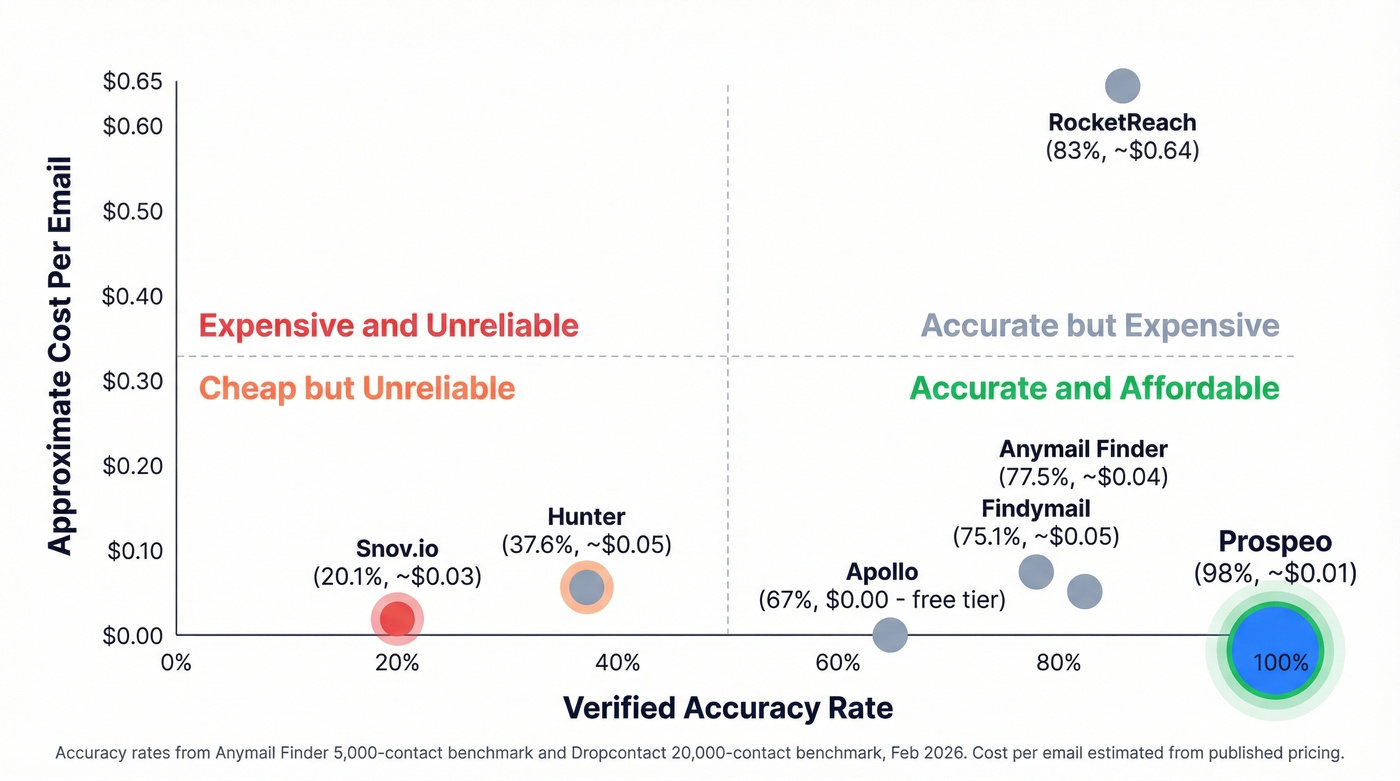
Prospeo
Use this if you care about deliverability more than anything else.
We've tested dozens of email finders over the years, and the difference comes down to what happens after the initial lookup. Prospeo runs a 5-step verification process with catch-all handling, spam-trap removal, and honeypot filtering - the infrastructure that prevents false positives from silently wrecking your sender reputation. The database covers 143M+ verified emails with a 98% accuracy rate on returned results, refreshed on a 7-day cycle. That refresh cadence matters: the industry average is six weeks, which means most databases are serving you stale data from people who've already changed jobs.
An important distinction: Prospeo's 98% accuracy applies to emails it returns as verified. It won't pad your results with unverifiable guesses. In benchmarks that measure raw find rate - how many contacts return any email at all - tools that accept catch-all and risky results will always score higher. That's not accuracy; that's recklessness with your domain reputation.
The Chrome extension has 40,000+ users and works across company websites and professional profiles. Pricing is credit-based at roughly $0.01 per email, with a free tier of 75 verified emails per month. No contracts, no sales calls, self-serve onboarding. It pushes directly to Lemlist, Instantly, Smartlead, and your CRM, so you're getting best-in-class data feeding your preferred workflow rather than a jack-of-all-trades platform trying to do everything.
Hunter
Use this if you need a simple, no-fuss email lookup for occasional prospecting. Hunter's been around forever, the interface is clean, and the domain search feature is genuinely useful for mapping out a company's email patterns. At $24/mo for 500 searches, it's affordable for light usage. The free tier gives you 50 searches per month.

Skip this if you need volume or high verified rates. Clay's testing showed Hunter at 89.56% data quality but only 47.62% coverage - meaning it's accurate when it finds something, but it doesn't find much. The Anymail Finder benchmark pegged Hunter's verified rate at just 37.6% across 5,000 contacts. That's a lot of "not found" results eating your credits.
Anymail Finder
Use this if you manage multiple client domains where a single bounce spike can torch a sender reputation. Anymail Finder's billing model is the draw: you only pay for emails that come back verified. Every other tool charges you whether the result is usable or not. Plans start at $14/mo.
Their own benchmark on 5,000 contacts showed a 77.5% verified rate - not the highest raw find rate, but every result you pay for has been through verification. For agencies running campaigns across a dozen client domains, this model makes real financial sense.
Skip this if you need a large database or polished UX. The interface is utilitarian, and the database is smaller than the big players.
Apollo
Apollo's free tier is absurdly generous - roughly 250 email lookups per day under fair-use limits. Basic paid plans start at $49/user/mo annually, and the platform doubles as a sequencer. But real-world accuracy hovers around 65-70% per user reviews, with bounce rates of 15-25% reported consistently on G2, Trustpilot, and r/coldemail. Phone number credits cost 8x more than email credits, overages run $0.20 each, and credits expire each billing cycle. If your deal sizes are large enough that a few bad emails don't matter, Apollo's free tier is fine for getting started. For anyone whose deliverability is their livelihood, the data quality gap is significant.
RocketReach
The consensus on r/coldemail is that RocketReach is one of the more accurate finders, especially for mid-market SaaS targeting. One practitioner reported their bounce rate "dropped a lot" after switching. It handles limited-info lookups well - you don't always need a full name plus domain. But it's expensive: Essentials runs $80/user/mo for just 125 lookups (email only), Pro jumps to $150/user/mo for 375 lookups with phone numbers, and extra lookups cost $0.30-$0.45 each. Users also flag unclear cancellation and billing policies.
Snov.io
Affordable at $30/mo for 1,000 searches, with a free tier of 50/month and a built-in email warm-up tool. But the Anymail Finder benchmark showed Snov.io at just a 20.1% verified rate across 5,000 contacts - the lowest in the test. SalesHandy's smaller 100-contact test was kinder at 79%, but vendor-run tests on small samples always skew favorable. You're getting volume, not quality.
Quick Mentions
| Tool | Price | Verified Rate | Note |
|---|---|---|---|
| GetProspect | $49/mo | 61.9% | Decent mid-range option |
| Skrapp | Free 100/mo | 42.8% | Good free tier, weak accuracy |
| Findymail | ~$49/mo | 75.1% | Strong quality (90.05% per Clay) |
| Voila Norbert | $39/mo | 36% | Dated; better options exist |
| Dropcontact | ~EUR24/mo | 54.9% real enrichment | Top performer in their own benchmark |
| Enrow | ~$49/mo | 40.9% real enrichment | Worth watching; less common in US workflows |
Findymail is the standout here - 75.1% verified rate and 90.05% data quality in Clay's testing. If Anymail Finder didn't exist, it'd be our budget pick.
How Accurate Are Email Finders, Really?
Let's be honest: every email finder claims 90%+ accuracy. Independent tests tell a very different story.
The most rigorous benchmark comes from Dropcontact's 20,000-contact test, updated February 2026. They didn't just check if an email existed - they sent a real email to every address found and tracked hard bounces and wrong-domain matches. Their formula strips out both failures: Real rate = Raw enrichment rate - Hard bounces - Wrong domains.

The top results were sobering. Dropcontact hit 54.9% real enrichment. Fullenrich reached 48.3% but with a 15.3% error rate (3.6% hard bounces plus 11.7% wrong domains). Findymail landed at 39.9%. These are the best performers in a 15-tool test.
Clay's region-based testing adds another dimension. Hunter scored 89.56% data quality but only 47.62% coverage, while Findymail hit 90.05% quality with 83.73% coverage. The takeaway: accuracy and coverage are separate metrics, and most tools sacrifice one for the other. A tool can be highly accurate on the emails it returns while finding very few - or it can return addresses for almost everyone while padding results with unverified garbage.
BuzzStream ran a smaller but equally revealing study on 553 journalist emails: only 38% came back correct after manual verification. The rest were wrong (34%) or not found (28%).
The gap between "what the tool says" and "what actually works" is consistently 30-50 percentage points. That gap is where your deliverability goes to die.
The Catch-All Problem
Picture this: you find an email address for a VP of Sales at a mid-market SaaS company. Your tool marks it "verified" with a confidence score of 92. You add it to your sequence. The email never bounces. It also never gets opened, never gets replied to, and never generates a complaint. It just vanishes.
That's a catch-all domain at work.
The mail server accepts every email sent to any address at that domain - real or fake. Your tool pinged the server, got a "yes," and called it verified. But the inbox doesn't exist. BuzzStream's study found that 59% of incorrect emails never generate a bounce notification. Tools reported an average confidence score of 87.5 even when they were wrong a third of the time. Your bounce rate dashboard isn't showing you the full picture - it's only catching the 41% of failures that are loud enough to bounce.
This is why catch-all handling is a non-negotiable feature in any email finder you're evaluating. Tools that flag catch-all domains rather than marking them as verified are the ones protecting your sender reputation. Tools that don't are quietly destroying it.
How to Choose the Right Tool
Your pick depends on your role and volume.
SDR running sequences at scale: You need accuracy plus integrations. At $0.01/email with 98% accuracy, the math is straightforward - and teams like Meritt report bounce rates dropping from 35%+ to under 4% after switching to verified data.
Agency managing multiple client domains: A single bounce spike can burn a client's domain. Anymail Finder's pay-per-valid model eliminates waste. Stack Optimize built from $0 to $1M ARR using a verification-first approach, maintaining 94%+ deliverability and under 3% bounce across all clients.
Founder doing manual outreach: Start with a free tier - Hunter gives you 50/mo, Prospeo gives you 75 verified emails/mo. You don't need a paid plan until you're sending more than a few dozen emails per week. Use the free methods above to find each email address one at a time before committing.
Recruiter needing phone + email: RocketReach combines both and is the most praised option on Reddit for this use case. Expensive, but if your placements justify $80-150/mo, the accuracy is worth it.
Here's the thing: run the cost-per-verified-email calculation before you commit. A tool charging $49/mo for 1,000 searches at 60% usable results costs you about $0.08 per verified email. A tool at $0.01/email with 98% accuracy isn't just cheaper - it's a different category of economics entirely.
If you're building lists in a workflow tool, it helps to understand Clay list building costs and steps before you scale.
Free methods work for one-off lookups. But if you're finding emails at scale, you need verification that actually catches what SMTP checks miss. Prospeo's proprietary infrastructure handles catch-all domains, spam traps, and honeypots - at roughly $0.01 per verified email.
Ditch the guesswork. Get emails that connect you to real people.
FAQ
Is it legal to find someone's email address?
Yes, finding publicly available business email addresses is legal in most jurisdictions. Comply with GDPR in the EU and CAN-SPAM in the US when sending outreach. Always include an unsubscribe link and honor opt-out requests promptly.
What's the most accurate email finder in 2026?
Independent benchmarks show most tools deliver 30-55% real enrichment rates despite claiming 90%+. The biggest differentiator is catch-all handling, spam-trap removal, and data refresh frequency. In our experience, a 7-day refresh cycle and strict verification on returned results make the biggest difference - most competitors refresh every six weeks, which means stale data is the norm.
Can I find email addresses for free?
Yes. Google search operators, company websites (18.7% list emails publicly), and email permutators with Gmail's hover-check trick all work for individual lookups. Free tiers range from 50 to 250 lookups per month - Prospeo offers 75 verified emails free, Hunter gives 50 searches, and Apollo provides roughly 250/day under fair-use limits.
Why do "verified" emails still bounce?
Most tools verify that a mail server accepts connections, not that a specific inbox exists. Catch-all domains accept all emails regardless of whether the address is real. BuzzStream found 59% of incorrect emails never generate a bounce - they fail silently, inflating your apparent deliverability while tanking real results.
How many free email lookups can I get per month?
Free tiers vary: Apollo gives roughly 250/day, Prospeo provides 75 verified emails/month, Skrapp offers 100/month, Snov.io gives 50/month, and Hunter allows 50 searches/month. For individual prospecting, these are enough to evaluate quality before paying.