

FindThatLead vs Hunter: Which Email Finder Actually Wins in 2026?
You've burned through Hunter's 50 free credits in two hours. Now you're staring at FindThatLead wondering if it's the answer - or just a different flavor of the same problem.
Both tools are email-first products from the mid-2010s. FindThatLead launched in 2014; Hunter followed in 2015. The market has since shifted toward full-stack B2B data platforms, and these two haven't fully kept up. Here's the honest breakdown of where each one stands, where they fall short, and what we'd actually recommend instead.
30-Second Verdict
Hunter wins this head-to-head for most users. Six million users, a permanent free plan, transparent credit mechanics, and monthly billing make it the safer bet. Hunter holds a 4.4/5 on G2 across 634 reviews versus FindThatLead's 4.0/5 from 92. FindThatLead wins only if you need built-in multi-sender email sequences.
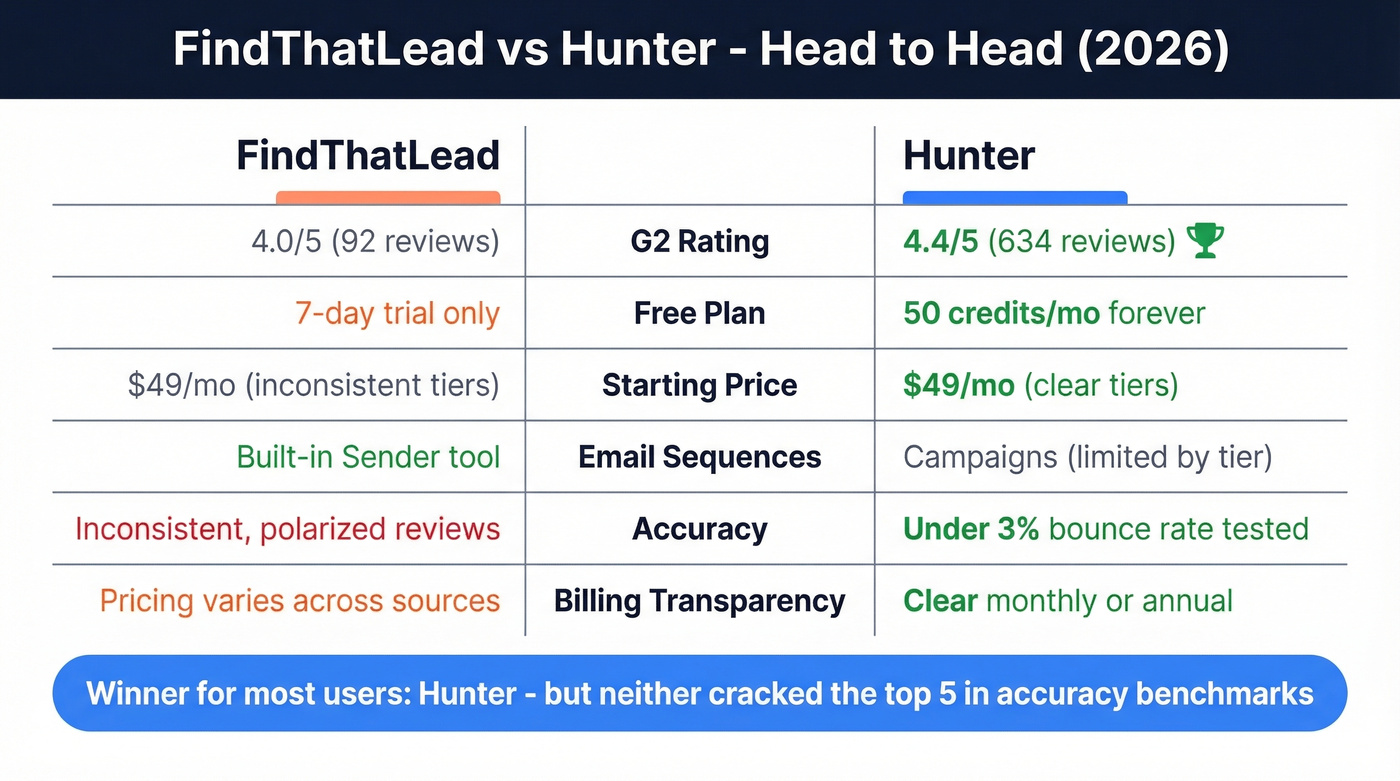
Skip both if email accuracy and data freshness are your top priorities - we'll explain why at the end.
Pricing Breakdown
Let's start where it matters most. Both tools begin around $49/month for paid plans, but the similarities end there.
Hunter offers four clean tiers with monthly or annual billing and a 30% discount when billed yearly:
| Plan | Monthly Price | Credits/mo | Billing |
|---|---|---|---|
| Free | $0 | 50 | Monthly |
| Starter | $49 | 2,000 | Monthly or annual |
| Growth | $149 | 10,000 | Monthly or annual |
| Scale | $299 | 25,000 | Monthly or annual |
FindThatLead is messier. GetApp lists Growth ($49/month), Startup ($150/month), and Suite ($399/month) with 5,000 to 30,000 monthly credits. Other sources list Starter ($37/month), Pro ($55/month), and Ultimate ($75/month) with completely different credit allocations. The inconsistency across review sites isn't confidence-inspiring.
What is consistent: FindThatLead's "free plan" is a 7-day test of the platform's main features, not a permanent tier. Also, the "Unlimited" plan comes with fair-use limits that can trigger blocks - so it's not really unlimited.
Hunter's month-to-month billing with no commitment is a real advantage if you're still evaluating tools.
How Credits Actually Work
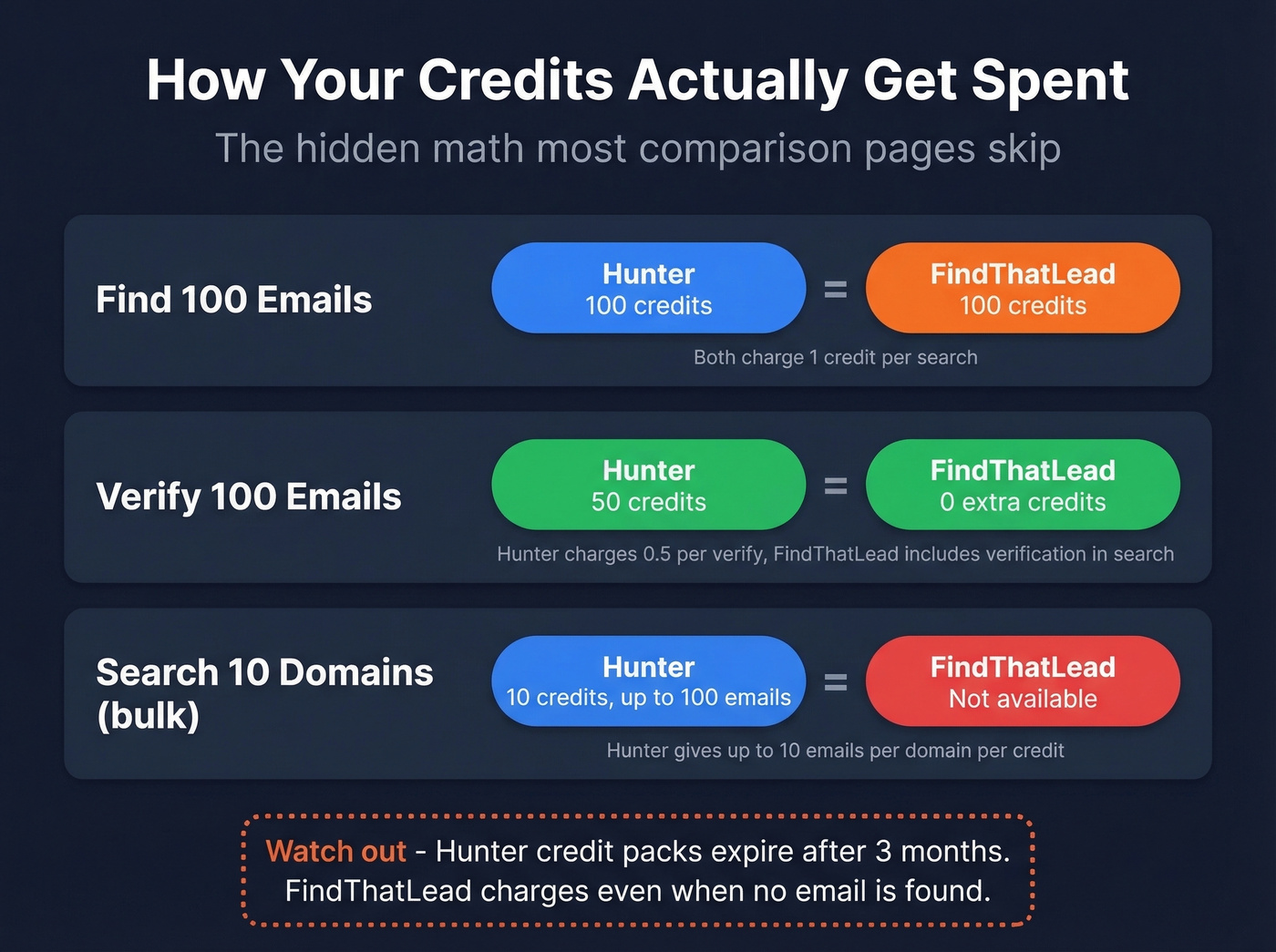
Here's the thing - most comparison pages skip credit mechanics entirely, and that's where these tools diverge in ways that hit your wallet.
| Action | Hunter | FindThatLead |
|---|---|---|
| Find emails | 1 credit per email found | 1 credit per search |
| Verify emails | 0.5 credit per verification | Included in search flow |
| Bulk domain search | 1 credit = up to 10 emails per domain | N/A |
Two rules matter in real life. Hunter verification costs half a credit, so if you're cleaning an existing list rather than finding new emails, your credits stretch further. FindThatLead doesn't charge for repeated leads you already searched within the same month, which helps if you revisit the same prospects.
Hunter also sells credit packs starting at $10, but those packs expire after 3 months.

Hunter charges half a credit to verify. FindThatLead charges for leads that return nothing. Prospeo's 5-step verification is built into every search - 98% email accuracy, no wasted credits, no bounced emails torching your domain.
Pay ~$0.01 per email and only get ones that actually land.
Features & Integrations
Both tools cover the basics: email finding, verification, a Chrome extension, and integrations with HubSpot, Salesforce, and Zapier.
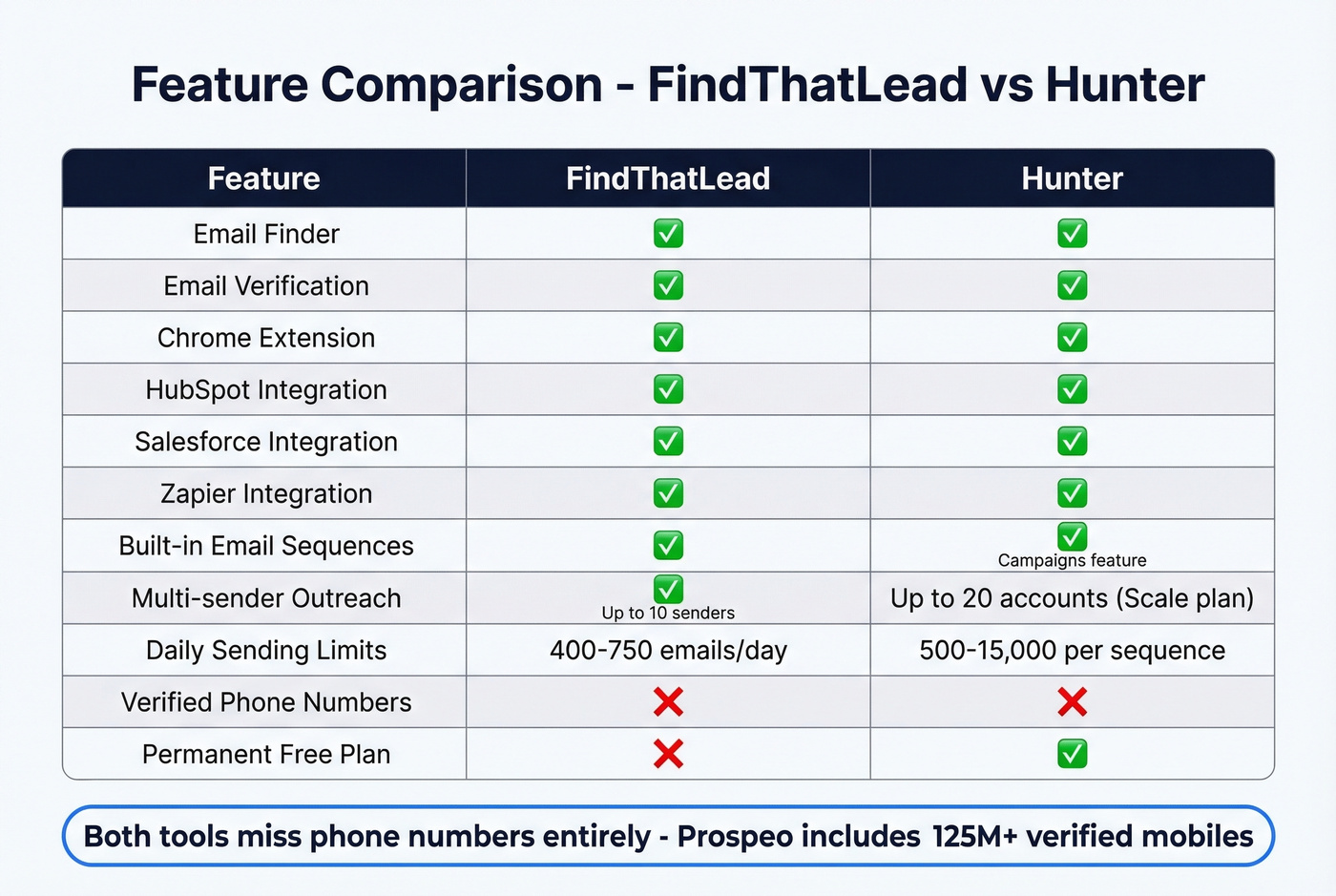
The meaningful difference is outreach. FindThatLead includes automated follow-ups via its built-in Sender sequencing tool. Depending on your plan, you can add up to 10 email addresses per user, with daily sending caps from 400 to 750 emails/day. Hunter includes Campaigns with connected email accounts by tier (Free: 1, Starter: 3, Growth: 10, Scale: 20) and recipient caps from 500 to 15,000 per sequence.
If cold email sequencing is your primary workflow and you don't want to pay for a separate tool like Instantly or Lemlist, FindThatLead's bundled approach saves you a subscription. For everyone else, Hunter's campaign feature is cleaner and better documented.
Accuracy & Data Quality
This is where we have strong opinions, because accuracy is the thing that actually determines whether your outreach works or tanks your domain reputation.

An independent test by Sparkle.io sent 2,469 emails sourced through Hunter and reported a bounce rate under 3% with a 20.1% open rate. Decent, not exceptional.
FindThatLead's accuracy is inconsistent. The G2 rating distribution tells the story: 70% five-star reviews but 10% one-star, with very little in between. Capterra reviews flag outdated data, being charged multiple times, and being charged for leads that returned no email address. We've seen FindThatLead's data quality vary wildly by industry - it works well for some domains and fails badly on others.
A 20,000-contact benchmark study by Dropcontact that tested 15 tools using live sending methodology found that neither Hunter nor FindThatLead cracked the top 5 in effective enrichment rate. Dropcontact funded the study, so take the rankings with a grain of salt, but the methodology - real sending to measure hard bounces plus manual domain verification - is solid.
What Real Users Say
Hunter
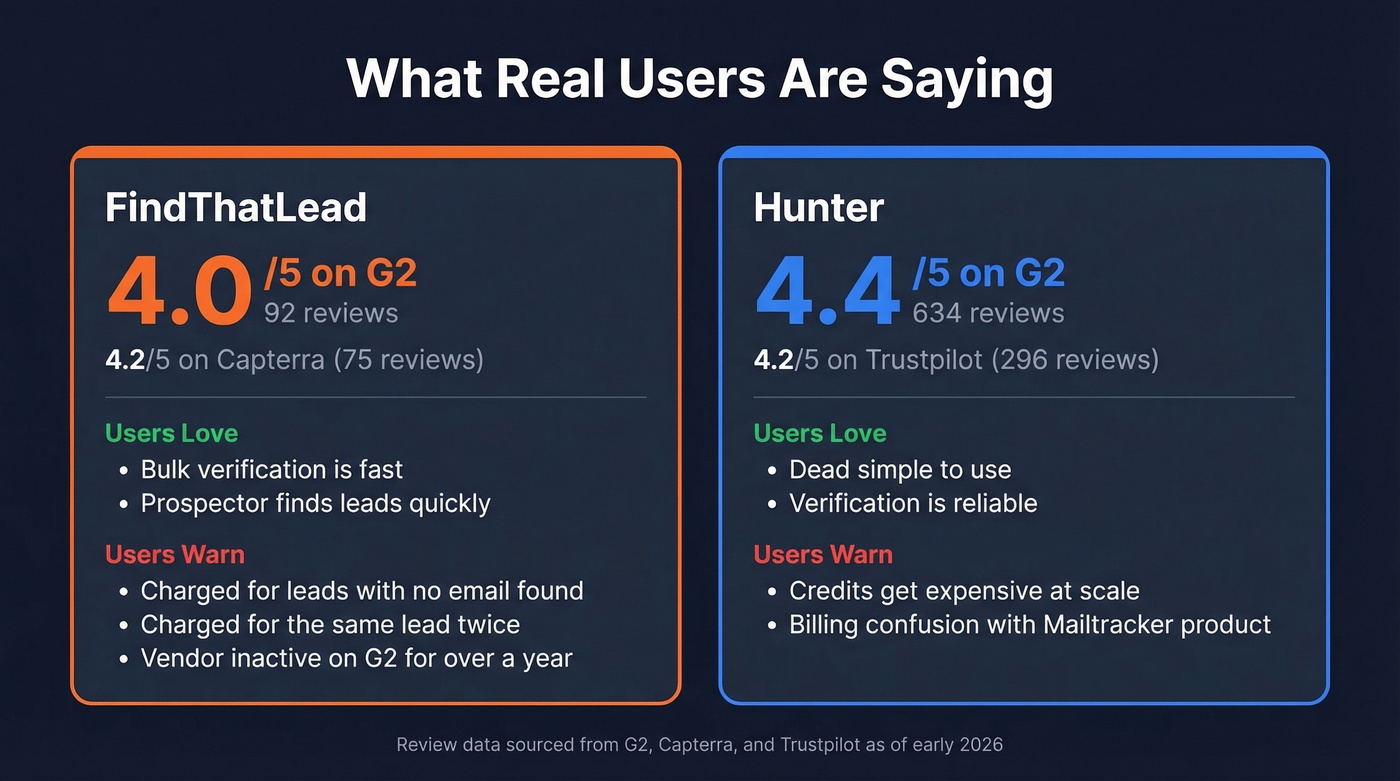
Users consistently praise ease of use and verification reliability. The tool holds a 4.4/5 on G2 with 634 reviews and 4.2/5 on Trustpilot with 296 reviews. The main complaints? Credit costs add up fast at scale, and some Trustpilot reviewers report billing confusion tied to Mailtracker, a separate product from the same founders. Hunter has responded publicly clarifying they're different entities, but the confusion persists.
FindThatLead
Fans love the bulk verification and Prospector feature. Ratings sit at 4.2/5 on Capterra with 75 reviews and 4.0/5 on G2 with 92 reviews. But the negatives are harder to ignore: multiple users report being charged for the same lead twice and charged for leads that returned no email. FindThatLead responded publicly in March 2023 promising a new version to fix billing and credit problems. G2 indicates the vendor hasn't been active on the profile for over a year. That's a red flag.
A Better Third Option
Look - if your average deal size is under $25k, you probably don't need a legacy email finder at all. You need accurate data. Both Hunter and FindThatLead were built for a simpler era of prospecting. The gap isn't features; it's data quality and freshness.
If you're rebuilding your outbound motion, it helps to start with a modern lead generation workflow and layer in data enrichment services that keep records current.
Neither Hunter nor FindThatLead cracked the top 5 in independent accuracy benchmarks. Prospeo refreshes all 300M+ profiles every 7 days - not every 6 weeks. That's why teams using Prospeo book 26% more meetings than ZoomInfo users and 35% more than Apollo.
Stop comparing two tools that both fall short. Switch to data that connects.
FAQ
Is Hunter or FindThatLead cheaper?
Both start around $49/mo, but Hunter is cheaper in practice. It offers true monthly billing and a permanent free plan with 50 credits/month. FindThatLead's free plan is a 7-day test, and pricing varies across sources.
Which tool has more accurate emails?
Hunter tested at under 3% bounce rate in an independent 2,469-email send. FindThatLead reviews flag inconsistent data quality. A 20,000-contact benchmark study found neither cracked the top 5 in effective enrichment rate.
Does either tool include phone numbers?
Neither Hunter nor FindThatLead offers verified mobile numbers. If direct dials matter to your outreach, Prospeo includes 125M+ verified mobiles with a 30% pickup rate - 10 credits per number, charged only when found.