

Firmographic Segmentation Examples That Actually Work
Teams using at least 10 firmographic attributes reduce prospecting time by 40% and increase average deal size by 73%, based on an analysis of 104 million companies in ZoomInfo's database. Teams doing it poorly waste months segmenting on stale CRM records that tell them nothing. The difference isn't strategy - it's execution.
A B2B distributor posted on Reddit about having 60,000 contacts in their CRM, only about a third tied to a company, and many records that were "just emails." That's the reality for most teams attempting firmographic segmentation. Actionable templates beat abstract frameworks every time, so let's get into the ones we've seen work.
What Is Firmographic Segmentation?
Firmographic segmentation groups companies by shared organizational attributes - industry, size, revenue, location, ownership structure - so you can target accounts that look like your best customers. It's the B2B equivalent of demographic segmentation in B2C: instead of segmenting people by age and income, you're segmenting companies by headcount and revenue. Every ICP definition and ABM program starts here.
Three Firmographic Segmentation Examples That Convert
These mirror real segmentation projects, not textbook theory.
SaaS Targeting Mid-Market Healthcare
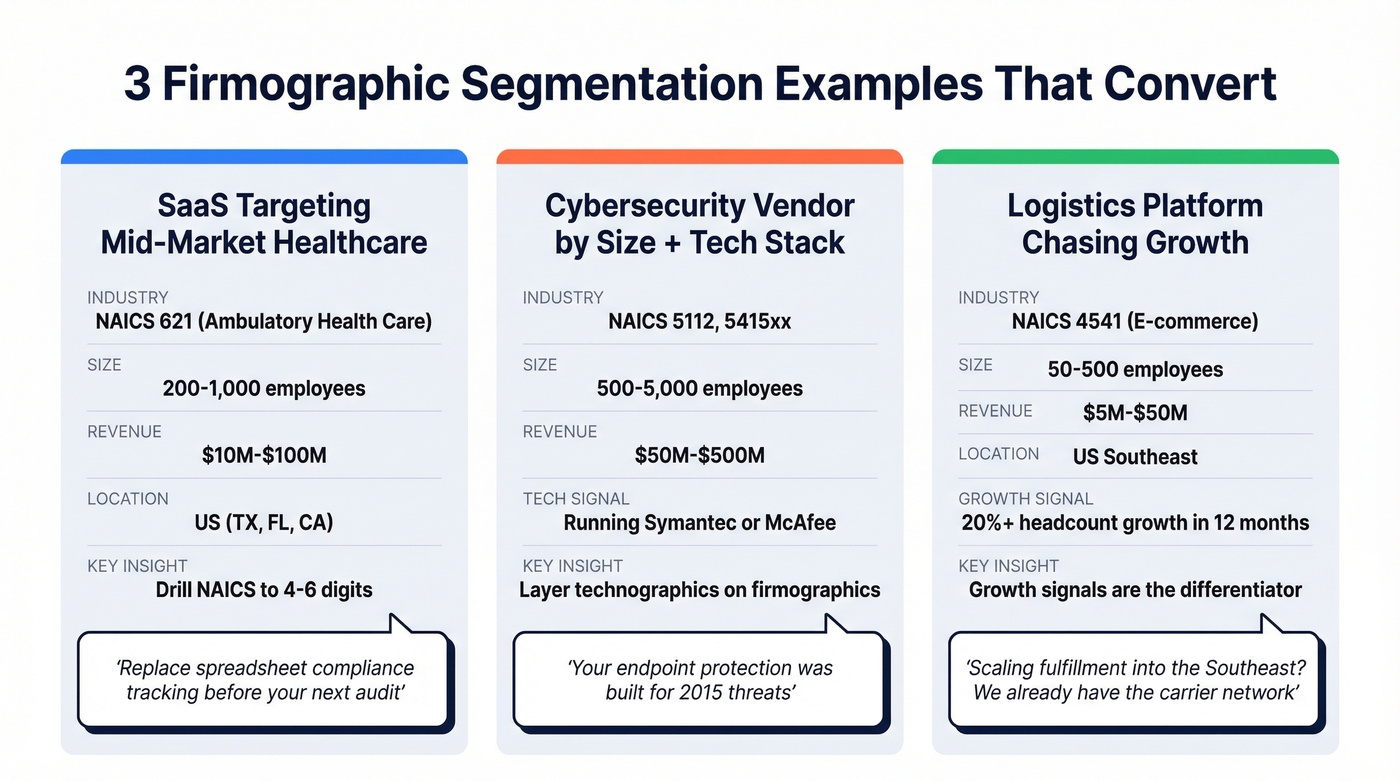
A compliance SaaS company wants healthcare organizations large enough to have a dedicated IT team but small enough that they haven't built custom solutions in-house.
| Field | Criteria |
|---|---|
| Industry | NAICS 621 (Ambulatory Health Care Services) |
| Headcount | 200-1,000 employees |
| Revenue | $10M-$100M |
| Location | US, priority: TX, FL, CA |
| Messaging angle | "Replace spreadsheet compliance tracking before your next audit" |
The NAICS drill-down matters here. Two-digit NAICS codes are too broad, and "Healthcare" as a generic category pulls in a ton of irrelevant results. Drill down to 4-6 digit codes to get closer to the right buyers.
Cybersecurity Vendor by Size + Tech Stack
A cybersecurity startup sells endpoint protection that replaces legacy antivirus. They need companies big enough to have a security budget but still running outdated tools.
| Field | Criteria |
|---|---|
| Industry | NAICS 5112 (Software Publishers), 5415xx (Computer Systems Design) |
| Headcount | 500-5,000 employees |
| Revenue | $50M-$500M |
| Tech stack | Running Symantec or McAfee (via technographic data tools like BuiltWith/Wappalyzer) |
| Messaging angle | "Your endpoint protection was built for 2015 threats" |
This is where firmographic segmentation gets powerful: layering technographic data on top of firmographics. The company-size filter narrows the universe; the tech-stack filter identifies accounts with a specific pain point. We've found that this kind of layered approach consistently outperforms single-variable segmentation by a wide margin, because you're not just finding companies that could buy - you're finding ones with a reason to buy right now.
Logistics Platform Chasing Growth Signals
Skip this one if your product doesn't have a regional angle. A freight-tech platform targets fast-growing e-commerce companies expanding into new distribution regions. The growth signal is the differentiator - without it, you're targeting every mid-size e-commerce company in the Southeast. With it, you're targeting the ones actively hiring, which means they're scaling operations and need logistics infrastructure now.
| Field | Criteria |
|---|---|
| Industry | NAICS 4541 (Electronic Shopping and Mail-Order Houses) |
| Headcount | 50-500 employees |
| Revenue | $5M-$50M |
| Location | US Southeast (new warehouse hubs) |
| Growth signal | 20%+ headcount growth in last 12 months |
| Messaging angle | "Scaling fulfillment into the Southeast? We already have the carrier network" |
Copy-Paste Segmentation Template
| Segment Name | Industry (NAICS) | Headcount | Revenue | Location | Tech Stack | Growth Signal | Messaging Angle |
|---|---|---|---|---|---|---|---|
| Mid-market healthcare | 621xxxx | 200-1,000 | $10M-$100M | US (TX, FL, CA) | - | - | Compliance automation |
| Legacy-stack mid-market | 5112, 5415xx | 500-5,000 | $50M-$500M | US/Canada | Symantec, McAfee | - | Endpoint modernization |
| Growth-stage e-commerce | 4541 | 50-500 | $5M-$50M | US Southeast | Shopify Plus | 20%+ headcount growth | Regional fulfillment |
| Enterprise financial services | 5221xx | 5,000+ | $500M+ | US Northeast | Salesforce, Oracle | Recent M&A activity | Post-merger data consolidation |
Keep it to 4-6 variables per segment - enough to be specific, not so many that you can't populate the data. Best viewed on desktop or copied into a spreadsheet.

Your firmographic segments are only as good as the data behind them. Prospeo gives you 30+ search filters - industry, headcount, revenue, technographics via Wappalyzer, headcount growth, funding, and buyer intent across 15,000 topics. Layer them in a single search across 300M+ profiles, refreshed every 7 days.
Stop segmenting on stale CRM records. Build segments on live data.
Key Firmographic Variables
Not all firmographic variables carry equal weight. Here are the ones that predict conversion, ranked by how often they appear in high-performing segments:
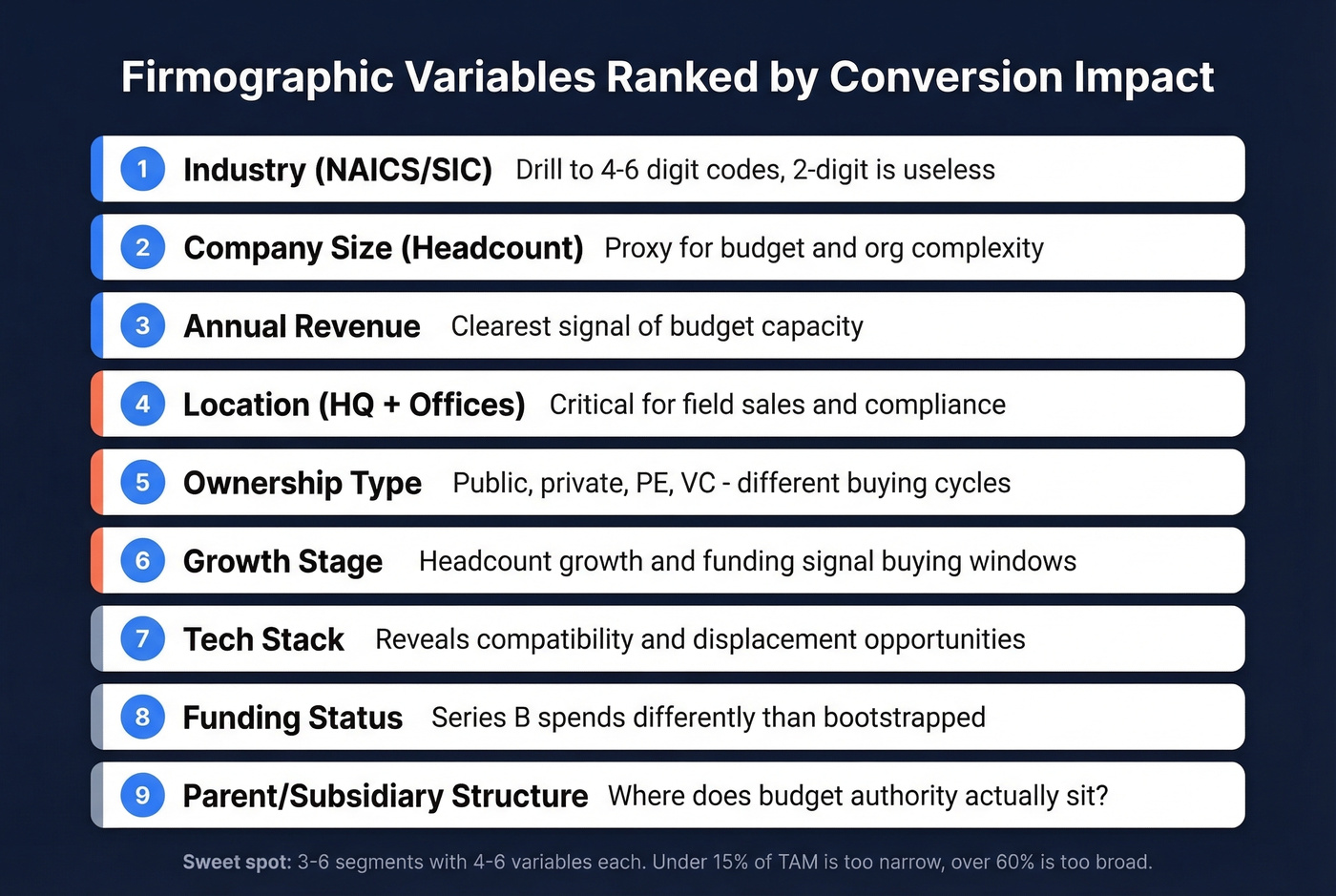
- Industry (NAICS/SIC) - The starting filter for every segment. Drill to 4-6 digit NAICS codes; filtering by "Software" alone returns 300,000+ companies. Two-digit codes are useless. NAICS updates every 5 years and SIC hasn't had a major update since 1987 - always cross-reference with actual business descriptions.
- Company size (headcount) - Proxy for organizational complexity and budget. A 50-person company buys differently than a 5,000-person company.
- Annual revenue - The clearest signal of budget capacity. Combine with headcount to avoid outliers like high-revenue, tiny-team consultancies.
- Location (HQ + offices) - Critical for field sales, regional compliance, or geo-specific products.
- Ownership type - Public, private, PE-backed, or VC-funded companies have different procurement cycles and budget pressures.
- Growth stage - Headcount growth, recent funding rounds, or new office openings signal active buying windows.
- Tech stack - What tools they already use reveals compatibility, displacement opportunities, and integration requirements.
- Funding status - Series B companies spend differently than bootstrapped ones. Recent raises often trigger new tool purchases.
- Parent/subsidiary structure - Determines where budget authority sits. Selling to a subsidiary when procurement lives at the parent wastes everyone's time.
Here's the thing: most teams over-segment. If a segment captures less than 15% of your addressable market, it'll struggle to attract internal investment. If it captures more than 60%, it's too broad. And if you have more than 8 segments, you'll end up with overlapping groups that nobody actually uses for campaign targeting. Three to six segments is the sweet spot, and you should validate each one against revenue outcomes, not just logical neatness.
Where to Get Firmographic Data
The average B2B sales team now uses 2.7 data providers simultaneously, up from 1.3 in 2022. Here's how the major options compare for populating your segments:
| Provider | Best For | Pricing | Database Size | Standout Feature |
|---|---|---|---|---|
| ZoomInfo | Enterprise full GTM | $15K-$40K+/yr | 300M+ contacts | Deepest platform integrations |
| Apollo | SMB prospecting | $49-$119/user/mo | 275M+ contacts | Built-in sequencing |
| Lusha | Quick lookups | $22-$52/user/mo | 100M+ contacts | Fastest single-record lookup |
| Breeze (Clearbit) | HubSpot-native enrichment | $30-$700/mo by credits | 100M+ contacts | Seamless HubSpot sync |
| D&B | Legacy enterprise data | ~$10K-$50K/yr custom | Large business database | Deep historical records |
A quick note on database sizes: "profiles" and "contacts" aren't identical metrics across providers. Both ZoomInfo and Prospeo are large enough for any firmographic segmentation project, but the way they count records differs.
A thread on r/datascience captured the D&B frustration well - a practitioner trying to buy firmographic data described D&B's offerings as "very complicated" and unclear. That tracks with what we've seen. D&B has deep data, but the buying experience is painful. For comparison, SalesIntel refreshes every 90 days; Prospeo refreshes every 7 days. If data freshness matters to your segmentation - and it should - that gap is significant.
Enrich First, Segment Second
Your segments are only as good as the data behind them. B2B data decays at 30%+ per year, which means roughly 7-8% of your records go stale every quarter. If you're segmenting on stale data, you're building on sand.
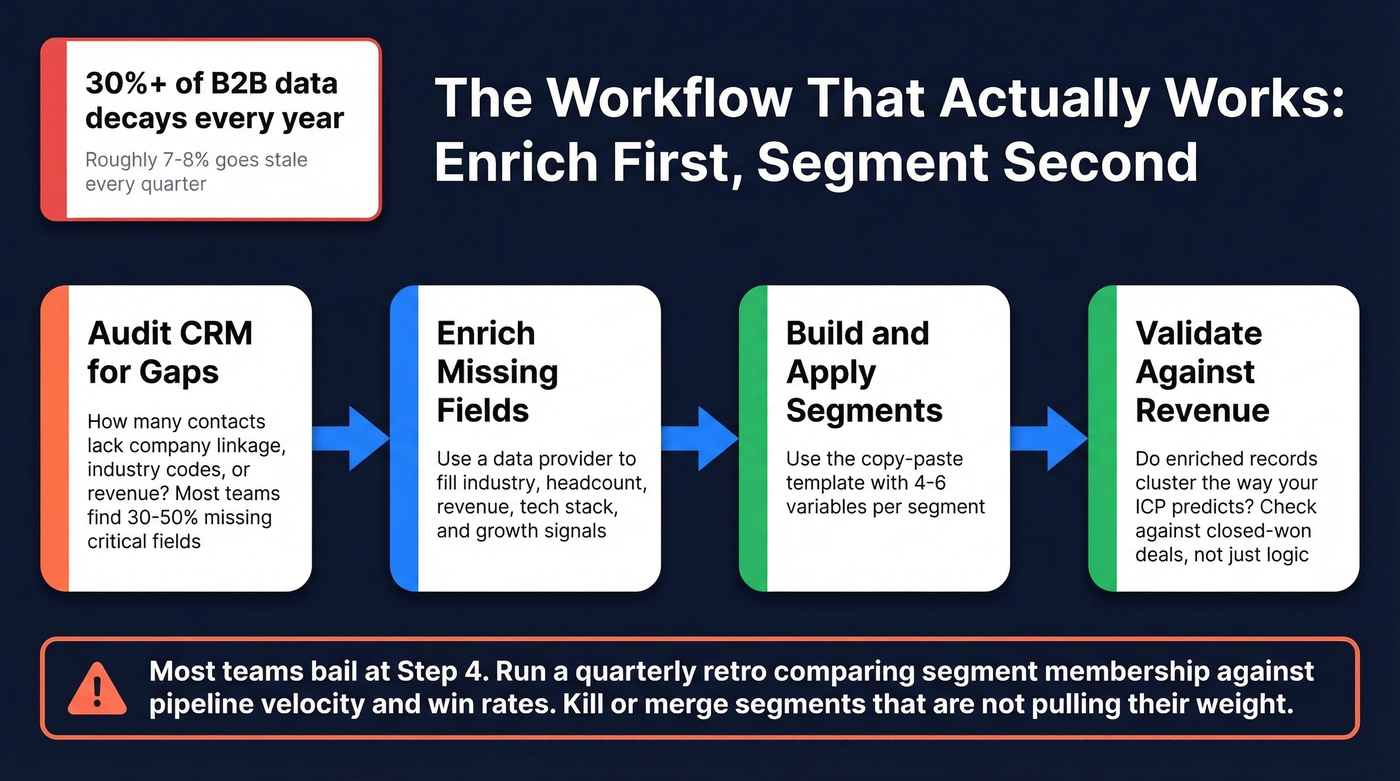
The workflow that actually works:
- Audit your CRM for gaps. How many contacts lack company linkage, industry codes, or revenue data? In our experience, most teams find 30-50% of records are missing at least one critical firmographic field.
- Validate your segments against revenue. Check whether enriched records actually cluster the way your ICP predicts - and whether those clusters correlate with closed-won deals, not just logical tidiness.
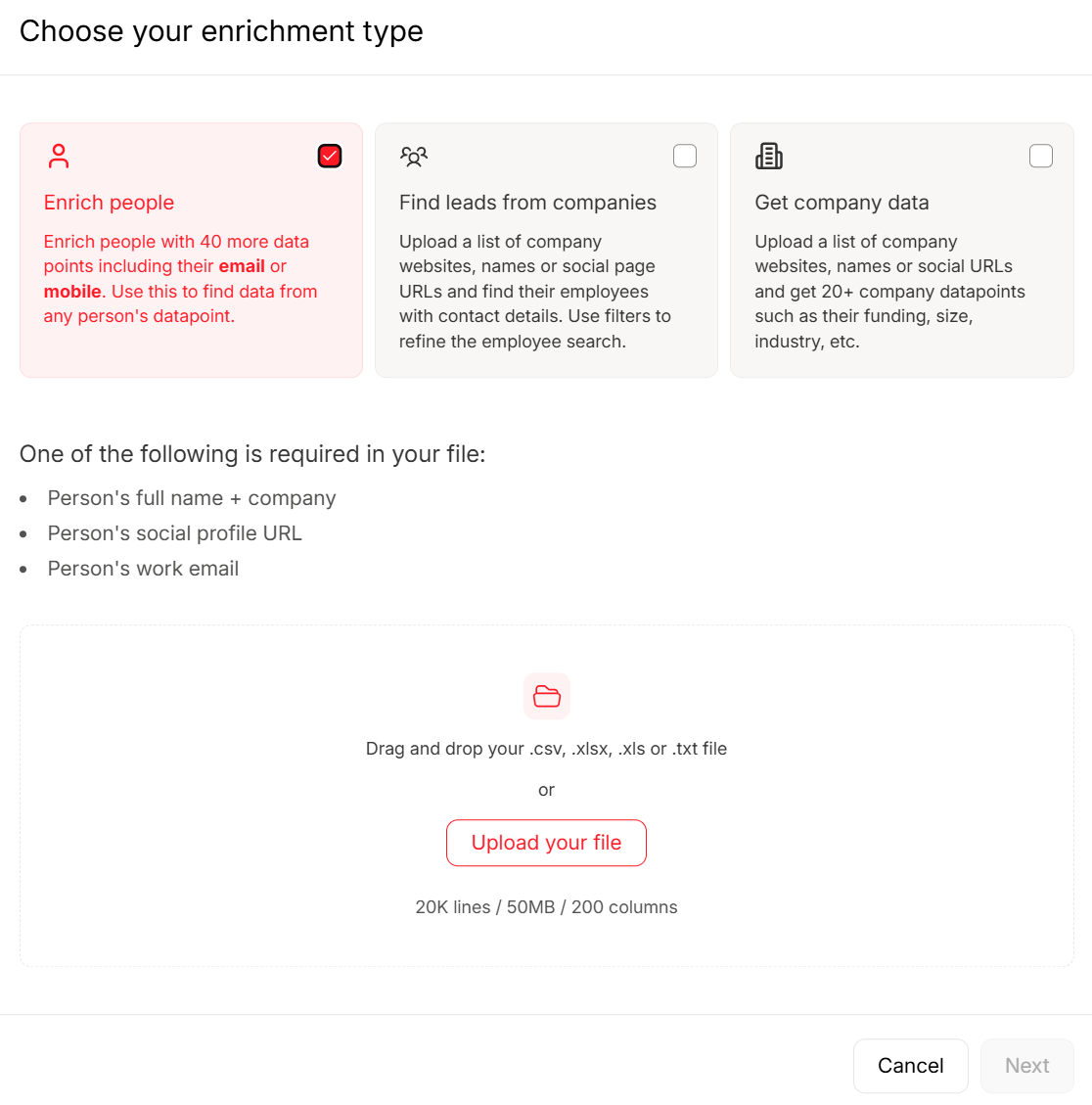
Let's be honest: step three is where most teams bail. They build the segments, launch campaigns, and never circle back to see if the segmentation predicted anything useful. Don't be that team. Run a quarterly retro where you compare segment membership against pipeline velocity and win rates, then kill or merge the segments that aren't pulling their weight.
That cybersecurity example above - filtering by company size plus tech stack - is exactly what Prospeo's database was built for. Combine firmographic filters with technographic signals and headcount growth data in one query, then export verified emails at 98% accuracy for $0.01 each. No contracts, no sales calls.
Turn your segmentation template into a live prospect list in minutes.
Beyond Firmographics
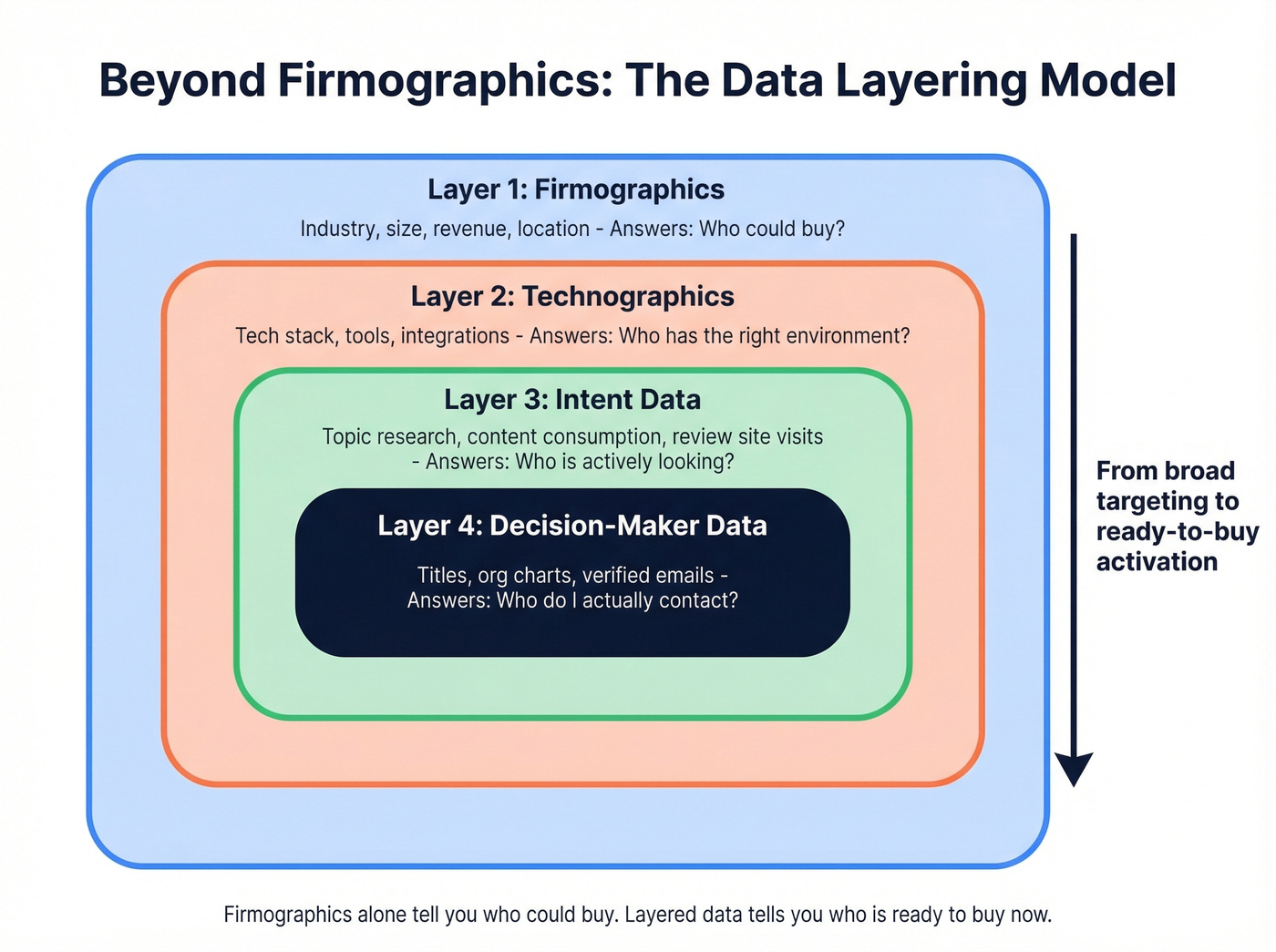
Firmographics are the first layer, not the only one. Think of it as an onion: firmographics shortlist the accounts, technographics refine which ones have the right tech environment, intent data prioritizes who's actively researching solutions, and decision-maker data activates outreach to the right people. Firmographics alone tell you who could buy. Layered data tells you who's ready to buy now.
FAQ
What's the difference between firmographic and demographic segmentation?
Firmographic segmentation uses company attributes - industry, size, revenue, location - while demographic segmentation uses individual attributes like age, job title, and seniority. In B2B, firmographics define which accounts to target; demographics define which buyers within those accounts to reach. You need both, but firmographics come first.
How many segments should I create?
Start with 3-6. Fewer than 3 means your messaging isn't differentiated enough; more than 8 gets unmanageable with overlapping groups nobody uses for targeting. Each segment should represent 15-60% of your addressable market.
What's a good firmographic segmentation example for SaaS?
The mid-market healthcare example above is a strong template: define industry at the 4-6 digit NAICS level, set headcount and revenue bands matching your pricing tier, and add one qualifying signal like tech stack or growth rate. "Mid-market healthcare running spreadsheet compliance" is actionable. "Healthcare companies" isn't.
What's the best free tool for firmographic enrichment?
Prospeo offers 75 free enrichment credits per month with 50+ data points returned per contact - enough to validate whether your segments hold up against real data. Apollo's free tier also works for basic lookups, though its enrichment depth is shallower and data refreshes less frequently.