

First-Party Data Collection: The Practitioner's Playbook for 2026
$15,000 a year on retargeting - and your CPA keeps climbing because half your pixel events never fire. Post-iOS 14, ecommerce practitioners on r/ecommerce describe pixel-based retargeting as "throwing spaghetti at a wall." Lookalike audiences built on third-party cookies perform like it's 2019. The brands pulling ahead aren't waiting for Google to make up its mind - they're building durable first-party data collection infrastructure that doesn't depend on browser cooperation.
What You Need (Quick Version)
Three things every team should do right now:
- Server-side tracking. Move to server-side or, at minimum, hybrid server-side tagging. Client-side tracking commonly loses close to 20% of real conversions once you factor in browser restrictions, consent friction, ad blockers, and bot noise.
- A real consent workflow. Not just a cookie banner - a system that enforces opt-in before non-essential trackers fire, logs consent for audits, and lets users change preferences.
- Data verification and enrichment. Your CRM is full of contacts from webinars, events, and form fills that are already decaying. Verify and enrich those records in bulk so you're not marketing to dead addresses.
What First-Party Data Actually Is
First-party data is information you collect directly from your audience through channels you own - your website, app, email, POS system, or CRM. It's behavioral (what people do), transactional (what they buy), and declarative (what they tell you). The key distinction: you collected it, you own it, and you have a direct relationship with the person it describes.
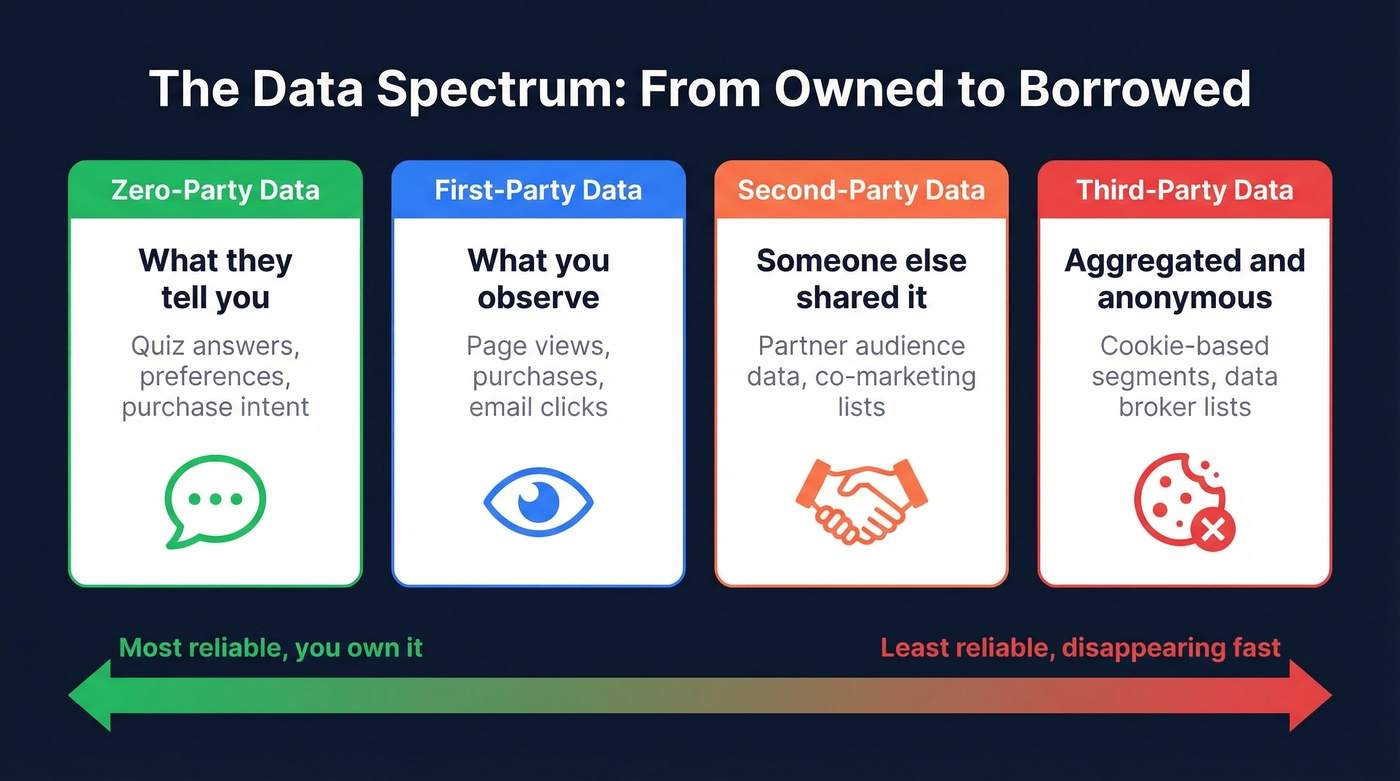
Forrester introduced the term "zero-party data" to describe information customers proactively share - preferences, purchase intent, feedback - typically in exchange for value.
| Type | What It Is | Example | How You Get It |
|---|---|---|---|
| Zero-party | Proactively shared | Quiz answers, preferences | Quizzes, surveys, forms |
| First-party | Observed behavior | Page views, purchases | Website, app, email, POS |
| Second-party | Someone else's 1P data | Partner audience data | Data partnerships |
| Third-party | Aggregated anonymous | Cookie-based segments | Data brokers, DMPs |
Zero-party and first-party data are both yours. The difference is intent: zero-party is what someone tells you ("I'm shopping for a friend"), first-party is what you observe (they browsed gift categories three times this week). Both survive cookie deprecation. Both get more valuable the more you unify them.
The Cookie Situation in 2026
Third-party cookies aren't dead. In April 2025, Google announced it won't roll out a new standalone cookie choice prompt in Chrome. Users manage cookie preferences in existing settings. Business as usual - for Chrome.
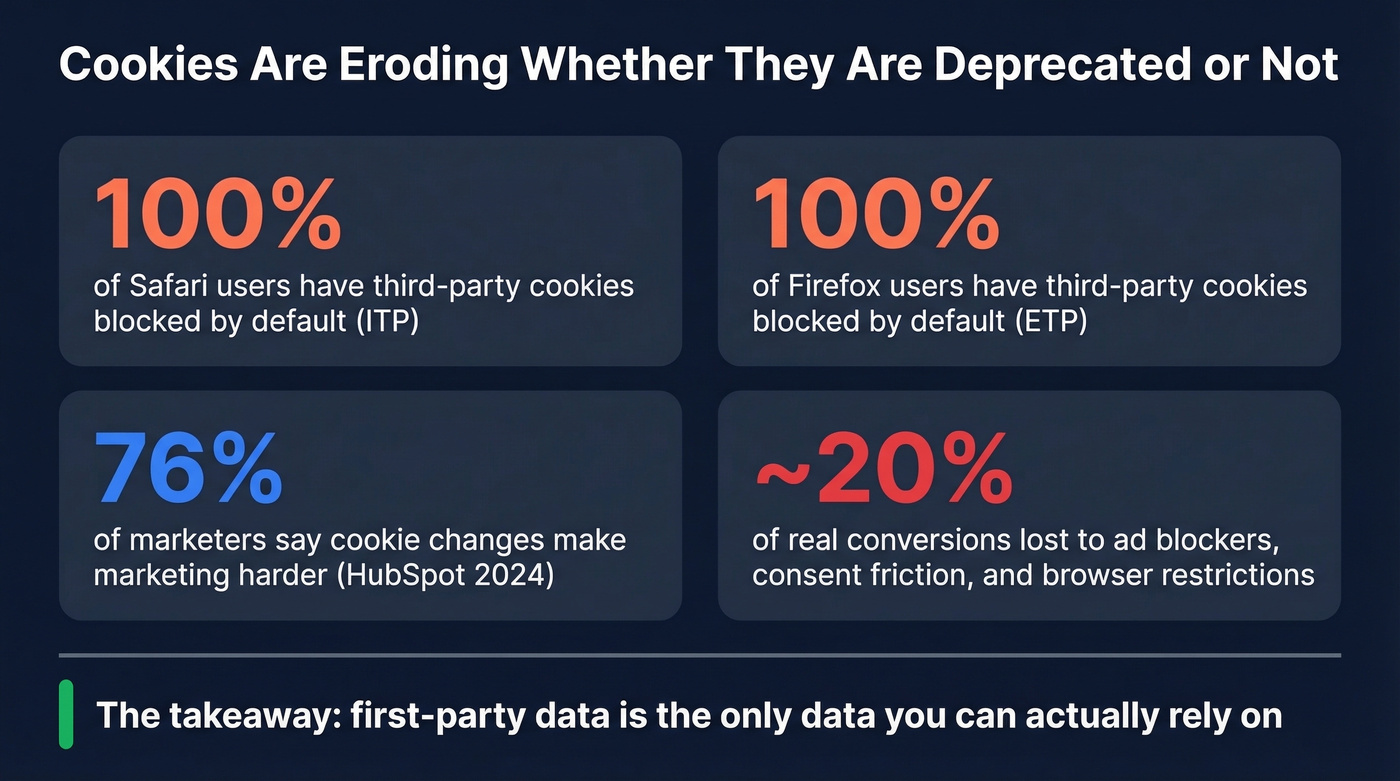
But "business as usual" is misleading. Safari's ITP already blocks third-party cookies by default. Firefox's ETP does the same. Ad blockers strip tracking scripts before they execute. Consent banners suppress opt-in rates across Europe. In HubSpot's 2024 State of Marketing report, 76% of marketers said the cookie phase-out makes marketing harder, and that sentiment hasn't softened just because Chrome kept the status quo.
Here's the thing: cookies are losing effectiveness whether they're technically "deprecated" or not. The practical erosion - ad blockers, Apple's ATT framework, browser restrictions, consent friction - means the data you collect directly is the only data you can actually rely on. Waiting for a definitive "cookies are gone" moment is a losing strategy. The shift already happened.
Why It Matters
The CDP market grew from $2.4B in 2020 to an estimated $10.3B by 2025 - that's not hype, that's infrastructure spend following strategy. 86% of respondents at medium and large companies consider first-party data the most significant aspect of their media strategy, per Nielsen. And 73% of consumers are more willing to share data with brands that are transparent about how they use it, per Deloitte. Transparency isn't just a compliance checkbox - it's a conversion lever.
On the B2B side, 75% of marketers are already transitioning to owned-data strategies, per Gartner.
The ROI case is straightforward. Directly collected data gives you higher match rates for ad targeting, better personalization, lower acquisition costs, and a dataset that doesn't evaporate when a browser ships an update. Teams that invest in marketing data collection now are building a compounding advantage over competitors still reliant on third-party signals.
Our take: If your deal sizes sit below five figures, you probably don't need a CDP or a data warehouse. A well-integrated CRM, server-side tracking, and clean contact data will outperform a six-figure martech stack that nobody fully implements.
How to Collect Customer Data: Channel by Channel
Website & App Behavior
Every interaction generates signal: page views, on-site search queries, product clicks, add-to-cart events, checkout behavior, scroll depth, and feature usage in-app. Most analytics platforms (GA4, Amplitude, Mixpanel) capture this by default. The real challenge isn't collection - it's unification. Behavioral data sitting in Google Analytics that doesn't connect to your CRM or email platform is just noise with a dashboard.
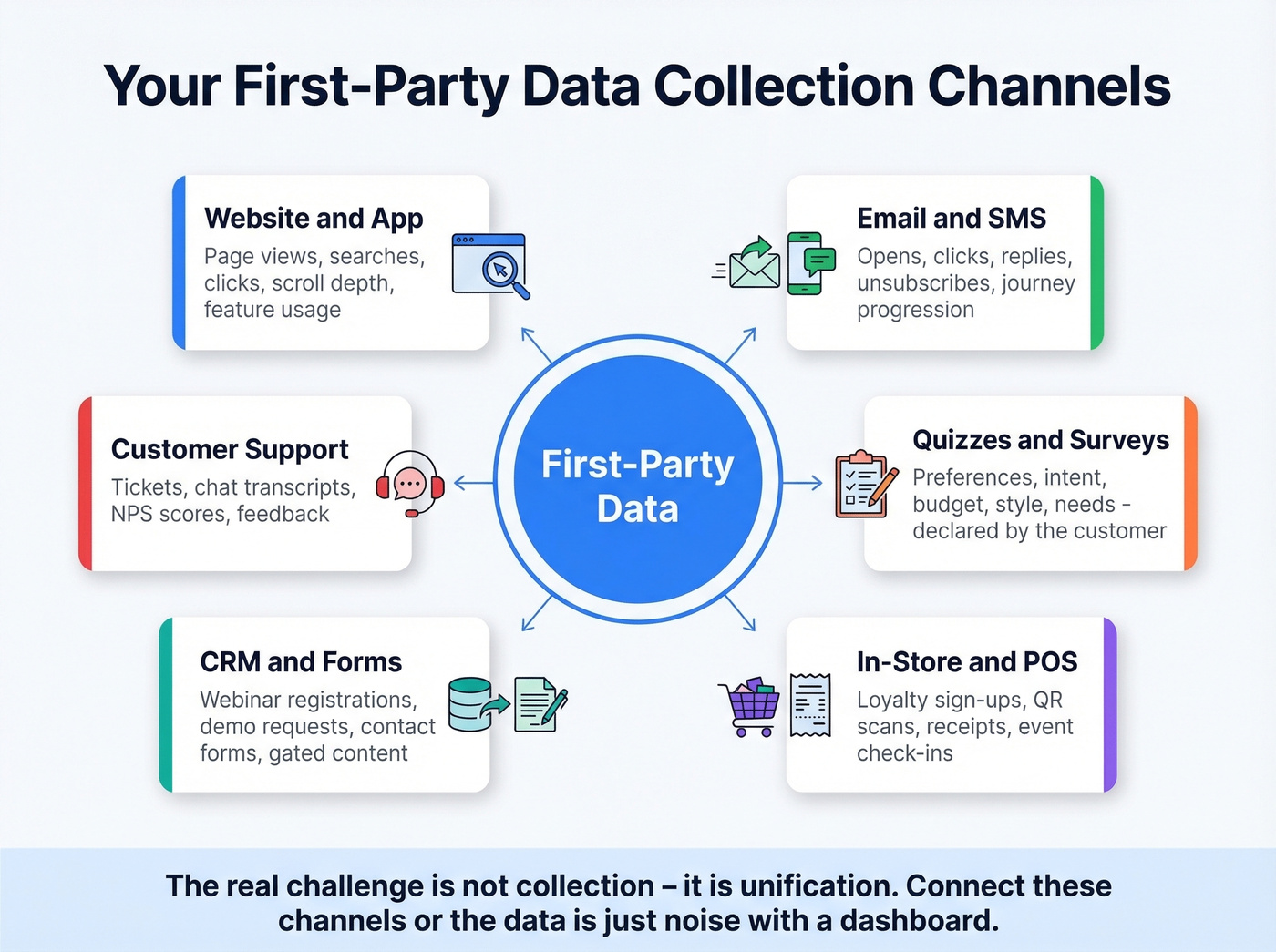
Before you instrument anything, establish consistent event naming conventions. A tracking plan that standardizes events across web, app, and server ensures your data is actually joinable downstream. Without it, you'll spend more time cleaning data than using it.
Email & SMS Engagement
38.49% average open rate. 8.29% click-through rate. That means the majority of your list is giving you behavioral data just by interacting with campaigns. Email remains the highest-signal first-party channel - opens, clicks, journey progression, and unsubscribes each tell you something about intent.
SMS adds a dimension email can't: two-way replies. When someone texts back a preference or responds to a prompt, that's zero-party data captured in a high-engagement channel. Track opt-outs carefully - SMS consent rules are stricter than email, and violations are expensive.
Quizzes & Zero-Party Data
Sephora's beauty quizzes. Stitch Fix's style surveys. These aren't gimmicks - they're structured customer data collection disguised as value delivery. A customer tells you their skin type, budget, and preferences in exchange for a personalized recommendation. You get declared intent data that's more accurate than any behavioral inference.
Nobody fills out a survey for fun. Offer a personalized recommendation, a discount, or early access, and completion rates climb dramatically.
In-Store, POS & Offline
In-store retail media is projected to reach $100B by 2026, and the brands capturing that spend are the ones with unified customer profiles bridging online and offline. QR codes on receipts, loyalty program sign-ups at checkout, post-purchase surveys, event check-ins - all generate first-party data that most brands leave on the table. If you're running physical retail and not connecting POS data to your digital profiles, you're operating with half the picture.

You just read that CRM records decay fast after webinars, events, and form fills. Prospeo's bulk enrichment returns 50+ verified data points per contact at a 92% match rate - with emails verified to 98% accuracy on a 7-day refresh cycle. Stop marketing to dead addresses.
Turn your decaying first-party data into pipeline for $0.01 per email.
Progressive Profiling
Asking for everything upfront kills conversion. Progressive profiling spreads data collection across multiple interactions:
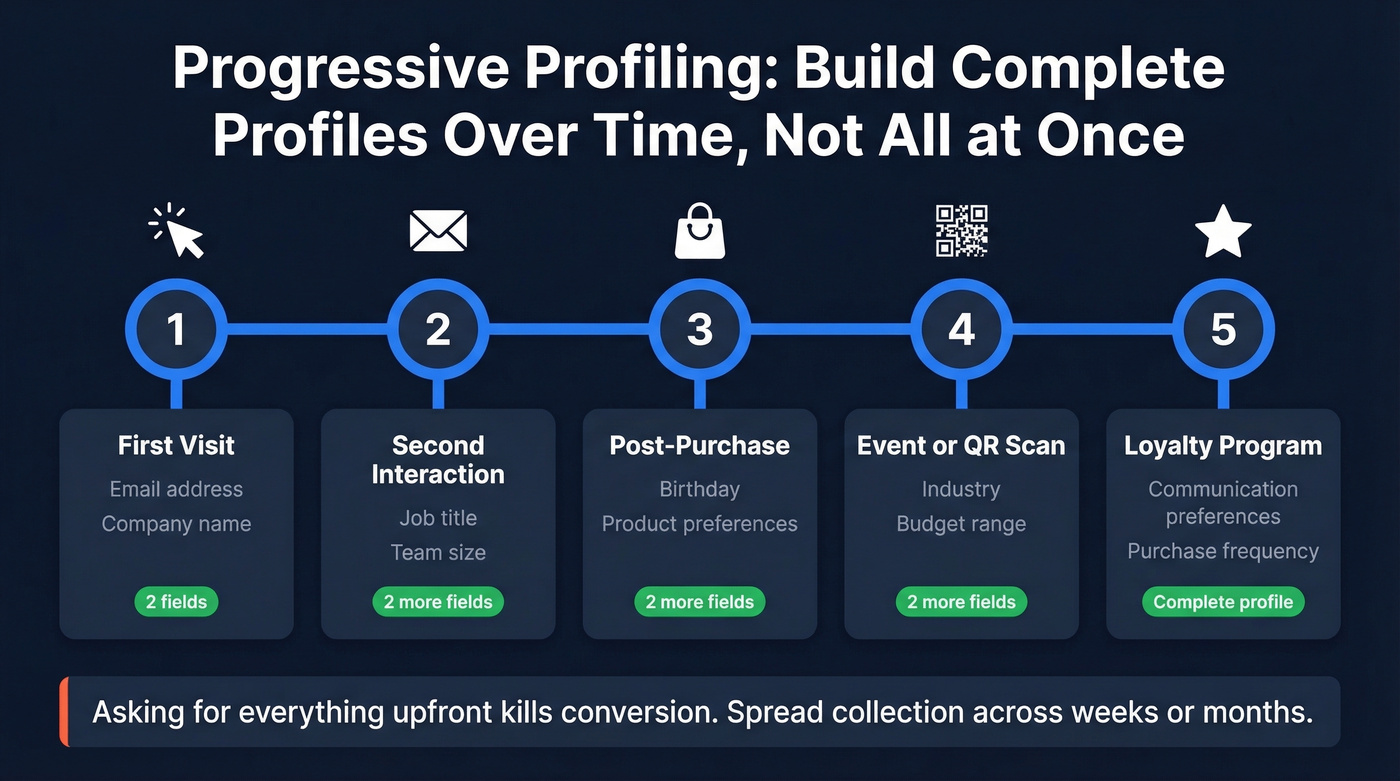
- Start minimal. First touchpoint captures 2-3 fields - email and maybe company name.
- Expand over time. Second interaction asks for role or team size. Third asks for budget timeline.
- Tie asks to moments. Post-purchase is a natural time to ask for a birthday. A QR code scan at an event is a natural time to ask for job title.
- Use incentives. Birthday gifts, exclusive deals, early access - give people a reason to share more.
- Test prompts and timing. The same question converts at different rates depending on when and where you ask it. Run A/B tests on form placement, field count, and incentive type.
The goal is building a complete profile over weeks or months, not in a single form fill.
Server-Side Tracking
Client-side tracking is leaking data. Ad blockers, browser restrictions, and consent tools prevent scripts from firing, which means your analytics undercount real conversions. One Stape case study found an ecommerce client was missing nearly 20% of real conversions. In a separate case, recorded purchases jumped from 1,724 to 4,512 after deploying server-side tracking. That's not a rounding error.
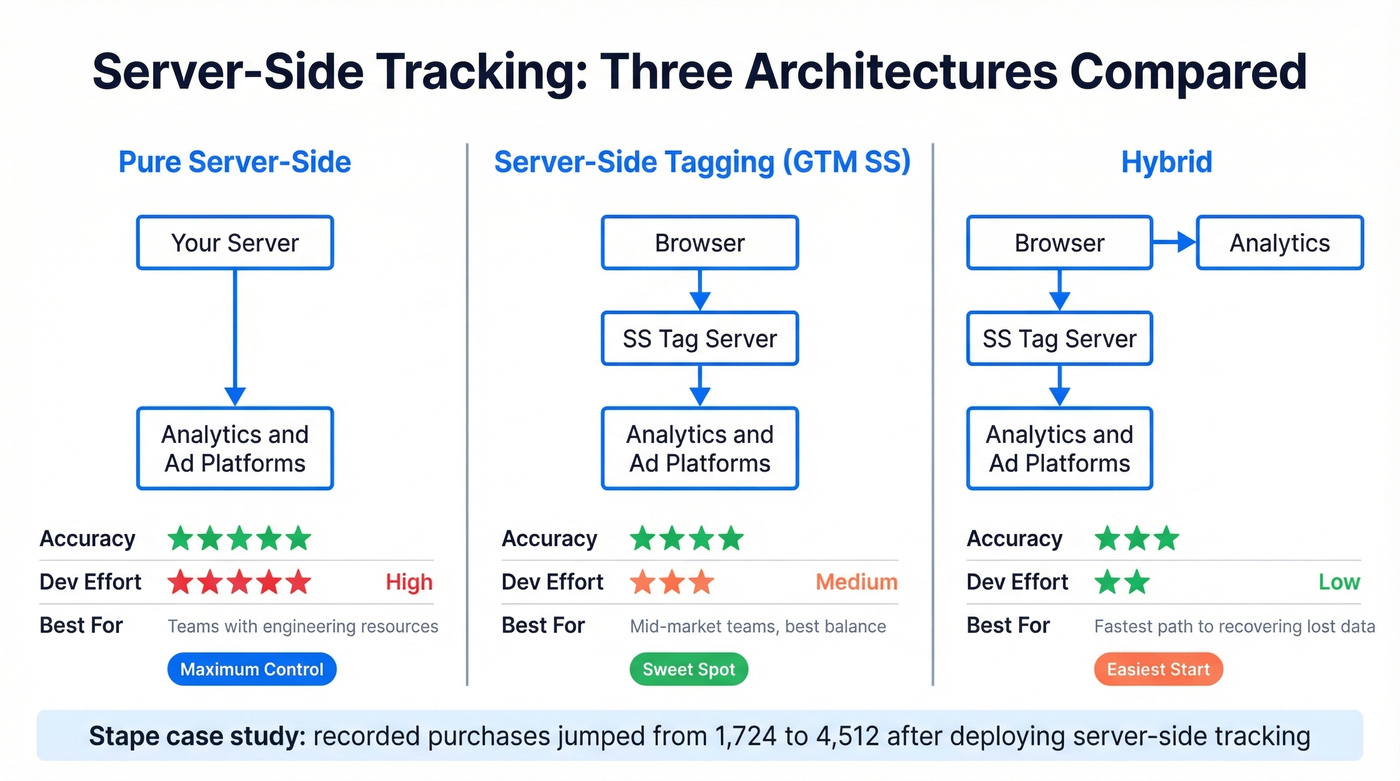
Let's break down the three architectures worth evaluating:
Pure server-side collects and sends data entirely from your server, with no browser involvement. Maximum accuracy, maximum control, but significant dev effort. Best for teams with engineering resources and the budget to match.
Server-side tagging uses a dedicated tag management server (like a server-side GTM container) to process and route data. More control than client-side, easier than pure server-side. The sweet spot for most mid-market teams.
Hybrid combines client-side collection with server-side processing. Easiest to implement, slightly less accurate, but still a massive improvement over pure client-side. For most teams, hybrid is the fastest path to recovering lost conversion data.
Real talk: moving tracking server-side doesn't automatically make it compliant. You still need valid consent or anonymization. Server-side tracking gives you better data quality and more control over what gets shared - but it's not a privacy shortcut. It does, however, filter bot traffic before it pollutes your analytics, which means cleaner segmentation and fewer phantom conversions inflating your reports.
Consent Management Done Right
A cookie banner isn't a consent workflow. A real consent system needs:
- Visible opt-in mechanisms that clearly explain what you're collecting and why
- Strict enforcement - non-essential trackers don't fire until consent is granted
- Secure consent logging with timestamps for audit trails
- Preference management so users can revisit and change choices
- Granular consent - separate permissions for analytics, marketing, and personalization
Consent extends beyond cookies. Forms, mobile SDKs, offline lead uploads, cross-channel messaging - each has channel-specific consent rules that need enforcement. Marketers on Reddit debate whether first-party data is "the new oil" or a privacy nightmare - the answer depends entirely on your consent infrastructure.
Watch the regulatory horizon. California's AB 566 takes effect January 1, 2027, requiring mobile OS developers to include a universal opt-out signal setting. SB 361 hits data brokers with $200/day fines for non-compliance. If your consent infrastructure can't recognize, record, and honor opt-out signals across channels and partners, you're building on sand.
Choosing the Right Tools
| CDP | CRM | DMP | |
|---|---|---|---|
| Primary data | First-party | First-party (known) | Third-party (anon) |
| Core use | Unification + activation | Sales + relationships | Ad targeting |
| Identity resolution | Yes | Limited | No |
| Real-time personalization | Yes (often sub-300ms) | No | Limited |
| Best for | 3+ data sources, real-time activation | Sales-led teams, single data source | Legacy ad targeting (declining) |
Not every team needs a CDP. If you have one or two data sources and a CRM that handles your segmentation, start there. Skip the CDP until you genuinely have three or more data sources and need real-time activation across channels - otherwise you're paying for infrastructure you won't use.
When evaluating CDPs, focus on five things: identity resolution quality (poor ID matching creates fictional customer profiles that poison your segments), real-time threshold (a practical bar is ~300ms), architecture (packaged vs composable/warehouse-native), compliance support (GDPR and CCPA enforcement built in, not bolted on), and scalability as your data sources grow.
Standardize your data formats before feeding anything into a CDP or enrichment tool. Inconsistent naming conventions, duplicate records, and mismatched schemas will undermine even the best platform.
Pricing ranges as of early 2026: Segment runs from free to a few hundred dollars per month for small teams, scaling into the low-thousands with volume. RudderStack commonly starts around the mid-hundreds per month for cloud plans. Tealium is typically in the low-thousands per month for enterprise deployments. For consent tools, OneTrust ranges from the mid-hundreds to low-thousands per month depending on modules; Cookiebot starts around ~$15/mo.
B2B Data: Fix Decaying CRM Records
B2B teams have a specific version of this problem. You collect first-party data through forms, webinars, events, and CRM interactions - but that data decays fast. Roughly 30% of B2B contact data goes stale within a year. People change jobs, companies get acquired, email addresses bounce. The webinar list you built six months ago? A chunk of it is already dead.
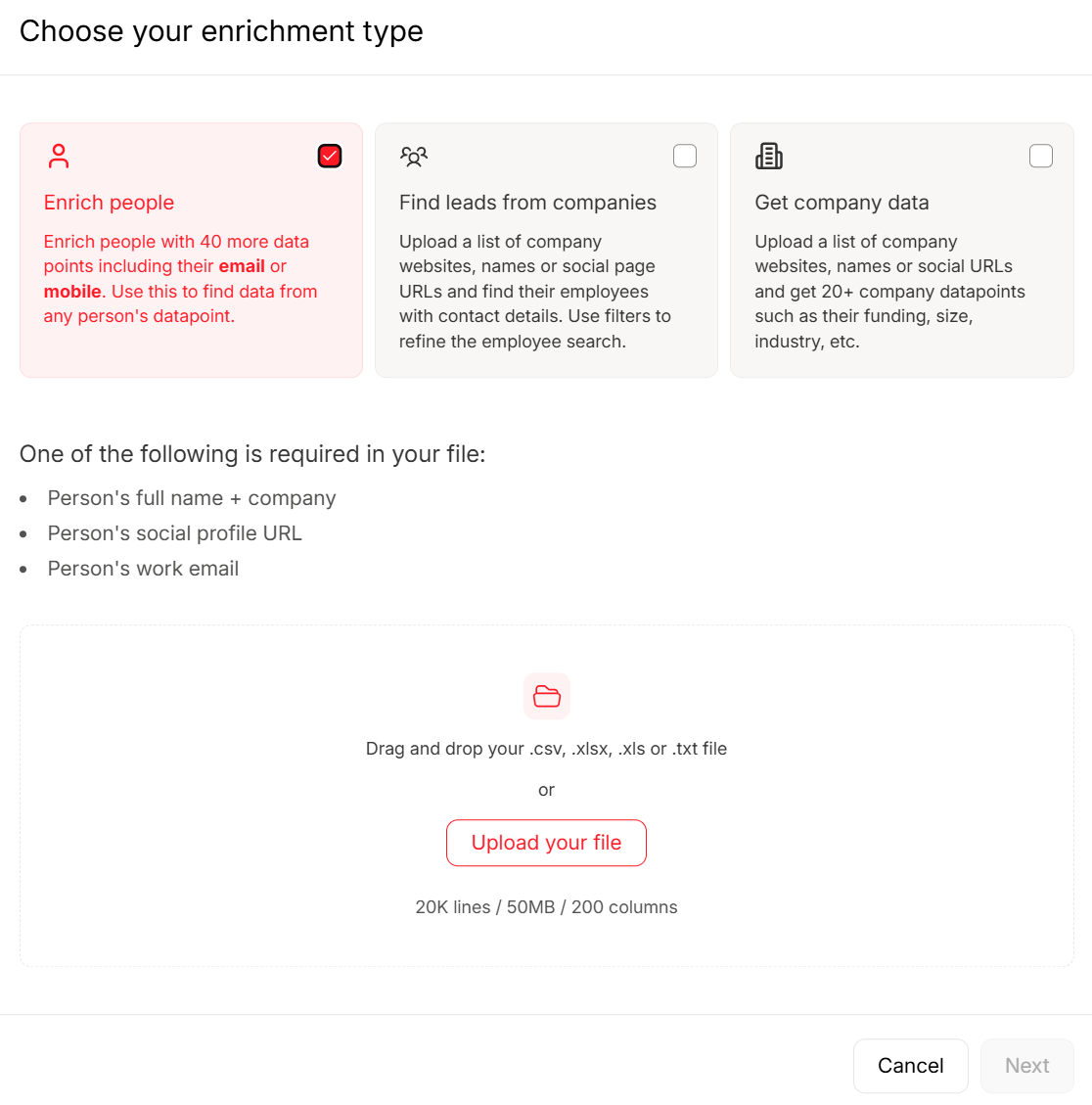
This is where enrichment becomes a first-party data strategy, not just a sales tool. Prospeo takes the contacts already in your CRM and verifies and enriches them in bulk - upload a CSV or connect directly to Salesforce or HubSpot and you get back 50+ data points per contact with a 92% API match rate and 98% email accuracy. The 7-day refresh cycle means your records stay current instead of rotting quietly in your database.
We've seen teams discover that 25-30% of their "first-party" CRM data is already bouncing. That's not a collection problem - it's a maintenance problem. Regular enrichment closes the gap and ensures your marketing data actually drives results instead of wasted outreach.
Activating Your Data
Collection without activation is just storage. The payoff comes when you put unified first-party data to work:
- Personalization - dynamic content based on behavior and declared preferences
- Segmentation - high-intent cohorts for targeted campaigns instead of batch-and-blast
- Retention - churn prediction models fed by engagement signals
- Cross-channel orchestration - consistent messaging across email, ads, and on-site experiences
- Sales enablement - verified contacts and firmographic context before outreach, so reps spend time selling instead of researching
Before you launch any outbound sequence, verify your list. Bad emails tank sender reputation, and no amount of clever copywriting fixes a 15% bounce rate. If you're seeing deliverability issues, start with email verification and a quick audit of domain reputation.
First-party data collection gives you the foundation. Enrichment makes it actionable. Prospeo layers 30+ filters - buyer intent, technographics, funding, headcount growth - onto your existing contacts so every record becomes a complete prospect profile.
Enrich your owned data with 50+ data points per contact - no contracts required.
FAQ
What is first-party data collection?
It's the process of gathering information directly from your audience through channels you own - website, app, email, POS, or CRM. This includes behavioral data (page views, purchases), transactional records (order history), and declarative inputs (survey responses). Because you collect it with a direct relationship, it's more accurate and durable than third-party data.
Are third-party cookies going away in 2026?
No. Google decided in April 2025 not to introduce a new cookie choice prompt in Chrome. But Safari and Firefox block them by default, ad blockers strip tracking scripts, and consent banners suppress opt-in rates - so cookies are unreliable even where they technically exist. Build your strategy around owned data, not browser cooperation.
Do I need a CDP for first-party data?
Not always. A CDP makes sense when you have three or more data sources and need real-time activation or cross-channel identity resolution. For smaller teams, a well-integrated CRM plus analytics handles most use cases. Pair that with an enrichment tool to keep records current without a $1K+/mo platform commitment.
What's the easiest data to start collecting?
Email engagement and on-site behavior - you likely already have both. The gap is unification. Connect your email platform to your analytics and CRM so a single profile captures opens, clicks, page views, and transactions. That alone unlocks meaningful segmentation without new tooling.
How does B2B data collection differ from B2C?
B2B involves longer sales cycles, multiple stakeholders per account, and heavier reliance on firmographic and technographic signals alongside behavioral data. Where B2C optimizes around individual purchase behavior, B2B teams need to stitch together activity across an entire buying committee - making CRM hygiene and regular enrichment even more critical.