

Follow Up Email After Sending a Quotation: 7 Templates + the Exact Sequence
It's Friday afternoon. You sent the quote on Tuesday. Your inbox? Empty. No reply, no questions, no "we're going with someone else." Just silence.
The temptation is to fire off a "just checking in" message - but that phrase is sales white noise, and prospects tune it out fast. What you need are follow up email after sending quotation examples that actually earn replies, not ones that get archived on sight.
Here's the short version: stop sending 5+ follow-ups. Belkins' analysis of 16.5 million cold emails shows performance drops with each follow-up, and four or more emails in a sequence more than triple unsubscribe and spam complaint rates. Use the Day 3 / Day 10 / Day 17 cadence below. Each email must add something new - a proof point, an objection answer, or a deadline.
Why They're Not Responding
Silence after a quote doesn't mean "no." It usually means your quote got deprioritized. Your contact forwarded it to procurement, who dropped it in a pile with six others. Or a budget cycle shifted. Or the decision-maker is on PTO and nobody wants to approve anything without them.
Multi-stakeholder delays are the norm. The prospect isn't ghosting you - they're stuck in an internal process you can't see.
The 3-Email Sequence After Sending a Quotation
Here's the cadence we recommend (the "3-7-7" rule):
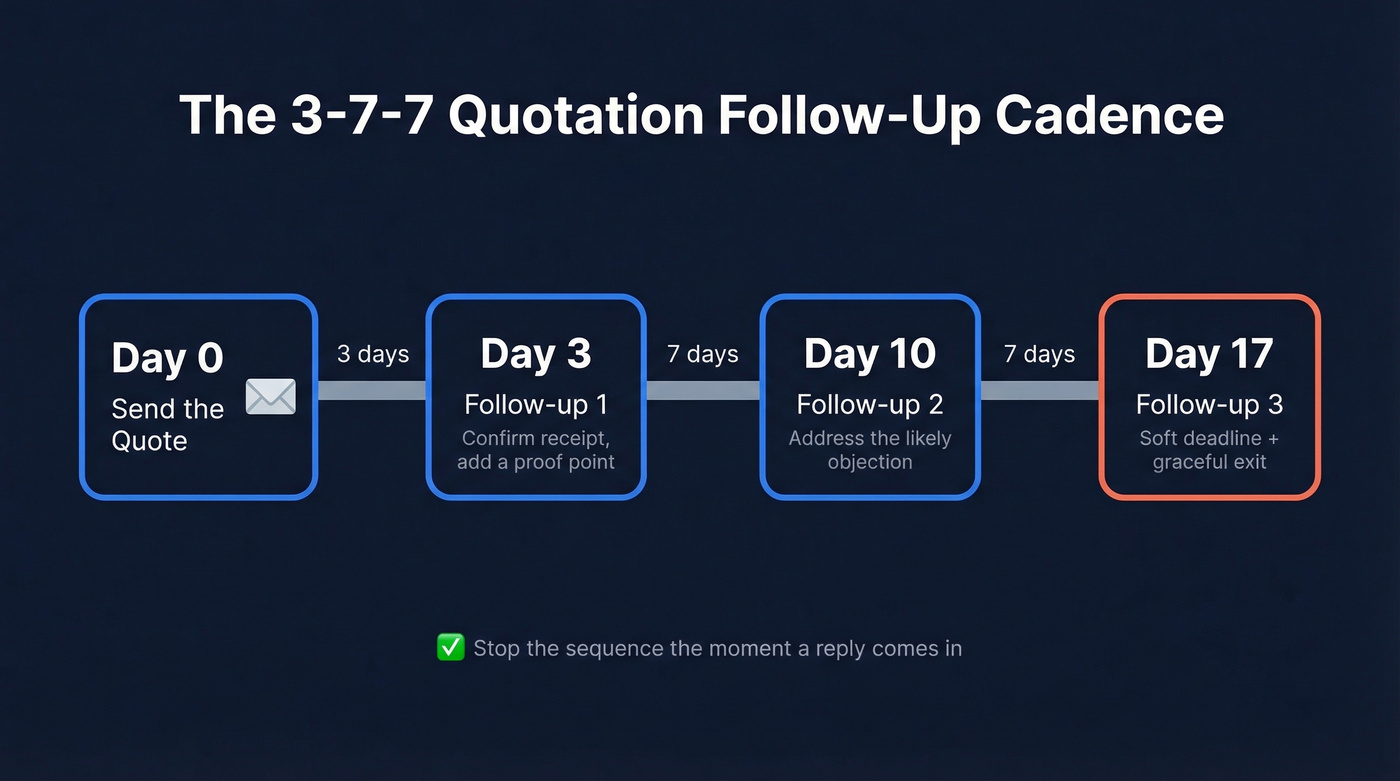
- Day 0: Send the quote
- Day 3: Follow-up #1 - confirm receipt, add a proof point
- Day 10: Follow-up #2 - address the likely objection
- Day 17: Follow-up #3 - soft deadline + graceful exit
Belkins' dataset makes the pattern clear: the highest reply rate (8.4%) comes from the first email, and each follow-up delivers diminishing returns while complaint risk climbs. That's why every follow-up needs to carry new value. No exceptions.
For construction teams specifically, follow up in 3-5 days for small contracts and about a week for larger projects. In that industry, follow-up accounts for roughly 25% of the win rate - price is 50%, relationships 25%. Whether you're sending an estimate follow up email for a remodel job or a six-figure commercial bid, the same timing principles apply.
If email isn't getting traction, switch channels. Belkins also found a "message + visit combo" can hit an 11.87% reply rate, which is worth adding as a parallel touch.
7 Quote Follow Up Templates You Can Copy
Keep each follow-up between 50 and 125 words - long enough to add value, short enough to get read. When possible, send each one as a reply to your original quote email so the full context stays in one thread. Plain text usually beats heavy HTML templates.
Receipt Confirmation + Value Add (Day 3)
Subject: Quick note on [Project/Product Name]
Hi [Name],
Wanted to make sure the quote landed and nothing looked off. While you're reviewing, I thought this might help - [Client in similar industry] saw a 30% reduction in [relevant metric] after implementing this same setup. Happy to walk through the numbers if that's useful.
[Your name]
Objection Preemption (Day 10)
Subject: One thing worth flagging on pricing
Hi [Name],
Teams comparing options at this stage usually have two questions: "Can we get this cheaper?" and "What's the ROI timeline?" On the first - the quote includes [specific value item]. On the second - most clients see payback within [timeframe]. Want me to build a quick ROI model for your team?
Quote Expiration Reminder
Subject: Pricing holds through [date]
Hi [Name],
Quick heads-up - the pricing in our quote is locked through [expiration date]. After that, [specific reason: material costs adjust / new pricing tier kicks in]. No pressure, but wanted to flag it so there aren't surprises. Anything I can clarify to help move things along?
Breakup / Final Follow-Up (Day 17)
Subject: Should I close this out?
Hi [Name],
I don't want to be the person clogging your inbox. If the timing isn't right or you've gone another direction, totally understood - no hard feelings. If things change down the road, I'm easy to find. Otherwise, I'll assume we're tabling this for now.
In our experience, the breakup email generates more replies than the second follow-up. Something about giving people permission to walk away makes them re-engage. We've seen it happen dozens of times.
No-Response Gentle Nudge (Alternate Day 10)
Subject: Still making sense?
Hi [Name],
I know these decisions take time, especially when multiple people are involved. Is there anything on the quote that needs adjusting, or a question I can answer to make the decision easier?
Use this instead of the objection preemption template when you genuinely don't know what's holding them up.
Proposal Accepted - Next Steps
Subject: Let's get started - next steps
Hi [Name],
Glad we're moving forward. Here's what happens next: [Step 1], [Step 2], [Step 3]. I'll send the [contract/onboarding form] by end of day. Any questions before we kick off?
Proposal Rejected - Learning + Re-engagement
Subject: Appreciate the update
Hi [Name],
Thanks for letting me know. If you're open to it, I'd love to hear what tipped the decision - that feedback genuinely helps. And if anything changes on your end, the door's always open. Wishing you a smooth rollout with [chosen vendor].

That perfect Day 3 follow-up won't matter if it bounces. Prospeo delivers 98% email accuracy with 5-step verification - so your quotation follow-ups land in the inbox, not the void. At $0.01 per email, one verified contact costs less than the coffee you're drinking while waiting for a reply.
Stop following up with dead email addresses. Verify before you send.
Subject Lines That Get Opened
Here's the thing: 69% of recipients decide to mark an email as spam based on the subject line alone. Get this wrong and your template never gets read.
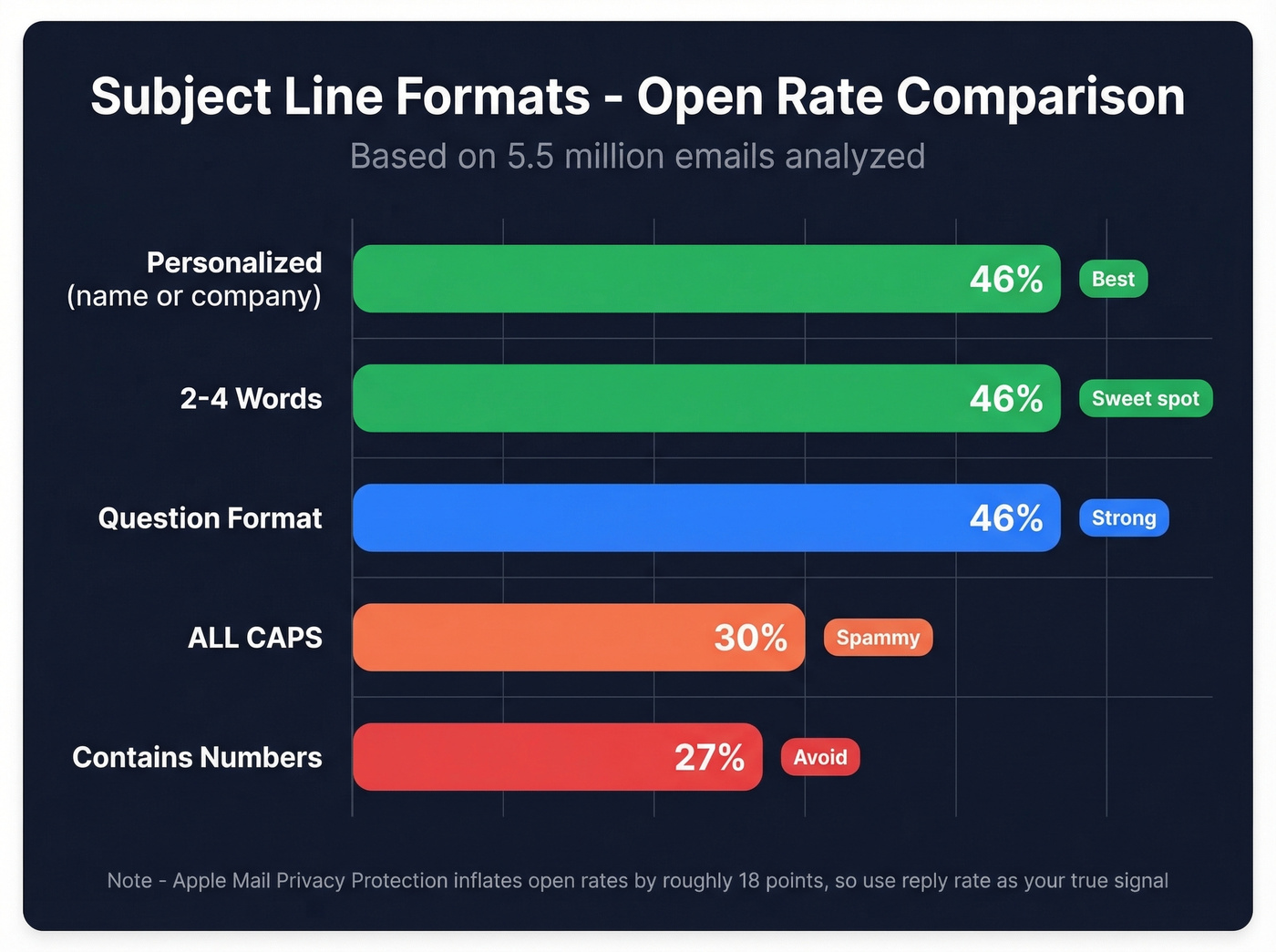
A study of 5.5 million emails found these patterns:
| Format | Open Rate | Verdict |
|---|---|---|
| Personalized (name/company) | 46% | Best performer |
| 2-4 words | 46% | Sweet spot |
| Question format | 46% | Strong |
| Contains numbers | 27% | Avoid |
| ALL CAPS | 30% | Spammy - skip |
One caveat worth knowing: Apple Mail Privacy Protection inflates open rates by roughly 18 points across the board, so treat reply rates as your true signal.
Front-load meaning into the first 33 characters - that's all most mobile clients display. Quote-specific subject lines that work:
- Quick note on [Project Name]
- Pricing holds through Friday
- One thing on the proposal
- Should I close this out?
- Still making sense?
- Revised numbers for [Company]
- Before I close the file
- Worth revisiting?
"Following up" and "Quick question" are low-signal. Retire them.
5 Mistakes That Kill Your Quotation Follow-Up
Empty bumps with no new info. "Just making sure you saw this" adds zero value. Every follow-up needs a new proof point, objection answer, or deadline. Period.
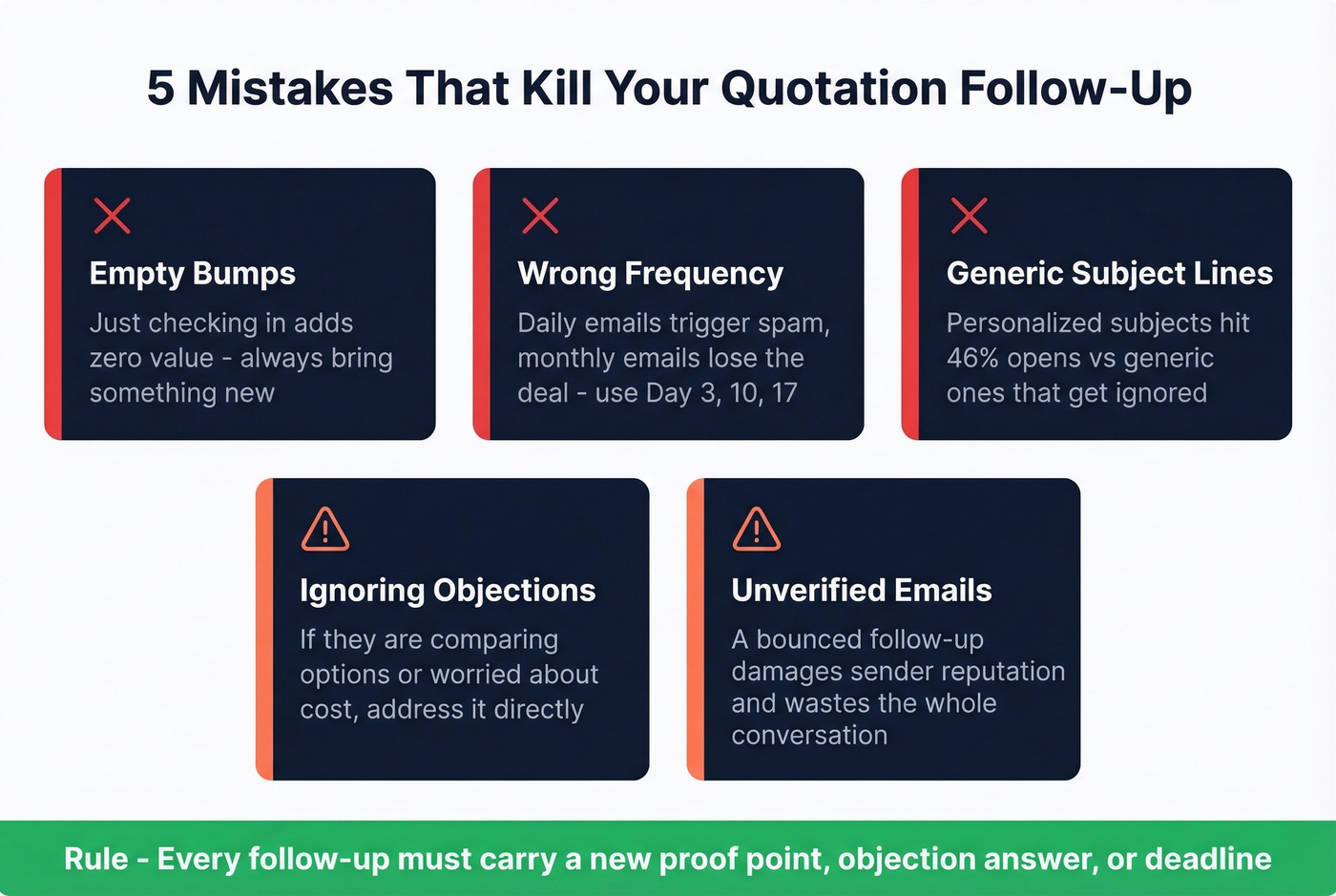
Wrong frequency. Too aggressive (daily emails) triggers spam complaints. Too passive (one email, then silence for a month) loses the deal. The Day 3 / Day 10 / Day 17 cadence is a clean middle ground that we've seen work across SaaS, services, and construction quotes alike.
Generic subject lines. Personalized formats hit roughly 46% opens in large datasets. Vague subject lines get ignored or flagged.
Not addressing the likely objection. If you know they're comparing options or worried about cost, say so. Ignoring the elephant in the room doesn't make it leave.
Sending to an unverified email that bounces. This one's frustrating because it's entirely preventable. A follow-up that bounces is worse than no follow-up - it damages your sender reputation and wastes the entire sales conversation. Prospeo verifies emails with 98% accuracy on a 7-day refresh cycle, so your sequence actually lands where it's supposed to.
Let's be honest about deal size, too: if your average deal is under $5k, three follow-ups is your ceiling. Anything beyond that costs more in rep time than the deal is worth. Save the five-touch sequences for enterprise deals where a single close pays for the effort.
Automate the Sequence
Don't rely on memory. Set up a CRM trigger: when a deal moves to "Quote Sent," fire the sequence automatically. Wait 3 days, send follow-up #1, wait 7 days, send #2, wait 7 more days, send #3. Stop the workflow the moment a reply comes in.
If you want a broader library beyond quotation-specific messages, keep a swipe file of sales follow-up templates you can adapt by deal stage.
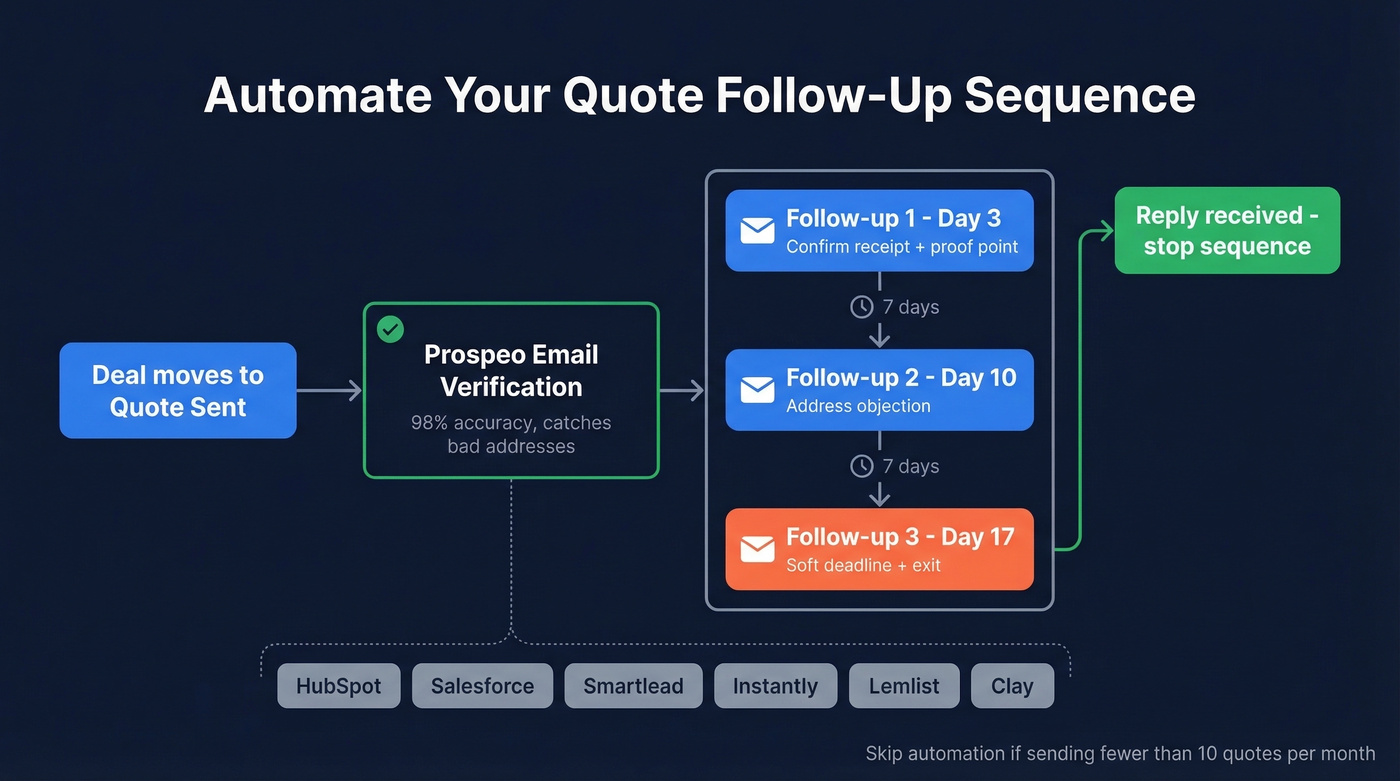
Prospeo integrates natively with HubSpot, Salesforce, Smartlead, and Instantly, so verified contacts flow directly into your follow-up sequences without manual exports. If you're running sequences through Lemlist or Clay, those work too.
If deliverability is a recurring issue, it’s worth tightening your email deliverability basics and monitoring email bounce rate benchmarks as you scale.
Skip the automation step if you're sending fewer than 10 quotes a month - at that volume, a calendar reminder and manual sends are fine. Automation pays off when you're juggling 20+ open quotes and can't afford to let any slip through the cracks.
Sending to an unverified email that bounces kills your follow-up sequence and your domain reputation. Prospeo's proprietary verification catches bad addresses, spam traps, and catch-all domains before you hit send. Teams using Prospeo cut bounce rates from 35% to under 4%.
Your quotation deserves an inbox that exists. Verify every contact first.
FAQ
How many follow-ups should I send after a quote?
Three. Belkins' 16.5M-email dataset shows 4+ emails in a sequence more than triple unsubscribe and spam complaint rates. Three emails - each carrying a new proof point, objection answer, or deadline - outperform longer drip sequences every time.
How long should I wait before following up on a quotation?
Three business days for the first touch. The Day 3 / Day 10 / Day 17 cadence balances urgency with patience and works whether you're following up on a SaaS deal, a freelance project, or a construction estimate.
What should I write in a follow up email after sending a quotation?
Lead with something new - a case study, an objection answer, or a deadline. Never send a bare "checking in" with no added value. The templates above give you copy-paste starting points for every stage of the conversation.
Can I use the same templates for an estimate follow up email?
Yes. An estimate follow up email follows the same structure - confirm receipt, add a proof point, then address objections. Just swap "quote" for "estimate" in your subject line and body copy so it matches what the prospect expects to see.
What tools help ensure my follow-up emails actually deliver?
Email verification before you send is the single highest-ROI step. Prospeo's free tier includes 75 email verifications per month - enough to validate a small pipeline of quote recipients before you hit send. Paired with a CRM sequence, verified contacts mean fewer bounces and a healthier sender reputation.