

Forager vs QuickEnrich: Which Enrichment Tool Wins in 2026?
Two newer enrichment tools, two very different strengths, and almost zero third-party reviews to guide you. If you're weighing Forager against QuickEnrich, the split is straightforward: Forager bets big on mobile numbers, while QuickEnrich undercuts most tools on unit cost for found emails. Here's how they stack up - and why a third option might beat both.
30-Second Verdict
Choose Forager if you need mobile numbers at scale. Its database covers 200M+ mobile phone numbers, making it the phone-first pick for cold calling teams.
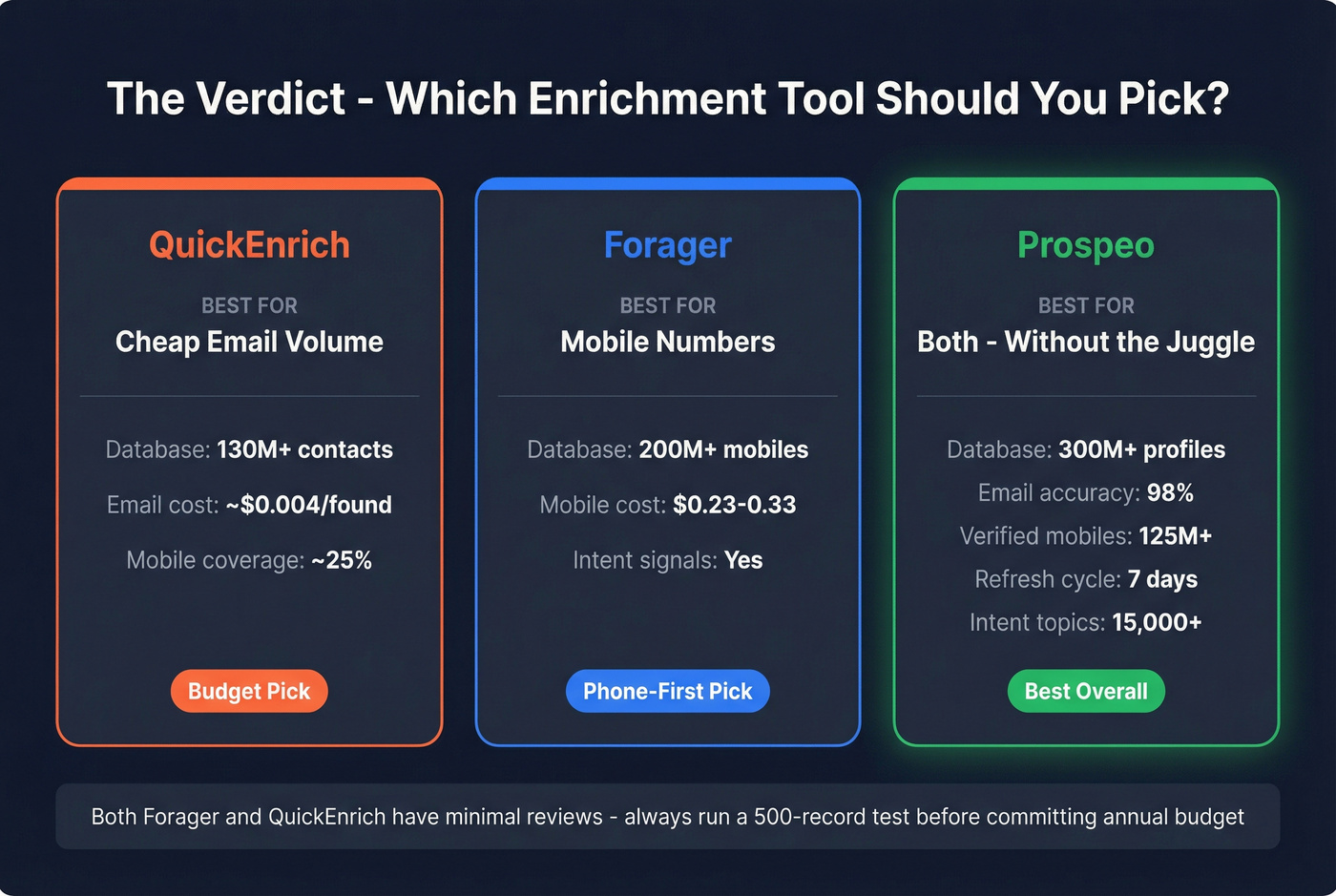
Choose QuickEnrich if you're optimizing for email volume on a budget. At roughly $0.004-$0.00483 per found email/phone on its monthly plans, the unit economics are hard to beat.
Both Tools at a Glance
What Is Forager?
Picture a team of 10 SDRs burning through dial lists. That's who Forager built for. The platform's database covers 200M+ mobile phone numbers with clear phone-first positioning, plus it supports people enrichment, company data, and job data.
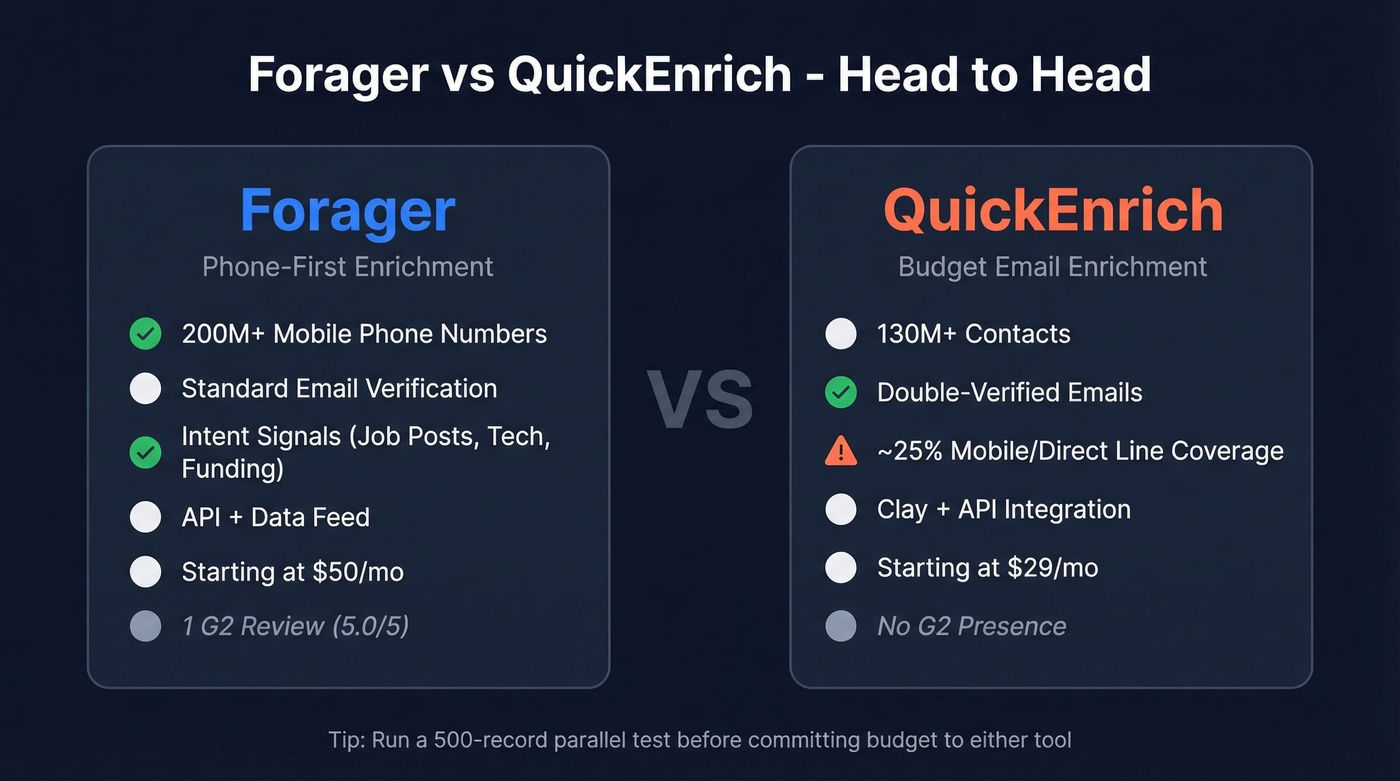
Forager offers an API for real-time people/company data retrieval and a data feed for bulk ingestion. The credit structure matters here: a successful mobile lookup costs 15 credits, a successful email lookup costs 5. Your effective cost per record swings hard depending on what data types you pull.
If you're evaluating providers beyond these two, start with this roundup of data enrichment services.
What Is QuickEnrich?
At $29/month for 6,000 found emails or phones, QuickEnrich is one of the cheapest ways to enrich a contact list in 2026. The platform is built around what it calls Double Verified Emails - it runs multiple email verification tools including catchall and SMTP checks, excludes risky addresses, and provides a verification date so you can gauge recency.
The database covers 130M+ contacts with strong email domain coverage. Mobile coverage is more modest: QuickEnrich sets the expectation that roughly 25% of enriched contacts include mobile numbers or direct lines. That's honest positioning, but it means you'll often need a second source for dial-heavy workflows. It integrates with Clay and offers a clean API.
Feature Comparison
| Feature | Forager | QuickEnrich | Winner |
|---|---|---|---|
| Database size | 200M+ mobile phone numbers | 130M+ contacts | Forager |
| Email verification | Standard | Double-verified | QuickEnrich |
| Mobile coverage | 200M+ mobile phone numbers | ~25% of contacts include mobile/direct lines | Forager |
| Data refresh | Not public | Date stamped | QuickEnrich |
| Intent data | Intent signals (job posts, tech adoption, funding) | None | Forager |
| Key integrations | API + data feed | Clay, API | Tie |
| Market validation | 5.0/5 on G2 (1 review) | No G2 presence | Neither |
Both tools have minimal third-party validation. We'd recommend running a 500-record parallel test - measuring match rate, bounce rate after send, and mobile connect rate - before committing budget to either.
If you're building a broader outbound stack, compare other SDR tools that pair well with enrichment.

Why manage two vendors when one covers both? Prospeo delivers 300M+ profiles with 98% email accuracy and 125M+ verified mobiles - on a 7-day refresh cycle. That's Forager's mobile depth plus QuickEnrich's email volume, without the vendor juggle.
Replace two enrichment tools with one that actually verifies its data.
Pricing Breakdown
Forager plans:
| Plan | Price/mo | Mobiles | Emails | Unit cost |
|---|---|---|---|---|
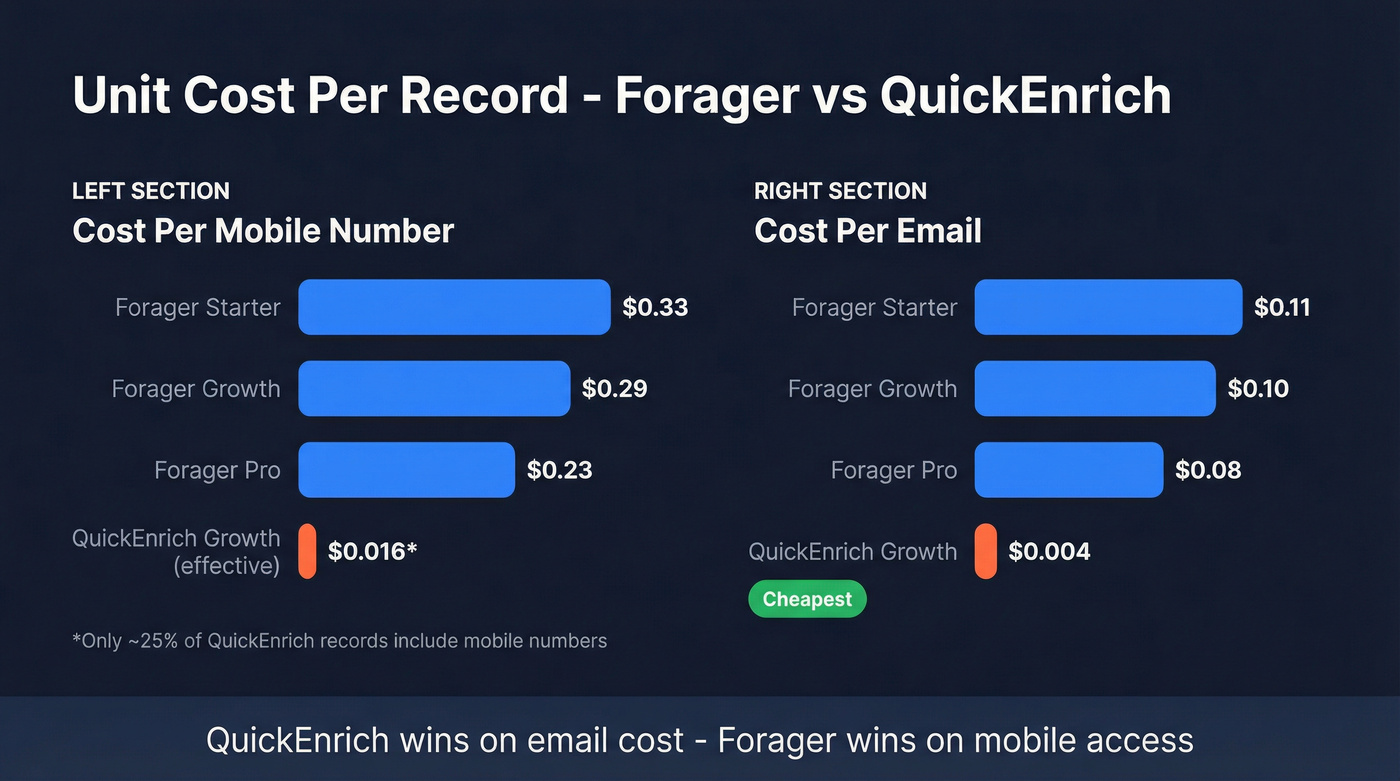
| Starter | $50 | 150 | 450 | $0.33/mobile, $0.11/email |
| Growth | $100 | 350 | 1,050 | $0.29/mobile, $0.10/email |
| Pro | $250 | 1,080 | 3,240 | $0.23/mobile, $0.08/email |
QuickEnrich plans (monthly):
| Plan | Price/mo | Found Emails or Phone | $/found |
|---|---|---|---|
| Starter | $29 | 6,000 | ~$0.00483 |
| Growth | $99 | 25,000 | ~$0.004 |
Here's the thing: QuickEnrich's pricing is genuinely cheap. But with only about 25% of enrichments including a mobile or direct line, your effective cost per mobile comes out closer to $0.016 on the Growth plan. If you need mobiles, Forager's phone-first approach can justify the premium.
If your main pain is bounces, it’s worth benchmarking against dedicated email verification options too.
Where Each Fits in a Waterfall
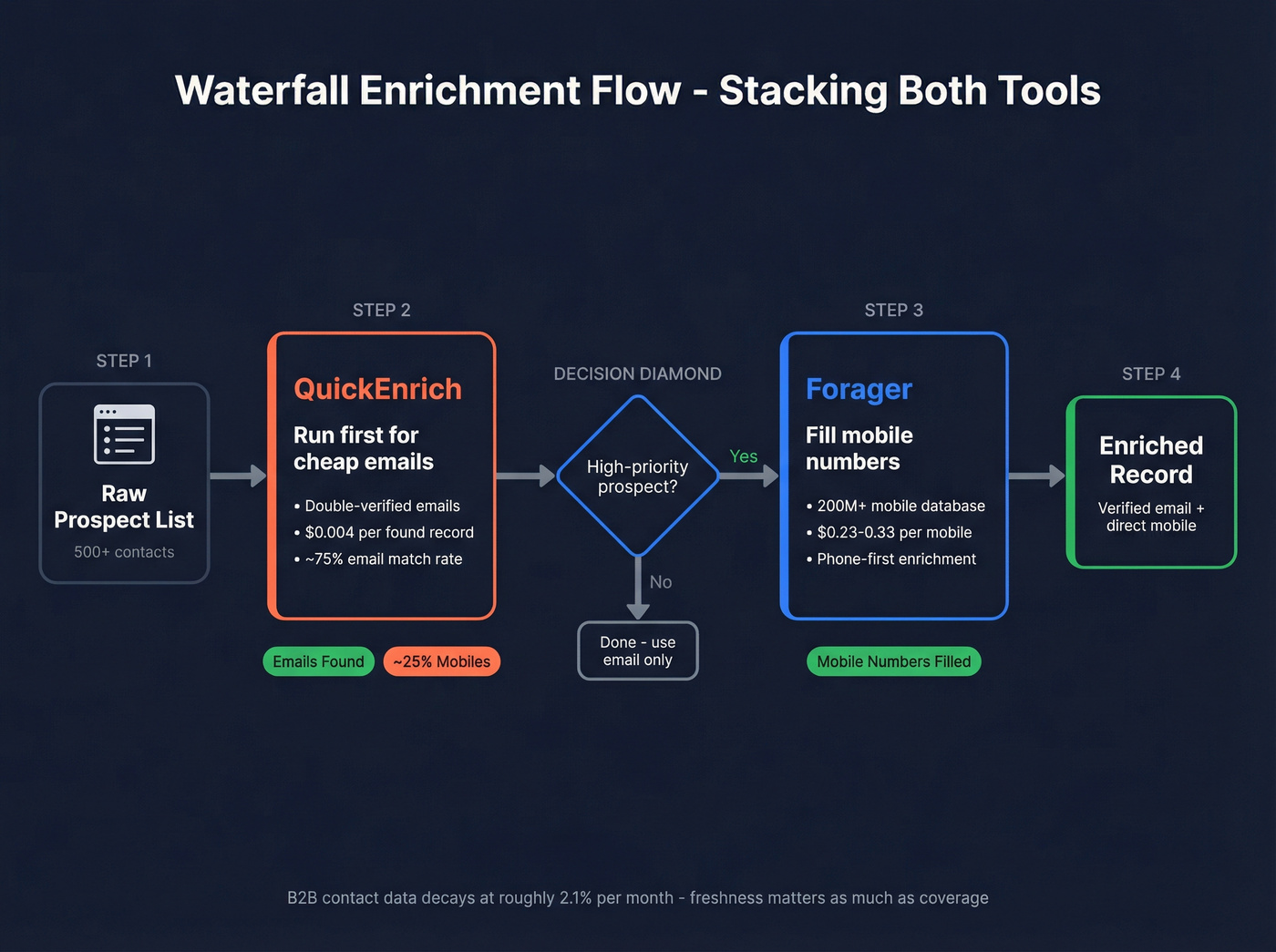
Relying on a single enrichment source typically leaves 40-60% of qualified prospects unreachable, which is why modern teams run waterfall enrichment - querying multiple providers in sequence until verified info is found. B2B contact data decays at roughly 2.1% per month, so freshness and verification matter as much as raw database size.
The practical sequence: run QuickEnrich first for cheap email coverage, then use a phone-first provider like Forager to fill mobile numbers on high-priority prospects.
If you’re formalizing this process, a documented lead generation workflow helps keep routing consistent across teams.
Let's be honest - if your average deal size is under $10K, you probably don't need Forager's mobile depth. QuickEnrich emails plus a basic dialer will get you 80% of the way there. Save the mobile budget for enterprise accounts where a direct dial actually moves the needle.
If you’re scaling phone-first outbound, build a repeatable cold calling system so the data actually turns into connects.
A Third Option Worth Testing
We've tested a lot of enrichment tools across our own outbound workflows, and the biggest frustration with stacking niche providers is managing two vendors, two billing cycles, and two sets of API docs for what should be one job. If you want both use cases covered in a single platform, Prospeo spans 300M+ profiles with 98% email accuracy and 125M+ verified mobiles on a 7-day refresh cycle. Add intent data across 15,000 topics, native integrations with Salesforce, HubSpot, Smartlead, Clay, Instantly, and Lemlist, and you get the coverage of both tools without the vendor juggle. No contracts, transparent pricing, and a free tier to test.
If you want more context on how enrichment impacts targeting, see this guide to lead enrichment.

Running a waterfall with Forager and QuickEnrich still leaves gaps. Prospeo's 92% API match rate and 30% mobile pickup rate mean fewer empty records and fewer providers to manage. At ~$0.01/email, the unit economics compete with QuickEnrich - with far stronger verification.
Get enterprise-grade enrichment without stacking niche tools.
Verdict
Best for cheap email volume: QuickEnrich. At roughly $0.004 per found email/phone on its Growth plan, the unit economics win for high-volume list building.
Best for mobile numbers: Forager. 200M+ mobile phone numbers beats QuickEnrich's 25% mobile/direct-line coverage decisively.
Best overall: Prospeo. Broader database, faster refresh, stronger verification, and 15,000+ companies already using it. In a waterfall stack, QuickEnrich handles cheap email coverage and Forager fills mobile gaps - but if you'd rather consolidate into one vendor, Prospeo covers both. Given both Forager and QuickEnrich have minimal reviews, test before you commit annual budget.
FAQ
Is Forager or QuickEnrich better for mobile numbers?
Forager wins decisively with 200M+ mobile phone numbers versus QuickEnrich's roughly 25% mobile/direct-line hit rate. If phone-first outbound is your strategy, Forager is the clear pick.
Can I use both tools together?
Yes - both offer APIs, making them easy to stack in a waterfall enrichment setup. Run QuickEnrich first for cheap emails, then Forager for mobile fills on priority prospects. Tools like Clay can orchestrate this sequence automatically.
How do I test enrichment quality before committing?
Run a 500-record parallel test across all providers you're evaluating. Measure three things: match rate (records returned vs. submitted), bounce rate after sending to returned emails, and mobile connect rate on returned phone numbers. That data beats any marketing claim. We've found this approach saves teams thousands in wasted annual contracts.