


Forager vs SignalHire: Which B2B Data Tool Wins in 2026?
Forager vs SignalHire is like comparing data plumbing to a Chrome extension. One's built for teams piping contact data into a warehouse via API and bulk feeds. The other's built for individual reps and recruiters who want to pull up an email in two seconds flat. The real difference isn't database size - it's whether you're building infrastructure or doing one-off lookups.
30-Second Verdict
Side-by-Side Comparison
| Database | 300M+ profiles | 850M+ profiles | 850M+ profiles |
| Email accuracy | 98% | ~95% | 95%+ (G2 disputes this) |
| Refresh cycle | 7 days | Bi-weekly | 7-10 days |
| Starting price | $0 (free tier) | $50/mo | $0 (free tier) |
| Credit model | ~$0.01/email; 10 credits/mobile | 15 credits/mobile; 5 credits/email | 1 credit per contact |
| Seats | Self-serve credits | Per-plan | Unlimited users, shared pool |
| Integrations | Salesforce, HubSpot, Clay, Zapier, Make | API, bulk data feed | Salesforce, Pipedrive, Zoho Recruit, ATS, extension |
| G2 rating | - | 5.0 (1 review) | 3.7 (56 reviews) |
| Best for | Accuracy & freshness | API pipelines | Browser-based lookups |
Forager Overview
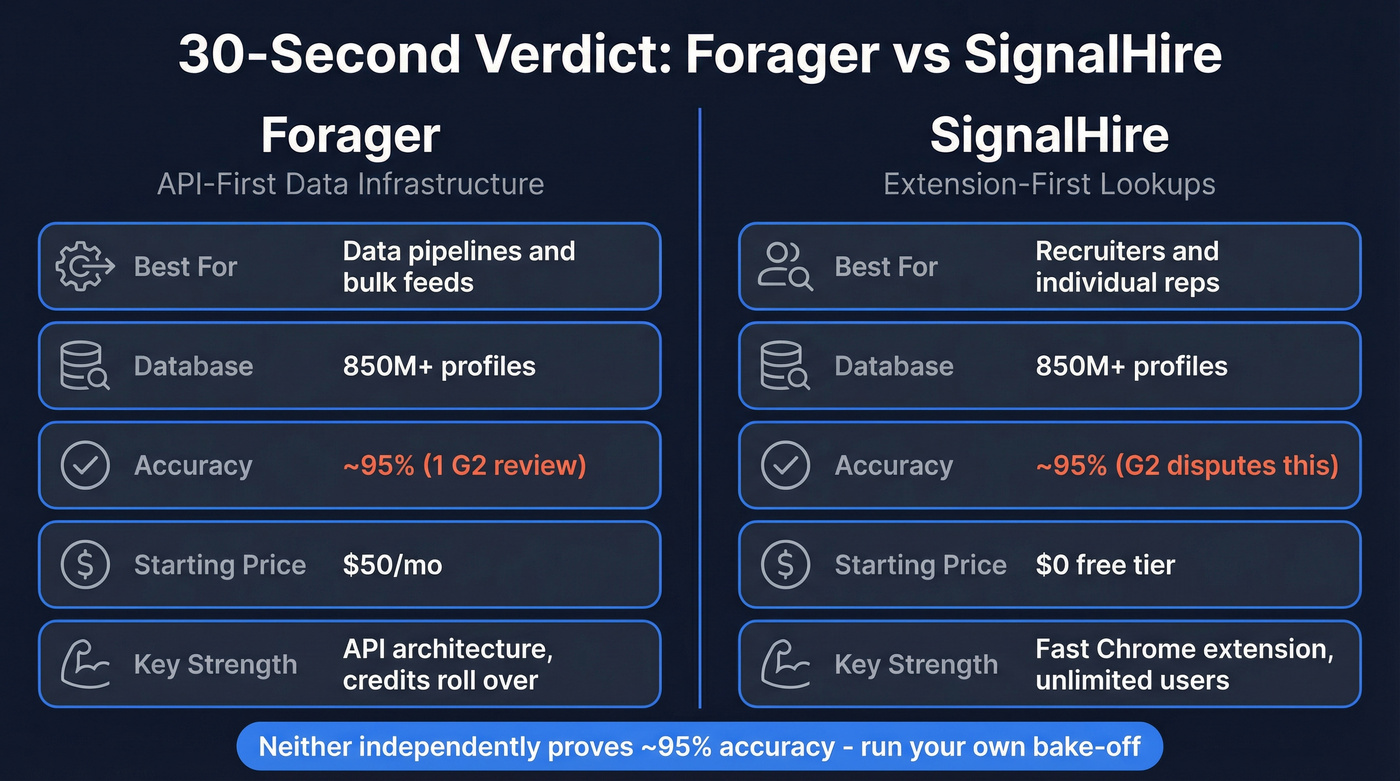
Forager positions itself as a real-time B2B data engine for teams that think in terms of APIs and data pipelines, not Chrome extensions. The database covers 850M+ profiles and 65M+ companies, with records refreshed bi-weekly and a validation pipeline targeting ~95% accuracy. The credit structure is unusual: 15 credits per successful mobile lookup, 5 per successful email, and credits roll over with no expiry.
Pricing starts at $50/mo for the Starter plan (2,250 credits), which works out to up to 150 mobiles/month and 450 emails/month. Growth runs $100/mo, Pro hits $250/mo, and annual billing knocks 10% off.
Here's the thing about Forager's G2 rating: 5.0/5 from a single review isn't validation. It's a sample size of one.
Use this if you're building enrichment workflows via API or ingesting contact data via bulk feeds into your data stack. The architecture is designed for data infrastructure teams, not individual reps.
Skip this if you want a simple browser extension workflow or need strong independent validation of accuracy. There's almost no third-party review data to lean on.
SignalHire Overview
SignalHire is the opposite play - extension-first, designed for recruiters and individual reps who need a contact fast. The Chrome extension is the core product, and it's genuinely quick. SignalHire's own analysis puts extension accuracy at 96% with 2-5 second lookups, and G2 reviewers consistently praise the ease of use and speed of contact discovery. The database covers 850M+ profiles and 30M+ companies with a 7-10 day refresh cycle, and SignalHire claims it finds emails for up to 90% of profiles and phones for up to 80%.

The free plan gives you 5 credits per month (10 if you install the extension). One credit unlocks one contact, but only if at least one email or phone number is returned - you don't burn credits on empty lookups. Emails-only and Phones-only plans start at $69/mo monthly or $57/mo billed annually. The combined Emails & Phones plan runs $139/mo monthly or $110/mo on annual billing.
Then there's the "Unlimited" plan at $167/mo billed annually. Read the fine print: it's capped at 5,000 credits per month under a fair-usage policy. That's not unlimited. That's marketing.
Paid tiers include API access, team management, CSV enrichment/export, ATS/CRM integrations, and shared credits. The Unlimited package also includes unlimited users sharing a single credit pool - a real differentiator for teams that don't want per-seat pricing.
Now, SignalHire's published numbers look strong, but the G2 reviews tell a different story. At 3.7/5 from 56 reviews, common complaints include outdated data, incomplete records, and inconsistent phone hit rates. Bulk enrichment caps at 1,000 contacts per run, and the built-in email sequences are basic compared to dedicated tools like Outreach or Salesloft.
Use this if you're a recruiter or individual rep who needs fast lookups via a browser extension and doesn't mind the credit constraints.
Skip this if you need reliable phone data at scale or plan to run bulk enrichment workflows. The accuracy complaints on G2 are hard to ignore.

Neither Forager nor SignalHire can independently prove their ~95% accuracy claims - and G2 reviewers keep flagging outdated records. Prospeo's 5-step verification pipeline delivers 98% email accuracy with a 7-day refresh cycle, so your sender reputation stays clean and your outbound actually lands.
Stop gambling your domain reputation on unverified ~95% claims.
Key Differences Explained
Data Accuracy
Both tools target ~95% accuracy, but neither has strong independent proof. SignalHire says 95%+ email accuracy and publishes a 3-5% bounce rate figure, yet G2 reviews flag outdated and incomplete records as a recurring theme. Forager's validation pipeline targets ~95% but has essentially zero independent verification.
We've seen extension-first tools look great on single lookups but fall apart on bulk enrichment. If deliverability matters to your outbound - and it should, because your domain reputation is on the line - don't accept ~95% as good enough. The gap between 95% and 98% verified accuracy is the difference between a healthy sender reputation and the spam folder.
Mobile Number Quality
Forager positions mobile validation as high-accuracy, but there's little independent verification to back it up. SignalHire's phone hit rates are inconsistent according to G2 review themes and one detailed SoftwareCurio analysis, with accuracy varying significantly by geography - stronger in North America and Western Europe, weaker elsewhere.

If verified mobiles are your priority, neither tool should be your primary source. A 30% pickup rate on 125M+ verified numbers beats a larger database where half the numbers ring out.
Pricing & Credit Economics
The math here is worth doing carefully.
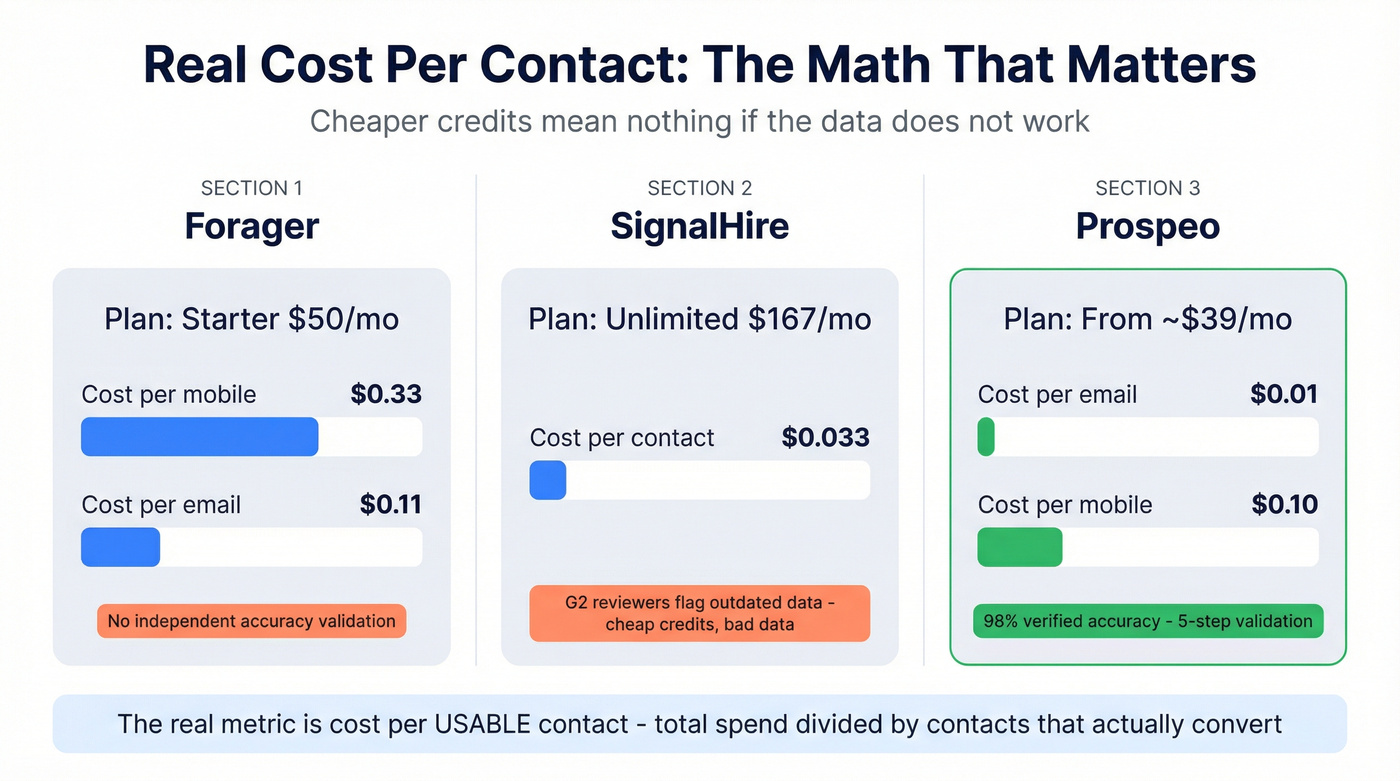
Forager's Starter plan gives you 2,250 credits for $50/mo - roughly $0.33 per mobile and $0.11 per email. SignalHire's "Unlimited" plan at $167/mo with 5,000 credits lands around $0.033 per contact, which looks cheaper on paper. But when G2 reviewers are flagging data quality issues, cheap credits that return bad data aren't actually cheap. You're paying per contact found, not per contact that works.
SignalHire's unlimited-users model does make it more cost-effective for teams - you share one credit pool instead of paying per seat. For a 5-person recruiting team, that's a meaningful advantage over per-seat tools.
Integrations & Architecture
These tools are built for different buyers entirely.
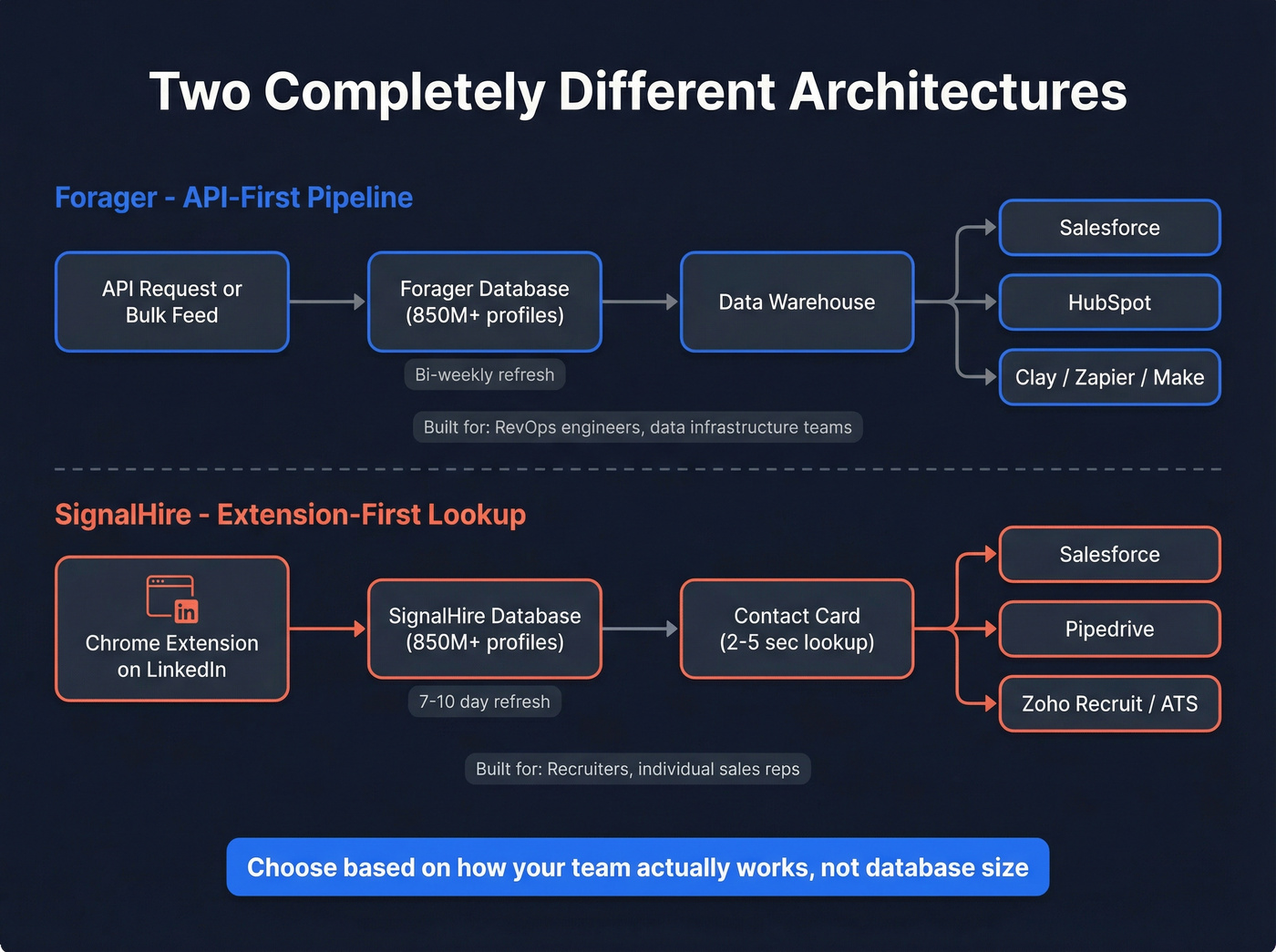
Forager is API-first with bi-weekly refresh cycles and bulk feeds - it's a data infrastructure play for teams that build pipelines. SignalHire integrates with Salesforce, Pipedrive, Zoho Recruit, Recruitee, and ActiveCampaign, with the browser extension as the primary interface and API access on paid tiers.
If you're a RevOps engineer, Forager's architecture makes sense. If you're a recruiter working in a CRM all day, SignalHire's extension-first approach is more practical. For teams that need a system-of-record feed into a warehouse, SignalHire is the wrong architecture. For those who prospect mainly from the browser, Forager is overkill.
Compliance & Data Rights
Both tools operate in the B2B data space where GDPR and CCPA compliance matter. SignalHire publishes compliance information and supports data subject rights including access, correction, deletion, and the right to be forgotten, plus opt-out mechanisms. Forager's compliance posture is less publicly documented. Before committing to either, confirm DPA availability and data-source transparency - especially if you sell into the EU.
How to Run Your Own Bake-Off
Don't trust vendor accuracy numbers. We've run this exercise ourselves dozens of times, and it's the fastest way to cut through the marketing. Take 100 leads from your ICP and measure what actually matters:
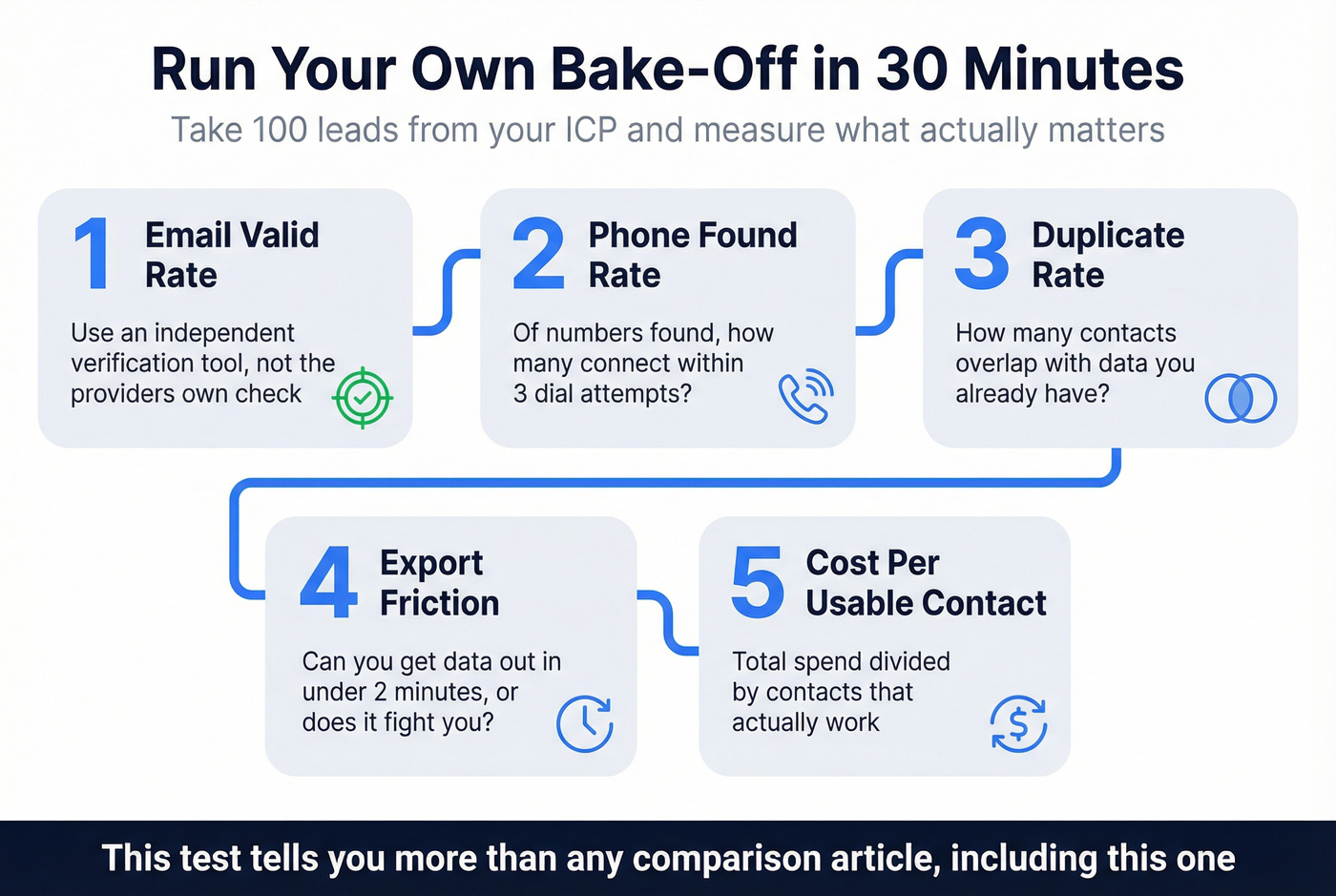
- Email valid rate - send through an independent verification tool, not just the provider's own check
- Phone found rate - and of those, how many connect within 3 dial attempts
- Duplicate rate - how many contacts overlap with data you already have
- Export friction - can you get data out in under 2 minutes, or does it fight you
- Cost per usable contact - total spend divided by contacts that actually work
This test takes 30 minutes and will tell you more than any comparison article, including this one.
Quick Decision Tree
You're ingesting data into a warehouse or building API enrichment workflows - Forager.
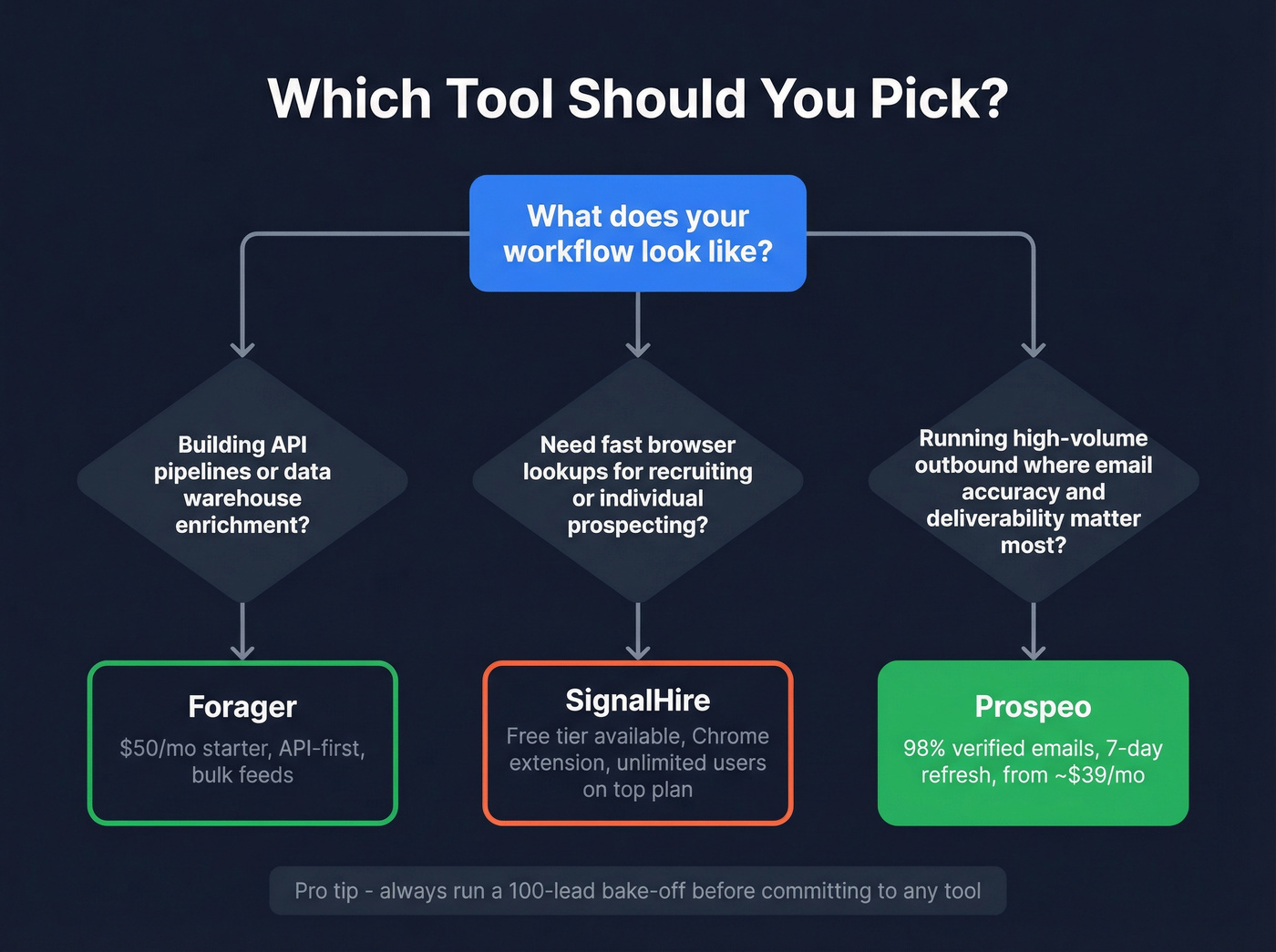
You're a recruiter doing 20 lookups a day from your browser - SignalHire.
Your deal sizes are small and you're running high-volume outbound - don't pay $139+/mo for a contact tool. Start with a free tier, prove ROI, then scale.
Worth Considering: Prospeo
If neither tool wins your bake-off on email accuracy, it's worth testing Prospeo against both. The database covers 300M+ profiles with 143M+ verified emails and 125M+ verified mobile numbers, all on a 7-day refresh cycle compared to the 6-week industry average. Email accuracy runs 98% through a proprietary 5-step verification process with catch-all handling, spam-trap removal, and honeypot filtering. The platform adds 30+ search filters and intent signals across 15,000 topics, plus API enrichment with a 92% match rate.

The free tier includes 75 verified emails and 100 Chrome extension credits per month - no credit card, no contract. Paid plans scale from ~$39/mo with self-serve pricing. To put the accuracy difference in context: Meritt tripled pipeline from $100K to $300K/week and dropped bounce rates from 35% to under 4% after switching to verified data.
If you're comparing vendors beyond these two, start with a broader list of data enrichment services and narrow down by your workflow.
Forager charges $0.33/mobile with no independent validation. SignalHire's phone hit rates are inconsistent across geographies. Prospeo gives you 125M+ verified mobile numbers with a 30% pickup rate at $0.10/number - and you only pay when a number is found.
Get mobile numbers that actually pick up, starting at $0.01/email.
Final Verdict
Forager for API-first data infrastructure teams who need bulk feeds and bi-weekly refresh cycles. SignalHire for individual reps and recruiters who want a fast browser extension with shared team credits. There's surprisingly little community chatter comparing these two directly - most public feedback is concentrated on G2 for SignalHire, and Forager barely registers.
Let's be honest: every vendor in this space targets 95%+ accuracy and 800M+ profiles. The real question isn't who has the biggest database - it's whether the data actually works when it hits your sequences. Test all three against your ICP list before committing. Measure usable-contact rate (valid email + reachable phone), not raw "contacts found."
If you're building a bigger outbound stack, it helps to benchmark against the best sales prospecting databases and the broader set of SDR tools.
FAQ
Is Forager or SignalHire better for mobile numbers?
Neither has strong independent validation for phone data. Forager claims high mobile accuracy but has almost no third-party reviews to verify it. SignalHire's phone hit rates are inconsistent per G2 reviewers, especially outside North America and Western Europe.
Does SignalHire really have an unlimited plan?
No. The $167/mo "Unlimited" plan is capped at 5,000 credits per month under a fair-usage policy. It does include unlimited user seats sharing that pool, which is genuinely useful for teams - but the credit cap means it's not unlimited in any meaningful sense.
Can I use Forager without an API?
Forager has a web interface for searching and exporting, but its core value proposition is API-first enrichment and bulk data feeds. If you want a Chrome extension workflow without touching APIs, SignalHire or Prospeo's extension (40,000+ users) are better fits for browser-based prospecting.
What's a good free alternative to both tools?
Prospeo's free tier gives you 75 verified emails and 100 Chrome extension credits monthly - no credit card required. That's significantly more generous than SignalHire's 5-10 free credits and covers Forager's gap entirely, since Forager doesn't offer a free plan at all. At 98% email accuracy, it's enough to run a real test campaign before committing budget.