

Formal Greetings in Email: You Need 5, Not 50
You're about to send something important and you don't want to blow it in the first line. That's the right instinct.
Most guides list 30-45 greeting options, as if you're browsing a buffet. That's a thesaurus, not a guide. You need five formal greetings in email and the judgment to pick the right one for the situation in front of you.
More than 250 billion emails are sent every day. Your opening line sets the tone for the entire exchange. A study by Waldvogel analyzing 515 workplace emails found that workplace culture - not status, not gender - is the primary driver of which salutations people use and expect. There's no universal "correct" greeting. There's only the right one for your context.
What Is a Professional Salutation?
A professional salutation is the opening line of a business email - the phrase that addresses your recipient before you get to the body of your message. It sets expectations for the entire exchange: how formal the conversation will be, how well you know the person, and how much effort you put into writing.
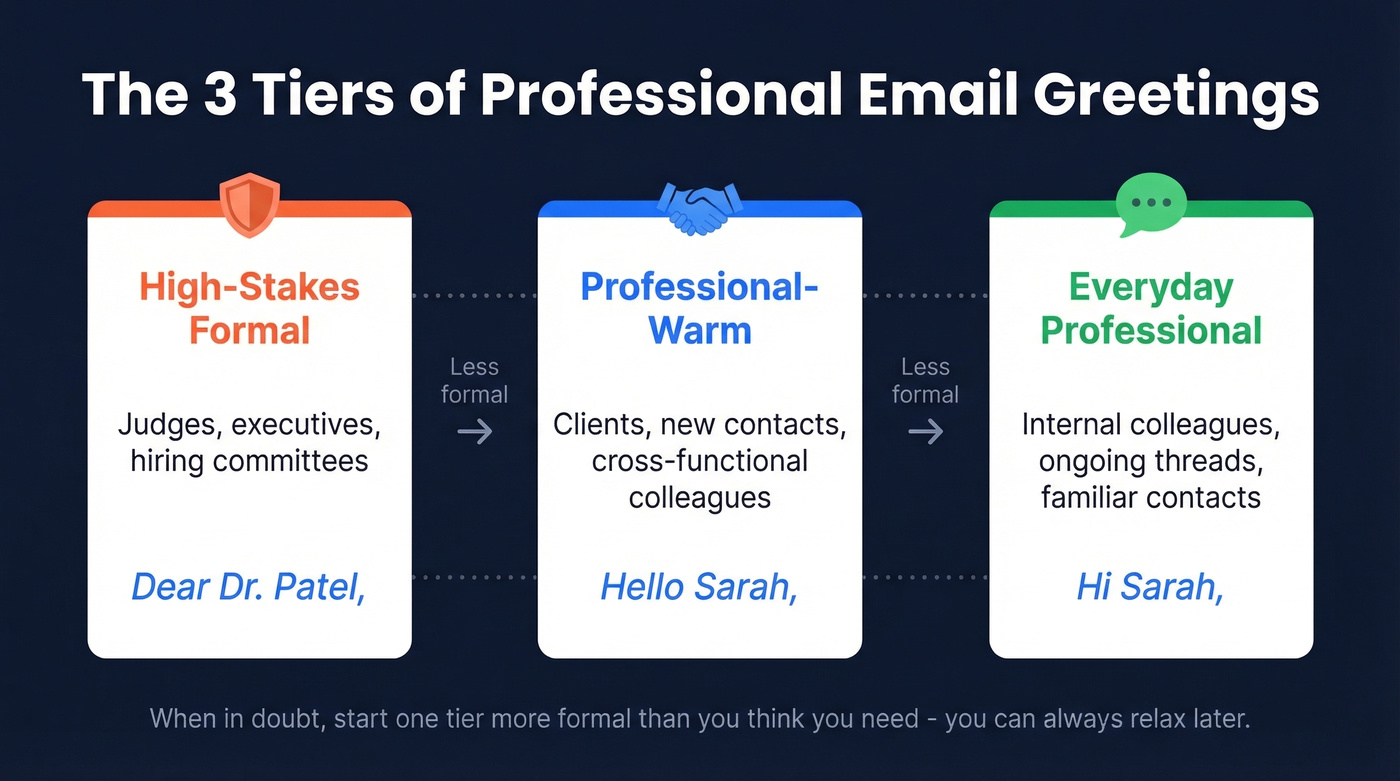
Three tiers cover most professional situations:
- High-stakes formal - judges, executives, hiring committees: "Dear [Title + Last Name],"
- Professional-warm - clients, new contacts, cross-functional colleagues: "Hello [First Name],"
- Everything else: "Hi [First Name],"
The rest of this guide handles the edge cases: unknown names, international recipients, cold outreach, job applications, and inclusive language.
The Research Behind Email Openings
This isn't just etiquette advice. There's actual data.
Marlow, Lacerenza, and Iwig ran a 2018 experiment with 288 participants, testing how email closings affect perceptions of professionalism. Closing choice measurably shifted how professional someone appeared - and the effect interacted with gender. Women who signed off with "Thanks!" were perceived as less professional than men who used the same closing. If closings carry that much weight, openings carry at least as much.
Waldvogel's study reinforced something we've seen in our own outreach: a manufacturing plant with open, positive relationships used extensive greetings and closings, while an educational organization with low morale barely used them at all. Your greeting isn't just politeness. It's a signal about the relationship you're proposing.
A peer-reviewed study in Business and Professional Communication Quarterly (with experiments run in 2019 and replicated in 2023) found that message timing cues didn't measurably change the impressions recipients formed from workplace emails. So don't overthink whether your "Good morning" arrives at 2 PM in their time zone. The greeting itself matters far more than the clock.
Complete List of Formal Email Greetings
Highly Formal
"Dear [Title + Last Name]," - Use this for courts, government officials, academia, and first contact with C-suite executives. It signals maximum respect and zero familiarity. "Dear Dr. Patel," "Dear Senator Williams," "Dear Mr. Nakamura."
"Dear [Full Name]," - When you know the name but aren't sure about preferred titles or honorifics, drop the title entirely. "Dear Jordan Chen" avoids misgendering and still reads as formal.
"Dear [Role/Department]," - When the name is genuinely unknown. "Dear Hiring Manager," "Dear Admissions Committee," "Dear Customer Support Team." Not ideal, but honest.
Professional-Formal
"Hello [First Name]," - Warm but professional. This has become the sweet spot for clients, partners, and new contacts where "Dear" feels stiff but "Hi" feels premature. We've found it's the safest default when you're unsure about the relationship.
"Good morning/afternoon," - Time-appropriate and polished. Research suggests recipients don't strongly judge send-time cues, so a "Good morning" that arrives later won't tank your credibility. If you're emailing across time zones regularly, "Hello" sidesteps the issue entirely.
Safe Default
"Hi [First Name]," - The modern business standard for most professional emails. "Hi" isn't unprofessional - it's efficient.
"Greetings," - Acceptable for group emails when you can't name everyone individually. A bit stiff for one-on-one correspondence, but it works in a pinch.
Punctuation matters. In American business writing, a comma is standard ("Dear Ms. Rodriguez,"). In highly formal contexts, a colon is also acceptable ("Dear Ms. Rodriguez:").
How to Choose: A Decision Framework
| Situation | Greeting | Why |
|---|---|---|
| First email to someone senior | Dear [Title + Last Name], | Shows respect; easy to relax later |
| Ongoing thread (3+ replies) | Drop the greeting entirely | Normal and expected; saves time |
| Unknown recipient name | Dear [Role/Department], | Find the name first if you can |
| Group email | Greetings, / Hello everyone, | Avoids naming some and missing others |
| Job application | Dear [Hiring Manager Name], | Proves you did the research |
| Cold outreach | Hello [First Name], | Personalization signals effort |
| Internal colleague | Hi [First Name], | Formality wastes everyone's time |
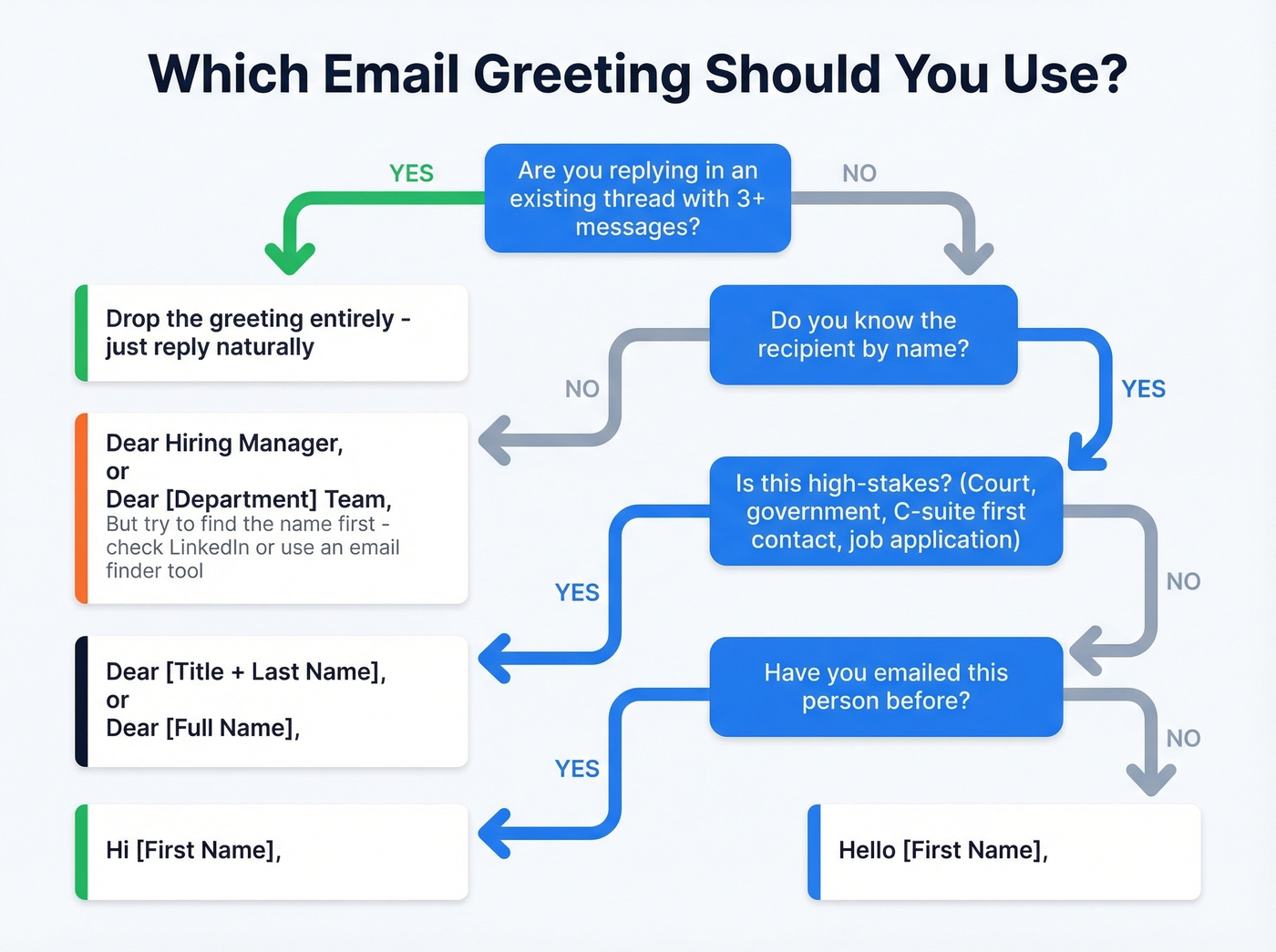
The "unknown recipient" row deserves emphasis. Generic greetings are a last resort, not a starting point. Spending two minutes finding the actual name - checking the company website, using an email finder tool like Prospeo - is one of the simplest ways to make your email feel intentional. In cold outreach, personalization is linked to 2-3x more replies.

You just read that personalizing your greeting gets 2-3x more replies. But personalization starts before the salutation - it starts with finding the right name and verified email. Prospeo's email finder gives you 98% accurate contacts from 300M+ profiles, so your "Dear [First Name]" actually lands in the right inbox.
Stop guessing names. Start verifying them at $0.01 per email.
Formal Greetings for Specific Scenarios
Job Applications
"To Whom It May Concern" is the greeting equivalent of showing up to an interview and asking what the company does. The Muse's ranked hierarchy is the best framework we've seen:
- Hiring manager's name - always try this first
- Department head's name
- "Dear [Department] Team"
- "Dear Hiring Manager"
- "Dear Search Committee"
"To Whom It May Concern" sits dead last. It signals you didn't try.
On r/jobsearchhacks, the question "Is it still acceptable to use Dear Sir or Madam?" comes up regularly - and the answer is increasingly no. If you can't confirm honorifics with certainty, drop the title and use the full name. "Dear Jordan Chen" avoids misgendering and still reads as professional.
Cold Outreach
Look, only about 5% of cold email senders personalize each message. Those who do see 2-3x the replies. In a channel where average open rates sit around 42% and reply rates hover near 3%, your greeting is the first personalization signal a prospect sees.
"Dear [First Name]" consistently outperforms "Dear Sir/Madam" because it proves you did the work. But in our experience, the greeting matters less than whether the email actually reaches the right inbox. If you're working from a stale list, bounces add up fast - and every bounce is wasted effort. That's why we built Prospeo with a 7-day data refresh cycle and 98% email accuracy: so your carefully chosen salutation actually lands. If you're building a repeatable outbound motion, pair this with a solid set of sales prospecting techniques.
Follow-Ups and Threads
After two or three exchanges, dropping the greeting entirely is normal. Nobody writes "Dear Dr. Patel" on the fifth reply in a thread about a meeting time. If you're not sure what to send next, keep a few proven sales follow-up templates handy.
But be careful with name-only openings. Starting an email with just "Sarah." - no "Hi," no "Thanks for the quick reply" - reads as curt, even hostile. The r/work post that kicked off that thread put it bluntly: starting with just a name feels like you're about to deliver bad news. If you greet at all, add "Hi" or lead with "Thanks for the quick reply."
Gender-Neutral and Inclusive Greetings
"Dear Sir or Madam" isn't just outdated - it's exclusionary. As Grammarly's style guidance points out, the phrase erases nonbinary recipients entirely. France has already phased out "Mademoiselle" in favor of "Madame" for similar reasons. On r/asktransgender, threads about email greetings consistently highlight how alienating gendered salutations feel to recipients who don't fit the binary.
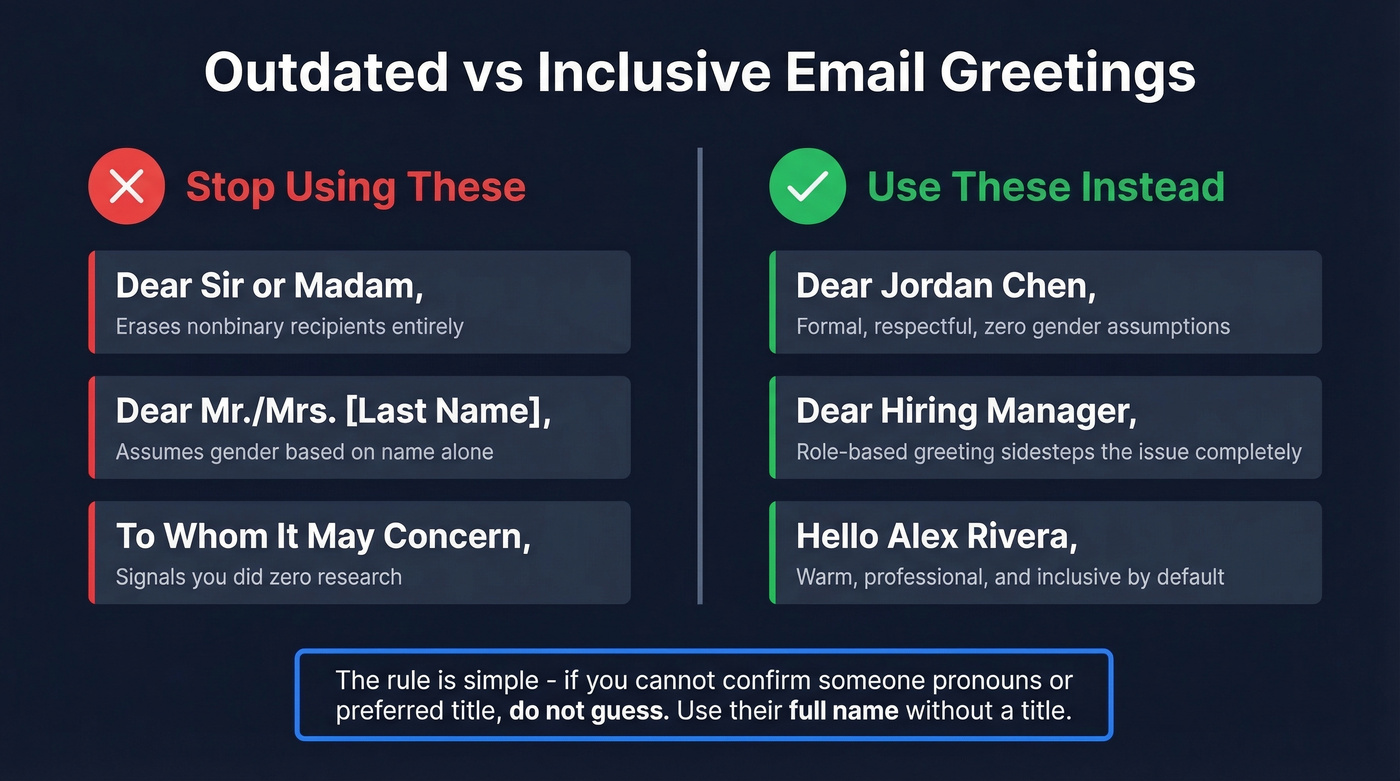
The fix is simple. Three alternatives that work in any context:
- Drop the honorific entirely. "Dear Jordan Chen" is formal, respectful, and makes zero assumptions about gender.
- Use role-based greetings. "Dear Hiring Manager" or "Dear Finance Team" sidesteps the issue completely.
- Use full name without title. "Hello Alex Rivera" is warm, professional, and inclusive by default.
If you can't confirm someone's pronouns or preferred title, don't guess. The safest formal opening is always the one that doesn't require you to assume anything about the recipient.
Formal Greetings Across Cultures
You got a reply from a Japanese client that starts with two paragraphs of pleasantries, and you're wondering if your "Hi Takeshi," was too abrupt. It probably was.
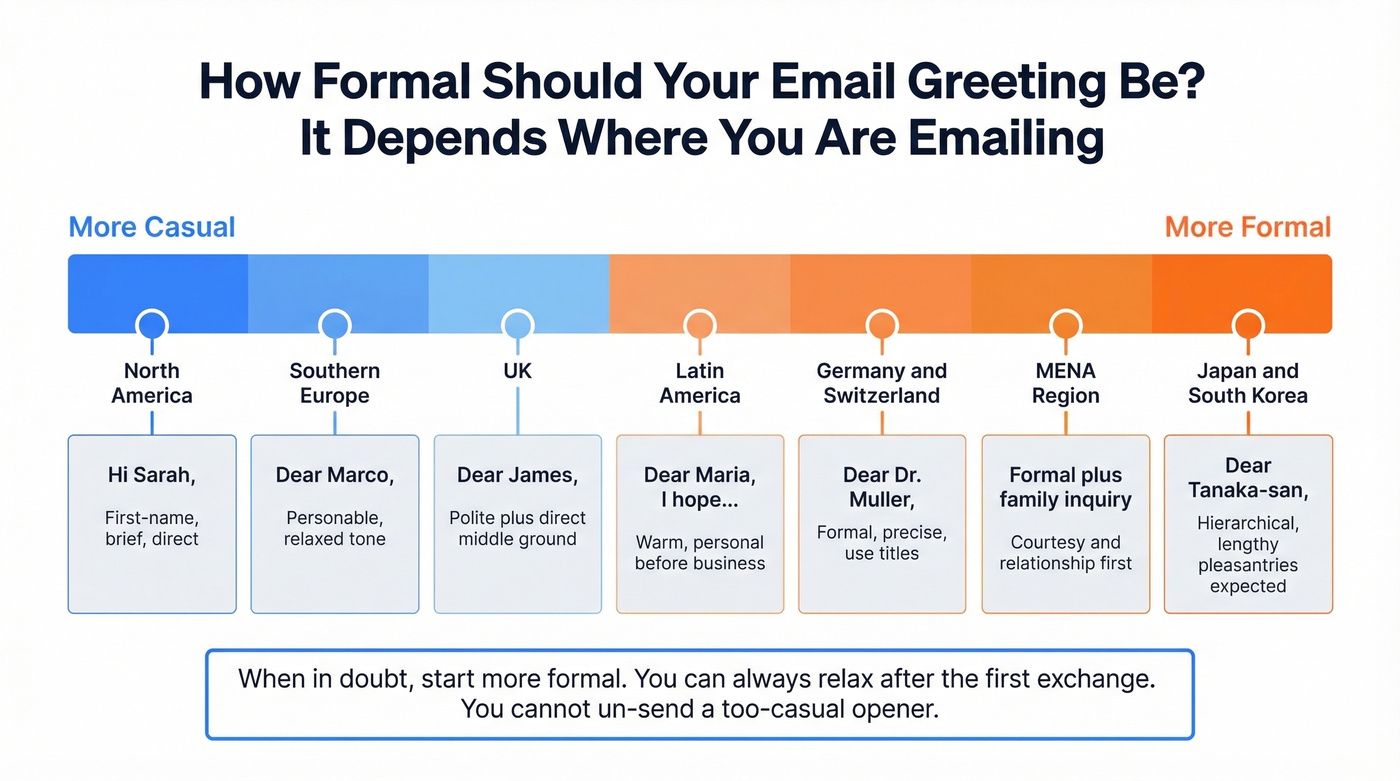
| Region | Norm | Example | Avoid |
|---|---|---|---|
| North America | First-name, brief, direct | "Hi Sarah," | Over-formality with peers |
| Latin America | Warm, personal before business | "Dear Maria, I hope..." | Jumping straight to business |
| Germany/Switzerland | Formal, precise, direct | "Dear Dr. Muller," | Casual first names early |
| UK | Polite + direct middle ground | "Dear James," | Excessive informality |
| Japan/South Korea | Hierarchical, lengthy pleasantries | "Dear Tanaka-san," | Skipping pleasantries |
| MENA | Formal courtesy, family inquiries | Formal + family/health inquiry | Rushing to the ask |
| Southern Europe | Personable, relaxed | "Dear Marco," | Overly stiff corporate tone |
If you're emailing internationally and you're unsure, err on the side of more formal. You can always relax after the first exchange. You can't un-send a too-casual opener to someone who expects hierarchy and ceremony.
Greetings to Avoid
Let's be direct about what doesn't work:
- "Hey" / "Yo" - Too casual for any professional context, full stop. Save it for Slack.
- "Dear Sir or Madam" - Outdated and exclusionary. There's no reason to use this in 2026.
- "To Whom It May Concern" - Signals you didn't spend 30 seconds looking up a name.
- Name-only openings ("Sarah.") - Reads as curt, even hostile. Add "Hi" or don't greet at all.
- "Greetings and Salutations" - You're writing an email, not performing Shakespeare.
Skip "Dear Sir or Madam" entirely if you're writing to anyone under 40 in a tech, creative, or startup environment - it'll read as tone-deaf rather than respectful. If you're doing outreach at scale, make sure your email deliverability is solid so the right greeting actually gets seen.
"To Whom It May Concern" is a last resort because it signals you didn't try. Prospeo eliminates that excuse - search by company, role, or department with 30+ filters and get the hiring manager's verified email in seconds. No more generic greetings.
Every email deserves a real name behind it. Find yours in one click.
FAQ
Is "Hi" too casual for a formal email?
"Hi [First Name]" is the standard professional greeting in most industries in 2026. It's only too casual for legal correspondence, government officials, or first contact with senior executives in formal cultures. When in doubt, upgrade to "Hello [First Name]" - it's warmer than "Dear" without being stiff.
What's the best greeting when you don't know the recipient's name?
Try to find it first - check the company website or use an email finder tool to locate verified contacts. If you genuinely can't, use "Dear Hiring Manager," "Dear [Department] Team," or "Hello" followed by a clear reason for writing. Avoid "To Whom It May Concern."
Should your greeting match your closing?
Yes - a formal opening like "Dear Dr. Patel" paired with "Cheers!" creates tonal whiplash. Match "Dear" with "Sincerely" or "Kind regards." Match "Hi" with "Best" or "Thanks." Marlow et al.'s research confirms closings measurably shape perception, so tonal alignment across your entire message matters.