

The Best Free Email Validation Software in 2026
You send a 5,000-email campaign. Four hundred bounce. Your domain reputation tanks, your sequences stall, and your ESP starts throttling you. That's an 8% bounce rate - four times the 2% threshold most ESPs consider acceptable. The fix isn't better copy or warmer subject lines. It's validating your list before you hit send.
You don't need to spend hundreds of dollars to clean a list. Genuinely useful free email validation software exists - SaaS platforms with free tiers and open-source libraries you can self-host. But accuracy varies wildly, and "99% accuracy" on a vendor's homepage means something very different in practice.
We've tested most of these tools across real B2B lists. Here's what's actually worth your time.
Our Picks at a Glance
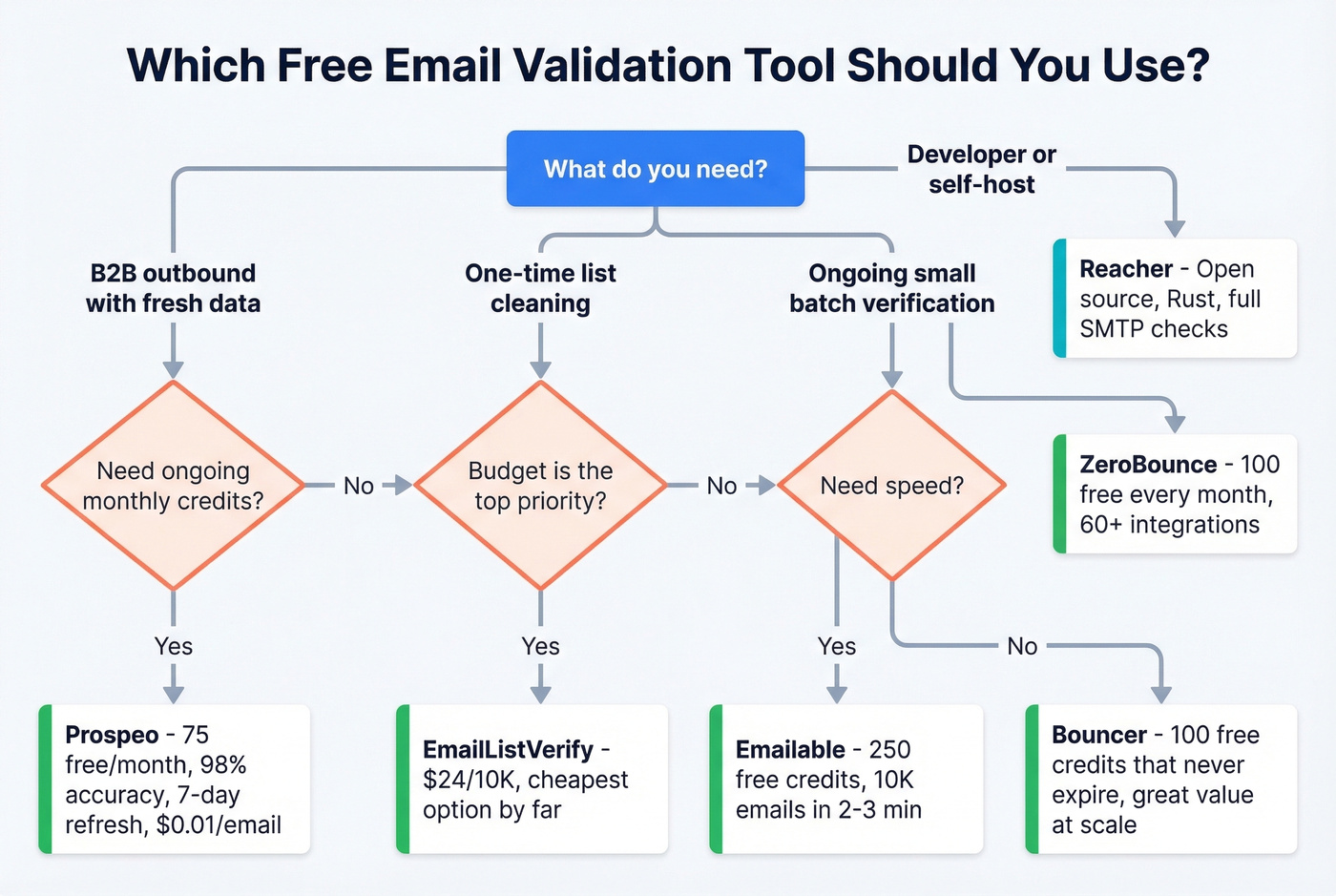
| Use Case | Pick | Why |
|---|---|---|
| Best B2B email accuracy | Prospeo | 98% accuracy, 7-day data refresh, 75 free emails/month |
| Best free tier for list cleaning | Emailable | 250 free credits, processes 10K emails in 2-3 min |
| Best recurring free allowance | ZeroBounce | 100 free verifications every month, 60+ integrations |
| Best for developers | Reacher | Open-source (Rust), 8.5K GitHub stars, full SMTP + catch-all |
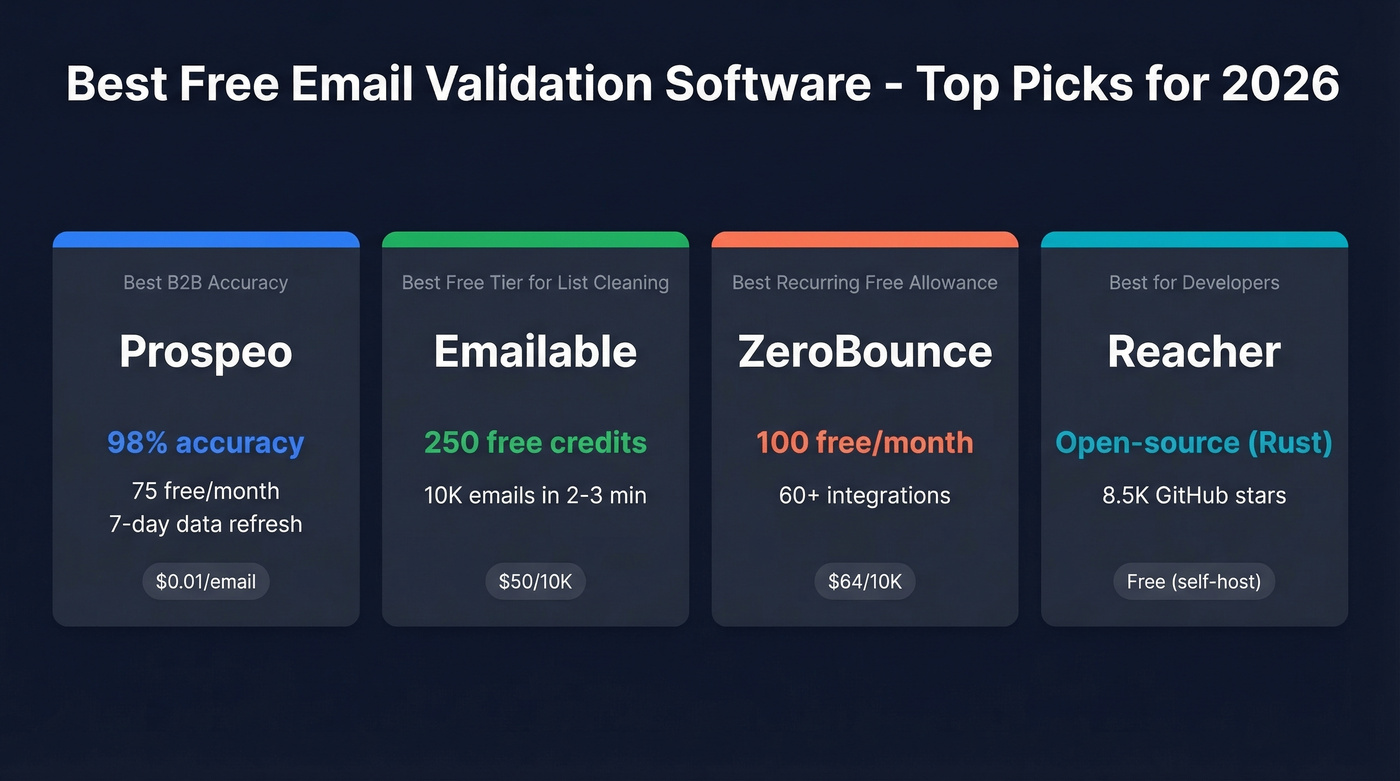
If you're running B2B outbound and care about data freshness - not just verification - Prospeo is the pick. For pure list cleaning on a budget, Emailable's 250 free credits and fast processing are hard to beat.
What "99% Accuracy" Actually Means
Every email verification vendor plasters "99% accuracy" on their homepage. That number is fiction for most of them.
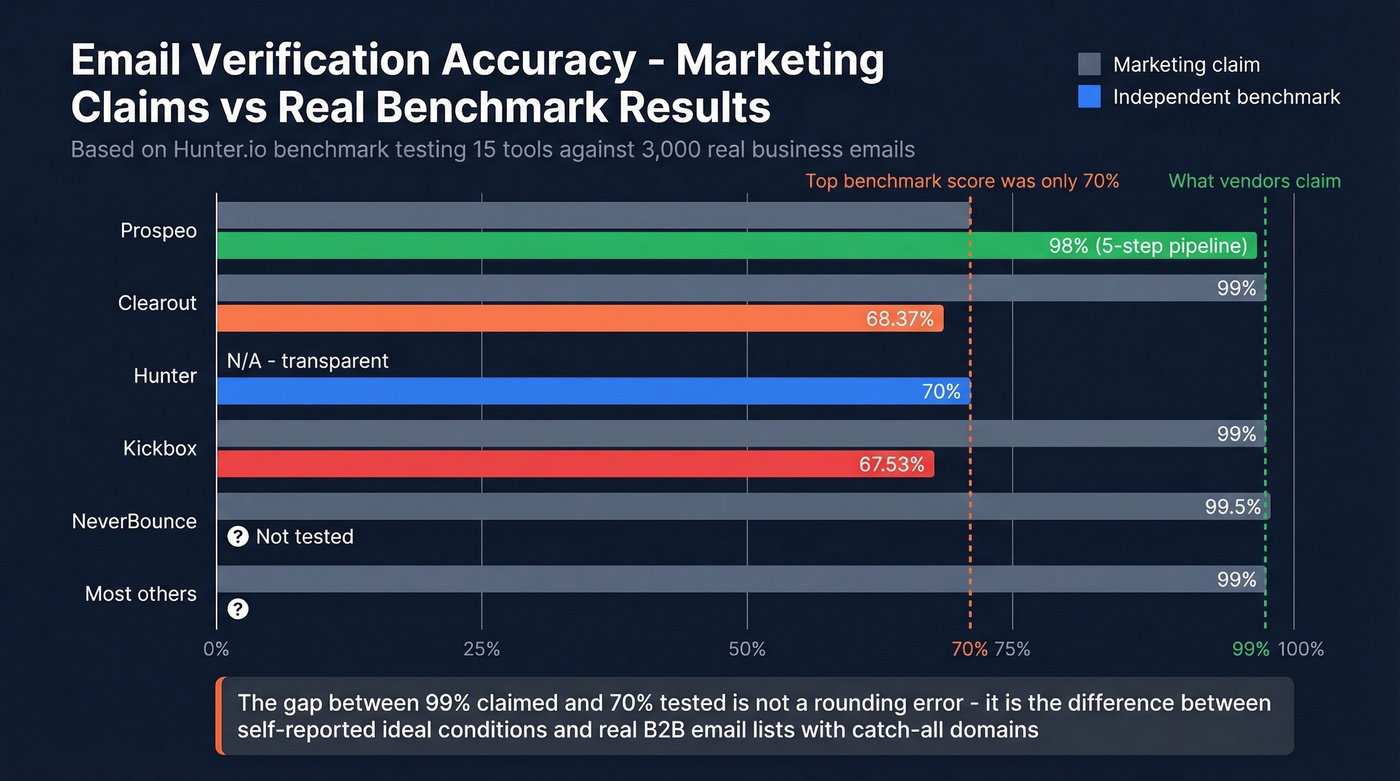
Hunter ran a benchmark testing 15 email verification tools against 3,000 real business emails, segmented by company size. The top overall score? 70%. Not 99%. Not 95%. Seventy percent. Clearout came second at 68.37%. Kickbox landed at 67.53%.
The gap between marketing claims and real-world testing is enormous. Those "99%" figures are self-reported, measured against the vendor's own test set under ideal conditions. Real-world accuracy drops hard on mid-market and enterprise domains, where stricter email server configurations make SMTP verification unreliable. Catch-all domains - where the server accepts everything regardless of whether the mailbox exists - are the biggest culprit. And they're everywhere in B2B.
Prospeo takes a different approach: a 5-step verification pipeline backed by 143M+ verified emails that handles catch-all domains, strips spam traps, and filters honeypots. That isn't the same thing as running a single SMTP check. The 7-day data refresh cycle matters too - you can't verify your way out of a database that was stale before you started.
Hunter deserves credit for publishing their methodology transparently, including a bias disclosure. Most vendors don't even try.
Validation vs. Verification
These terms get used interchangeably, but they check different things.
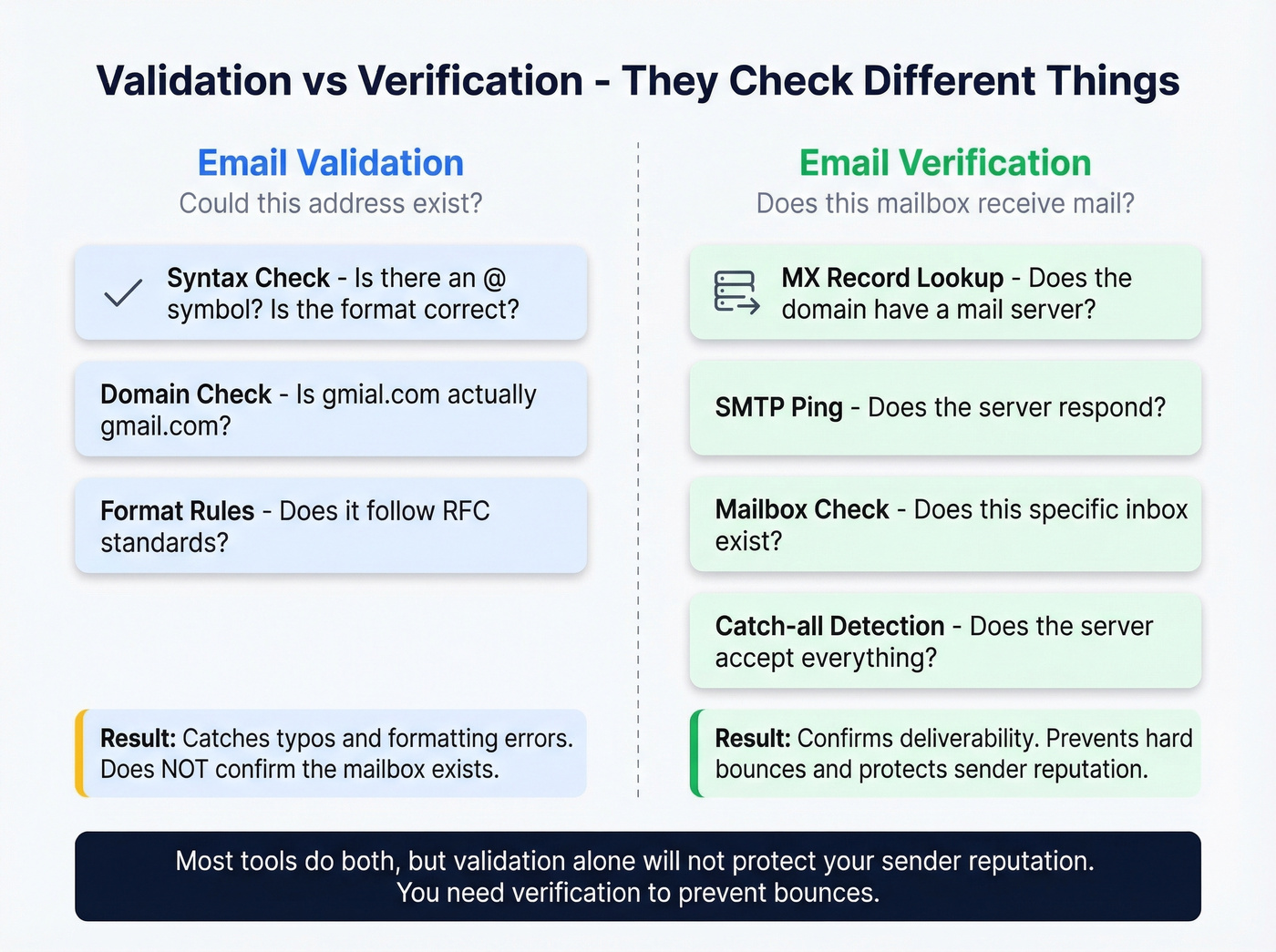
Email validation confirms whether an address could exist. It checks syntax, format, and basic rules - catching typos like "gmial.com" or missing @ symbols. Think of it as a spell-checker for email addresses.
Email verification confirms whether the mailbox actually receives mail. It queries MX records, pings the SMTP server, and detects catch-all configurations. This is the step that prevents hard bounces.

Most tools marketed as "validators" actually do both. But validation alone won't protect your sender reputation. If a tool only checks syntax without hitting the mail server, you'll still bounce on addresses that look correct but don't exist. If you're troubleshooting deliverability end-to-end, pair verification with email reputation monitoring.

You just read that the top-scoring tool in an independent benchmark hit 70% accuracy - not the 99% plastered on every homepage. Prospeo's 5-step verification pipeline catches what single SMTP checks miss: catch-all domains, spam traps, and honeypots. Stack Optimize keeps bounce rates under 3% across every client using Prospeo data.
Start with 75 free verified emails and see real accuracy at $0.01/email.
Free Email Verifiers Compared
The price spread across verification tools is staggering. Cleaning 10,000 emails costs $24 on EmailListVerify and $149 on Hunter - about a 6.2x difference for the same job. Free tiers vary just as much.
If you're also sending at scale, it's worth understanding email velocity and how it interacts with bounce rates.
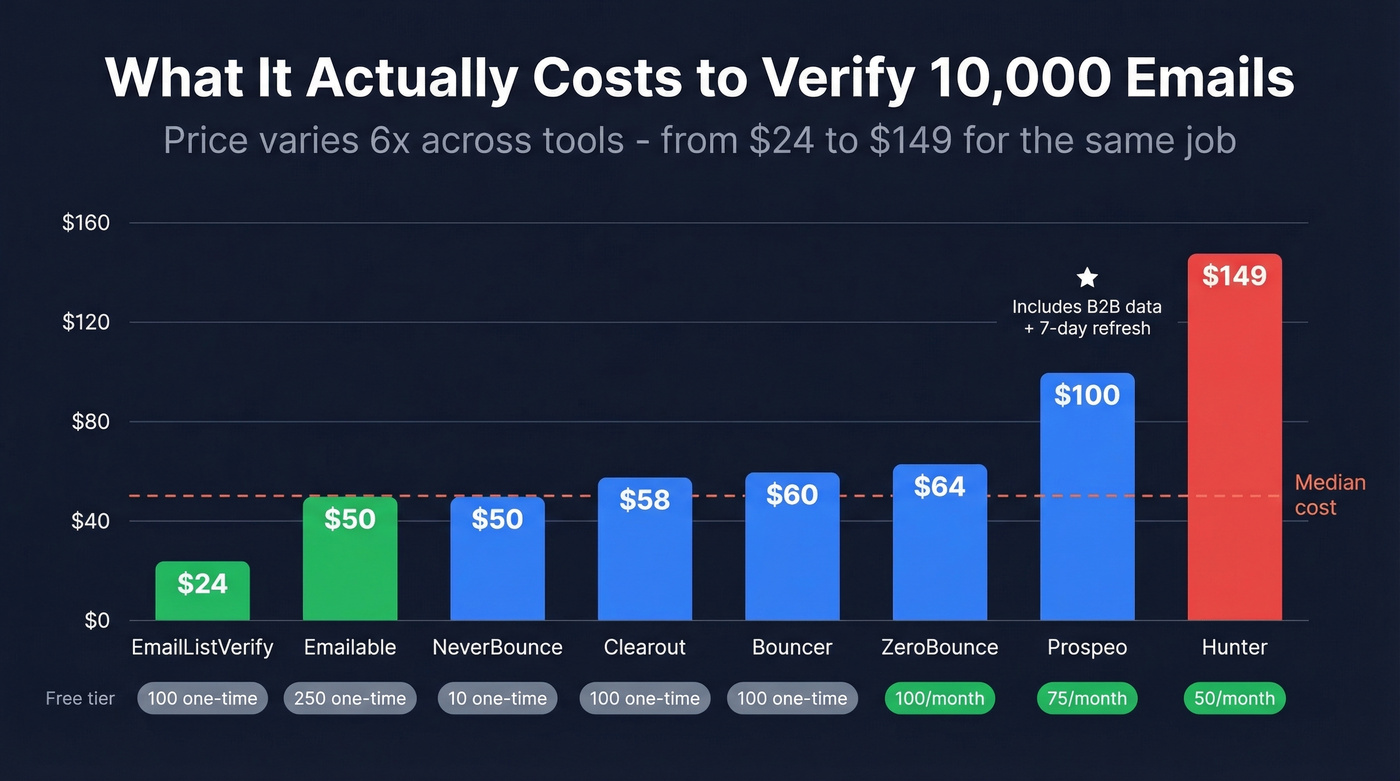
| Tool | Free Credits | Cost/10K | Benchmark Accuracy | Expire? |
|---|---|---|---|---|
| Prospeo | 75/mo | ~$100 | 98% (5-step pipeline) | Monthly refresh |
| Emailable | 250 (one-time) | $50 | Self-reported ~99% | Never |
| Bouncer | 100 (one-time) | $60 | Self-reported ~99% | Never |
| ZeroBounce | 100/mo | $64 | Self-reported 99% | Monthly reset |
| Hunter | 50/mo | $149 | 70% (Hunter benchmark) | Monthly reset |
| NeverBounce | 10 (one-time) | $50 | Self-reported 99.5% | - |
| Clearout | 100 (one-time) | $58 | 68.37% (Hunter benchmark) | Never |
| EmailListVerify | 100 (one-time) | $24 | Self-reported ~99% | - |
| QuickEmailVerification | 3,000/mo | $4/500 | Self-reported | Monthly reset |
| Verifalia | Limited widget | ~$50-$70 | Self-reported | - |
| Kickbox | Limited | $80 | 67.53% (Hunter benchmark) | - |
"Hunter benchmark" = results from Hunter's published 3,000-email test. "Self-reported" = vendor marketing claims. These aren't equivalent.
Best Free Email Validation Tools Reviewed
Prospeo - Best B2B Email Accuracy
Prospeo is a B2B data platform first: 300M+ professional profiles, 143M+ verified emails. Verification is built into the data layer, not bolted on top. Most verification tools check whether an email is deliverable right now. Prospeo solves the upstream problem - making sure the email was accurate before you verified it, with data that's never more than 7 days old. The industry average refresh cycle? Six weeks.
If you're building lists from scratch, combine verification with data enrichment so you’re not cleaning incomplete records later.
Stack Optimize, one of Prospeo's customers, keeps bounce under 3% and has zero domain flags across all clients using this data. The free tier gives you 75 verified emails plus 100 Chrome extension credits per month - enough to test on a real campaign before committing. GDPR compliant, with integrations across the full outbound stack: Salesforce, HubSpot, Smartlead, Instantly, Lemlist, Clay, Zapier, and Make. Paid plans run about $0.01/email with no contracts.
Use this if: You're doing B2B outbound and need emails that are accurate and fresh - not just syntactically valid.
Skip this if: You only need a one-time bulk clean of a massive consumer email list.
Bouncer - Best Value at Scale
Bouncer gives you 100 free credits to start, then pay-as-you-go pricing that scales well: $8 for 1,000 credits, $60 for 10,000, and $2,000 for a million. Credits never expire, and Bouncer won't charge you for duplicates or unknown results - a policy most competitors don't match.
If you're comparing similar tools, see our breakdown of Bouncer alternatives.
Processing speed hits 180,000 emails per hour. TechRadar named it their #1 email checker overall. The tradeoff is a smaller integration library (16 vs. ZeroBounce's 60+), so check compatibility before committing.
Use this if: You're cleaning large lists on a budget and want credits that never expire.
Skip this if: You need deep native integrations or a recurring monthly free allowance.
Emailable - Fastest Processing
Emailable's 250 free credits are the most generous one-time free tier on this list. But speed is the real story: 10,000 emails in 2-3 minutes, 250,000 in about 10 minutes, with bulk uploads up to 250K per file. For teams running time-sensitive campaigns, that speed differential is meaningful.
If you're doing cold outreach, pair list cleaning with a solid B2B cold email sequence so you’re not wasting verified sends.
G2 reviewers rate it 4.8/5 across 277 reviews, with consistent praise for accuracy and simplicity. Duplicates plus Unknown results get refunded. The catch: the minimum purchase is 5,000 credits, and pricing gets expensive at volume for smaller teams. Expect $50 per 10K emails.
Use this if: Speed matters and you want the largest one-time free tier among SaaS tools.
Skip this if: You're a small team worried about per-email costs scaling up.
ZeroBounce - Best Recurring Free Tier
ZeroBounce gives you 100 free verifications every single month - you'll need a business email to sign up. That recurring allowance makes it ideal for teams verifying small batches continuously rather than cleaning big lists quarterly.
The platform supports 60+ integrations across CRMs, ESPs, and marketing automation platforms. Processing speed runs about 133,000 emails per hour. Pay-as-you-go starts at $0.008/email, with subscription plans from $15/month. At $64 per 10K, it's mid-range on price but strong on ecosystem compatibility.
Use this if: You want a steady monthly free allowance without re-buying credits.
Skip this if: You need the cheapest per-email cost at scale.
Hunter Email Verifier
Hunter's free tier is modest - 50 verifications per month - and at $149 per 10K, it's the most expensive tool on this list by a wide margin. So why include it?
The case for Hunter: They published the most transparent accuracy benchmark we've found - 15 tools, 3,000 real business emails, full methodology disclosure including bias acknowledgment. Their own tool scored 70%, which is honest even if it isn't flattering. That transparency builds trust.
The case against: The price-to-value ratio is brutal for pure verification. You're paying a premium for Hunter's broader email-finding ecosystem, not just the verifier. If all you need is list cleaning, Bouncer does the same job at a fraction of the cost.
If you're shopping around, compare feature sets in our guide to Hunter alternatives.
NeverBounce
NeverBounce's free tier is the weakest here - just 10 credits, barely enough to test the interface. Where it earns its spot is the real-time form validation widget, which checks emails as users type them into web forms. If you're running lead capture and want to prevent bad data at the source, that's a genuinely useful feature most competitors don't offer.
Processing speed sits around 100,000 emails per hour. Pay-as-you-go starts at $0.008/email for 10K and drops to $0.003 at the million-email tier.
Clearout
Clearout scored 68.37% in Hunter's benchmark - second place overall - which is notable given that most tools don't publish benchmark-style results at all. The 100 free credits never expire, and the platform supports 38 integrations. At roughly $0.007/email on pay-as-you-go, it sits in the affordable middle of the pack. A solid all-rounder that doesn't get enough attention.
EmailListVerify
The budget pick, and it isn't close. At $24 per 10,000 emails, EmailListVerify is less than half the cost of most competitors. You get 100 free credits to start, and the 11 integrations cover the basics. If you're doing a one-time clean of a large legacy list and cost is the primary concern, this is the obvious choice. The feature set is thinner than Bouncer or ZeroBounce, but for raw verification at scale, the math wins.
QuickEmailVerification
QuickEmailVerification offers the largest free tier for single-email checks: 3,000 free credits per month. Bulk verification is capped at 100 free per day. Starter packs begin at $4 for 500 credits, making it accessible for freelancers who verify emails one at a time. If your workflow is "check this prospect's email before I send," the free tier is more than enough.
Verifalia
Verifalia offers a free widget for single-email checks directly on their site. The free tier for bulk verification is limited, and paid plans run around $50-$70 per 10K. Decent for a quick one-off check. Not built for list-scale operations.
Kickbox
Kickbox scored 67.53% in Hunter's benchmark, third place. Pricing is about $80 per 10K. The free tier is limited. Worth evaluating if you want another established option, but the benchmark performance doesn't justify paying more than Clearout or Bouncer.
Validation only works if the underlying data is fresh. Most providers refresh every 6 weeks - by then, 15-20% of B2B emails have already decayed. Prospeo refreshes every 7 days across 143M+ verified emails, so you're verifying against data that's actually current.
Stop validating stale data. Get emails that were accurate before you checked them.
Free Open-Source Validators
If you've got a developer on the team and want truly free - no credits, no limits, no vendor lock-in - open-source is the move. Fair warning though: self-hosted tools can't match SaaS platforms on disposable email detection or spam-trap databases. They check syntax, DNS, and SMTP, but they lack the proprietary intelligence layers commercial tools maintain. For teams processing millions of emails or with strict data-sovereignty requirements, the tradeoff is worth it.
Reacher (Rust)
The most-starred open-source email verifier on GitHub, with 8.5K stars and updates as recent as March 2026. Reacher handles syntax, MX, SMTP, and catch-all detection - the full verification stack. Run it as a CLI tool, Docker container, or HTTP service.
The AGPL license is the key caveat: if you're using it in a commercial product, you'll need to open-source your code or buy a commercial license. For internal tooling, it's genuinely excellent.
AfterShip/email-verifier (Go)
A MIT-licensed Go library covering syntax, DNS, MX, and SMTP reachability checks. Actively maintained and straightforward to integrate into Go-based backends. The MIT license means no commercial restrictions - use it however you want. It won't detect disposable domains or spam traps out of the box, but it handles the core verification pipeline cleanly.
email-validator (Python)
JoshData's Python library is the go-to for Python projects needing email validation. It handles syntax validation, internationalized domain names (IDNA), and MX record checks. Widely used across the Python ecosystem. It doesn't do SMTP-level verification, so pair it with an SMTP checker if you need full deliverability confirmation.
validator.js (Node)
The isEmail() function in validator.js is syntax-only - no DNS, no MX, no SMTP. Zero dependencies, extremely fast. Use it as a first-pass filter in web forms or data pipelines to catch obviously malformed addresses before sending them to a deeper verification tool. Not a replacement for real verification, but a solid front-line check.
How to Choose the Right Tool
Three questions cut through the noise.
How many emails per month? Under 100 monthly, ZeroBounce's recurring free tier handles it. Under 250 one-time? Emailable. Over 10,000? You're paying regardless - compare per-email costs and pick based on integrations.
Can you self-host? If you've got engineering resources and process high volumes, Reacher gives you unlimited verification for the cost of server time. If "Docker" sounds like a shipping company, stick with SaaS.
One-time clean or ongoing verification? A legacy list clean is a different problem than continuous outbound verification. For one-time jobs, EmailListVerify at $24/10K is the budget winner. For ongoing B2B outbound, data freshness matters more than verification cost - you need records that are current, not a cheap way to clean stale data after the fact.
If you're trying to keep bounces down long-term, it helps to understand email bounce rate benchmarks and what actually moves them.
Here's our hot take: if your average deal size is under $5K, you probably don't need a premium verification tool at all. EmailListVerify or a self-hosted Reacher instance will get you 90% of the way there. But the moment you're sending sequences to VP-level prospects at mid-market companies - where a single bounced email can burn a domain - data freshness and catch-all handling become non-negotiable.
Let's be honest about something we see constantly: teams that skip the freshness question end up re-cleaning their lists every quarter and wondering why bounce rates creep back up. An email can pass SMTP checks today and bounce tomorrow because the person changed jobs last week. The freshness of your underlying data is at least as important as the verification layer on top of it.
One more tool worth watching: Allegrow offers a 14-day free trial for up to 1,000 contacts, with paid plans starting at $99/month.
FAQ
Is free email validation software accurate enough for cold outreach?
Free tools use the same SMTP checks as paid ones, but accuracy varies wildly. Hunter's benchmark showed the best tool scored just 70% on real business emails. For cold outreach, pair verification with a fresh data source to stay under the 2% bounce threshold most ESPs enforce.
What's the difference between email validation and verification?
Validation checks syntax and format - whether an address could exist. Verification confirms the mailbox actually receives mail via MX and SMTP checks. Most tools do both. Validation alone won't prevent bounces; you need the SMTP-level check to protect sender reputation.
Can I validate emails in bulk for free?
Yes, but with limits. QuickEmailVerification offers 100 free bulk verifications per day. ZeroBounce gives 100 per month recurring. For larger lists, expect to pay $24-$64 per 10,000 emails depending on the tool.
Are open-source email validators worth using?
For developers, absolutely. Reacher handles syntax, MX, SMTP, and catch-all detection with 8.5K GitHub stars and active maintenance. Self-hosted tools require infrastructure and can't match SaaS on disposable-email databases or spam-trap detection. Use them for volume; supplement with a commercial verifier for accuracy on high-value prospects.
What free email checker has the best accuracy?
Among tools tested in Hunter's published benchmark, Clearout scored 68.37% and Kickbox scored 67.53% on 3,000 real business emails. Prospeo's 5-step verification pipeline - backed by 143M+ verified emails with catch-all handling and spam-trap removal - delivers 98% accuracy with a 7-day data refresh cycle.