

Best Free Email Verification APIs in 2026 (Compared)
Most "free" email verification APIs are demos, not tools. The generous ones give you 100 free calls per day. Others hand you 100 per month - or a tiny one-time trial that's barely enough to test the response format.
But the free tier matters less than what happens when you outgrow it. We're covering both: what you get for zero dollars, and what it costs when you need to clean a real list or wire verification into a production workflow.
Our Top Picks
Best for teams that need clean data from the start: Prospeo. Most verification APIs assume you already have emails. Prospeo finds them and verifies them in one step - 98% email accuracy, 5-step verification with catch-all handling, 75 free emails per month. You're not buying a verification API; you're buying pre-verified data so you verify less.
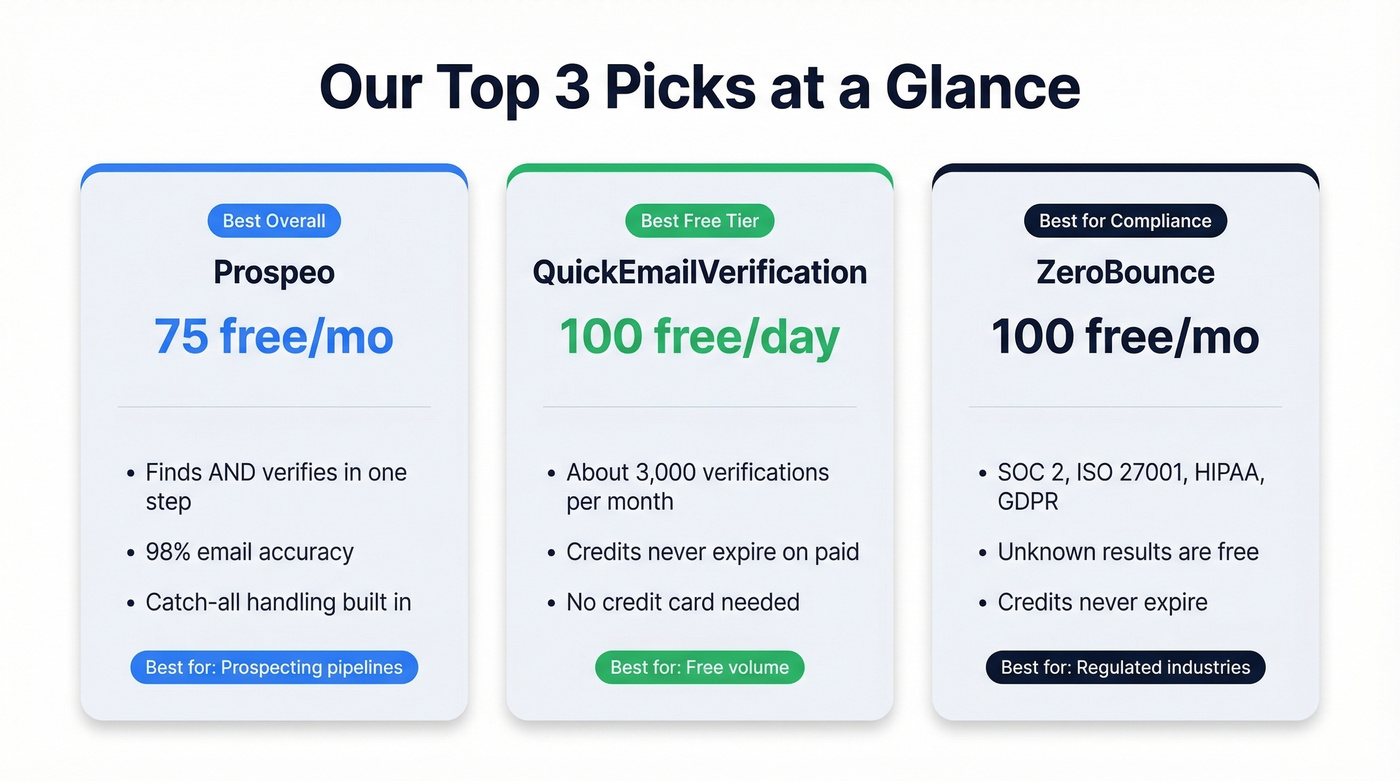
Best pure free tier: QuickEmailVerification. 100 free credits per day, roughly 3,000 per month. Purchased pay-as-you-go credits never expire, and there are no contracts. If you need a free email verification API with real daily volume, this is it.
Best for compliance-heavy teams: ZeroBounce. Only 100 free verifications per month, but unknown results don't cost credits, credits never expire, and it's SOC 2 Type II, ISO 27001, HIPAA, and GDPR/CCPA compliant. When your security team has a checklist, ZeroBounce checks every box.
Side-by-Side Comparison
Every tool side by side. The "Best For" column is our actual recommendation - not a hedge.
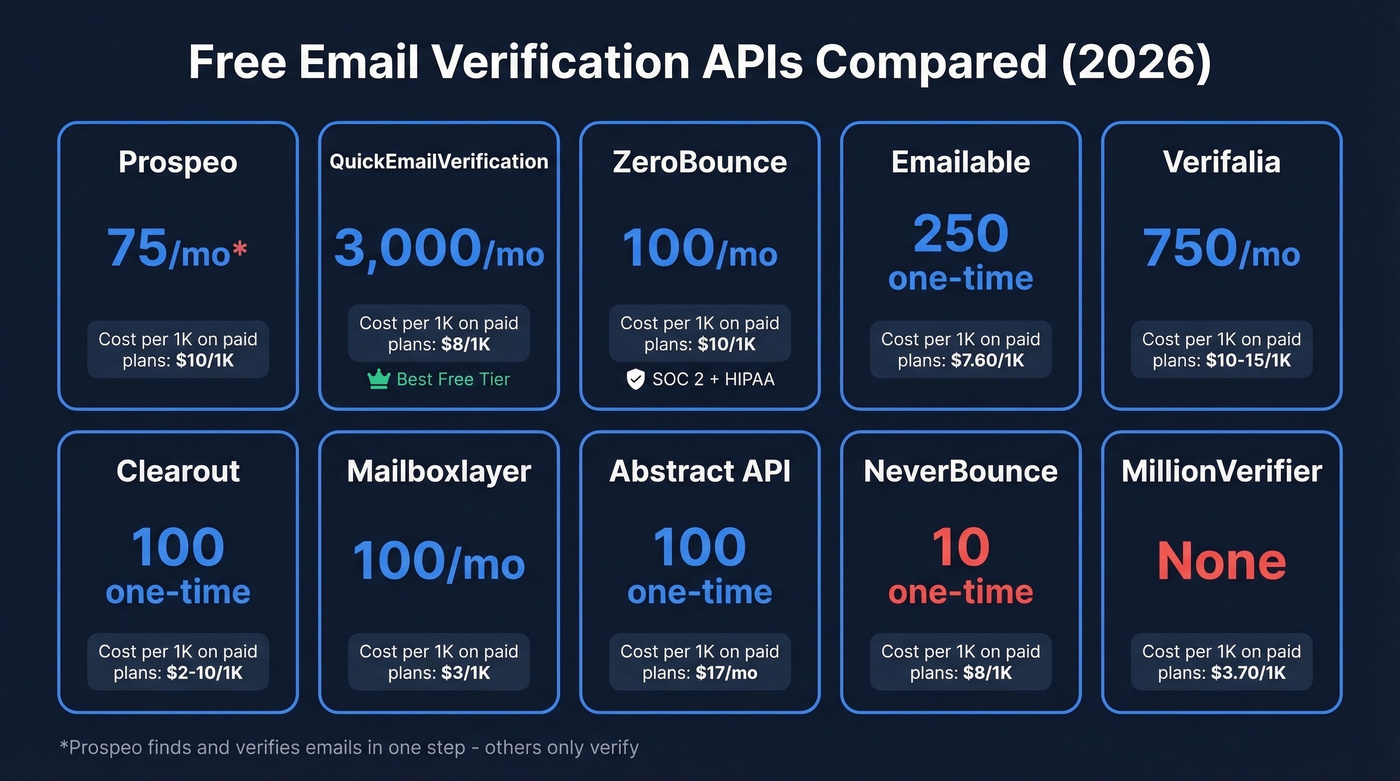
| Tool | Free Tier | Cost/1K (Paid) | Credits Expire? | Catch-All | Best For |
|---|---|---|---|---|---|
| Prospeo | 75 pre-verified emails/mo* | ~$10 | No | Built-in | Finding + verifying in one step |
| QuickEmailVerification | 100/day (~3K/mo) | ~$8 | Never (PAYG) | Yes | Free tier volume |
| ZeroBounce | 100/mo | ~$10 | Never | Yes | Compliance & regulated industries |
| Emailable | 250 one-time | ~$7.60 | Never | Yes | Speed at scale (30K/min) |
| Verifalia | 25/day (~750/mo) | ~$10-15 | Daily: yes; Packs: no | Yes (multi-pass) | Developer ergonomics |
| Clearout | 100 one-time | ~$2-$10 | Not public | Yes | Deepest validation checks |
| Mailboxlayer | 100/mo | ~$3 (on 5K plan) | N/A (subscription) | Plan-restricted | Legacy projects, basic checks |
| Abstract API | 100 one-time | Starts at $17/mo | Not public | Basic | Lightweight form validation |
| NeverBounce | 10 one-time | ~$8 | After 1 year | Yes | Mid-market teams already using it |
| MillionVerifier | None | ~$3.70 | N/A | Limited | Cleaning millions of addresses cheaply |
*Prospeo finds and verifies emails in a single step - the other tools on this list only verify addresses you already have.
10 Best Free Email Verification APIs
Prospeo
Most email verification APIs solve a downstream problem - you already have bad emails, and you need to clean them. Prospeo solves the upstream problem instead. Its email finder pulls from 143M+ verified emails across 300M+ professional profiles, running every address through a 5-step verification process that includes catch-all handling, spam-trap removal, and honeypot filtering before you ever see the result.
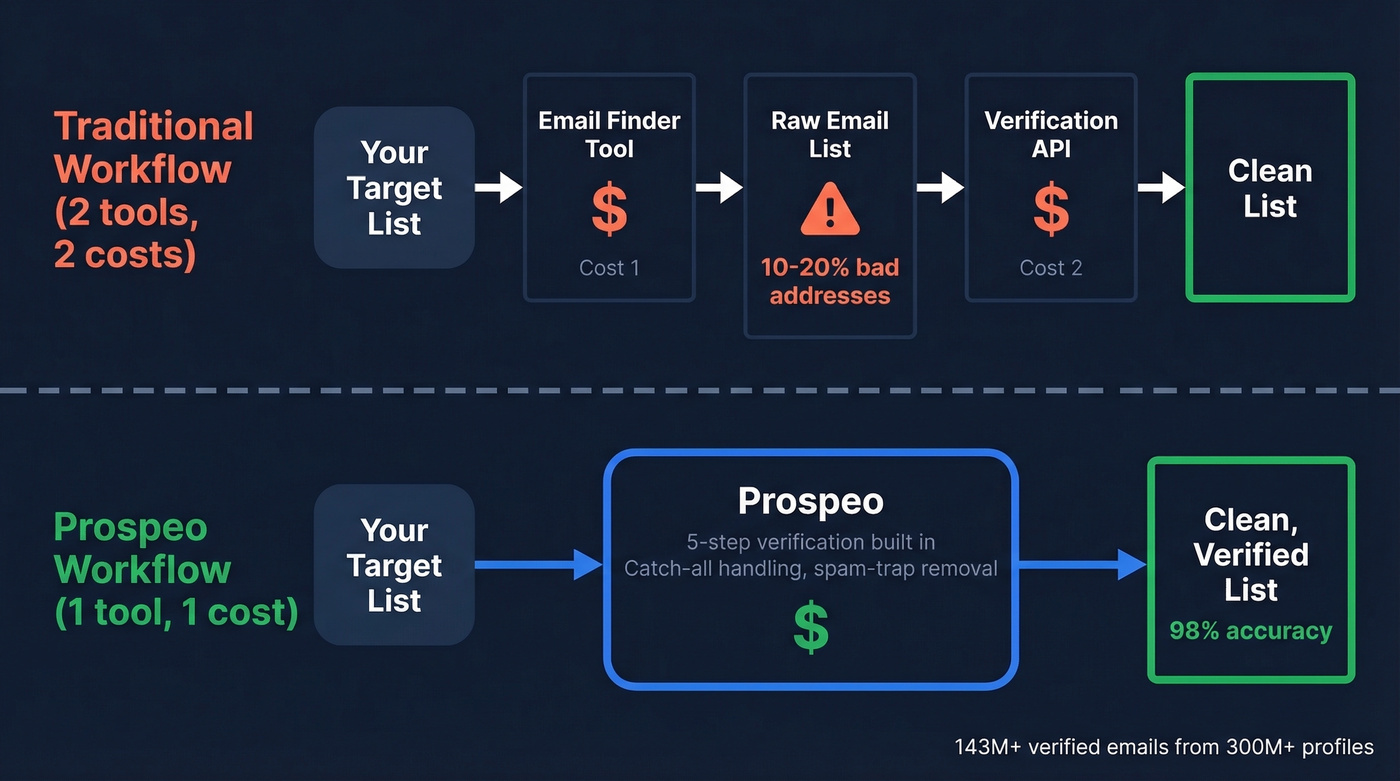
The API match rate sits at 92%, with 98% email accuracy on returned results. Data refreshes every 7 days - the industry average is 6 weeks, which means most verification APIs are checking stale addresses against stale servers.
Use this if: You're building a prospecting pipeline and want verified emails without bolting on a separate verification step. The free tier gives you 75 emails plus 100 Chrome extension credits per month. Paid plans run about $0.01 per email with no contracts.
If you already have a list that needs cleaning, pair Prospeo's enrichment API with a bulk cleaner like Emailable or MillionVerifier - but for net-new prospecting, nothing else combines finding and verification this cleanly. Integrations cover the stack most teams actually use: Salesforce, HubSpot, Clay, Zapier, Make, Instantly, and Lemlist.
QuickEmailVerification
Who should care: Anyone who needs a real free tier, not a glorified trial.
100 free credits per day, resetting daily, no credit card required. That's roughly 3,000 verifications per month - enough to run a real workflow, not just kick the tires. For teams evaluating a free email verifier API, this daily reset model is far more useful than a one-time credit dump.
The API is straightforward REST. You send an email, you get back a status - valid, invalid, unknown, catch-all - with sub-statuses for disposable, role-based, and free-provider addresses.
When you outgrow the free tier, pay-as-you-go starts at $4 for 500 credits. Those purchased credits never expire, there are no contracts, and no hidden fees. At scale, you're looking at roughly $8 per 1,000 verifications.
Skip this if: You need enterprise compliance certifications or advanced catch-all resolution. QuickEmailVerification is solid and reliable, but it doesn't differentiate on those fronts.
ZeroBounce
SOC 2 Type II. ISO 27001. HIPAA. GDPR. CCPA. If those acronyms matter to your security team - and in healthcare, fintech, or any regulated industry, they do - ZeroBounce is the answer before you even ask the question.
The free tier is modest at 100 verifications per month, but two details set it apart. Unknown results don't consume credits. And credits never expire, so unused verifications carry forward indefinitely.
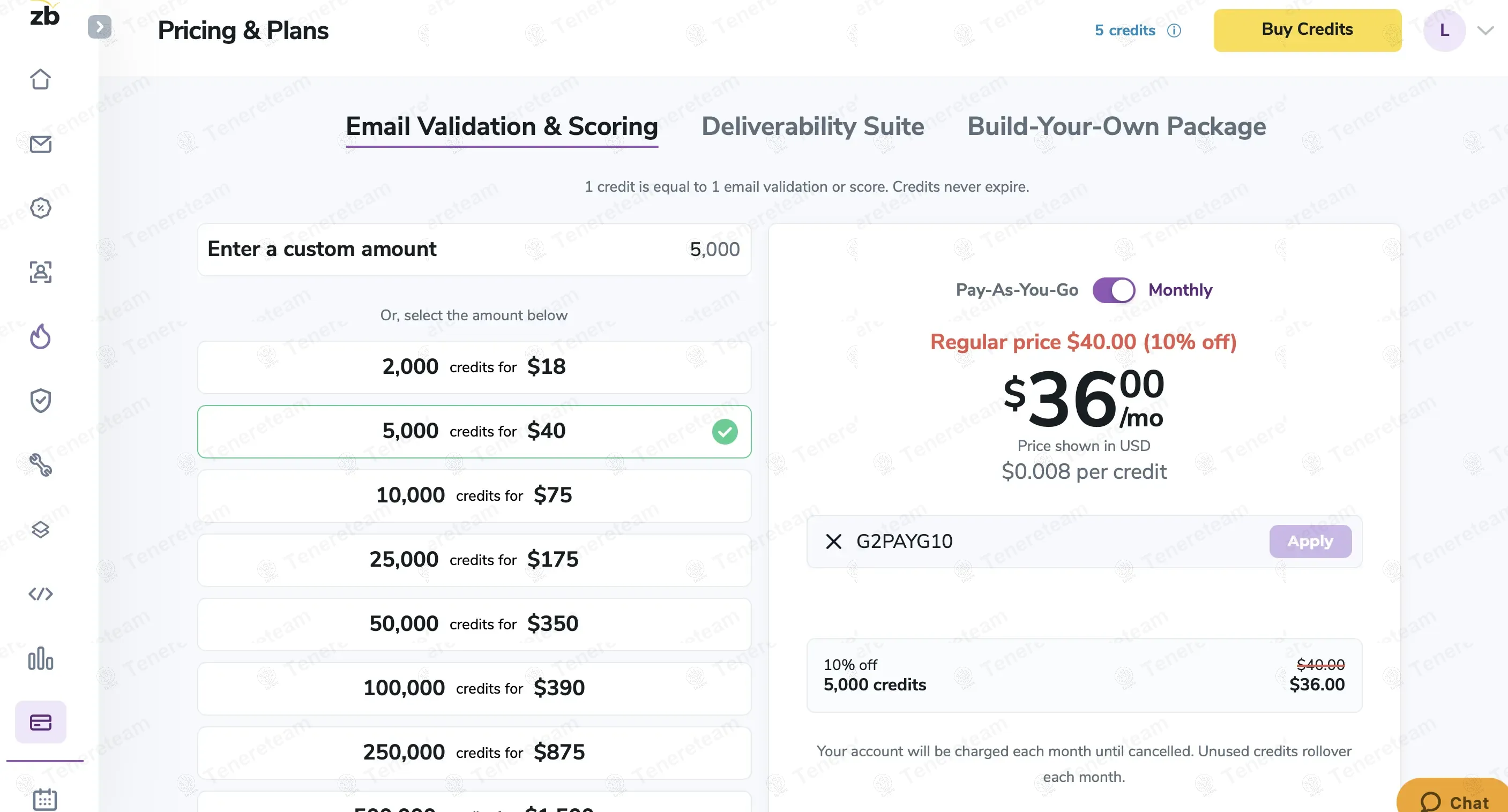
Paid pricing starts at about $10 per 1,000 verifications with a $20 minimum (2,000 credits). They also offer an Email Finder, but it costs 20 credits per successful lookup - expensive compared to dedicated finding tools.
Skip this if: You need high-volume catch-all resolution. In a 10,000-email benchmark, ZeroBounce resolved 12% of catch-all addresses compared to 94.2% for LeadMagic. That test was run by LeadMagic's founder, so discount their own score - but the gap between providers is real regardless. The Resend team also flagged that ZeroBounce doesn't detect temporary email addresses, so if disposable email filtering matters to your use case, verify that before committing.
Emailable
| Pros | Cons |
|---|---|
| 250 free verifications to start | One-time free credits, no daily reset |
| 30,000 verifications/min in bulk | Minimum $38 purchase for paid |
| SOC 2 Type II + GDPR compliant | No standout catch-all handling |
| Credits never expire | Less known than ZeroBounce or NeverBounce |
Paid plans run $0.0021-$0.0076 per verification depending on volume, with 99.99% claimed uptime. A clean, no-drama option for teams that want reliability without complexity. If you use Resend for transactional email, their partnership bumps the free tier to 1,000 verifications - worth checking.
Verifalia
Verifalia takes a unique approach with three quality levels: Standard costs 1 credit per email and runs a single verification pass, High costs 2 credits and runs three passes with 50 seconds of anti-greylisting wait time, and Extreme costs 4 credits, runs nine passes, and waits up to two minutes per email. The free tier gives you 25 daily credits, roughly 750 per month, though daily credits expire at end of day while purchased credit packs don't.
The developer documentation is unusually thorough - rate limits clearly published at 18 requests per second with burst to 45, multiple API base URLs for load distribution, and gzip response support. If your engineering team cares about API ergonomics, Verifalia respects their time.
Clearout
Clearout offers 100 free email verifications and runs 20+ validation checks per address - anti-greylisting, catch-all verification, spam-trap detection, extended SMTP validation, gibberish detection, and sub-address normalization. They guarantee bounce rates of 3% or less, backed by a 4.9/5 rating on G2. Webhook support for async verification is a nice touch for pipeline architectures.
Mailboxlayer
A legacy REST API that's been around for years. The pricing page shows 100 free requests per month - the homepage claims 1,000, but trust the pricing page. Paid plans start at $14.99/mo for 5,000 requests with a 300 requests-per-minute rate limit. Catch-all detection is restricted by plan tier, which is frustrating if that's the whole reason you're verifying.
Fine for basic syntax/MX/SMTP checks, but there are better options now.
Abstract API
Simple REST API with 100 free requests. Starter plans run $17/month paid annually. Good for basic syntax, MX, and SMTP checks if you're building lightweight form validation. Limited differentiation beyond simplicity - you won't find advanced catch-all handling or compliance certifications here.
NeverBounce
Only 10 free verifications. Barely enough to test the API response format.
Paid pricing is competitive at roughly $8 per 1,000, but credits expire after one year - the only tool in this list where purchased credits have an expiration date. If you're buying in bulk for intermittent use, that's a real cost risk. On Reddit, one r/software poster ranked tools they'd used best to worst: Instantly.ai, NeverBounce, then MillionVerifier.
MillionVerifier
No free tier at all, but MillionVerifier is one of the cheapest options at scale - roughly $3.70 per 1,000 verifications, dropping to $0.0003/email at very high volume. If you're cleaning millions of addresses and accuracy on catch-all domains isn't critical (their catch-all resolution rate came in at 5% in one benchmark), the math works. Volume over precision.

Every API on this list verifies emails you already have. Prospeo finds verified emails from 300M+ profiles so you skip the cleaning step entirely. 98% accuracy, catch-all handling, spam-trap removal - all built in at ~$0.01/email.
Stop paying twice - once to find emails, again to verify them.
The Catch-All Problem
Here's the thing most verification API docs gloss over: catch-all domains. These are mail servers configured to accept any address at that domain, which means SMTP verification can't tell you whether john.smith@company.com is real or made up. Most APIs return "unknown" or "accept-all" - and still charge you a credit.
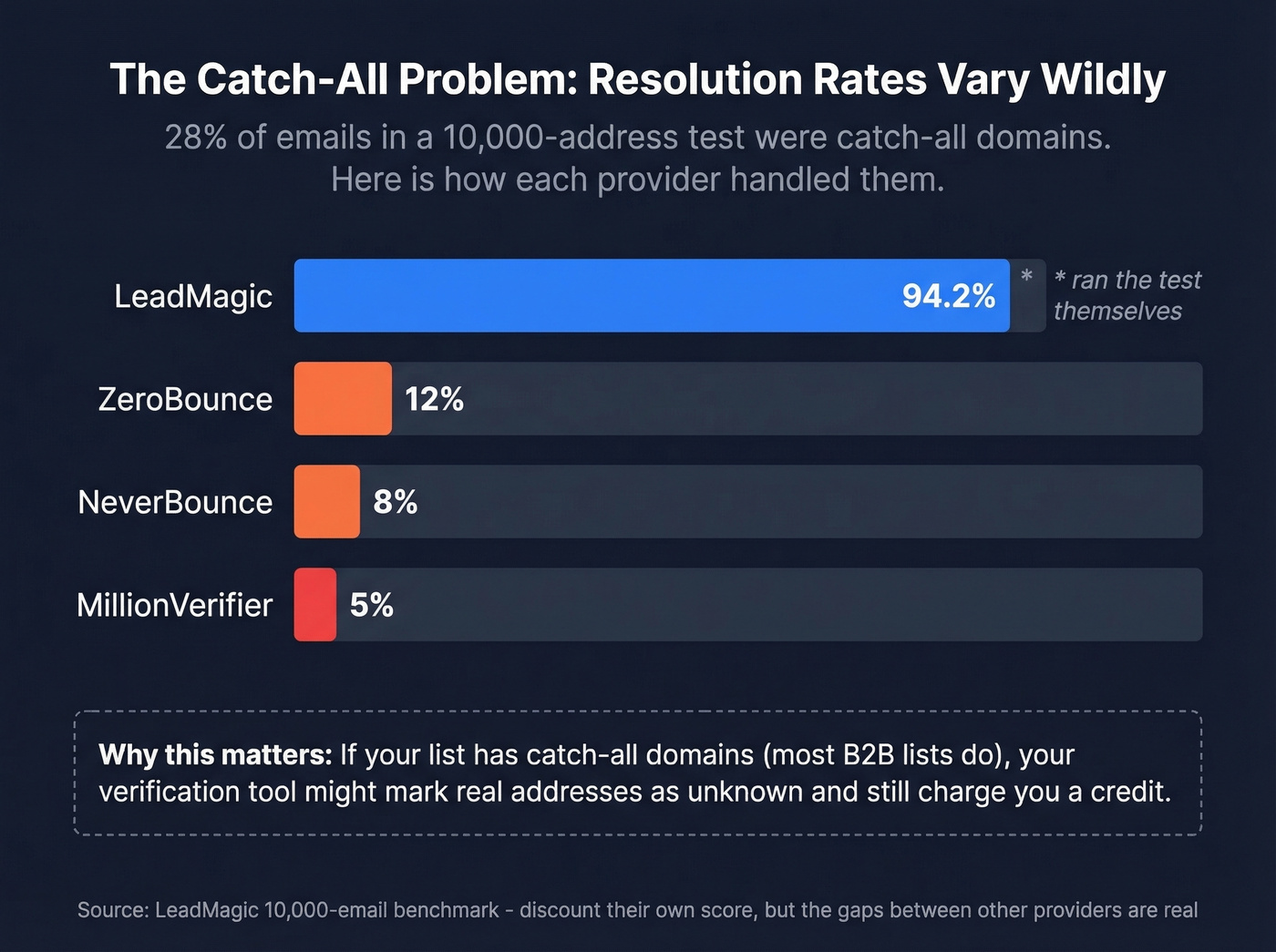
In LeadMagic's 10,000-email test, 2,800 of the addresses (28%) were catch-all. The resolution rates across providers were stark: LeadMagic resolved 94.2%, ZeroBounce managed 12%, NeverBounce hit 8%, and MillionVerifier came in at 5%. The obvious caveat is that LeadMagic's founder ran the test. But even throwing out their own score, the gap between providers is enormous.
On r/coldemail, one developer reported that adding a lesser-known tool called InvalidBounce to their workflow dropped their bounce rate from 16% to under 2%. Another on r/email said mails.so cut invalid emails by 96%. The point isn't that these specific tools are better - it's that catch-all handling varies wildly, and the only way to know is to test with your own data.
Accuracy Benchmarks in Practice
Every verification API claims 95-99% accuracy. Real-world benchmarks tell a different story.
Hunter ran the most rigorous public test - 15 email verification tools tested on ~3,000 real business emails plus 300 invalid emails added, verified in bulk mode via Clay integrations with identical default settings across tools.
| Tool | Accuracy (Hunter Benchmark) |
|---|---|
| Hunter | 70.00% |
| Clearout | 68.37% |
| Kickbox | 67.53% |
| Usebouncer | 65.43% |
Hunter disclosed that their dataset used their own activity data for validity labeling, which may have given them an edge. But let that sink in: the best verification-only tool in a controlled benchmark hit 70% accuracy. Not 99%. Not 95%. Seventy percent.
The gap between marketing claims and benchmark reality exists because accuracy depends heavily on input data quality. Verification tools can only check what you give them. If you're feeding in stale emails scraped months ago, even the best API will return more unknowns and false positives.
Let's be honest: most teams don't have a verification problem - they have a data sourcing problem. If your emails are stale or scraped from unreliable sources, no verification API will save you. The smarter move is to start with pre-verified data from a platform that refreshes weekly, then run a lightweight verification pass as a safety net. You'll spend less on credits and bounce fewer emails.
How to Choose the Right API
Three common architecture patterns exist for wiring verification into your stack. Edge validation calls the API directly at the point of capture - signup forms, lead gen pages, manual imports. A dedicated internal verification service centralizes key management, normalization, caching, and retries behind a single interface your other services call. Pipeline-based verification runs checks as part of an ETL or data warehouse workflow, typically in batch.
We've found the hybrid approach works best for most teams: verify in real time at capture, and run periodic bulk passes to catch decay.
For reliability, implement retry logic with exponential backoff on 429 responses, and add a circuit breaker that falls back to basic syntax and MX checks if the vendor API goes down. Don't let a third-party outage block your signup flow.
Treat "unknown" as its own status in your data model - never bucket it with "invalid." Store the normalized address, verification status (valid, invalid, catch-all, risky, unknown), vendor metadata, and a checked_at timestamp. This lets you re-verify unknowns after 24-48 hours, potentially with a different provider.
The golden rule for deliverability: keep your total bounce rate below 2%, with hard bounces under 1%. If you're above that threshold, your sending domain reputation is taking damage with every campaign.
If you're doing outbound, pair verification with a real email deliverability plan (SPF/DKIM/DMARC, warmup, and sane sending velocity). Otherwise you're just cleaning data while your domain reputation keeps sliding.
Free tiers run out. When yours does, you'll pay $8-$10/1K just to verify addresses that might already be stale. Prospeo refreshes data every 7 days - not 6 weeks - so the emails you pull are already clean. 92% API match rate, 75 free emails to start.
Get pre-verified emails and never bolt on a separate verification API again.
FAQ
Is a free email verification API enough for production?
For testing and low-volume form validation under 100 emails per day, free tiers work fine. For list cleaning or outbound campaigns, you'll outgrow them fast. QuickEmailVerification's ~3,000/month equivalent is the only free tier here that supports moderate ongoing volume without immediately forcing an upgrade.
How do I test which email validation API is most accurate?
Run 200-500 known-good and known-bad addresses from your own CRM through two or three providers simultaneously. Compare valid/invalid/unknown classifications against your ground truth. Don't trust marketing accuracy claims - the Hunter benchmark showed even top tools landing around 70% in controlled conditions.
How many verifications do I need per month?
A signup form processing 2,000 submissions per day needs 60,000 verifications per month minimum. An outbound team importing 5,000 leads per week needs 20,000+. Budget for 2-3x your expected volume to cover re-checks and address decay.
What should I do with catch-all results?
Never treat them as invalid - you'll discard real contacts. Store them separately and apply rules: send to catch-all addresses cautiously at lower volume while monitoring bounces, and retry unknowns after 24-48 hours with a different provider. In benchmarks, catch-all resolution rates range from 5% to 94% depending on the tool.
Can I build email verification in-house?
Syntax checks, MX lookups, and SMTP handshakes aren't complicated. But greylisting, rate limiting, catch-all domains, spam traps, and temporary server failures will eat you alive. Most teams spend more maintaining a homegrown system than they'd pay for an API that scales to paid tiers at $3-10 per thousand verifications.