

Funny Email Subject Lines: 50+ Examples That Work in 2026
69% of people say they're more likely to open an email with a humorous subject line. Yet only 24% of teams actually use humor in their email marketing. That gap isn't because humor is risky - it's because most marketers don't know how to be funny on purpose. They either copy a list of "wacky" subject lines from 2019 or slap "RE: Your million-dollar idea" on a cold email and wonder why their sender reputation craters.
Let's fix that. Below you'll find 50+ funny email subject lines organized by category, five repeatable humor formulas, and the testing framework to know what's actually working.
The Cheat Sheet
If you're short on time:
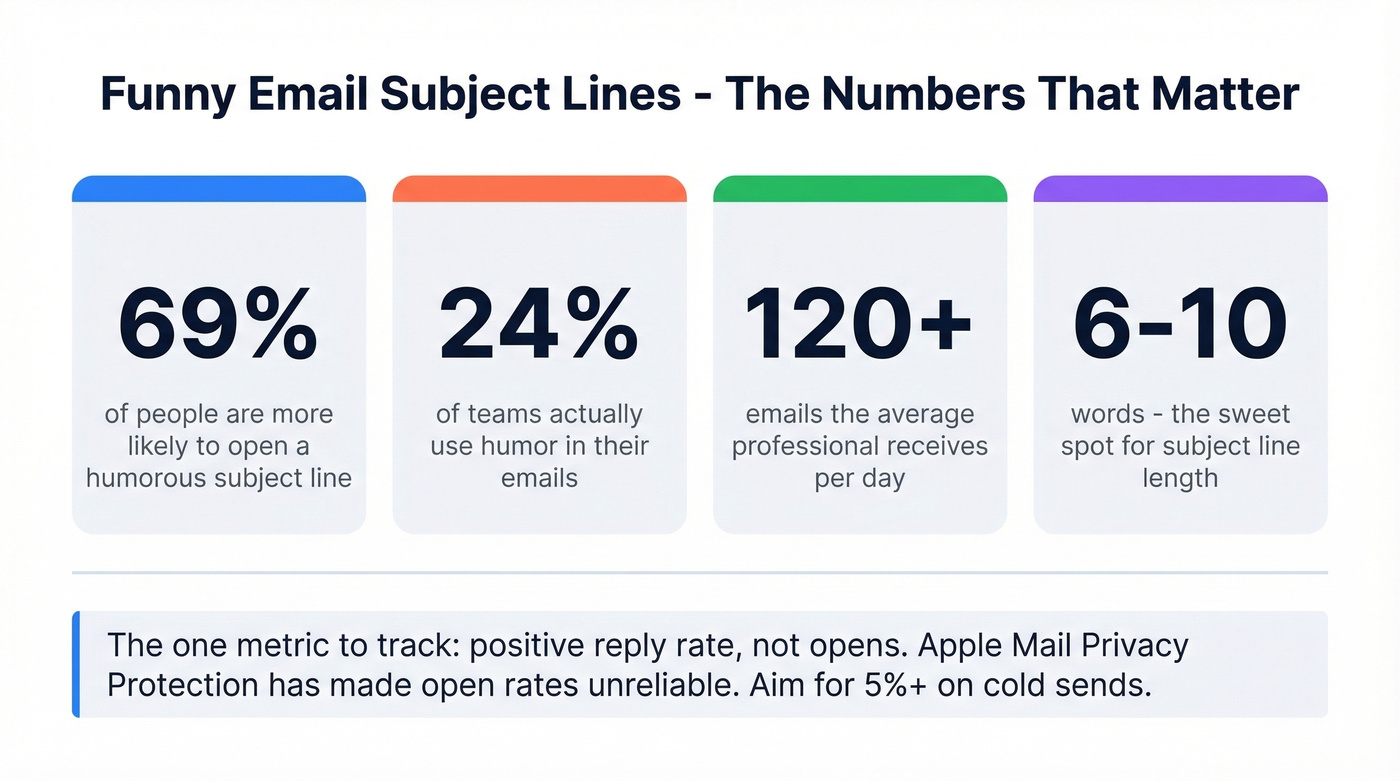
- Five humor formulas that work: incongruity pairing, specificity over cleverness, the callback, self-deprecation, and the anti-subject-line. Templates below.
- The one metric to track: positive reply rate, not opens. Apple Mail Privacy Protection has made open rates unreliable. Aim for 5%+ on cold sends.
- Three contexts where humor backfires: regulated industries, transactional emails, and crisis communications. Clarity beats comedy every time in those spots.
Why Humor Boosts Opens
The average professional receives 120+ emails per day. Most subject lines sound identical - "Quick sync," "Following up," "Your monthly report." The brain filters them out before the finger even moves.
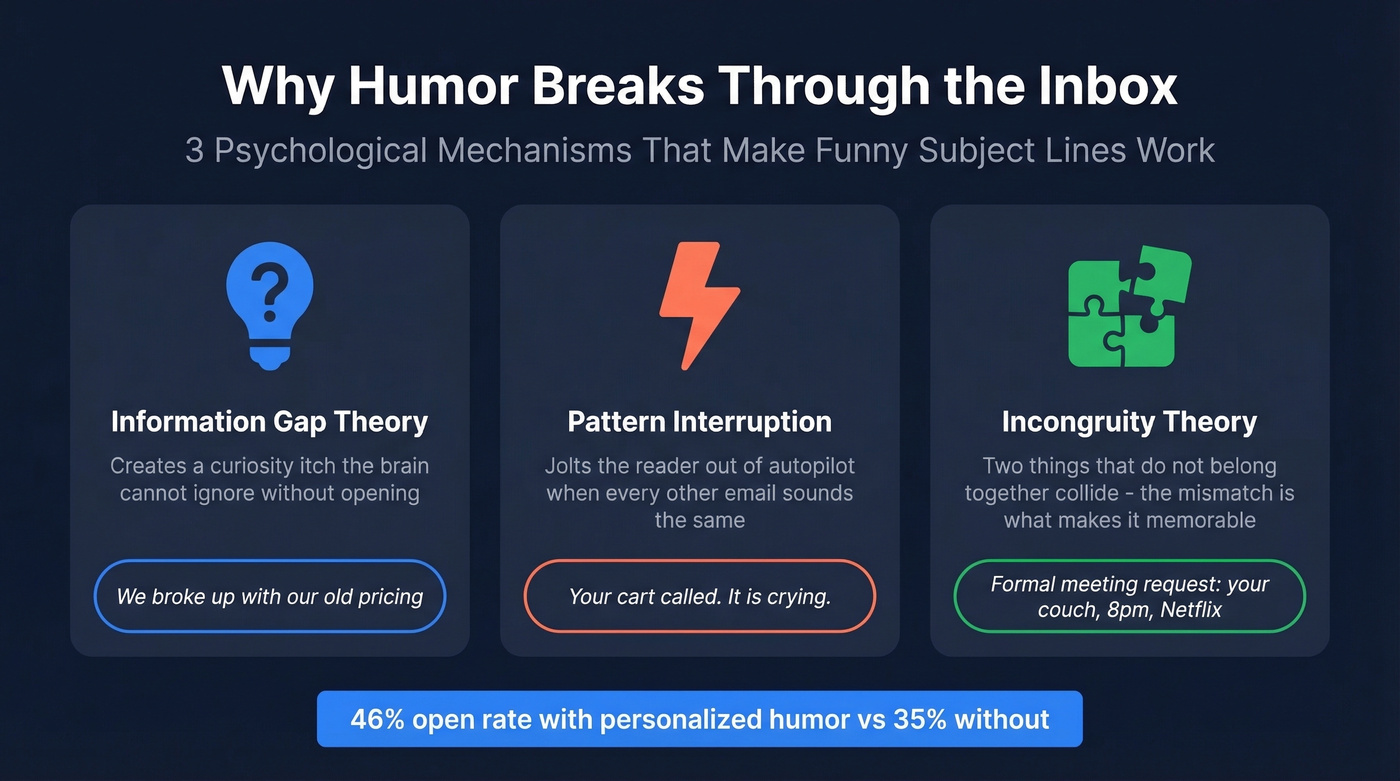
Humor breaks through because of three psychological mechanisms.
Information gap theory. A funny subject line creates a curiosity gap the reader can't close without opening. "We broke up with our old pricing" makes you wonder what the new pricing looks like. The brain treats that gap like an itch.
Pattern interruption. When every other email is corporate-speak, something unexpected - "Your cart called. It's crying." - jolts the reader out of autopilot. That jolt triggers a novelty response, and the brain starts associating the surprise with the sender.
Incongruity theory. Humor works when two things that don't belong together collide. "Formal meeting request: your couch, 8pm, Netflix" pairs professional language with a lazy evening. The mismatch is what makes it funny - and what makes it memorable. Personalized subject lines push this further: they pull 46% open rates vs. 35% without personalization, because a name or company reference inside a funny frame feels like an inside joke between two people who've never met.
50+ Examples by Category
A BuzzStream study of 6 million subject lines found that subject lines around 6-10 words tend to perform best overall. Keep that range in mind as you steal from the lists below. Most examples include a character count and the humor mechanism at play.
E-Commerce & Promotional
- "Screw it, let's just give everyone free stuff" (45 chars) - incongruity, brand voice. Chubbies used this for a flash promo event.
- "Your wallet's going to hate us" (31 chars) - self-deprecation, honesty
- "We made too many. Your gain." (29 chars) - specificity, transparency
- "This sale is better than your ex" (33 chars) - incongruity, relatability
- "Open for 20% off. Or don't. We're not your mom." (49 chars) - anti-authority
- "New arrivals that'll make your closet jealous" (46 chars) - personification
- "We put the 'fun' in 'refund policy'" (36 chars) - wordplay, self-deprecation
- "Treat yourself. You survived Monday." (37 chars) - specificity, shared experience
- "C'mon, it's Friday and you're killing time anyway" (50 chars) - honesty. RebelsMarket used this one.
- "Be the Notes app of your friend group" (37 chars) - incongruity, internet culture
B2B Sales Subject Lines
This is where humor gets misunderstood. In B2B, "funny" means human, not comedian. The best funny sales email subject lines lean on self-awareness and conversational tone rather than punchlines. Here's what actually pulls responses:
| Subject Line | Response Rate | Mechanism | Opening Line That Pairs Well |
|---|---|---|---|
| "Quick question, {{firstName}}" | 25-30% | Conversational brevity | "Saw {{companyName}} is hiring 3 SDRs - scaling outbound?" |
| "Saw your post on {{topic}}. Had thoughts." | 30-35% | Specificity | "Your point about [X] was spot on. Here's what I'd add." |
| "This isn't a sales email (okay, it kind of is)" | - | Self-deprecation | "I'll keep this short because you're busy and I respect that." |
| "I promise this is my last email (it's not)" | - | Callback, self-awareness | "Look, I know persistence is annoying. But I genuinely think..." |
| "Your competitor just signed up" | - | Social proof | "Not trying to start drama, but [competitor] just..." |
A few more that work well as follow-ups when you've got nothing to lose:
- "I wrote you 3 emails. This is the funny one." (45 chars) - meta-humor, pattern interruption
- "Not sure who needs to hear this, but your CRM does" (50 chars) - meme reference
- "Permission to be blunt?" (23 chars) - curiosity gap, brevity
- "{{companyName}}'s pipeline called. It misses you." (42 chars + name) - personification
Newsletter & Content
- "The one where we actually have good news" (41 chars) - incongruity, TV reference
- "We read 47 reports so you don't have to" (40 chars) - specificity, reciprocity
- "Plot twist: this email is worth reading" (39 chars) - pattern interruption
- "Your weekly dose of unsolicited opinions" (41 chars) - self-deprecation
- "TL;DR - we found something cool" (32 chars) - brevity, curiosity gap
- "This week in 'things that shouldn't work but do'" (49 chars) - incongruity
- "Sorry in advance for the hot takes" (34 chars) - self-deprecation
Win-Back & Re-Engagement
Win-back emails are where self-deprecation shines brightest, because the brand is already in a vulnerable position. Missguided's "Hey, we need to talk..." borrowed the anxiety of a relationship conversation - you open it because the alternative is worse. The email itself was light and friendly, which made the bait-and-switch feel charming rather than deceptive.
In the same vein:
- "We miss you. Do you miss us? No? Fair." (38 chars) - acknowledges the reader's power
- "It's not you, it's our email frequency" (38 chars) - flips the breakup trope into honest self-awareness
- "Come back and we'll pretend this never happened" (47 chars) - a brand offering amnesty like a friend after a fight
- "Your account is gathering dust" (30 chars) - visual specificity
- "We changed. Pinky promise." (27 chars) - brevity, vulnerability
Seasonal & Holiday
- "🎃 Scarier than Halloween: your empty cart" (37 chars) - incongruity, single emoji
- "New year, same you. Better deals though." (40 chars) - anti-inspirational
- "Cupid called. He recommends 30% off." (36 chars) - personification, specificity
- "Turkey's done. So are these prices." (35 chars) - wordplay, urgency
- "Happy Monday (we know, we know)" (31 chars) - shared misery, relatability
Internal & Colleagues
Nobody talks about internal emails, but they're where humor has the highest hit rate - you already know your audience.
- "Formal meeting request: your couch, 8pm, Netflix" (49 chars) - pure incongruity
- "Please don't reply all to this" (30 chars) - shared frustration every office worker feels in their bones
- "The spreadsheet that broke me" (29 chars) - self-deprecation with specificity
- "I have snacks and a question" (28 chars) - bribery dressed as brevity
- "This could've been a Slack message" (34 chars) - meta-humor that lands because it's true
Abandoned Cart
- "Your cart's getting cold feet" (29 chars) - personification
- "Did you forget something or are you playing hard to get?" (50 chars) - relationship framing
- "Still thinking it over? Same." (29 chars) - self-deprecation, brevity
- "Your items are starting to worry" (32 chars) - personification
- "We saved your cart. It didn't save itself." (42 chars) - incongruity, specificity
5 Humor Formulas You Can Steal
These aren't joke structures - they're repeatable frameworks. We've tested all five across campaigns, and each one works because it triggers a specific psychological response.
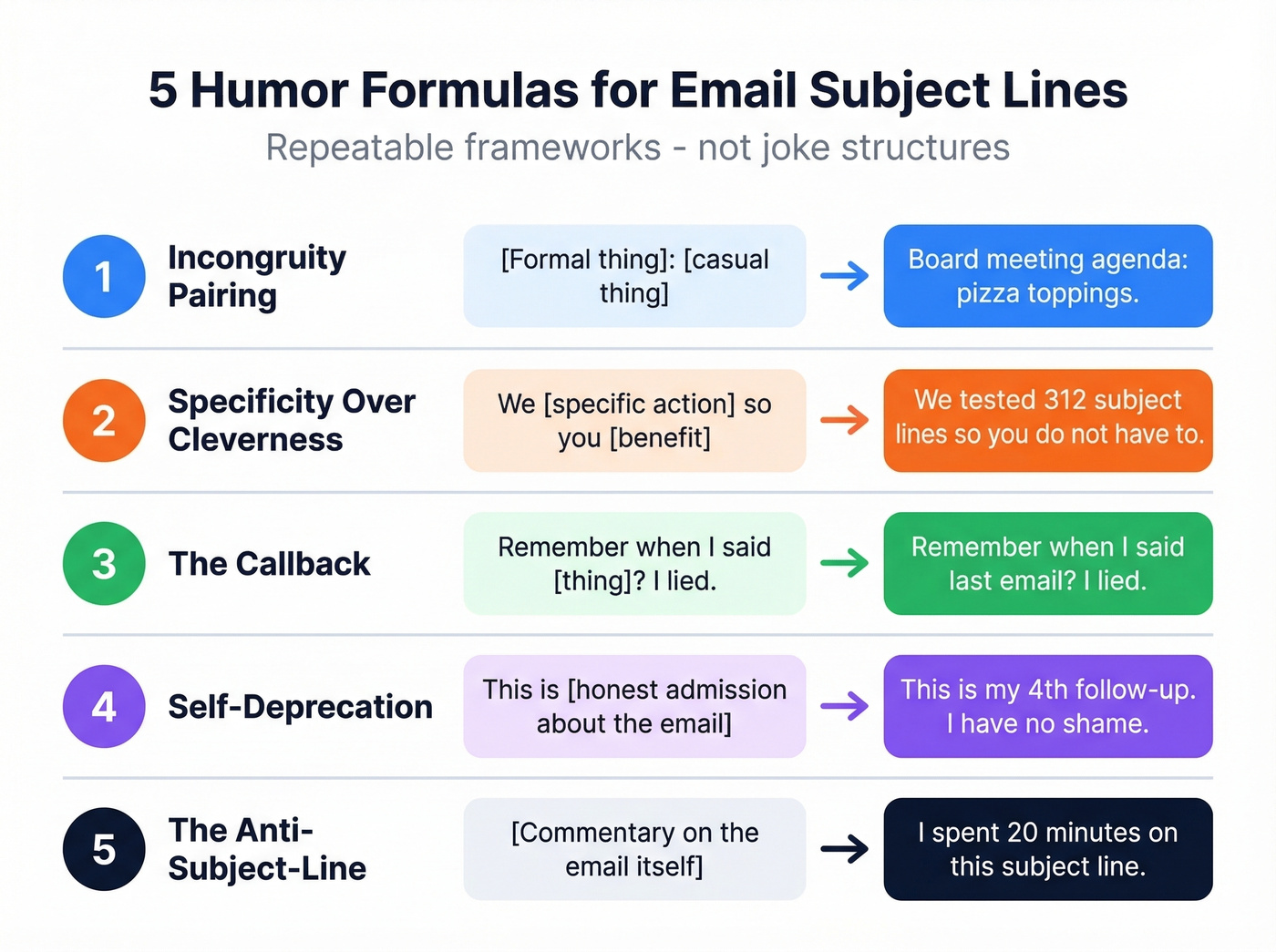
1. Incongruity Pairing. Smash two things together that don't belong. Professional language + casual context, or serious framing + trivial topic.
Template:
[Formal thing]: [casual thing]Example: "Board meeting agenda: pizza toppings."
2. Specificity Over Cleverness. Specific details are funnier than generic jokes. "We read 47 reports" beats "We did a lot of research." The number makes it real, and real is funny.
Template:
We [specific action] so you [benefit]Example: "We tested 312 subject lines so you don't have to."
3. The Callback. Reference something from a previous email. This rewards engaged readers and creates an inside joke.
Template:
Remember when I said [thing]? I lied.Example: "Remember when I said last email? I lied."
4. Self-Deprecation. Acknowledge the awkwardness of what you're doing. Readers respect honesty, and it disarms the sales reflex.
Template:
This is [honest admission about the email]Example: "This is my 4th follow-up. I have no shame."
5. The Anti-Subject-Line. Write a subject line that comments on itself being a subject line. It's meta, it's unexpected, and it works because nobody else does it.
Template:
[Commentary on the email itself]Example: "I spent 20 minutes on this subject line."

A clever subject line is worthless if it bounces. Prospeo's 98% email accuracy and 7-day data refresh mean your funniest lines actually land in real inboxes - not spam traps.
Stop wasting your best copy on dead email addresses.
When Humor Backfires
Here's the thing - humor isn't a universal key. We've seen it bomb spectacularly in the wrong context. This decision framework has saved us from a few embarrassing sends:
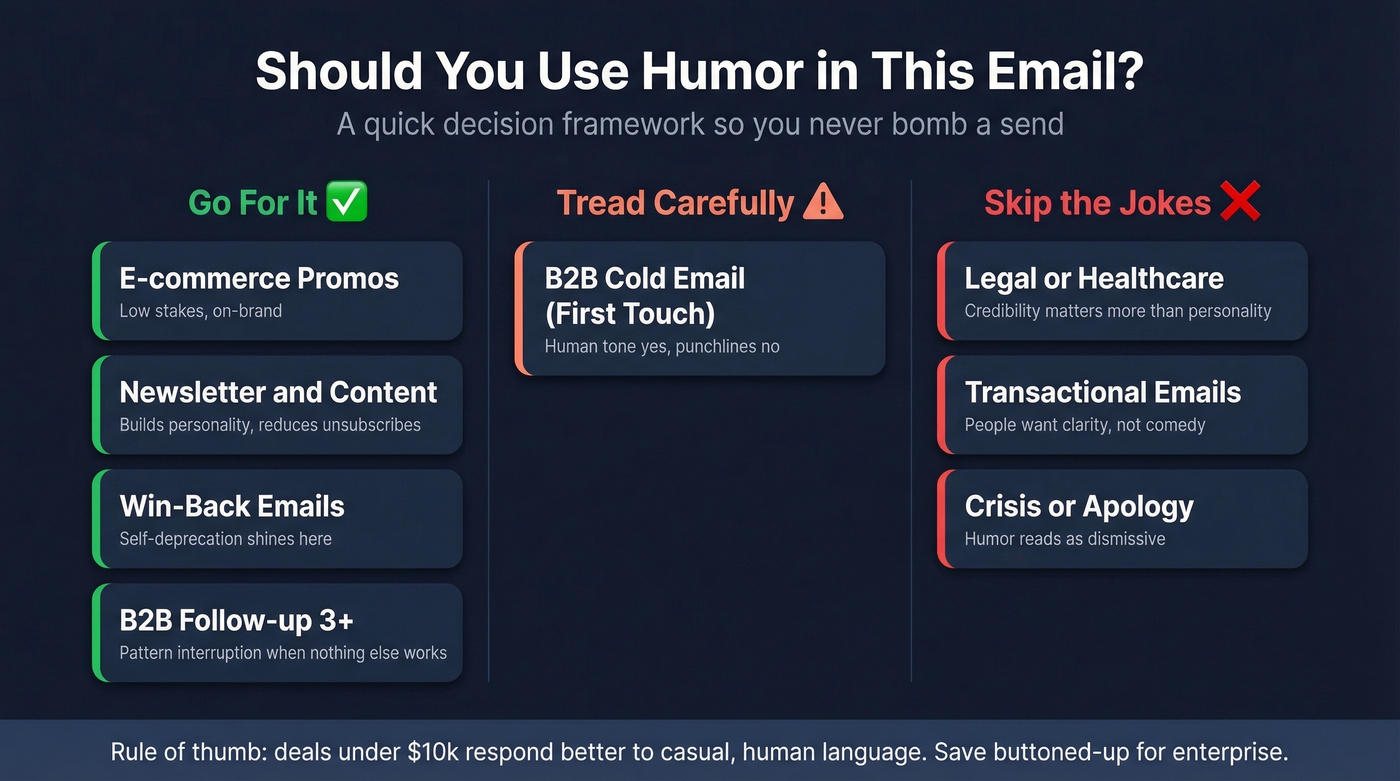
| Context | Use Humor? | Why |
|---|---|---|
| E-commerce promo | ✅ Yes | Low stakes, on-brand |
| B2B cold (first touch) | ⚠️ Careful | Human tone yes, jokes no |
| B2B follow-up #3+ | ✅ Yes | Pattern interruption |
| Newsletter / content | ✅ Yes | Builds personality, reduces unsubscribes |
| Win-back | ✅ Yes | Self-deprecation works |
| Legal / healthcare | ❌ No | Credibility > personality |
| Transactional | ❌ No | People want clarity |
| Crisis / apology | ❌ No | Humor reads as dismissive |
If you're selling deals under $10k, you probably don't need "professional" subject lines at all. The companies we see overthinking email tone are almost always selling to SMBs who respond better to casual, human language anyway. Save the buttoned-up approach for enterprise - and even there, follow-up #3 is fair game for humor.
Funny vs. Deceptive - The $51,744 Line
There's a line between funny and deceptive, and crossing it costs real money. CAN-SPAM fines run up to $51,744 per email violation.
The most common offenders are fake "RE:" and "FWD:" prefixes. Writing "RE: Your $100 credit" when there's no prior conversation isn't clever - it's deceptive. These tricks boost opens once, but a Gartner study found 30.4% of subscribers opt out when subject lines don't match the email content. That's nearly a third of your list gone because you tried to be cute.
The rule is simple: your subject line can be surprising, weird, or absurd - but it can't promise something the email doesn't deliver. "Your cart called. It's crying." is funny. "RE: Your refund has been processed" when there's no refund is fraud-adjacent.
Subject Lines That Tank Deliverability
Spam filters don't care if you're funny. They care about patterns. With 160 billion spam emails sent daily and 45% of all emails landing in spam, the filters are ruthless.
Skip these:
- ALL CAPS ("HUGE SALE TODAY") - try instead: "Huge sale today (seriously, this one's real)"
- Emoji overload (🔥🚀💰) - one emoji max. Test with and without.
- "URGENT!" false alarms - try instead: "Time-sensitive, but no pressure"
- Fake RE: / FWD: prefixes - filters catch these now. So do recipients.
- One-word subjects ("Hi" or "Hey") - filters flag these, and they're lazy
- "Newsletter" in the subject - an analysis of 2,500+ subject lines called this "instant death" for engagement. Use the actual topic instead.
One more technical note: studies show higher clicks when subject lines max out at 49 characters. Front-load the punchline before the truncation point.
A/B Testing Humorous Subject Lines
Don't guess. Test. But test correctly.
Step 1: Pick one variable. Test funny vs. straight, not funny + emoji + personalization vs. straight + short + no emoji. One variable per test.
Step 2: Use enough volume. You need at least 250 contacts per variant. 500+ is better. Anything less and your results are noise.
Step 3: Measure reply rate, not opens. Over 55% of emails are opened on mobile, and many of those "opens" are Apple's proxy servers, not humans. Track positive replies. Aim for 5%+.
Step 4: Respect mobile truncation. Many mobile clients cut off after 33-43 characters. Front-load the punchline. The sweet spot is 25-45 characters.
Step 5: Send Tue-Thu, 9-11am in the recipient's timezone. Humor tends to land better when people aren't buried in Monday catch-up or Friday wind-down. Timing won't save a bad subject line, but it amplifies a good one. (If you want the data-backed breakdown, see best time to send.)
Step 6: Clean your list first. Before you test that clever subject line on 1,000 contacts, verify the list. Bounces don't just waste credits - they poison your domain reputation, and then every future email suffers. We learned this the hard way on a client campaign where a 6% bounce rate tanked deliverability for three weeks. (More on benchmarks and fixes in our email bounce rate guide.)
Those B2B subject lines above work best when you're reaching the right person. Prospeo gives you 300M+ verified contacts with 30+ filters - so your humor hits decision-makers, not gatekeepers.
Pair sharp subject lines with the right prospects for $0.01 per email.
Real Brands That Nailed It
Chubbies - "Screw it, let's just give everyone free stuff." Their "Julyber Monday" flash promo. The incongruity between a brand giving things away and the reckless tone made it irresistible. It worked because Chubbies has always sounded like your funniest friend - they earned the right to be this casual through years of consistent brand voice.
Dollar Shave Club - "Are You a Genius? You Could Be." Curiosity gap plus flattery. DSC's entire brand is built on irreverent humor, so a playful subject line never feels forced. The key: consistent voice over time, not a one-off attempt at being funny.
Missguided - "Hey, We Need to Talk..." A win-back email that borrows the anxiety of a relationship conversation. You open it because the alternative - not knowing - is worse. The email itself was light and friendly, making the tension feel charming rather than deceptive. The consensus on r/emailmarketing is that this kind of emotional bait only works when the payoff matches the setup, and Missguided nailed the landing.
FAQ
How long should a funny email subject line be?
25-45 characters is the sweet spot. Many mobile clients truncate after 33-43 characters, so front-load the punchline. A BuzzStream study of 6 million subject lines found 6-10 words perform best overall.
Do funny subject lines work for B2B sales?
Yes, but "funny" means conversational and human - not puns or dad jokes. "Quick question, {{firstName}}" pulls 25-30% response rates. Save actual jokes for follow-up #3+ when pattern interruption matters most.
Should I use emojis in humorous subject lines?
One emoji max. More than one triggers spam filters and looks unprofessional in B2B contexts. A single 🎃 or 👀 can work. The 🔥🚀💰 combo won't.
How do I measure if my subject line humor is working?
Track positive reply rate and clicks, not open rate. Apple Mail Privacy Protection inflates opens artificially. A 5%+ positive reply rate on cold outreach means the humor is landing. Below 2%, the joke isn't connecting or the list quality is bad.
What if my emails bounce despite great subject lines?
Bounces destroy sender reputation regardless of how witty your copy is. A bounce rate above 1% pushes future emails toward spam. Verify your list before any campaign - tools like Prospeo catch invalid addresses, spam traps, and honeypots with 98% accuracy so your A/B test measures what you actually want to measure.