

Gigasheet vs ZoomInfo (2026): These Aren't Competing Products
Someone on your team mentioned Gigasheet as a cheaper option right after your ZoomInfo renewal came in at $30k+. You clicked. Totally reasonable - but this comparison is misleading from the jump, and some comparison pages out there make it worse by treating Gigasheet like it's a ZoomInfo competitor.
We dug into both platforms. Here's what's actually going on, and what to buy depending on the job you need done.
Apples vs Stethoscopes
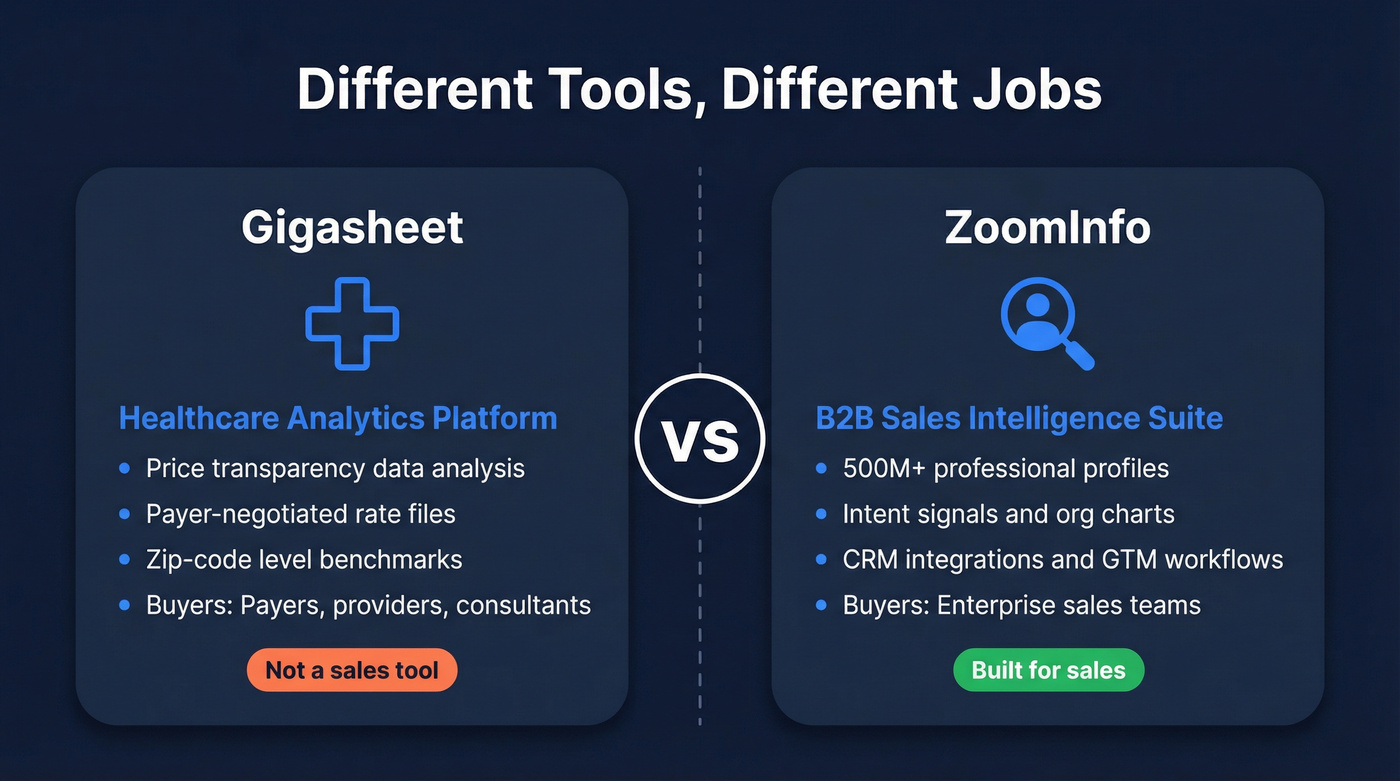
Gigasheet is a healthcare price transparency analytics platform. ZoomInfo is an enterprise B2B sales intelligence suite. Different categories, different buyers, different outcomes.
What Gigasheet Actually Is
Gigasheet started as a "big-data spreadsheet" built to analyze massive datasets, up to billions of rows. In 2023 and 2024, they published content about B2B data enrichment, positioning alongside tools like Apollo and Hunter. That's a big reason this keyword exists in the first place.
They've since pivoted hard into healthcare. Their Price Transparency Explorer, announced in February 2026, turns payer-negotiated rate files into interactive maps, plan comparisons with color-coded dollar deltas, and automated benchmarks that let you zoom from nationwide down to zip-code level. The buyer is typically payers, provider organizations, consultants, and employers - not a sales team hunting for prospect emails.
The legacy enrichment capability still exists. You can upload a file and enrich rows via providers like Apollo, Hunter, and People Data Labs through a credit-based system that adds new columns to your sheet. But it's a side feature, not the product's direction.
Gigasheet carries a 4.9/5 on G2 with 23 reviews. Reviewers consistently praise the UI, support, and ability to handle large datasets, while also calling out that the subscription isn't cheap.
Use this if you're analyzing healthcare price transparency data at scale. Skip this if you need a searchable B2B contact database.
Pricing: The MRF Explorer starts at $5,000/year. For the enrichment-focused SKU, there's a free Community plan (1,000 credits/month) and Premium at $95/month ($79/month on annual) for 10,000 credits/month.
What ZoomInfo Actually Is
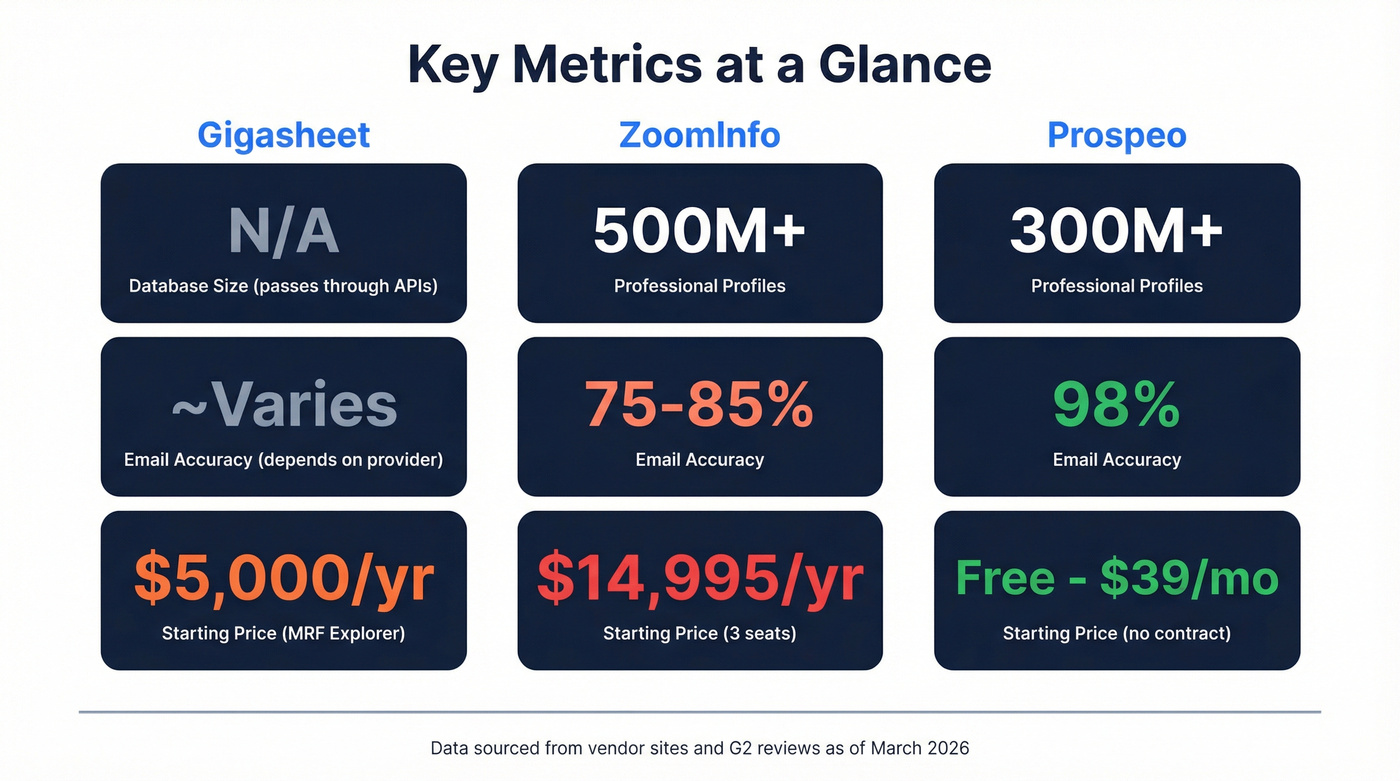
ZoomInfo is the default enterprise B2B data platform. The database covers 500M+ professional profiles, 174M verified emails, and 70M+ direct dials. It also includes GTM capabilities like intent signals and conversation intelligence as part of a broader suite. G2 rating: 4.5/5 across 9,037 reviews.
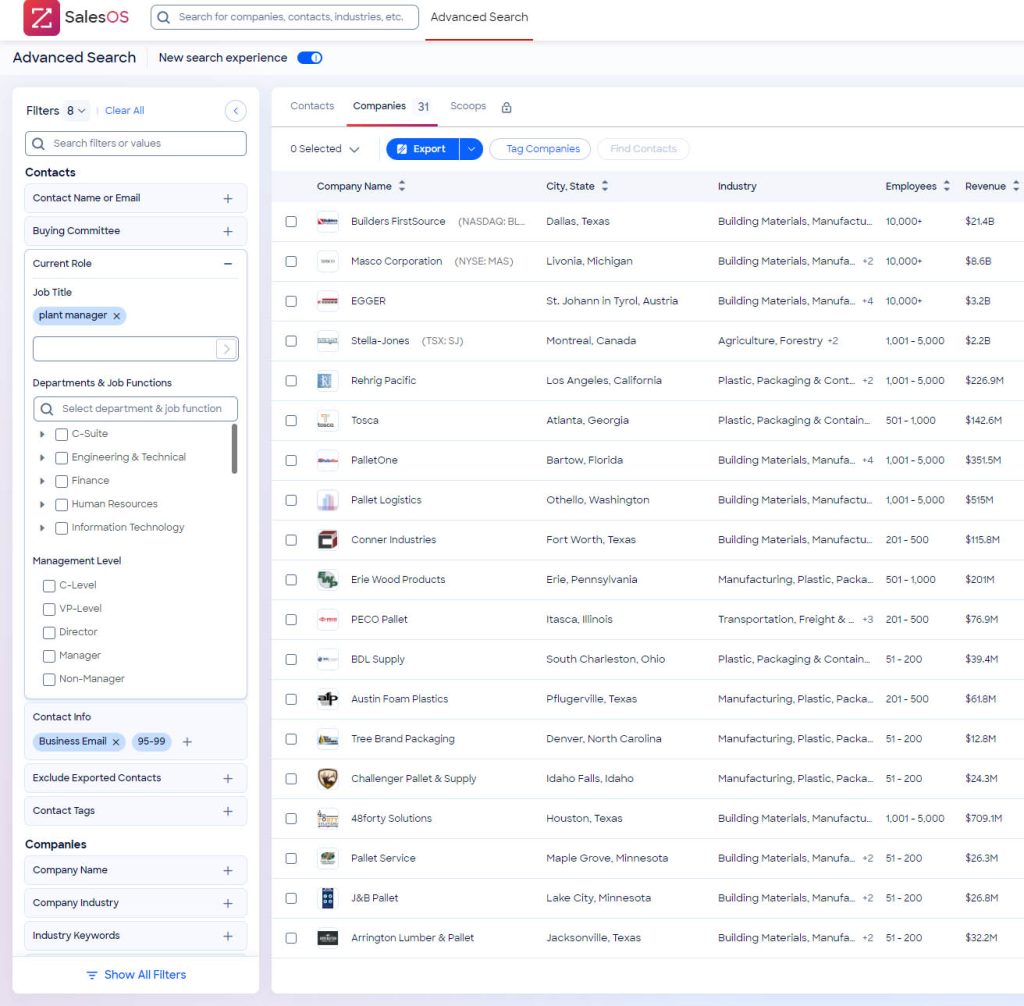
Here's the thing about ZoomInfo: its biggest strength and biggest weakness are the same database. "Contact Information" is the #1 praised theme on G2 with 413 mentions. But "Inaccurate Data" and "Outdated Data" each hit 232 mentions on the complaints side. Email accuracy runs roughly 75-85% depending on the segment. The consensus on r/sales echoes the same two frustrations over and over: data freshness and contract flexibility.
Use this if you need enterprise-scale sales intelligence with intent data, org charts, and deep CRM integrations - and you've got the budget. Skip this if you're a lean team that just needs accurate contact data without a six-figure commitment.
Pricing: Professional+ starts at $14,995/year for 3 seats. Vendr benchmarks put typical spend at $24,800-$44,200 for 200-person companies, scaling to $50,200-$113,800 at 1,000 headcount. Contracts are annual; the cancellation window is typically 60 days before renewal.
Where They Overlap (Barely)
There's exactly one intersection point, and it's thin.
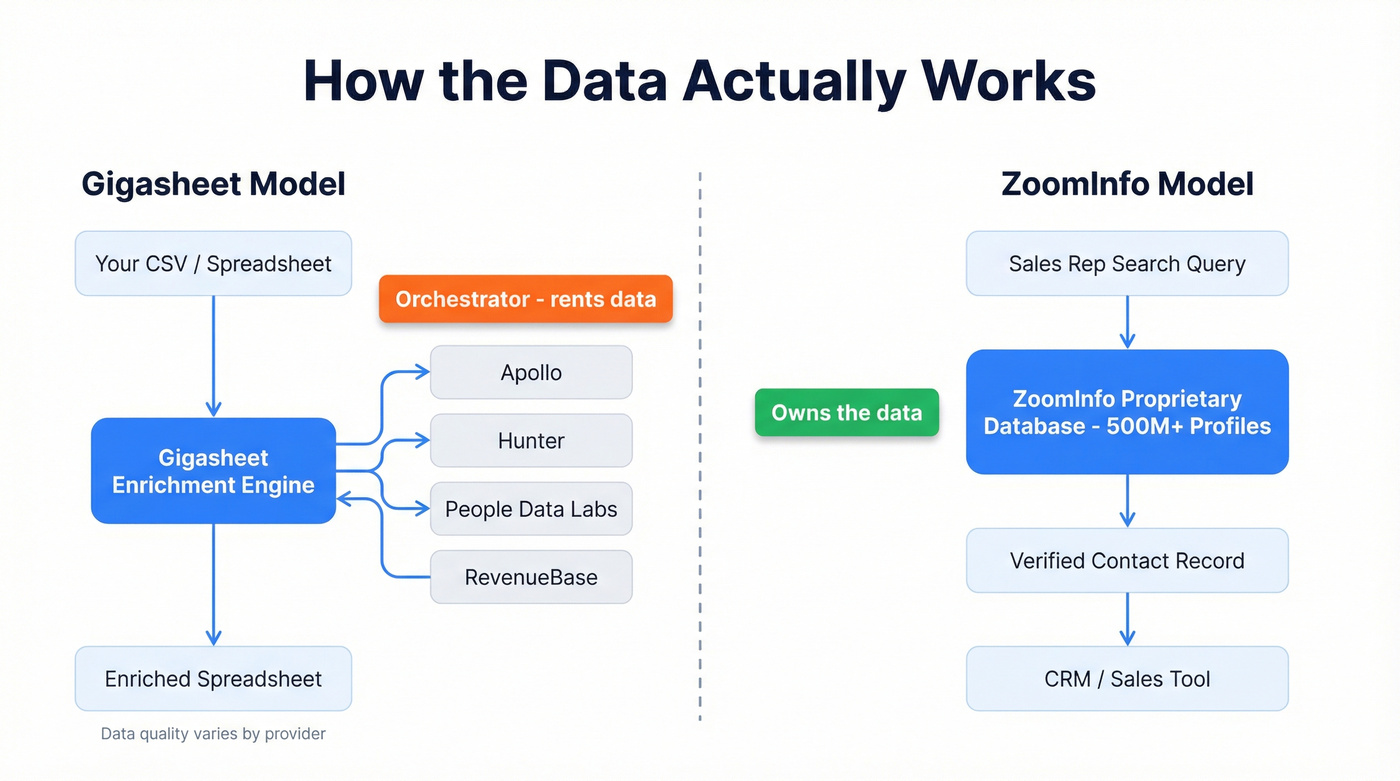
Gigasheet's enrichment engine can call third-party data providers through its credit-based system. Providers listed across Gigasheet materials include Apollo, Hunter, People Data Labs, and RevenueBase (110M contact profiles). It's one credit per enriched row, and you're only charged when a match is found.
This makes Gigasheet an enrichment orchestrator, not a data provider. It doesn't ship with a proprietary contact database you can search. It routes your spreadsheet rows through third-party APIs and returns the results. ZoomInfo owns its data. Gigasheet rents someone else's. That's a fundamental difference, and it shows up in coverage, freshness, and consistency.
Gigasheet has claimed its approach can be "8x-10x more cost effective" than alternatives on a per-record basis, and that can be true if you're enriching lists in bulk. But you're still getting third-party data quality, not a single verification infrastructure behind every record. Gigasheet's own 2023 content listed ZoomInfo at 235M professionals; ZoomInfo now positions at 500M+, which further widens the gap between an orchestrator and a proprietary platform.

Gigasheet routes your data through third-party APIs. ZoomInfo owns its database but charges $30K+ and refreshes every 6 weeks. Prospeo gives you 300M+ profiles on a proprietary verification infrastructure with 98% email accuracy, 7-day refresh cycles, and no annual contract - starting free.
Get enterprise-grade B2B data without the enterprise invoice.
Gigasheet vs ZoomInfo: Side-by-Side
| Gigasheet | ZoomInfo | Prospeo | |
|---|---|---|---|
| Category | Healthcare analytics | B2B sales intelligence | B2B data platform |
| Primary use | Price transparency | Full GTM suite | Contact data + verification |
| Data ownership | Third-party APIs | Proprietary database | Proprietary infrastructure |
| Database size | N/A (passes through) | 500M+ profiles | 300M+ profiles |
| Email accuracy | Depends on provider | ~75-85% | 98% |
| Starting price | $5,000/yr (MRF Explorer) | ~$15,000/yr | Free-$39/mo |
| Contract terms | Varies by offering | Annual | No contract |
| Ideal buyer | Healthcare orgs | Enterprise sales teams | Any B2B team |
Choosing the Right Tool
You need healthcare price transparency analytics. Gigasheet, no question. It's purpose-built for analyzing massive payer-negotiated rate files, and nothing in ZoomInfo's suite touches this.
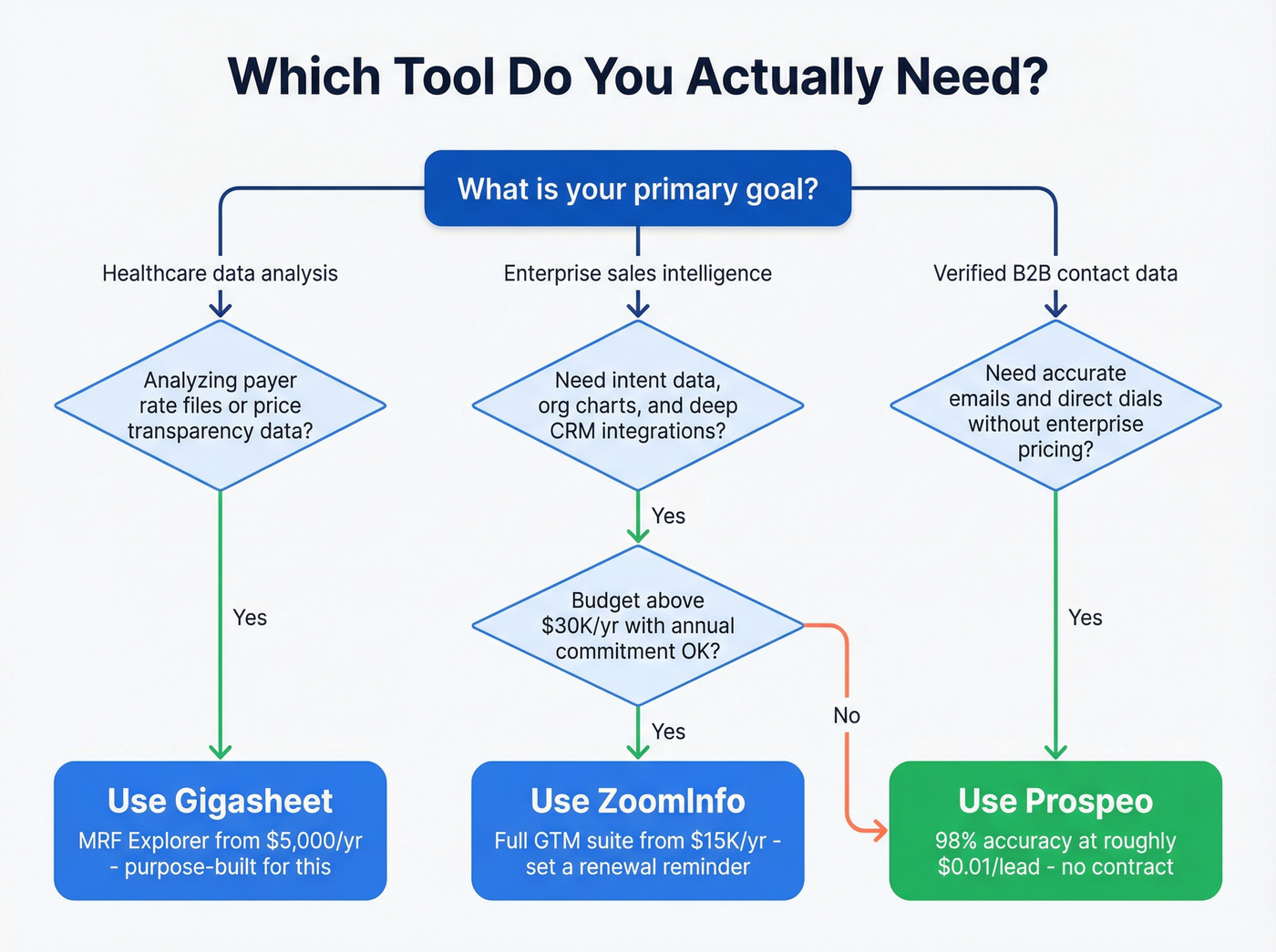
You need enterprise-scale sales intelligence with intent data and org charts. ZoomInfo, if you can stomach $30K+/year and annual lock-in. It's the most feature-rich GTM platform on the market - just set a calendar reminder 61 days before renewal.
You need verified B2B contact data without the enterprise tax. Neither of these tools. Let's be honest: if your average deal size is under ~$50k, you almost certainly don't need ZoomInfo-level platform complexity. You need accurate emails and direct dials that actually connect.
If You Need Affordable B2B Data Without the Contract
We've tested a lot of data providers over the years, and the math on Prospeo keeps winning. It delivers 98% email accuracy through a 5-step verification process with catch-all handling, spam-trap removal, and honeypot filtering. Records refresh every 7 days - the industry average is 6 weeks - which is why teams using it book 26% more meetings than ZoomInfo users.

It's self-serve at roughly $0.01 per lead, with 30+ search filters including buyer intent (15,000 topics via Bombora), technographics, job change signals, and headcount growth. Native integrations push directly into Salesforce, HubSpot, Lemlist, Instantly, and Clay. For enrichment workflows, the API returns 50+ data points per contact with a 92% match rate.
If your team just needs verified emails and direct dials that connect, you don't need a healthcare analytics tool or a $30K platform. Prospeo delivers 98% accurate emails at ~$0.01 each, 125M+ verified mobiles with a 30% pickup rate, and 30+ filters including buyer intent - all self-serve, no contract.
Teams using Prospeo book 26% more meetings than ZoomInfo users.
What This Comparison Really Means
The Gigasheet vs ZoomInfo debate only exists because search results blur categories. In reality, Gigasheet is built for healthcare price transparency analytics, while ZoomInfo is built for enterprise sales intelligence. If your goal is simply accurate, fresh B2B contact data without annual lock-in, you'll get a better fit from a self-serve data platform with proprietary verification behind every record.
FAQ
Is Gigasheet a ZoomInfo alternative?
No. Gigasheet is a healthcare analytics platform focused on price transparency data, not a sales intelligence database. While it can enrich spreadsheets via third-party B2B APIs, it doesn't provide a proprietary, searchable contact database the way ZoomInfo does.
How much does ZoomInfo cost per year?
ZoomInfo Professional+ starts at $14,995/year for 3 seats, and many teams land in the $30K-$75K+ annual range depending on seats and add-ons. Most contracts are annual, and the cancellation window is typically 60 days before renewal.
Can Gigasheet replace ZoomInfo for sales prospecting?
Not effectively. Gigasheet's enrichment is list-based and depends on third-party providers, while ZoomInfo is built around a proprietary database plus GTM features like intent, org charts, and CRM workflows. For prospecting, you'll feel the difference immediately in search, filtering, and coverage.
What's a good lower-cost option for verified emails?
For most outbound teams, Prospeo is the simplest cost drop without sacrificing deliverability: 98% email accuracy, a 7-day refresh cycle, and pricing around $0.01/lead with no contract. The free tier includes 75 verified emails/month plus 100 Chrome extension credits, which is enough to validate real workflows before paying.