

5 Go-to-Market Case Studies With Real Numbers (and What They Prove)
42% of startup failures get blamed on "no market need." Not because the product was bad - because the go-to-market motion was wrong. New business ARR growth rates have dropped 34 percentage points since early 2022 for companies under $1M ARR. The five case study breakdowns below prove what actually works, with hard numbers from real launches.
Here's a quick framework to anchor the rest of this piece: match your GTM motion to your average selling price. Below ~$100, go PLG or self-serve, then layer sales later. Above $500K deals, run ABM. In between, start with founder-led distribution plus a simple outbound motion, then add sales-assist as deal size and complexity climb.
The GTM Framework That Actually Holds Up
Forget the 47-step playbook. The model that consistently works follows four phases with decision gates between each.
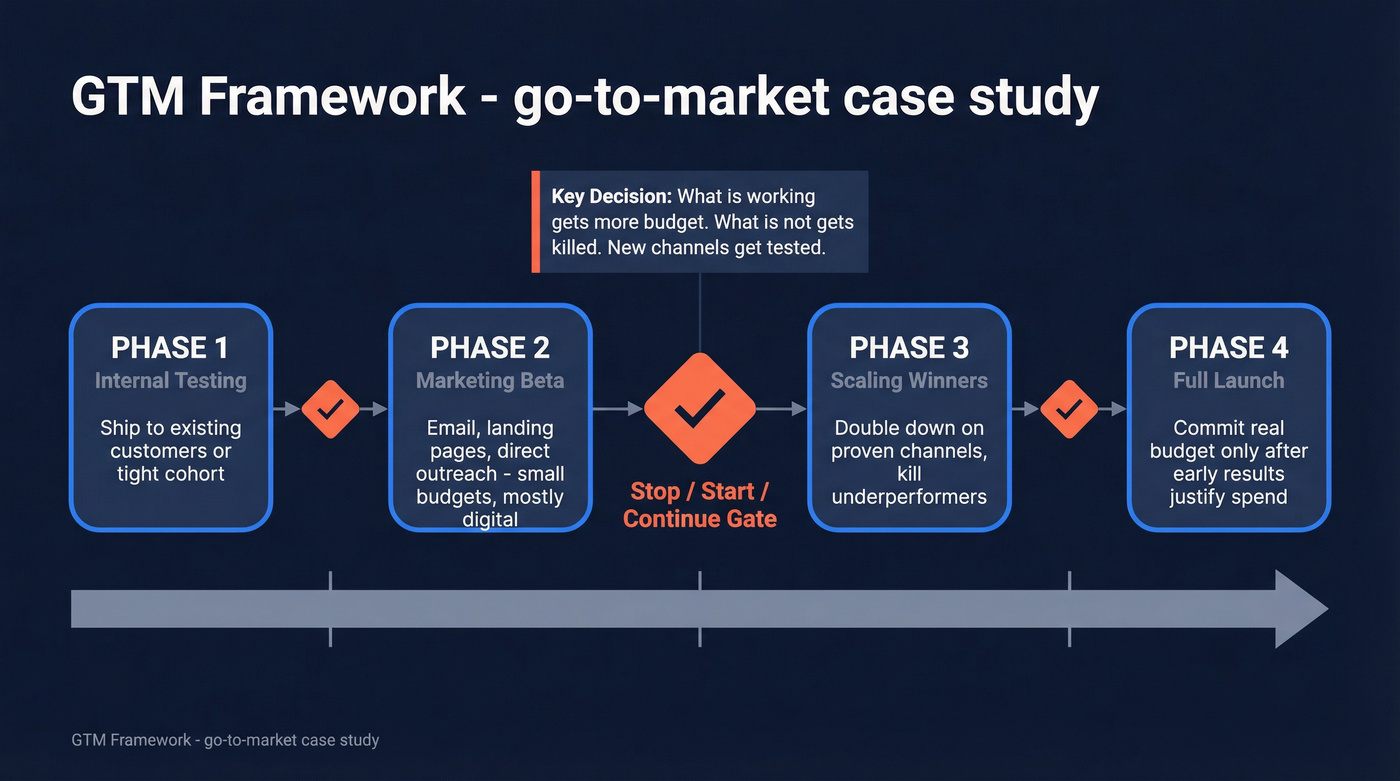
Phases 1 and 2 are your marketing beta. Ship to existing customers or a tight cohort. Prove demand with email, landing pages, and direct outreach - small budgets, mostly digital. Nothing fancy.
At the gate between Phase 2 and 3, run a stop/start/continue evaluation: what's working gets more budget, what's not gets killed, new channels get tested. Don't commit budget to Phases 3 and 4 until the early results justify the spend. We've watched teams blow six figures scaling a channel that only worked for the first 20 customers, and it's painful every time.
One timing insight worth calling out: trial-to-paid conversions spike around day 7 for both PLG and sales-led companies. If your onboarding doesn't deliver an "aha" moment in the first week, you're leaking conversions regardless of motion.
5 Go-to-Market Strategy Examples With Hard Numbers
Slack - Viral Preview Release
Slack's team used the product internally starting March 2013, then recruited six to ten external companies for feedback by May. The preview release hit August 2013 - deliberately not called a "beta" to avoid reliability concerns. Day one: 8,000 invitation requests. Two weeks later: 15,000.
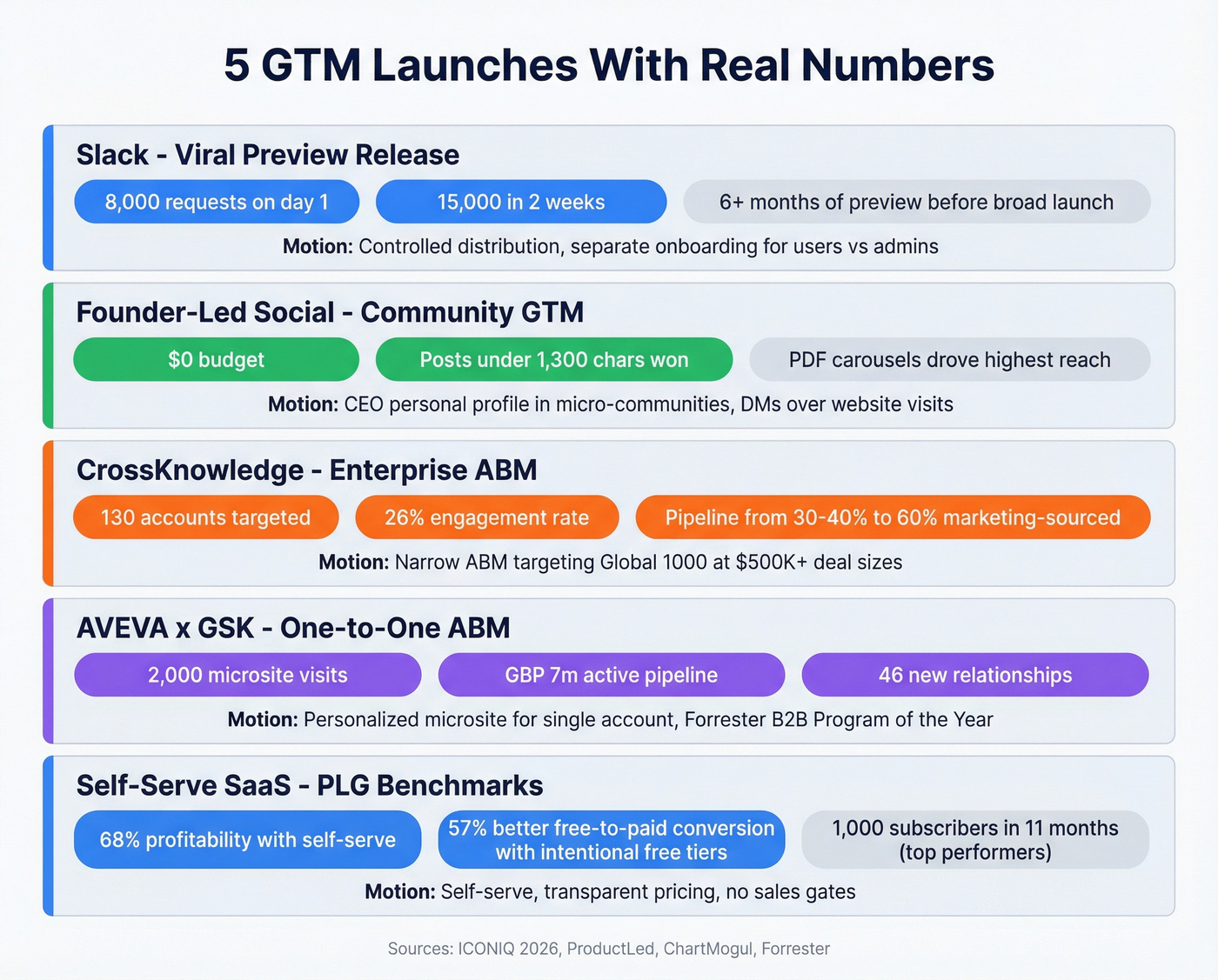
But the real insight wasn't virality. Slack sells to teams, not individuals, which means every team member has a veto. One person hates it, the whole team churns. So Slack built separate onboarding materials for individual users and team admins, then ran more than six months of iterative preview before going broad. That patience is rare. As a go-to-market case study, Slack's launch remains one of the clearest demonstrations of how controlled distribution beats a broad blast - and why "viral" is a result, not a strategy.
Founder-Led Social - Community GTM
This is the most underrated motion in 2026. A detailed breakdown on r/SaaS showed how a founder-led social strategy filled an entire sales pipeline on zero budget.
The playbook: focus on the CEO's personal profile instead of the brand page. Post in micro-communities (6K-20K members) with subtle product mentions. Use PDF carousels - they made reach "skyrocket" - and skip video content entirely, which underperformed relative to effort. Posts under ~1,300 characters beat long-form articles. External links killed performance because social networks penalize outbound URLs and users don't click them anyway. The founders who won kept everything in-feed and drove DMs instead of website visits.
Here's the thing: if your average deal size is under $25K, this motion will outperform paid ads for the first 12 months. I've watched founders burn $50K on paid channels that a consistent posting habit would have beaten.
CrossKnowledge - Enterprise ABM Pilot
CrossKnowledge sells to Global 1000 companies at $500K+ deal sizes with three-year-or-longer contracts. Their six-month ABM pilot targeted 130 accounts and engaged 35 - a 26% engagement rate - in multiple meetings and project discussions. Marketing-sourced qualified pipeline shifted from 30-40% to 60%. Marketing went from a supporting function to the primary pipeline engine in six months.
Every ABM-focused launch study we've reviewed points to the same lesson: narrow targeting with personalized content outperforms broad demand gen at enterprise deal sizes, but only if the data behind your account list is accurate enough to actually reach the right people. Bad contact data turns a surgical ABM play into an expensive guessing game.
AVEVA and GSK - One-to-One ABM
Use this when a single deal justifies dedicated resources. AVEVA's one-to-one ABM campaign with GSK built a personalized microsite that drew 2,000 visits, generated GBP 7m in active pipeline, created 46 new relationships, and won Forrester's B2B Program of the Year. GSK expanded from one AVEVA platform to three.
Skip this if you can't build personalized content for individual accounts - the resource commitment is real. But for proof it scales down: BlueBotics ran a similar motion with a one-person marketing team and generated GBP 4m+ in opportunities.
Self-Serve SaaS - PLG Benchmarks
The strongest recent datasets from ProductLed and ChartMogul point in the same direction: self-serve and PLG mechanics correlate with better outcomes when the product and onboarding are built for it.
Companies with self-serve revenue report 68% profitability vs 36.4% for those without it. Companies with intentional free models see 57% better free-to-paid conversion than those who bolted on a free tier as an afterthought. Below $25 ASP, median new business ARR growth hits 20% for B2B companies vs 0% for those layering sales too early. Top-performing B2B companies reach 1,000 subscribers in 11 months; the median takes two years.
Prospeo followed this playbook from day one - self-serve, transparent credit-based pricing, no sales-call gates - and scaled to 15,000+ companies. The free tier acts as the onboarding ramp, and a 7-day data refresh cycle keeps users from churning back to competitors with stale data.

CrossKnowledge's ABM pilot hit 26% engagement because they reached the right people. Bad contact data turns surgical ABM into expensive guesswork. Prospeo's 300M+ profiles with 98% email accuracy and 7-day refresh give your GTM launch the data foundation these case studies prove you need.
Your GTM motion is only as good as the data behind it.
2026 GTM Benchmarks
| Metric | Number | Source |
|---|---|---|
| Top-quartile ARR growth ($25-100M) | 93% YTD | ICONIQ 2026 |
| AI-native trial conversion | 56% vs 32% non-AI | ICONIQ 2026 |
| AI adoption in GTM workflows | ~70% moderate+ | ICONIQ 2026 |
| Companies reaching $10M ARR after 10 yrs | Only 13% | ChartMogul |
| Self-serve profitability edge | 68% vs 36.4% | ProductLed |
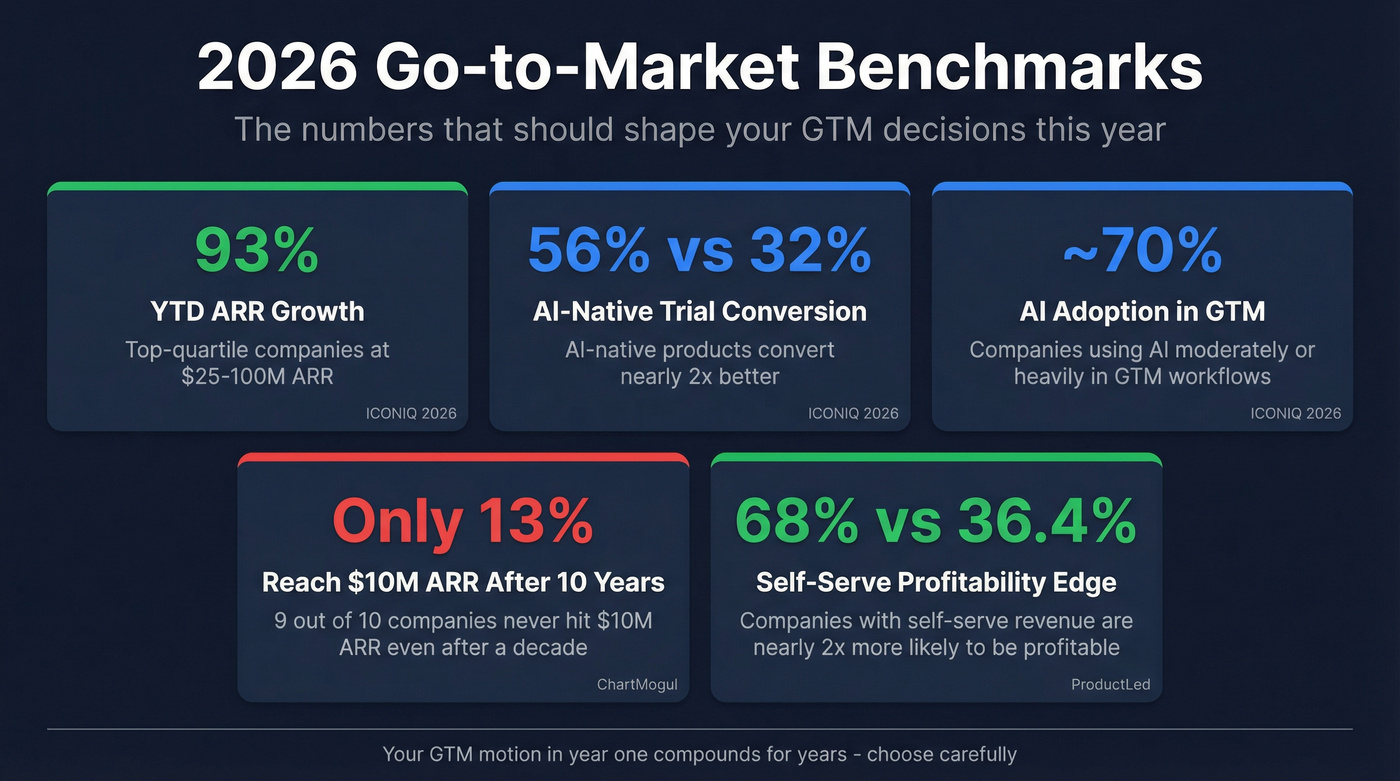
That 13% figure should stop you cold. Nine out of ten companies never hit $10M ARR even after a decade. The GTM motion you pick in year one compounds - or doesn't - for years.
7 GTM Mistakes That Sink Launches
1. Confusing GTM with marketing. Running ads without defining your ICP, buying process, or sales motion isn't a GTM strategy. It's spending money.
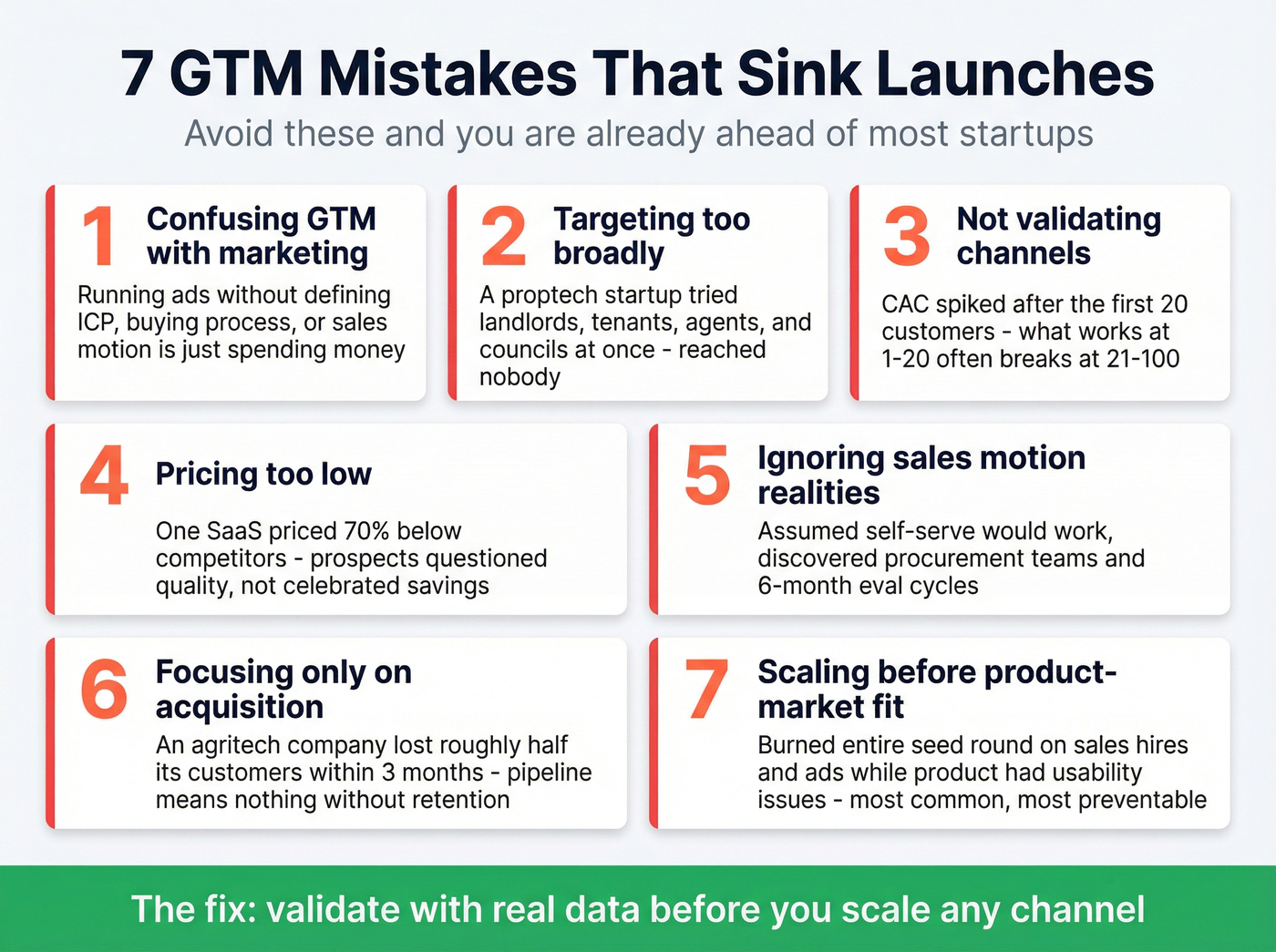
2. Targeting too broadly. A property-tech startup tried selling to landlords, tenants, agents, and councils simultaneously. They reached nobody.
3. Not validating channels. A healthtech company saw CAC spike sharply on Facebook ads after the first ~20 customers. The channel that works for customer 1-20 often breaks at 21-100. And outbound collapses when bounce rates climb into the high single digits - we've seen teams hit 35-40% bounce rates before switching to verified-data tools.
4. Pricing too low. One SaaS priced 70% below competitors. Prospects didn't think "great deal" - they questioned quality.
5. Ignoring sales motion realities. A B2B startup assumed self-serve would work, then discovered procurement teams and six-month evaluation cycles. Know your buyer's process before you design your motion around what's convenient for you.
6. Focusing only on acquisition. An agritech company lost roughly half its customers within three months. Pipeline means nothing without retention.
7. Scaling before product-market fit. One startup burned its entire seed round on sales hires and paid ads while the product still had usability issues. High churn, frustrated sales team, dead runway. Let's be honest - this one's the most common and the most preventable.

Prospeo scaled to 15,000+ companies on the same self-serve PLG playbook this article benchmarks - transparent pricing at ~$0.01/email, no sales gates, and a free tier that proves value in minutes. 83% enrichment match rates mean your outbound actually connects.
Stop burning budget on channels built on stale data.
FAQ
What should a go-to-market case study include?
Name the company, specify the motion (PLG, ABM, outbound, community-led), include a timeline, and quantify results - pipeline generated, conversion rates, or revenue impact. The strongest examples show clear before-and-after metrics rather than vague success narratives. Aim for at least two hard numbers per writeup.
Which GTM motion works best for B2B SaaS?
It depends on deal size. Below ~$100 ASP, PLG outperforms every other motion. Above $500K deal sizes, ABM delivers - CrossKnowledge shifted marketing-sourced pipeline to 60% targeting just 130 accounts. Studying a go-to-market case study at your price point is the fastest way to shortlist the right approach.
How do you avoid bad data killing your GTM launch?
Verify every contact before sequencing. Once bounce rates climb into the high single digits, deliverability and domain reputation deteriorate fast. In our experience, teams that switch to real-time verification see bounce rates drop from 35-40% to under 5% within weeks. That's the difference between a launch that builds momentum and one that stalls before it starts.