

Go-to-Market Channels: Real Costs, Real Frameworks, No Fluff
CAC rose 40-60% between 2023 and 2025, and 2026 hasn't reversed the trend. That's not a rounding error. It's a structural shift that punishes teams spreading budget across every go-to-market channel they can name.
The companies winning right now aren't running nine motions. They're running two or three, backed by real data on what each one actually costs.
What Are Go-to-Market Channels?
A go-to-market channel is the system through which your product reaches buyers - not a single tactic, but an interconnected motion of messaging, distribution, and sales. Your GTM channel strategy determines how efficiently you turn budget into pipeline.
This matters because B2B buying isn't linear. The average B2B customer touches 36 touchpoints before converting, and enterprise deals involve six to ten stakeholders. Companies with a documented GTM framework see 10% higher launch success rates and 3x revenue growth, yet fewer than 33% have a formal playbook. Most teams are winging it against a buying process that demands precision, and it shows in their numbers.
The Short Version
- Pick 2-3 channels, not 9. A small budget spread across seven channels means you do nothing well. Dominate a couple, then expand.
- Channel-led is the cheapest motion. At $150 average CAC, partner and referral programs are the lowest-cost acquisition path in the Optifai benchmark. Start here if your product lends itself to it.
- Outbound only works with clean data. A 35% bounce rate doesn't mean outbound is broken - it means your contact data is. Fix the data layer first.
The 9 GTM Channel Types
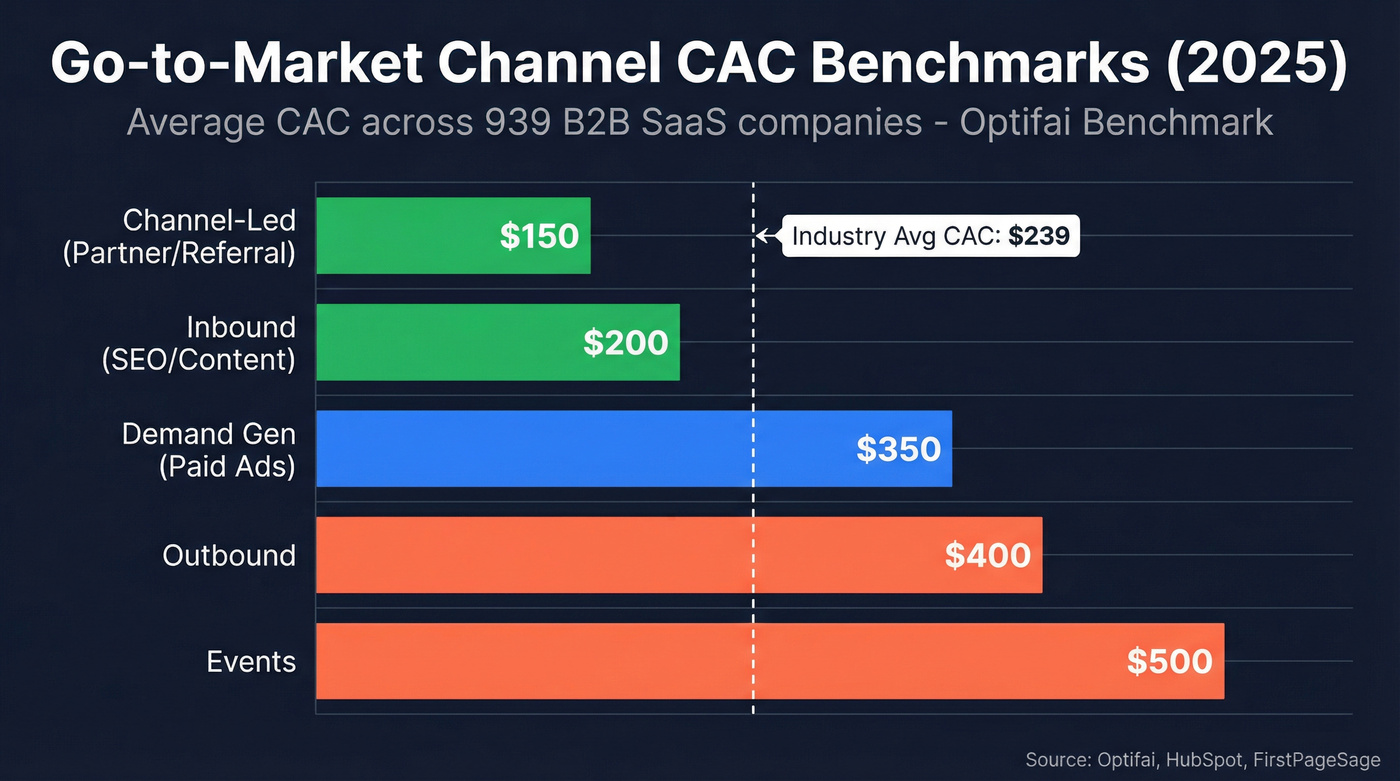
The GTM Alliance taxonomy identifies nine distinct motions. Optifai's benchmark gives hard CAC numbers for the most common acquisition channels across 939 B2B companies (Q1-Q3 2025):
| Channel | Avg CAC | Best For |
|---|---|---|
| Channel-Led (Partner/Referral) | $150 | Established products, trust-driven sales |
| Inbound (SEO/Content) | $200 | Long sales cycles, thought leadership |
| Demand Gen (Paid Ads) | $350 | Fast pipeline, retargeting |
| Outbound | $400 | Tight ICP, high-ACV deals |
| Events | $500 | Enterprise, relationship-heavy |
And the remaining GTM Alliance motions - important to plan for, though they lack explicit CAC benchmarks in the Optifai dataset:
| Motion | Best For |
|---|---|
| Community-Led | Developer tools, niche markets |
| Product-Led | Self-serve, lower-ACV products |
| Ecosystem-Led | Platform plays, integrations |
| Account-Based | Named accounts, enterprise targeting |
| Sales-Led | Complex deals with longer cycles |
For context, HubSpot and FirstPageSage put the combined B2B SaaS average CAC at $239. Anything below that line is outperforming the market. Channel-led at $150 clears it easily, yet most teams still default to paid plus outbound first.
One B2B marketer on r/sales summed it up well: analyze which channels already bring results, then double down. If a channel shows traction even with low activity, it has upside worth exploiting before you go chasing new ones.
Why Outbound Deserves a Closer Look
Optifai pegs outbound at $400 average CAC across the benchmark, but the real swing factor is execution quality - especially contact data.
Meritt was running outbound with a 35% bounce rate before switching to Prospeo's 98% email accuracy and 7-day data refresh. Bounce rate dropped under 4%, pipeline tripled from $100K to $300K per week. The channel wasn't broken. The data was.
Here's our take: if your average deal size is under $10K, you probably don't need outbound at all. Inbound plus a strong partner program will get you further, faster, and cheaper.

Outbound at $400 CAC only makes sense when your data actually connects. Prospeo delivers 98% email accuracy on a 7-day refresh cycle - the same data layer that took Meritt from a 35% bounce rate to under 4% and tripled their weekly pipeline to $300K.
Stop blaming the channel. Fix the data feeding it.
Which GTM Motion Fits Your ACV?
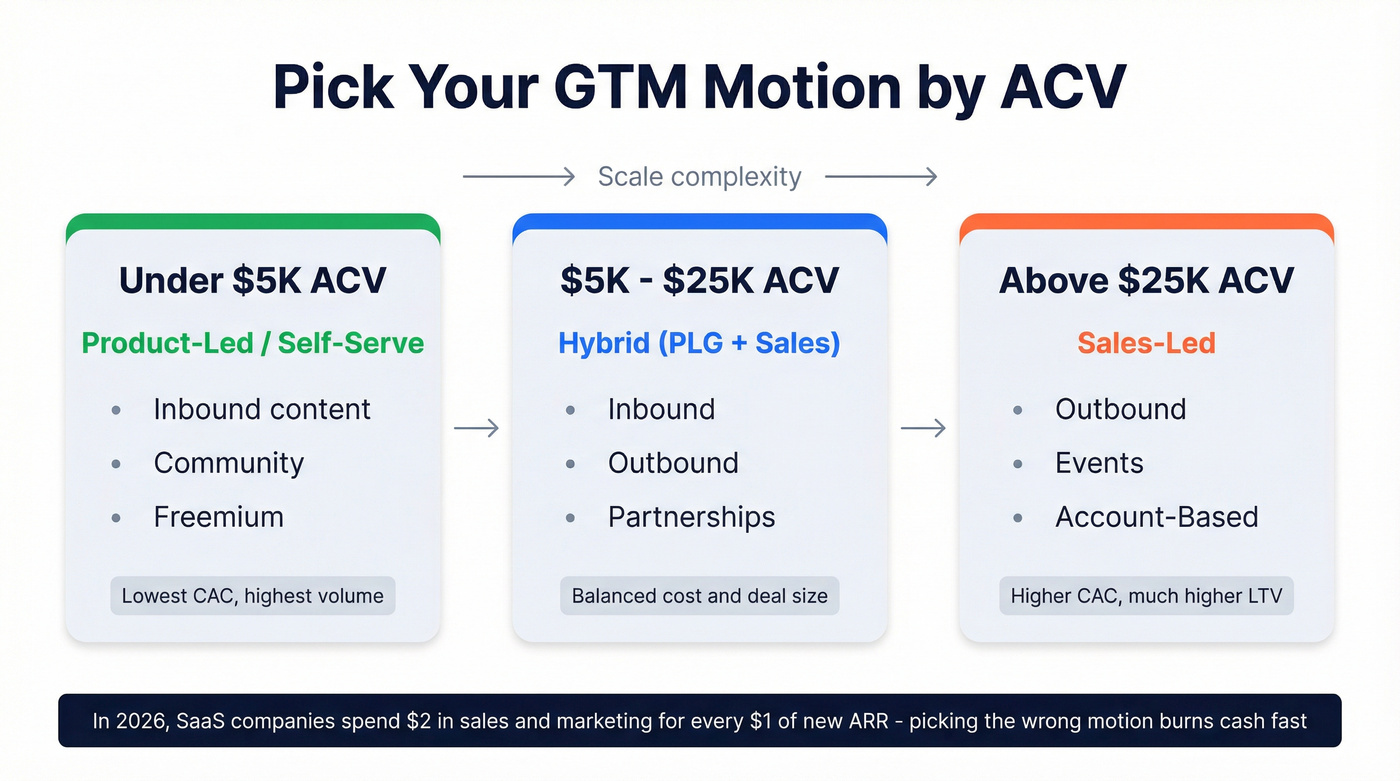
Your average contract value dictates your motion more than any other variable. Aligning your sales and distribution model to ACV is the single highest-leverage decision in go-to-market planning, and we've seen teams waste entire quarters ignoring this.
| ACV Range | Motion | Primary Channels |
|---|---|---|
| Under $5K | Product-led / self-serve | Inbound, community, freemium |
| $5K-$25K | Hybrid (PLG + sales) | Inbound, outbound, partnerships |
| Above $25K | Sales-led | Outbound, events, account-based |
In 2026, SaaS companies spend $2 in sales and marketing for every $1 of new ARR, up 14% since 2024. That ratio makes channel selection existential - picking the wrong motion at the wrong ACV burns cash faster than ever.
Building Your Distribution Strategy
Gartner pegs average B2B marketing spend at 8.4% of revenue. 87% of B2B marketing decision-makers plan a budget increase in the year ahead, though most expect only 1-4% growth. Every dollar needs to land in the right place.
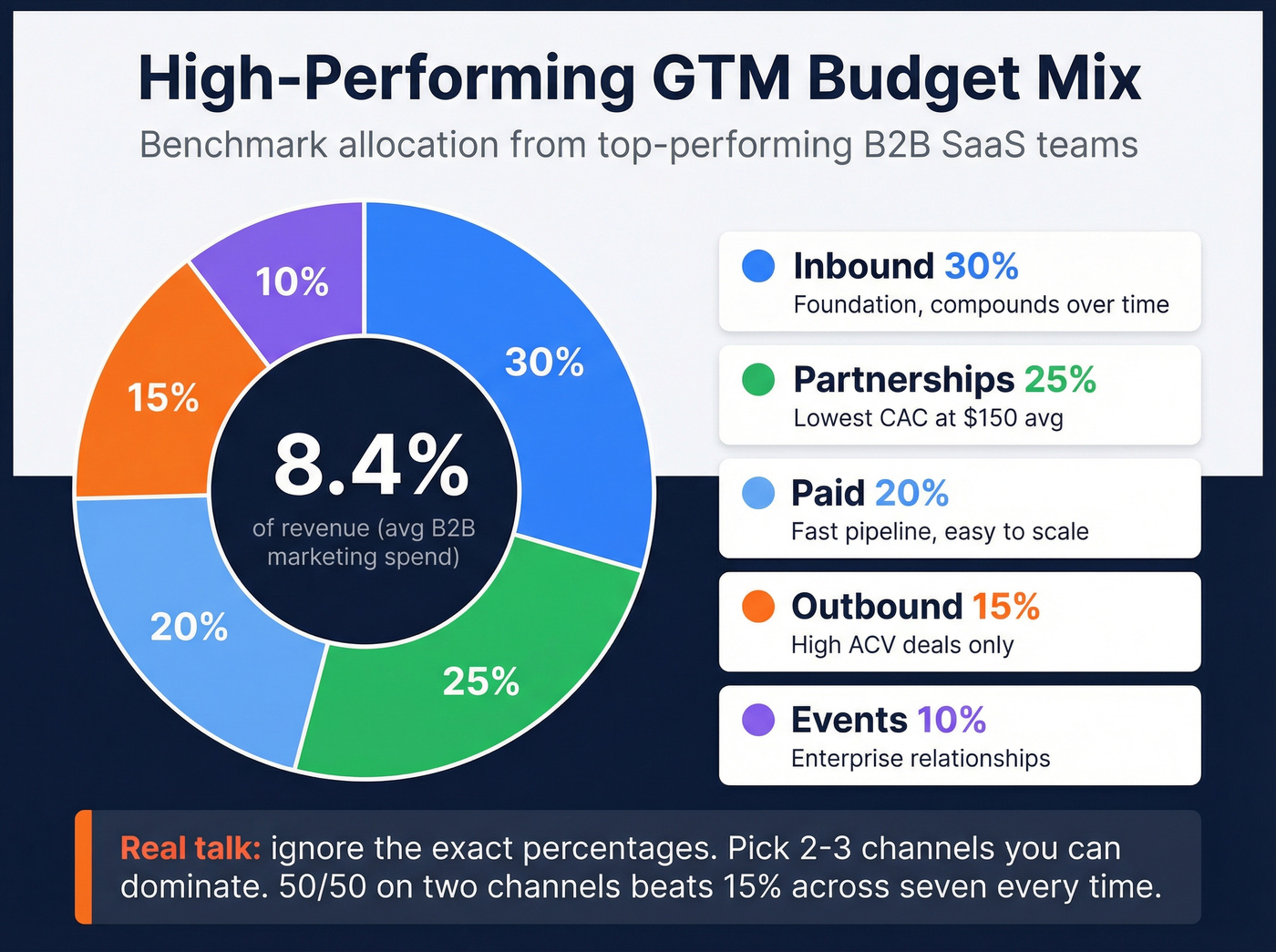
The high-performing mix from the benchmark: 30% inbound, 25% partnerships, 20% paid, 15% outbound, 10% events. That's a useful starting template, but let's be honest - ignore the percentages and pick two to three channels you can actually dominate. A startup putting 50% into inbound and 50% into partnerships will outperform one spreading 15% across seven channels every single time. A multi-pronged approach sounds impressive in a board deck, but it only works once each individual channel is already generating repeatable pipeline.
To pressure-test your assumptions, start with your ideal customer profile and map which channels can reliably reach that buyer.
Why GTM Channels Fail
95% of new products fail annually. That's not just about bad products - it's about bad execution across every stage of the launch.
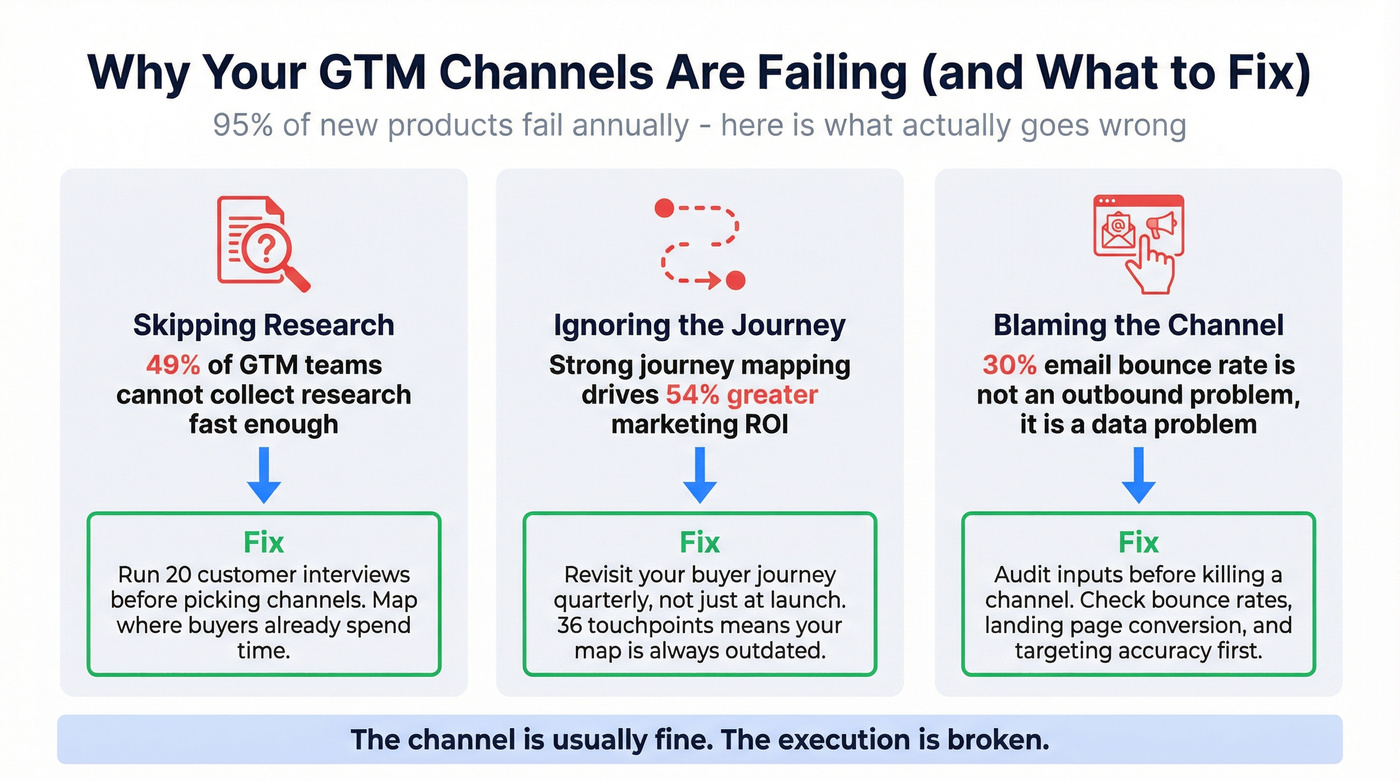
First, teams skip research. 49% of GTM teams can't collect consumer research fast enough, so they proceed on assumptions. Second, they ignore the customer journey. Companies with strong journey mapping see 54% greater marketing ROI, yet most teams map once during launch and never revisit it. Third - and this is the one that drives us crazy - they blame the channel instead of the inputs. Outbound "doesn't work" when your email list bounces 30%. Paid "doesn't work" when your landing page converts at 0.5%. The channel is usually fine. The execution is broken.
A channel-based GTM strategy fails when teams treat channel selection as a one-time decision rather than an ongoing experiment. The teams that win are the ones running channel-level experiments quarterly and measuring leading indicators like meetings booked and pipeline created, rather than waiting six months for perfect attribution that never arrives.
If you're building a repeatable outbound motion, treat list quality and data enrichment as part of the channel, not an afterthought.
Measuring What Works
Look, 80% of marketers are dissatisfied with their attribution tools, and only 29% are extremely confident in attribution accuracy. With 36 touchpoints per B2B conversion, perfect attribution is a fantasy. Stop chasing it.
Use directional data instead. Companies with proper attribution see 15-20% better budget allocation - not because their models are perfect, but because they're making decisions with data instead of gut feel. Run channel-level experiments, measure leading indicators, and reallocate quarterly. The best go-to-market channels for your business are the ones you can measure, iterate on, and scale - not the ones that look good on a strategy slide.
Skip the elaborate multi-touch attribution platform if you're under $5M ARR. A spreadsheet tracking pipeline by channel, updated weekly, will tell you more than a $50K attribution tool that takes three months to implement.
If you need a tighter operating cadence, borrow a few lead generation metrics and keep them consistent quarter to quarter.
Your GTM channel mix lives or dies on execution quality. At $0.01 per verified email with 30+ search filters - including buyer intent, technographics, and headcount growth - Prospeo gives you the precision targeting that turns outbound from a $400 CAC line item into your highest-ROI motion.
Build pipeline with data that actually reaches real buyers.
FAQ
What's the cheapest go-to-market channel?
Channel-led (partner/referral) averages around $150 CAC for B2B SaaS, per the Optifai benchmark across 939 companies. That's 37% below the $239 industry-wide average. If your product has natural referral loops or integration partners, this should be your first motion.
How many GTM channels should a startup use?
Two to three maximum. Dominate those before expanding - sequencing channels beats launching them simultaneously. Most startups that spread across five or more channels end up with none producing repeatable pipeline.
How do you fix a high outbound CAC?
Check your data first. If your bounce rate exceeds 10%, the channel isn't broken - your contact data is. Real-time email verification with a weekly refresh cycle drops bounce rates under 5% and cuts wasted spend per sequence. We've seen teams cut outbound CAC by 40% just by fixing the data layer.
What is a channel go-to-market strategy?
A channel go-to-market strategy routes your product to buyers through partners, resellers, or referral networks instead of relying solely on direct sales. It typically produces the lowest CAC because partners bring built-in trust and existing relationships with your target audience.