

GTM Enablement Is Failing at Most Companies - Here's What Actually Works
Your PMM spent 40 hours building a launch deck. Three weeks later, your top AE asks "wait, what's the pricing for the new module?" That disconnect isn't a training problem. It's a go-to-market enablement problem, and it's everywhere.
Highspot and Dynata surveyed 463 senior leaders and found that 98% say their GTM strategy is in motion. Only 10% say it's delivering at the level they need. That's not a gap - that's a chasm. Buyers spend just 17% of their time talking to sales. If your team isn't enabled to make that window count, the deal dies before it starts.
Here's the short version:
- GTM enablement ≠ sales enablement with a new name - it spans marketing, CS, and product across the full lifecycle.
- Most programs fail because of absorption and governance, not content creation.
- Start with three layers: a CRM, verified prospect data, and a collaboration tool. Add an enablement platform only after the workflow works.
What Go-to-Market Enablement Actually Means
GTM enablement means equipping every customer-facing team - sales, marketing, CS, product - with the tools, training, content, and data they need across the full customer lifecycle. Not just helping reps close deals. From first touch through retention and expansion.
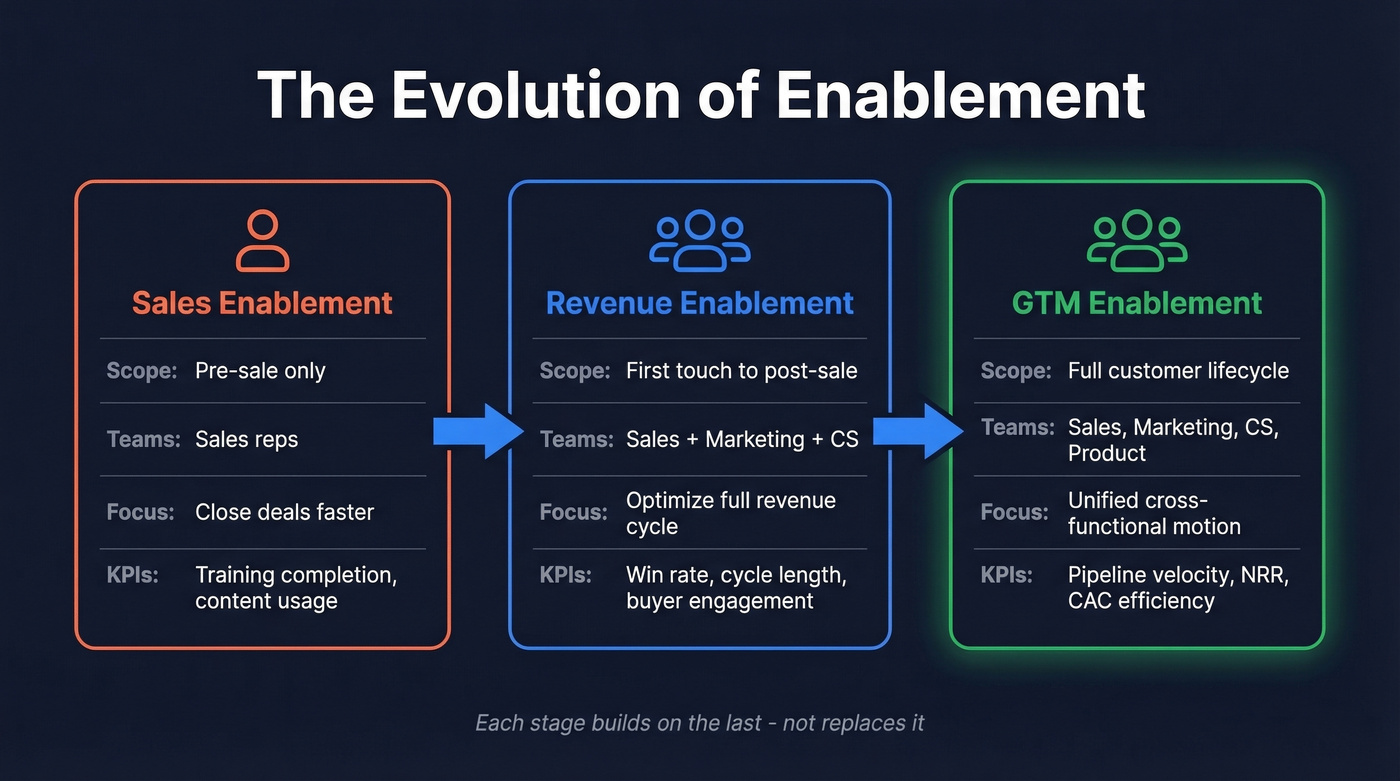
The distinction matters because most companies still run sales enablement and call it something bigger.
| Sales Enablement | Revenue Enablement | GTM Enablement | |
|---|---|---|---|
| Scope | Pre-sale only | First touch → post-sale | Full lifecycle |
| Teams | Sales reps | Sales + marketing + CS | Sales, marketing, CS, product |
| Example KPIs | Training completion, content usage | Win rate, cycle length, buyer engagement | Pipeline velocity, NRR, CAC efficiency |
Revenue enablement widened the scope from reps to the full revenue team. Go-to-market enablement takes it further by including post-sale teams and product in a unified motion. The old model - annual training sessions and content dumps nobody revisits - doesn't work anymore. Modern enablement is continuous, cross-functional, and data-driven. When only sales is enabled, you get clunky handoffs to CS, dissatisfied customers, and churn that erases the deal you just closed.
Why Most Programs Fail
We've seen the same three failure modes kill programs over and over.
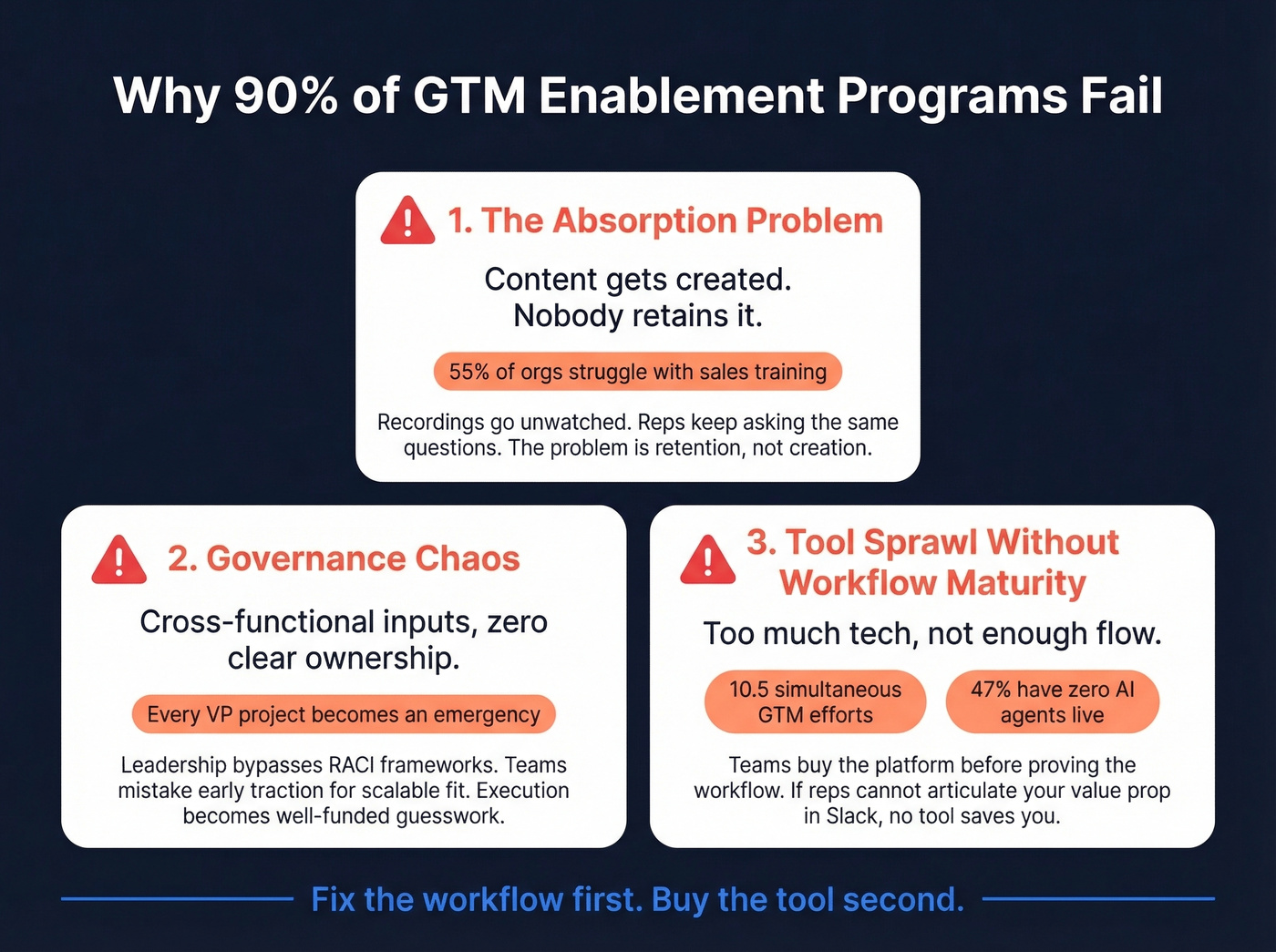
The absorption problem. Content gets created. Recordings get made. Nobody rewatches them. The r/ProductMarketing consensus is brutal: recordings "aren't well catalogued," sellers experience enablement as "chaotic and overwhelming," and reps keep asking the same questions answered in last week's call. Fifty-five percent of organizations struggle with sales training or coaching. The problem isn't creation - it's retention.
Governance chaos. Cross-functional inputs without clear ownership produce what one PMM on Reddit called a "Frankenstein plan with everyone's opinions." Leadership bypasses RACI frameworks. Commercial leaders set targets without win/loss analysis. Worse, teams mistake early traction as proof of scalable fit and skip the "where not to play" analysis entirely. Execution becomes well-funded guesswork.
Tool sprawl without workflow maturity. The average software company now runs 10.5 simultaneous GTM efforts - five core channels plus 5.5 experimental initiatives. Meanwhile, 47% have zero AI agents in production despite 90% planning adoption. Too much tech, not enough flow.
Let's be honest: most teams don't have an enablement problem. They have a confidence-masquerading-as-readiness problem. They buy the platform before they've proven the workflow. If your reps can't articulate your value prop in a Slack message, no enablement tool will save you.

You just read it: if 5-10% of your emails bounce, every enabled rep wastes time on dead addresses. Prospeo's 5-step verification delivers 98% email accuracy with a 7-day refresh cycle - not the 6-week industry average. That's the data quality foundation your GTM enablement framework needs before anything else.
Stop enabling reps to send emails that bounce. Start with verified data.
A Framework That Actually Sticks
You don't need a six-figure enablement platform to start. You need a workflow that sticks.
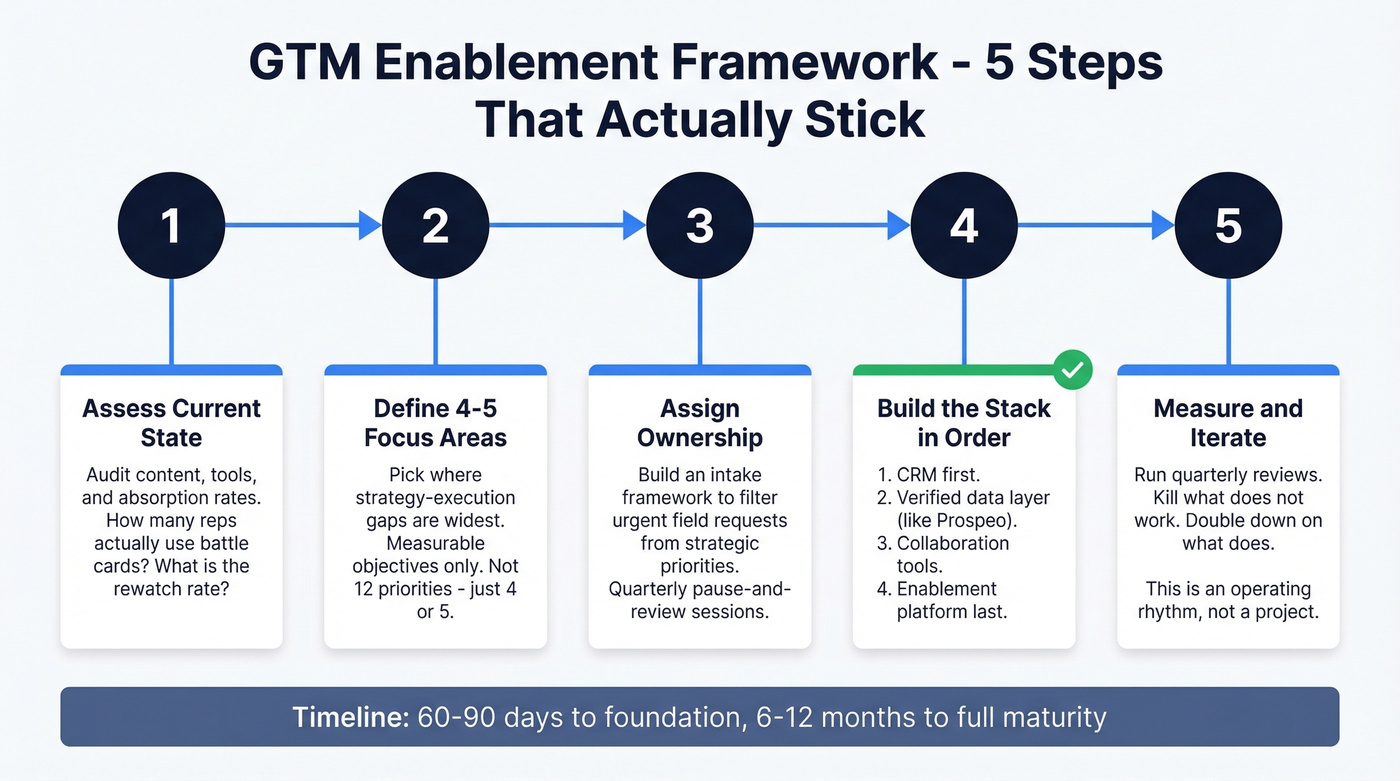
Assess your current state. Audit content, tools, and absorption rates. How many reps actually use the battle cards? What's the rewatch rate on enablement recordings? If you can't answer these questions, you're flying blind.
Define 4-5 focus areas with measurable objectives. Not 12. Pick the areas where the gap between strategy and execution is widest. "Increase product knowledge test scores by 25%" beats "improve enablement" every time.
Assign ownership with an intake framework. This is where most programs die. Build a system to filter urgent field requests from strategic priorities - without it, every VP's pet project becomes an emergency and your enablement team becomes a reactive content factory. We've found that quarterly pause-and-review sessions to assess where KPIs feel "fuzzy" work well here.
Build the stack in the right order. CRM first. Then a data quality layer - verified contact data is the foundation everything else sits on. If 5-10% of your emails bounce, every enabled rep is still wasting time on dead addresses. Then collaboration tooling. An enablement platform comes last, not first.
Measure and iterate. Run pause-and-review sessions quarterly. Kill what isn't working. Double down on what is. This isn't a project with an end date - it's an operating rhythm. One practical benchmark worth distributing to your team: cold outreach using timeline hooks pulls a 10.01% reply rate versus 4.39% for problem-focused hooks. That's the kind of granular insight your enablement program should surface.
Metrics That Matter
Companies with well-integrated enablement stacks are 42% more likely to increase sales productivity. AI training users are 35% more likely to increase deal size. But you need to measure the right things.
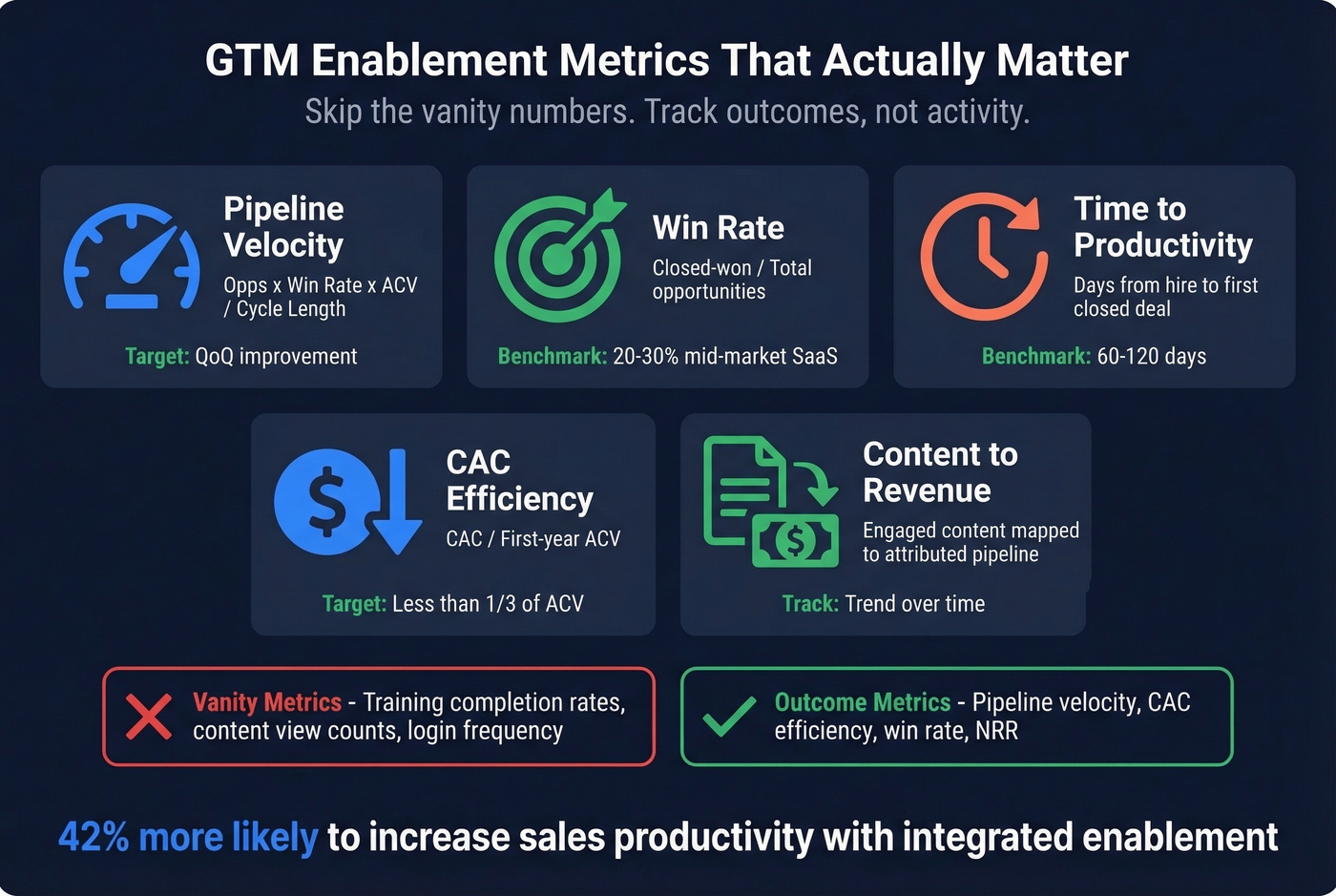
| Metric | What to Track | Benchmark |
|---|---|---|
| Pipeline velocity | Opps x Win rate x ACV / Cycle length | QoQ improvement |
| Win rate | Closed-won / Total opps | ~20-30% (mid-market SaaS) |
| Time-to-productivity | Days from hire to first closed deal | 60-120 days |
| CAC efficiency | CAC / First-year ACV | < 1/3 of ACV |
| Content-to-revenue | Engaged content → attributed pipeline | Track trend over time |
Most teams track training completion and content views. Those are activity metrics, not outcome metrics. Pipeline velocity and CAC efficiency tell you whether enablement is actually working. Skip the vanity numbers.
The Tool Landscape in 2026
The enablement market is consolidating fast. Seismic and Highspot announced a merger in February 2026. Showpad completed its Bigtincan merger in late 2025. Gong expanded into full revenue enablement. If you're buying a platform right now, you're buying into uncertainty - start with the workflow, not the vendor.
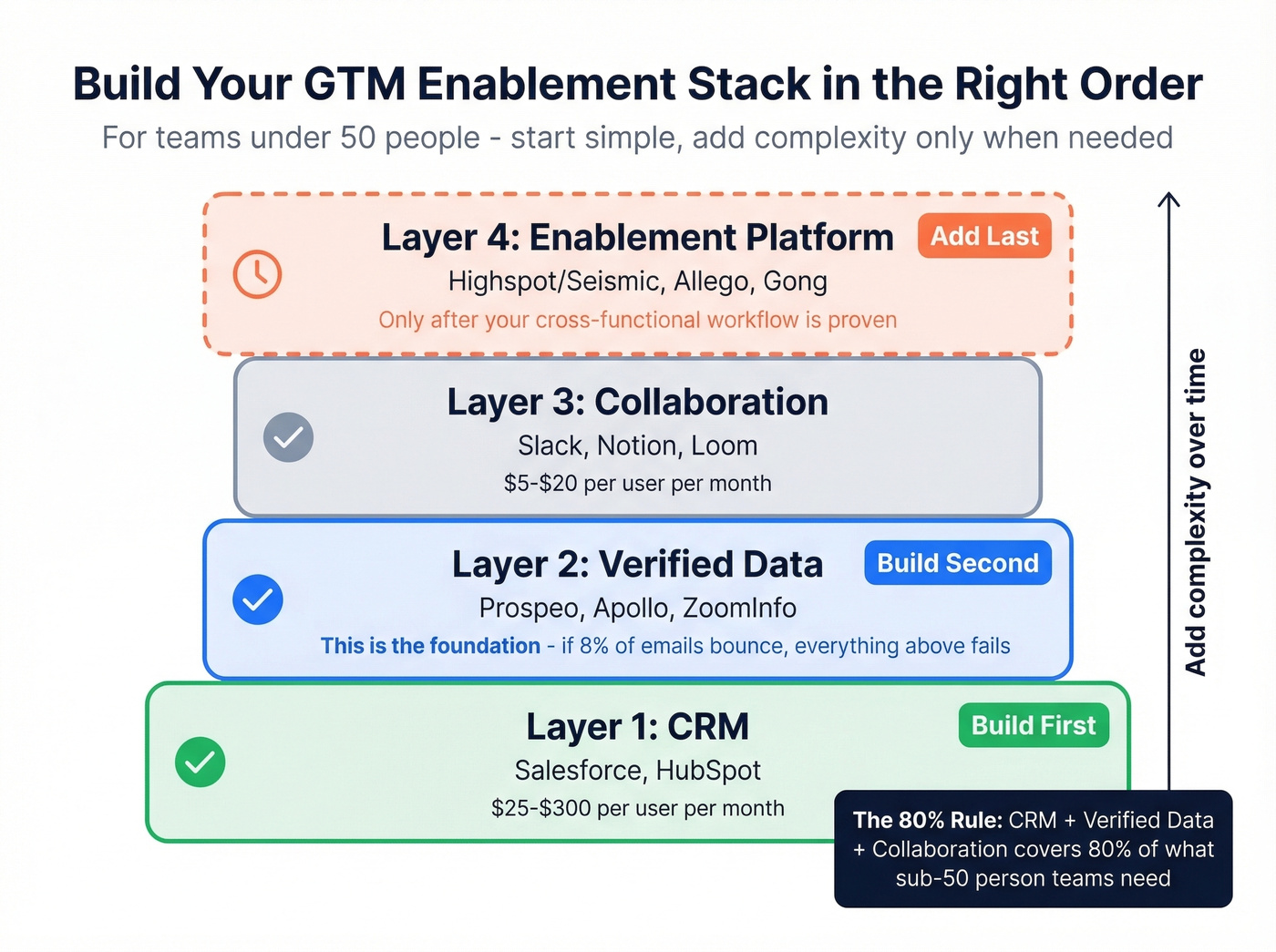
| Category | Examples | Typical Cost |
|---|---|---|
| CRM | Salesforce, HubSpot | $25-$300/user/mo |
| Enablement platform | Highspot/Seismic, Allego | $30-80k/yr (mid-market); $100k+ (enterprise) |
| Conversation intel | Gong, Chorus | $12k-$60k+/yr |
| Prospecting/data | Prospeo, Apollo, ZoomInfo | $39-$3,000+/mo |
| Collaboration | Slack, Notion, Loom | $5-$20/user/mo |
Here's the thing about enablement content: it's only as effective as the data your reps act on. We've watched teams invest $80k in an enablement platform while their reps bounce 8% of outbound emails because the underlying contact data is stale. Prospeo handles this with 300M+ professional profiles, 98% email accuracy, and a 7-day data refresh cycle - at roughly $0.01 per verified email. It plugs directly into Salesforce, HubSpot, and the major outbound tools, so the data layer doesn't become another silo.

For teams under 50 people, skip the enterprise enablement platform entirely. A CRM, a verified data source like Prospeo, and Slack plus Notion will cover 80% of what you need. Add the platform when your cross-functional workflow is proven and you're outgrowing manual processes.
GTM enablement fails when teams prospect with stale contacts. Prospeo gives your entire revenue team - sales, marketing, CS - access to 300M+ profiles with 30+ filters including buyer intent, technographics, and job changes. At $0.01 per email, you build the data layer without the six-figure platform price tag.
Equip every customer-facing team with contacts that actually connect.
FAQ
What's the difference between go-to-market enablement and sales enablement?
Sales enablement equips reps with training, content, and tools for the pre-sale motion only. Go-to-market enablement expands that scope to every customer-facing team - marketing, CS, product - across the full lifecycle from first touch through retention and expansion. The key difference is who gets enabled and at what stage of the buyer journey.
How long does it take to build a GTM enablement program?
A functional foundation takes 60-90 days: 30 days for assessment and goal-setting, 30 for ownership and tool setup, 30 for first iteration and metric baselining. Full maturity with governance, AI integration, and cross-functional adoption typically takes 6-12 months. Don't try to boil the ocean in month one.
What's the highest-ROI investment in an enablement stack?
Verified contact data. A CRM is table stakes, but every dollar spent on training and content gets wasted if 5-10% of emails bounce. Get the data layer right first, then layer on enablement platforms once your workflow is solid.
Can small teams run go-to-market enablement without a dedicated platform?
Yes - and they should. A CRM, a verified data source, and a collaboration tool (Slack + Notion or Loom) cover 80% of what a sub-50-person team needs. Add a dedicated enablement platform only after your cross-functional workflow is proven and your team outgrows manual processes.