

Go-to-Market Model: How to Pick the Right One (2026)
You've read 10 GTM guides this quarter. They all said "define your ICP" and "align sales and marketing." None of them told you which go-to-market model to actually pick - or gave you a number to prove it's working. Meanwhile, 49% of GTM teams can't collect research fast enough to make the decisions they're already behind on.
Here's what we've learned after watching dozens of teams pick the wrong model and spend two quarters unwinding it: the decision comes down to a handful of numbers, not a philosophy debate. This guide gives you a decision framework with real thresholds, benchmarks by stage, and the five mistakes that kill launches before they start.
The Short Answer
Five go-to-market models exist: product-led, sales-led, channel-led, ecosystem-led, and community-led. Everything else - inbound, outbound, ABM, demand gen - is a channel you run within a model. Pick based on ACV: under $10K, go product-led. Between $5K and $25K, run a hybrid. Above $25K or selling to complex buying committees, go sales-led. Measure with LTV:CAC above 3:1 and CAC payback under 12 months.
What Is a Go-to-Market Model?
Most GTM content conflates two things that aren't the same.
A go-to-market model is the operating structure for how your organization creates and captures demand. It defines org design, hiring profiles, pricing architecture, and onboarding flow. A go-to-market strategy is the specific launch plan you execute inside that model - the campaigns, the messaging, the sequencing.
Think of it this way: the GTM model is the operating system, and the strategy is the application running on top of it. You can swap strategies quarterly. Changing your model is a multi-quarter, cross-functional overhaul that touches comp plans, hiring, product roadmap, and pricing. Picking the wrong model is a structural error, not a tactical one. You can't A/B test your way out of it.
The 5 GTM Models Explained
Product-Led (PLG)
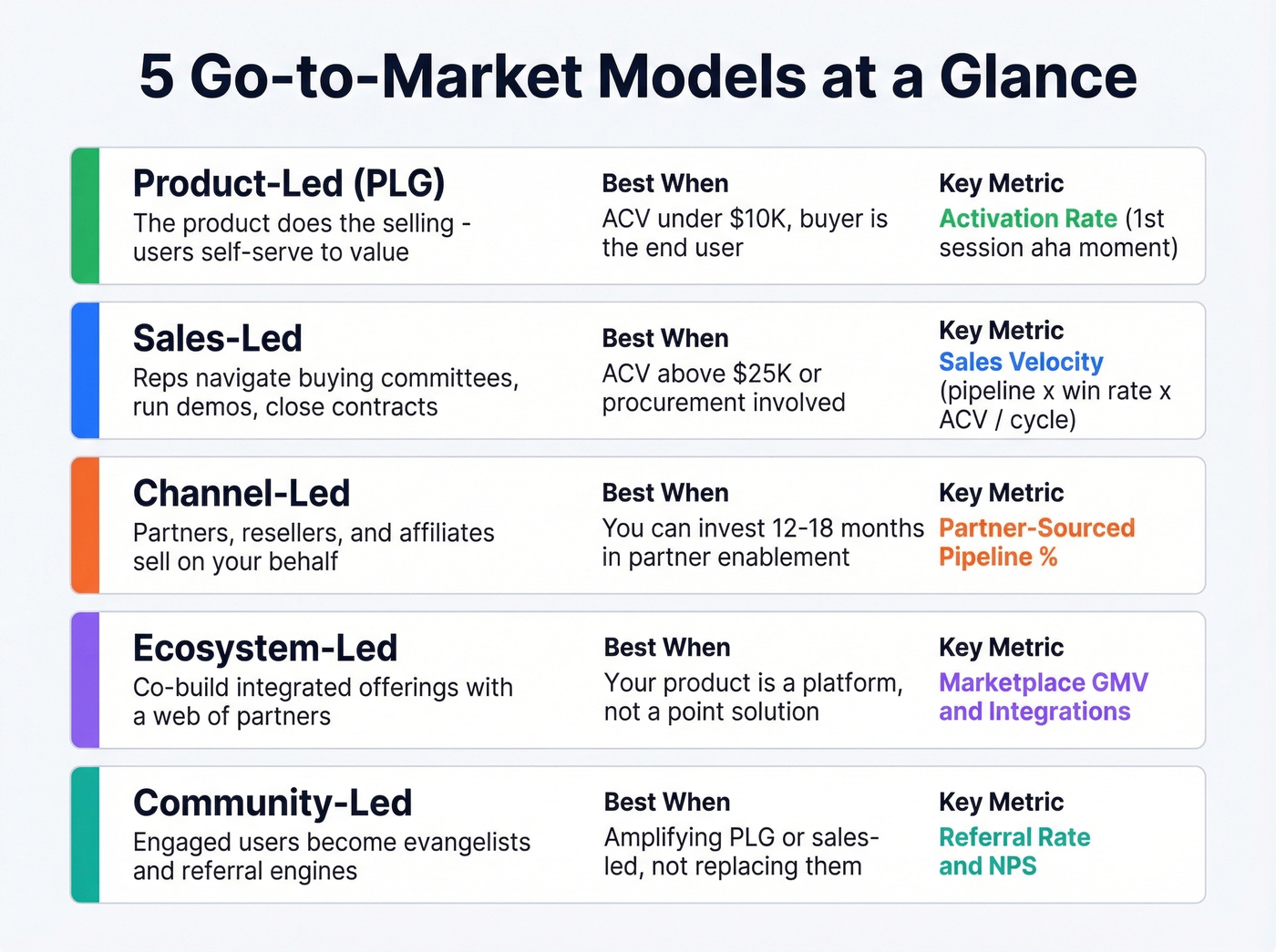
The product does the selling. Users sign up, onboard themselves, and hit value before talking to a human. PLG works when your ACV is under $10K, your product is intuitive enough for self-serve, and your buyer is the end user - not a committee. The software itself is the primary acquisition and conversion engine, and Slack is the classic example of this motion at scale before it layered sales for enterprise expansion.
Freemium conversion typically lands at 1-5%, while free-trial-to-paid runs 10-20%. The key metric is activation rate: what percentage of signups reach the "aha" moment within the first session. If that number is low, no amount of top-of-funnel spend fixes it.
Sales-Led
Consultative selling driven by reps who navigate complex buying committees, run demos, handle procurement, and negotiate custom contracts. This is the model when ACV exceeds $25K or when the buyer isn't the user.
Sales cycles run 3-9 months for mid-market, 6-12+ months for enterprise. The key metric is sales velocity: pipeline x win rate x ACV / cycle length.
Channel-Led
You build a network of partners, resellers, or affiliates who sell on your behalf. Channel-led is one of the most underrated models in SaaS - it requires serious upfront investment in partner enablement, and most startups don't have the patience for it. But partner-sourced deals often close at higher rates than cold direct deals once the program matures, and marginal cost per partner-closed deal drops as the network scales. If you can stomach 12-18 months of enablement work before seeing real pipeline, this model compounds beautifully.
Ecosystem-Led
Distinct from channel-led. Ecosystem-led means co-building integrated offerings with a web of partners - think HubSpot's marketplace. Partners aren't just reselling; they're building on your platform and creating mutual lock-in. This model works when your product is a platform, not a point solution.
Community-Led
Community-driven acquisition and retention, where engaged users become evangelists and referral engines. Notion, Figma, and dbt have all built community into their growth motion.
Let's be honest, though: community-led is overhyped as a primary model. It usually takes 12+ months of consistent investment before you see pipeline impact. Use it to amplify a PLG or sales-led motion, not to replace one.
Models vs. Channels
This is where most GTM guides go wrong. They list "inbound" and "ABM" alongside "product-led" as if they're the same category.
| Models (Operating Structure) | Channels (Tactics) | |
|---|---|---|
| Examples | PLG, Sales-led, Channel-led, Ecosystem-led, Community-led | Inbound, Outbound, ABM, Demand Gen, Content |
| Defines | Org design, hiring, pricing, onboarding | How you generate and capture demand |
| Changes | Multi-quarter / infrequent | Weekly/monthly |
A sales-led company can run inbound and outbound simultaneously. A PLG company can layer account-based selling on top for enterprise expansion. The model is the foundation; channels are the rooms you build on it.

Picking the right GTM model is a structural decision. Running it on bad data is a structural failure. Prospeo gives you 300M+ profiles with 98% email accuracy, 125M+ verified mobiles, and 30+ filters - including buyer intent, technographics, and headcount growth - so your model actually converts.
Fix your GTM economics with data that costs $0.01 per verified email.
How to Choose the Right Model
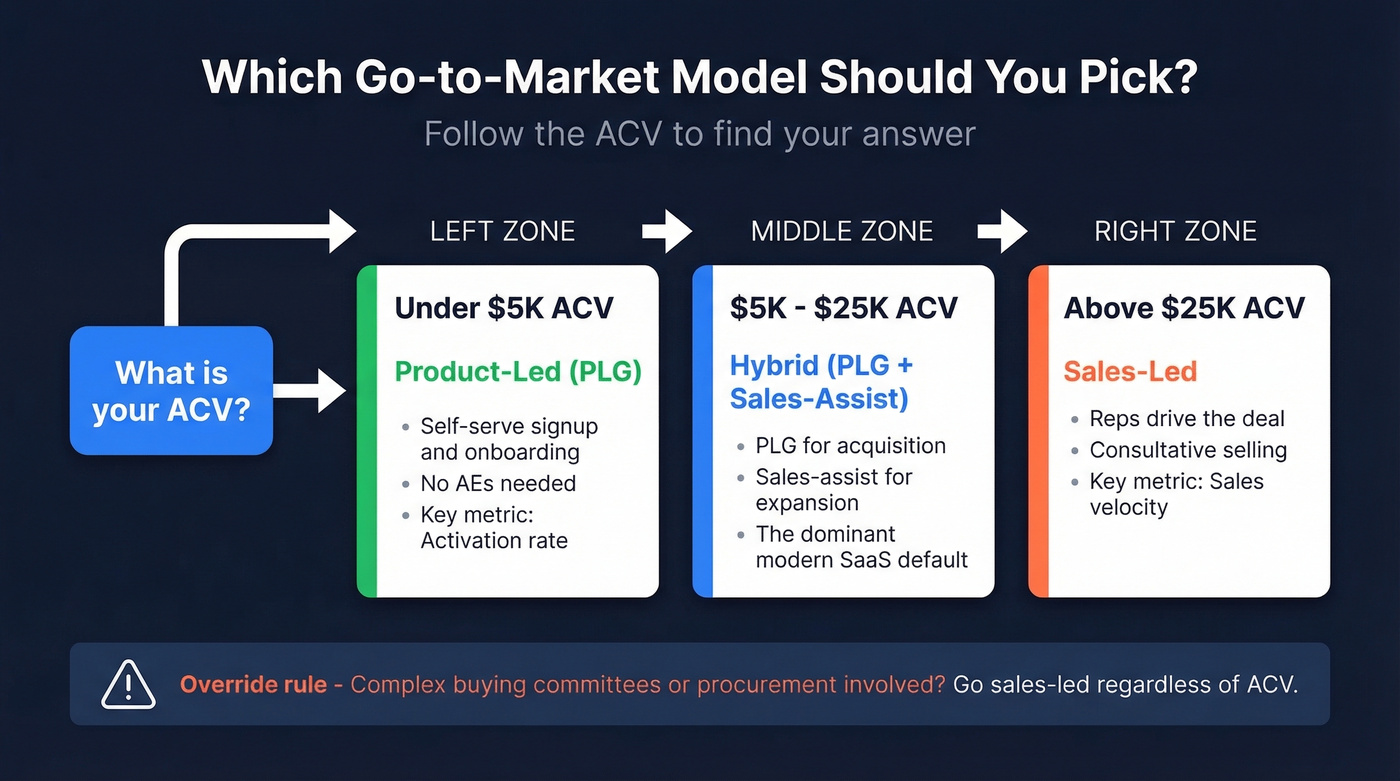
ACV is the primary decision variable. Buyer complexity is the override.
- ACV under $5K: Product-led, self-serve. Don't hire AEs for four-figure deals.
- $5K-$25K: Hybrid. PLG for acquisition, sales-assist for expansion. This is the dominant modern default for SaaS.
- Above $25K: Sales-led. Optionally offer trials for evaluation, but reps drive the deal.
- Complex buying committees: Sales-led regardless of ACV. If procurement is involved, you need a human.
Here's a scenario we see constantly. Your board just asked why CAC payback is 22 months. You're selling an $8K ACV product with four AEs running six-month sales cycles. That's a structural mismatch - you're running a sales-led approach on a product that should be hybrid or PLG. Companies now spend $2 in S&M for every $1 of new ARR, up 14% since 2024. If your model doesn't match your economics, that ratio only gets worse.
Another pattern: you've got 50,000 free users and 200 paying customers. The instinct is to pour more into top-of-funnel. Wrong move. You need a sales-assist layer to convert the usage signals you're already generating.
Our strong take: most SaaS companies between $5K-$25K ACV should start with the hybrid model and never leave it. The pure PLG dream is seductive, but the companies that actually scale - HubSpot, Slack, Atlassian - all layered sales on top of product-led acquisition. The hybrid isn't a compromise. It's the endgame.
GTM Model Benchmarks
Numbers separate a real GTM framework from a slide deck.
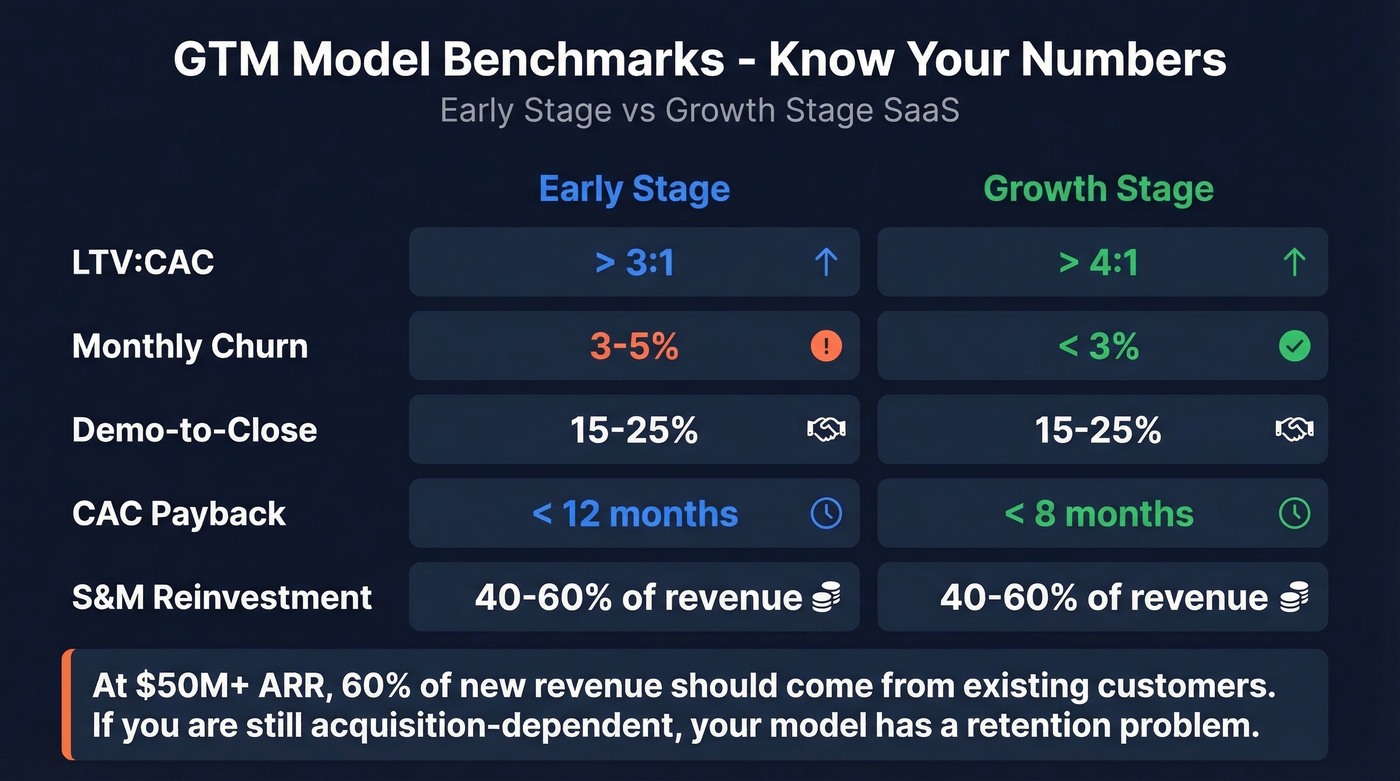
| Metric | Early Stage | Growth Stage |
|---|---|---|
| LTV:CAC | > 3:1 | > 4:1 |
| Monthly churn | 3-5% | < 3% |
| Demo-to-close | 15-25% | 15-25% |
| CAC payback | < 12 months | < 8 months |
| S&M reinvestment | 40-60% of revenue | 40-60% of revenue |
For companies past $50M ARR, 60% of new revenue should come from existing customers. If you're still acquisition-dependent at that scale, your model has a retention problem.
Pricing model matters too. Subscription businesses target LTV:CAC of 3:1 with 12-18 month payback. Usage-based models aim for 5:1 with 6-12 month payback. CAC payback varies by segment: SMB averages 9-15 months, enterprise runs 18-31 months.
5 Mistakes That Kill GTM Launches
Misaligned market understanding. Building for the wrong buyer is the most expensive mistake because everything downstream inherits the error. The consensus on r/SaaS is blunt: talk to roughly 10 ICP-matching people before you commit to a model. Not surveys - real conversations where they tell you what they'd actually pay for.
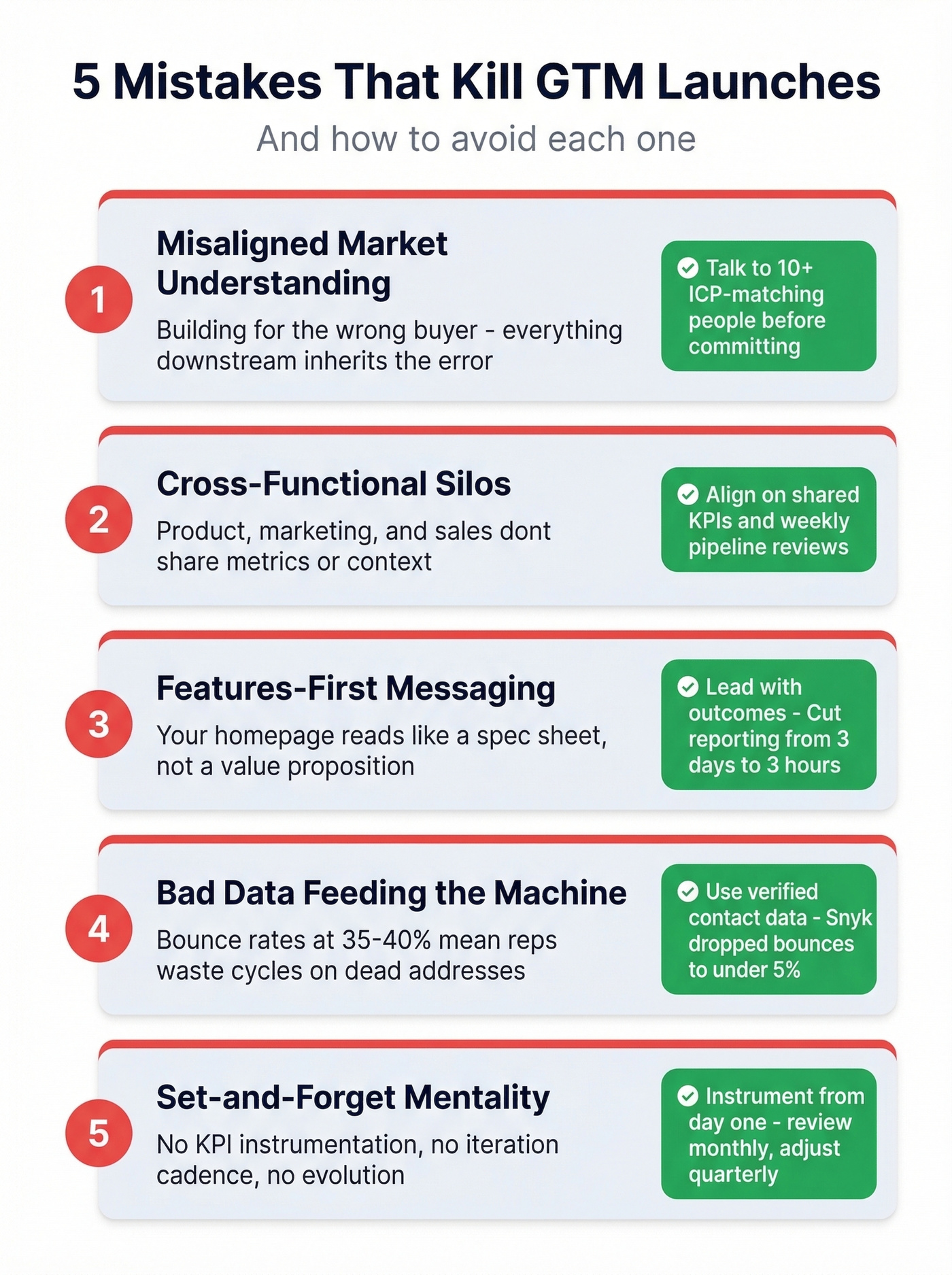
Cross-functional silos. Product builds features marketing can't position. Marketing generates leads sales can't close. When these functions don't share common metrics, your pipeline leaks at every handoff. We've watched teams blow an entire quarter because product shipped a feature nobody in sales knew how to demo.
Features-first messaging. "AI-powered analytics with real-time dashboards" tells the buyer nothing about their problem. "Cut monthly reporting from 3 days to 3 hours" is a GTM message. If your homepage reads like a spec sheet, start over.
Bad data feeding the machine. This one's frustrating because it's so fixable. When Snyk equipped 50 AEs with Prospeo, bounce rates dropped from 35-40% to under 5%, and AE-sourced pipeline jumped 180%. The reps didn't get better overnight - they just stopped wasting cycles on dead email addresses. If your outbound connect rates are below 10%, fix the data layer before you blame the reps or the messaging.
Set-and-forget mentality. No KPI instrumentation, no iteration cadence. Instrument from day one: CAC, payback, conversion by stage, churn by cohort. Review monthly. Adjust quarterly. Your product, pricing, and messaging should evolve together - not in isolation.
Building an Adaptive System
Your go-to-market model isn't a document. It's an operating system you tune continuously.
Management teams promise 2x market revenue growth, but only 9% of 2,300 global companies achieved 5.5%+ sustained annual growth. The gap between planning and execution is where most GTM models die. Winners build adaptive systems with fast feedback loops and deep cross-functional integration in daily operations - not just in quarterly planning decks.
Practically, this means three things. Build regular feedback cycles: weekly pipeline reviews, monthly metric audits, quarterly model assessments. Reduce time-to-value as a retention lever, because the faster a new customer hits their first win, the lower your churn. And treat your data layer as critical infrastructure. If prospect emails bounce at 35%, your outbound motion is dead before it starts. We've seen teams waste entire quarters on outbound campaigns built on stale data when the fix was a verified contact database with a weekly refresh cycle.
Skip the adaptive system talk if you haven't nailed the basics first. There's no point building feedback loops around a model that doesn't match your ACV. Get the structural decision right, instrument the core metrics, then iterate.
Whether you're running PLG, sales-led, or hybrid, your CAC payback depends on reaching the right buyers fast. Prospeo's 7-day data refresh, intent signals across 15,000 topics, and 92% enrichment match rate mean your reps spend time selling - not chasing dead leads.
Stop spending $2 in S&M per $1 ARR because your contact data is stale.
FAQ
What's the difference between a GTM model and a GTM strategy?
A GTM model is your operating structure - org design, pricing, and onboarding built around how you create and capture demand. A strategy is the specific launch plan you execute within that model. Models change infrequently; strategies adapt quarterly. Confusing the two leads to tactical fixes for structural problems.
Which go-to-market model works best for SaaS?
PLG works under $10K ACV with self-serve products. Sales-led works above $25K or with complex buying committees. Most SaaS companies between $5K-$25K run a hybrid: PLG for acquisition, sales-assist for expansion. The economics dictate the model - there's no universal answer.
How do you know if your GTM model is wrong?
Three red flags: CAC payback exceeding 12-15 months for SMB deals, win rates below 15% despite strong pipeline, or 60%+ of revenue still from new logos past $50M ARR. If your ACV is under $10K and AEs run six-month cycles, that's a structural mismatch - fix the model before optimizing tactics.
What data tools support a sales-led or hybrid GTM model?
For teams running outbound, verified contact data directly impacts connect rates and pipeline velocity. Prospeo offers 300M+ profiles with 98% email accuracy and a 7-day data refresh cycle. ZoomInfo and Apollo are alternatives worth evaluating, though both carry higher bounce rates and longer refresh windows based on our testing.