

Go-to-Market Strategy for Consulting Services
A principal at a 30-person firm posted on [r/consulting](https://www.reddit.com/r/consulting/) describing a familiar situation: newsletter going out, speaking when they can, most revenue from referrals and returning clients. The question was whether to add a podcast, sponsor conferences, or start making videos. That post could've been written by half the firm leaders we talk to.
The real problem isn't which channel to add - it's that referrals aren't a go-to-market strategy for consulting services. They're a byproduct of good work, and they plateau. Over half of consulting firms don't even have a documented sales strategy, and two out of three lack an ongoing sales improvement plan. Let's fix that.
The Short Version
- Define a narrow ICP based on problems, not services. "We help mid-market SaaS companies fix post-acquisition integration" beats "we do strategy consulting."
- Package 2-3 outcome-based offers with clear pricing. If you can't describe what you sell in two sentences, no channel will save you.
- Pick two channels - thought leadership plus outbound - and commit for 90 days. Don't spread across five channels at 20% effort each.
- Track CAC:LTV and pipeline coverage from day one. A healthy ratio is at least 3:1.
Why Most Consulting Firms Get GTM Wrong
What looks like a positioning problem is almost always a segmentation failure. Firms describe themselves as "management consultants" or "digital transformation advisors" and then wonder why their content doesn't resonate. You're talking to everyone, which means you're talking to no one.
In a study of over 6,000 B2B salespeople, 54% of [high performers were challengers](https://challengerinc.com/challenger-selling-profiles/) - people who teach and provoke - while only 4% were relationship builders. The consulting industry's instinct to rely on warm introductions is actively working against growth.
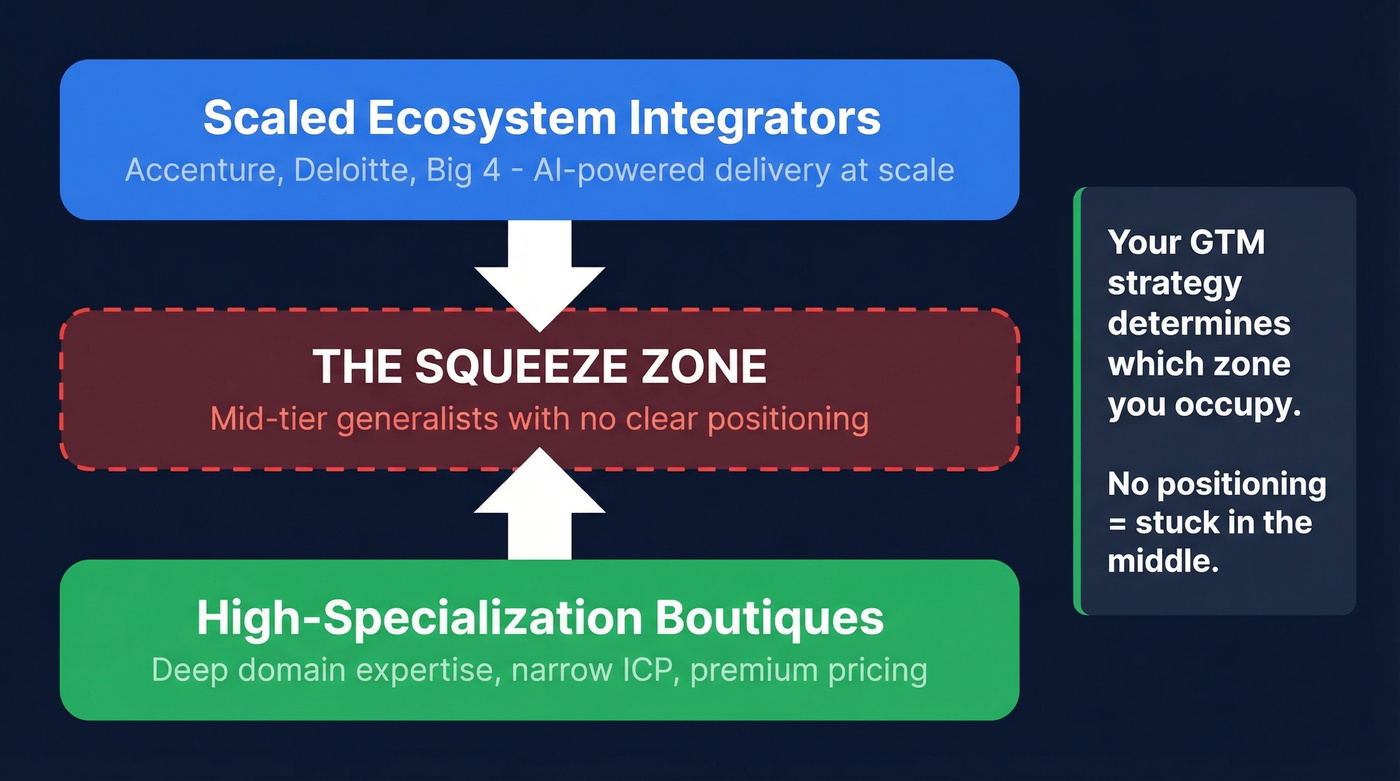
The 2026 landscape makes this worse. The industry is bifurcating into scaled ecosystem integrators like Accenture and Deloitte on one end, and high-specialization boutiques on the other, while AI-embedded execution models raise the bar for what clients expect. Mid-tier generalists are getting squeezed from both sides. If you don't have a clear GTM position, you're in the squeeze zone.

You defined your ICP. Now you need direct access to those decision-makers. Prospeo's 30+ search filters - including funding rounds, headcount growth, and job changes - let consulting firms pinpoint the exact trigger-event prospects this article describes. 98% email accuracy means your outbound actually lands.
Stop waiting for referrals. Start 50 real conversations this week.
A GTM Framework for Consulting Firms (7 Steps)
This framework adapts Hinge Marketing's professional services GTM model and layers in outbound, pricing, and implementation specifics that most consulting GTM guides skip entirely.
Step 1: Define Your Target Market
Start with problems, not services. "We help private-equity-backed B2B companies integrate acquisitions in the first 120 days" is a target market. "We do strategy and operations consulting" is a brochure.
Do secondary research to size the market, then do brand research - original data about how your firm is perceived versus competitors. Most firms skip the second part entirely, and it's the part that actually tells you where you stand.
Step 2: Build Your Ideal Client Profile
Use this if: You're getting meetings but they don't convert. Skip this if: You already have a tight niche with win rates above 40%.
Your ideal client has a problem you solve, budget and authority to hire you, and a trigger that makes now the right moment - a funding round, a new CTO hire, a regulatory shift, or a failed internal initiative. Companies with a well-defined ICP close deals 68% faster than those without. For consulting firms where sales cycles run 3-6 months, that's the difference between a healthy pipeline and a cash flow crisis.
Step 3: Position and Differentiate
Hinge's approach is simple: choose a clear positioning and avoid conflicting signals. If you try to look like a thought leader and a low-price provider and a full-service execution shop, you end up looking like a generalist pretending to be a specialist.
Here's the thing: if you're a 15-person firm, stop competing with McKinsey for the same client. You win by being the obvious expert in a specific domain. Your positioning should make 80% of the market say "that's not for us" - and make the remaining 20% say "they get our problem."
Step 4: Package Your Services
Most consulting firms skip packaging and jump straight to marketing. That's backwards.
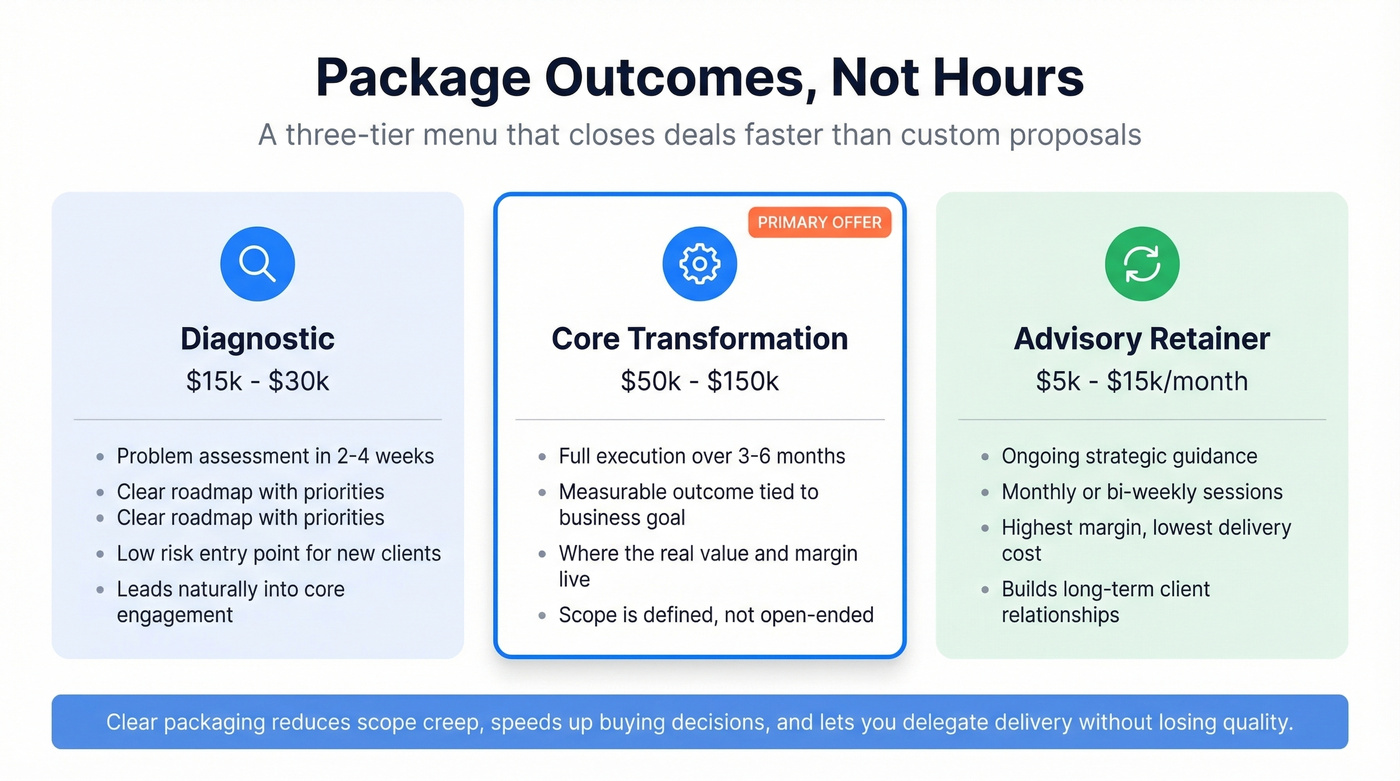
Sell outcomes, not hours. Package 2-3 tiers: a diagnostic engagement at $15-30k, a core transformation project at $50-150k, and an ongoing advisory retainer at $5-15k/month. Clear packaging reduces scope creep, speeds up buying decisions, and lets you delegate delivery without losing quality. We've watched firms struggle for months with "custom everything" proposals when a simple three-tier menu would've closed the deal in a week.
Step 5: Set Your Pricing Model
| Model | How It Works | Best For |
|---|---|---|
| Value-based | Fee tied to outcome | High-impact engagements |
| Retainer | Fixed monthly fee | Ongoing advisory |
| Performance | Fee linked to results | Growth-confident firms |
| Productized | Fixed scope, fixed price | Scalable diagnostics |
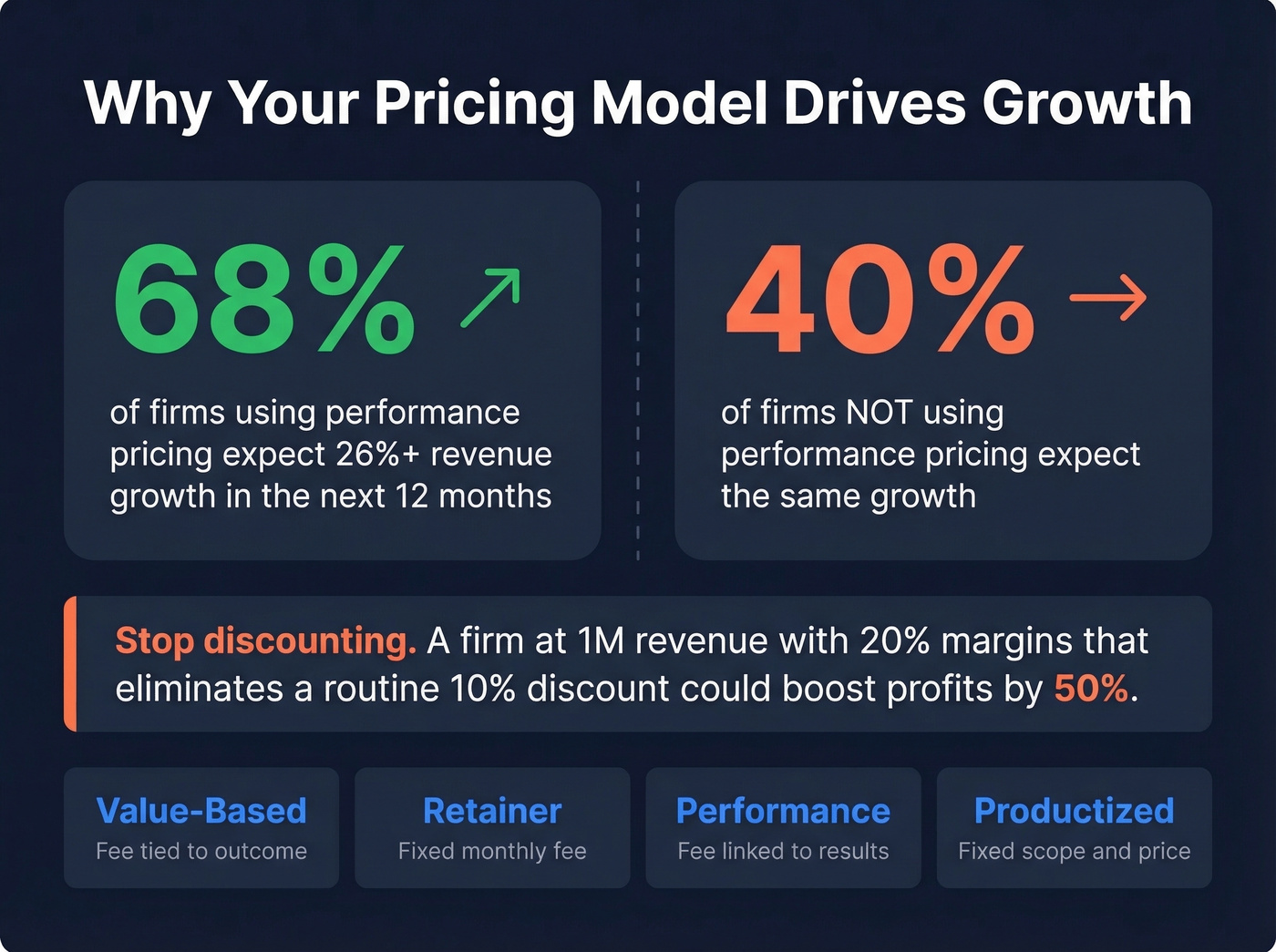
Performance pricing correlates strongly with growth: 68% of firms using it expect 26%+ revenue growth in the next 12 months, versus 40% of firms that don't. Outcome-based pricing and quantified ROI are becoming baseline expectations in 2026, not a differentiator - firms still billing hourly are already behind.
And stop discounting. A firm at £1M revenue with 20% margins that eliminates a routine 10% discount could boost profits by 50%.
Step 6: Choose Your Channels
More than 40% of B2B deals stall because of internal misalignment within buying groups. Thought leadership is the highest-ROI channel for consulting because it creates internal advocates - people who share your ideas and champion your firm before you're even in the room.
But thought leadership only works if you have a point of view. Generic trend roundups don't count.
You need three things: a weekly insight email with a clear perspective, speaking engagements where you teach not pitch, and targeted outbound to ICP-fit prospects. That's your channel stack. You don't need a podcast. You don't need to sponsor conferences. You need 50 conversations with the right people.
Step 7: Build Your Outbound Engine
The consulting industry's allergy to outbound is costing firms millions. I've seen it over and over: firms that invest heavily in content and speaking but refuse to send a single cold email, then wonder why pipeline is unpredictable.
Define your ICP triggers - funding round, leadership change, expansion into new markets. Build a targeted list of 200 decision-makers who match those triggers. Personalize your outreach around the specific problem you solve for their specific situation.
For list-building, Prospeo's database lets you filter by industry, job title, headcount growth, funding, revenue, and buyer intent signals across 15,000 topics, then export verified decision-maker emails with 98% accuracy. Start with 50 personalized emails per month. If your ICP and messaging are tight, you'll generate more qualified conversations in a month than six months of unfocused content marketing.
Here's a real scenario: a 20-person operations consulting firm we worked with defined their ICP around PE-backed logistics companies, packaged a 90-day integration diagnostic at $25k, and generated 14 qualified conversations in 60 days from 100 outbound emails. Tight targeting paired with clear packaging did all the heavy lifting.

90-Day Implementation Plan
| Phase | Focus | Key Actions |
|---|---|---|
| Days 1-30 | Foundation | Define ICP, package services, build 200-contact list, audit website |
| Days 31-60 | Execution | Launch outbound at 50 emails/month, publish thought leadership, activate referral program |
| Days 61-90 | Optimization | Double down on best channel, track CAC:LTV, optimize stage conversion rates |
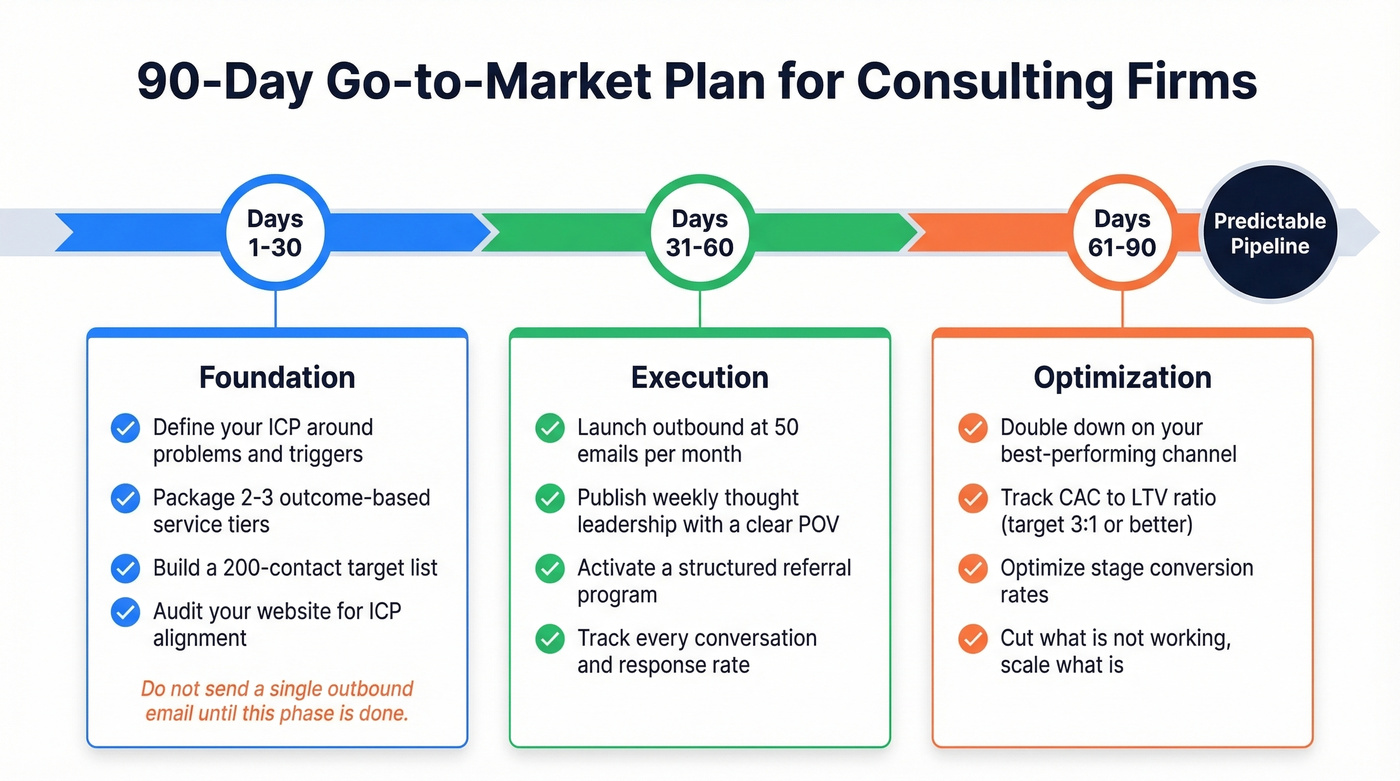
Don't send a single outbound email until your ICP is defined and your services are packaged. Days 31-60 are about volume and learning. Days 61-90 are about cutting what isn't working and scaling what is.
Metrics That Matter
Track these from day one - not after you "feel ready":
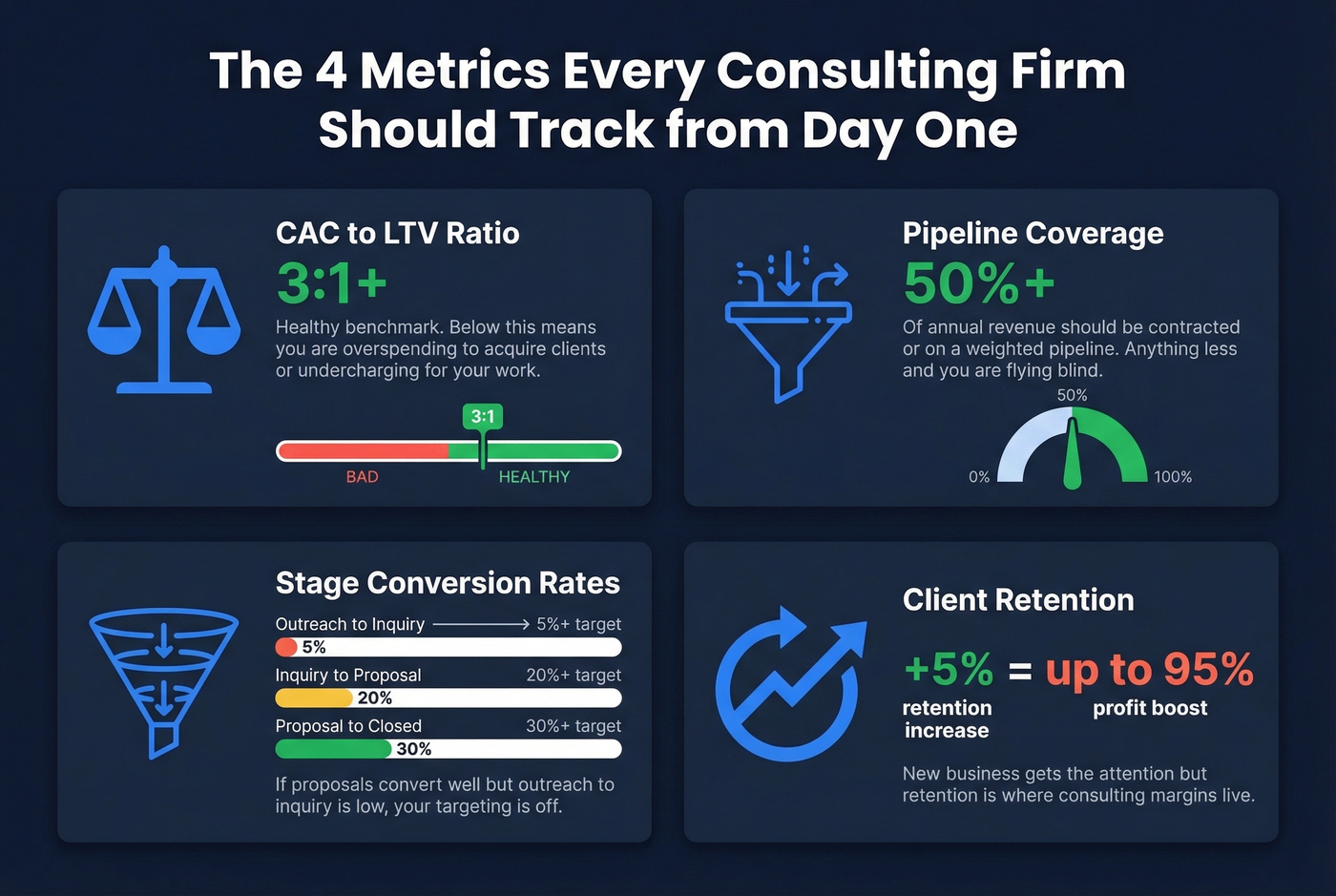
- CAC:LTV ratio: 3:1 is healthy. Below that, you're overspending to acquire clients or undercharging. (If you want a deeper breakdown, see CAC.)
- Pipeline coverage: 50%+ of annual revenue contracted or on a weighted pipeline is a good sign. (More on pipeline health.)
- Stage conversion rates: Track outreach to inquiry to proposal to closed. If proposals convert at 30%+ but outreach-to-inquiry is below 5%, your targeting is off. (Use a simple funnel metrics view to spot leaks.)
- Retention impact: A 5% increase in client retention can boost profits by up to 95%. New business gets the attention, but retention is where consulting margins live.
Building a go-to-market strategy for consulting services isn't about adding more channels. It's about getting the fundamentals right first. Define a narrow ICP, package clear outcomes, price with confidence, and run disciplined outbound alongside thought leadership. The firms that commit to this framework for 90 days rarely go back to hoping the phone rings.
Your outbound engine is only as good as your data. Consulting firms using Prospeo get verified emails at $0.01 each and 125M+ direct mobile numbers with a 30% pickup rate - so every outreach touches a real buyer, not a dead inbox. Data refreshes every 7 days, not 6 weeks.
Build the outbound pipeline your consulting firm has been avoiding.
FAQ
How long does a consulting GTM strategy take to show results?
Most firms see pipeline movement within 60-90 days. Outbound generates qualified conversations in 2-4 weeks if your ICP is tight and your packaging is clear. Thought leadership compounds over 6-12 months but builds durable inbound alongside outbound efforts.
Should a small consulting firm invest in outbound?
Yes - especially firms under 50 people where referrals have plateaued. Fifty personalized emails per month to ideal-fit companies routinely outperform months of unfocused content. A free tier with 75 emails per month is enough to test targeting before committing budget.
What's the biggest GTM mistake consulting firms make?
Skipping service packaging and jumping straight to marketing. Without clear, outcome-based offers at defined price points, no channel - content, events, or outbound - will convert consistently. Package first, then market. Every firm that reverses this order wastes 3-6 months learning the same lesson.