

The Operator's Go-to-Market Strategy for Product Launch
You shipped the product. It's live. And nobody's signing up. The dashboard shows three trial accounts - two are your co-founder's test emails.
This is normal. 95% of newly launched products fail, and 56% of product launches fail due to lack of internal alignment - not bad products. The gap isn't what you built. It's your go-to-market strategy for product launch that's missing.
What You Need (Quick Version)
Your GTM strategy needs three things: 50 customer conversations before launch, a 200-account target list with verified contact data, and consistent execution. You don't need a 47-slide deck. The rest of this guide shows you how to build each one with real benchmarks.
GTM Strategy vs. Product Launch
A go-to-market strategy is the full system - ICP definition, positioning, pricing, channel selection, metrics, and iteration loops. It applies whenever you're entering a market: new product, new segment, pivot to a different buyer.
A product launch is one phase within that strategy: the announcement, the initial push, the first-wave distribution. The strategy is the playbook; the launch is the opening play. Getting this wrong leads teams to treat launch day as the finish line instead of the starting gun.
Why Most GTM Strategies Fail
90% of product launches require post-launch adjustments. The real failures come from skipping the work that makes those adjustments productive.
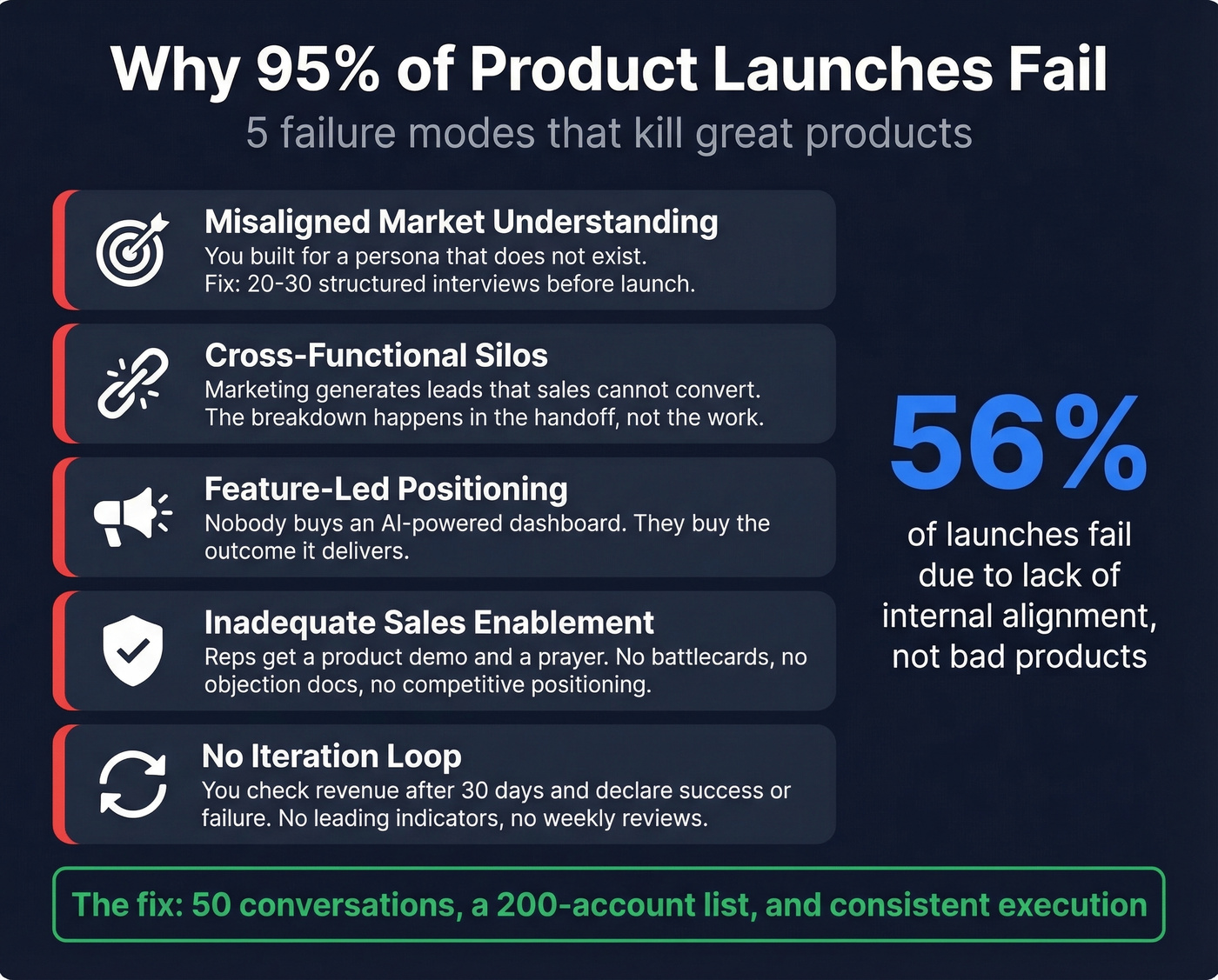
Misaligned market understanding. You built for a persona that doesn't exist. Even 20-30 structured interviews before launch reveal what users actually value versus what you assumed.
Cross-functional silos. Marketing generates leads that sales can't convert because nobody aligned on ICP, messaging, or handoff criteria. We've seen this kill launches at companies with great products and strong teams - the breakdown happens in the handoff, not the work.
Feature-led positioning. Nobody buys an "AI-powered dashboard." They buy the outcome it delivers. If your messaging lists capabilities instead of addressing buyer pain, it's dead on arrival.
Inadequate sales enablement. Reps get a product demo and a prayer. No battlecards, no objection docs, no competitive positioning they can use in calls.
No iteration loop. You launch, check revenue after 30 days, and declare success or failure. No leading indicators, no weekly funnel reviews.
Founders on Reddit consistently call out the "just post on ProductHunt and Reddit" approach as useless - and they're right. Both ProductHunt and AppSumo face growing skepticism around fake reviews and sponsored content. Channels aren't a strategy. They're a delivery mechanism for a strategy that already works.


Your GTM strategy is only as good as the contact data behind it. Prospeo's 300M+ profiles with 98% email accuracy and 7-day refresh cycles mean your launch outbound actually lands - not bounces. One team tripled pipeline from $100K to $300K/week after switching.
Build your 200-account launch list with data that connects you to real buyers.
Choose Your GTM Motion
Before you plan channels or write copy, decide how customers will buy. McKinsey's analysis of 107 publicly listed B2B SaaS companies found that pure PLG rarely scales alone - most successful companies run a hybrid "product-led sales" motion.
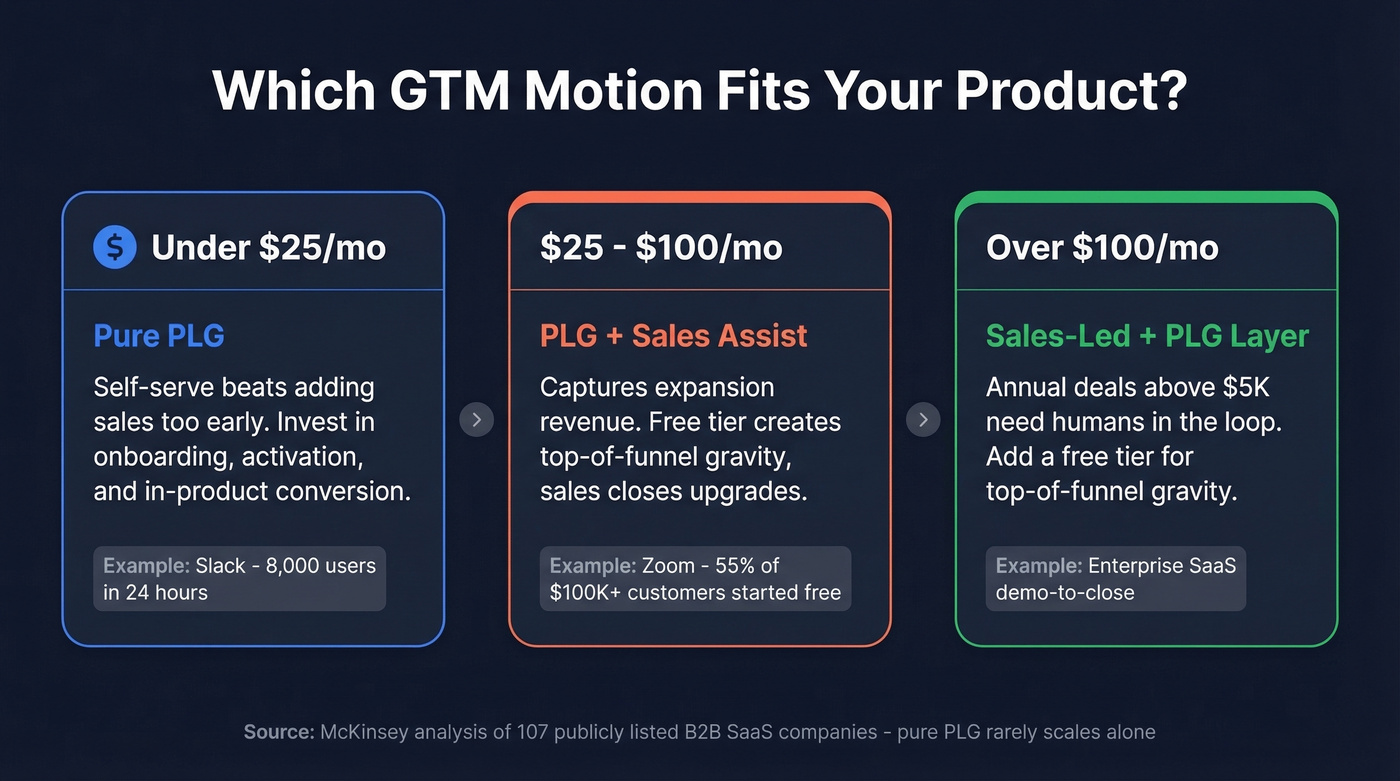
| ASP Range | Motion | Why | Example |
|---|---|---|---|
| Under $25/mo | Pure PLG | Self-serve can outpace adding sales too early | Slack: 8,000 users within 24 hours |
| $25-$100/mo | PLG + sales assist | Captures expansion revenue | Zoom: 55% of $100K+ customers started with a free host |
| Over $100/mo | Sales-led + PLG layer | Annual deals above $5K need humans in the loop | Enterprise SaaS demo-to-close |
Here's the thing: if your ASP is under $25/month, don't hire salespeople. Full stop. Invest in onboarding, activation, and in-product conversion instead. I've watched founders burn six months of runway on an SDR team for a $15/month product. At $100+ ASP, you need a sales motion - but even then, a free tier creates the top-of-funnel gravity that makes outbound cheaper.
7-Step GTM Framework for Launching
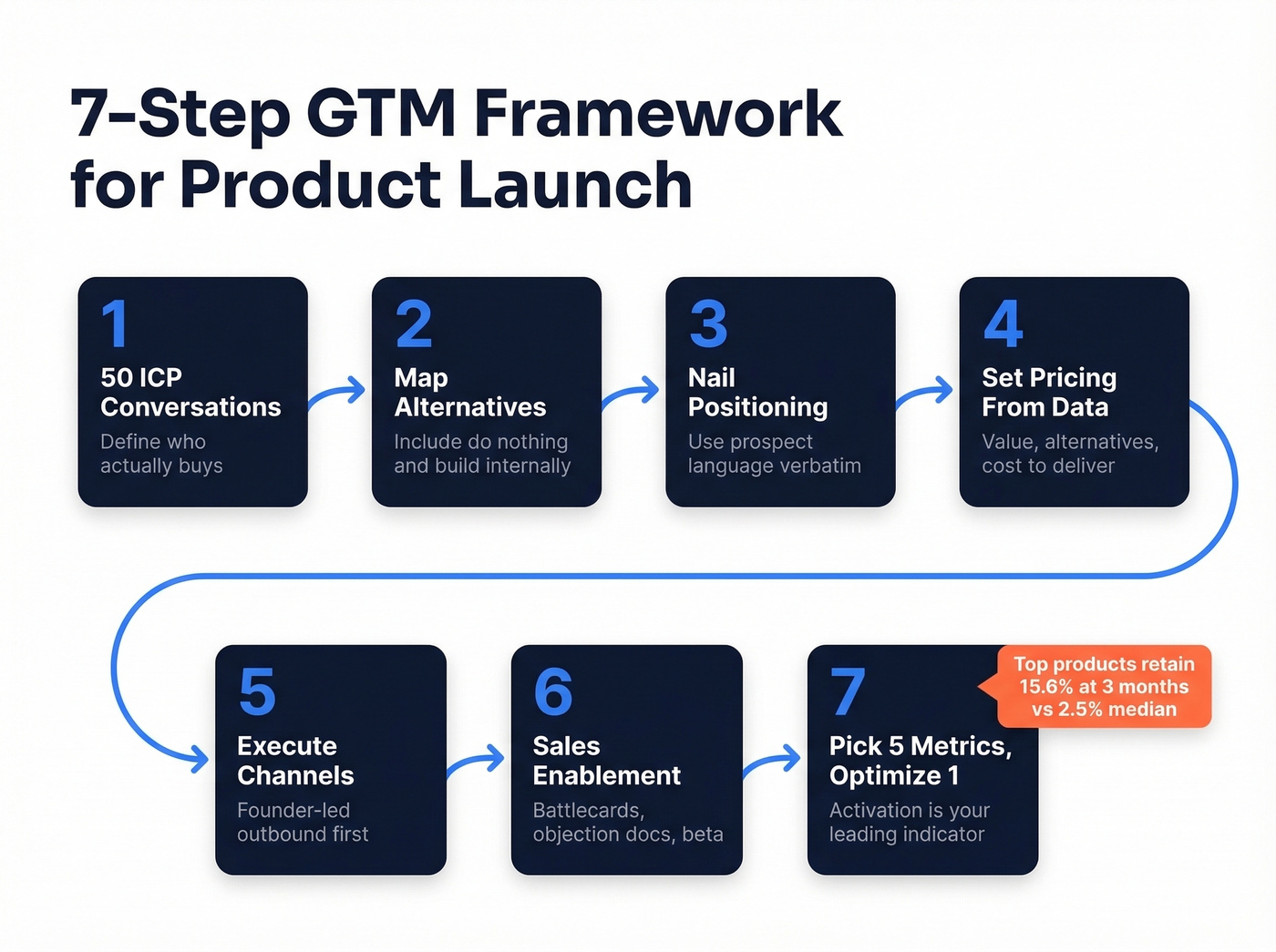
Step 1: Define Your ICP With 50 Conversations
Every GTM guide tells you to define your ICP. Almost none show you how.
A GrowthX case study illustrates the stakes: a founder thought their ICP was "high schools" - that was actually their TAM. After narrowing by value drivers and proxy signals, they built a tangible list of about 200 accounts that matched their real ICP. That specificity changed everything. Messaging got sharper, conversion rates climbed, and outbound stopped feeling like spam.
Step 2: Map Competitive Alternatives
Don't just list competitors. Map every alternative your buyer actually considers - including "do nothing" and "build internally."
Your positioning needs to address the real decision, not just the feature comparison. The question isn't "why us over Competitor X?" It's "what does the buyer lose by staying with their current approach?" That reframe forces pain-point-led positioning instead of feature-led positioning, which is one of the top GTM failure modes we see repeatedly.
Step 3: Nail Positioning and Messaging
Here's a test we run with every team: read your homepage headline to a prospect. If they don't immediately understand the outcome you deliver, rewrite it.
Your messaging should articulate the pain you eliminate and the result you create - not the features you built. Test positioning in those 50 conversations. The language your prospects use to describe their problem is better copy than anything your marketing team will write. Seriously. Record those calls, pull exact phrases, and put them on your landing page verbatim.
Step 4: Set Pricing From Data
Guesswork pricing kills more launches than bad products. Triangulate three inputs: what's the value to the customer, what do alternatives cost, and what does it cost you to deliver. The intersection gives you a defensible starting point. You'll iterate - everyone does - but start from data, not vibes.
Skip this step if you're planning to launch with a free-only tier and "figure out pricing later." That's not a strategy; it's procrastination that trains your market to expect free.
Step 5: Execute Your Channels
Three GTM motions work especially well for early-stage B2B SaaS: founder-led outbound, PLG with sales assist, and community-led acquisition. Most early-stage companies should run founder-led outbound first because it generates learning and revenue simultaneously.
Your outbound channel is only as good as your contact data. High bounce rates damage your domain reputation and can kill the channel before it has a chance to work. One team saw bounce rates drop from 35% to under 4% and pipeline triple from $100K to $300K per week after switching to verified data refreshed every 7 days - the difference between fresh data and stale lists is that stark.
AI is accelerating this step too. Use it to enrich your target accounts and tailor first-touch messaging so you can move faster without sacrificing relevance.

Step 6: Build Sales Enablement
Before launch, arm your team with competitive battlecards, one-page value props per persona, objection-handling docs, and a demo script that follows the buyer's journey rather than your feature list.
Then run a beta with 5-10 ICP-matching companies. Beta isn't a soft launch - it's a structured feedback loop that validates your enablement materials against real buying conversations. If your battlecards don't address the objections that come up in beta, rewrite them before GA.
Step 7: Pick 5 Metrics, Optimize 1
Select 3-5 metrics, then pick one to optimize at a time. Trying to move five numbers simultaneously means you move none.
Amplitude's benchmark data across 2,600+ B2B companies tells the story: top B2B products retain 15.6% of users at three months versus a median of 2.5%. And 69% of products with strong early activation also retain well at three months. Activation is your leading indicator. Optimize that first.
Your GTM doc should include three artifacts: an ICP definition sheet, a positioning template with tested messaging, and a KPI tracker with weekly review cadence baked in.
12-Week Launch Timeline
Twelve weeks gets you through initial launch, but products take an average of 28 weeks to reach 75% of peak distribution. Plan for a marathon.
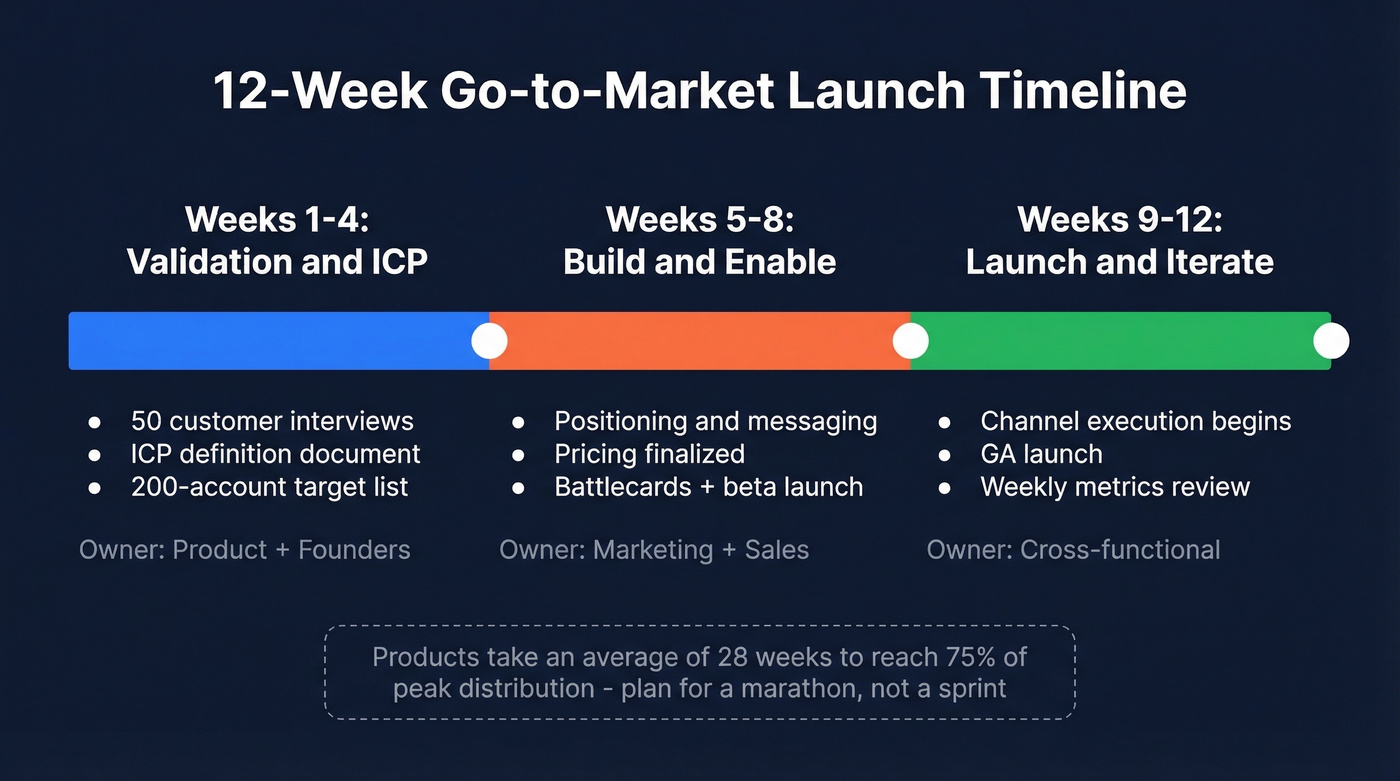
| Weeks | Focus | Key Deliverables | Owner |
|---|---|---|---|
| 1-4 | Validation & ICP | 50 interviews, ICP doc, 200-account list | Product + Founders |
| 5-8 | Build & Enable | Positioning, pricing, battlecards, beta | Marketing + Sales |
| 9-12 | Launch & Iterate | Channel execution, GA launch, metrics review | Cross-functional |
The phased approach - alpha to beta to general availability - isn't bureaucracy. It's how you catch positioning mistakes before they're expensive. We've found that teams who skip the beta phase spend 2-3x more on post-launch fixes than they would've spent on a structured 2-week beta.
The First 90 Days After Launch
Launch day is a spike, not a trend. Slack attracted 8,000 users within 24 hours - but only 11% of users remain engaged after 52 weeks. Your job in the first 90 days is to build the habits and feedback loops that keep the curve from cratering.
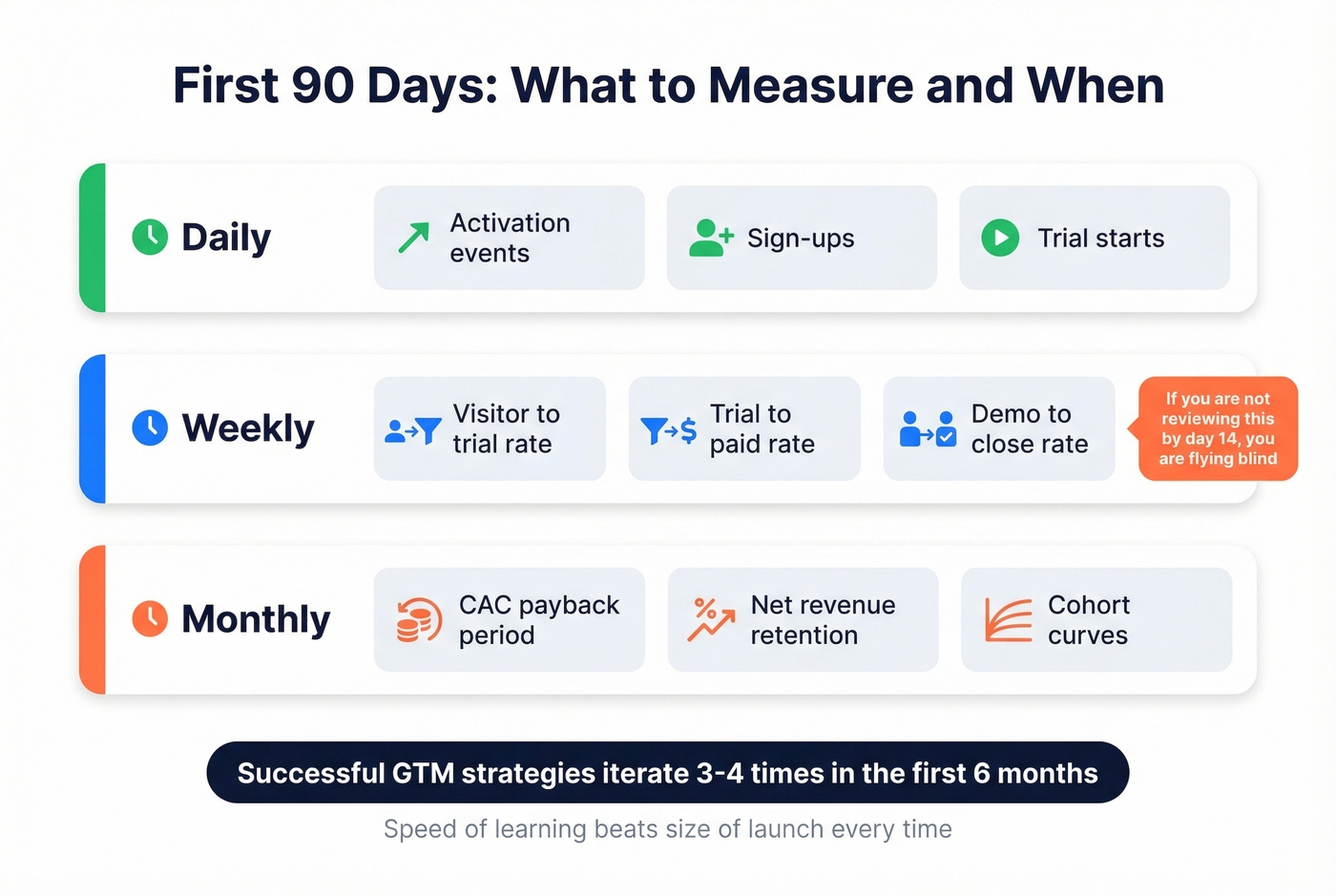
Successful go-to-market strategies iterate 3-4 times in the first six months. Set a measurement cadence that supports that tempo:
Daily: activation events, sign-ups, trial starts.
Weekly: funnel conversion rates - visitor-to-trial, trial-to-paid, demo-to-close. This is where you catch problems early. If you're not reviewing weekly funnel data by day 14 post-launch, you're flying blind.
Monthly: unit economics - CAC payback, net revenue retention, cohort curves.
Let's be honest about something most launch guides won't say: mediocre launch days don't mean failure. We've watched teams with quiet launches outperform splashy ones by week 8 because they iterated faster in weeks 2 through 12. The First Round Review is full of stories like this. Speed of learning beats size of launch every time.
Founder-led outbound is the fastest GTM motion - but one bad bounce rate tanks your domain before launch week ends. Prospeo delivers verified emails at $0.01 each with 30+ filters for intent, technographics, and company growth so every first touch is relevant.
Stop burning domain reputation on stale data before your product even launches.
FAQ
What's the difference between a GTM strategy and a product launch plan?
A GTM strategy covers ICP definition, positioning, pricing, channel selection, and metrics - it applies to new products, market expansions, and pivots. A product launch is one execution phase within that broader strategy. The strategy outlives any single launch event.
How long does a go-to-market strategy take?
Plan 12 weeks minimum for initial launch, but expect 3-4 major iterations in the first six months. Products take an average of 28 weeks to reach 75% of peak distribution. Teams that treat GTM as a continuous process - not a one-time event - are the ones that survive past year one.
What are the biggest GTM mistakes?
Skipping customer conversations before launch, treating launch day as the finish line, and defaulting to feature-led messaging instead of pain-point positioning. The most expensive mistake is building outbound on unverified data - high bounce rates torch your domain reputation and can make the channel unrecoverable for months.
What metrics matter most after launch?
Start with activation rate as your primary metric. Amplitude's data shows 69% of products with strong early activation retain well at three months. Layer in trial-to-paid conversion, weekly active usage, and CAC payback period. Review weekly - monthly is too slow to catch problems before they compound.
What tools help execute a GTM launch faster?
For ICP list-building and outbound, Prospeo lets you filter 300M+ profiles by buyer intent, technographics, and headcount growth, then export verified emails at 98% accuracy. Pair that with a CRM like HubSpot or Salesforce, a sequencing tool like Instantly or Lemlist, and an analytics platform like Amplitude for activation tracking.