

GTM Automation: The Practitioner's Guide to What Actually Works
A RevOps lead we know ran a full audit last year. Twenty-five GTM tools. $56,000 in annual spend. He canceled twenty and kept five. Pipeline didn't drop.
His SDRs had been spending three hours a day building lists that half-bounced on the first sequence, and the "automation" was just expensive plumbing connecting tools nobody used. He also found LinkedIn outperformed email 20:1 for his use case - a reminder that no amount of GTM automation fixes a bad channel strategy.
That's the state of go-to-market automation for most teams: lots of spend, lots of logos on the tech stack slide, not a lot of revenue impact.
The Minimum Viable Stack
GTM automation is only as good as the data feeding it. Start with verified contact data, add a workflow orchestrator, plug in a sequencer, and track everything in a CRM. If your budget is under $500/mo, you need exactly four tools. Spending more? Add signal intelligence.
- Data layer: Prospeo for verified emails and mobiles (free tier: 75 emails + 100 Chrome extension credits/month)
- Workflow orchestrator: n8n or Make, free to ~$10-$30/mo
- Outbound sequencer: Smartlead, ~$30-$40/mo
- CRM: HubSpot Free
That lands under ~$200/mo. Everything else is optimization.
What GTM Automation Actually Means
GTM automation isn't GTM engineering. Engineering means building systems from scratch - writing Clay workflows with conditional logic, stitching APIs, debugging broken webhooks at 2am. Automation is using those systems once they exist. The line is blurring fast, but the distinction matters when you're hiring.
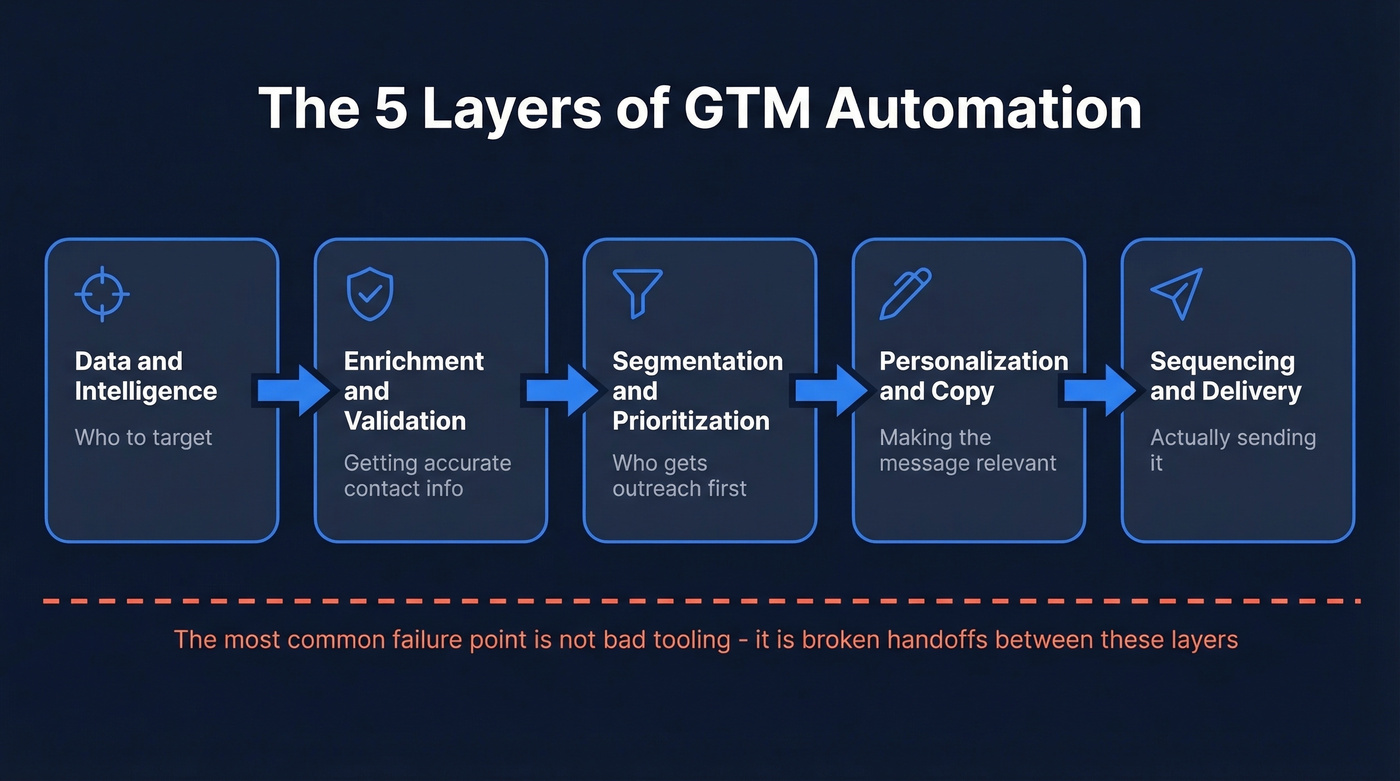
The useful mental model comes from Bitscale's framework: five layers.
- Data & intelligence - who to target
- Enrichment & validation - getting accurate contact info
- Segmentation & prioritization - deciding who gets outreach first
- Personalization & copy generation - making the message relevant
- Sequencing & delivery - actually sending it
Here's the thing: the most common failure point isn't bad tooling. It's broken handoffs between layers. Enrichment data goes stale by the time it hits the sequencer. Segmentation logic doesn't match what personalization needs. The connections between layers are where deals die, and getting go-to-market workflow automation right means obsessing over these handoffs, not just the individual tools.
Why It's Non-Optional in 2026
Three forces are converging to make automated go-to-market motions a requirement, not a luxury.
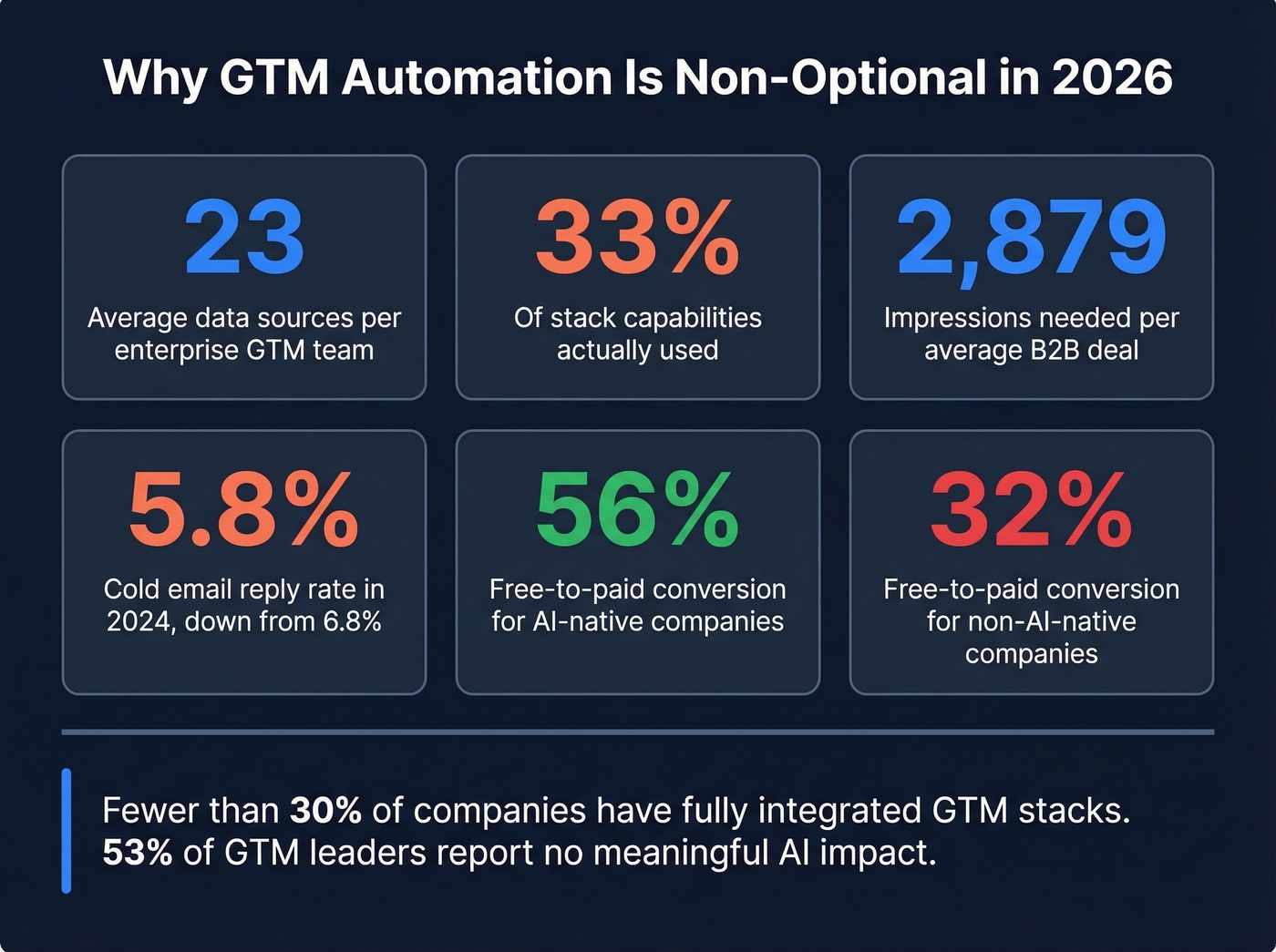
Stack sprawl is out of control. The average enterprise GTM team pulls data from 23 sources. Two-thirds of marketers use 16+ tools. They're using 33% of their stack's capabilities. That's a lot of shelfware.
Buyers are harder to reach. In recent benchmarks, the average B2B deal requires 2,879 impressions and 266 touchpoints. For $100k+ ACV deals, that jumps to ~5,500 impressions and 417 touchpoints. You can't do that manually. Cold email reply rates dropped from 6.8% in 2023 to 5.8% in 2024, and the trend isn't reversing. Meanwhile, 61% of B2B buyers prefer rep-free experiences - meaning your automation has to deliver value before a human ever gets involved.
Most teams haven't connected the dots. Fewer than 30% of companies have fully integrated GTM tech stacks, and 53% of GTM leaders report no meaningful impact from AI despite heavy pressure to adopt it. The problem isn't the tools - it's the architecture. Teams buy point solutions and never wire them together. AI-native companies convert free trials to paid at 56%, versus 32% for non-AI-native companies. The teams that embed workflow automation into their motion from the start outperform those bolting it on later.
One concrete example: a company that switched to signal-based workflows reported a 6% drop in CAC, 3x outreach engagement, and 60+ hours per week saved. That's not marginal improvement - that's a structural advantage.
If your deal size is under $15k, you probably don't need ZoomInfo-level data or a six-figure GTM engineer. A lean, well-wired stack will outperform an expensive one that nobody maintains.
Three Workflows You Can Build This Week
Signal-Based Outbound
Trigger: Intent signal fires - job change, funding round, tech install, or Bombora topic surge.
Outcome: Your reps only see pre-verified, high-intent contacts in their sequence queue. No list-building. No bounced emails tanking domain reputation. We've seen teams cut list-building time by 80%+ with this workflow.
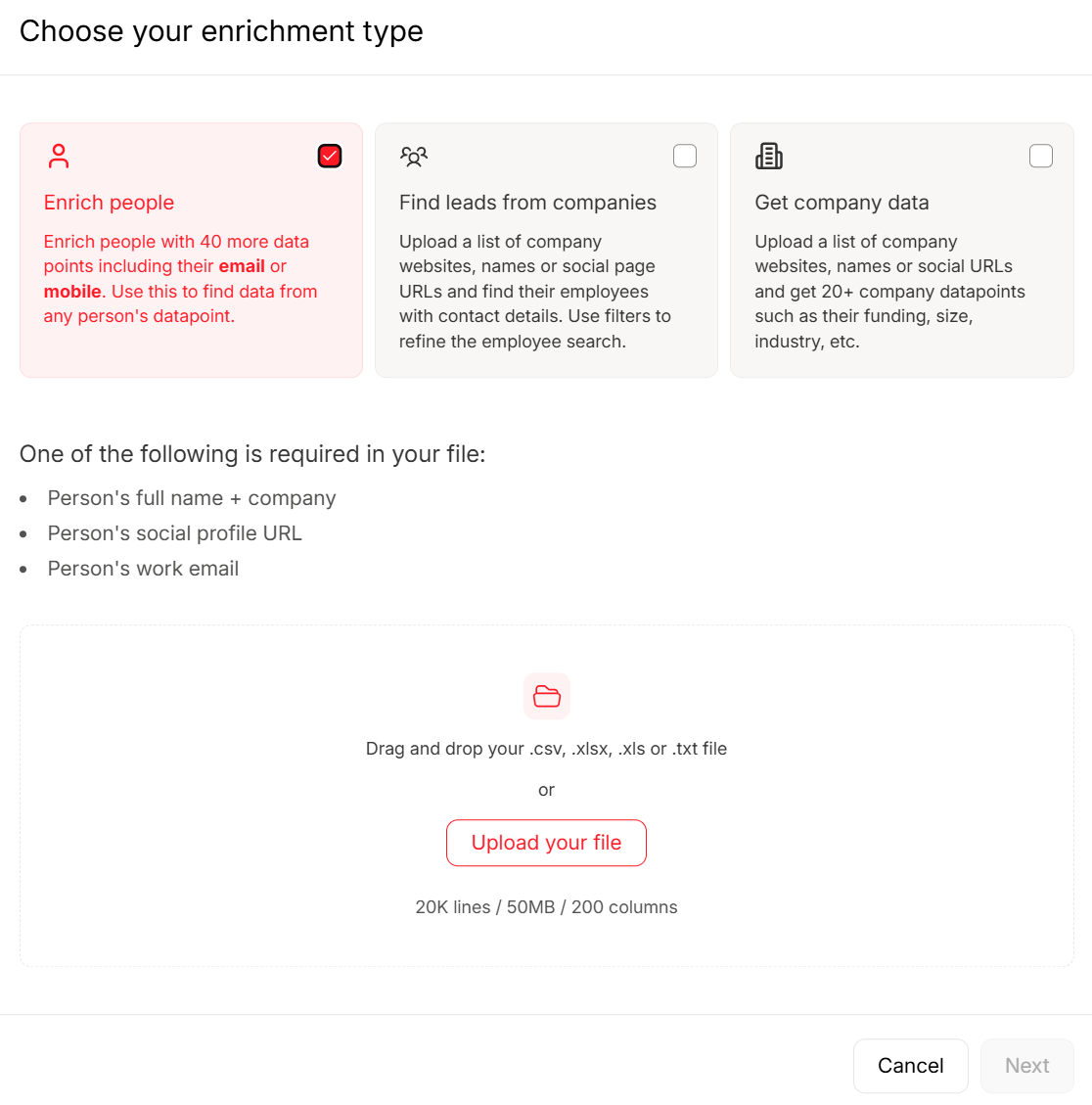
Inbound Speed-to-Meeting
This one is less about tools and more about discipline.
Most teams route inbound leads manually through Slack channels, and response times stretch to hours or days. That's a conversion killer. The workflow: a form fill triggers instant enrichment with firmographic and technographic data, scores the lead against your ICP model, routes to the right rep based on territory or segment, and auto-books a meeting if the score clears your threshold. Sub-5-minute response time should be the standard - it's one of the strongest predictors of conversion we've found.
Account Expansion via Job Changes
Trigger: A champion or power user from an existing account changes jobs.
Action: Re-enrich the contact at their new company. Check if the new company fits your ICP. If yes, add to a warm nurture sequence referencing the prior relationship.
Outcome: Warm pipeline from people who already know your product. This is the highest-conversion outbound motion most teams aren't running. In our experience, champion-tracking workflows generate 3-5x the reply rates of cold outbound - and they cost almost nothing to maintain.

The signal-based workflows above only work if your enrichment layer delivers clean data. Prospeo's 7-day refresh cycle means contacts never go stale between enrichment and sequencing - the exact handoff where most GTM stacks break. 98% email accuracy, 125M+ verified mobiles, starting at $0.01/email.
Fix the data layer and the rest of your GTM stack actually works.
What It Actually Costs
The fact that most GTM guides don't include a single price is telling.
| Tool | Category | Starting Price | Best For |
|---|---|---|---|
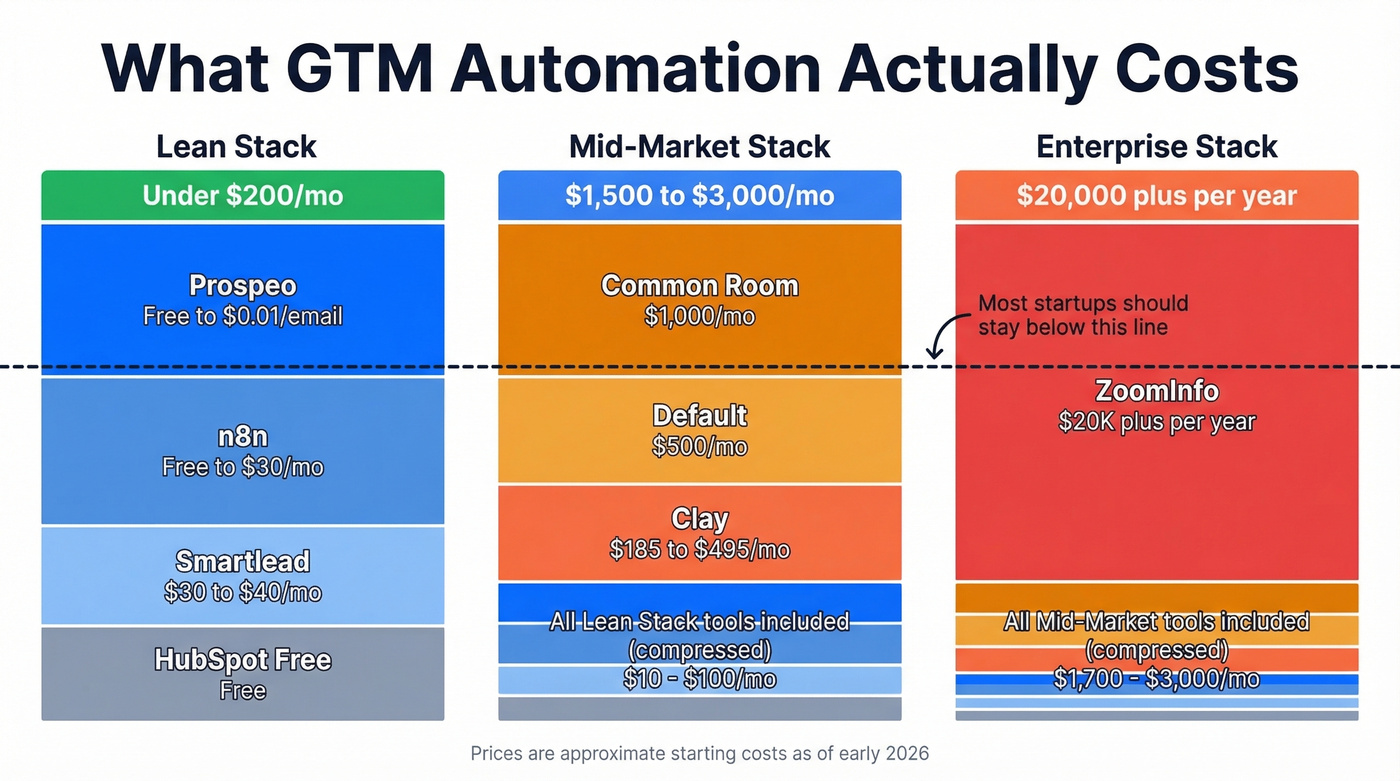
| Prospeo | Data & Enrichment | Free; ~$0.01/email | Verified emails + mobiles at any budget |
| n8n | Workflow Automation | Free; ~$10-$30/mo cloud | Full control, technical teams |
| Smartlead | Sequencing | ~$30-$40/mo | High-volume cold email |
| HubSpot | CRM | Free tier available | Pipeline management |
| Apollo.io | Data + Engagement | $49-$119/mo | All-in-one on a budget |
| Clay | Orchestration | $185/mo (Launch) | Complex enrichment flows |
| Default | Inbound Ops | $500/mo | Speed-to-meeting routing |
| Common Room | Signal Intelligence | $1K/mo | Multi-channel buying signals |
| ZoomInfo | Enterprise Data | $20K+/yr | Large orgs with budget |
A lean stack runs under ~$200/mo. A mid-market stack with Clay and signal intelligence lands in the $1,500-$3,000/mo range. ZoomInfo alone can eat $20K+ annually - before you add seats or modules. The consensus on r/SaaS is pretty blunt about that price tag: "wild" for startups.
What Breaks (And How to Fix It)
Automating the personal touch end-to-end. A team documented in a Zapier case study automated their entire webinar follow-up sequence with personalization tokens. Zero responses. They kept automation for list sync and the initial thank-you, then wrote real follow-ups manually. The lesson: automate the plumbing, not the conversation.
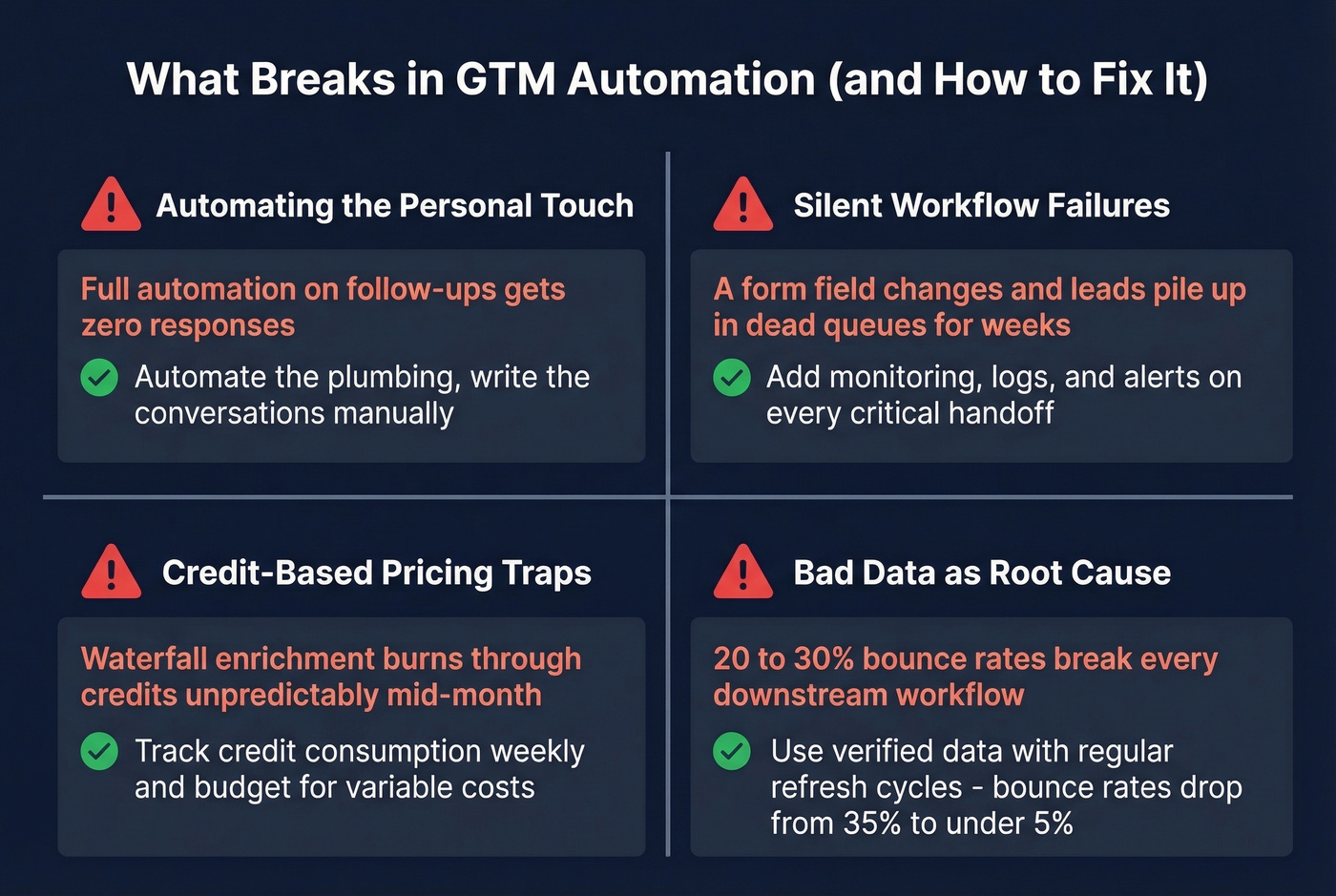
Silent workflow failures. Someone changes a form field name, and your entire routing workflow breaks without alerting anyone. Leads pile up in a dead queue for weeks. The fix: monitoring, logs, and alerts on every critical handoff. Treat your go-to-market workflow automation like production code.
Credit-based pricing traps. Apollo credits don't roll over and expire each billing cycle. Their waterfall enrichment makes credit consumption unpredictable - one contact might cost 1 credit, another might cost 5 depending on which data source returns first. Budget accordingly, or you'll blow through credits mid-month.
Bad data as the root cause. This is the one that frustrates us most because it's so preventable. When 20-30% of your emails bounce, every downstream workflow breaks. Personalization is wasted. Sequences get flagged. Attribution falls apart. Snyk's sales team saw bounce rates drop from 35-40% to under 5% after switching to verified data with a 7-day refresh cycle - and AE-sourced pipeline jumped 180% with 200+ new opportunities per month. Data quality isn't a nice-to-have; it's the foundation everything else depends on.

The Right Stack by Company Stage
Seed / Solo Founder
Budget: Under $500/mo
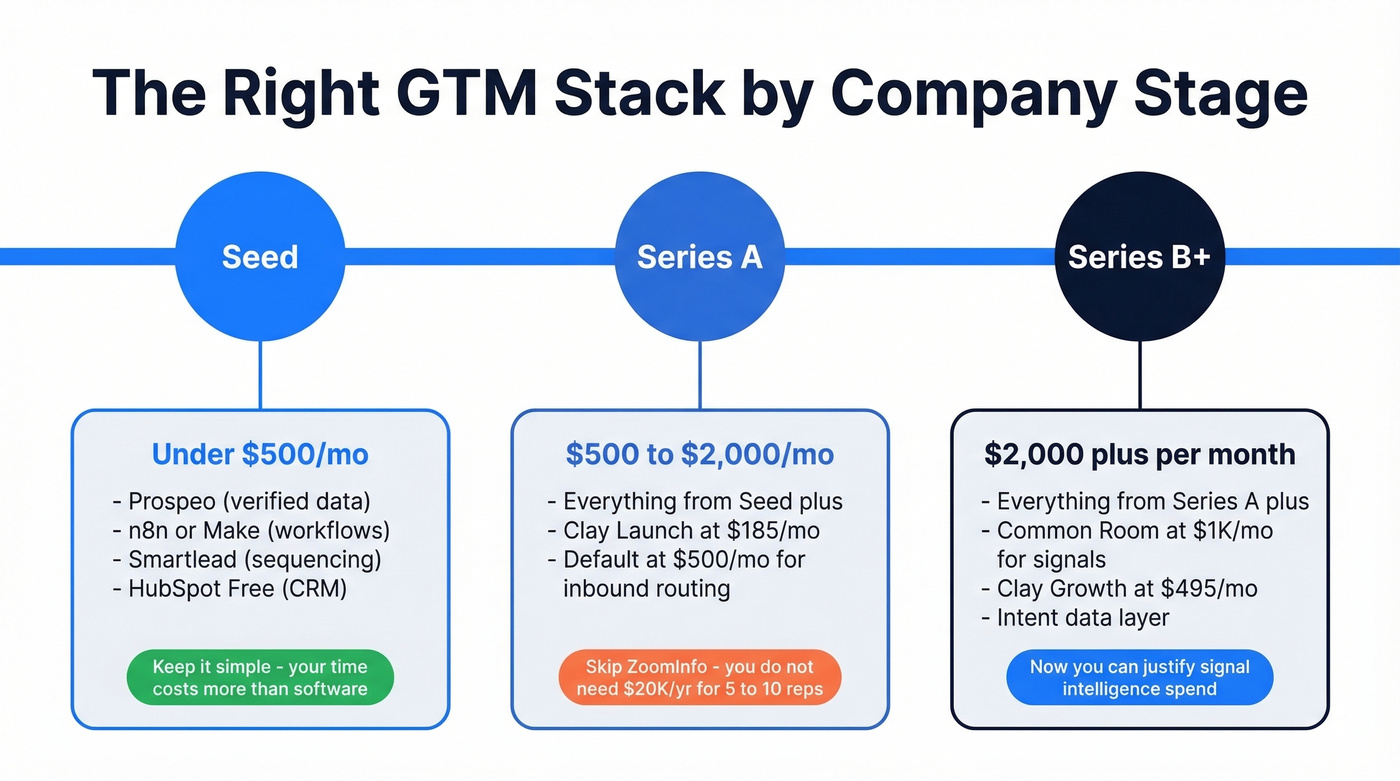
Stack: Verified data provider, n8n or Make, Smartlead, HubSpot Free.
Bitscale's decision rule is worth memorizing: if you're sending fewer than 500 contacts per month, an integrated platform beats stitching five tools together. At this stage, your time is more expensive than your software.
Series A
Budget: $500-$2,000/mo
Stack: Add Clay Launch at $185/mo for complex enrichment workflows and Default at $500/mo for inbound routing. You need verified contacts feeding every workflow, and at ~$0.01/email, the data layer is the cheapest part of the stack with the highest accuracy.
Skip ZoomInfo here. You don't need a $20K/yr platform when your team is 5-10 reps.
Series B+
Budget: $2,000+/mo
Stack: Add Common Room at $1K/mo for multi-channel signal intelligence. Move Clay to Growth at $495/mo for CRM auto-sync and higher credit volumes. Layer in intent data for in-market buyer signals.
Let's be honest about the GTM engineer role. The "GTM engineer is dying" take from r/SalesOperations has merit. Clay's Sculptor now lets an SDR with zero Clay experience build a workflow in ~20 minutes by describing their ICP in plain English. Companies were paying $100K-$130K for GTM engineers who did this manually. That job is shifting toward broader RevOps architecture, not workflow building.
That minimum viable stack above runs under $200/mo with Prospeo as the data layer. Free tier gives you 75 verified emails and 100 Chrome extension credits monthly - enough to build and test every workflow on this page before spending a dollar.
Stop paying $56K/year for data that half-bounces. Start with 75 free verified emails.
GTM Automation FAQ
What's the difference between GTM automation and GTM engineering?
GTM automation means using tools to streamline go-to-market workflows - triggers, sequences, routing - while GTM engineering is building those systems from scratch with custom code and API integrations. As tools like Clay Sculptor add natural-language builders, a sharp RevOps person can handle most automation without writing code.
How much does a go-to-market automation stack cost?
A minimum viable stack runs $100-$500/mo: a verified data provider at ~$0.01/email, a workflow tool like n8n, a sequencer like Smartlead, and a free CRM. Mid-market stacks with signal intelligence and orchestration run $1,500-$3,000/mo. Enterprise setups with ZoomInfo push $5K+/mo.
What's the biggest reason GTM automation fails?
Bad data. When 20-30% of your emails bounce, every downstream workflow breaks - personalization is wasted, sequences get flagged, attribution falls apart. Fixing data quality with a provider that verifies emails at 98% accuracy and refreshes weekly is the single highest-ROI investment in any GTM stack.
Do I need a GTM engineer in 2026?
Probably not. Natural-language workflow builders mean a RevOps person or a sharp SDR can handle most go-to-market automation without custom code. Hire a dedicated engineer only if you're building complex multi-system architectures across multiple CRMs, data warehouses, and custom integrations.
What tools should I start with?
Start with four: a verified data provider, a workflow orchestrator like n8n or Make, an outbound sequencer like Smartlead, and a free CRM. That runs under ~$200/mo. Add orchestration platforms like Clay or signal tools like Common Room only when you've maxed out what those four can do.