

The 12 Best GTM Platforms in 2026 (With Real Pricing)
"GTM platform" is the most overloaded acronym in B2B. Gartner uses it for Global Trade Management. Google thinks you want Tag Manager. And somewhere in between, there are actual go-to-market tools worth buying.
The number of martech tools has ballooned past 15,000, and the average organization runs 305 apps - most of which overlap. Vendors love this confusion; it sells enterprise contracts. Meanwhile, companies using AI-native go-to-market tools convert free trial/POC to paid at 56% versus 32% for everyone else, per ICONIQ's 2026 State of GTM report. The tools matter. Picking the wrong ones is expensive.
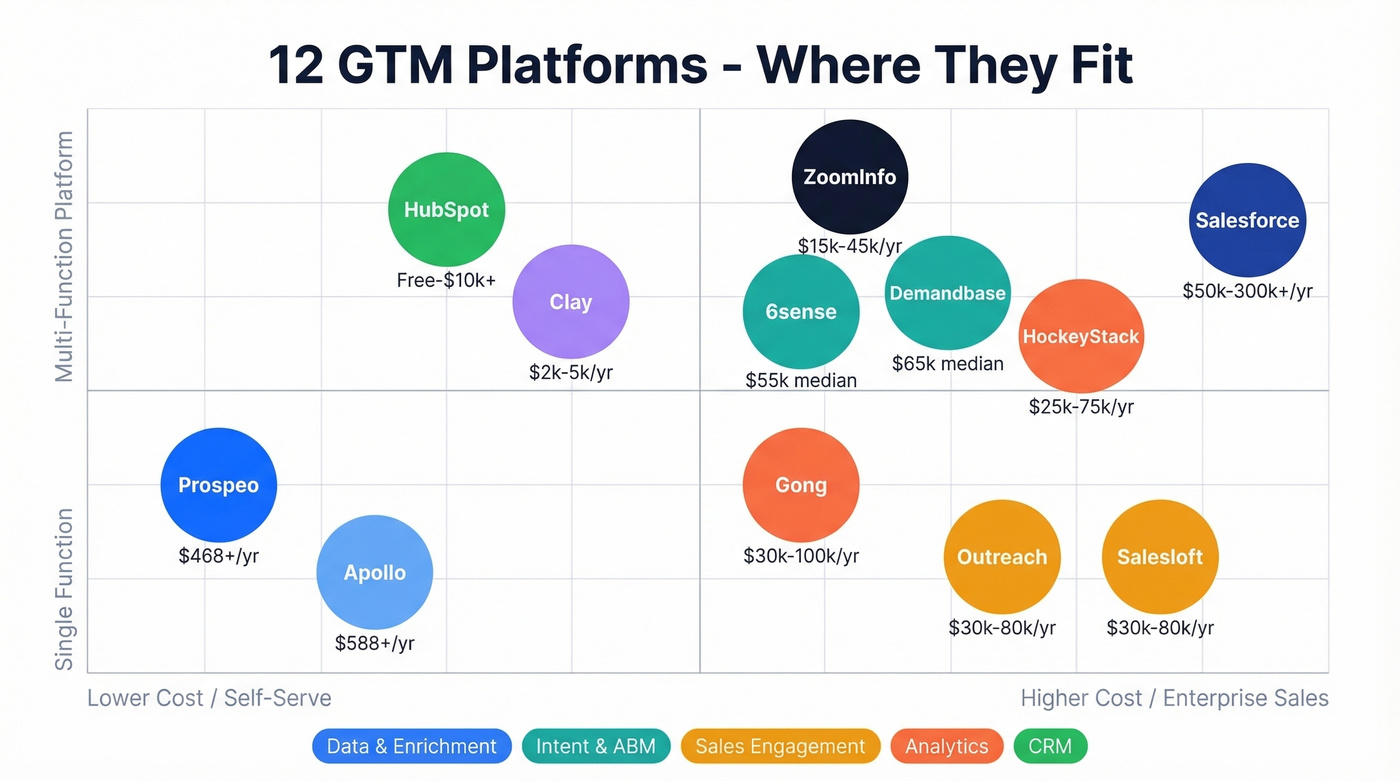
A GTM platform is any tool that helps revenue teams find, engage, and close buyers - data providers, intent platforms, sales engagement tools, CRMs, and the new wave of "GTM AI" products all qualify. What follows is an honest breakdown of 12 platforms worth evaluating, with real pricing instead of "contact sales" placeholders.
Our Picks at a Glance
| Category | Top Pick | Why |
|---|---|---|
| Data Accuracy & Freshness | Prospeo | 98% email accuracy, 7-day refresh, ~$0.01/lead |
| All-in-One (Enterprise) | ZoomInfo | 500M+ contacts, broadest feature set, $15k+/yr |
| Intent & ABM | 6sense | Free tier + predictive AI, median $55k/yr |
| Enrichment & Orchestration | Clay | 150+ data providers, waterfall enrichment |
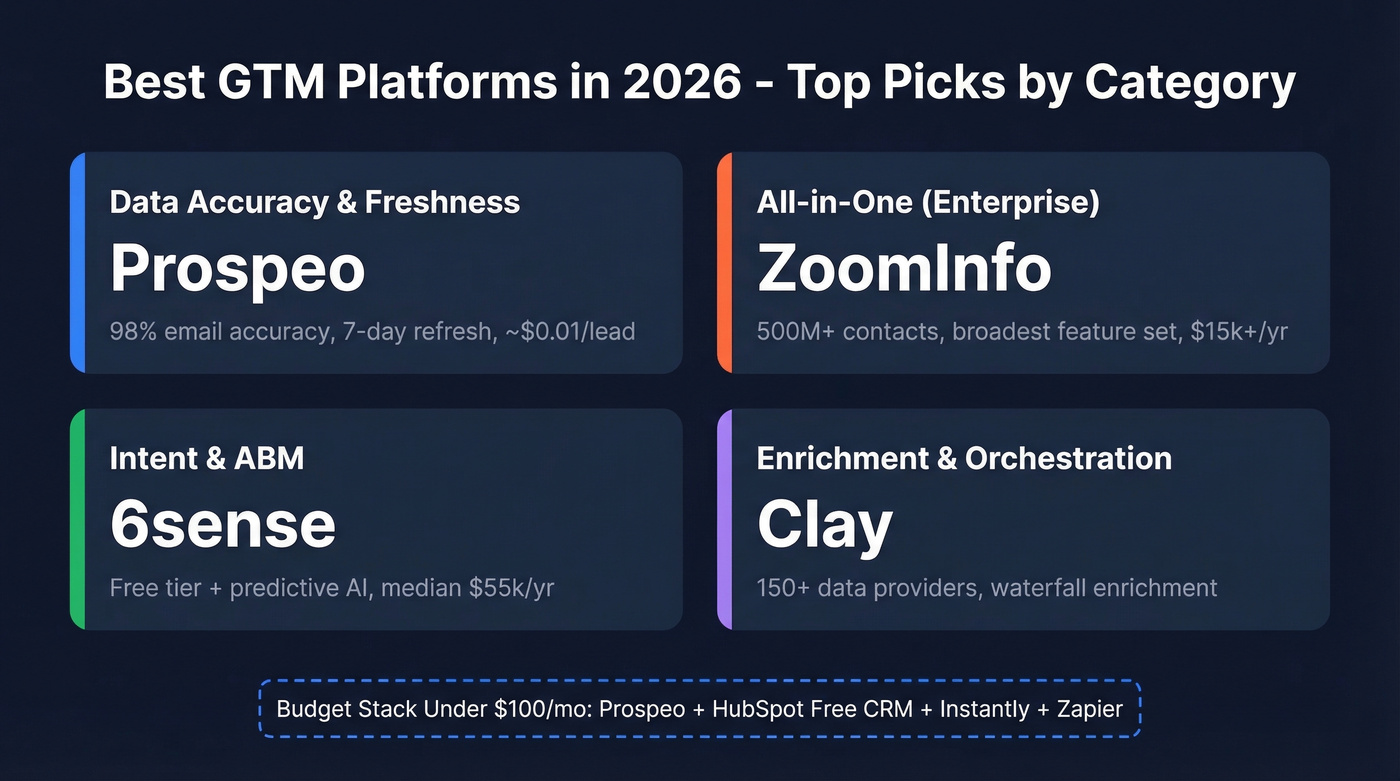
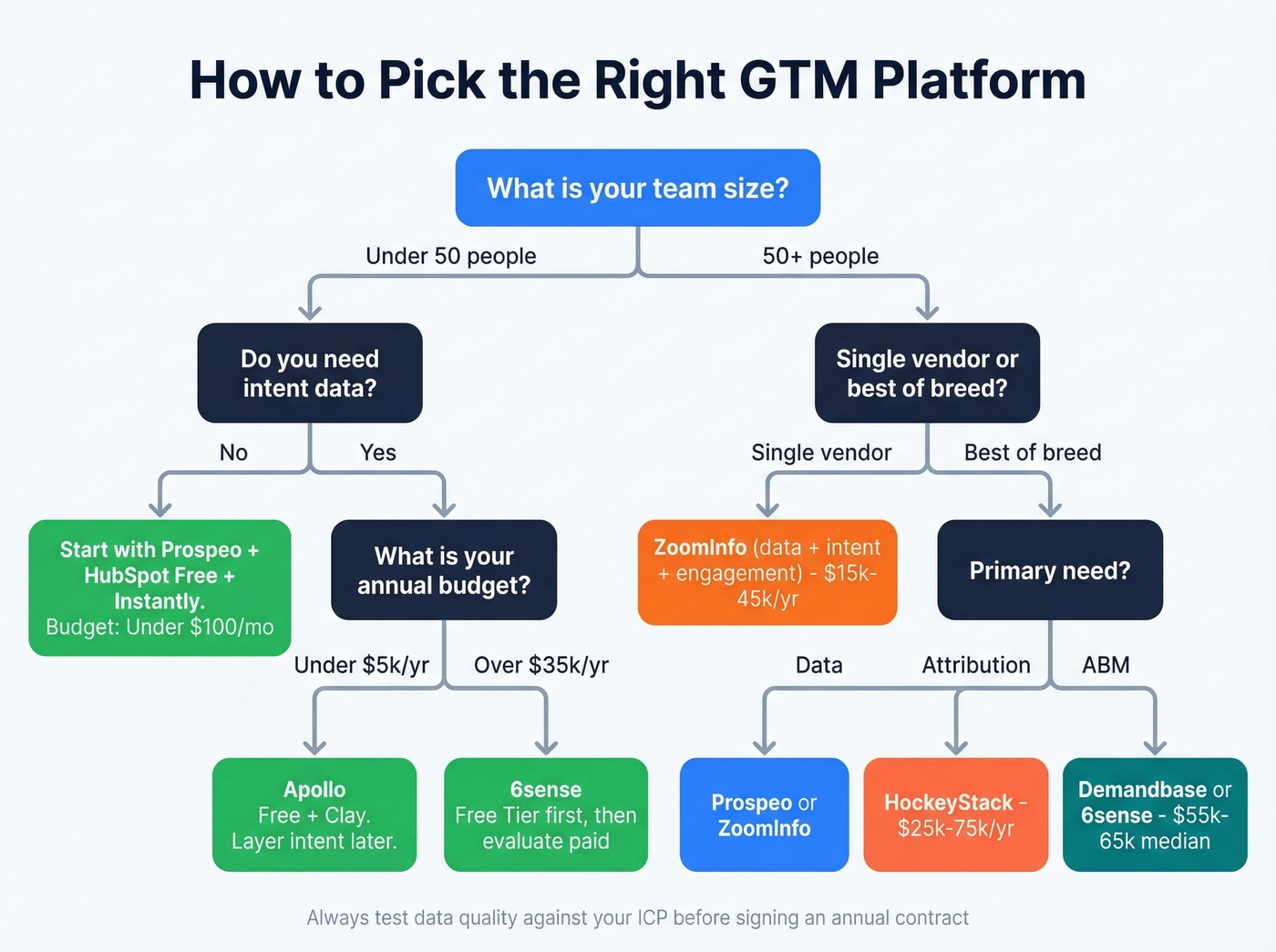
Budget stack that works (under $100/mo): Prospeo + HubSpot free CRM + Instantly + Zapier. That covers data, CRM, sending, and automation. We've seen early-stage teams run this exact combo for months before needing to upgrade anything.
The 12 Best Go-to-Market Tools in 2026
Data & Enrichment
Prospeo - Best for Email Accuracy
Prospeo's database covers 300M+ professional profiles, 143M+ verified emails, and 125M+ verified mobile numbers with a 30% pickup rate. Everything refreshes on a 7-day cycle versus the six-week industry average, which is the kind of gap that shows up immediately in bounce rates. The 98% email accuracy comes from a proprietary 5-step verification process with catch-all handling and spam-trap removal. GDPR compliant with DPAs available.

Snyk's 50-person AE team dropped bounce rates from 35-40% to under 5% and generated 200+ new opportunities per month after switching over. Thirty-plus search filters include buyer intent powered by 15,000 Bombora topics, technographics, job changes, and funding signals. The Chrome extension (40K+ users) handles one-click prospecting from any website.
Pricing runs ~$0.01 per email. Free tier: 75 emails and 100 Chrome extension credits per month. No annual contracts, no sales calls required. Native integrations with Salesforce, HubSpot, Clay, Zapier, Instantly, Lemlist, Smartlead, and Make.
ZoomInfo - Biggest Database, Biggest Price Tag
ZoomInfo is the default enterprise go-to-market platform - 500M+ contacts, 100M+ companies, and one of the broadest feature sets in the category. If you're a 200+ person sales org running outbound, ABM, intent, and conversation intelligence from one vendor, it's still the obvious choice.
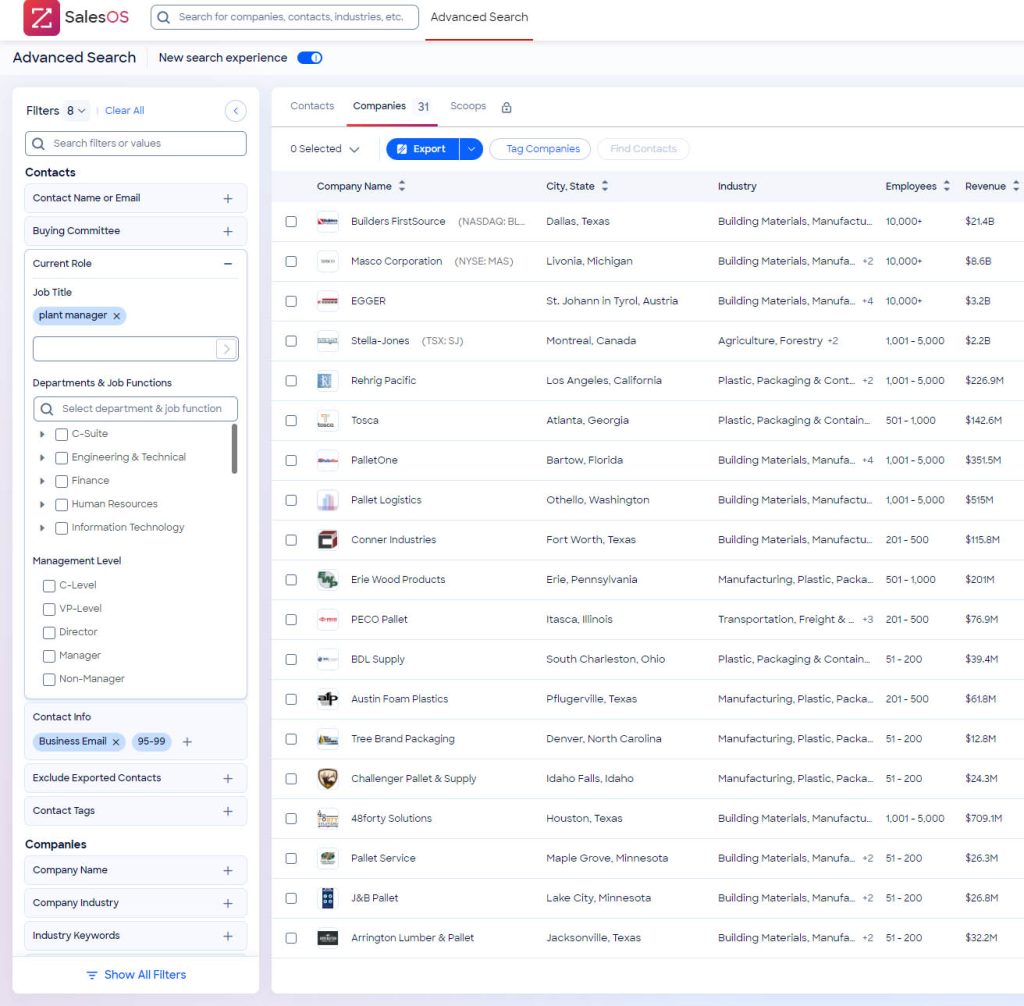
Skip this if you're a startup or mid-market team that only needs the database. You'll pay for intent modules, org charts, and workflow features you never activate.
Pricing reality: ZoomInfo Lite is free (10 credits/month), but paid plans start at $15k-$18k/year for Professional with 1-3 seats and roughly 5,000 credits, no intent data included. Advanced runs $22k-$28k/year. Elite hits $35k-$45k+. Annual contracts only, and expect 10-20% renewal uplifts. The top complaint on r/SaaS is predictable: "$20k+ annual is wild."
Apollo - Best Free Tier for Startups
Apollo covers 210M+ contacts with a genuinely useful free tier. Paid plans run ~$49-$119/user/month. For early-stage teams running lean outbound, Apollo is the obvious starting point - a stack that keeps surfacing in Reddit outbound threads pairs it with Clay for enrichment and Instantly for sending. The database isn't as deep as ZoomInfo's in enterprise segments, and email accuracy runs lower than dedicated verification tools, but the price-to-value ratio for sub-20-person teams is hard to beat.
Clay - Most Flexible Enrichment Engine
Clay pulls from 150+ data providers through waterfall enrichment, querying multiple sources sequentially until it finds a match. In a 2,000-contact test, that approach delivered a 78% email match rate.
Use this if you want maximum enrichment flexibility and you're willing to invest 4-6 weeks learning the platform. Clay's workflow builder is genuinely powerful for custom enrichment logic and AI-powered personalization.
Skip this if you want plug-and-play simplicity. The credit system has sharp edges: failed lookups still cost credits, and top-ups carry a 30% markup.
Full enrichment runs roughly 75 credits per lead at ~$0.05/credit - that's $3.75 per fully enriched contact. Pricing starts free (100 credits/month), with Launch at $167/month and Growth at $446/month, which is required for CRM auto-sync. Budget it carefully.
Intent & ABM
6sense - Best for Predictive Intent
6sense is the platform teams buy when they want to stop guessing which accounts are in-market. The predictive AI scores accounts based on intent signals, web activity, and firmographic fit. The free tier with 50 credits/month is worth testing before committing. G2 rating: 4.4/5.
Here's the thing: intent data is only valuable if your team acts on it fast. We've seen organizations spend $55k+/year on intent signals that feed dashboards nobody checks. The median buyer pays $55,211/year per Vendr data. Enterprise packages run $100k-$200k+. Implementation costs $5k-$50k over 4-8 weeks, and credits don't roll over.
Demandbase - Enterprise ABM Workhorse
Demandbase is the other heavyweight in ABM, with a 4.4/5 on G2 across 1,900+ reviews. Contracts typically start at ~$18k/year, but the median buyer pays $65k/year. Full Demandbase One deployments run much higher - AWS Marketplace lists a 12-month contract at $215,000.
The common complaints are real: pricing opacity, company-level visitor ID only (no person-level), and a steep learning curve from years of acquisitions. Strong for enterprise teams committed to account-based everything. Overkill for everyone else.
GTM AI & Analytics
HockeyStack - Revenue Attribution
HockeyStack earns a 4.8/5 on G2 and has become the go-to for multi-touch revenue attribution. If your CMO needs to prove which channels actually drive pipeline - not just MQLs - this is the tool. Expect $25k-$75k/year based on company size and data volume.
The practitioner question that keeps surfacing on r/b2bmarketing is fair: do signal tools "actually create pipeline or just create dashboards everyone ignores?" If your team will act on the data, HockeyStack delivers. If they won't, save the budget.
HubSpot - Best Free CRM Foundation
HubSpot's free CRM (2 users, 1,000 contacts) remains the best foundation for SMB go-to-market stacks. 42% of companies cite their CRM as their central platform, and HubSpot makes it easy to start there without a five-figure commitment.
Sales Hub starts at $90/month, Marketing Hub at $800/month - costs climb fast once you need automation. For teams under 50 people, pair HubSpot free with a dedicated data provider and a sending tool, and you've got a functional revenue stack without enterprise overhead.
Sales Engagement & Conversation Intelligence
Outreach & SalesLoft
The two dominant sales engagement platforms, now converging on similar feature sets. Both run ~$100-$150/user/month, translating to $30k-$80k/year for a mid-size team. They're the execution layer where sequences, calls, and tasks actually happen. Pick based on CRM integration depth and which UI your reps prefer. Neither is a data source; pair with a dedicated database.
Gong
Gong owns conversation intelligence - recording, transcribing, and analyzing sales calls to surface deal risk and coaching opportunities. Pricing lands at ~$100-$150/user/month, or $30k-$100k/year depending on team size. If your team runs fewer than 50 calls per week, the ROI gets harder to justify.
Salesforce
The default enterprise CRM. Sales Cloud runs $25-$300+/user/month; enterprise deployments land at $50k-$300k+/year once you add integrations, customization, and admin overhead. You probably already know if you need it.
What Every GTM Platform Actually Costs
| Tool | Free Tier? | Starting Price | Typical Annual | Notes |
|---|---|---|---|---|
| Prospeo | Yes (75 emails/mo) | ~$39/mo | $468+/yr | Monthly billing, no hidden costs |
| ZoomInfo | Yes (10 credits/mo) | ~$15k/yr | $15k-$45k+ | Annual only; renewal uplifts |
| Apollo | Yes | ~$49/user/mo | $588+/user/yr | Monthly available |
| Clay | Yes (100 credits/mo) | $167/mo | $2k-$5.4k+ | Failed lookups still cost credits |
| 6sense | Yes (50 credits/mo) | ~$35k/yr | $55k median | Implementation $5k-$50k extra |
| Demandbase | No | ~$18k/yr | $65k median | Onboarding + ad spend extra |
| HockeyStack | No | ~$25k/yr | $25k-$75k | Data integration costs extra |
| HubSpot | Yes (2 users) | $90/mo (Sales Hub) | $1k-$10k+ | Hub add-ons stack fast |
| Outreach | No | ~$100/user/mo | $30k-$80k | Annual; seat minimums |
| Salesloft | No | ~$100/user/mo | $30k-$80k | Annual; seat minimums |
| Gong | No | ~$100/user/mo | $30k-$100k | Annual; recording storage |
| Salesforce | No | $25/user/mo | $50k-$300k+ | Admin + customization costs |
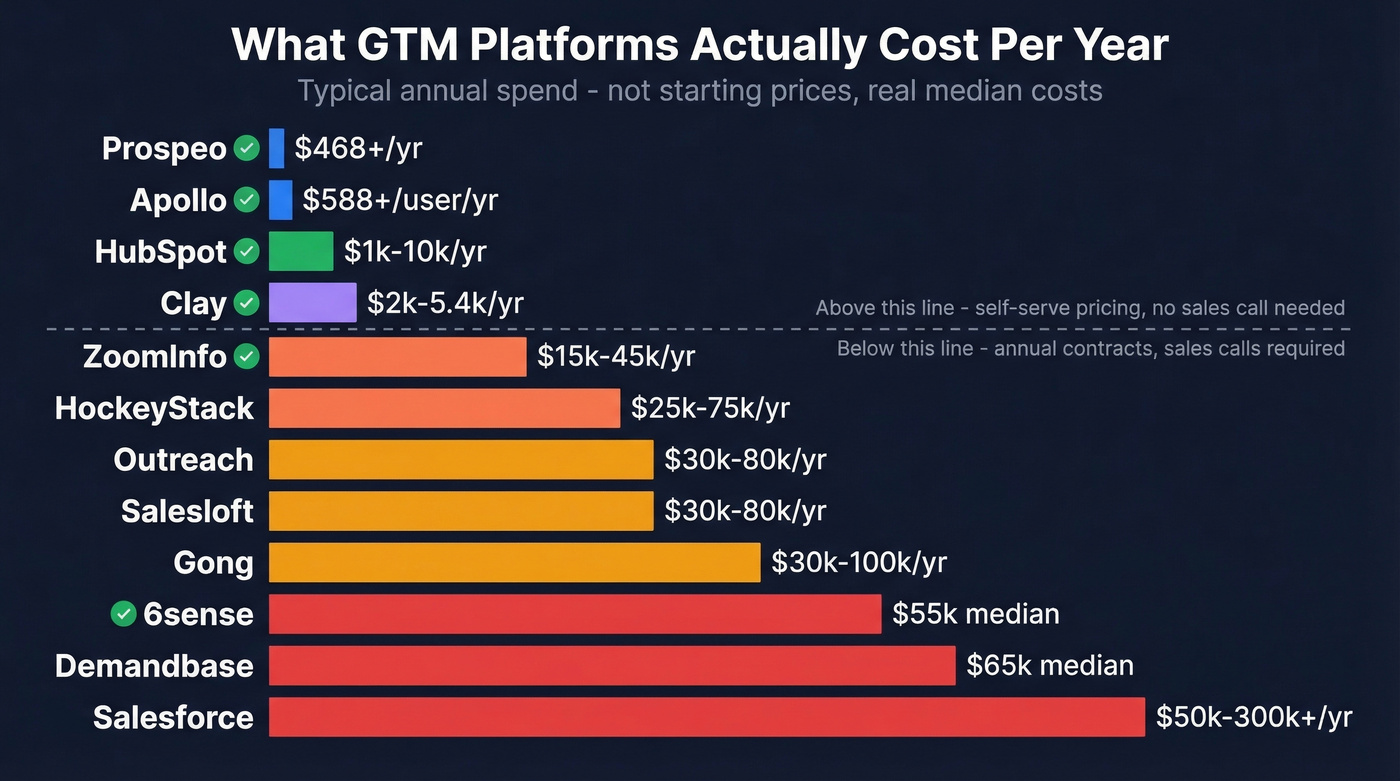
The pattern is obvious. Enterprise go-to-market platforms gate pricing behind sales calls, lock you into annual contracts, and layer on renewal uplifts. Self-serve tools publish pricing and let you cancel anytime. That difference tells you a lot about how the vendor views the relationship.

Your GTM platform is only as good as the data feeding it. Prospeo delivers 98% email accuracy on 300M+ profiles with a 7-day refresh cycle - while most providers take 6 weeks. Snyk's 50 AEs cut bounce rates from 40% to under 5% and added 200+ opportunities per month.
Stop paying enterprise prices for stale data. Start at $0.01 per email.
How to Evaluate a GTM Platform
Don't start with features. Start with these questions.
Data quality and compliance. How often is the database refreshed? What's the email bounce rate in practice, not on a marketing page? Is the vendor GDPR and CCPA compliant, and can they provide a DPA? Ask for a test batch against your ICP before signing anything. RevOps teams that skip this step end up rebuilding their enrichment pipeline six months later.
Integration depth. Does it connect natively to your CRM, sequencer, and enrichment tools, or do you need middleware? Every integration gap is a workflow tax your ops team pays indefinitely.
Signal-to-noise ratio. Intent data is only valuable if your team acts on it within 48 hours. If signals feed a dashboard nobody checks, you're paying for noise. This is the single biggest source of wasted GTM spend we see across mid-market teams.
Total cost of ownership. Add up the subscription, implementation fees, credit overages, seat expansion costs, and the ops headcount to maintain it. A $55k/year platform that requires a dedicated admin is really a $130k/year platform.
Contract flexibility. Annual-only contracts with 10-20% renewal uplifts are the norm at the enterprise tier. If you're not certain about a tool, find one that offers monthly billing first.
Three Mistakes That Waste Your Budget
1. Tool sprawl without consolidation. The average org runs 305 apps. One Reddit user put it perfectly: they ended up with "multiple tools that evolved to essentially do the same thing." Before adding a new platform, audit what you already have. Let's be honest - most teams don't need 12 tools. They need four good ones that actually talk to each other.
2. Dashboard fatigue. Paying $55k+/year for intent signals that nobody acts on within 48 hours is the most common waste we see in GTM budgets. Intent data decays fast. 70% of companies report moderate or full AI adoption in go-to-market workflows, but adoption doesn't equal activation.
3. Hidden costs that compound. Credit overages at 6sense. Renewal uplifts of 10-20% at ZoomInfo. Implementation fees of $5k-$50k at Demandbase. Failed lookups still costing credits at Clay. The sticker price is never the real price. Map out year-two costs before signing year one.
Build Your GTM Stack by Budget
Under $500/month (startup/SMB): Prospeo (free tier or ~$39/mo) + HubSpot free CRM + Instantly ($30/mo) + Zapier (free tier). Total: under $100/month. You get verified contact data, a CRM, automated sending, and workflow glue. We've tested this exact combination, and it punches way above its weight for teams doing under 5,000 emails per month.
$3k-$5k/month (growth stage): A paid data provider for volume + 6sense free tier for intent signals + Outreach or Salesloft for engagement + Salesforce Essentials. You're adding intent-driven prioritization and structured sales engagement without the six-figure commitment. For job-change signals specifically, UserGems is worth evaluating as a lighter alternative to full ABM platforms.
$50k+/year (enterprise): ZoomInfo or Cognism for database depth + 6sense or Demandbase for ABM + Gong for conversation intelligence + Salesforce Enterprise. Real talk: verify you need every module before signing. I've watched teams commit to $150k+ in annual tooling and use 40% of the features.
Here's my hot take: ZoomInfo is still the best all-in-one GTM platform. But most teams don't need all-in-one. If your average deal size is under $15k, a $39/month data provider paired with a free CRM will outperform a $45k/year enterprise suite that your reps half-use. The best go-to-market stack is the one your team actually adopts.
The budget GTM stack mentioned above - Prospeo + HubSpot + Instantly + Zapier - runs under $100/mo and covers data, CRM, sending, and automation. Prospeo's native integrations with all three mean zero custom setup. 75 free emails per month to prove it works.
Launch a complete go-to-market stack in under 10 minutes.
FAQ
What's the difference between GTM AI and GTM intelligence?
GTM AI applies machine learning to automate workflows like lead scoring, forecasting, and outreach generation. GTM intelligence focuses on aggregating buyer signals and intent data to prioritize accounts. Companies with advanced go-to-market strategies achieve up to 2.5x greater valuation according to ZoomInfo's survey of 1,000+ professionals - the investment pays off when your team activates the data, not just collects it.
Do I need a dedicated GTM platform or just a better CRM?
If your CRM data is clean and your team is under 20 people, a CRM plus a solid data provider is likely all you need. Go-to-market platforms add real value when you need intent signals, multi-channel orchestration, or attribution across complex buying committees with 6+ stakeholders.
What's the cheapest GTM stack that actually works?
Prospeo's free tier (75 emails/mo) + HubSpot free CRM + Instantly ($30/mo for sending) + Zapier's free tier. Total: under $50/month for verified contact data, a CRM, automated sequences, and workflow automation. Scale individual components as outbound volume demands it.
Why don't most go-to-market platforms publish pricing?
Enterprise sales models incentivize opacity - vendors price based on your budget, not their costs. Transparent, self-serve pricing signals buyer-friendly practices. If a vendor won't give you a ballpark without a demo, that tells you something about how the next three years of renewals will go.
How often should B2B contact data be refreshed?
Monthly at minimum. People change jobs every 2-3 years on average, meaning roughly 3-4% of your database goes stale each month. Weekly refresh cycles significantly reduce bounce rates and protect sender reputation. The industry average of six weeks leaves a dangerous gap that compounds with every campaign you send.