

How Many Times Should You Contact a Prospect? Here's What 28 Million Emails Say.
Five different sales trainers will give you five different numbers on how many times to contact a prospect. One says 5 touches. Another says 12. A third quotes a stat about "80% of sales needing five follow-ups" that nobody can trace to an original study.
Here's the thing: most of those numbers are made up, or at least stripped of context so thoroughly they're useless.
The short answer: Reach out 5-8 times over 2-3 weeks, mixing email, phone, and social. Your first follow-up is the most valuable - it lifts replies by 65.8%. After 3-4 emails with no response, switch channels and send a breakup message around Day 21. Adjust by deal size: 3-5 touches for small deals, 8-12 for enterprise.
What the Data Actually Shows
Two large-scale studies give us the clearest picture. [Belkins analyzed 16.5 million cold emails](https://belkins.io/blog/sales-follow-up-statistics) across 93 business domains throughout 2024. The highest reply rate - 8.4% - came from the initial email alone. Every subsequent follow-up pulled a lower response rate. And sending 4+ emails in a sequence more than triples unsubscribe and spam complaint rates.
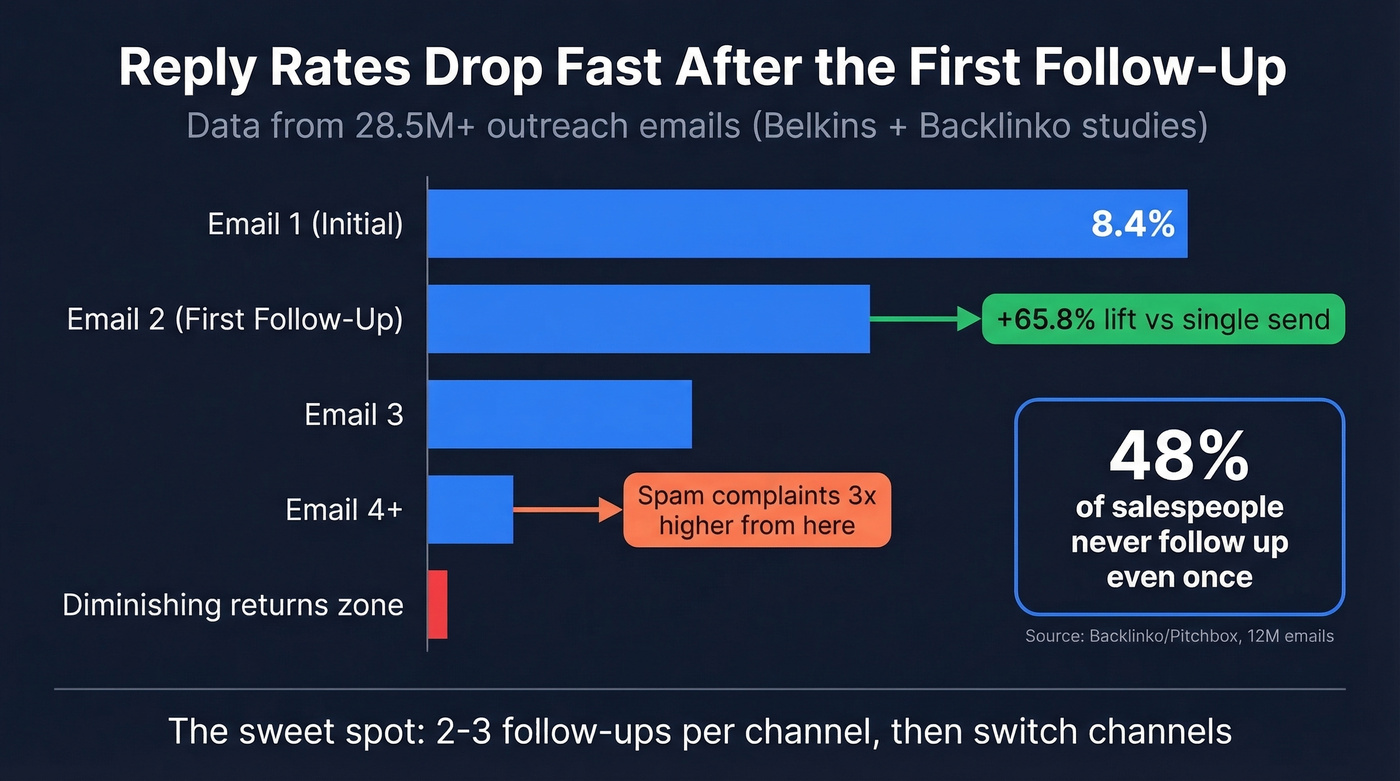
That's not diminishing returns. That's active damage to your sender reputation.
Backlinko and Pitchbox [studied 12 million outreach emails](https://backlinko.com/email-outreach-study) and found that one follow-up boosted replies by 65.8%. Emailing the same contact multiple times roughly doubled total responses compared to a single send. Meanwhile, 48% of salespeople never make a single follow-up attempt after the initial contact. The bar is shockingly low.
So which is it - do follow-ups help or hurt? Both. The first 2-3 follow-ups earn their keep. After that, you're burning goodwill and risking your domain. Understanding which follow-ups move the needle versus which ones just annoy people is the difference between a healthy pipeline and a blacklisted domain.
Reply rates also vary sharply by industry. Manufacturing holds steady at ~6.7% through two follow-ups. Solar peaks at 6.83% on the first follow-up then drops off a cliff. Cloud solutions crater to 4.47% by later emails. If you're selling into a low-tolerance vertical, shorten your sequence.
The widely cited "80% of sales require five follow-ups" stat conflates multi-channel touches with email-only sequences. Five touches across email, phone, and social is fundamentally different from five emails to the same inbox. Three channels beats seven emails - that's the takeaway most guides miss.
The ceiling isn't about total touches. It's about touches per channel.
Follow-Up Frequency by Deal Size
A $5k deal doesn't need the same persistence as a $150k enterprise contract. The number of follow-ups before a sale depends almost entirely on what you're selling and to whom.
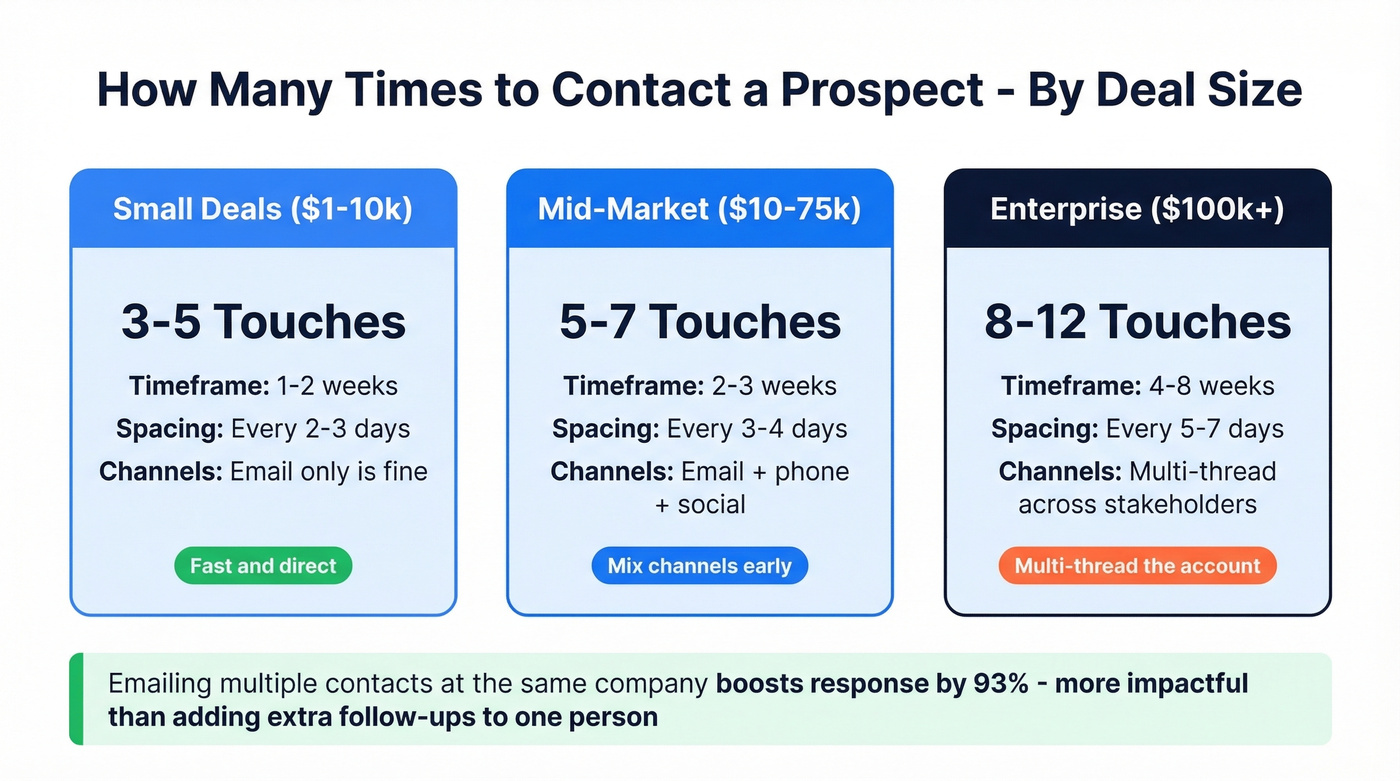
| Deal Size | Touches | Timeframe | Spacing | Notes |
|---|---|---|---|---|
| Small ($1-10k) | 3-5 | 1-2 weeks | 2-3 days | Fast, direct |
| Mid-market ($10-75k) | 5-7 | 2-3 weeks | 3-4 days | Mix channels |
| Enterprise ($100k+) | 8-12 | 4-8 weeks | 5-7 days | Multi-thread |
Belkins' data backs this up. Small businesses (2-50 employees) start at a 9.2% reply rate and bounce back to 8.4% on the second follow-up - they're responsive to persistence if you keep it brief. Enterprise prospects are allergic to it. Founders follow a similar arc: reply rates peak at the second follow-up (6.94%) then crater to 3.01% by the fourth.
Match your cadence to the deal size, not to some universal "always send 7 emails" rule.
And here's a stat worth acting on: Backlinko found that emailing multiple contacts at the same organization boosts response by 93%. Multi-threading within an account matters more than adding a sixth email to one person's inbox. If you're only emailing one stakeholder per company, you're leaving the biggest lever untouched.

Multi-threading beats extra emails - but only if you have verified contacts for multiple stakeholders. Prospeo gives you 300M+ profiles with 98% email accuracy and 125M+ verified mobiles, refreshed every 7 days. Find 2-3 decision-makers per account instead of hammering one inbox.
Stop adding follow-ups. Start adding contacts.
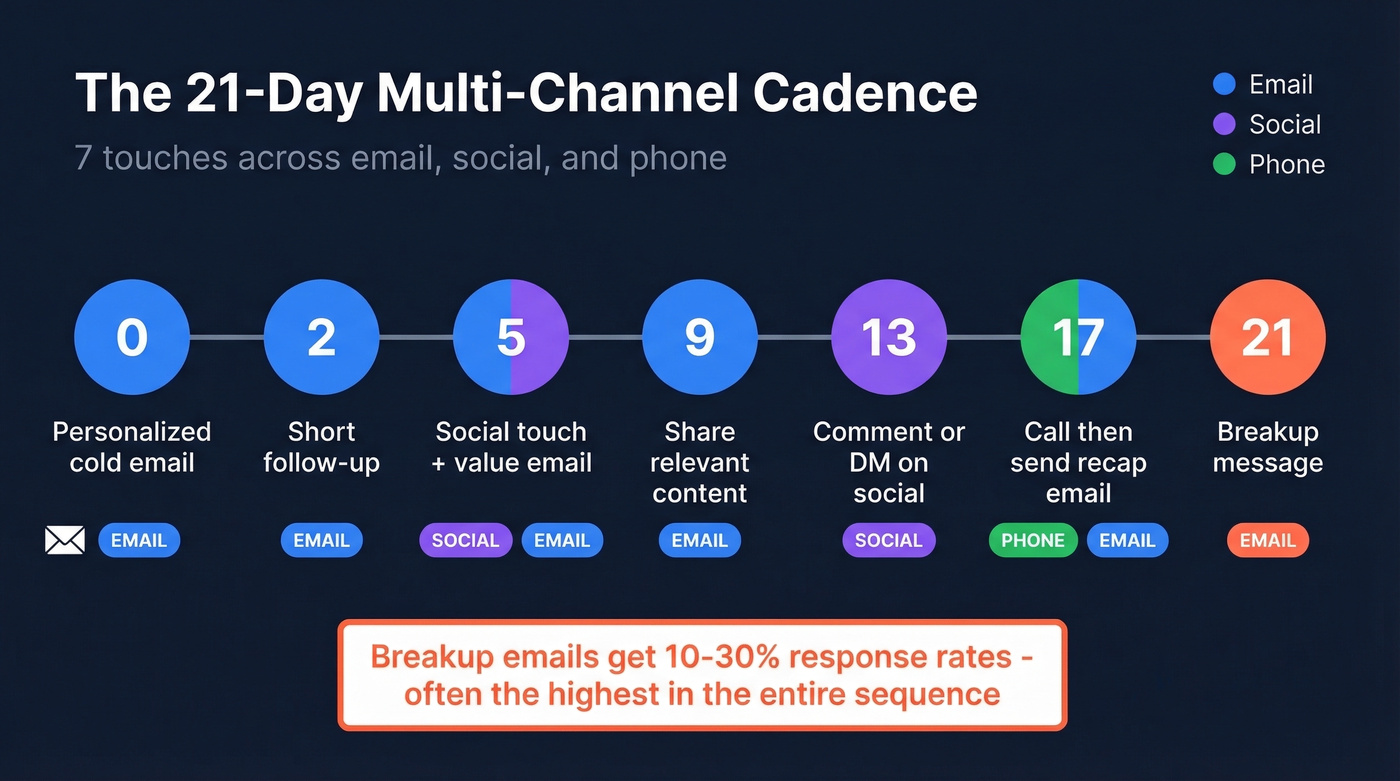
A 21-Day Multi-Channel Cadence
| Day | Channel | Action |
|---|---|---|
| 0 | Personalized cold email | |
| 2 | Short follow-up | |
| 5 | Social + Email | Social touch + value email |
| 9 | Share relevant content | |
| 13 | Social | Comment or DM |
| 17 | Phone + Email | Call, then send recap |
| 21 | Breakup message |
Send an email, then call within 24 hours referencing it. The email gives context; the call converts. In our experience, the SDR teams with the best reply rates aren't the ones sending the most emails - they're the ones mixing channels early and often.
Belkins' data reinforces this. A message paired with a profile visit on social pulled an 11.87% reply rate - meaningfully higher than the 8.4% email-only baseline. We've tested this ourselves: layering a social touch between emails two and three consistently outperforms pure email sequences by 20-40%.
Skip the 21-day cadence if you're selling a sub-$2k product with a short sales cycle. For those deals, a 3-touch email sequence over 7 days is plenty. Anything more and you're over-engineering it.
When to Stop
Knowing when to quit matters as much as knowing how many touchpoints to use. Pull back immediately if you see:
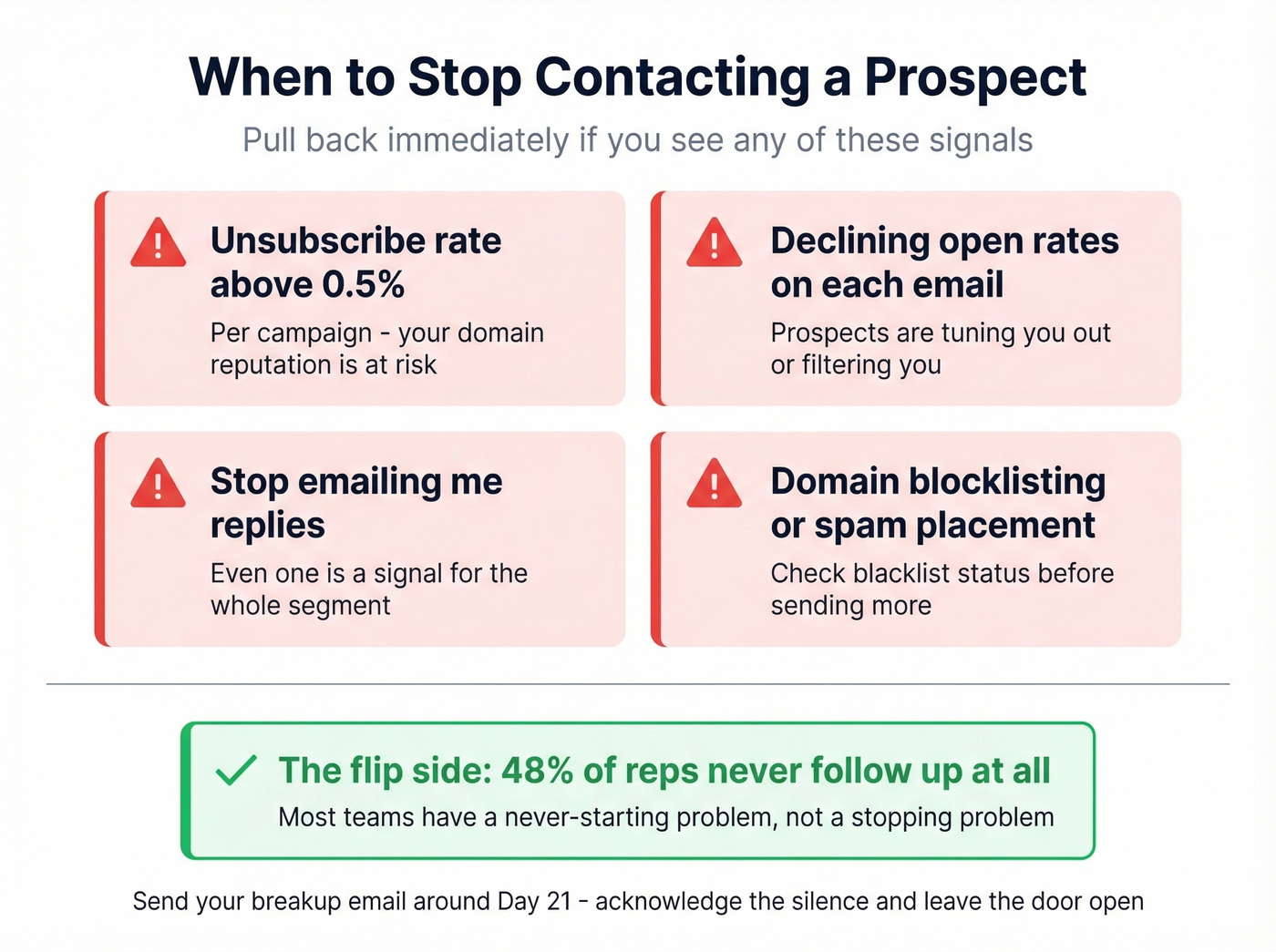
- Unsubscribe rates above 0.5% per campaign
- Declining open rates on each subsequent email
- "Stop emailing me" replies - even one is a signal
- Domain blocklisting or spam folder placement
Your breakup email should land around Day 21. Acknowledge the silence, offer a graceful exit, and leave the door open. Breakup emails generate 10-30% response rates - often the highest in the entire sequence. People respond to finality. Something about "this is my last email" makes prospects actually read the thing.
Let's be honest: most reps don't have a stopping problem. They have a never-starting problem. That 48% who never follow up at all? They're leaving more money on the table than the rep who sends one too many emails.
Bad Data Kills Your Cadence
Every guide on follow-up cadence ignores the same thing: if the email address is wrong, every touch is wasted. Worse, bounces actively damage your sender reputation, which tanks deliverability for all future outreach. We've watched teams obsess over cadence timing while sending to lists that bounce at 15%+. It's like optimizing your golf swing while aiming at the wrong fairway.
Before you launch any sequence, run your list through bulk verification. Prospeo catches invalid addresses at 98% accuracy on a 7-day data refresh cycle, compared to the 6-week industry average. That means the contacts you pulled last month are still current. Upload a CSV, verify in bulk, push clean contacts to Instantly or Lemlist, and launch knowing every touch hits a real inbox. Snyk's team cut bounce rates from 35-40% to under 5% after switching - meaning every touch in their cadence actually reached someone.
Bounced emails don't just waste a touch - they destroy your sender reputation and tank deliverability for every follow-up after. Prospeo's 5-step verification catches bad addresses before they hit your sequence. Snyk cut bounce rates from 35% to under 5% and generated 200+ new opportunities per month.
Clean your list before you launch a single cadence.
FAQ
How many follow-ups does it take to close a sale?
Most closed deals involve 5-8 total multi-channel touches. Cap email-only sequences at 3-4 messages - Belkins' 16.5M-email study shows 4+ emails triples spam complaints. After that, switch to phone or social. Enterprise deals may need 8-12 touches spread over 4-8 weeks, but founders' reply rates drop from 6.94% to 3.01% by the fourth email, so watch your audience closely.
Should I call or email a prospect first?
Email first, then call within 24 hours referencing the email. The email gives context for the conversation; the call converts it. Belkins found social touches layered between email steps lifted reply rates to 11.87%, so adding a third channel early outperforms doubling down on email alone.
What's the biggest mistake teams make with follow-up sequences?
Sending to bad data. You can have the perfect 7-touch cadence, but if 15% of your list bounces, you're torching your domain reputation with every send. Verify first, sequence second. Always.