

How to Be a Great Sales Manager: 3 Systems That Beat 16 Tips
You just got promoted. It's Monday morning, your inbox has 47 unread messages, two reps are arguing about territory overlap, the VP wants a forecast by noon, and you haven't had coffee yet. Nobody gave you a playbook. They gave you a title and a Slack channel.
Here's the uncomfortable reality: 84% of sales reps missed quota last year, and reps spend 60% of their time on non-selling tasks. Those aren't rep problems. Those are management problems. The gap between a mediocre manager and a great one isn't charisma or deal-closing instincts - it's systems.
What You Need (Quick Version)
You don't need 16 tips. You need three systems.
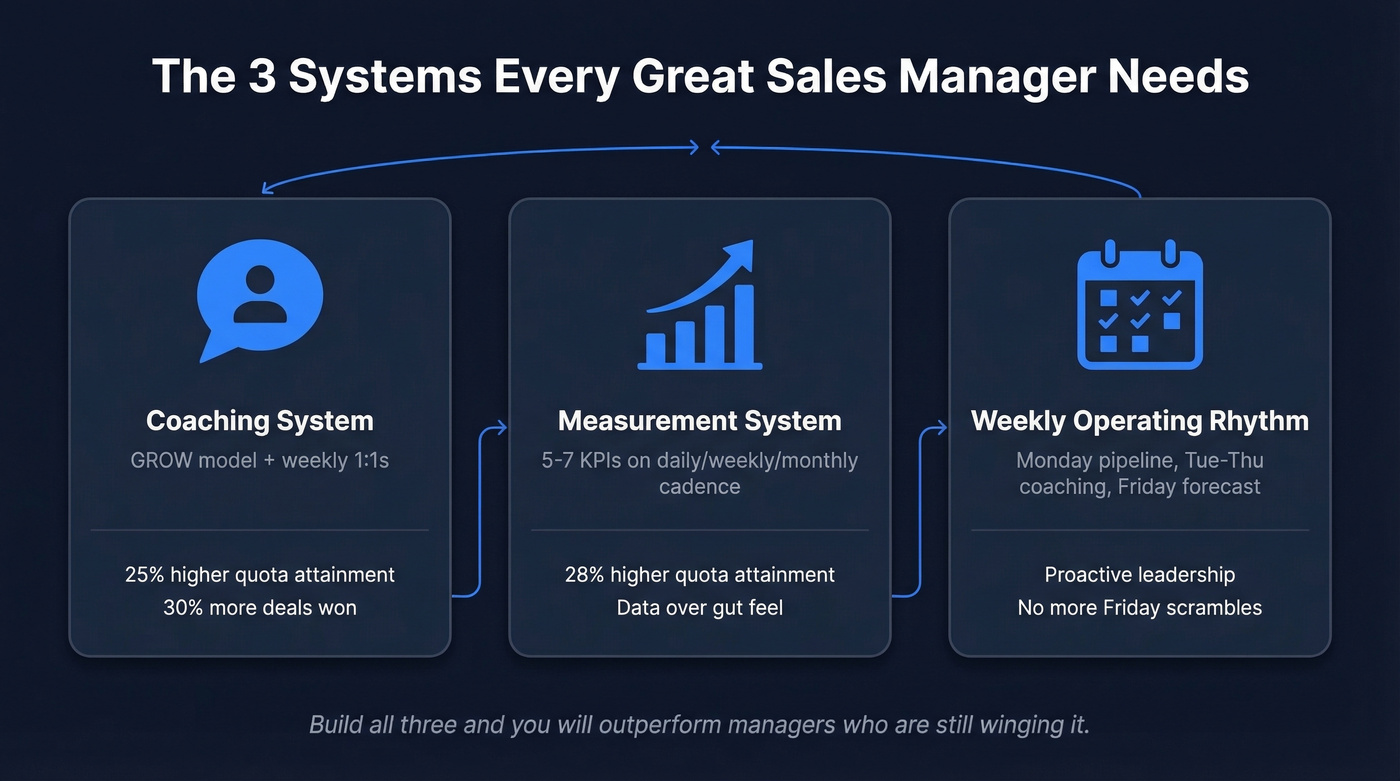
A coaching system - the GROW model paired with weekly 1:1s gives every rep a clear path to improvement. A measurement system - five to seven KPIs reviewed on a daily/weekly/monthly cadence so you're managing from data, not gut feel. A weekly operating rhythm - Monday pipeline review, Tuesday through Thursday coaching, Friday forecast and planning. Build those three and you'll outperform most managers who are still winging it.
The rest of this article shows you exactly how to build each one, plus a 90-day ramp plan, the peer-management minefield, and the five mistakes that get managers fired.
What Great Sales Managers Do Differently
The biggest trap for new sales managers is the "super-rep" identity. You were promoted because you crushed your number. Now you think your job is to crush it harder, but through other people. It's not. Your job is to build the machine that makes reps better.
75% of sales reps say they're more likely to hit targets with a coach or mentor. Yet only 52% of CEOs even believe in their own growth plans, according to SBI Growth Advisory. That disconnect - between what reps need and what leadership provides - is where every effective manager finds their edge.
Research from Varicent found that organizations with a well-executed go-to-market strategy are 2x more likely to meet or exceed revenue expectations, with 74% achieving or surpassing their goals. The manager is the connective tissue between strategy and execution. You're not closing deals anymore. You're building the system that closes deals at scale.
Hot take: If your average deal size is under five figures, you probably don't need a complex sales methodology or an expensive enablement platform. You need a manager who actually coaches. That single variable - consistent, skill-specific coaching - moves the needle more than any tool or framework you'll buy this year.
Your First 90 Days
The instinct is to come in hot - restructure territories, change the comp plan, overhaul the tech stack. Resist it. The best first 90 days follow a phased approach that builds credibility before demanding change.
Days 1-30: Listen and Map
Run a 1:1 with every rep in your first week. Ask three questions: What's working? What's broken? What do you need from me? Don't make changes yet. You're building a map of the team's strengths, weaknesses, and interpersonal dynamics.
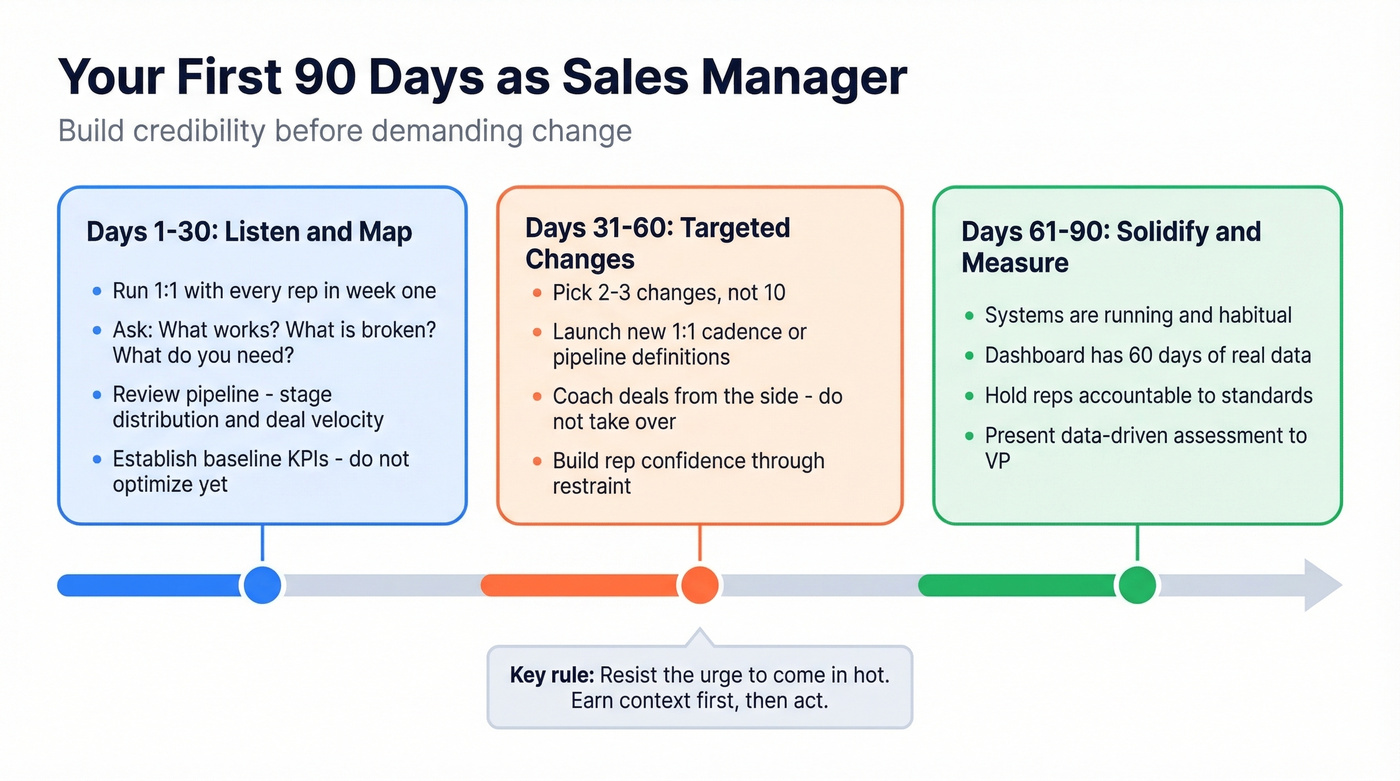
Review the pipeline with fresh eyes. Look at stage distribution, deal velocity, and where opportunities stall. Sit in on calls - not to coach, just to observe. Document patterns. Structured onboarding retains 50% more new hires and drives 54% higher engagement, so the patterns you document now feed a repeatable onboarding playbook later.
Set up your early KPIs: new meetings booked, pipeline movement through stages, opportunity quality, and average order value. You're not optimizing yet. You're establishing a baseline.
Days 31-60: Targeted Changes
Now you've earned enough context to act. Pick two or three changes - not ten. A new 1:1 cadence, a revised pipeline stage definition, or a call review process. The key is targeted, data-backed adjustments rather than sweeping overhauls.
Don't take over every deal. We've seen new managers jump into negotiations because they can't resist the adrenaline, and every time they do, they're teaching reps that they don't trust them. Coach the deal from the side. Let them run it. This restraint is one of the hardest sales manager best practices to internalize, but it pays dividends in rep confidence and long-term quota performance.
Days 61-90: Solidify and Measure
By now your systems should be running. Weekly 1:1s are habitual. Your KPI dashboard is populated with 60 days of data. You can see which reps are trending up and which need intervention.
This is when you start holding people accountable to the standards you set in month two. It's also when you present your first data-driven assessment to your VP - not opinions, not vibes, but pipeline coverage ratios, win rates, and activity trends. That's how you build credibility upward while maintaining trust downward.
Build a Coaching System
This is the highest-leverage activity in your entire job. Only 26% of reps receive weekly coaching, and weekly coaching is linked to 25% higher quota attainment and 30% more deals won. Every dollar spent on sales training returns $4.53. The math is absurdly clear, yet most managers still spend their coaching time reviewing spreadsheets instead of developing skills.
The GROW Model for 1:1s
GROW stands for Goals, Reality, Options, Will. It's the simplest coaching framework that actually works in a sales context.
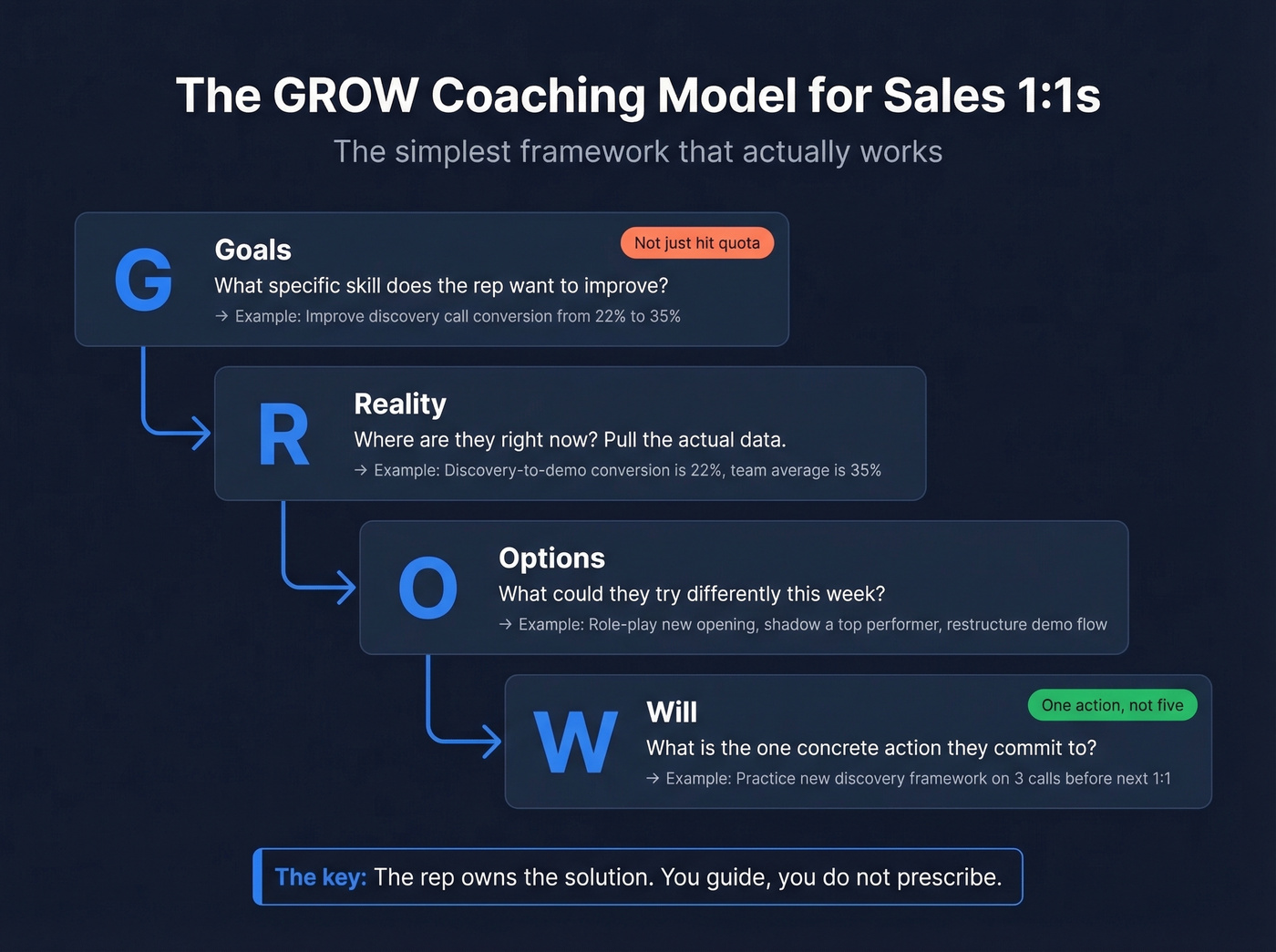
- Goals - What does the rep want to improve this quarter? Not "hit quota" - something specific. Discovery call conversion. Multi-threading into the C-suite. Handling pricing objections.
- Reality - Where are they now? Pull the data. If their discovery-to-demo conversion is 22% and the team average is 35%, that's the gap.
- Options - What could they try? Role-play a new opening. Shadow a top performer. Restructure their demo flow.
- Will - What will they commit to this week? One concrete action, not five aspirational ones.
The beauty of GROW is that it forces the rep to own the solution. You're not prescribing - you're guiding. Spencer Wixom, SVP at Challenger, puts it well: reps consistently attribute their success to implementing and applying learnings through coaching interactions, not classroom training.
A 1:1 Template That Works
Mark Roberge, former CRO of HubSpot, built a 1:1 structure that we've adapted across multiple teams. It runs about 25 minutes.
Start with a qualitative check-in - how's the rep feeling about their pipeline, their deals, their energy? Then shift to the quantitative view - pull up the dashboard together and look at activity metrics and conversion rates. From there, pick one improvement area for the week, define how you'll help - whether that's a joint call, a role-play session, or removing an internal blocker - and schedule the coaching touchpoint before the 1:1 ends.
The critical detail: 55% of sales leaders hold 1:1s weekly. If you're not in that group, you're already behind. Block the time. Protect it like a customer meeting.
How to Know If Coaching Works
Track three things over a rolling 90-day window: quota attainment trends by rep, average deal value movement, and the specific skill metric you're coaching on - discovery conversion, close rate, whatever the focus is. If a rep's coached skill improves but quota doesn't move, you're coaching the wrong skill. If quota improves but the coached skill doesn't, something else is driving results and you need to understand what.
Only 18% of buyers believe salespeople are well-prepared. That's a coaching failure at scale. Your job is to make sure your team isn't part of that statistic.

Your reps spend 60% of their time on non-selling tasks - and bad contact data is a huge chunk of that waste. Prospeo gives your team 300M+ verified profiles with 98% email accuracy and 125M+ direct dials, so every rep spends more time selling and less time hunting for working contact info.
Cut your team's prospecting time in half and watch pipeline coverage ratios climb.
The Weekly Operating Rhythm
The difference between a proactive leader and a firefighter is a weekly rhythm. Without one, you'll spend every Friday scrambling to assemble a forecast from scattered Slack messages and half-updated CRM records.
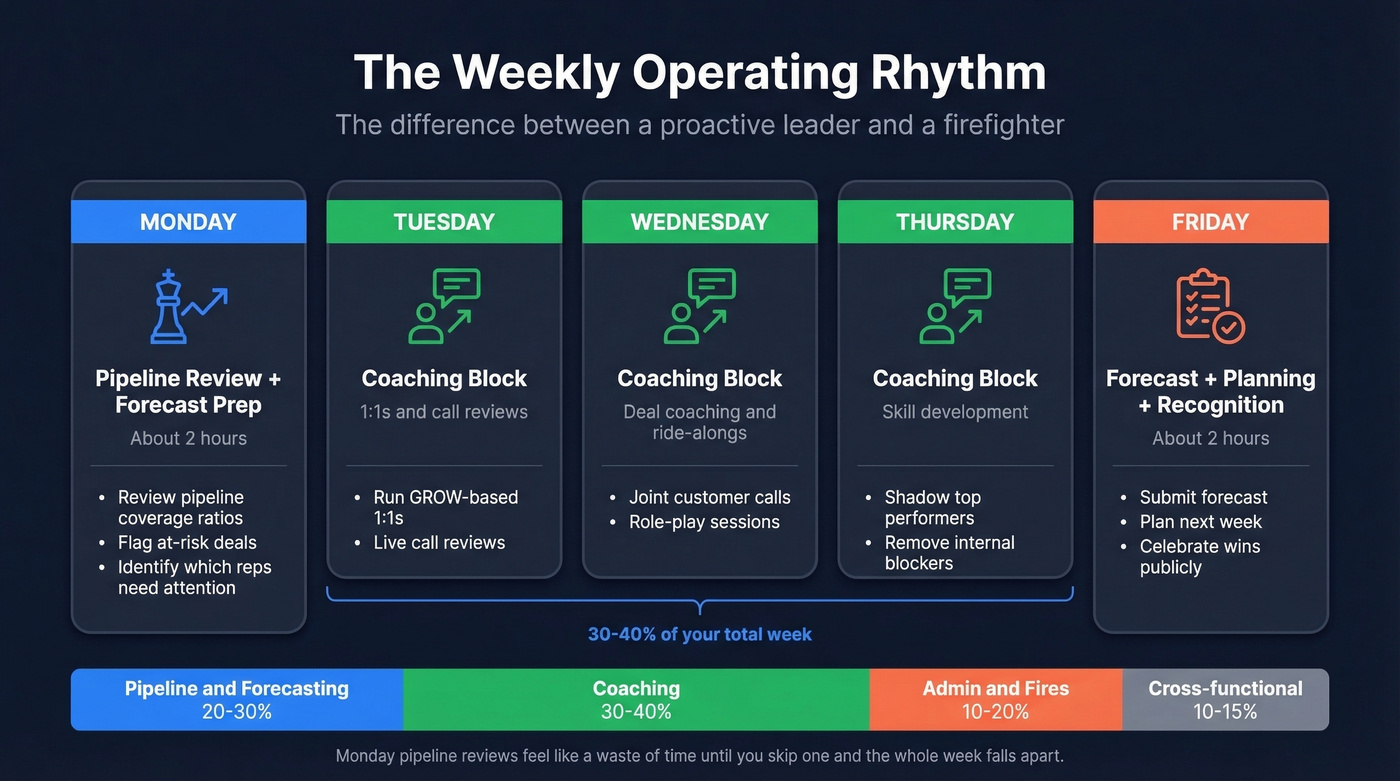
| Day | Primary Focus | Time Allocation |
|---|---|---|
| Monday | Pipeline review + forecast prep | ~2 hrs |
| Tuesday-Thursday | Coaching, 1:1s, call reviews | ~30-40% of week |
| Friday | Forecast, planning, recognition | ~2 hrs |
Monday is your strategic day. Review pipeline coverage, flag at-risk deals, and identify which reps need your attention this week. Tuesday through Thursday is where the real work happens - 1:1s, call reviews, ride-alongs, and deal coaching. This block should consume roughly 30-40% of your total time. Friday is for forecast submission, next-week planning, and recognizing wins.
Let's be honest: Monday pipeline reviews feel like a waste of time until you skip one and the entire week devolves into reactive chaos. The rhythm isn't exciting. It's the scaffolding that keeps everything else from collapsing.
The common planning mistakes are unrealistic expectations and lack of specificity. "Coach the team" isn't a plan. "Run call review with Sarah on her Acme discovery call, focus on multi-threading" is a plan. Decompose your week into measurable KPIs and day-by-day tasks, and you'll stop ending every month in a panic.
Allocate roughly 20-30% of your time to pipeline and forecasting, and accept that the remaining 10-20% will go to admin, cross-functional meetings, and the inevitable fires. The goal isn't eliminating reactive work - it's containing it so it doesn't eat your coaching time.
The KPI Dashboard: Metrics That Matter
Tracking everything is the same as tracking nothing. Teams that focus on the right KPIs see 28% higher quota attainment. Start with five to seven core metrics and expand only when you're consistently acting on the data you already have.
Which Metrics to Track
| Metric | Benchmark / Target | Review Cadence |
|---|---|---|
| Pipeline Coverage | 3-4x quota | Weekly |
| Win Rate | 21% average | Monthly |
| Close Rate (lead-to-customer) | 29% average | Monthly |
| New Rep Ramp Time | 3.2 months | Quarterly |
| Lead Response Time | Under 5 min (9x lift) | Daily |
| Email Bounce Rate | Under 5% | Weekly |
| Sales Cycle Length | 1-2 full quarters | Monthly |
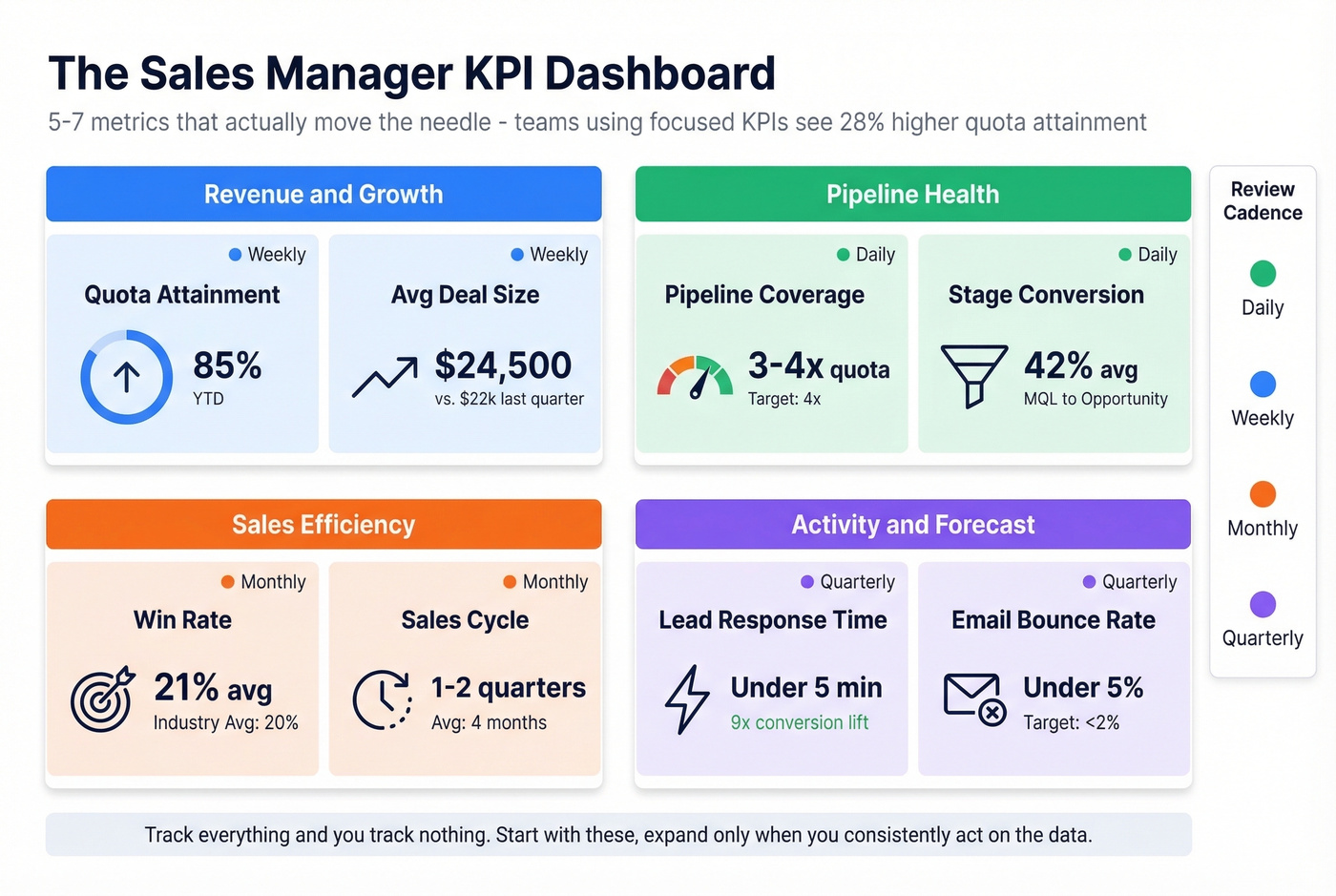
Organize these into four categories. Revenue & Growth covers quota attainment, MRR, and average deal size. Pipeline Health tracks coverage ratio, stage conversion, and velocity. Sales Efficiency measures win rate, cycle length, and ramp time. Activity & Forecast captures calls made, emails sent, and forecast accuracy. This framework, adapted from Optif.ai's KPI model, gives you both leading and lagging indicators.
How Often to Review Them
Activity metrics - calls, emails, meetings booked - get a daily glance. Not a daily interrogation. You're looking for patterns, not policing individual dials. Pipeline metrics get a weekly review during your Monday session. Revenue metrics get a monthly deep dive where you compare actuals to forecast and identify systemic gaps.
The dashboard isn't for you. It's for your reps. When a rep can see their own conversion rates compared to the team average, coaching conversations become collaborative instead of confrontational. Transparency turns metrics from a surveillance tool into a development tool.
Managing Former Peers
This is the part nobody prepares you for. Yesterday you were splitting a lunch tab with these people. Today you're responsible for their performance reviews. And there's almost always one person who also wanted the promotion.
Name the dynamic on day one. Literally say it out loud in your first team meeting: "This is weird. I know it's weird. My role changed, but my respect for you hasn't. I'm going to make mistakes as a manager, and I need you to tell me when I do." That kind of transparency disarms the tension faster than pretending nothing changed.
The biggest mistake new managers make with former peers is acting superior - overcompensating for imposter syndrome by pulling rank. The second biggest is the opposite: being so afraid of conflict that you never set expectations or boundaries. Both paths lead to the same place - a team that doesn't respect you. Set clear expectations early, hold everyone to the same standard including the person who wanted your job, and if you play favorites or avoid hard conversations, the team will figure it out within two weeks. The consensus on r/sales backs this up: the managers who survive the peer-to-boss transition are the ones who lead with honesty, not authority.
Protect Your Reps' Selling Time
If your reps spend 60% of their time on non-selling tasks, your job is to claw back as much of that time as possible. 57% of sales professionals say the cycle is getting longer - your team can't afford to waste hours on admin, bad data, or meetings that should've been emails. One of the most underrated sales team management strategies is simply removing friction from your reps' day.
Eliminate status update meetings that duplicate CRM data, manual list cleaning, and any approval process that takes more than 24 hours. Invest in call recording tools for async coaching, automated CRM enrichment, and verified prospect data that doesn't bounce.

Data quality is one of the fastest wins a new manager can deliver. If your team's email bounce rate is above 5%, you're burning domain reputation and wasting rep time on contacts that don't exist. Tools like Prospeo run 98% email accuracy with a 7-day refresh cycle, and the free tier gives you 75 verified emails per month - enough to audit your current list quality and spot the rot before spending a dollar.
Lead response time is another lever most managers ignore. Responding to an inbound lead within five minutes increases engagement likelihood by 9x, yet over 99% of companies fail this benchmark. That's not a rep problem - it's a routing and notification problem. Fix the system, and the reps will follow.
Mistakes That Get Managers Fired
1. Micromanaging activity instead of coaching outcomes. The "spreadsheet manager" who polices daily call counts but never listens to an actual call. Reps learn to game the metrics, and pipeline quality craters.
2. Neglecting your own development. You're so focused on coaching reps that you stop learning. The moment you stop asking how to be a better sales leader is when your playbook gets stale - and your VP notices before you do.
3. Killing autonomy. If every deal needs your approval and every email needs your edit, you've created a bottleneck, not a team. Skip this approach entirely.
4. Failing to set expectations early. Ambiguity breeds resentment. If reps don't know what "good" looks like - activity levels, pipeline standards, communication norms - they'll define it themselves, and you won't like their definition.
5. Ignoring strategic leadership in favor of management tasks. You can run a perfect Monday pipeline review and still lose because you never stepped back to ask whether your team is selling to the right market, with the right message, at the right price point. Management is execution. Leadership is direction. You need both. I made this mistake once - spending an entire quarter perfecting the operating rhythm while the market shifted underneath us. The rhythm was flawless. The results weren't.
FAQ
What's the most important skill for a first-time sales manager?
Coaching. Reps who receive weekly coaching hit 25% higher quota attainment and close 30% more deals. If you can improve one specific skill per rep per quarter, pipeline growth and quota performance follow naturally.
How many KPIs should a sales manager track?
Five to seven. Start with pipeline coverage at 3-4x quota, win rate around 21% average, average deal size, activity volume, and forecast accuracy. Add more only when you're consistently acting on these core metrics.
How do you handle an underperforming rep?
Compare their metrics to the team average within two weeks of spotting the gap. If effort is there but results aren't, it's a coaching problem - focus on the weakest conversion point. If effort is missing, it's a fit conversation. Never let underperformance linger past the point where the rest of the team notices.
What tools should a new sales manager evaluate first?
A CRM you'll actually use like HubSpot or Salesforce, a call recording tool like Gong or Chorus at roughly $100-200/user/month, and a data quality tool to stop reps chasing bounced emails. Prospeo's free tier of 75 verified emails/month lets you audit list quality before committing budget.
How can I boost team morale quickly?
Recognize wins publicly during your Friday wrap-up, rotate "deal of the week" spotlights so every rep gets visibility, and carve out time for peer-led skill shares where top performers teach a tactic they've been using. Small, consistent recognition outperforms quarterly bonuses for day-to-day motivation.
You're building a KPI dashboard and coaching reps on pipeline velocity - but none of that matters if your team is bouncing 35% of emails. Prospeo's 7-day data refresh and 5-step verification keep bounce rates under 4%, just like it did for Snyk's 50-person AE team that grew pipeline 180%.
Fix the data problem so you can focus on the coaching problem.