

How to Build an Email List Fast - Tactics Ranked by Speed
You've got 47 subscribers and most of them work at your company. Meanwhile, email returns $36-$42 for every $1 spent. That ROI is real - but only if you have a list worth emailing. Here's how to build an email list fast, with every tactic ranked by speed and real benchmarks so you know what "working" looks like.
Quick-Start Roadmap
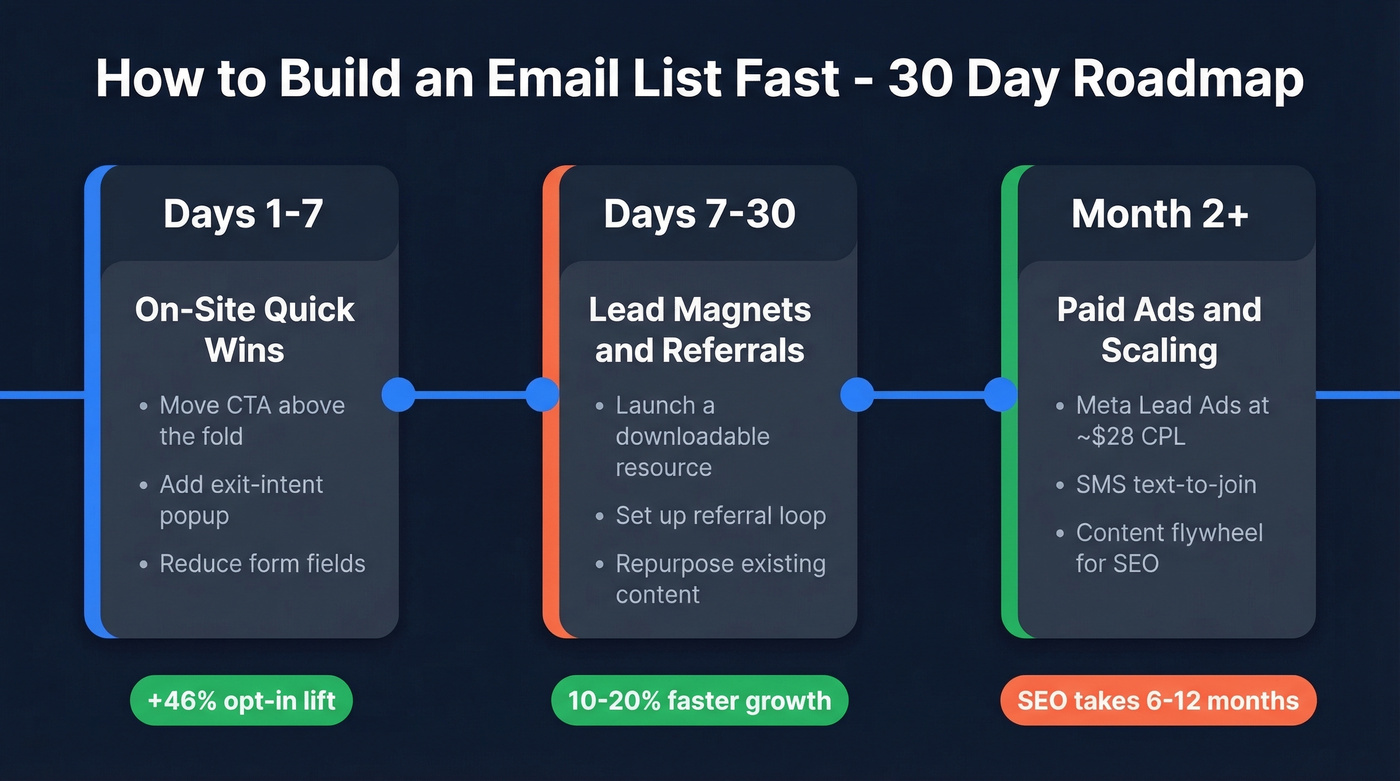
- Days 1-7: Move your opt-in CTA above the fold and add an exit-intent popup. These two changes alone can lift opt-ins 46%. Start here.
- Days 7-30: Launch a lead magnet and a referral loop. A good free resource can grow your list in one quarter as much as the entire previous year.
- Month 2+: Layer in paid ads (Meta Lead Ads at ~$28 CPL), SMS text-to-join, and the content flywheel. SEO is a 6-12 month slow burn - don't count on it for speed.
This Week - On-Site Quick Wins
The fastest list growth comes from converting traffic you already have. Most sites bury their email signup in the footer where nobody scrolls. One case study showed that moving the opt-in CTA from the footer to just below the navigation produced a 46% increase in opt-in rate - measured across ~39,000 new visitors over a 7-day window. That's not a controlled A/B test, but the signal is loud enough to act on.
In our testing, this single change is the highest-ROI move you'll make all week.
Your day-one checklist:
- Header CTA placement. Put the signup form where every visitor sees it - above the fold, below the nav, or as a sticky bar.
- Exit-intent popup. Ecommerce sites can salvage up to 35% of otherwise lost visitors with a well-timed exit popup.
- Reduce form fields. Name and email. That's it. Every extra field drops your conversion rate.
The benchmark: 5%-20% of new visitors opting in with proper optimization. Most sites start under 1%. These three changes move the needle within days, not months, and they're the fastest way to grow your list without spending a dollar on ads.
This Month - Lead Magnets and Referrals
Once your on-site conversion is dialed in, you need reasons for people to subscribe beyond "get our newsletter." Nobody wants another newsletter. They want something specific.
Lead magnets trade real value for an email address. One B2B company repurposed existing content into a downloadable resource and saw 61% open rates and 42% click rates on the automated delivery series - their list grew in the first quarter as much as it had in the entire previous year. The key wasn't creating something new. It was packaging what they already had into a format that felt valuable. If you're trying to build an email list for free, repurposing existing content into a lead magnet is the highest-leverage move available.
Referral loops come next. SparkLoop's analysis of 1,000+ newsletter referral programs shows small newsletters grow 10-20% faster with referral programs using free rewards. For lists over 20,000 subscribers, the acceleration jumps to 30-80% faster growth. The best rewards cost you nothing: insider content, early access, or exclusive PDF guides. We've seen referral programs stall when the reward isn't tangible enough - "exclusive community access" underperforms a specific downloadable asset almost every time.
Month 2+ - Paid Ads and Scaling
If you've got budget, paid acquisition is the fastest way to scale beyond organic. WordStream's 2026 benchmarks put Meta Lead Ads at ~$28 CPL, compared to Google Ads at about $70 CPL. Not even close.
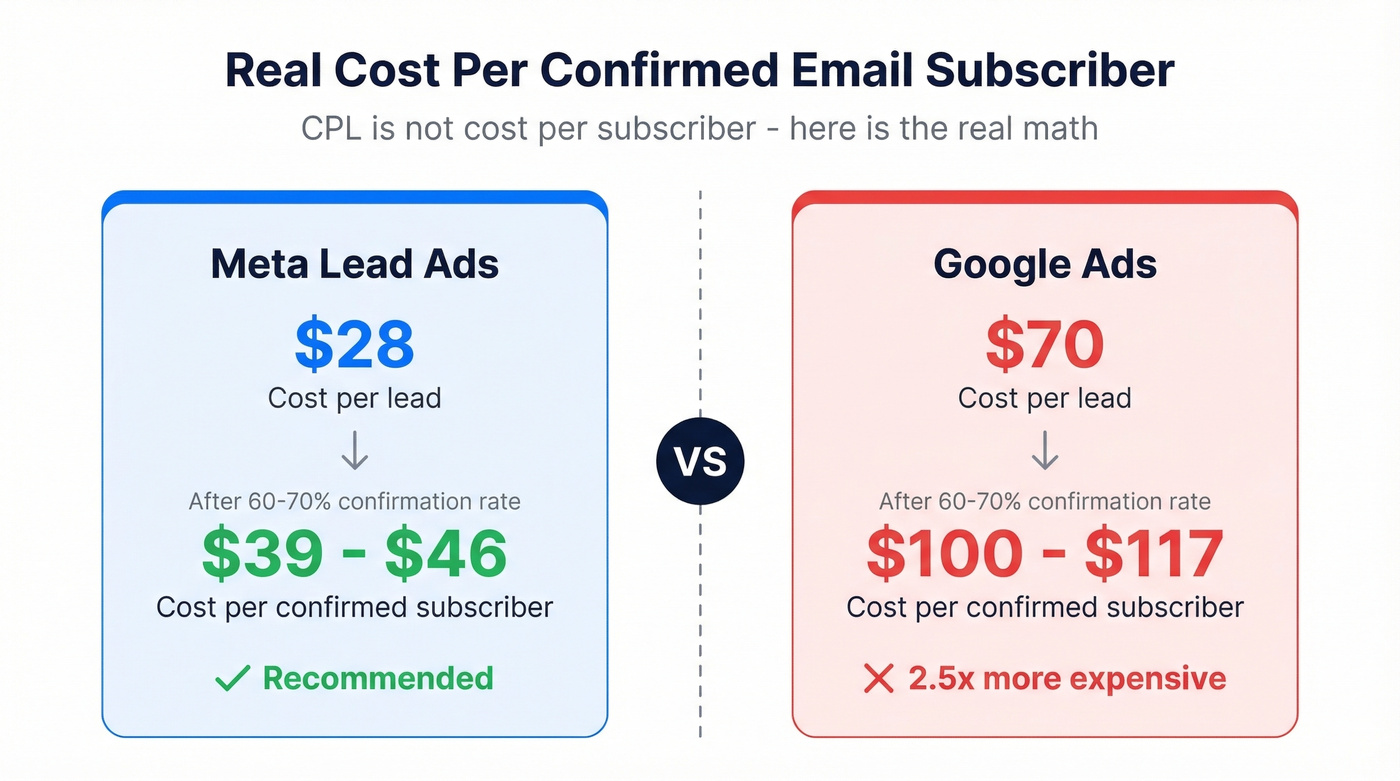
But CPL isn't cost-per-subscriber. Assume only 60-70% of leads become confirmed, usable subscribers after double opt-in drop-off, invalid emails, and people who forget they signed up. Your real cost per confirmed subscriber on Meta lands around $39-$46. At Google's CPL, you're looking at roughly $100-$117 per confirmed subscriber. For most teams, Meta is the clear winner for paid list building.
Beyond ads, consider SMS text-to-join as a feeder channel and QR codes at events or on packaging - both drive subscribers from offline touchpoints that your competitors' popups can't reach.
Here's the thing about SEO: it's not a speed play. Expect the first 6-12 months to be the slowest, with compounding returns after that. Build the content flywheel in parallel, but don't count on it for near-term numbers.
Most teams overthink the channel and underthink the offer. A mediocre lead magnet promoted through Meta ads will always lose to a great lead magnet promoted through a footer link. Fix the offer first, then scale the distribution.

Lead magnets and popups build inbound lists over weeks. But if you're in B2B and need verified emails now, Prospeo's database of 300M+ profiles with 98% email accuracy lets you build a targeted list in minutes - not months. Data refreshes every 7 days, so you're never emailing stale contacts.
Skip the opt-in wait. Export verified emails in minutes.
The B2B Shortcut - Skip the Opt-Ins
Use this if: You're in B2B sales or outbound and need verified emails for specific prospects this week.
Skip this if: You're a creator, ecommerce brand, or building a newsletter - the inbound tactics above are your path.
If you need 500 verified B2B emails by Friday, a popup form won't get you there. Prospeo's Email Finder lets you search 300M+ professional profiles, then export verified contacts directly. 98% email accuracy means you're not burning your domain on bounces, and the database refreshes every 7 days so you're not emailing people who changed jobs last month. Search, filter, export, and push straight to your sequencer. The free tier gives you 75 verified emails per month - enough to test whether outbound list building fits your workflow.
If you're doing outbound, treat this like lead generation: define your ICP, pull a clean list, then run a tight sequence.

Five Mistakes That Kill Your List
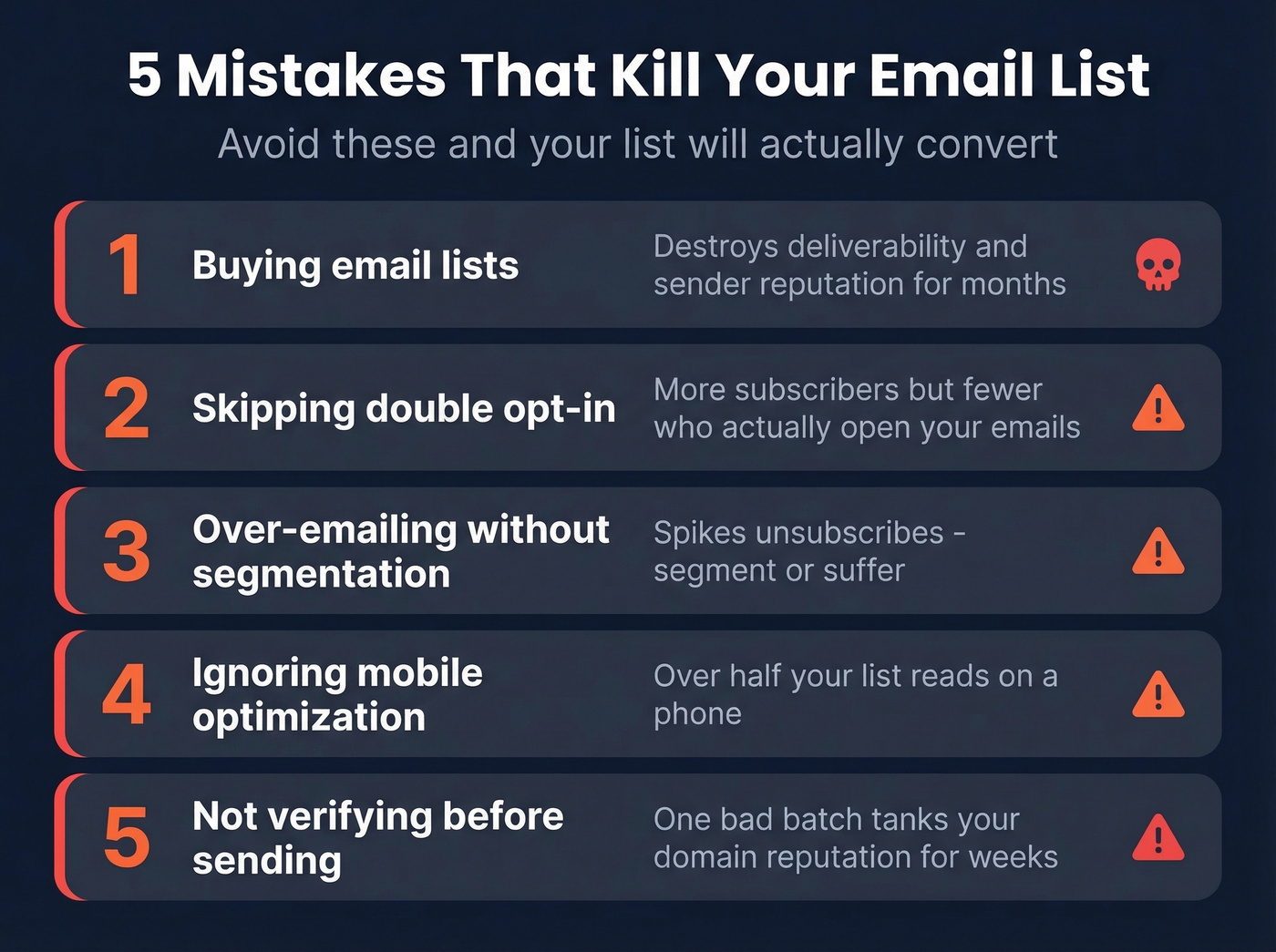
- Buying email lists. Deliverability death sentence. Purchased lists generate spam complaints, unsubscribes, and bad addresses that drag down your sender reputation for months.
- Skipping double opt-in. Single opt-in gets more subscribers. Double opt-in gets subscribers who actually open emails - and it strengthens your compliance posture for GDPR and CAN-SPAM.
- Over-emailing without segmentation. Blasting your entire list three times a week spikes unsubscribes. The consensus on r/EmailMarketing is clear: segment or suffer.
- Ignoring mobile. Tiny text, broken layouts, and un-tappable CTAs still plague most campaigns. Over half your list reads on a phone.
- Not verifying before sending. Run every list through a verification tool before you hit send. One bad batch can tank your domain reputation for weeks.
Benchmarks - What "Good" Looks Like
| Metric | Target Range | Notes |
|---|---|---|
| Opt-in rate (new visitors) | 5%-20% | Below 1% = fix placement |
| Email conversion rate | 2%-5% | Grocery ~7.9%, Fintech ~5.8%, Fashion ~1.4% |
| Welcome series conversion | ~3% | Automated > broadcast |
| Abandoned cart recovery | 10%-15% | Ecommerce only |
| Media/publishing conversion | ~4.2% | Higher than retail (~2.3%) |
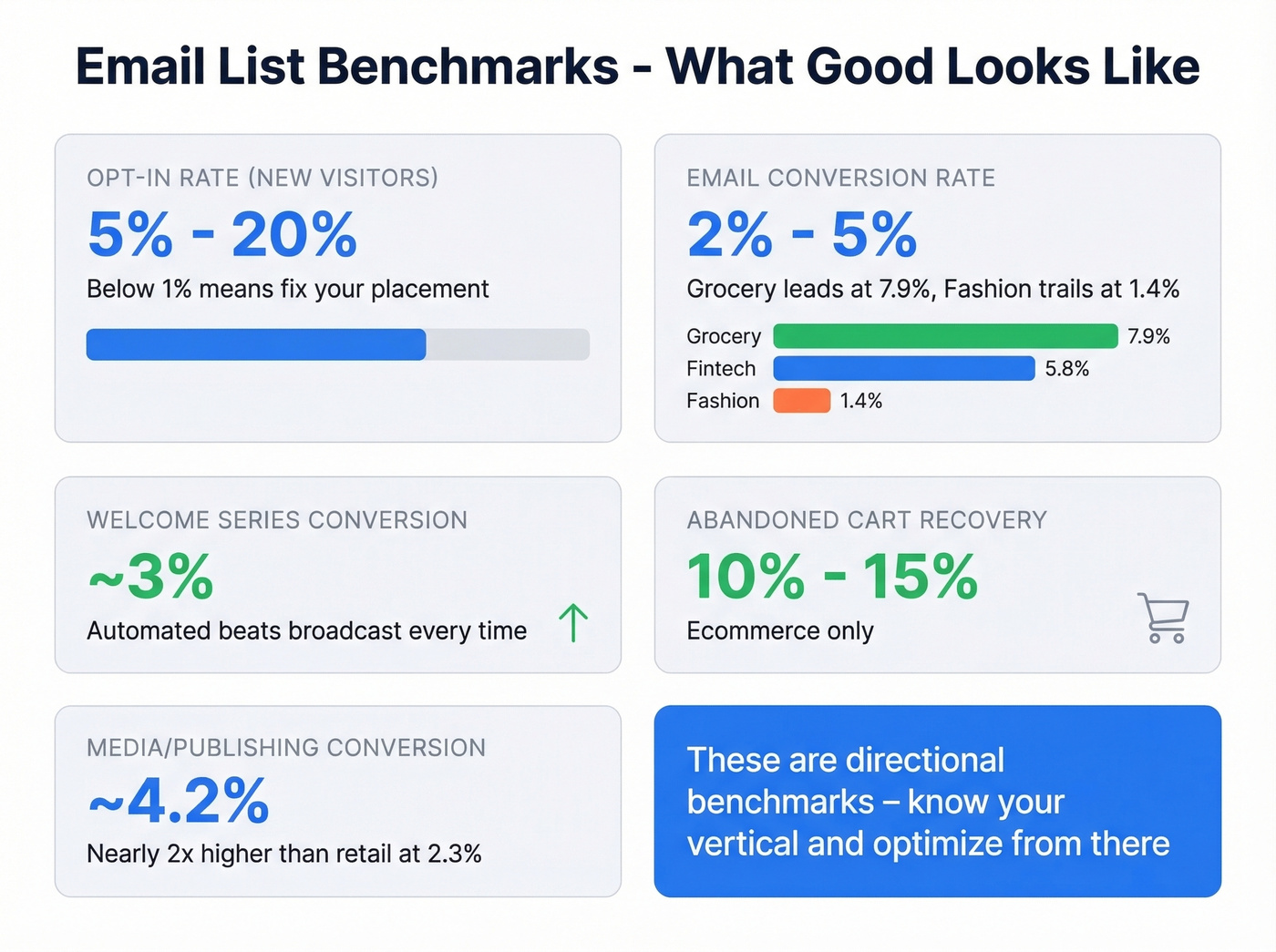
These are directional benchmarks, not gospel. Know your vertical's norms and optimize from there.
Start Building Today
Pick your speed tier and execute. If you've got a website with traffic, start with the header CTA and exit popup - that's a 30-minute project with measurable results by next week. For your ESP, Kit works well for creators, Brevo handles ecommerce nicely, and Mailchimp is solid when you need lots of integrations.
If you're building lists for outbound, pair your list growth with sales prospecting techniques and a simple B2B cold email sequence so new contacts actually turn into replies.
Let's be honest: a 200-person list that converts at 5% beats a 10,000-person list at 0.1%. Speed matters, but not at the expense of quality. Every tactic above prioritizes verified, engaged subscribers over vanity metrics. Build the list that actually drives revenue - and build it fast.
At $39-$46 per confirmed subscriber through Meta ads, paid list building gets expensive fast. Prospeo finds verified B2B emails for ~$0.01 each - with 30+ filters to target the exact buyers you want. That's 4,000x cheaper than a paid ad subscriber.
Stop paying $40 per subscriber when verified emails cost a penny.