

How to Calculate Churn Rate: Formulas, Examples, and Benchmarks
Your board deck says 4% churn. Finance says 8%. The CS team swears it's closer to 6%, but they're excluding downgrades. Everyone's using the same word - "churn" - and nobody's talking about the same number.
If you're trying to figure out how to calculate churn correctly, you're not alone. A thread on r/SaaS described a common scenario: teams think they have ~5% monthly churn when the real number is closer to 12% because different systems and definitions don't match. This disconnect happens because churn has several legitimate formulas, each measuring something different.
The fix isn't picking one formula. It's knowing which formula answers which question, and running the math right every time.
Quick Version
Customer churn rate = Lost customers / Customers at start of period x 100 -> 500 customers, 50 leave = 10% churn.
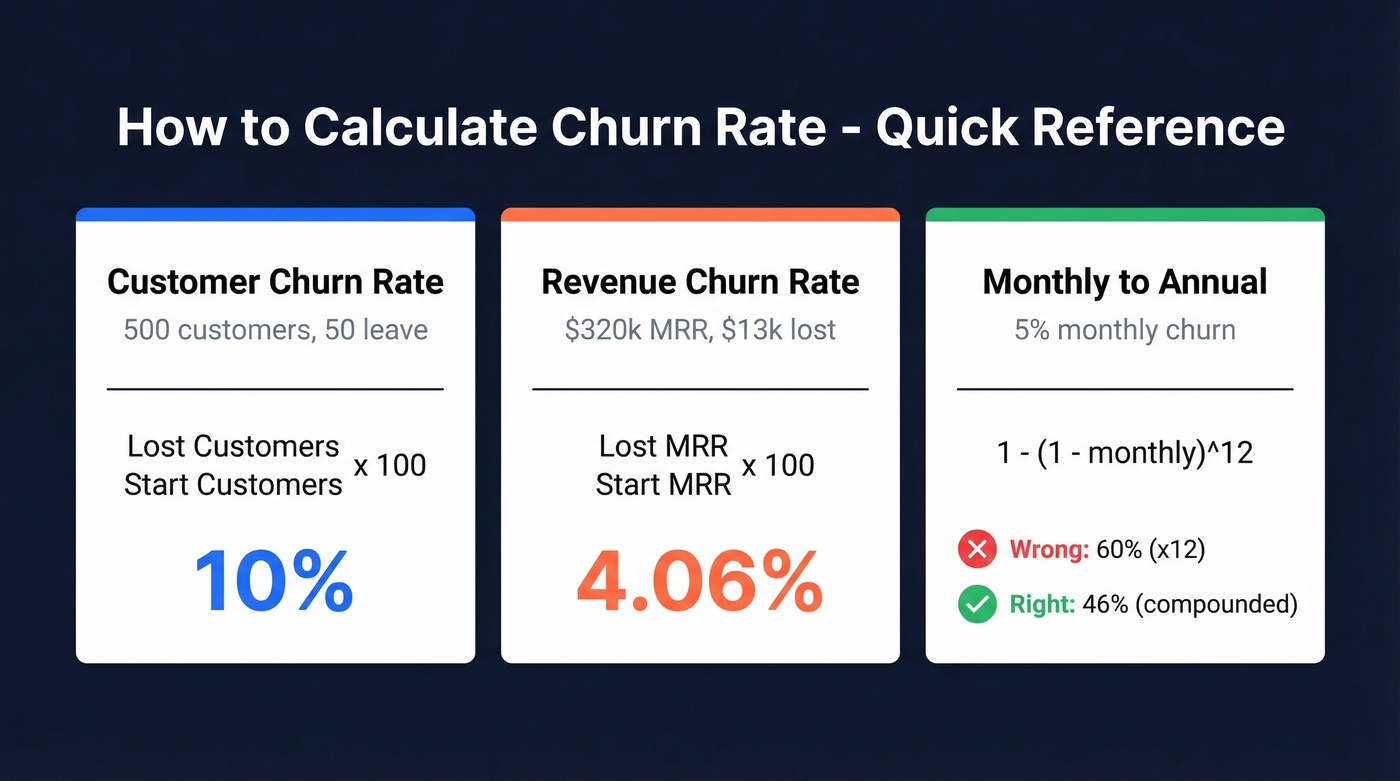
Revenue churn rate = Lost MRR / MRR at start of period x 100 -> $320k MRR, $13k lost = 4.06% churn.
Monthly to annual churn: Don't multiply by 12. Churn compounds. Use: Annual churn = 1 - (1 - monthly churn)^12. A 5% monthly rate is 46% annual, not 60%.
Jump to what you need:
- Every formula with worked examples
- Five mistakes that wreck your number
- 2026 benchmarks by stage, vertical, and pricing model
Customer Churn Rate Formula
The basic formula is simple:
Customer Churn Rate = (Customers Lost During Period / Customers at Start of Period) x 100
Getting the inputs right matters more than the formula itself. Say you start January with 500 paying customers. By January 31, you have 450. That's 50 lost customers.
50 / 500 x 100 = 10% monthly customer churn.
Retention is the mirror image: 1 - 0.10 = 90% retention.
A few rules that matter more than they seem.
Always use start-of-period as your denominator - not end-of-period, not an average. Using end-of-period inflates the rate because the denominator already reflects the losses. Some teams use an average of start and end counts, arguing it smooths out mid-period additions. It does, but it also makes month-over-month comparisons muddier. Stick with start-of-period for clean, comparable numbers.
Pick a consistent time period. Monthly is the standard for SaaS; quarterly works for enterprise contracts with longer sales cycles. Annual is useful for board reporting but hides seasonal patterns.
Exclude trials and internal accounts from the denominator. If you've got 500 paying customers and 200 trial users, your denominator is 500. Trials haven't committed yet. Mixing them in dilutes your churn rate and gives you a false sense of health.
Use monthly customer churn when you need a pulse check on logo retention. Skip it when you need to understand revenue impact - a churned $20/mo customer and a churned $5,000/mo customer look identical in this formula.
Revenue Churn Formulas
Customer churn tells you how many logos you're losing. Revenue churn tells you how much money is walking out the door. They diverge - sometimes dramatically - depending on which customers leave.
Gross Revenue Churn
Here's a worked example that shows why the distinction matters.
Say your MRR breaks down like this: 6,000 Basic customers at $20/mo ($120,000 MRR) and 4,000 Premium customers at $50/mo ($200,000 MRR). Total MRR: $320,000. In a given month, 400 Basic customers and 100 Premium customers churn. That's 500 customers lost out of 10,000 - a 5% customer churn rate.
But the revenue math tells a different story. Lost MRR: (400 x $20) + (100 x $50) = $8,000 + $5,000 = $13,000. Revenue churn rate: $13,000 / $320,000 = 4.06%.
Customer churn is 5%. Revenue churn is 4.06%. The gap exists because lower-value customers churned at a higher rate than higher-value ones. If the pattern reversed - if your Premium customers were leaving faster - revenue churn would exceed customer churn. This is exactly why you need both metrics, tracked separately.
GRR vs NRR
Gross Revenue Retention and Net Revenue Retention are the two metrics your investors actually care about. They answer different questions, and confusing them leads to bad decisions.
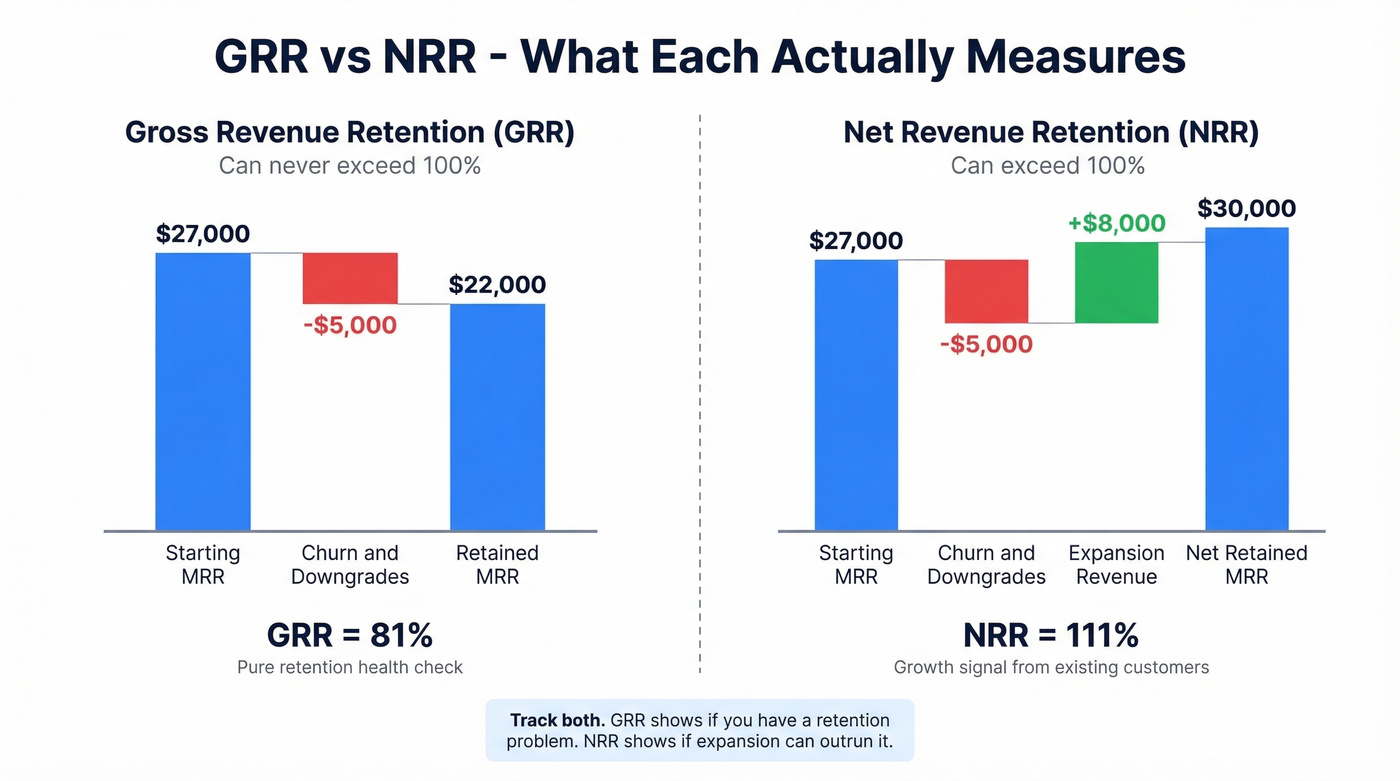
GRR measures how much revenue you kept from existing customers, excluding any expansion. It's a pure measure of your ability to retain what you already have. Worked example: Start MRR of $27,000. Revenue churn from cancellations and downgrades of $5,000. GRR = ($27,000 - $5,000) / $27,000 = 81%. GRR can never exceed 100%.
NRR includes expansion revenue - upsells, cross-sells, price increases. Same starting MRR of $27,000, same $5,000 in churn, and $8,000 in expansion. Net retained MRR from that cohort is $30,000, so NRR = $30,000 / $27,000 = 111%.
| Metric | Includes | Excludes | Max Value | Best For |
|---|---|---|---|---|
| GRR | Churn, downgrades | Expansion, new biz | 100% | Retention health |
| NRR | Churn, downgrades, expansion | New biz | Unlimited | Growth signal |
Here's the thing: over-indexing on NRR alone creates dangerous behavior. Teams start doing excessive custom work for large accounts to juice expansion numbers while ignoring the fact that GRR is eroding underneath. Track both. GRR tells you if you have a retention problem. NRR tells you if your expansion motion can outrun it.
Negative Churn
Negative churn means your existing customers are growing faster than they're leaving. It's rare and extremely valuable.
The full formula accounts for every type of MRR movement:
Net MRR Churn Rate = [(Churn MRR + Contraction MRR) - (Expansion MRR + Reactivation MRR)] / Starting MRR
Worked example: Starting MRR of $2,000. Churn loss of $500. Expansion revenue of $600. No contraction or reactivation for simplicity.
Net MRR churn = ($500 - $600) / $2,000 = -5%.
That negative sign means your existing customer base is growing by 5% per month before you add a single new customer. This is what makes NRR exceed 100%, and it's the engine behind the best SaaS growth stories. ChartMogul's analysis found that 40% of businesses in the $15-30M ARR range achieve negative churn. It's rare at earlier stages and a hallmark of the best-performing companies at scale.
Monthly to Annual Conversion
Multiplying monthly churn by 12 is wrong. It's the most common mistake in churn math, and it overstates your annual rate every single time.
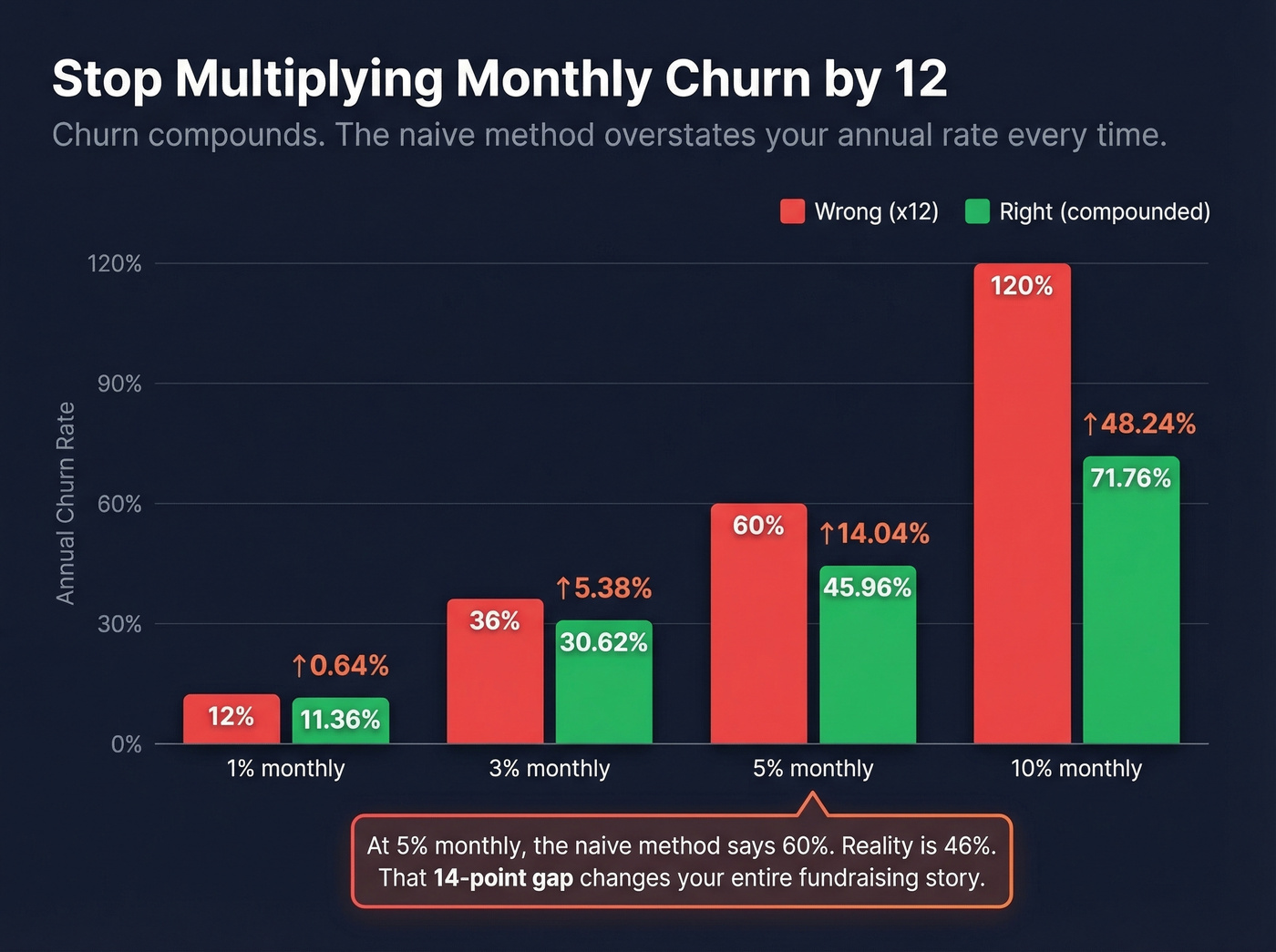
Churn compounds. Each month's losses apply to a smaller remaining base - it's exponential decay, not linear subtraction. The correct formula:
Annual Churn = 1 - (1 - Monthly Churn)^12
The difference gets dramatic fast:
| Monthly Churn | x12 (Wrong) | Compounded (Right) | Error |
|---|---|---|---|
| 1% | 12% | 11.36% | +0.64% |
| 3% | 36% | 30.62% | +5.38% |
| 5% | 60% | 45.96% | +14.04% |
| 10% | 120% (!) | 71.76% | +48.24% |
At 5% monthly, the naive calculation says you'll lose 60% of customers annually. The real number is 45.96%. That's a 14-point gap - enough to completely change your fundraising narrative or your board's confidence level. At 10% monthly, the naive method produces an impossible 120%.
To reverse the conversion (annual to monthly): Monthly churn = 1 - (1 - Annual churn)^(1/12).
Churn and Customer Lifetime Value
Your churn rate directly determines customer lifetime: Customer Lifetime = 1 / Monthly Churn Rate. At 5% monthly churn, your average customer lasts 20 months. At 3%, it's 33 months. This makes churn one of the most sensitive inputs in your LTV/CAC model - a one-percentage-point improvement in monthly churn can shift LTV by thousands of dollars per customer.
Five Mistakes That Wreck Your Churn Number
Teams report churn numbers that are wrong because of measurement errors, not actual customer behavior.
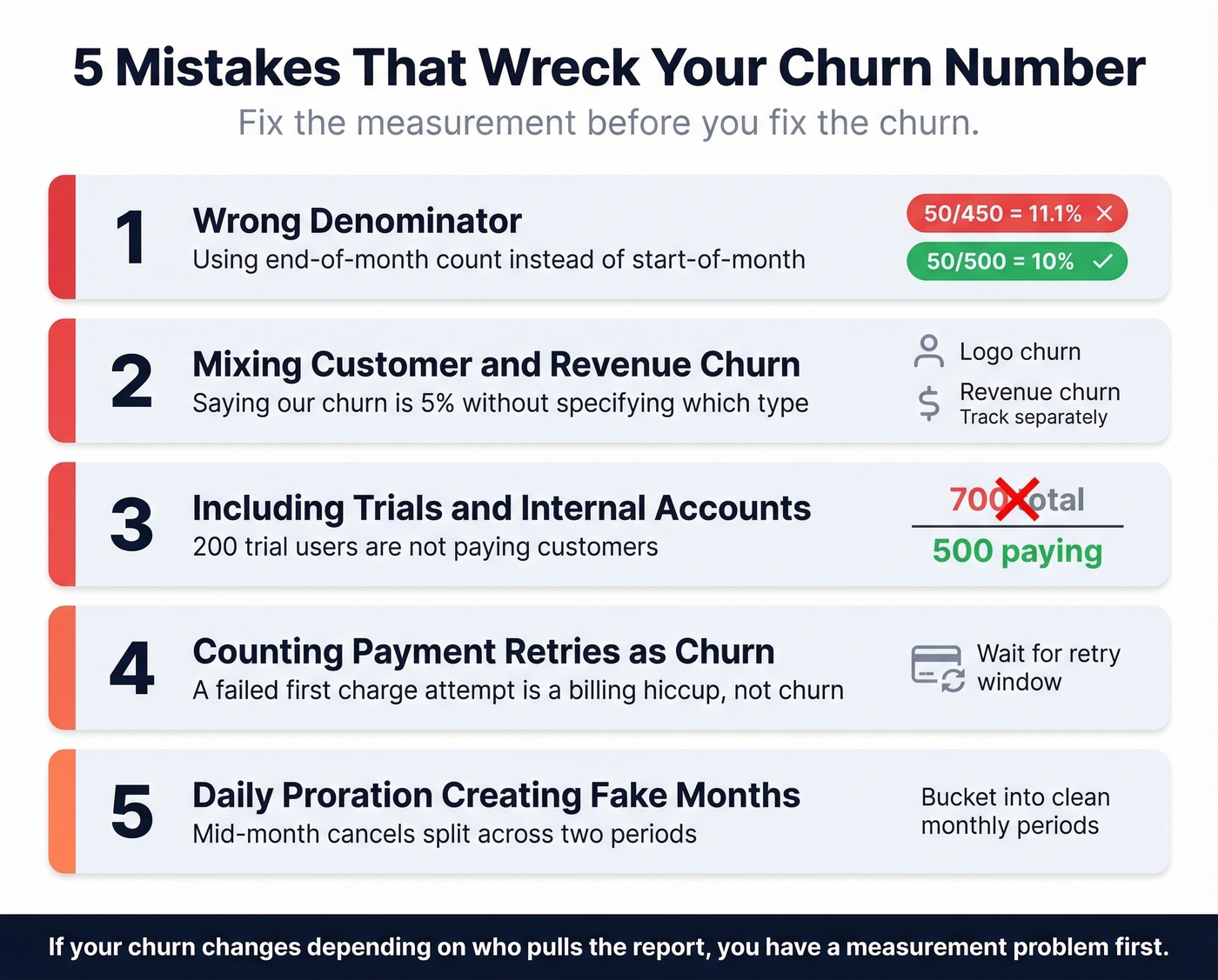
1. Wrong denominator. Using end-of-month customer count instead of start-of-month. If you lost 50 customers and ended with 450, dividing by 450 gives you 11.1%. Dividing by the correct 500 gives you 10%. Small difference? It compounds over quarters.
2. Mixing customer churn and revenue churn into one metric. These are different numbers that answer different questions. Reporting "our churn is 5%" without specifying which type is meaningless. The r/SaaS community calls this out constantly as a core source of cross-team confusion.
3. Including trials and internal accounts. Your 200 trial users and 15 internal test accounts aren't paying customers. Including them in the denominator artificially suppresses your churn rate. Strip them out.
4. Counting payment retries as churn. Stripe and other payment processors retry failed charges automatically. A failed first attempt isn't churn - it's a billing hiccup. If you're pulling churn data directly from payment exports without accounting for retry windows, you're overcounting. We've seen teams report monthly churn nearly double the real number because their data pipeline treated every failed charge as a cancellation.
5. Daily proration creating fake months. Revenue schedules that prorate daily can generate fractional "months" that distort MRR churn calculations. A customer who cancels mid-month shows up as partial churn across two periods instead of full churn in one. The fix: build operational MRR tables that bucket subscriptions into clean monthly periods without daily proration.
If your churn numbers change depending on who pulls the report, you have a measurement problem before you have a churn problem. Fix the measurement first.

You're calculating churn to fix retention. But if bad contact data is tanking your outreach, you're losing deals before they even start. Prospeo delivers 98% verified emails on a 7-day refresh cycle - so your pipeline stays full of reachable buyers, not bounced addresses inflating your churn.
Stop feeding your funnel with data that expires in weeks.
2026 Churn Benchmarks
Benchmarks are useful as sanity checks, not as targets. Your churn rate depends on your vertical, stage, pricing model, and a dozen other factors that no benchmark table captures. That said, here's what the data shows.
By Industry Vertical
| Vertical | Monthly Churn |
|---|---|
| Infrastructure & DevOps | 1.8% |
| ERP | 2.1% |
| CRM | 2.4% |
| Marketing Automation | 4.8% |
| Project Management | 6.1% |
| Email & Communication | 8.1% |
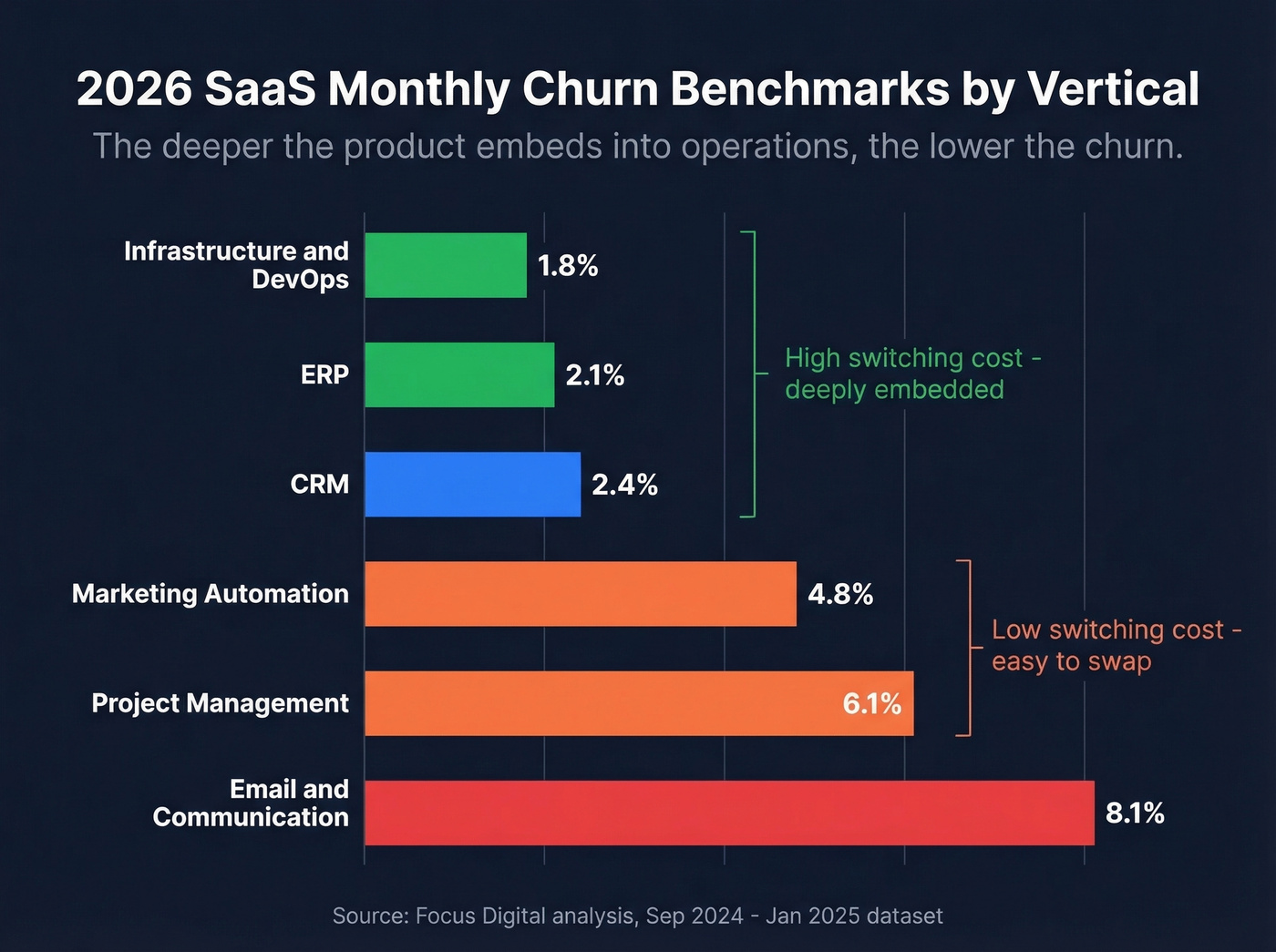
The pattern is clear: the deeper a product embeds into a company's operations, the lower the churn. Infrastructure and ERP are painful to rip out. Email tools are easy to swap. Data from a Focus Digital analysis covering 15 SaaS verticals (dataset window Sep 2024 - Jan 2025).
By Company Stage
| Stage | Monthly Churn |
|---|---|
| Pre-PMF (<$1M ARR) | 8.2% |
| Early ($1M-$5M ARR) | 5.7% |
| Growth ($5M-$20M ARR) | 3.9% |
| Established ($50M+ ARR) | 1.9% |
If you're a founder at $3k MRR seeing 7-8% monthly churn, take a breath. That's normal for pre-PMF companies, not a crisis signal. Reddit's r/SaaS is full of founders who feel like their churn is catastrophic because they're comparing against advice calibrated for companies 10x their size.
Let's be honest about benchmarking. In our experience, the companies that obsess over industry comparisons are the same ones that never fix their measurement methodology. Stop benchmarking against averages. Benchmark against yourself 90 days ago. If your monthly churn dropped from 8.2% to 7.1% over a quarter, that's meaningful progress regardless of what some table says.
By Pricing Model
| Pricing Model | Monthly Churn |
|---|---|
| Usage-based | 2.1% |
| Per-seat | 3.9% |
| Flat-rate | 5.6% |
Usage-based pricing creates natural stickiness - customers scale up as they use more, and the switching cost is embedded in their workflow. Flat-rate has the highest churn because there's no usage-driven lock-in. Per-seat sits in the middle, with some natural friction from team adoption but less than usage-based models.
Voluntary vs Involuntary Churn
Not all churn is a customer choosing to leave.
A significant chunk is purely mechanical: failed payments, expired cards, billing errors. The monthly medians show voluntary churn at 2.6% (74% of total) and involuntary churn at 0.9% (26%). That involuntary slice is the lowest-hanging fruit in your entire retention strategy, and most teams ignore it completely.
| Failure Type | Share | Recovery Rate |
|---|---|---|
| Expired card | 42% | 68% |
| Insufficient funds | 31% | 34% |
| Fraud block | 18% | 52% |
| Processing error | 9% | 87% |
Processing errors have an 87% recovery rate - almost all of them are recoverable with proper retry logic. Expired cards recover at 68% with dunning sequences and card updater services. If you aren't running automated dunning management, you're leaving recoverable revenue on the table every single month.
And here's something worth noting: not all churn is bad. Losing low-value, high-support-cost accounts can actually improve your unit economics. Segment your churn by customer tier before panicking.
Cohort Analysis
A single churn number is almost useless without segmentation. Telling your board "we have 4% monthly churn" hides whether that churn is concentrated in your first 60 days (an onboarding problem), evenly distributed (a product-market fit problem), or spiking at renewal (a pricing problem).
Two cohort types matter. Acquisition cohorts group customers by signup month and track retention over time - they reveal when churn happens in the customer lifecycle. Behavioral cohorts group customers by actions taken and reveal why churn happens.
Start with monthly acquisition cohorts. Build a simple grid: rows are signup months, columns are months since signup, cells are retention percentages. You'll immediately see if certain signup months have worse retention due to seasonal effects or marketing channel quality, and whether churn is front-loaded or steady-state. Once you've identified when customers drop off, layer in behavioral cohorts to understand why. Chargebee's cohort analysis guide walks through the methodology in detail.
How to Reduce Attrition
Knowing how to calculate churn is step one. Fixing it is step two. Here are six tactics, ordered by impact-to-effort ratio.
Fix involuntary churn first. Implement dunning sequences, enable automatic card updaters, and configure smart retry logic. Processing errors recover at 87% and expired cards at 68% with the right billing workflows. It's pure revenue recovery with zero product changes required. If you only do one thing on this list, do this.
Track leading indicators. A 20% month-over-month drop in product usage is your outreach trigger. By the time a customer cancels, the decision was made weeks ago. Build alerts around usage decline, login frequency drops, and support ticket patterns.
I'll share a strong opinion on the next two tactics: most teams try to reduce churn globally with broad initiatives - better onboarding emails, NPS surveys, quarterly business reviews for everyone. That's backwards. Churn reduction is a segmentation problem, not a coverage problem.
Segment by cohort and fix the worst one. Find the cohort with the worst retention curve - maybe it's customers acquired through a specific channel, or customers on your lowest tier - and focus there. One targeted fix beats ten generic initiatives every time.
Set stage-appropriate expectations. For pre-PMF companies, your job isn't to optimize churn. It's to find product-market fit. Churn optimization at $3k MRR is premature optimization. Focus on learning why customers leave, not on reducing the number.
Acquire better-fit customers. This one's upstream of churn entirely, but it matters enormously. If your outbound pipeline is full of wrong-fit contacts, you'll close deals that were never going to stick. Starting with verified, accurate contact data - tools like Prospeo refresh their database every 7 days with 98% email accuracy - means your closed-won customers are actually the right fit. Those customers stick around longer.
Run exit surveys with specific options. Offer concrete choices instead of freeform text: "too expensive for the value," "missing [feature]," "switched to [competitor]," "project ended." Structured data you can act on beats vague responses you can't.
Negative churn requires expanding existing accounts - and that starts with reaching the right stakeholders. Prospeo's 300M+ profiles with 30+ filters (intent data, headcount growth, funding) help you find expansion contacts inside accounts you already serve.
Find upsell contacts at your existing accounts for $0.01 each.
Churn Rate FAQ
What's a good monthly churn rate for SaaS?
It depends on your stage. Pre-PMF companies under $1M ARR see a median of 8.2% monthly churn, while established companies at $50M+ ARR average 1.9%. Generic advice saying "3-5% is good" ignores company stage, vertical, and pricing model. Benchmark against your own trajectory, not someone else's number.
What's the difference between customer churn and revenue churn?
Customer churn counts logos lost; revenue churn measures MRR lost. They diverge when high-value and low-value customers churn at different rates - a 5% customer churn rate can translate to 4% or 8% revenue churn depending on who leaves. Always track and report them separately.
How do I convert monthly churn to annual?
Don't multiply by 12 - churn compounds. Use: Annual churn = 1 - (1 - monthly churn)^12. A 5% monthly rate equals 45.96% annual churn, not 60%. The naive multiplication method overstates annual churn by an increasingly large margin as the monthly rate rises.
How do I calculate churn for a non-subscription business?
Define a "lapse window" - typically 90-180 days for e-commerce - after which a non-repurchasing customer counts as churned. Then divide customers who didn't repurchase within that window by total active customers at the start of the window x 100. Track repeat purchase rate alongside this for a fuller picture.
Does outbound data quality affect churn?
Yes. Bad prospect data means reaching wrong-fit contacts who were never your ICP, wasting sales cycles and creating downstream retention problems. Starting your pipeline with verified, accurate contact data ensures you close customers who actually match your ideal profile - and those customers churn far less.