

How to Calculate a Sales Forecast for a New Business
Four in five sales and finance leaders missed a quarterly forecast in the past year - and those are companies with years of CRM data behind them. SiriusDecisions found that 79% of sales organizations miss their forecast by more than 10%. If established teams with historical pipelines can't nail it, building a sales forecast for a new business obviously requires a different playbook. You can't extrapolate past performance when there's no past.
You need a market ceiling, a bottom-up funnel model, and three scenarios. A spreadsheet is the only tool required for the first 12 months. Let's walk through each step with real numbers you can adapt.
Size Your Market Top-Down
Top-down market sizing isn't your forecast. It's a sanity check - a ceiling that tells you whether the opportunity is big enough to bother with.
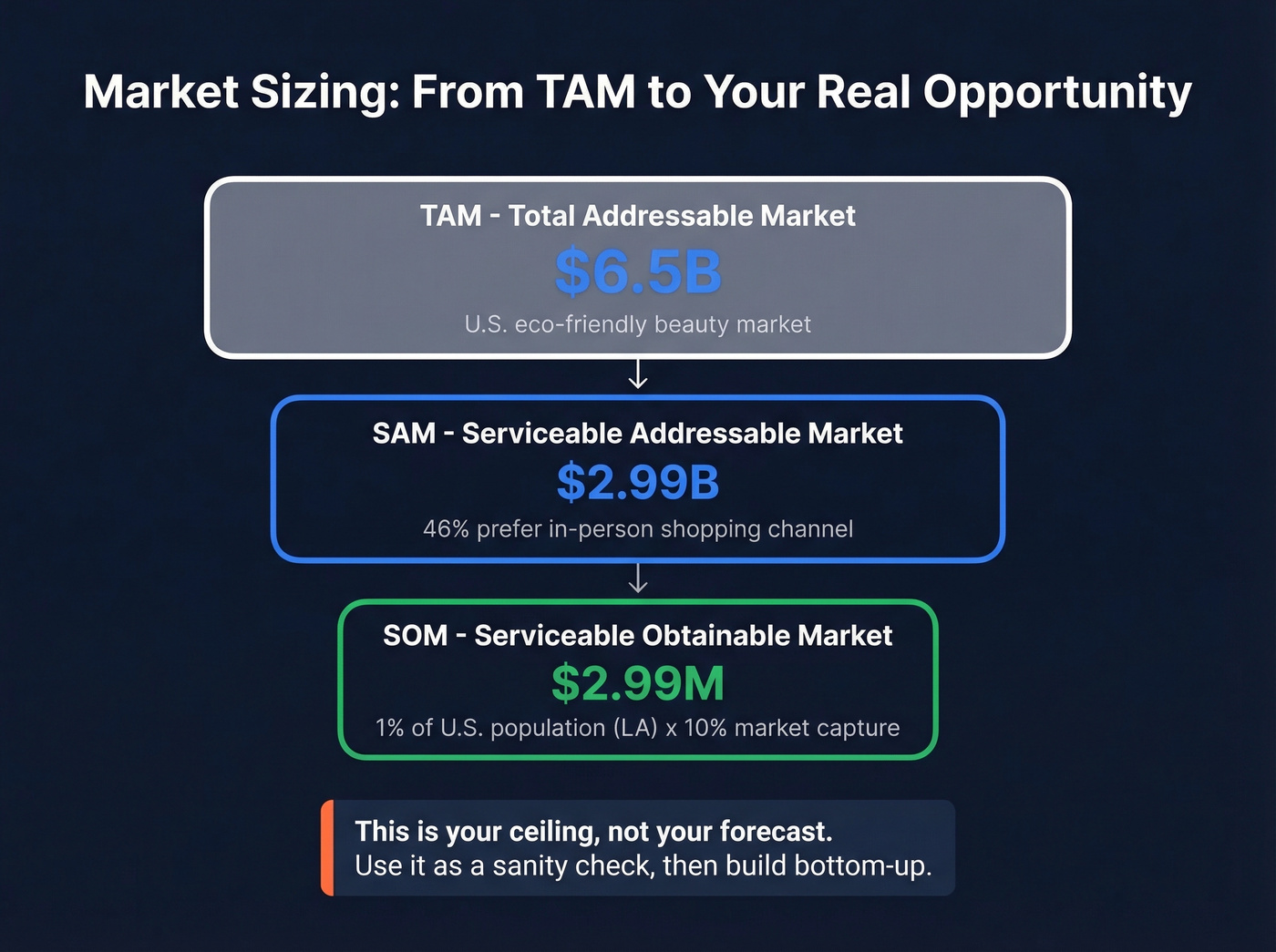
You need three numbers. TAM is the total revenue if you captured 100% of demand. SAM is the slice you can realistically serve given your geography, capacity, and segment. SOM is the portion of SAM you can actually win given competition and resources.
Here's how it works with real numbers, adapted from Salesforce's walkthrough. Say you're launching an eco-friendly beauty brand in LA. U.S. eco-friendly beauty is a $6.5B market (TAM). 46% of buyers prefer in-person shopping - that's your channel, so SAM = $2.99B. LA represents roughly 1% of the U.S. population, narrowing to $29.9M. Capture 10% of that local market and your SOM is $2.99M.
That $2.99M is a ceiling, not a plan. "TAM x 1%" is the forecasting equivalent of a horoscope - it sounds precise but it's disconnected from how you'll actually acquire customers. Use it to confirm the market's worth entering, then move on to the real work.
Build a Bottom-Up Revenue Projection
This is where your forecast gets real. Bottom-up means starting with what you can control: how many prospects you can reach, how many convert, and what they pay.
The approach differs by business model. A transactional e-commerce company forecasts from traffic x conversion rate x average order value. A SaaS company layers in monthly churn and expansion revenue on top of new customer acquisition. A services business forecasts from pipeline deals x close rate x average project size. The funnel math below works for all three - just swap in the metrics that match your model.
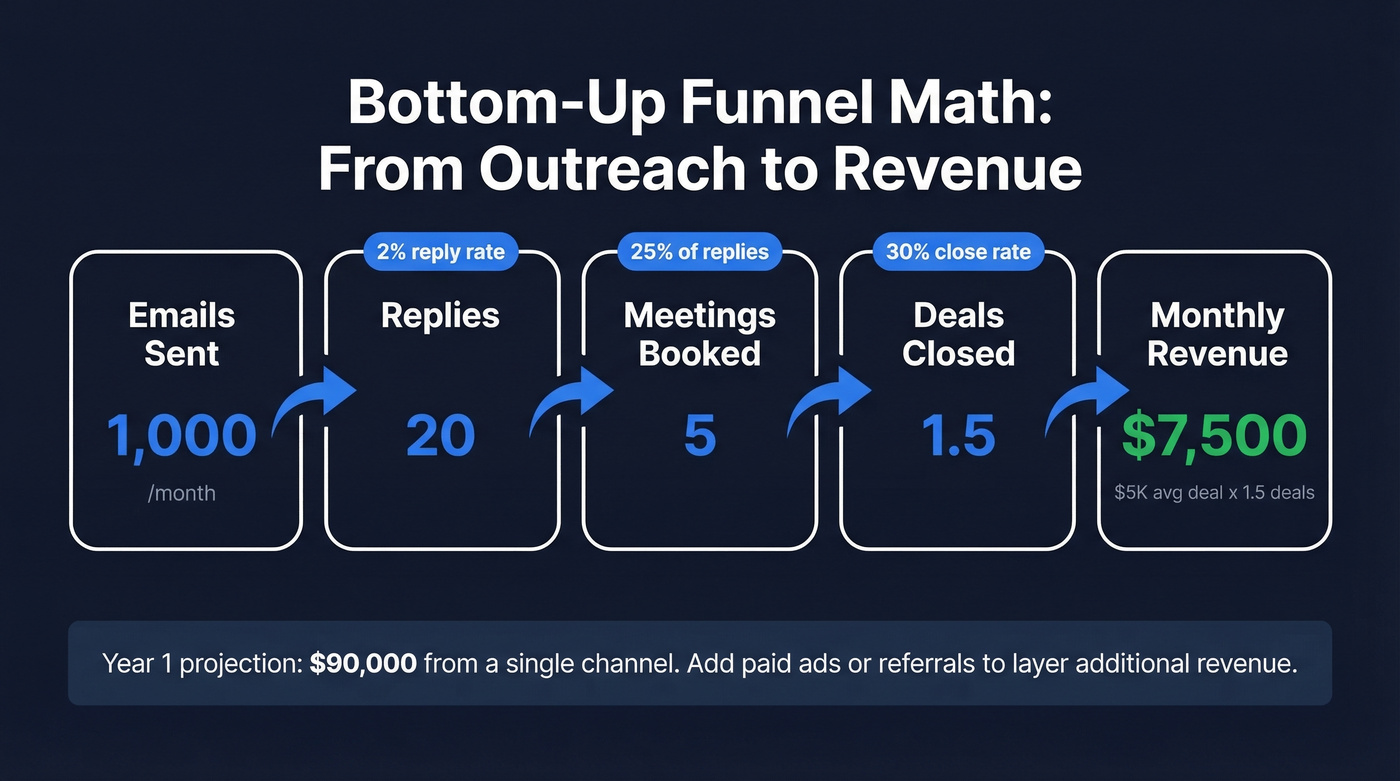
Let's walk through a worked example for a B2B company selling a $5,000 product with cold email as the primary channel.
| Funnel Stage | Monthly Volume | Rate |
|---|---|---|
| Emails sent | 1,000 | - |
| Replies | 20 | 2% reply |
| Meetings booked | 5 | 25% of replies |
| Deals closed | 1.5 | 30% close |
| Revenue | $7,500 | $5K x 1.5 |
That gives you $7,500/month - roughly 3 deals every two months - for $90,000 in year-one revenue from a single channel. Add a second channel like paid ads with 2-5% CTR, 10-20% lead-to-meeting rate, and similar close rates, and you layer in additional revenue streams.
Cold email typically runs 1-3% reply rates, 15-25% meeting rates from those replies, and 20-30% close rates depending on your product and market. These are starting assumptions. Your real numbers will replace them within the first 1-3 months.
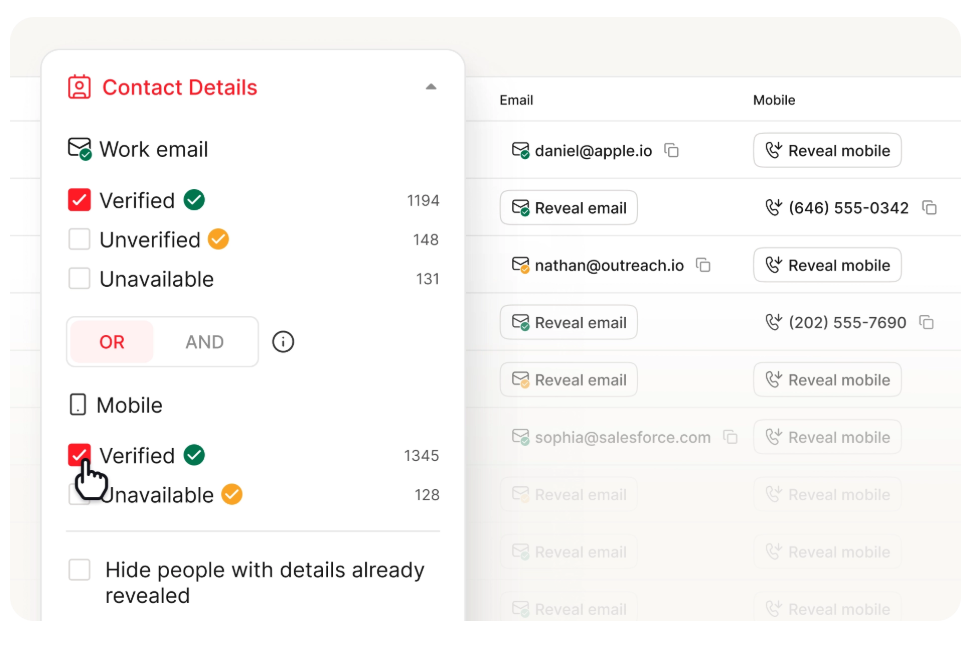
Here's the thing, though: your financial model is only as good as your ability to actually reach those 1,000 prospects per month. That "estimated outreach" cell in your spreadsheet is either a guess or a real number, and the difference matters enormously. Prospeo covers 300M+ professional profiles with 30+ search filters and 98% email accuracy, so you're not burning sends on bad addresses. The free tier gives you 75 verified emails per month to start validating your funnel assumptions with real outreach before you commit budget.
The MaRS bottom-up forecasting workbook is a free resource worth downloading - it walks through funnel stages, selling costs, and cash flow timelines specifically for pre-revenue startups.
Gather Real-World Inputs
Assumptions are a starting point. Real inputs make them credible. We've seen founders build beautiful spreadsheet models that fall apart the moment they start selling because every assumption was a guess.
Ask your sales reps - even if that's just you - for realistic unit estimates and ramp expectations (a simple 30-60-90 day plan helps). Talk to trusted customers, suppliers, and distributors. As the BDC puts it, "It's amazing what people will tell you if you ask." Run a pilot before full rollout: test with a small segment, measure real conversion rates, then scale. Use competitor analogs - if a similar product in your space does $X in its first year, that's a useful benchmark. And don't ignore external factors like seasonality, economic conditions, and regulatory shifts. They can all move your numbers significantly.
The Xactly survey found that 97% of sales leaders say the right data would make accurate forecasts easier. That tracks. Before you can survey potential customers or run a pilot, you need to find them - and the quality of your prospect data directly determines whether your pilot results mean anything.

Your bottom-up forecast assumes you can actually reach 1,000 prospects a month. With bad data, half those sends bounce and your funnel math collapses. Prospeo gives you 300M+ profiles with 98% email accuracy and 30+ filters to build the exact prospect list your model needs - starting free with 75 verified emails/month.
Turn your spreadsheet assumptions into real pipeline numbers.
Build Three Scenarios
A single-point forecast is a wish. Three scenarios are a plan.
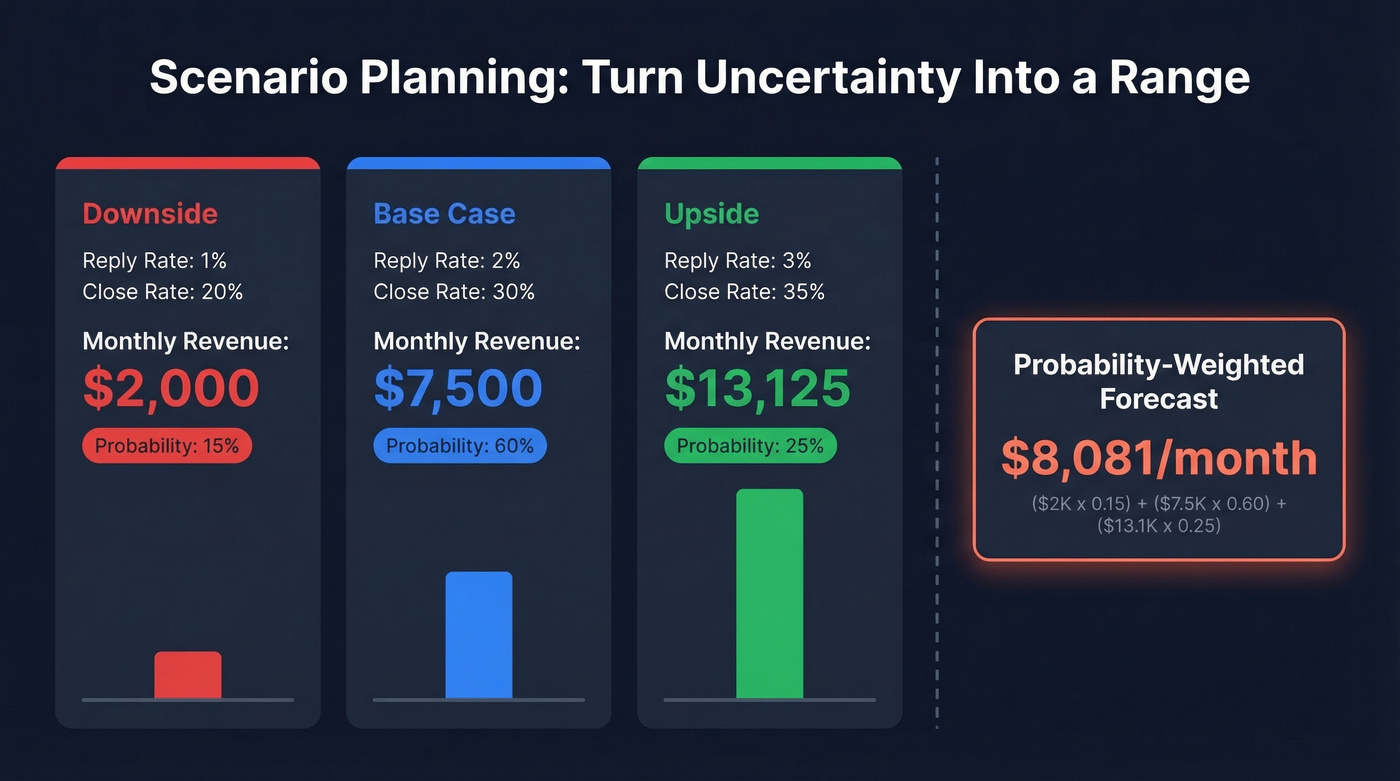
According to industry data, 90% of CFOs now use at least three scenarios for planning. Here's a simple framework using the funnel numbers from above:
| Scenario | Reply Rate | Close Rate | Monthly Rev | Probability |
|---|---|---|---|---|
| Downside | 1% | 20% | $2,000 | 15% |
| Base | 2% | 30% | $7,500 | 60% |
| Upside | 3% | 35% | $13,125 | 25% |
Your probability-weighted forecast: ($2,000 x 0.15) + ($7,500 x 0.60) + ($13,125 x 0.25) = $8,081/month.
That weighted number is what you put in front of investors and use for cash flow planning. The range - $2K to $13K - is what you plan operations around. Scenario planning turns uncertainty into a manageable range rather than a paralyzing unknown.
If you've already got a few early deals in motion, you can also use deal-category probabilities: Pipeline deals at 30%, Best Case at 70%, Commit at 90%. Multiply each deal's value by its probability and sum them up. This works well once you have even a handful of real opportunities to categorize.
Set Up Your Spreadsheet
Keep it simple. Three tabs in Google Sheets.
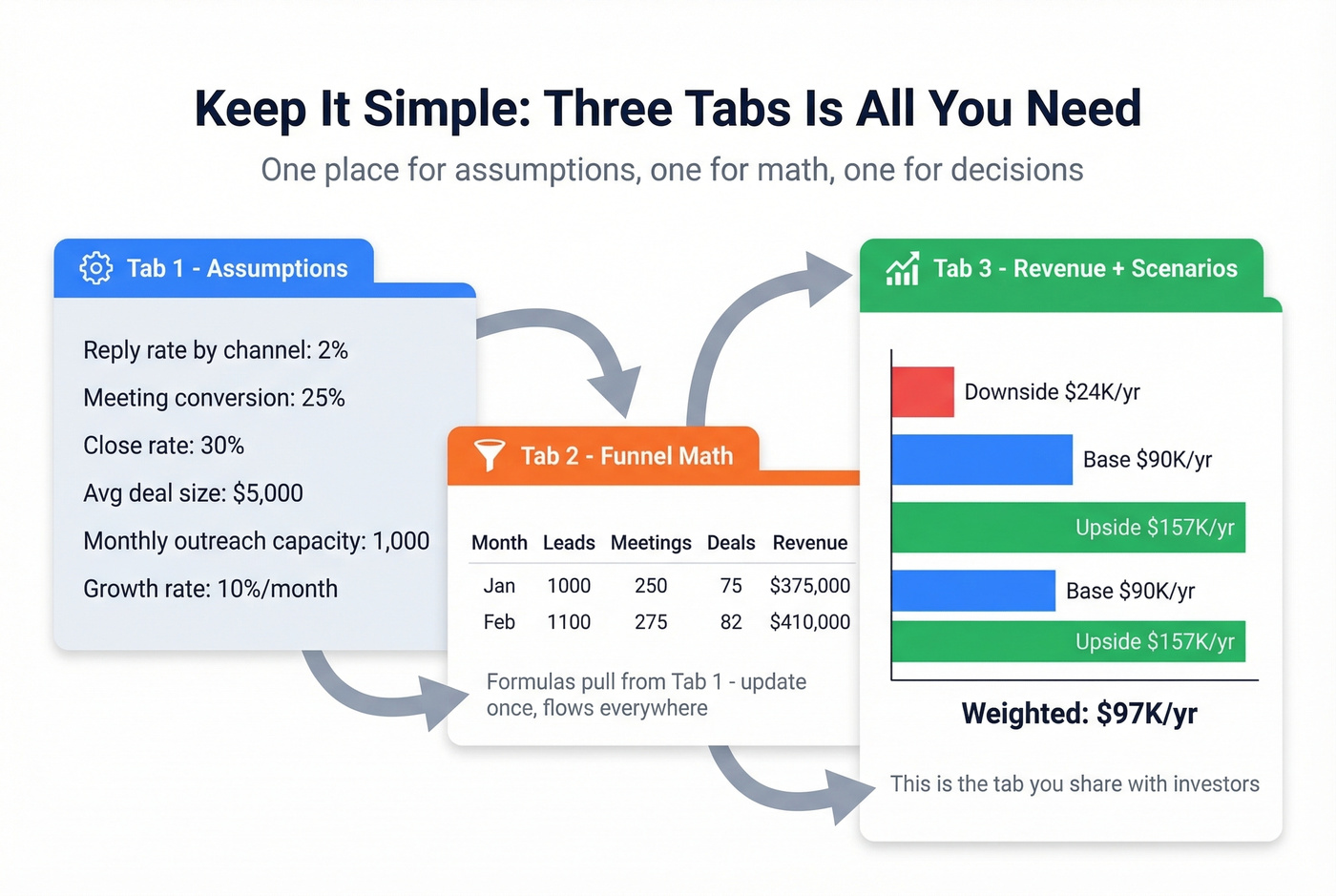
Tab 1 - Assumptions. Conversion rates by channel, average deal size, channel capacity, monthly growth rate. Every number that feeds your model lives here so you can update in one place.
Tab 2 - Funnel math. Monthly rows with columns for leads, meetings, deals, and revenue, broken out by channel. Formulas pull from Tab 1. If you're running a subscription model, add rows for churn, expansion revenue, and net MRR.
Tab 3 - Revenue + scenarios. Base, upside, and downside with probability-weighted totals. This is the tab you share with investors and your board.
The MaRS workbook gives you a solid starting template if you don't want to build from scratch. Don't overcomplicate it - a model with 15 tabs and 200 assumptions is harder to maintain and easier to break than a clean three-tab setup.
Mistakes That Kill Credibility
Investors can smell a top-down forecast from across the table. Here are the five mistakes that destroy credibility fastest:
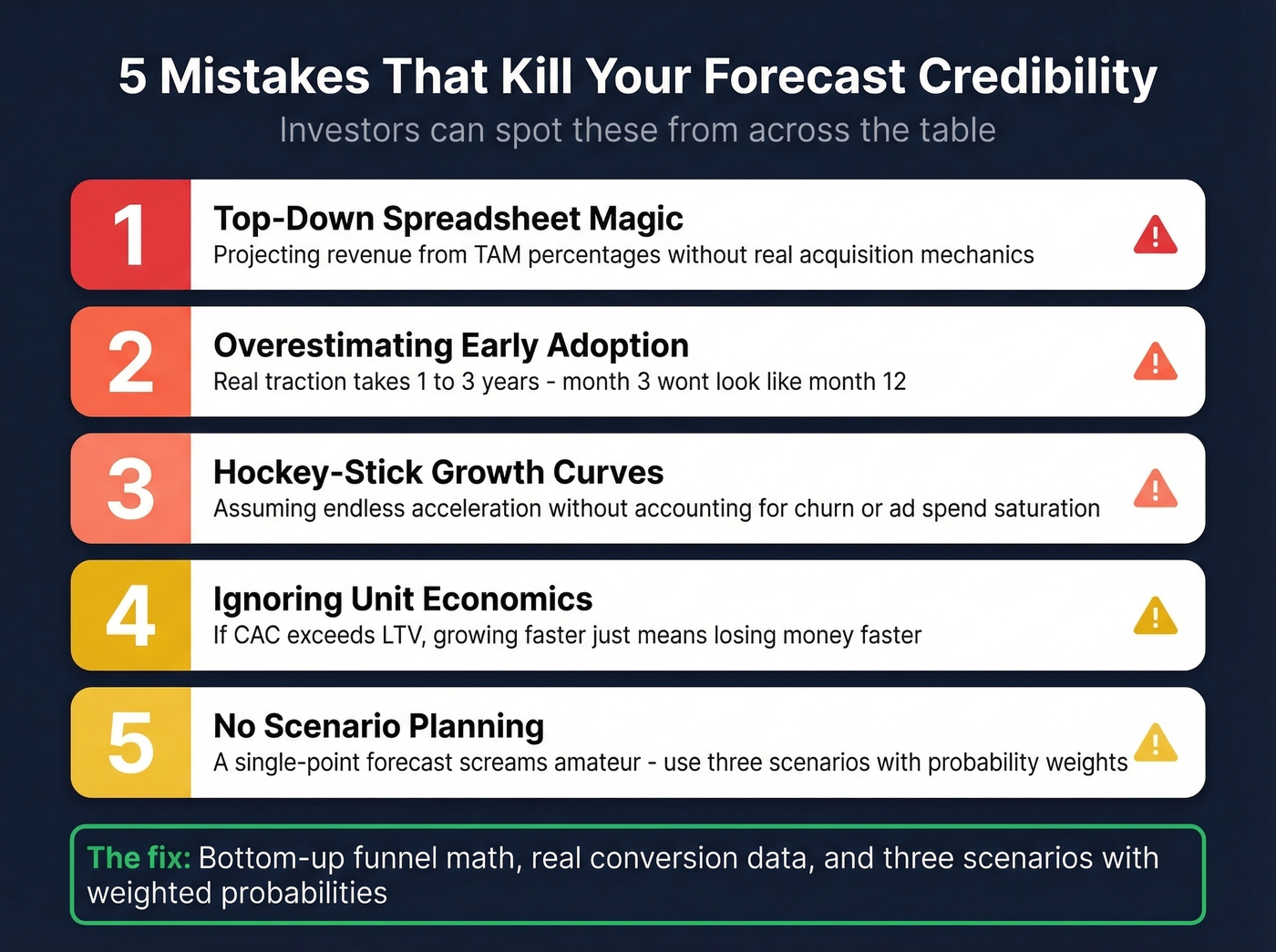
- Top-down spreadsheet magic - projecting revenue from TAM percentages without connecting it to acquisition mechanics or channel capacity. It's the #1 red flag.
- Overestimating early adoption - real traction typically takes 1-3 years. Your month-three revenue won't look like your month-twelve revenue, and that's fine.
- Hockey-stick growth curves - we've seen founders lose investor credibility over this more than any other single mistake. Assuming endless acceleration without accounting for saturation, churn, or diminishing returns on ad spend is a fantasy.
- Ignoring unit economics - if your customer acquisition cost exceeds lifetime value, growing faster just means losing money faster. Run a break-even analysis before you scale.
- No scenario planning - a single-point forecast screams amateur. Three scenarios with probability weights show you've thought about what could go wrong.
Update and Improve
Your forecast isn't a document you file away. It's a living financial model.
Update monthly at minimum. If you're running a high-velocity sales pipeline with short deal cycles, update weekly. A common theme in Reddit's r/smallbusiness threads is that forecasts go stale within days in fast-moving B2B contexts, and probability-weighting every deal is exhausting but necessary. Bedford Consulting recommends shifting from static annual forecasts to rolling forecasts that incorporate new data continuously - for a new business, that advice is especially relevant.
No investor expects month-one accuracy. Your first 90 days will have wide variance - 30-50% accuracy is normal. By month six, you should be tightening toward the 50-70% range that average B2B teams hit. World-class organizations reach 80-95%, but that takes years of data and disciplined CRM hygiene. The goal early on isn't precision - it's structured learning. Every month, your assumptions get replaced by real numbers, and your forecast gets sharper.
Let's be honest: most new businesses don't fail because their forecast was wrong. They fail because they never updated it. A forecast that's 40% accurate but revised weekly will outperform a "perfect" model that sits untouched in a Google Drive folder. Treat your forecast like a product - ship it, measure it, iterate.
Running a pilot to validate your forecast? The quality of your prospect data determines whether those conversion rates mean anything. Prospeo's 7-day data refresh and 5-step verification ensure your test outreach hits real inboxes - so your base, upside, and downside scenarios reflect reality, not stale contacts.
Validate your forecast with data that's never more than 7 days old.
FAQ
How accurate should a new business forecast be?
Expect 30-50% accuracy in the first 90 days - that's completely normal. By month six, aim for 50-70%, which is the average B2B benchmark. World-class teams hit 80-95% after years of data. The early goal is structured learning, not precision.
What's the simplest sales forecasting formula?
Prospects you can reach x conversion rate x average deal size x time period. For example: 500 outbound emails/month x 1.5% close rate x $5,000 deal = $37,500/month. Adjust monthly as real data replaces your initial estimates.
Should I use top-down or bottom-up forecasting?
Both, but in the right order. Use top-down (TAM/SAM/SOM) as a ceiling check to confirm your market is large enough. Then build your actual forecast bottom-up from funnel math - prospects, conversion rates, and deal sizes you can control and measure.
How do I find prospects to validate my forecast?
Use a B2B data platform with filters for industry, job title, company size, and other firmographic criteria. Build a list matching your ideal customer profile, verify emails before sending, and use results to validate funnel assumptions. Prospeo's free tier at prospeo.io gives you 75 verified emails per month to get started.