

How to Create a B2B Sales Funnel That Doesn't Leak
B2B buyers spend 17% of their total purchase time meeting with suppliers. When they're comparing three vendors, that's 5-6% of their time per supplier. The traditional funnel wasn't built for this. It was designed for a world where buyers depended on salespeople - a single-buyer consumer model shoved into complex B2B deals with committees, long cycles, and self-directed research. That world is gone, and teams still running the old playbook are watching leads evaporate before reps get a conversation.
Here's the thing: the fix isn't complicated. It's just specific. You need stages with real exit criteria, data that doesn't bounce, and benchmarks that tell you where the leaks actually are.
What You Need (Quick Version)
- Define your ICP and buying committee - multi-thread 3-5 contacts per account
- Map CRM stages with exit criteria - no deal advances without meeting them
- Feed the funnel with verified data, not stale lists that bounce 10%+
- Measure stage-by-stage conversion rates against benchmarks, not gut feel
Funnel vs. Pipeline vs. Flywheel
A funnel tracks aggregate conversion rates across buyer stages - what percentage of MQLs become SQLs. A pipeline tracks individual deals and seller actions: where a specific deal sits, who owns it, what's next. You need both. Funnel for forecasting, pipeline for execution.
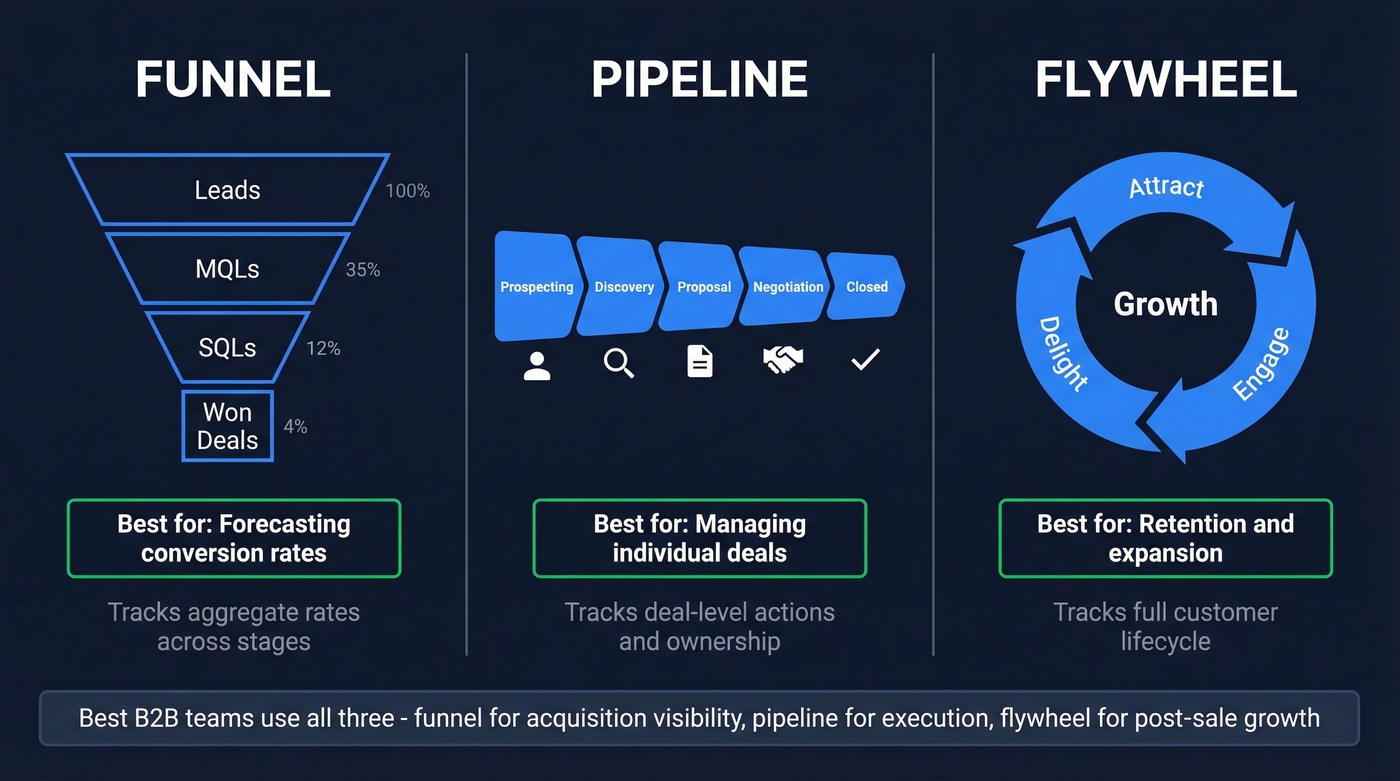
Modern B2B deals involve 8-13 stakeholders and run 3-12 month cycles. The flywheel crowd has a point - funnels ignore retention and expansion entirely. The best teams we've seen blend both: funnel for acquisition visibility, flywheel thinking for post-sale growth.
Build Your B2B Sales Funnel in 6 Steps
1. Define Your ICP and Buying Committee
Every deal has a committee, and every member needs different proof:
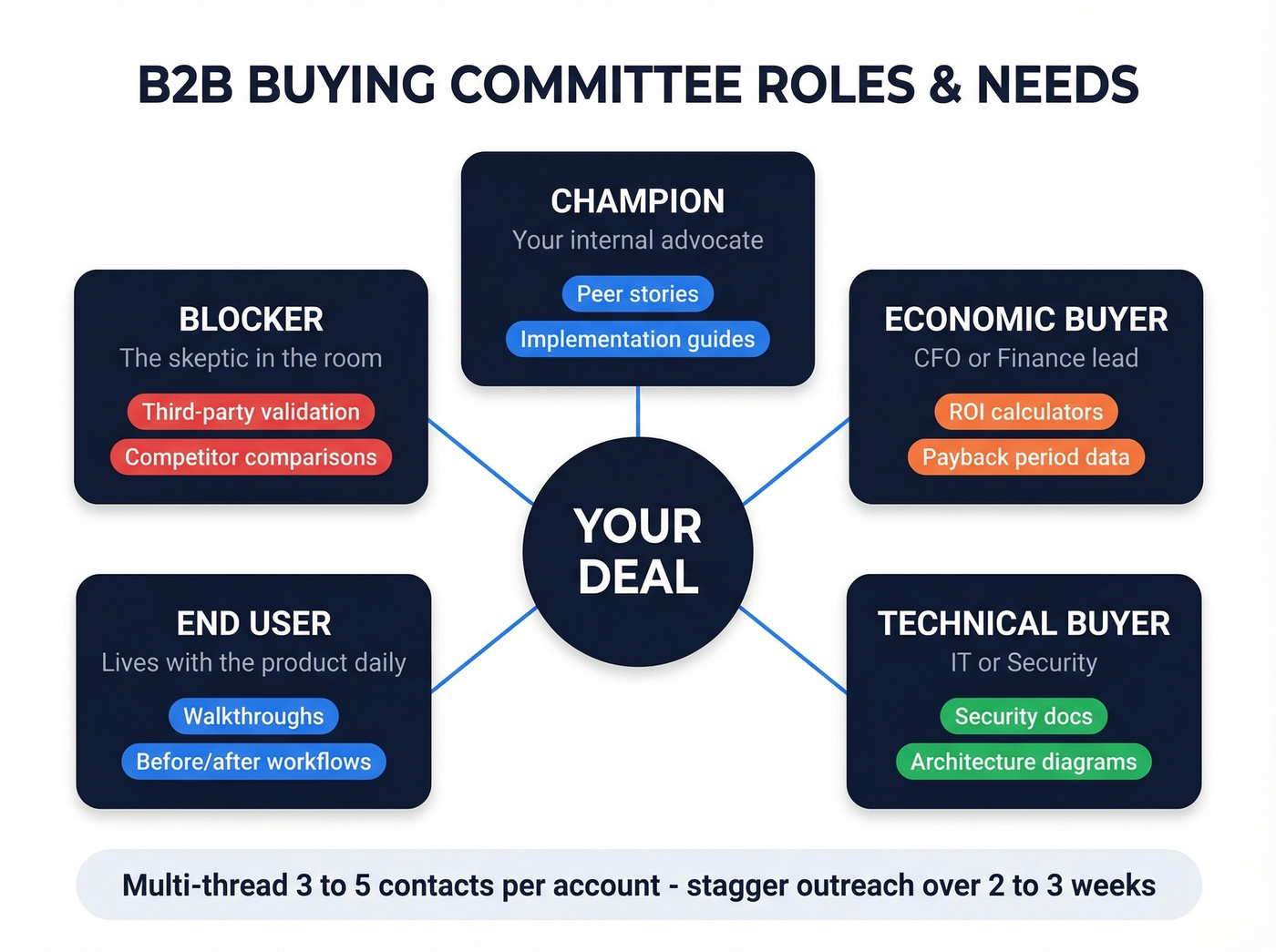
- Champion - your internal advocate. Give them peer stories and implementation guides.
- Economic Buyer (CFO/Finance) - controls budget. Needs ROI calculators and payback period data.
- Technical Buyer (IT/Security) - evaluates feasibility. Needs security docs and architecture diagrams.
- End User - lives with the product daily. Needs walkthroughs and before/after workflows.
- Blocker - the skeptic. Needs third-party validation and competitor comparisons.
Multi-thread 3-5 contacts per account and stagger outreach over 2-3 weeks. Hitting one person and hoping they'll champion internally is how deals die quietly. We've watched this pattern kill six-figure opportunities - a single thread goes dark and there's nobody else in the account who even knows your name.
2. Map Content to Each Stage
75% of B2B research happens before a buyer talks to a rep. Your content has to do the selling your reps can't.
| Stage | Buyer Action | Your Content |
|---|---|---|
| TOFU (Awareness) | Researching the problem | Blog posts, industry reports, benchmarks |
| MOFU (Consideration) | Evaluating solutions | Case studies, ROI calculators, webinars |
| BOFU (Decision) | Choosing a vendor | Proposals, security docs, pricing, references |
Skip this if your sales cycle is under two weeks and deal sizes are small. For anything with a buying committee, though, content gaps at MOFU are where most funnels starve.
3. Set CRM Stages and Exit Criteria
A Vantage Point study found 56% of teams rate their pipeline management as poor or neutral - and effective pipeline management drives up to 15% more revenue. In our experience, teams that skip exit criteria end up with bloated pipelines full of zombie deals that inflate forecasts and waste everyone's time.
Every stage needs an exit criterion. No exceptions. Track these fields at minimum: deal stage with defined exit criteria, win probability tied to stage, expected close date, deal size and owner, next steps with a date.
Don't have a CRM yet? Start with a Google Sheet. A disciplined spreadsheet beats a misconfigured Salesforce instance every time. If you need examples of what “good” looks like, start with CRM setups that match your motion.
4. Build Your Data Foundation
Bad data is a silent funnel killer. Bounced emails waste your TOFU ad spend. Wrong phone numbers kill MOFU outreach. Stale contacts fill your pipeline with ghosts who changed jobs six months ago. No amount of funnel optimization compensates for a rotten data layer underneath.
Prospeo addresses this at the source - 300M+ professional profiles with 98% email accuracy and a 7-day data refresh cycle versus the six-week industry average. You get 30+ search filters including buyer intent, technographics, job changes, and headcount growth, so lists match your ICP from the start. There's a free tier with 75 emails and 100 Chrome extension credits per month to test it before committing anything. One proof point worth noting: Meritt's bounce rate dropped from 35% to under 4% after switching, and their pipeline tripled from $100K to $300K per week. If you’re comparing providers, data enrichment is the category to evaluate, not just “lead lists.”

5. Automate the Repetitive Stuff
61% of businesses using sales automation exceeded their annual targets, and teams using automation close deals 23% faster. Meanwhile, reps spend only 28% of their time actually selling. The rest? Data entry, scheduling, internal updates, searching for contact info.
The average B2B sales team uses 10+ tools. Reps actively use about three. Don't build a stack - build a workflow. Pick tools that live where your reps already work and automate the handoffs between them. If a tool requires a separate tab and a separate login, it won't get used. If you’re building this out, start with sales funnel automation that reduces admin work without breaking deliverability.
6. Measure and Fix Leaks
HubSpot data shows 61% of B2B marketers send all leads directly to sales - but only 27% are actually qualified. The MQL-to-SQL handoff is the #1 leak point in most funnels.
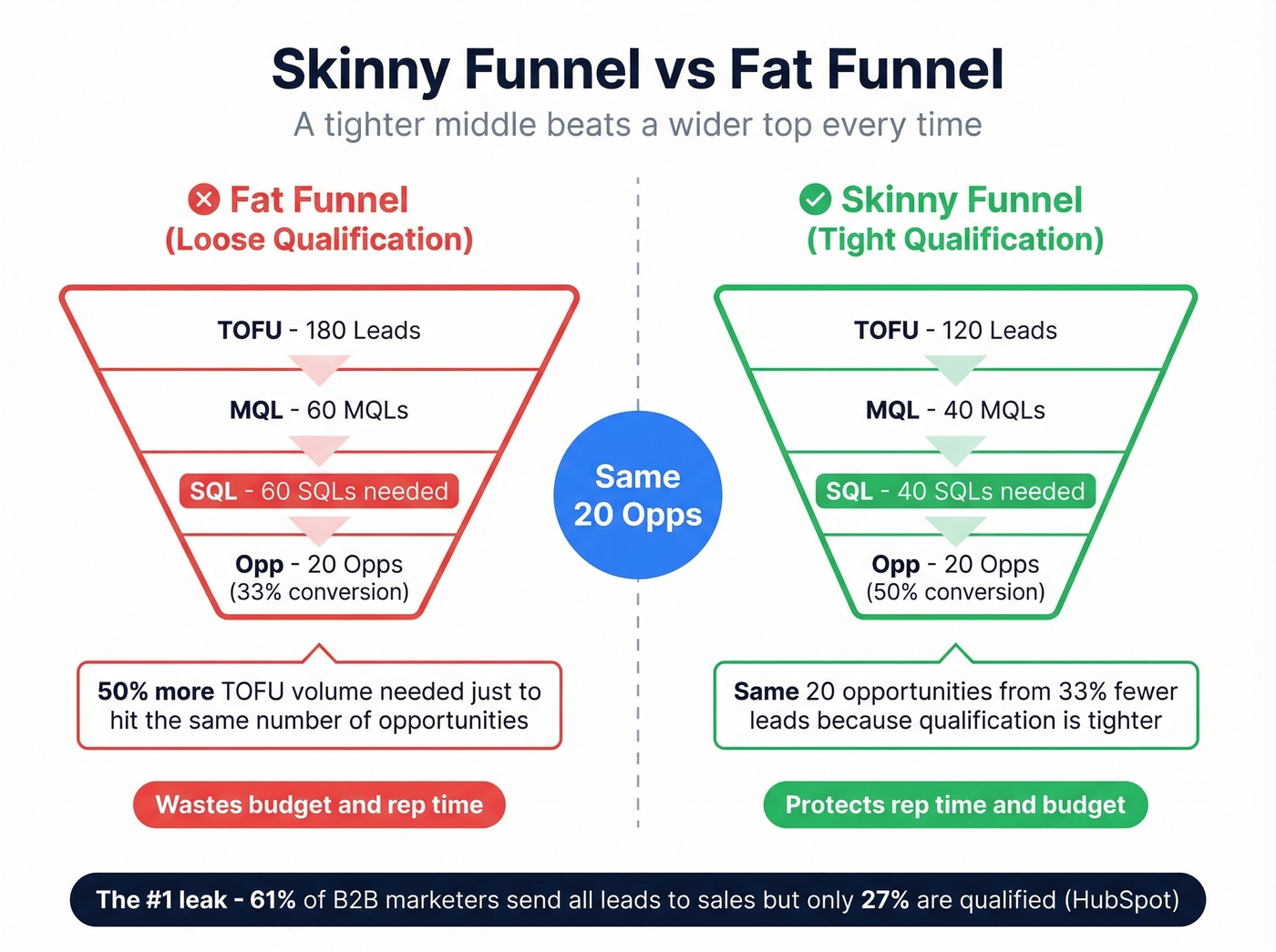
Most teams need a skinnier funnel, not a fatter one. A skinny funnel that disqualifies early protects your team's time better than a fat funnel full of unqualified leads. Let's break down the math: if your SQL-to-Opp rate is 50%, you need 40 SQLs to get 20 opportunities. Drop that rate to 33% and you suddenly need 60 SQLs for the same 20 opps - that's 50% more TOFU volume just to compensate for loose qualification. Tighten the middle of your funnel before you spend another dollar widening the top. If you want a clean KPI set, use funnel metrics to diagnose where the math breaks.

Every funnel leak starts with bad data. Prospeo gives you 300M+ profiles with 98% email accuracy, refreshed every 7 days - not 6 weeks. Use 30+ ICP filters including buyer intent and job changes to multi-thread the right buying committee from day one.
Stop losing deals to bounced emails and stale contacts.
Benchmarks by Industry
Here are stage-by-stage conversion benchmarks from First Page Sage, based on data collected from 2017-2025:
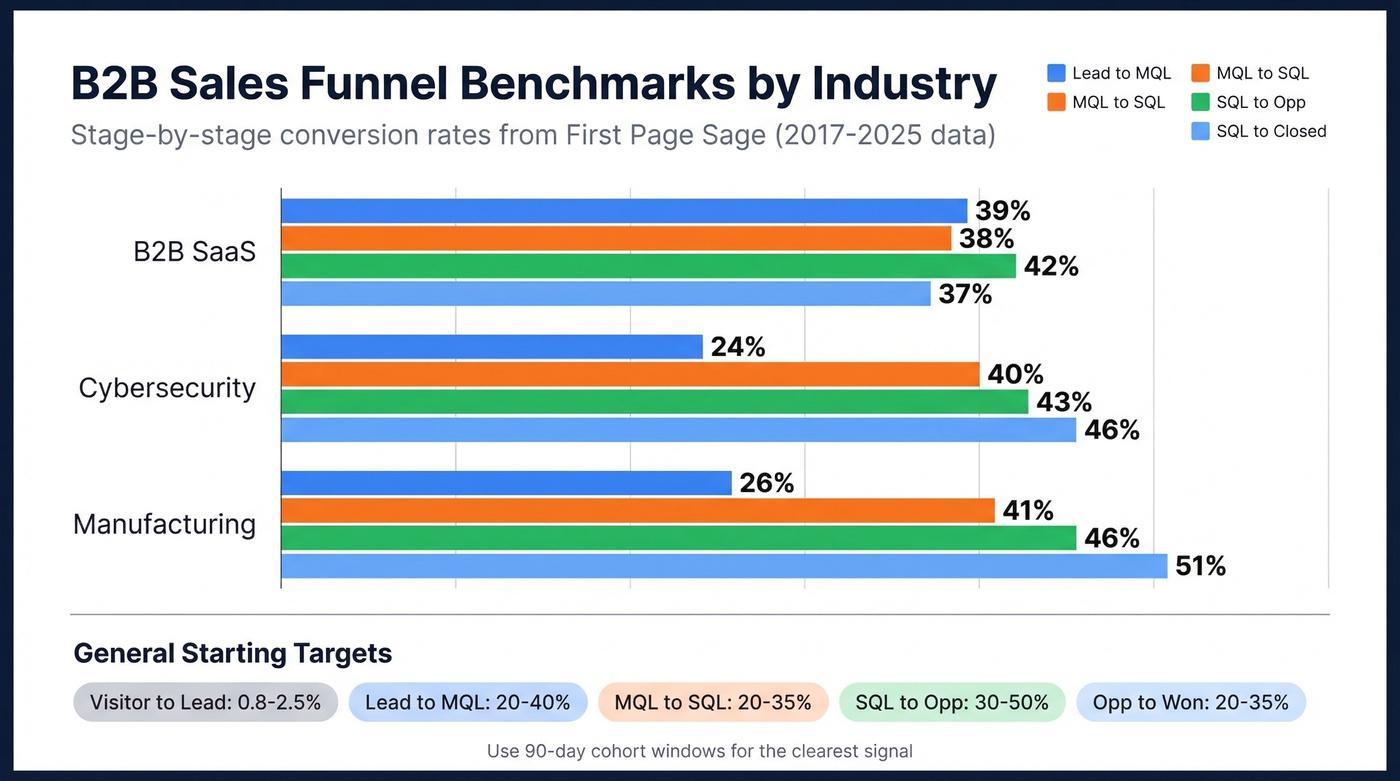
| Industry | Lead-to-MQL | MQL-to-SQL | SQL-to-Opp | SQL-to-Closed |
|---|---|---|---|---|
| B2B SaaS | 39% | 38% | 42% | 37% |
| Cybersecurity | 24% | 40% | 43% | 46% |
| Manufacturing | 26% | 41% | 46% | 51% |
If you don't have industry-specific data yet, use these general bands as starting targets: Visitor-to-Lead 0.8-2.5%, Lead-to-MQL 20-40%, MQL-to-SQL 20-35%, SQL-to-Opp 30-50%, Opp-to-Won 20-35%. For more context, compare against the average B2B lead conversion rate and then adjust to your channel mix.
We've found 90-day cohort windows give the clearest signal. Anything shorter and you're reacting to noise.
Sales Velocity Formula
This is the single number that tells you how fast your funnel generates revenue:
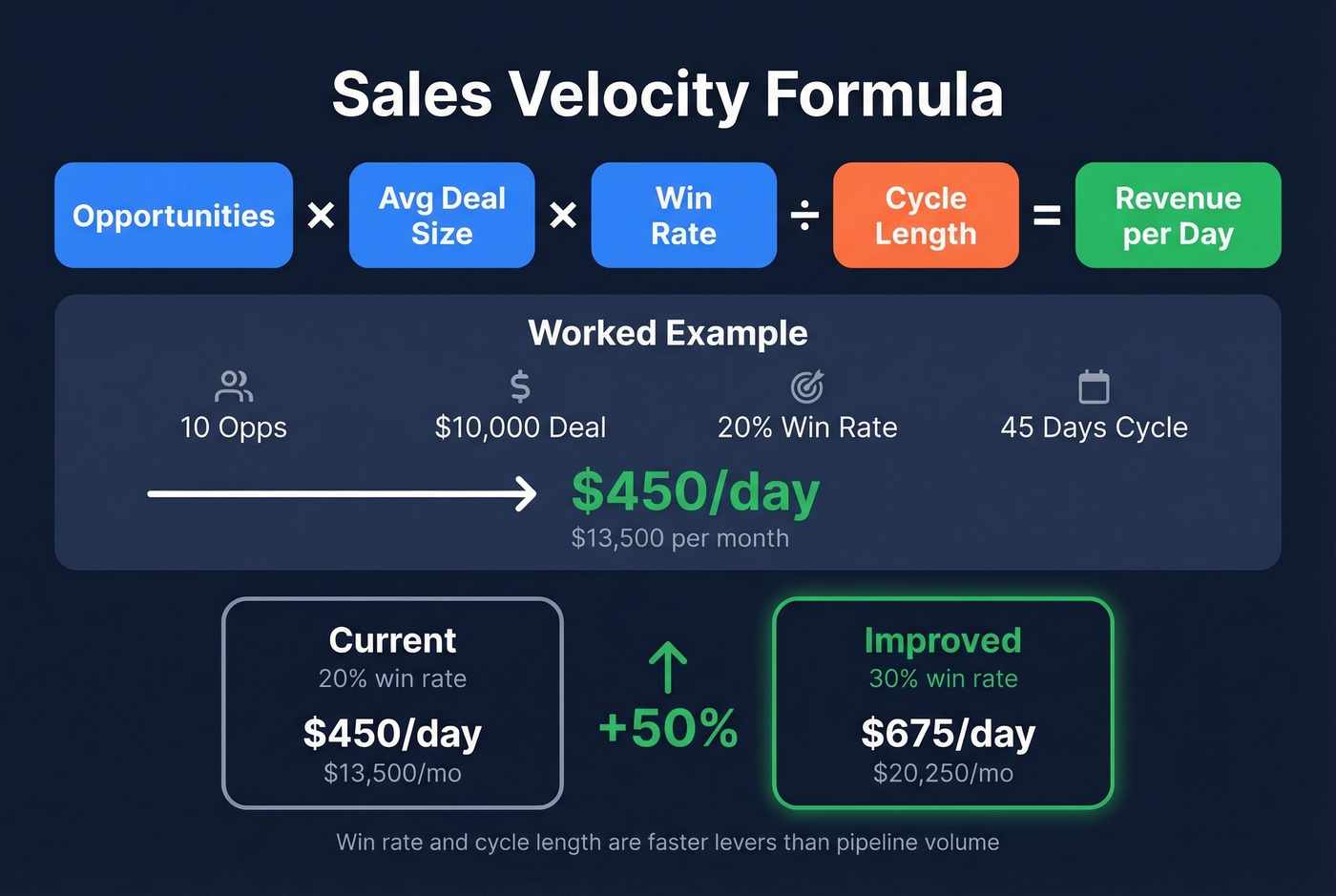
Sales Velocity = (Opportunities x Avg Deal Size x Win Rate) / Sales Cycle Length
Worked example: 10 opportunities x $10,000 avg deal x 20% win rate / 45 days = $450/day ($13,500/month).
Push win rate from 20% to 30% and velocity jumps to $675/day - a 50% increase from a single lever. That's why measuring each variable independently matters more than obsessing over total revenue. The consensus on r/sales is that most teams fixate on pipeline volume when win rate and cycle length are faster levers to pull. If you’re trying to forecast this reliably, pair velocity with pipeline health metrics.
Essential Tools for Each Stage
| Tool | Best For | Starting Price |
|---|---|---|
| Prospeo | Prospecting and data (TOFU-MOFU) | Free; ~$0.01/email |
| HubSpot CRM | Pipeline management (all stages) | Free; Sales Hub from ~$15-$20/mo |
| Apollo | Sequences + prospecting (MOFU-BOFU) | Free; from ~$49/mo |
| Pipedrive | Pipeline for SMBs (all stages) | From ~$14/mo |
| Zapier | Workflow automation (all stages) | Free; from ~$20/mo |
Start with three tools: a CRM, a data source, and a sequencing tool. Add everything else later. I've seen teams burn months evaluating twelve platforms when three would've had them selling by week two. If you’re building an SDR stack, use a ranked list of SDR tools to avoid tool sprawl.
Meritt tripled their pipeline from $100K to $300K/week and cut bounce rates from 35% to under 4%. The difference wasn't a new funnel framework - it was feeding their funnel with verified data instead of hoping stale lists would convert.
Start with 75 free verified emails and see what clean data does to your conversion rates.
FAQ
What's the difference between a sales funnel and a sales pipeline?
A funnel tracks aggregate conversion rates across buyer stages (e.g., 35% of MQLs become SQLs). A pipeline tracks individual deals and seller actions - who owns it, what's next. You need both: the funnel for forecasting, the pipeline for day-to-day execution.
How long does it take to build a B2B sales funnel?
You can set up CRM stages and start tracking in a single day. Meaningful benchmark data takes 90 days of consistent measurement. Most teams see reliable patterns after two full sales cycles - typically 6-12 months for enterprise deals, faster for SMB motions.
How do I fill the top of the funnel with quality leads?
Start with a verified data source that lets you filter by ICP criteria - job title, industry, company size, buyer intent. Pair that with content addressing early-stage questions your buyers already search for. The combination of targeted outbound and inbound content that answers real questions is what keeps TOFU healthy without flooding your pipeline with junk.
What's a good MQL-to-SQL conversion rate?
For most B2B companies, 20-35% is healthy. B2B SaaS teams average around 38%, while cybersecurity hovers near 40%. If you're below 15%, your lead scoring criteria or qualification definitions likely need tightening - the problem is almost always at the definition layer, not the volume layer.