

How to Create a Sales Strategy That Doesn't Collect Dust
95% of new products fail. Most sales strategies fail for the same reason - they're built on vibes instead of math, then abandoned by February. If you're figuring out how to create a sales strategy that actually drives revenue, the answer is simple: keep it short, specific, and rooted in real numbers.
Whether you're refining an enterprise playbook or building a first-pass process for a startup, the fundamentals don't change.
Sales Strategy vs. Sales Plan
A sales strategy is your direction - the principles, positioning, and market bets that guide every decision. A sales plan is the execution layer: territories, quotas, timelines, comp structures, and resourcing. Teams with strategic plans see 30% productivity improvements within the first year because everyone cuts busywork and focuses on high-impact work.
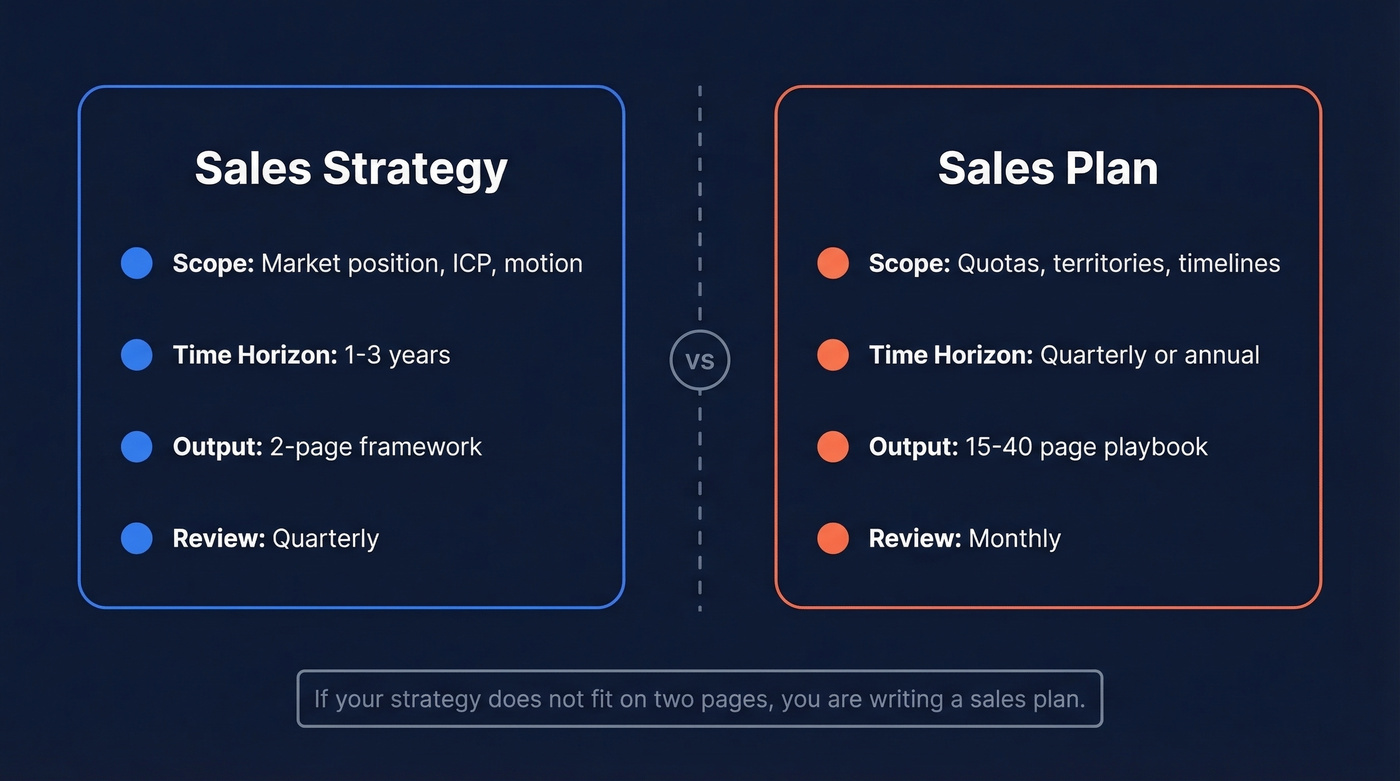
| Dimension | Sales Strategy | Sales Plan |
|---|---|---|
| Scope | Market position, ICP, motion | Quotas, territories, timelines |
| Time horizon | 1-3 years | Quarterly / annual |
| Output | 2-page framework | 15-40 page playbook |
| Review cadence | Quarterly | Monthly |
If your strategy doesn't fit on two pages, you're writing a sales plan and calling it a strategy.
B2B vs. B2C - Why It Matters
B2C: one person sees an ad, feels something, buys. Hours or days. B2B is structurally different. A typical B2B buying group includes 6-10 stakeholders, each with different priorities. Finance cares about ROI, IT cares about security, the end user cares about not hating the product.
Your B2B strategy needs to account for longer cycles (enterprise deals run 6-18 months), custom pricing, and multi-threaded selling. You're not convincing one person - you're building consensus across a committee. If your strategy doesn't address how you'll navigate that committee, it won't survive first contact with a real deal.
Pick Your Sales Methodology
A methodology gives your team a shared language for how deals move forward. Without one, every rep invents their own process, and pipeline reviews become chaos.
| Methodology | Best For | Complexity |
|---|---|---|
| SPIN Selling | Discovery-heavy sales | Medium |
| Challenger | Competitive markets | High |
| MEDDIC | Enterprise qualification | High |
| Consultative | Relationship-driven SMB | Low |
| Value-Based | High-ACV, ROI-driven | Medium |
MEDDIC is the gold standard for enterprise qualification - if you're selling six-figure deals with long cycles, it forces rigor on every opportunity. Challenger works when buyers think they already know what they need. For SMB and mid-market, Consultative selling is the right call because the relationship carries more weight than the framework.
Here's the thing: the mistake isn't picking the wrong methodology. It's picking two or three and letting reps choose. Pick one. Train on it. Reinforce it in pipeline reviews. A team running three methodologies is a team running none.

You just did the pipeline math - 305 opportunities to hit $2M. Now ask: how many of those opportunities die before they start because the email bounced? Prospeo delivers 98% email accuracy across 143M+ verified addresses, refreshed every 7 days. At $0.01 per email, building 305 real opportunities costs less than your team's coffee budget.
Stop feeding bad data into a good strategy. Start with 75 free verified emails.
8 Steps to Build Your Strategy
1. Audit Current Performance
Before you build anything new, diagnose what's broken. The average rep spends 60% of their time on non-selling activities - admin, CRM updates, internal meetings, searching for content. If reps aren't selling, no strategy fixes that. Process does.
Look for three patterns. Is your pipeline propped up by two or three top performers while everyone else treads water? That's a hiring or enablement problem. Are late-stage deals stalling quarter after quarter? That points to weak qualification. Count your "no decision" losses - if prospects ghost after demo, your value prop isn't landing with the buying committee.
2. Set Revenue Targets With Pipeline Math
Revenue targets mean nothing without the pipeline math to back them.
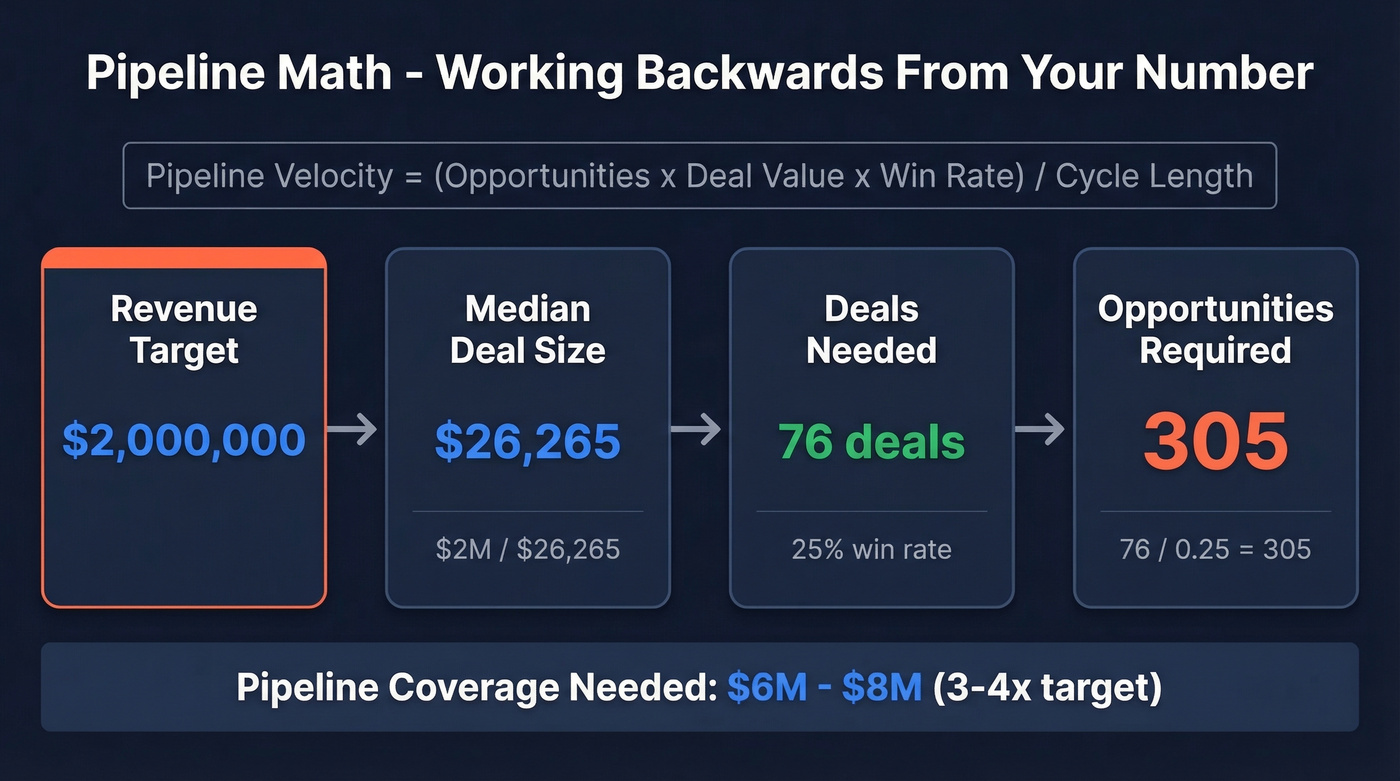
Pipeline Velocity = (Opportunities x Deal Value x Win Rate) / Cycle Length
Say you need $2M in new revenue this quarter. The median private SaaS deal size is $26,265, and your win rate is 25%. That means you need about 305 opportunities to close enough business:
- Required closed deals: $2,000,000 / $26,265 = 76 deals
- Required opportunities: 76 / 0.25 = 305 opportunities
At 3-4x pipeline coverage, that's $6-8M in qualified pipeline behind the number.
If those numbers look aggressive, they should. Most teams under-build pipeline because they forecast with hope instead of math. Work backwards from the number, and your activity targets - calls, emails, meetings - become obvious.
3. Define Your ICP - And Your Disqualifiers
Every team has an ICP doc. Few teams have a disqualification list. That's the gap.
Bad-fit deals consume the same resources as good-fit deals - they just don't close. Your ICP should include firmographics like industry, headcount, revenue, and geography. Layer on technographics - what tools they already use - and behavioral signals such as hiring patterns, funding events, and intent data. But the disqualification criteria keep your team honest. If companies under 50 employees never close, write that down. If a specific industry churns at 3x your average, flag it.
And remember: 6-10 stakeholders. Your ICP isn't just a company profile. It's a map of the people inside that company who need to say yes.
4. Map Your Process Stage by Stage
Every deal moves through defined steps: Lead, MQL, SQL, Opportunity, Closed-Won. The value isn't the stages - it's defining exit criteria for each one. What has to be true for a lead to become an MQL?
The biggest drop-off in most funnels is MQL to SQL. Benchmark data puts that conversion at 15%, meaning 85% of marketing-qualified leads never become sales-qualified. If your number is worse, the problem is usually misalignment between marketing's definition of "qualified" and sales' definition of "worth my time." Fix the handoff criteria before you fix anything else.
5. Build Your Pipeline Engine
Your pipeline needs two fuel sources: inbound and outbound. Inbound - content, SEO, events, paid - builds over time and compounds. Outbound - cold email, cold call, social selling - gives you control and speed. Most teams need both.
Here's where data quality becomes infrastructure, and honestly, it's where we've seen the most teams shoot themselves in the foot. I've watched teams send 10,000 emails and get 2,200 bounces. That's not wasted effort - it's active damage. High bounce rates tank sender reputation, which means even good emails land in spam. Contacting leads within 24 hours increases conversion by 5x, but speed is worthless if the contact data is wrong.
We use Prospeo for outbound data - 98% email accuracy on 143M+ verified addresses with a 7-day refresh cycle, compared to the six-week industry average. The free tier gives you 75 verified emails per month, enough to test before committing. For outbound agencies scaling client campaigns, the difference between 98% and 85% accuracy is the difference between healthy domains and blacklisted ones.
6. Equip Your Team
Your tech stack should cover four categories: CRM, data enrichment, analytics, and enablement content. Don't over-buy. Most teams pay for far more than they actually use.
On CRM: HubSpot has a free tier, and Salesforce offers a free trial. Paid CRM plans typically run $25-$150/user/month depending on edition and add-ons. Skip this section if you're pre-revenue - a spreadsheet and a verified email tool will get you further than a $150/seat CRM you won't configure properly.
Training matters more than tools. Most teams see real improvement in 1-2 quarters after implementing a new methodology, but only if managers reinforce it in every pipeline review. Buy the tool after you've built the habit.
7. Integrate AI Into Your Workflow
AI adoption in sales jumped from 24% to 43% between 2023 and 2024, and Gartner found that sellers who effectively partner with AI are 3.7x more likely to meet quota.
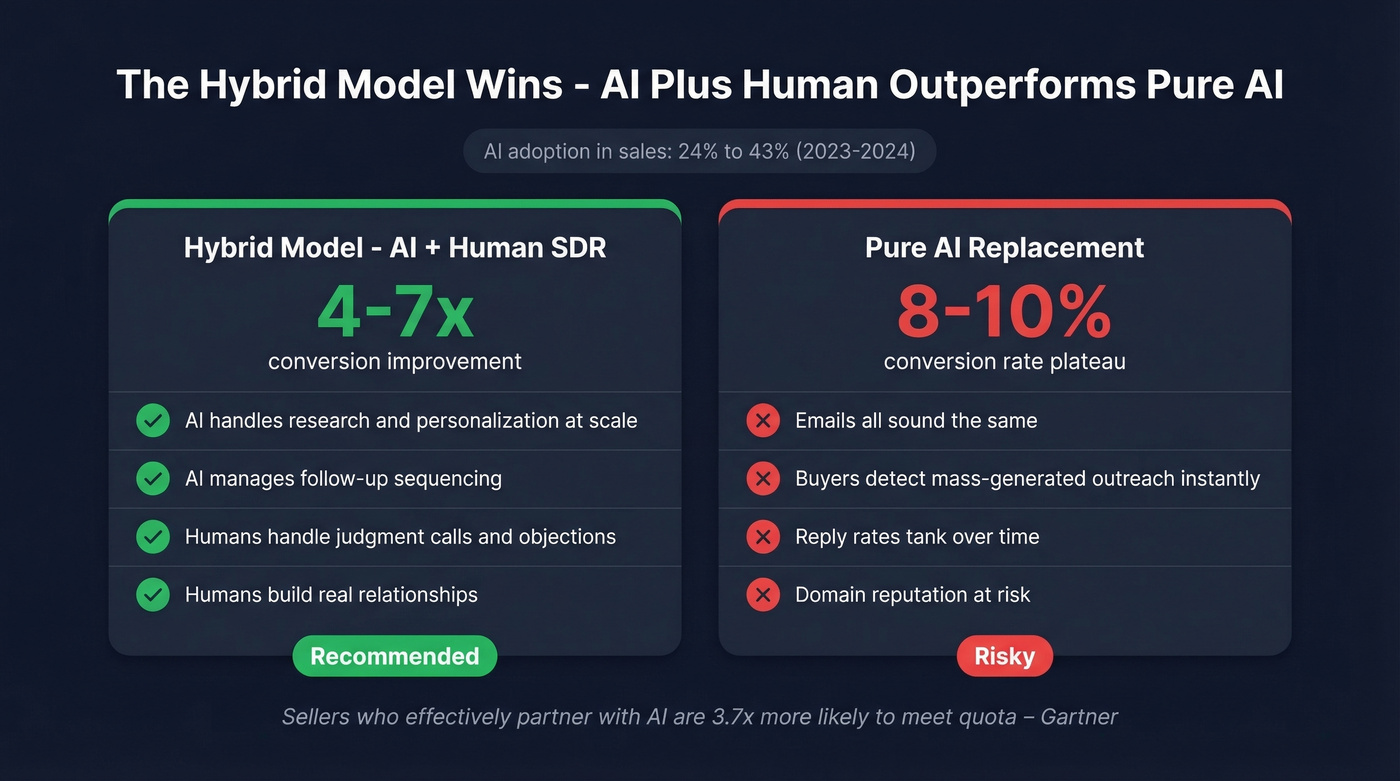
Let's be honest about what works here: the hybrid model is the only model that works. Teams combining AI automation with human SDR oversight see 4-7x conversion improvements. Pure AI replacement plateaus at 8-10% conversion rates. AI handles research, personalization at scale, and follow-up sequencing. Humans handle judgment calls, relationship building, and complex objection handling.
Over-automation - sending 5,000 AI-generated emails that all sound the same - is the fastest way to destroy a domain. The consensus on r/sales is pretty clear on this: buyers can smell mass-generated outreach instantly, and it tanks reply rates.
8. Measure, Diagnose, Iterate
The single most useful diagnostic metric is pipeline velocity. It combines four variables into one number that tells you whether your engine is accelerating or stalling.
| Indicator Type | Examples | Frequency | Signal |
|---|---|---|---|
| Leading | Calls, emails, meetings booked | Weekly | Activity health |
| Leading | New opportunities created | Weekly | Pipeline generation |
| Lagging | Win rate, revenue closed | Monthly | Execution quality |
| Lagging | Deal size, cycle length | Monthly | Market fit |
Review the strategy quarterly. Adjust tactics monthly. If you increased outbound volume and meetings didn't move, the problem is targeting or messaging, not effort. Lagging indicators take 3-6 months to reflect strategic changes - don't panic-pivot after one bad month.
Your Strategy Document - Section by Section
If your strategy document is longer than two pages, people won't read it. Here's what belongs:
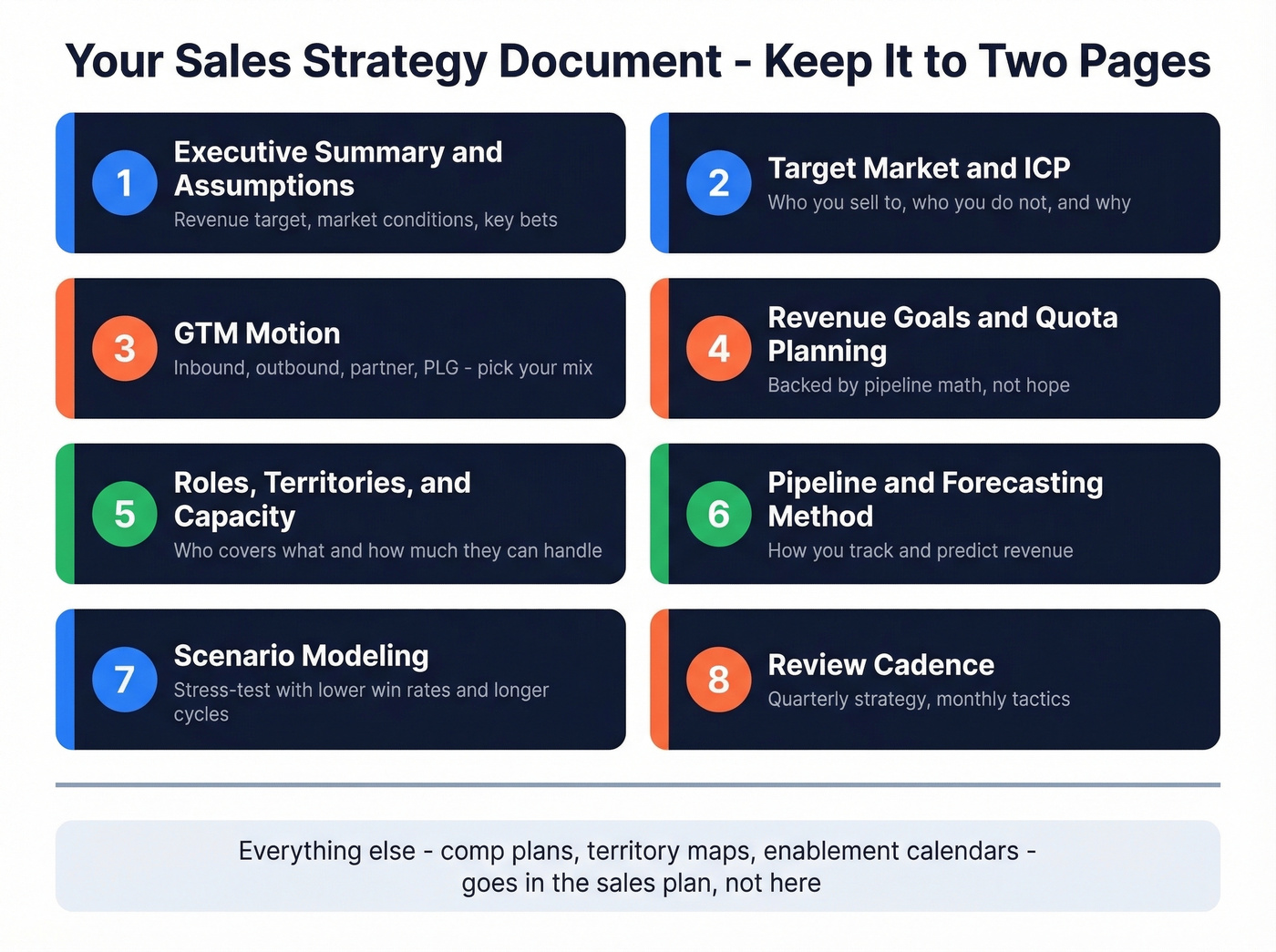
- Executive summary & assumptions - revenue target, market conditions, key bets
- Target market & ICP - who you're selling to, who you're not, and why
- GTM motion - inbound, outbound, partner, PLG - pick your mix
- Revenue goals & quota planning - backed by pipeline math
- Roles, territories & capacity planning
- Pipeline & forecasting methodology
- Scenario modeling - stress-test your targets with lower win rates, longer cycles, and customer mix shifts
- Review cadence - quarterly strategy review, monthly tactical adjustment
Everything else - comp plans, territory maps, enablement calendars - goes in the sales plan.
Funnel Benchmarks for 2026
These benchmarks come from aggregated 2024-2025 SaaS data. We've found they hold up well for mid-market B2B, though enterprise and SMB will skew in opposite directions.
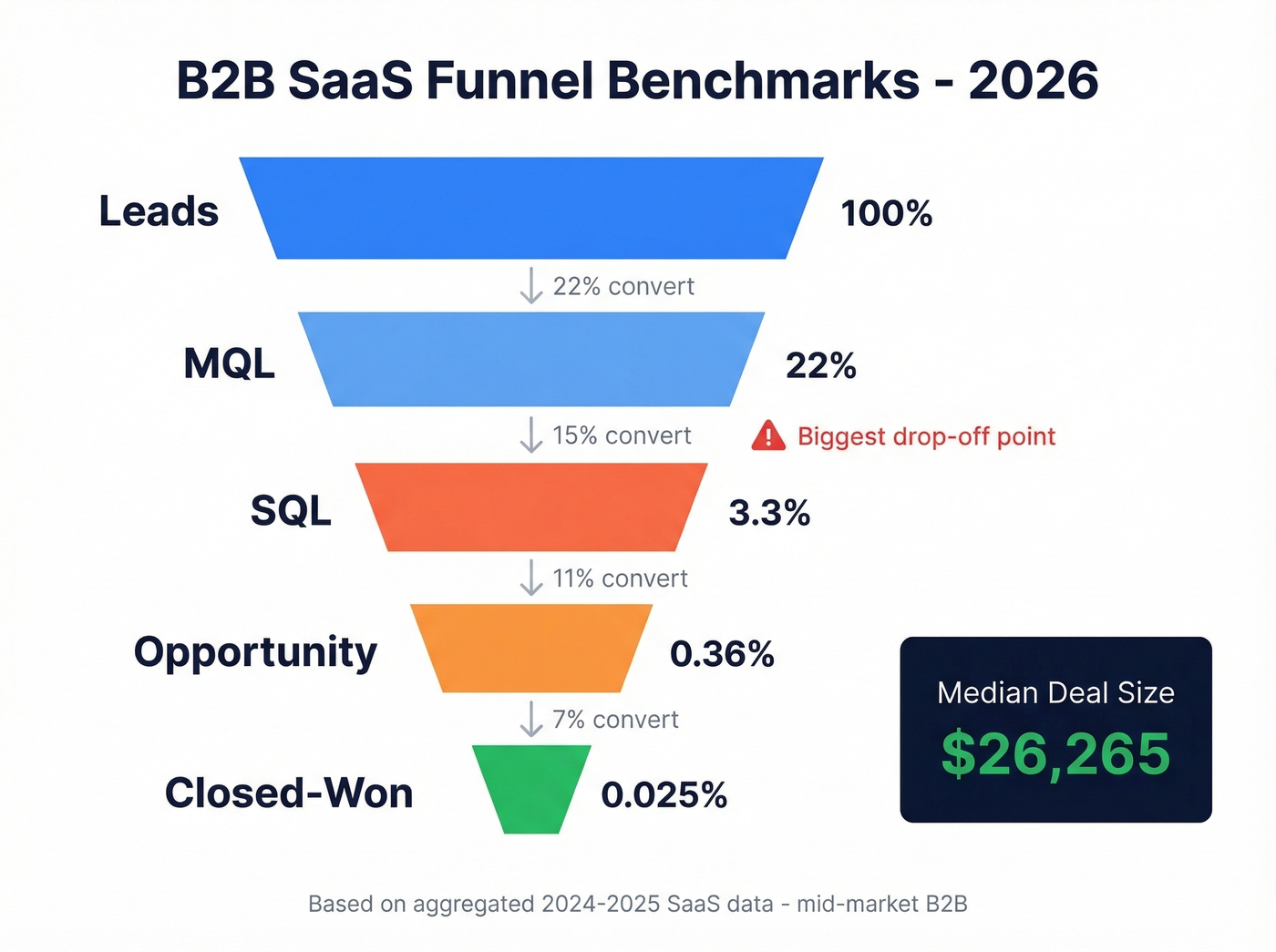
| Stage | Benchmark Rate | Notes |
|---|---|---|
| Lead to MQL | 22% | Varies heavily by channel and offer |
| MQL to SQL | 15% | Biggest drop-off point |
| SQL to Opportunity | 11% | Qualification quality matters |
| Opp to Closed-Won | 7% | Enterprise runs lower |
| Median deal size | $26,265 | Private SaaS median; enterprise skews higher |
The median sales cycle runs 84 days, with an optimal range of 46-75 days. Win rates land between 20-30%. If your numbers are significantly below these benchmarks at any stage, that's where to focus first. Don't try to fix everything - find the leakiest stage and plug it.
Mistakes That Kill Revenue
Not qualifying leads. Every unqualified deal in your pipeline steals time from a qualified one. Build disqualification criteria and enforce them.
Overusing scripts. Rigid scripts kill conversations. Give reps a framework and talk tracks, not a teleprompter.
Ignoring the buying committee. Selling to one champion and hoping they'll convince the CFO is a strategy for "no decision" losses. In our experience, deals where reps multi-thread to 3+ stakeholders close at nearly double the rate of single-threaded ones.
Pitching too early. Reps who jump to the demo before understanding the problem close at half the rate. A strong intro that leads with a relevant insight - not a product pitch - sets the tone for the entire conversation.
No follow-up system. Bryan Vasquez, Head of Sales at LinkBuilder.io, increased his win rate by 20% over two quarters by replacing urgency-based CTAs with data-backed proposals and structured mutual action plans. That's not a methodology change - it's a discipline change. (If you need a starting point, use proven sales follow-up templates.)
Sales and marketing misalignment. If marketing's MQL definition doesn't match what sales considers worth pursuing, you're burning budget on both sides. One of the most common B2B mistakes is treating strategy as a one-time exercise. Markets shift, buyers evolve, competitors adjust - your strategy needs to keep pace.
Your ICP definition means nothing if you can't find the 6-10 stakeholders inside each account. Prospeo's 30+ search filters - buyer intent, technographics, headcount growth, funding signals - let you build targeted lists that match your exact disqualification criteria. Layer in intent data across 15,000 topics to reach buyers already in-market.
Turn your ICP doc into a live pipeline with verified contacts in minutes.
FAQ
What's the difference between a sales strategy and a sales plan?
A strategy defines your direction - target market, positioning, and selling principles - and fits on two pages. A sales plan is the execution layer: territories, quotas, timelines, comp structures, and resourcing. The strategy guides what you do; the plan dictates how and when.
How long does it take to see results?
Leading indicators like meetings booked shift within 2-4 weeks. Lagging indicators - win rate, closed revenue - take 3-6 months to reflect strategic changes. Expect meaningful behavior change in 1-2 quarters with consistent reinforcement.
What's a good pipeline coverage ratio?
Aim for 3-4x your revenue target in qualified pipeline. Below 3x means you're forecasting with hope. If your win rate is under 25%, push toward 4-5x to give yourself a realistic margin.
How often should I update my sales strategy?
Review quarterly, adjust tactics monthly. Monthly adjustments focus on what's working - messaging, channel mix, targeting. Quarterly reviews ask whether the market has shifted enough to change direction. Use Q1 as a forcing function to reset pipeline assumptions before bad habits calcify.
What tools do I need to execute a sales strategy?
Start with a CRM (HubSpot's free tier works), a verified data source for outbound, and basic analytics. Upgrade when you've outgrown free tiers - most teams over-buy tools before building the habits that make them useful.