

How to Do B2B Marketing: The 90-Day Playbook With Real Benchmarks
92% of B2B buyers already have a shortlist before they start researching solutions. Even more brutal: 41% walk in with a single vendor already in mind. If you're not on that shortlist, your ads, your content, your outreach - all of it is fighting for scraps.
We've watched teams burn entire quarters debating positioning while competitors booked meetings. This playbook is the antidote: a 90-day execution plan built on real benchmarks, not theory, so you can start building pipeline this week.
The Short Version
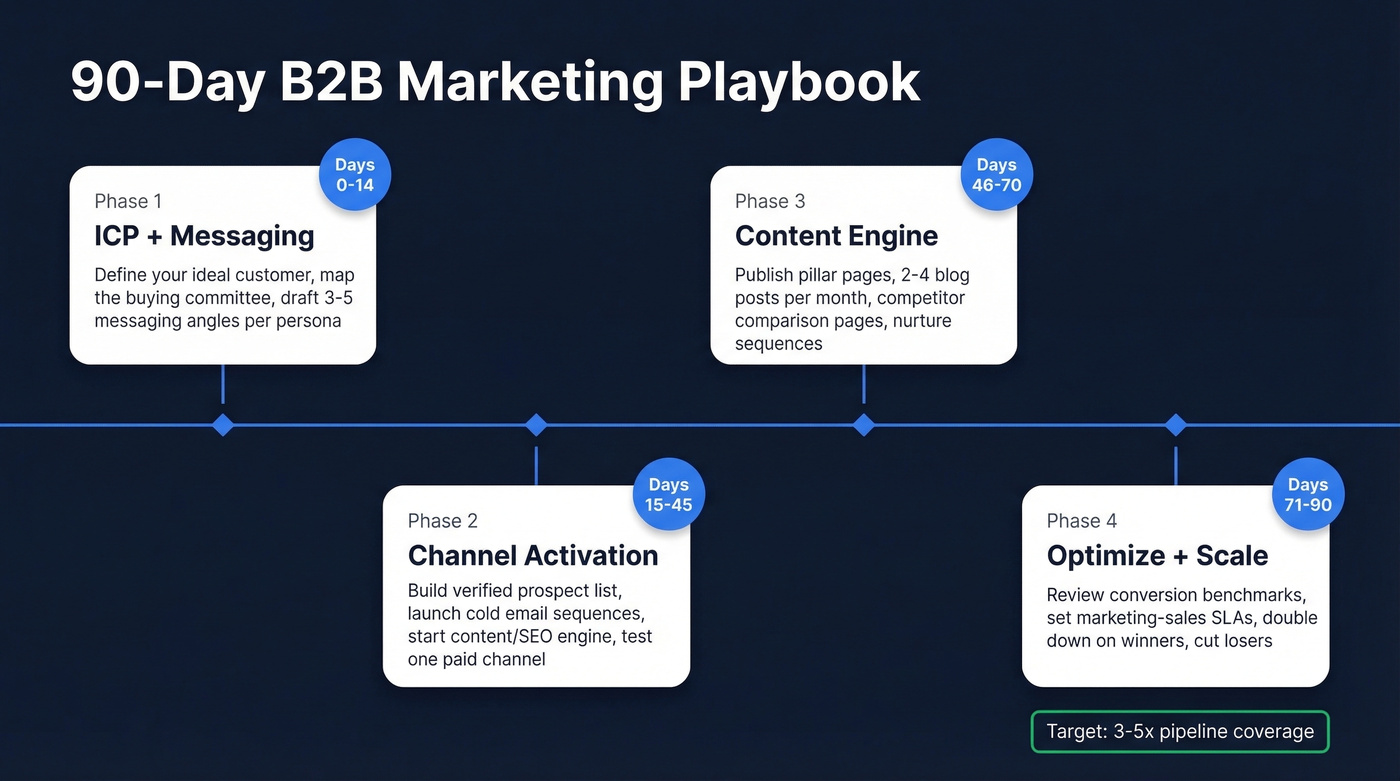
- Nail your ICP and messaging before touching any channel (weeks 1-2)
- Build a verified prospect list and start outbound - the fastest path to pipeline (weeks 3-4)
- Launch a content/SEO engine that compounds over 6-12 months (weeks 5-8)
- Add paid channels once you know what messaging converts (weeks 9-12)
Here's the thing: pick two or three channels and go deep. Teams that spread across ten channels in the first quarter generate noise, not pipeline. Sequence matters more than coverage.
B2B Marketing Defined (Briefly)
B2B marketing generates demand and pipeline from other businesses. The mechanics differ from B2C because the buying process is longer, more complex, and involves more people.
| Factor | B2B | B2C | |---|---|---| | Buying committee | ~11 people | 1-2 people | | Sales cycle | Often 4-8 months | Minutes to weeks | | Time with sales | ~17% of journey | Minimal | | Decision driver | ROI / risk reduction | Emotion / price | | Channels | Multi-touch, multi-stakeholder | Direct response |
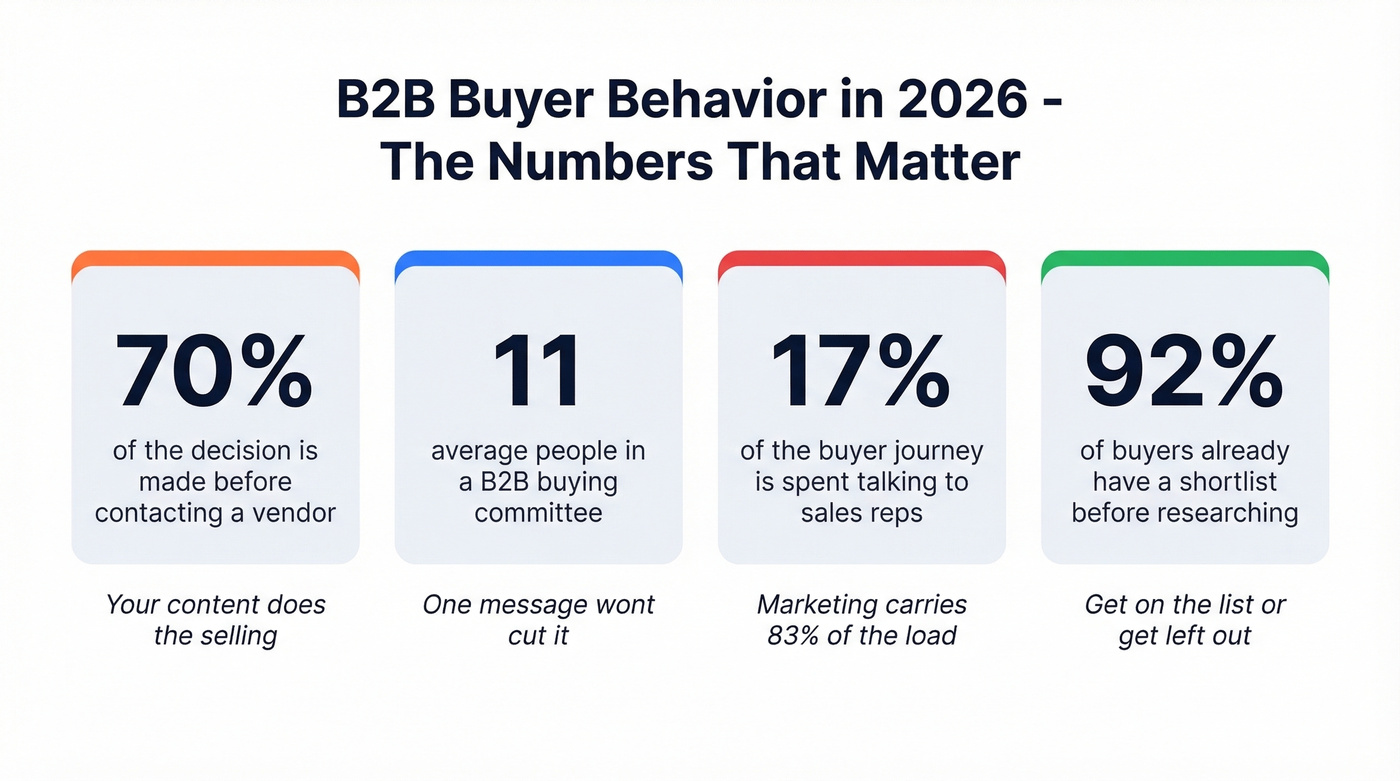
Buyers spend just 17% of their purchase journey talking to any sales rep. Your marketing has to do the heavy lifting across the other 83%.
The B2B Buyer Journey in 2026
Buyers are roughly 70% through their decision-making before they contact a vendor. Eight in ten initiate that contact themselves - they aren't waiting for your SDR to call. The average buying group runs about 11 people deep, and each one consumes content through different channels.
The channels that actually shape shortlists aren't always the ones you're measuring. Slack communities, Reddit threads, niche newsletters, peer conversations in WhatsApp groups - these "dark social" channels influence buying decisions long before someone fills out a demo form.
| Stage | Channels That Work |
|---|---|
| Awareness | SEO, top-of-funnel content, paid social, community |
| Consideration | Comparison pages, email nurture, case studies |
| Decision | Product marketing, sales enablement, proof points |
| Retention | Customer marketing, product updates, feedback loops |
How to Launch B2B Marketing in 90 Days
Most teams overthink strategy and underthink execution. We've seen companies spend three months debating positioning while competitors book meetings. This framework, adapted from Directive's GTM playbook, prioritizes action with built-in checkpoints.
Your pipeline coverage target should be 3-5x quota. If your team needs to close $500K this quarter, you need $1.5-2.5M in pipeline. Keep the velocity formula close: (# Opportunities x Avg Deal Size x Win Rate) / Sales Cycle (days).
Days 0-14: ICP and Messaging
Define your ICP with firmographic, technographic, and intent criteria - not just "companies with 50-500 employees." Layer in technology stack signals, hiring patterns, and funding events to narrow your list to accounts that actually look like your best customers. Make sure your CRM is configured to track pipeline stages before you launch anything. You can't optimize what you don't measure.
Map the buying committee. With about 11 people involved in a typical B2B deal, you need messaging hypotheses for each persona: the economic buyer, the technical evaluator, the end user, and the internal champion. Draft three to five messaging angles per persona and prepare to test them in weeks 3-4.
Days 15-45: Channel Activation
This is where execution starts. Build your verified prospect list using a platform like Prospeo - filter by intent signals, technographics, job changes, and headcount growth to find accounts showing buying behavior right now. With 98% email accuracy and a 7-day data refresh cycle, you avoid the domain reputation damage that kills outbound before it starts.
Launch cold email sequences targeting your top ICP segments. Early-stage marketers on r/b2bmarketing often start by scraping Google Maps and sending personalized cold emails, and it works at small scale. But a systematic approach with verified data protects your sender reputation and actually scales past the first hundred prospects.
Simultaneously, start your content/SEO engine. Publish two or three pillar pages targeting your core buying keywords, set a blog cadence of two to four posts per month, and build competitor comparison pages for the consideration stage. Covering the right topics - pain points your buyers actually search for - matters far more than publishing volume.
Activate one paid channel, Google Ads or LinkedIn, with a $2K-5K/month test budget to validate messaging.
Days 46-90: Optimization
Review pipeline stage conversions against benchmarks. MQL-to-SQL should hit ~15%, SQL-to-Opportunity 25-30%. If you're below these numbers, the problem is usually qualification criteria or handoff timing, not lead volume.
Implement SLAs between marketing and sales. Inbound demo requests get contacted within 15 minutes during business hours. Outbound replies answered within one business day. These aren't aspirational - they're the baseline that separates teams that convert from teams that leak pipeline.
Double down on what's working. Cut what isn't. If cold email generates 3x the pipeline of paid social at half the cost, reallocate budget accordingly. This isn't a one-time setup; it's a continuous loop of testing, measuring, and shifting resources.

Your outbound engine is only as good as your data. Prospeo gives you 300M+ profiles filtered by intent signals, technographics, job changes, and headcount growth - exactly the buying behavior signals this playbook recommends. With 98% email accuracy and a 7-day refresh cycle, your sender reputation stays intact while you scale.
Stop leaking pipeline to bad data. Build your verified prospect list now.
B2B Marketing Channels That Drive Pipeline
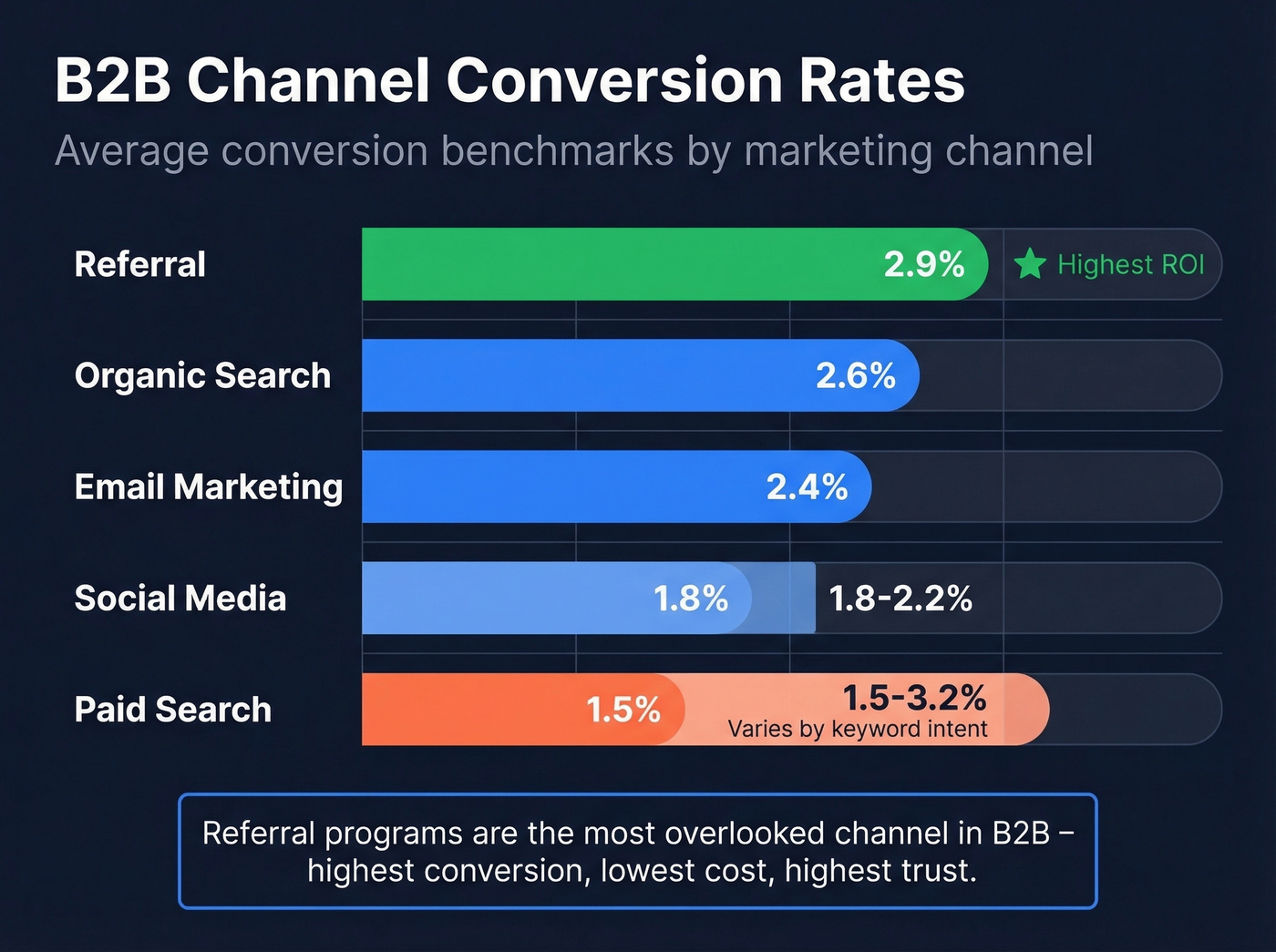
Not all channels are created equal, and the conversion benchmarks prove it.
| Channel | Avg Conversion Rate |
|---|---|
| Referral | 2.9% |
| Organic search | 2.6% |
| Email marketing | 2.4% |
| Social media | 1.8-2.2% |
| Paid search | 1.5-3.2% |
SEO and Content Marketing
66% of B2B buyers discover products through search. SEO compounds over 6-12 months and consistently ranks as the top ROI channel. But website conversion rate matters more than traffic - the B2B SaaS benchmark is just 1.1%, which means most sites are leaking leads. Fix conversion before buying more traffic.
In our experience, teams that obsess over publishing frequency while ignoring on-page conversion are doing the equivalent of filling a leaky bucket faster. Audit your landing pages, test your CTAs, and tighten your forms before you write another blog post.
Outbound and Cold Email
Outbound is the fastest path to pipeline. A well-built sequence targeting verified contacts can generate meetings within two weeks of launch. But data quality is the prerequisite - bad emails destroy domain reputation, and once you're flagged as spam, recovery takes months.
One practitioner on r/b2bmarketing built an internal tool scraping 100K+ B2B reviews from Clutch and GoodFirms to extract lead challenges and enrich profiles, then nurtured those leads through a LinkedIn group with targeted content. That's the kind of creative signal-building that separates good outbound from generic spray-and-pray. Skip this channel if you don't have verified data - the downside risk to your domain isn't worth it.

Teams using Prospeo book 26% more meetings than ZoomInfo users and 35% more than Apollo - at $0.01 per email. Layer 30+ filters including buyer intent across 15,000 topics to find accounts that match your ICP before day 15 of your 90-day plan.
Hit your 3-5x pipeline coverage target with data that actually connects.
Email Nurture
Email nurture converts at 2.4%, and 75% of B2B businesses rate email ROI as good to excellent. It's the workhorse for consideration and decision stages - drip campaigns, case study sequences, and event follow-ups that keep you top of mind while the buying committee deliberates over weeks or months.
Paid Search and Social
Paid search converts at 1.5-3.2% depending on industry and keyword intent. Use it to test messaging before scaling - run $2K-10K/month in Google Ads to learn which pain points resonate, then feed those insights back into content and outbound. Layer in retargeting and sequential ads to stay visible across the buying committee's research journey. Don't scale paid until you know what converts.
Account-Based Marketing
For mid-market and enterprise teams with defined target account lists, ABM combines intent data, personalized content, and multi-channel outreach into coordinated plays. Most effective when you have fewer than 500 target accounts and deal sizes above $50K.
Referral and Partner Programs
Highest conversion rate at 2.9%. Consistently overlooked.
Low cost, high trust. If you don't have a formal referral program, you're leaving your easiest pipeline on the table.
How Much to Spend
The most recent Gartner CMO Spend Survey puts marketing budgets at 7.7% of company revenue - flat year over year. And 59% of CMOs say it's not enough. Paid media takes the largest slice at 30.6%.
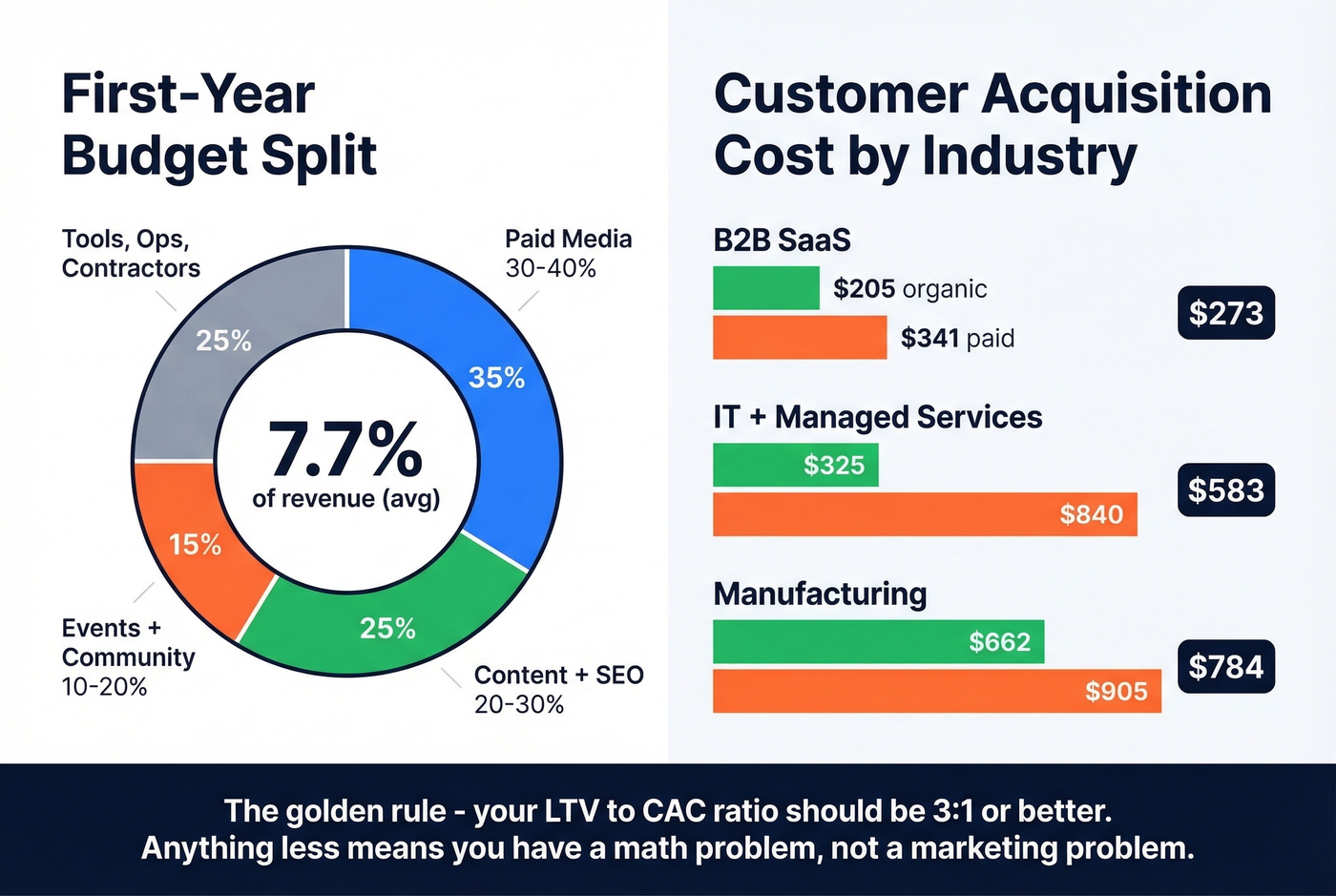
A realistic first-year allocation: 30-40% paid media, 20-30% content and SEO, 10-20% events and communities, and the remainder on tools, ops, and contractor support.
| Industry | Organic CAC | Paid CAC | Combined |
|---|---|---|---|
| B2B SaaS | ~$205 | ~$341 | ~$273 |
| IT & Managed Services | ~$325 | ~$840 | ~$583 |
| Manufacturing | ~$662 | ~$905 | ~$784 |
The rule of thumb: your LTV:CAC ratio should be 3:1 or better. If you're spending $500 to acquire a customer worth $1,000, you've got a math problem, not a marketing problem.
Measuring Performance
Pipeline stage benchmarks give you the diagnostic framework:
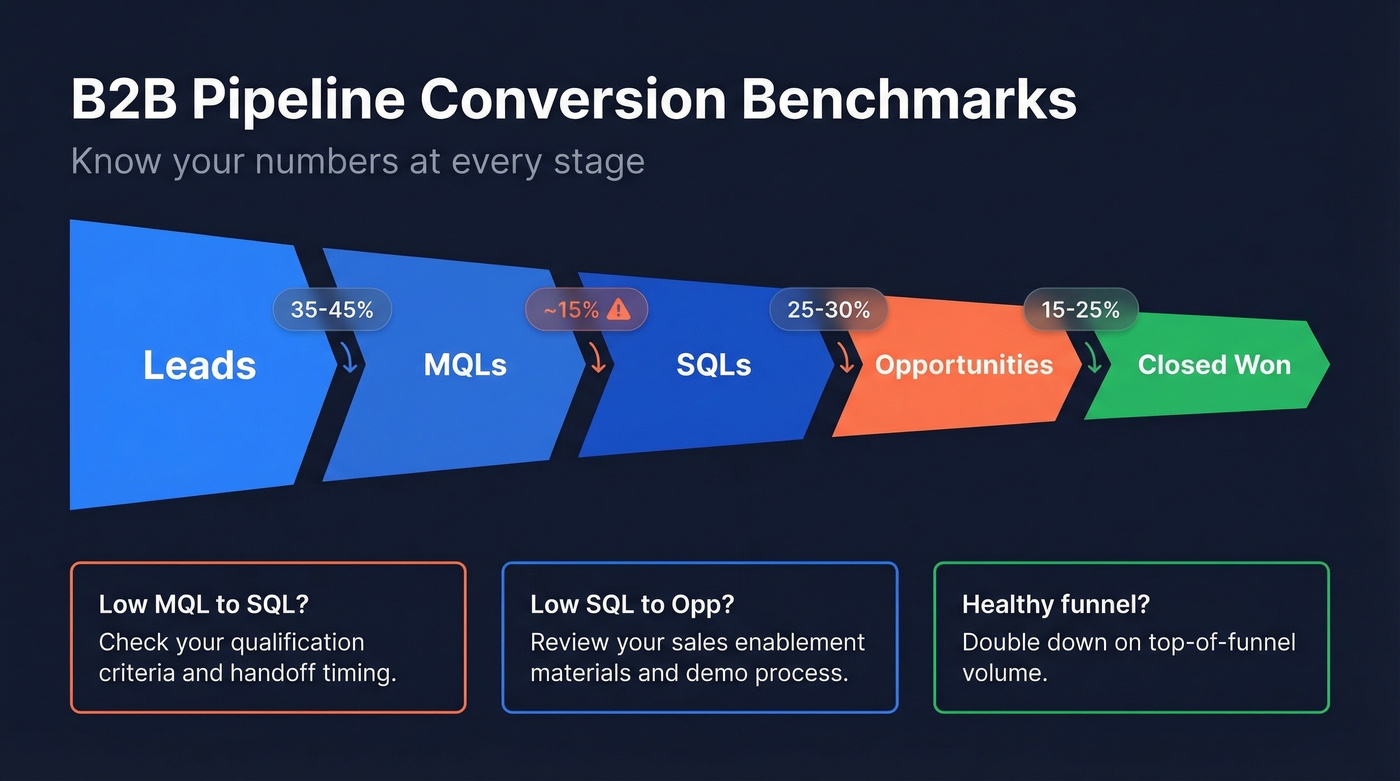
| Stage | Benchmark |
|---|---|
| Lead to MQL | 35-45% |
| MQL to SQL | ~15% |
| SQL to Opportunity | 25-30% |
| Opp to Closed-won | 6-9% |
| Lead to Customer | 1.5-2.5% |
The MQL-to-SQL handoff is where most funnels break. If you're converting leads to MQLs at 40% but only 8% become SQLs, your qualification criteria are too loose or your sales team doesn't trust the leads. Fix that gap before spending another dollar on top-of-funnel.
Let's be honest: if your site converts below your industry benchmark (1.1% for B2B SaaS, 2.2% for manufacturing, 1.5% for IT services), every dollar you spend driving traffic is partially wasted. Fix conversion first, then scale spend.
2026 Trends Shaping Execution
AI is baseline, not a differentiator. 96% of marketers are using AI, and 45% cite efficiency as the top benefit. 22% of teams have already reduced agency reliance, and 39% plan to cut agency budgets further. If you're not using AI for content drafts, data analysis, and campaign optimization, you're slower than your competitors.
Preference marketing is replacing demand capture. With 92% of buyers arriving with a shortlist, the game has shifted from capturing intent to shaping preference before intent forms. Millennials and Gen Z now make up over two-thirds of buyers in complex B2B transactions, and they're influenced by Reddit, YouTube, newsletters, and creators more than traditional analyst reports. First-party data strategies matter more than ever as third-party tracking continues to erode.
GEO is the next frontier. Beyond traditional SEO, Generative Engine Optimization - optimizing for AI-powered search and discovery platforms - is emerging as a real consideration for teams investing in organic visibility. If your content doesn't surface in AI-generated answers, you're invisible to a growing segment of researchers.
FAQ
What's the fastest B2B marketing channel?
Outbound prospecting with verified data delivers pipeline within 2-4 weeks. SEO compounds over 6-12 months but produces higher ROI long-term. Start outbound immediately while building your content engine in parallel.
How long does it take to see results?
Outbound generates meetings in 2-4 weeks. Paid needs 4-8 weeks for statistically significant data. Content and SEO take 6-12 months to compound. Plan for patience on organic, speed on direct outreach.
What are the main types of B2B marketing strategies?
The core types include content/SEO, outbound prospecting, paid search and social, ABM, email nurture, and referral programs. Most teams see the best results combining two or three rather than spreading thin across all six.
How do I build a prospect list without bad data?
Use a verified data platform that refreshes records frequently and verifies emails before export. Look for 98%+ email accuracy and weekly data refresh cycles - anything less and you're risking your domain reputation at scale.
What percentage of revenue should go to B2B marketing?
The 2026 benchmark is 7.7% of company revenue per Gartner. Early-stage companies often spend 10-15% to accelerate growth. Paid media typically takes the largest slice at about 30% of the total marketing budget.