

How to Find Leads for Your Business - The Data-Driven Playbook
You just spent $2,000 on Google Ads and got 30 leads. Two responded. One was a competitor doing research.
That's not a lead generation problem - it's a lead economics problem. 79% of marketing leads never convert to sales, and 68% of B2B marketers now prioritize lead quality over volume. Yet most advice still boils down to "cast a wider net." If you're figuring out how to find leads for your business, this playbook gives you real CPL benchmarks, channel conversion data, and the tactics that actually move revenue in 2026.
Quick Version: Three Things That Work
If you can only do three things: set up a referral program, build a cold email system with verified data, and publish one SEO article per week targeting buyer keywords.
Best channel by business type:
- Services firms - referrals and partnerships
- SaaS - SEO and content marketing
- B2B with a defined ICP - cold email outbound
- Ecommerce - paid ads and retargeting
What Leads Actually Cost
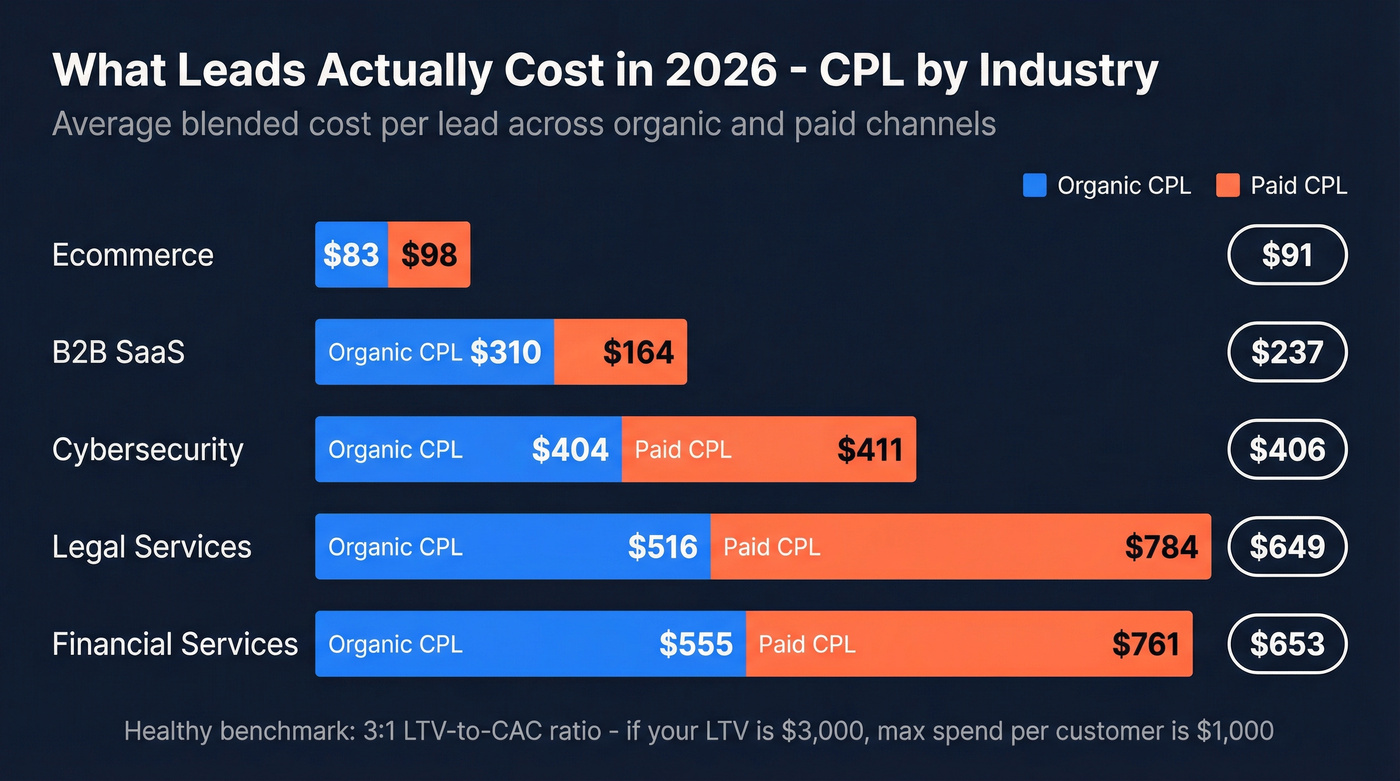
Before you choose a channel, know what leads cost in your industry. The average B2B cost per lead is $84 across all channels, but that average hides massive variance.
| Industry | Blended CPL | Organic CPL | Paid CPL |
|---|---|---|---|
| Ecommerce | $91 | $83 | $98 |
| B2B SaaS | $237 | $310 | $164 |
| Cybersecurity | $406 | $404 | $411 |
| Legal Services | $649 | $516 | $784 |
| Financial Services | $653 | $555 | $761 |
If you're in B2B SaaS, every lead costs ~$237 on average. A 10-lead campaign runs $2,370 - and if only two convert, your effective cost per customer is $1,185. For legal and financial services, the math gets brutal fast.
Channel-level benchmarks matter too. Google Ads averages $70.11 per lead. LinkedIn runs $110. The healthy benchmark for sustainable growth is a 3:1 LTV-to-CAC ratio, meaning if your customer lifetime value is $3,000, you can't spend more than $1,000 acquiring them. Most teams don't do this math before picking channels, and it shows in their burn rate.
Which Channels Actually Convert
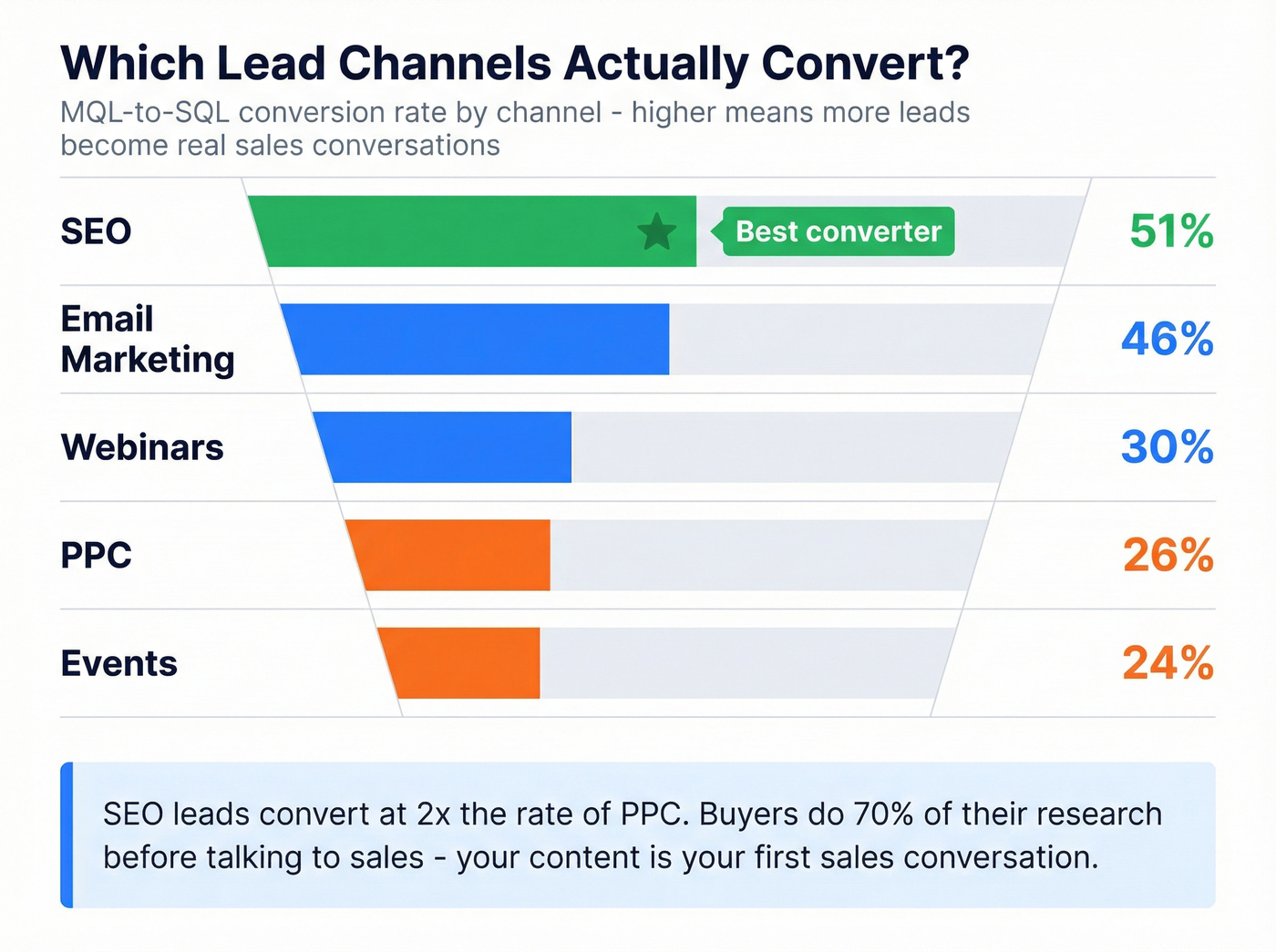
Raw lead volume means nothing if those leads don't turn into sales conversations.
| Channel | MQL-to-SQL Rate |
|---|---|
| SEO | 51% |
| Email Marketing | 46% |
| Webinars | 30% |
| PPC | 26% |
| Events | 24% |
SEO leads convert to sales-qualified at 51% - double the rate of PPC. If you're only running ads, you're leaving the highest-converting channel on the table. Someone who finds your content through search is actively researching a problem. Someone who clicks an ad is often just curious.
Here's the thing: buyers do up to 70% of their research before talking to sales. Your content IS your first sales conversation. If you're not publishing, you're invisible during the phase where decisions actually get shaped.

You just saw that cold email with verified data outperforms mass blasts by 2.76x. Prospeo gives you 300M+ profiles with 30+ filters - buyer intent, technographics, funding, job changes - so your 50-200 person precision list is built in minutes, not hours. Every email is 98% verified. Every record refreshed every 7 days.
Stop paying $237 per lead. Start building lists at $0.01 per verified email.
Lead Generation Channels That Work
Omnichannel outreach - combining email, social, and phone - outperforms single-channel by up to 75%. With B2B buying groups averaging 10-11 stakeholders per purchase, you need multiple entry points into the same account.
Referrals and Partnerships
Lowest CPL, highest trust. Referred leads close faster and churn less because they arrive with built-in credibility.
The mistake most businesses make is treating referrals as passive - waiting for happy customers to mention them at dinner parties. Systematize it instead: build a formal program with incentives, create partner agreements, and ask for introductions at specific milestones in the customer relationship. We've seen structured referral programs generate qualified prospects at a fraction of what paid channels cost, and the close rates aren't even comparable.
SEO and Content Marketing
That 51% MQL-to-SQL rate makes SEO the highest-converting channel for most B2B companies. But you have to target buyer-intent keywords, not vanity terms. "Best CRM for construction companies" converts. "What is CRM" doesn't.
Publish at least one article per week. The compounding effect takes 3-6 months to kick in, but once it does, you've built an asset that generates leads without ongoing ad spend. That's the real advantage - paid stops the moment your budget does.
Cold Email Outbound
Precision targeting with verified data outperforms mass blasts by 2.76x. Cold email isn't dead. Lazy cold email is dead. This gets a full deep-dive below.
Social Selling
Spend 10 minutes a day commenting on 5 prospects' posts for two weeks before sending your first DM. That pre-engagement significantly increases response rates compared to cold outreach. Social selling works best combined with email - that's where the omnichannel 75% lift comes from. Pure social outreach without a follow-up channel has low conversion on its own.
Paid Ads
Google Ads at $70.11 CPL and LinkedIn at $110 CPL make paid acquisition viable for demand capture - but expensive for demand creation. Meta ads work well for retargeting warm audiences. Skip LinkedIn ads to cold audiences if you don't have a retargeting strategy behind them. You're just burning money.
Intent Data and Trigger-Based Prospecting
This is the 2026 advantage most small businesses don't know exists. Job changes, funding rounds, technology adoption signals, and hiring patterns all indicate buying intent. New executives typically evaluate and replace tools in their first ~90 days - that's your window.
Tools like Clay can synthesize trigger signals across dozens of sources, turning hours of manual research into automated prospect briefs. Layer that with intent signals and you're reaching buyers when they're actually in-market, not when it's convenient for your sales calendar.
Events, Webinars, and Communities
Webinars convert at 30% MQL-to-SQL - solid for a channel that scales well. But the real play in 2026 is niche communities over broad events. A 200-person community in your vertical will outperform a 5,000-person trade show for deal quality every time.
Don't have an in-house SDR team? Outsourced lead gen delivers 43-65% better ROI than building in-house, with qualified meetings in 4-6 weeks versus 3-6 months for a new hire to ramp. Worth considering before you commit to full-time headcount.
Cold Email: A Tactical Deep Dive
We've tested enough cold email campaigns to know what separates the ones that book meetings from the ones that get ignored. It comes down to three things.
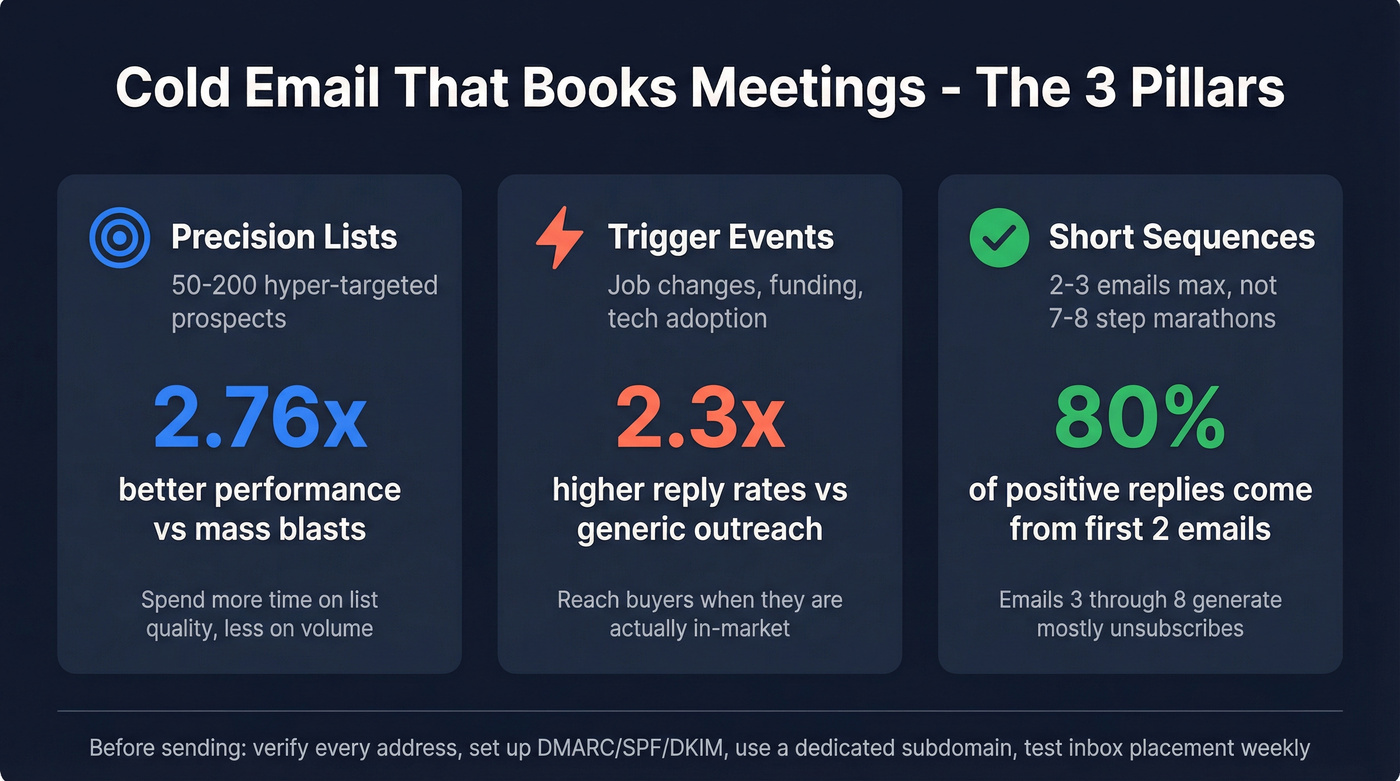
Build precision lists. A list of 50-200 hyper-targeted prospects who match your ICP will outperform a 5,000-contact mass blast by 2.76x. Spend more time on list quality, less on volume. The consensus on r/sales backs this up - the threads praising "spray and pray" outbound are nonexistent.
Use trigger events. Job changes, funding announcements, and technology adoption signals deliver 2.3x higher reply rates versus generic cold outreach. "Congrats on the Series B - here's how we help companies at your stage" beats "Hi, we help companies like yours" every single time.
Keep sequences short. 80% of positive responses come from the first two emails. We've seen teams running 7-8 step sequences where emails 3 through 8 generate nothing but unsubscribes. Two to three emails is the sweet spot.
Before you send a single cold email, verify every address. Spam traps, honeypots, and catch-all domains tank your sender reputation overnight. On the infrastructure side, DMARC, SPF, and DKIM aren't optional anymore - they're table stakes. Use a dedicated subdomain for outbound and test inbox placement weekly. If you're below 75% inbox placement, stop sending and fix your infrastructure first.
Building Your Prospect List
Before spending another dollar on new lead gen, enrich your existing CRM. Most teams are sitting on thousands of contacts with outdated emails and missing phone numbers. Running enrichment on what you already have - where 83% of leads typically come back with usable contact data - will surface deals you didn't know existed.

For fresh prospects, Prospeo's database covers 300M+ professional profiles with 98% verified email accuracy, 143M+ verified emails, and 125M+ verified mobile numbers. You can filter by buyer intent across 15,000 topics, technographics, job changes, funding signals, and 30+ other criteria. Data refreshes every 7 days - the industry average is six weeks, which means most databases serve you stale contacts by default. The free tier gives you 75 emails per month with no contracts, so you can validate data quality before committing a dollar.
Pair with: Instantly or Lemlist for outreach sequencing, or your existing dialer for cold calling.
How to Qualify Your Leads
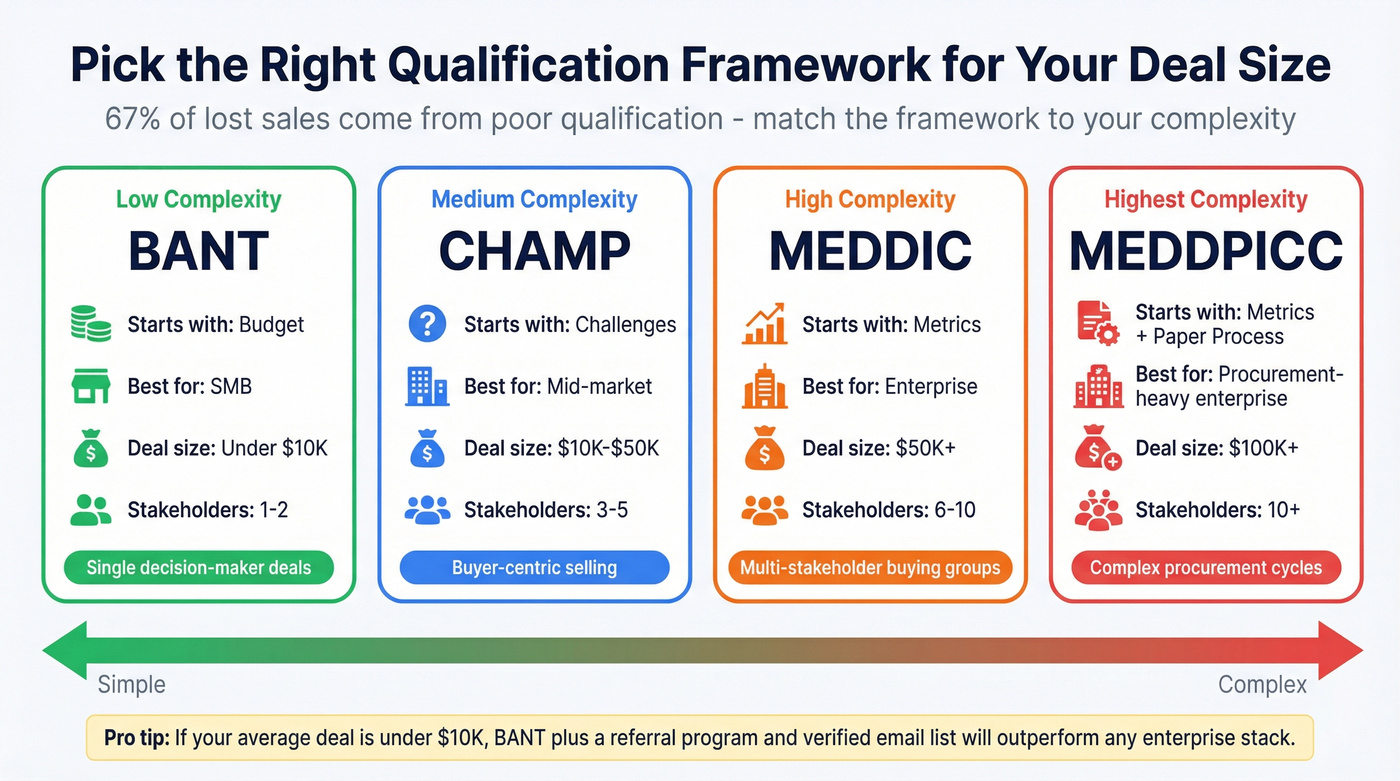
67% of lost sales happen because of poor qualification. You can source prospects all day long, but it won't matter if your team can't separate buyers from browsers.
An MQL fits your ideal customer profile but hasn't shown active buying intent. An SQL has both fit and intent - they're ready for a sales conversation. The gap between MQL and SQL is where qualification frameworks earn their keep.
| Framework | Best For | Starts With | Complexity |
|---|---|---|---|
| BANT | SMB, sub-$10K deals | Budget | Low |
| CHAMP | Mid-market, buyer-centric | Challenges | Medium |
| MEDDIC | Enterprise, multi-stakeholder deals | Metrics | High |
| MEDDPICC | Procurement-heavy enterprise | Metrics + paper process | Highest |
For a $5K product sold to a single decision-maker, BANT works fine. For a $50K platform going into a multi-stakeholder buying group, MEDDIC is the right default. The framework you choose should match your deal complexity - not your ambition. We've seen teams adopt MEDDIC for four-figure deals and drown in process overhead that adds zero value.
Let's be honest: if your average deal size is under $10K, you probably don't need sophisticated lead gen tooling at all. A referral program, a verified email list, and a two-step cold email sequence will outperform any $50K/year platform. Save the enterprise stack for enterprise deals.
Qualification doesn't end at first contact either. Set up automated nurture sequences for leads that aren't ready to buy - a simple drip campaign keeps you top of mind until the timing is right.
The article proves it: trigger-based prospecting and intent data are the 2026 advantage. Prospeo tracks 15,000 intent topics via Bombora, surfaces job changes and funding signals, and pairs them with 125M+ verified mobile numbers (30% pickup rate). That's how teams like Snyk generated 200+ new opportunities per month.
Reach in-market buyers before your competitors even know they exist.
FAQ
What's the cheapest way to find leads?
Referrals cost almost nothing and convert at the highest rate of any channel. For outbound, pair a free-tier data tool with a sending platform and you're running campaigns for under $100/month total.
How many leads do I need per month?
Work backward from revenue: if you close 5% of leads and need 10 new customers per month, you need roughly 200 leads. Most teams overestimate their close rate - audit your actual pipeline conversion before setting targets.
Is cold email still effective in 2026?
Yes, but only with verified data and proper deliverability infrastructure. Precision-targeted lists outperform mass blasts by 2.76x, and 80% of positive responses come from the first two emails. Lazy, unverified blasts are what's dead.
What's the difference between MQL and SQL?
An MQL fits your ideal customer profile but hasn't demonstrated buying intent. An SQL has both fit and active interest - they're ready for a direct sales conversation. The gap between them is where qualification frameworks like BANT or MEDDIC earn their keep.
How much should I budget for lead generation?
The average B2B CPL is $84, but industry variance is massive - from $91 in ecommerce to $653 in financial services. Plan for $500-$2,000/month minimum to generate enough data on what works, then double down on your best-performing channel.