

How to Forecast Sales Growth in 2026: Formulas, Examples, and Frameworks
In Xactly's benchmark survey, 4 in 5 sales leaders reported missing a quarterly forecast. Not because they lacked tools - because most teams still mix up two different questions. Revenue forecasting asks "how much will we close this quarter?" Growth forecasting asks "at what rate is the business compounding, and what does that imply for next year?" Those are fundamentally different exercises, and blurring them is how you end up with a board deck that doesn't match your bank account.
Let's separate them properly.
What You Actually Need
If you have 2+ years of historical data, use CAGR as your baseline, then layer pipeline-weighted forecasting for quarterly precision.
If you're early-stage with no data, build bottom-up funnel math - reachable audience, engagement rate, conversion rate. Skip the TAM fantasy.
If you're running SaaS, cohort-based forecasting with NRR tracking matters more than new bookings alone. We'll cover the math below.
Formulas for Sales Growth Rates
CAGR (Compound Annual Growth Rate)
CAGR is the smoothed annualized rate at which revenue compounds:
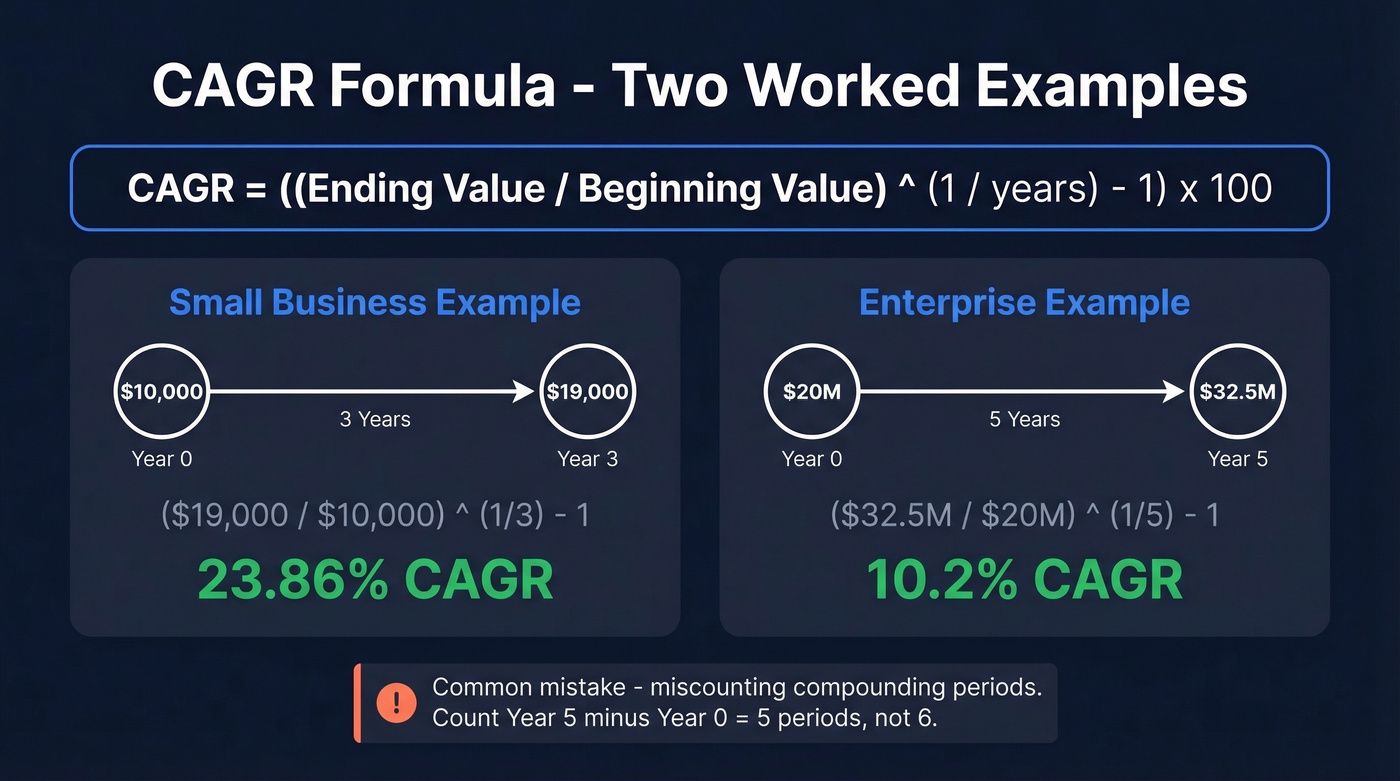
CAGR = ((Ending Value / Beginning Value) ^ (1 / years) - 1) x 100
A company growing from $10,000 to $19,000 over 3 years has a CAGR of 23.86%. A larger business going from $20M to $32.5M over 5 years hits 10.2%. Count periods as Year 5 minus Year 0 - miscounting compounding periods is the most common spreadsheet error we see.
The limitation is real, though. CAGR smooths volatility completely. A company that grew 80% in year one and shrank 10% in year two looks "steady" through a CAGR lens. Use it as a sanity check, not gospel.
If you want the definition and edge cases, see Compound Annual Growth Rate.
YoY and CMGR
Year-over-year growth: (Current Year Revenue - Prior Year Revenue) / Prior Year Revenue x 100. $2M last year and $2.6M this year = 30% YoY growth. Simple.
For SaaS teams tracking monthly, CMGR is more useful: CMGR = ((Ending MRR / Beginning MRR) ^ (1 / months) - 1) x 100. MRR from $50K to $85K over 12 months gives you roughly 4.54% CMGR. Use YoY for board decks. Use CMGR for monthly ops reviews where you need to spot deceleration before it becomes a crisis.
Which Forecasting Method Fits?
| Method | Best For | Data Needed | Complexity |
|---|---|---|---|
| Time series | Stable demand | Historical sales | Low-Med |
| Bottom-up funnel | Early-stage / SMB | Funnel metrics | Low |
| Top-down TAM | Market sizing | TAM + share est. | Low |
| Weighted pipeline | B2B sales teams | CRM pipeline | Medium |
| Cohort-based | SaaS / subscription | Retention data | Medium |
| Regression | Complex markets | Multi-variable data | Medium |
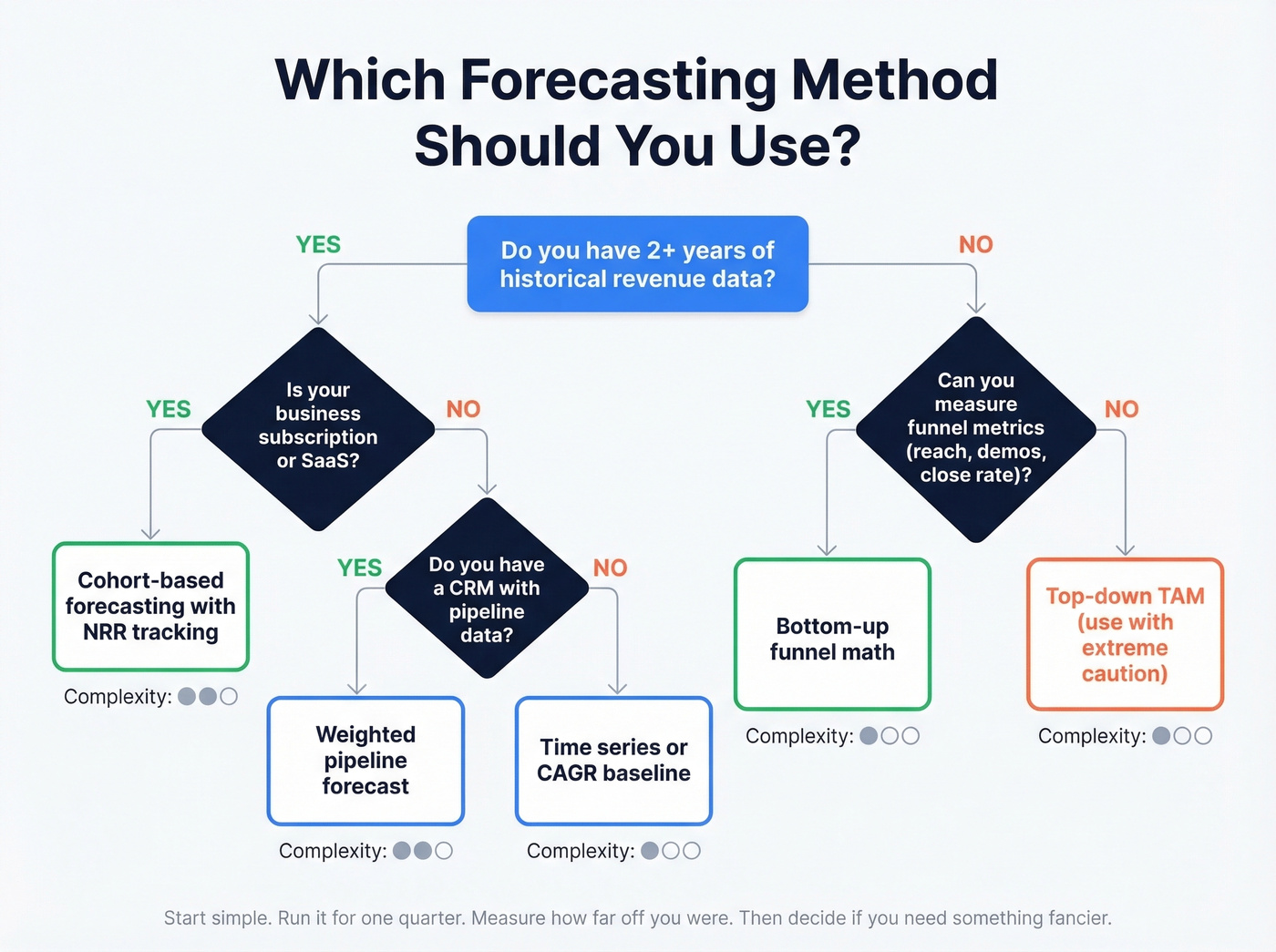
Start with the simplest method your data supports. We've seen teams burn weeks building regression models when a weighted pipeline forecast in a spreadsheet would've gotten them 90% of the way there. You don't need forecasting software to do this well - you need clean inputs and honest assumptions. Growth projections also improve dramatically when sales, finance, and marketing align on those assumptions rather than building models in silos, each with their own version of the truth.
Here's the thing: pick one method, run it for a quarter, measure how far off you were, then decide if you need something fancier. Most teams don't.

Every forecasting method above depends on one thing: a pipeline full of real, reachable buyers. Prospeo's 98% email accuracy and 7-day data refresh keep your CRM stages honest - so your weighted pipeline forecast reflects deals that are actually alive.
Stop forecasting on top of stale data. Start with contacts that connect.
Building a Forecast With No Data
Top-down forecasting - "we'll capture 1% of a $5B TAM" - is lazy math. That 1% is coming out of thin air. The addressable market framing in this Reddit thread mirrors what we've seen in practice: bottom-up funnel math is the only honest approach when you don't have historical data.
How many prospects can you actually reach per month? What percentage will engage? What percentage will convert? If you can reach 2,000 prospects per quarter, get 5% to a demo, and close 15% of demos at a $10K average deal, that's 15 deals and $150K for the quarter. Run worst-case and most-likely scenarios and present both. Anyone who shows a single-line forecast with no range is either naive or selling something.
One thing most forecasting guides skip entirely: if your growth forecast isn't connected to cash flow timing, it's incomplete. Closing $150K in Q3 means nothing if payment terms push actual cash to Q4 and you can't make payroll in between. I've watched a startup celebrate a "record quarter" while scrambling to cover a wire transfer the following Monday.
Cohort Forecasting for SaaS
New bookings get all the attention. Churn does the actual damage.
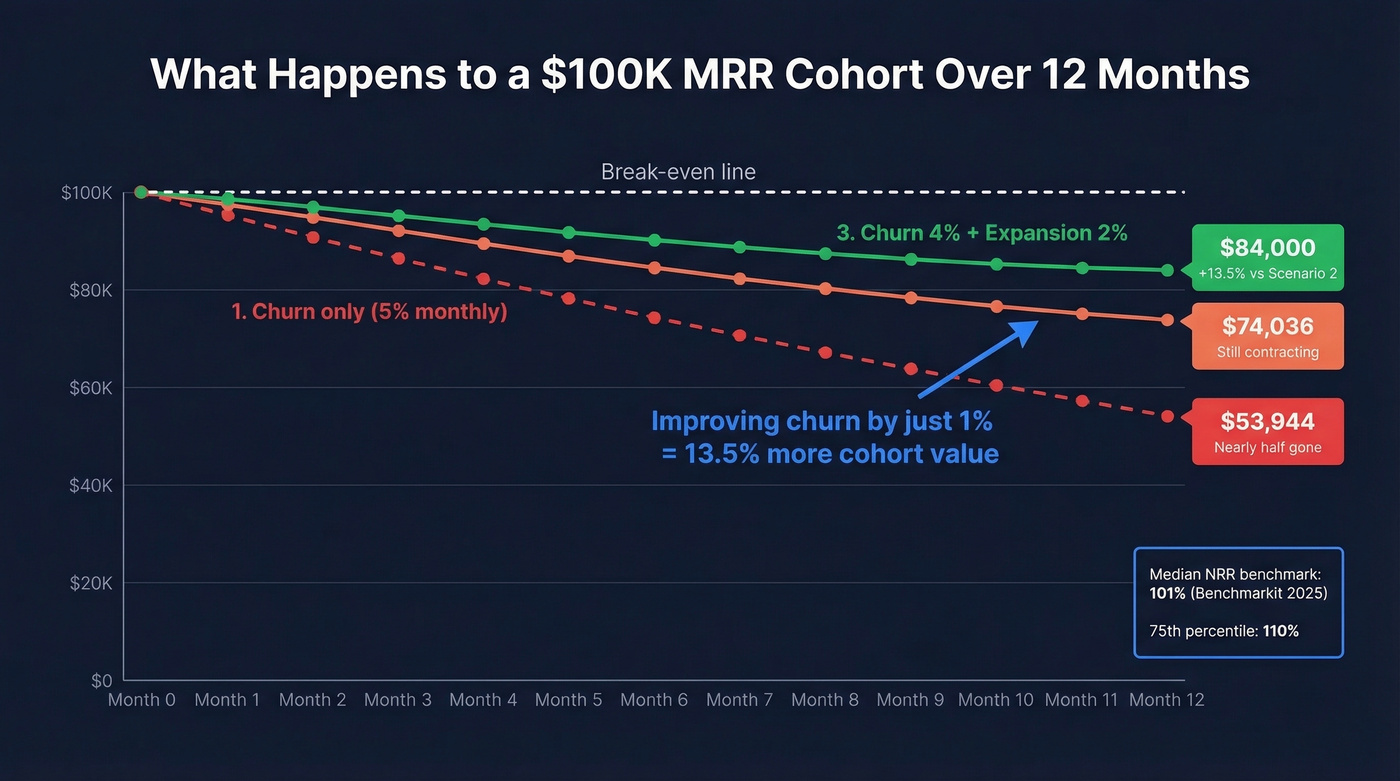
A $100K MRR cohort with 5% monthly gross churn declines to $53,944 after 12 months - nearly half gone. Add 2% monthly expansion revenue and that same cohort lands at $74,036. Still contracting, but the gap between those two numbers separates a healthy business from a crisis.
Improving churn from 5% to 4% monthly increases that 12-month cohort value by 13.5%. From a single percentage point.
Your monthly waterfall: Starting MRR + New Bookings + Expansion - Churn = Ending MRR. Use trailing 3-6 month averages for churn and expansion rates. Benchmark yourself: median NRR sits at 101% (Benchmarkit 2025 data), with the 75th percentile at 110%. If you're below 100%, your new bookings are running on a treadmill.
Mistakes That Kill Forecast Accuracy
Treating all deals in a stage as equal. A $200K deal at "proposal sent" with a champion isn't the same as one where the buyer went dark two weeks ago. Stage-based probabilities lie when deal health varies wildly within the same stage. If you want a tighter model, start with pipeline health metrics, not just stage labels.
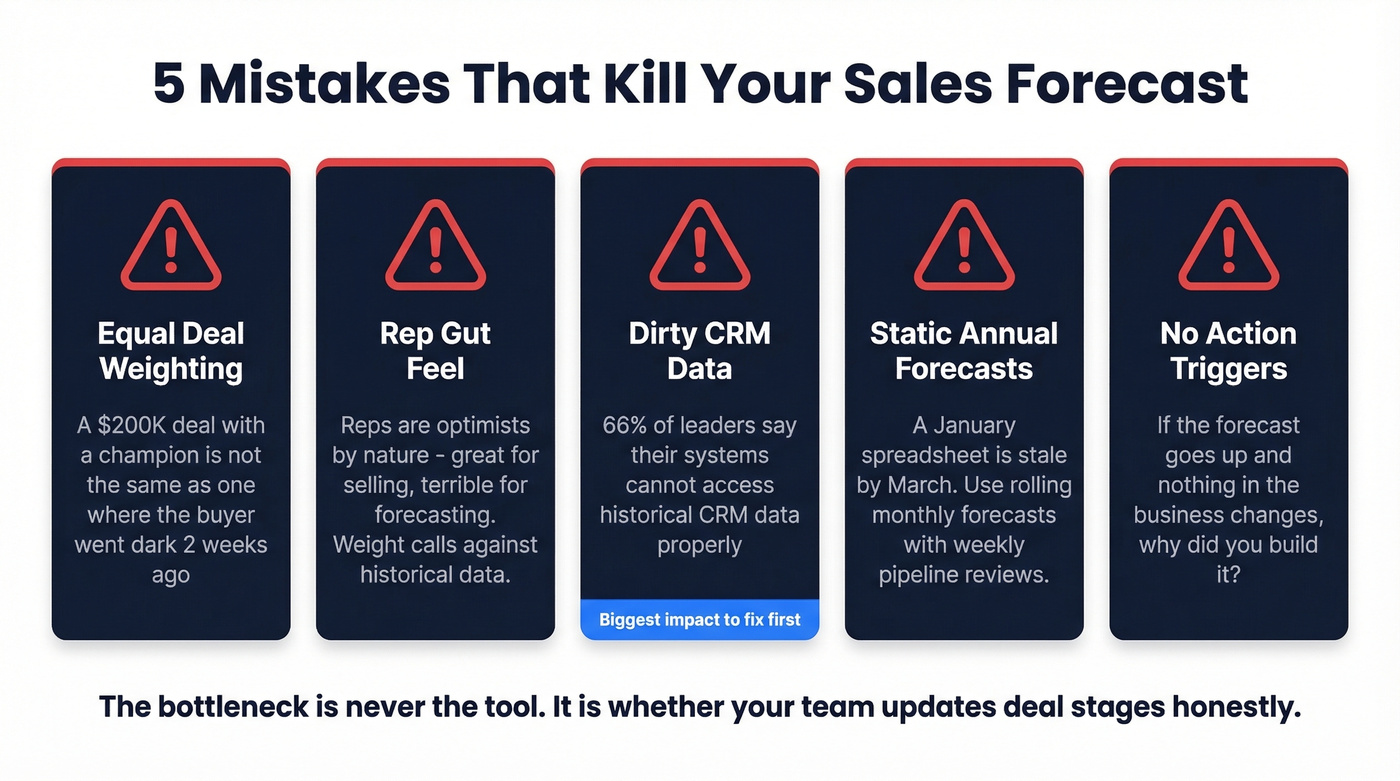
Relying on rep gut feel. Reps are optimists by nature - it's what makes them good at selling and terrible at forecasting. Weight their calls against historical conversion data, not vibes.
Dirty CRM data. 66% of leaders say their systems can't access historical CRM data properly. Your forecast is only as accurate as the contact data feeding your pipeline. If half your records have outdated emails, your stage-by-stage probabilities are fiction. Tools like Prospeo that refresh data every 7 days keep pipeline stages reflecting deals that are actually alive, not ghosts from six months ago. If you're evaluating vendors, compare data enrichment services before you commit.
Static annual forecasts. Markets shift. Rolling forecasts that update monthly - with weekly pipeline reviews - keep your model connected to reality instead of a January spreadsheet that's stale by March.
Not connecting forecast to action. A forecast that doesn't trigger hiring, budget, or territory changes is just a spreadsheet exercise. If the number goes up and nothing in the business changes, why did you build it?
Let's be honest: if your average deal size is under $25K and your sales cycle is under 30 days, a weighted pipeline model in Google Sheets will outperform a pricey forecasting platform. The bottleneck is never the tool. It's whether your team updates deal stages honestly. If you're still fighting process issues, start with the most common sales pipeline challenges and fix those first.
Dirty CRM data is the #1 forecast killer on this list. Prospeo enriches your pipeline with 50+ data points per contact at a 92% match rate - for roughly $0.01 per email. Your bottom-up funnel math finally works when every prospect is verified and current.
Clean data in, accurate forecast out. It really is that simple.
FAQ
What's the simplest formula for a sales growth rate?
YoY growth rate: (Current - Prior) / Prior x 100. For example, $2M to $2.6M = 30%. For multi-year compounding, use CAGR: ((Ending / Beginning) ^ (1 / years) - 1) x 100.
How far ahead should a growth forecast look?
Twelve months with monthly rolling updates is the sweet spot for most B2B teams. Quarterly re-forecasting catches drift early while keeping the planning horizon long enough for hiring and budget decisions. Skip this if you're pre-revenue - focus on 90-day sprints instead.
Can you forecast sales growth without a CRM?
Yes - a spreadsheet with deal stages, probabilities, and close dates works for teams under 10 reps. But clean, enriched CRM data dramatically improves accuracy once you're past that point. The difference between a forecast that's 15% off and one that's 40% off usually comes down to whether your contact records reflect reality.