

How to Generate Leads From Website Visitors: A Data-Backed Playbook
You've got 5,000 monthly visitors and 12 leads to show for it. That math doesn't work - and buying more traffic won't fix it. The fix is in the 97% who visit, browse, and vanish without a trace.
This playbook covers how to generate leads from website visitors who'd otherwise disappear, using identification tools, fast follow-up, and verified contact data.
The 97% Problem
The average website converts 2.9% of visitors into qualified leads, based on 100M+ data points across 14 industries. For every 1,000 people who land on your site, 971 leave without raising their hand.
Most teams respond by spending more on ads. That's backwards. You're already paying for those visitors through content, SEO, paid campaigns, or referrals. B2B lead costs balloon from $40 to $300+ when you chase low-intent audiences instead of converting the high-intent traffic you already have. Converting existing traffic is cheaper and faster than buying new eyeballs.
Three Moves That Drive Most Results
Let's keep this simple. Three things matter more than everything else combined.
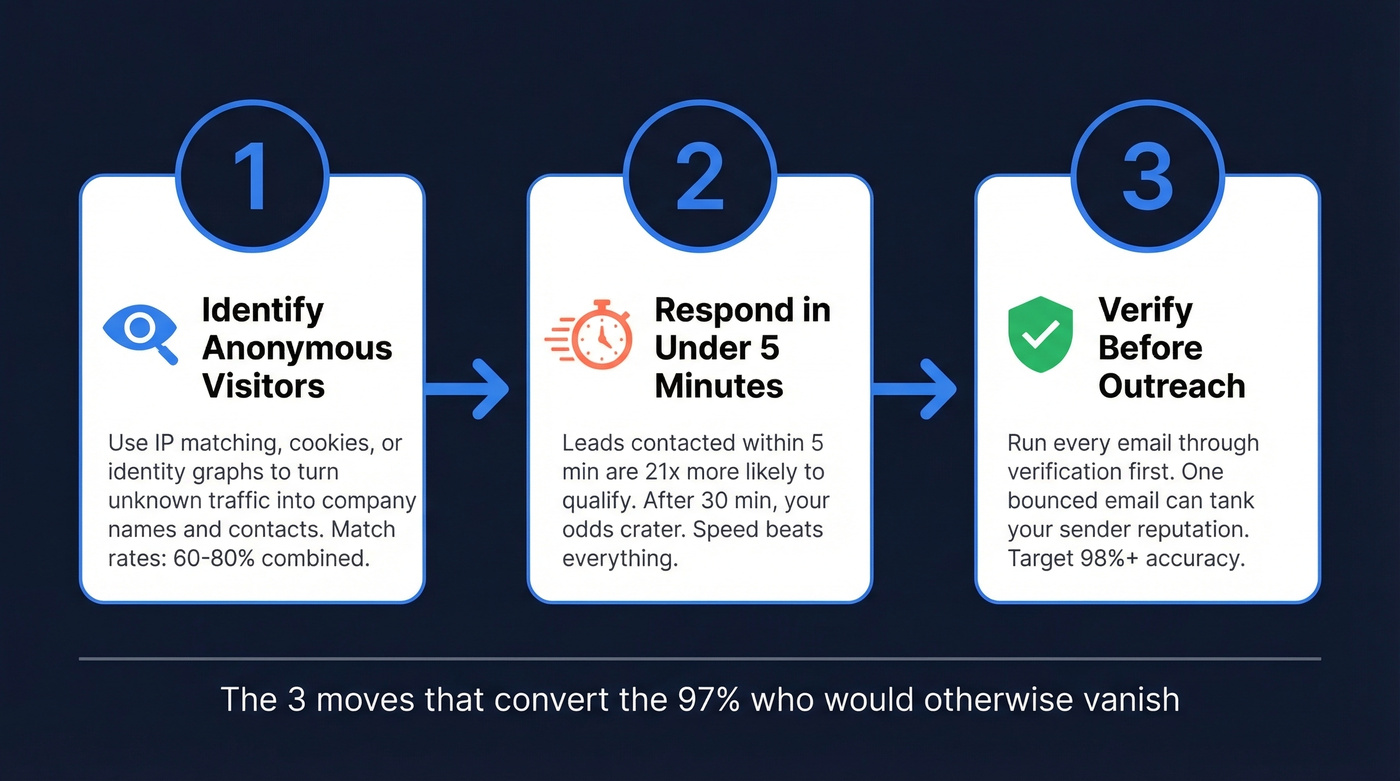
First, identify anonymous visitors using a pixel or IP-matching tool that turns "someone visited your pricing page" into a company name or contact record. Second, respond in under 5 minutes - leads contacted that fast are 21x more likely to qualify, and speed beats everything else. Third, verify contact data before outreach by running every email through a verification tool before it hits a sequence, because one bounced email can tank your sender reputation.
Know Your Baseline
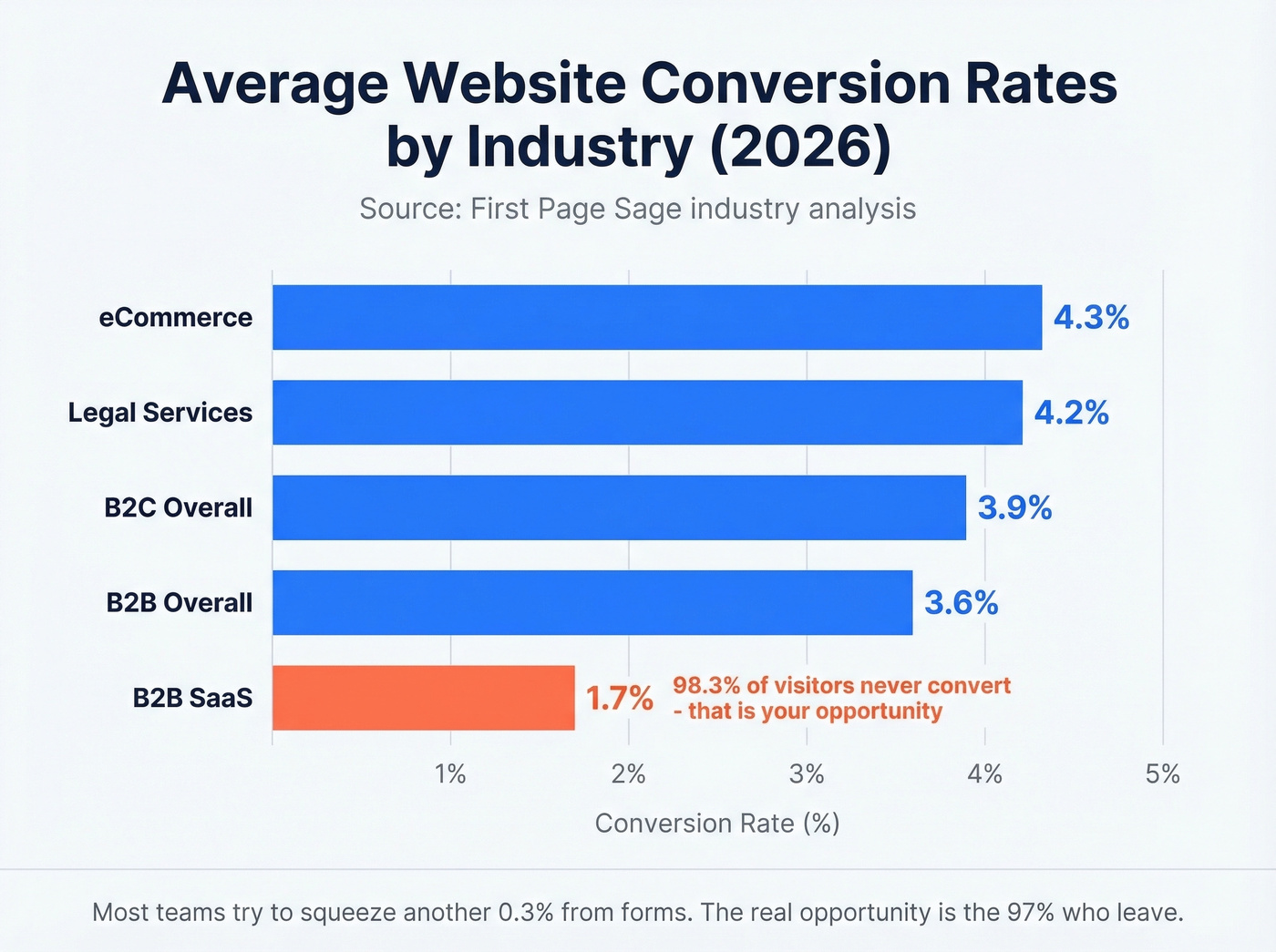
Before you optimize anything, know where you stand. If you've spent time on r/Entrepreneur, you've seen the complaint that most lead generation advice is outdated or generic. Fair point. So here are current numbers from First Page Sage's industry analysis:
| Segment | Avg. Conversion Rate |
|---|---|
| B2B overall | 3.6% |
| B2C overall | 3.9% |
| B2B SaaS | 1.7% |
| Legal Services | 4.2% |
| eCommerce | 4.3% |
Ruler Analytics breaks it down further: the average form conversion rate is 1.7%, while calls convert at just 1.2%. If you're a B2B SaaS company converting at 1.7%, you're average. The opportunity isn't in squeezing another 0.3% out of your forms - it's in reaching the 98.3% who never submit one.
Identify Anonymous Visitors
Three methods turn anonymous website visitors into actionable leads, each at a different level of precision.
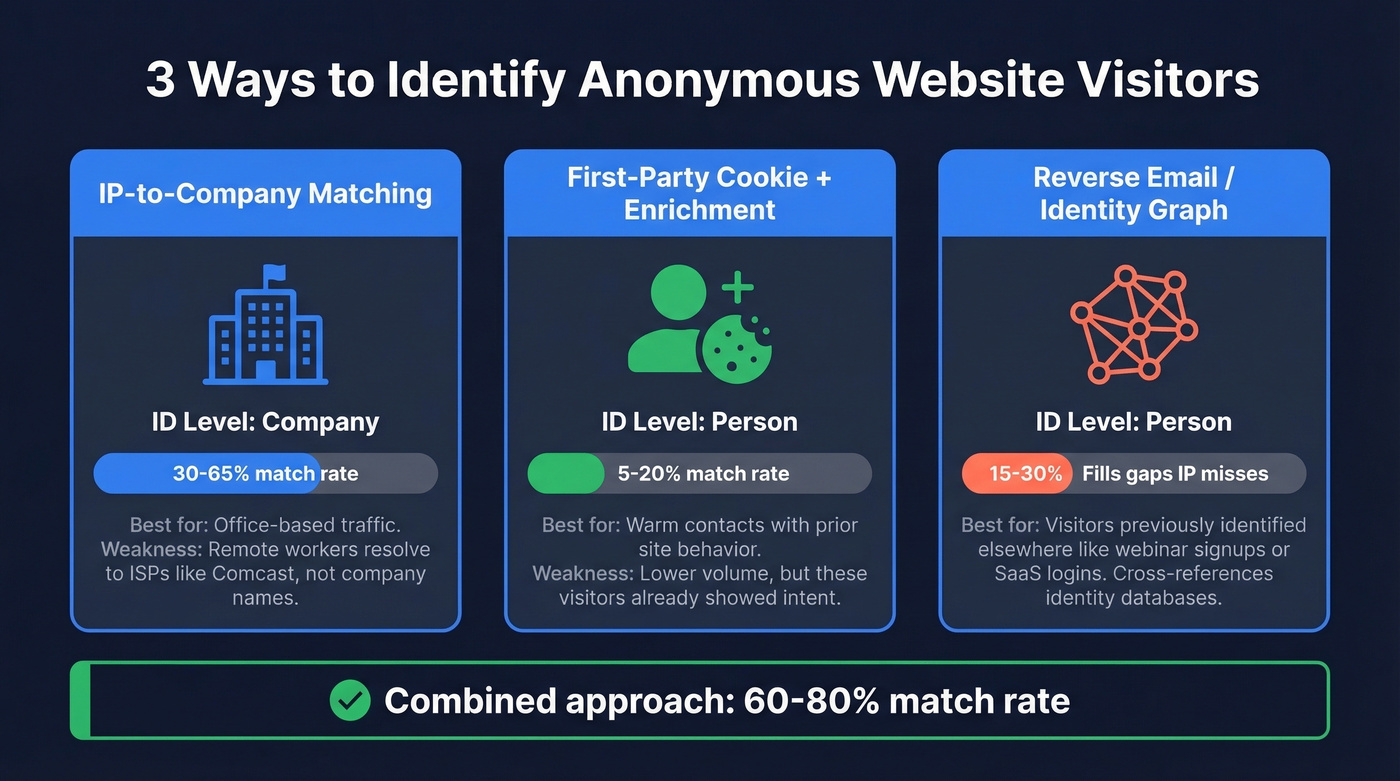
IP-to-company matching maps a visitor's IP to a business. It works best for office-based traffic, but with over 60% of knowledge workers now remote or hybrid, many visitors resolve to ISPs like Comcast instead of company names. Match rates typically land around 30-65%.
First-party cookie + enrichment layers behavioral data with identity resolution to reach person-level identification. Realistic match rates: 5-20% for individual contacts. Not huge, but these are warm contacts who already showed intent on your site.
Reverse email / identity graph cross-references visitor signals against known identity databases. When a visitor has been previously identified elsewhere in the graph - through a webinar registration, a content download, or a SaaS login - the tool can resolve them back to a person. This method fills gaps that IP matching misses entirely.
Combined approaches push match rates to 60-80%.
| Tool | ID Level | Starting Price |
|---|---|---|
| Leadfeeder | Company | Free / ~$99/mo |
| RB2B | Person (US) | Free / $79/mo |
| Snitcher | Company | $39/mo |
| Factors.ai | Company | $99/mo |
| Warmly | Both | $700/mo |
| ZoomInfo WebSights | Both | ~$15K+/yr |
RB2B is a strong option for person-level identification if your traffic is US-based. For enterprise budgets, Warmly and ZoomInfo WebSights combine both levels. For most teams, though, a free-tier tool paired with fast follow-up and verified data will outperform an expensive stack that nobody fully uses.

You just identified anonymous visitors and enriched their profiles. Now what? If those emails bounce, your domain reputation tanks and the whole workflow collapses. Prospeo's 5-step verification - with catch-all handling, spam-trap removal, and honeypot filtering - delivers 98% email accuracy at ~$0.01/email. That's the missing link between visitor ID and booked meetings.
Verify every visitor email before it hits your sequence. Free tier included.
Optimize On-Site Capture
Use chat if your site gets high-intent traffic on pricing, demo, or comparison pages. About 50% of entrepreneurs surveyed by Databox say chat produces higher on-site conversion rates than forms. And 67% of customers now prefer self-service over speaking to a rep - chat bridges that gap.
Skip chat if you need structured qualification data upfront. Forms still win when you need budget range, company size, or use case before routing to sales.
Don't ignore mobile. Conversion rates run 2.8% on mobile versus 3.2% on desktop, and cart abandonment hits 79% on mobile versus 68.1% on desktop. If your forms aren't thumb-friendly, you're losing leads before they start typing.
Follow Up in Under 5 Minutes
Here's the thing: your capture mechanism barely matters if your response time is measured in hours. Turning website visitors into leads depends less on what you capture and more on how fast you act.
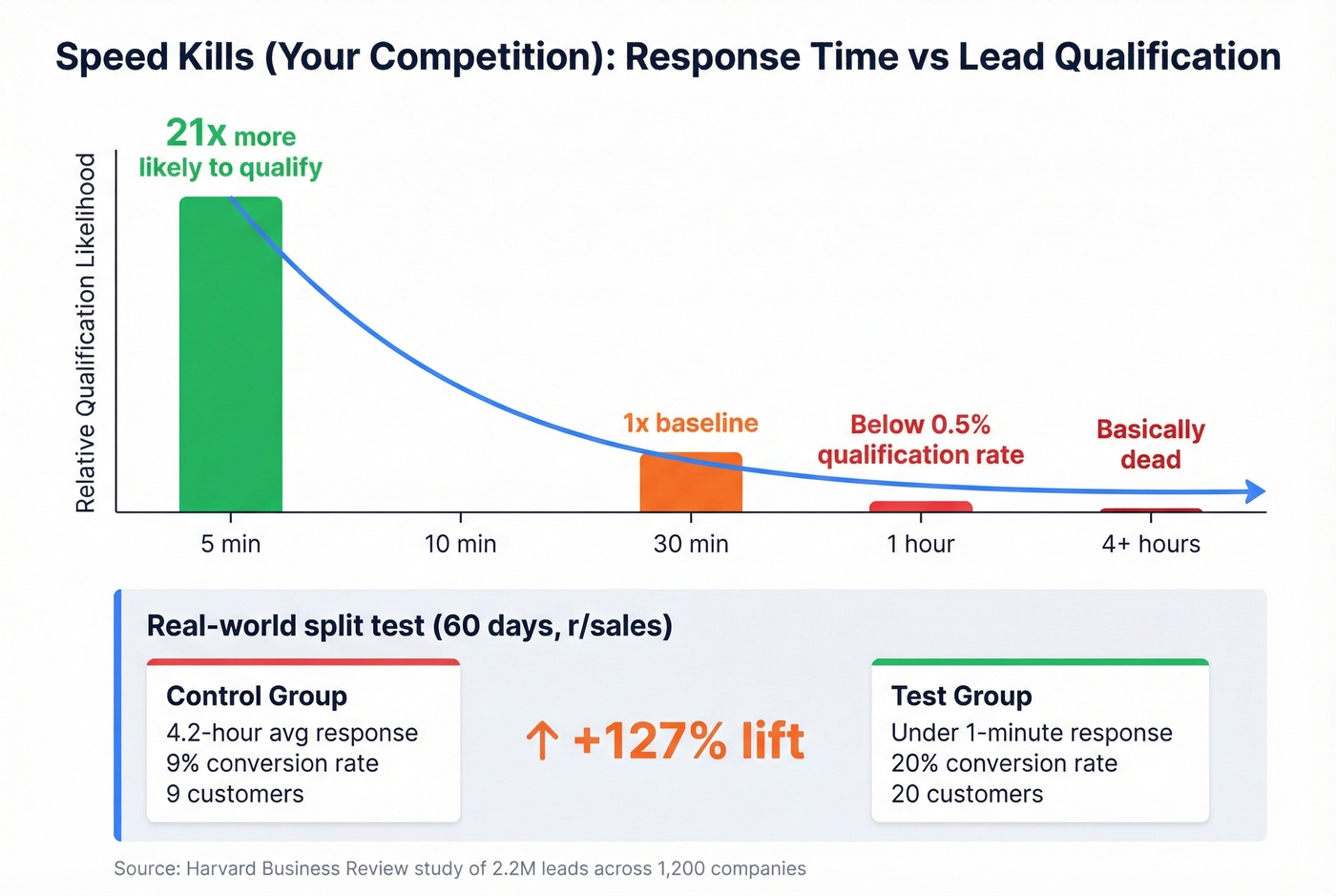
A Harvard Business Review study analyzed 2.2 million leads across 1,200 companies. Leads contacted within 5 minutes were 21x more likely to qualify than those contacted after 30 minutes. After an hour, qualification rates drop below 0.5%.
A Reddit user on r/sales ran a 60-day split test that sharpens the point. The control group averaged 4.2-hour response times and converted 9 customers from their leads - a 9% lead-to-customer rate. The test group responded in under a minute using AI-assisted chat: 20 customers, a 20% conversion rate, a 127% lift. Same traffic. Same offer. Just faster.
Stop optimizing your button color. Start optimizing your response time. We've seen that single change move the needle more than any landing page redesign.
Enrich and Verify Before Outreach
You've identified the visitor and responded fast. Now you need to reach them - and this is where most visitor-to-lead workflows fall apart.
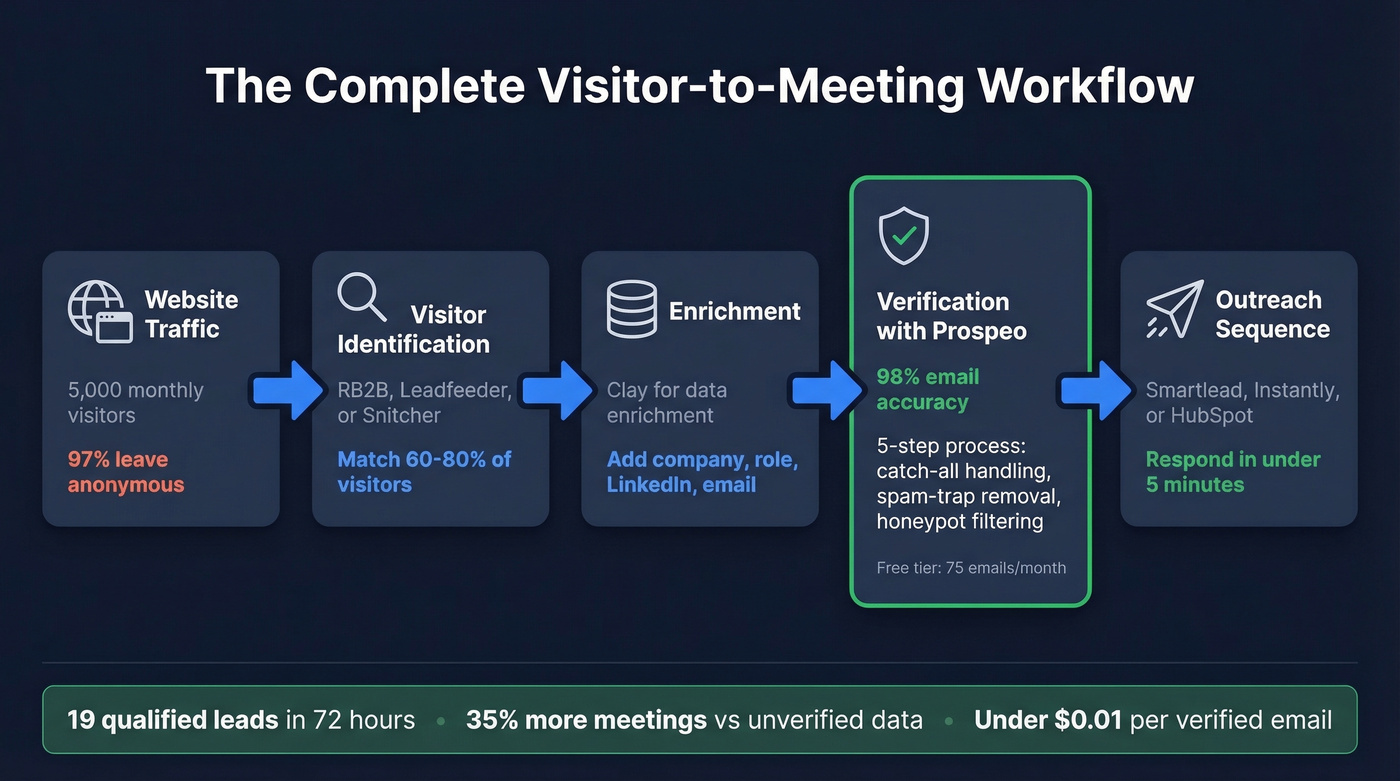
A practitioner on r/coldemail shared a workflow worth stealing: RB2B for visitor identification, Clay for enrichment and routing, Smartlead for sequences. They generated 19 qualified leads in 72 hours. The critical link most people skip is verification. Prospeo sits between enrichment and outreach, verifying every email at 98% accuracy before it enters a sequence. Its 5-step verification process handles catch-all domains, removes spam traps, and filters honeypots - catching bad addresses that simpler tools miss. The free tier covers 75 emails per month, enough to validate your workflow before committing a dollar.
Teams using Prospeo's verified data book 35% more meetings than Apollo users and 26% more than ZoomInfo users - because 98% accuracy means your outreach reaches real inboxes, not spam folders. Pair it with your visitor identification tool and Clay enrichment workflow, then push verified contacts straight to Smartlead, Instantly, or HubSpot via native integrations.
Stop losing the 97% twice - once on your site, once in spam folders.
Stay Compliant
Visitor identification involves tracking, and tracking involves privacy law.
GDPR requires explicit consent before non-essential cookies. No pre-ticked boxes. Include a "Reject All" button. Penalties run up to EUR 20M or 4% of global turnover. CCPA/CPRA follows an opt-out model - you need a visible "Do Not Sell or Share My Personal Information" link. Violations cost up to $7,500 each.
Audit your backend. If your consent banner says "no tracking until you accept" but your pixel fires on page load, you're in violation. A Cisco survey found 81% of consumers say how a company handles personal data reflects how it treats them as customers. Compliance isn't just legal cover - it's a trust signal that affects conversion rates downstream.
When You Don't Need the Enterprise Stack
Let's be honest: if your average deal size is under five figures, you probably don't need ZoomInfo-level visitor identification. A free tool like Leadfeeder or RB2B paired with fast follow-up and verified contact data will outperform a $15K/year stack that your team half-uses. Agencies focused on website lead generation for clients especially benefit from this leaner approach - lower overhead means faster ROI.
FAQ
What percentage of website visitors can you identify?
Company-level tools match 30-65% of traffic. Person-level identification reaches 5-20%. Combined approaches push to 60-80%, but remote work reduces IP-based accuracy since many visitors resolve to consumer ISPs instead of corporate networks.
How fast should you follow up with website leads?
Within 5 minutes. Research on 2.2 million leads found contacts made within 5 minutes are 21x more likely to qualify than those reached after 30 minutes. After one hour, qualification rates drop below 0.5%.
How do you verify visitor contact data before outreach?
Run captured emails through a dedicated verification tool before any sequence. Prospeo's free tier covers 75 emails per month at 98% accuracy with catch-all handling and spam-trap removal - enough to validate your entire visitor-to-lead workflow without upfront cost.
What's the biggest mistake in website visitor conversion?
Investing in identification tools but neglecting response speed and data quality. The best visitor identification stack won't help if you wait hours to follow up or send outreach to unverified emails that bounce and damage your domain reputation.