

How to Get Corporate Clients - A Data-Driven System That Actually Works
You've closed a few small deals, maybe some five-figure contracts, but now you want the $20K+ orders - the corporate ones with real budgets and multi-year potential. Every guide out there tells you to "network more" or "attend industry events." That's not a system. That's hope with a dress code.
The average professional receives 121 emails per day. Corporate buyers aren't sitting around waiting for your cold call. They're researching solutions across roughly 10 interaction channels on average, comparing vendors before you even know they're in-market. What follows is the exact five-step system we use and recommend for landing corporate clients, backed by current B2B benchmarks.
What You Need (Quick Version)
- Define your ideal corporate client - 20-50 target accounts, not thousands
- Build a verified prospect list - the average buying committee has 7 people, so you need multiple contacts per account
- Run multi-touch outreach - 5-12 touches minimum across channels
- Prepare for procurement - security reviews, compliance docs, insurance certs
- Follow up relentlessly - 60% of replies come after the second follow-up
Most reps give up after one or two emails. The ones who land corporate contracts don't.
How Corporate Buyers Actually Buy
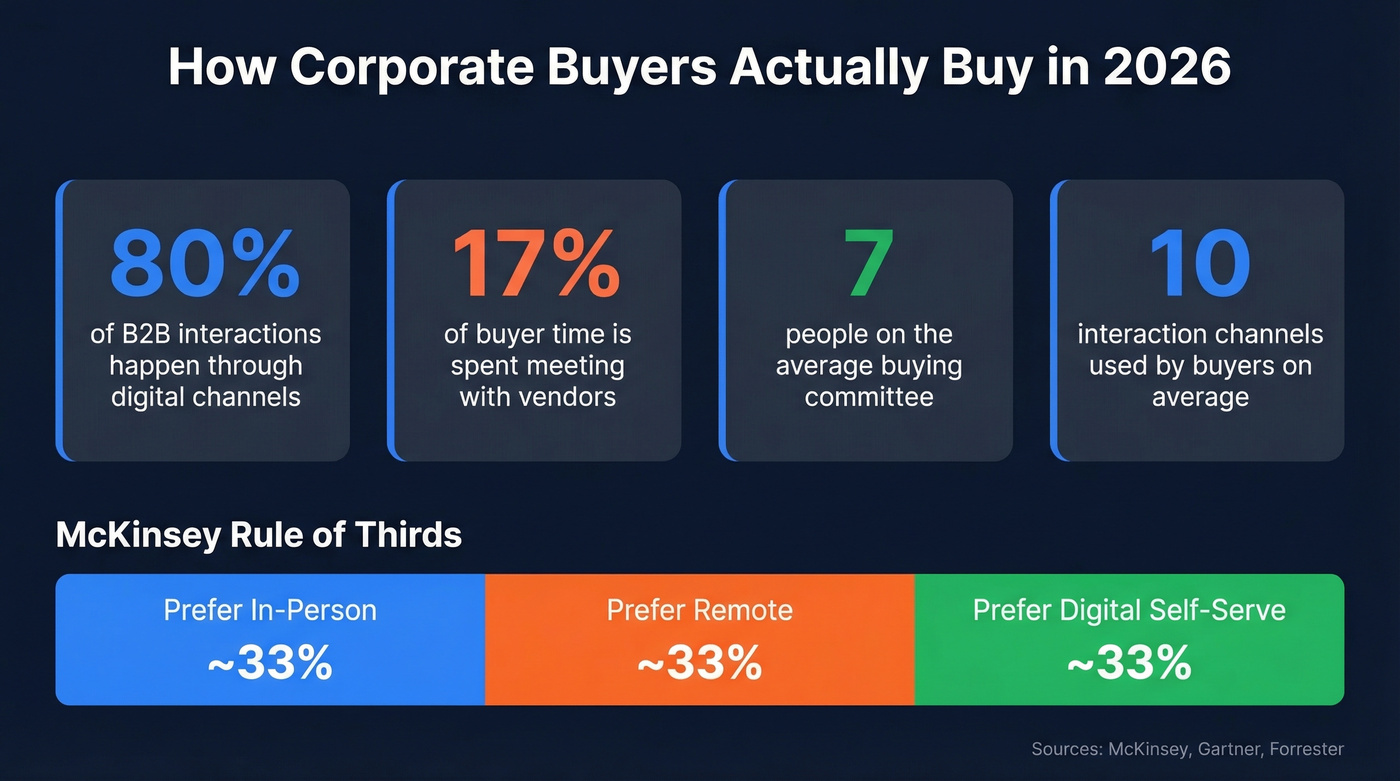
Corporate buying looks nothing like SMB sales. 80% of B2B sales interactions now happen through digital channels, and buyers spend just 17% of their time meeting vendors. The rest goes to independent research and internal alignment.
McKinsey's "rule of thirds" captures it well: at any stage, roughly a third of buyers prefer in-person, a third prefer remote, and a third want digital self-serve. You can't pick one channel and hope. Buyers use about 10 interaction channels on average, 75% say they're taking longer to decide than they were two years ago, and with 7 people on the average buying committee, you're selling to a small committee with competing priorities - not a single decision-maker. That last point changes everything about how you structure outreach.

Corporate buying committees average 7 people. You need verified contact data for every one of them. Prospeo gives you 30+ filters - buyer intent, technographics, headcount growth - across 300M+ profiles with 98% email accuracy and a 7-day refresh cycle.
Stop guessing email formats. Start reaching the full buying committee.
The 5-Step System for Landing Corporate Clients
Step 1: Define Your Ideal Corporate Client
Stop targeting "companies with 500+ employees." That's not an ICP - that's a census filter.
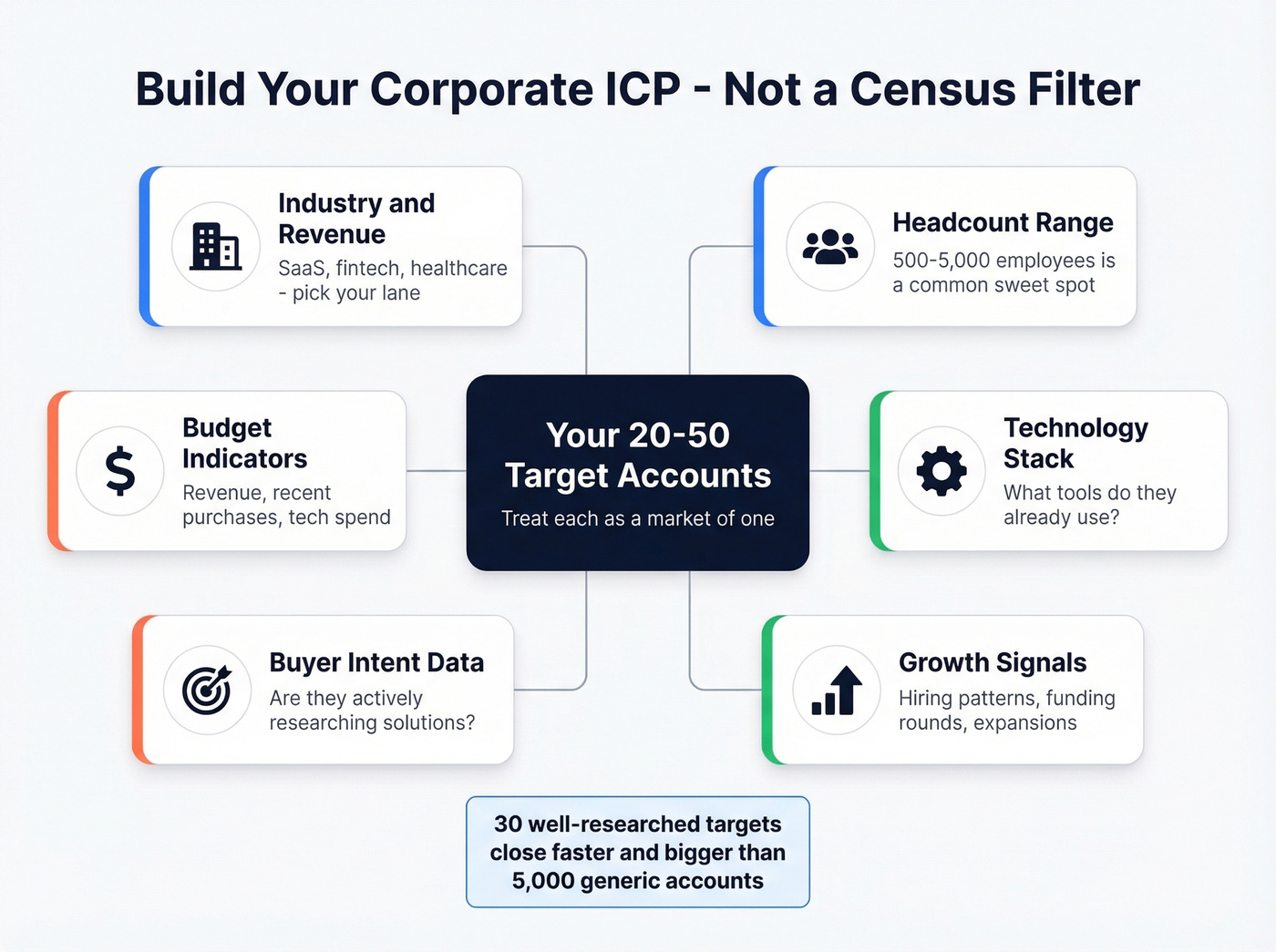
Real corporate targeting means building a list of 20-50 best-fit accounts and treating each as a market of one. Your ICP should combine firmographic and behavioral signals: industry, revenue range, headcount, technology stack, buyer intent signals, and growth indicators like hiring patterns or funding rounds. We've seen teams waste months blasting 5,000 generic accounts when 30 well-researched targets would've closed faster and bigger.
Step 2: Build a Verified Prospect List
Every guide says "find the decision-maker." None of them explain how. With 7 people on the average buying committee, you need 5-7 contacts per account - the economic buyer, the champion, and the end users who'll influence the decision.
What works: A B2B data platform that filters by job title, company size, buyer intent, and technographics, then delivers verified contact data for the full committee. Prospeo does this across 300M+ professional profiles with 30+ search filters and intent data powered by Bombora. It includes 143M+ verified emails and 125M+ verified mobile numbers, with data refreshing every 7 days instead of the 6-week industry average - so you're not emailing someone who changed jobs last quarter. The free tier gives you 75 emails/month plus 100 Chrome extension credits, no contract required.

What wastes time: Buying stale lists from data brokers or guessing email formats. About 20% of legitimate cold emails never reach the inbox due to bad data. That's not a deliverability problem. It's a data quality problem.
Step 3: Run Multi-Touch Outreach
77% of B2B buyers prefer email during their research phase, and cold email still delivers roughly $36 in ROI per $1 spent. But one email isn't outreach - it's a lottery ticket. You need 3-7 touches per sequence, and 60% of your replies will come after that second follow-up.
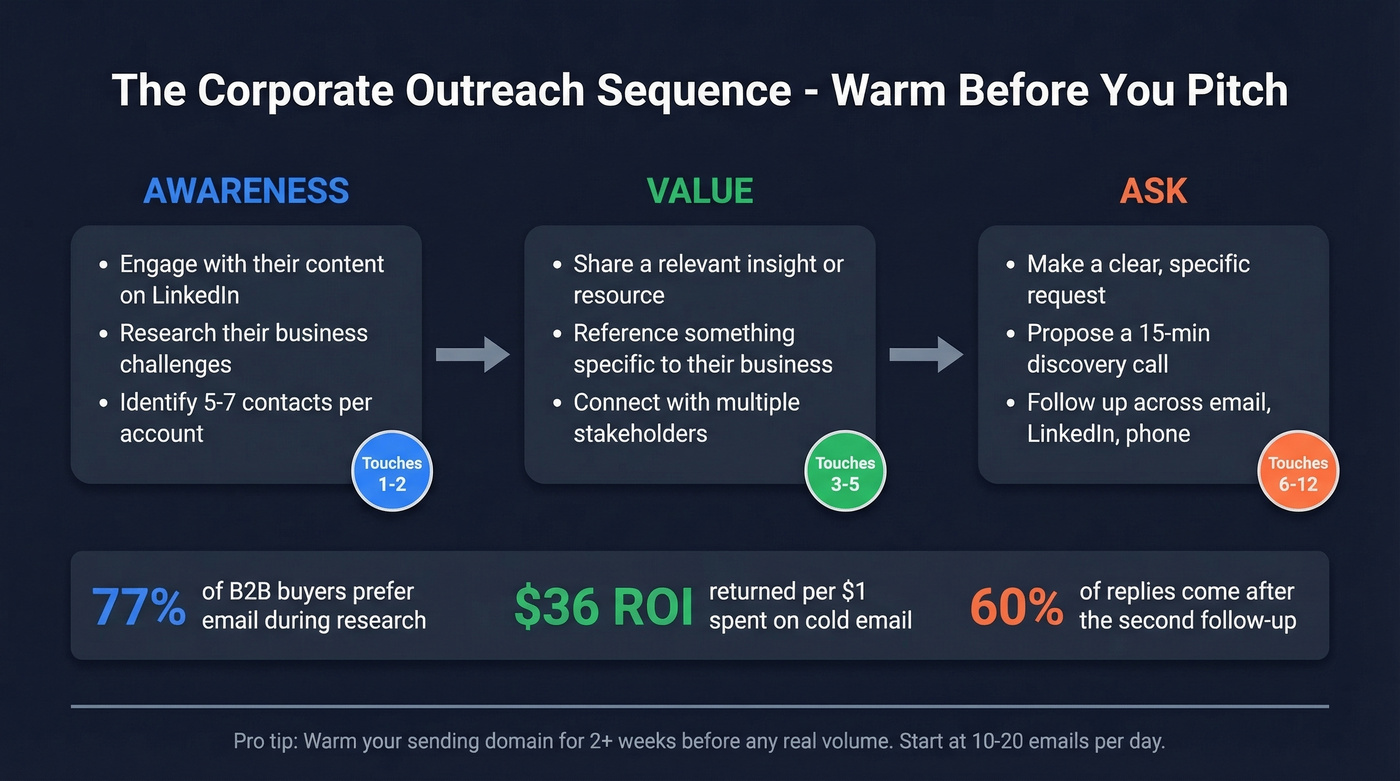
The best corporate outreach follows a warm-before-you-pitch framework: Awareness, then Value, then Ask. Engage with a prospect's content, share something genuinely useful, then make the request. Prospects decide in about 3 seconds whether to keep reading, so your first line needs to be specific to their business - not a template with {FirstName} swapped in.
Here's the thing: for high-value targets, consider direct mail. One ABM team mailed a guide locked in a physical safe to CIOs, then sent the combination to their security managers - forcing multi-threading. It got meetings email alone couldn't. That's the kind of creative thinking that separates corporate outreach from mass blasting.
Whether you're sending 50 emails or 500, list hygiene determines whether your messages land. Use a separate sending domain, authenticate with SPF/DKIM/DMARC, and start at 10-20 emails per day before ramping up. The consensus on r/sales is that warming your domain for at least two weeks before any real volume is non-negotiable - skip it and you'll tank your sender reputation before you even start.
Step 4: Prepare for Procurement
This is where most small vendors lose corporate deals they've already won. Nearly 80% of companies face challenges when adopting new vendors, and in our experience, procurement and legal can add weeks - sometimes months - to a deal timeline. Have these ready before you need them:

- Security documentation - map your controls to NIST or ISO frameworks
- Compliance certifications - SOC 2, GDPR documentation, HIPAA if relevant
- Insurance certificates - general liability, cyber liability, E&O
- Payment flexibility - net-30, net-60, or net-90 terms
- RFP templates - pre-built responses for common procurement questions
If you don't have SOC 2 yet, don't panic. Start the process now and be transparent about your timeline. Most corporate buyers would rather work with a vendor who's honest about where they are than one who dodges the question.
Step 5: Follow Up Relentlessly
Most deals require 5-12 touchpoints before a decision, and up to 50% of sales go to the first vendor to respond. Yet 84% of reps missed quota last year. The average close rate sits at 29%.
Let's be honest: if your deal sizes clear $20K, your follow-up system matters more than your pitch deck. A sales cycle running 1-3 months - with 8% of high-value deals stretching past 5 months - demands persistence that doesn't depend on memory or sticky notes. Ask any founder who's landed their first enterprise deal and they'll tell you the same thing. The ones who won weren't more talented. They just didn't stop after email two.
Mistakes That Kill Corporate Deals
No ICP definition. Targeting "enterprise companies" isn't a strategy. Without firmographic and intent filters, you're spraying into the void.
One-and-done outreach. A single email and silence is the fastest way to lose. Corporate buyers need multiple touches across multiple channels before they'll engage.
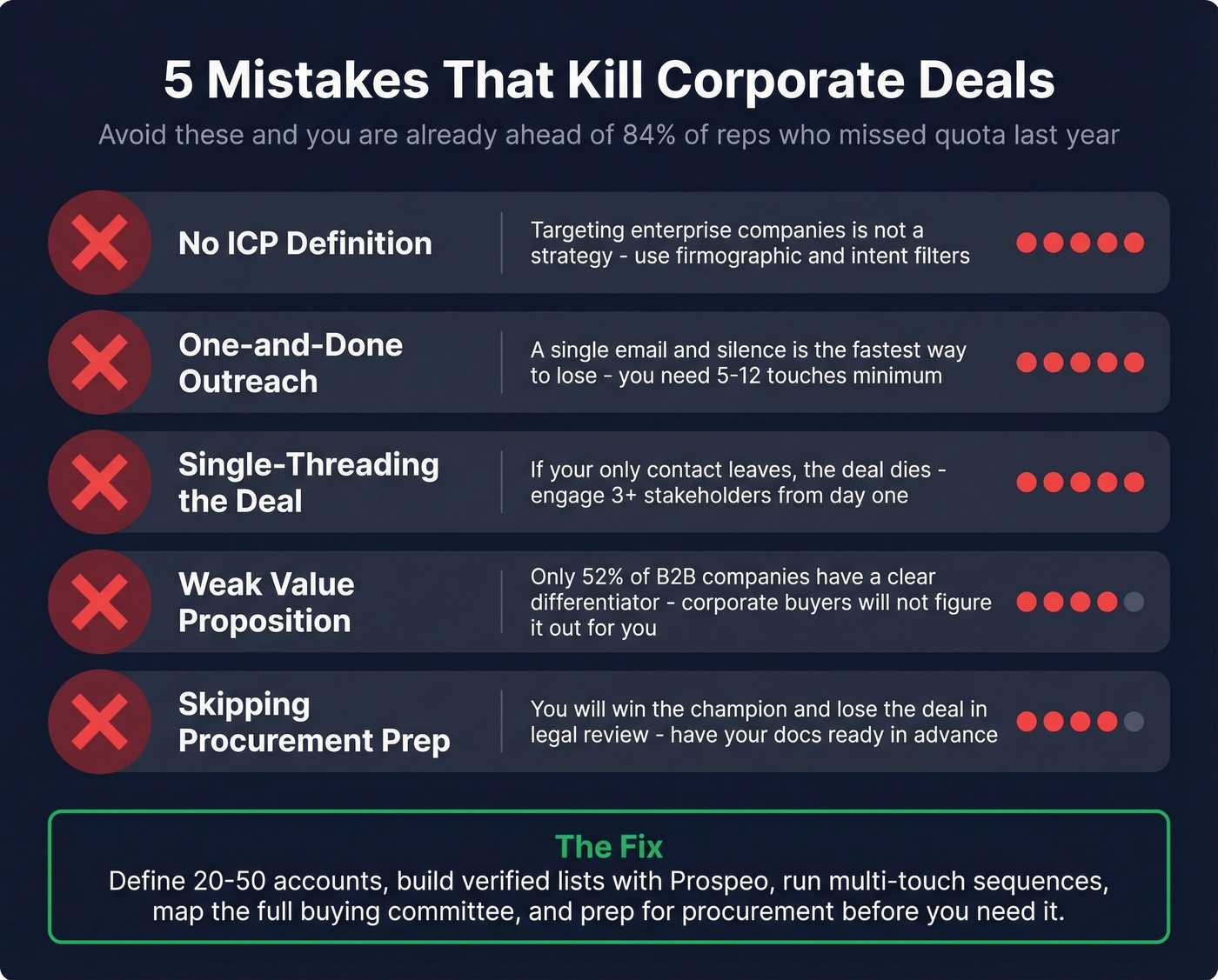
Single-threading the deal. If your only contact leaves or loses internal influence, the deal dies. Always engage 3+ stakeholders per account from the start.
Weak value proposition. Only 52% of B2B companies have a clearly defined differentiating value prop. If yours isn't one of them, corporate buyers won't figure it out for you.
Skipping procurement prep. You'll win the champion's heart and lose the deal in legal review. I've watched it happen to teams with great products who simply weren't ready for the paperwork gauntlet.
Bad data kills corporate deals before they start. 20% of cold emails never reach the inbox because the data is stale. Prospeo refreshes every 7 days - not 6 weeks - and delivers 143M+ verified emails and 125M+ verified mobiles so your multi-touch sequences actually land.
Your outreach is only as good as your data. Fix that at $0.01 per email.
FAQ
How long does it take to land a corporate client?
Most B2B sales cycles run 1-3 months, with 8% of high-value deals exceeding 5 months. Budget extra time for procurement and legal review on your first few deals - having security docs and compliance certs ready in advance can shave weeks off the timeline.
How many prospects should I target?
Start with 20-50 best-fit accounts using an ABM approach rather than blasting thousands. The average B2B close rate is 29%, so targeting 40 well-researched accounts should yield roughly 10-12 closed deals over a full sales cycle - assuming your outreach and follow-up are solid.
How do I find corporate decision-makers' contact info?
Use a B2B data platform to search by job title, company size, and buyer intent signals, then pull verified emails and direct dials for the full buying committee - 5-7 contacts per account. Prospeo's 30+ search filters and 7-day data refresh make this step fast, and the free tier covers 75 lookups per month so you can start without a budget.
What's the biggest mistake when trying to attract corporate clients?
Single-threading - relying on one contact inside the target company. With 7 people on the average buying committee, losing your sole champion means losing the deal. Always map and engage at least 3 stakeholders across different functions from day one.