

How to Hire Salespeople Who Don't Quit After 4 Months
About half of first sales hires don't make it past year one. If you're figuring out how to hire salespeople who actually stick, that's not a recruiting problem - it's a process problem. When an AE seat sits empty for 60 days on a $1.2M quota, you're looking at roughly $200k in missed revenue before the replacement even starts ramping.
What You Need (Quick Version)
- Don't hire until you've closed 5-10 deals yourself and can describe your sales process in 10 minutes flat.
- Hire a doer - a full-stack SDR/AE hybrid with 2-5 years of startup experience. Hire two if budget allows.
- Use a weighted interview scorecard, pay a real base + variable, and invest in 30/60/90-day onboarding - or you'll be re-hiring in 4 months.
Are You Actually Ready?
The biggest mistake founders make isn't hiring the wrong person - it's hiring at the wrong time. When you bring someone on before you understand your own sales motion, you're testing the person, the process, and product-market fit simultaneously. When it fails, you won't know which variable broke.
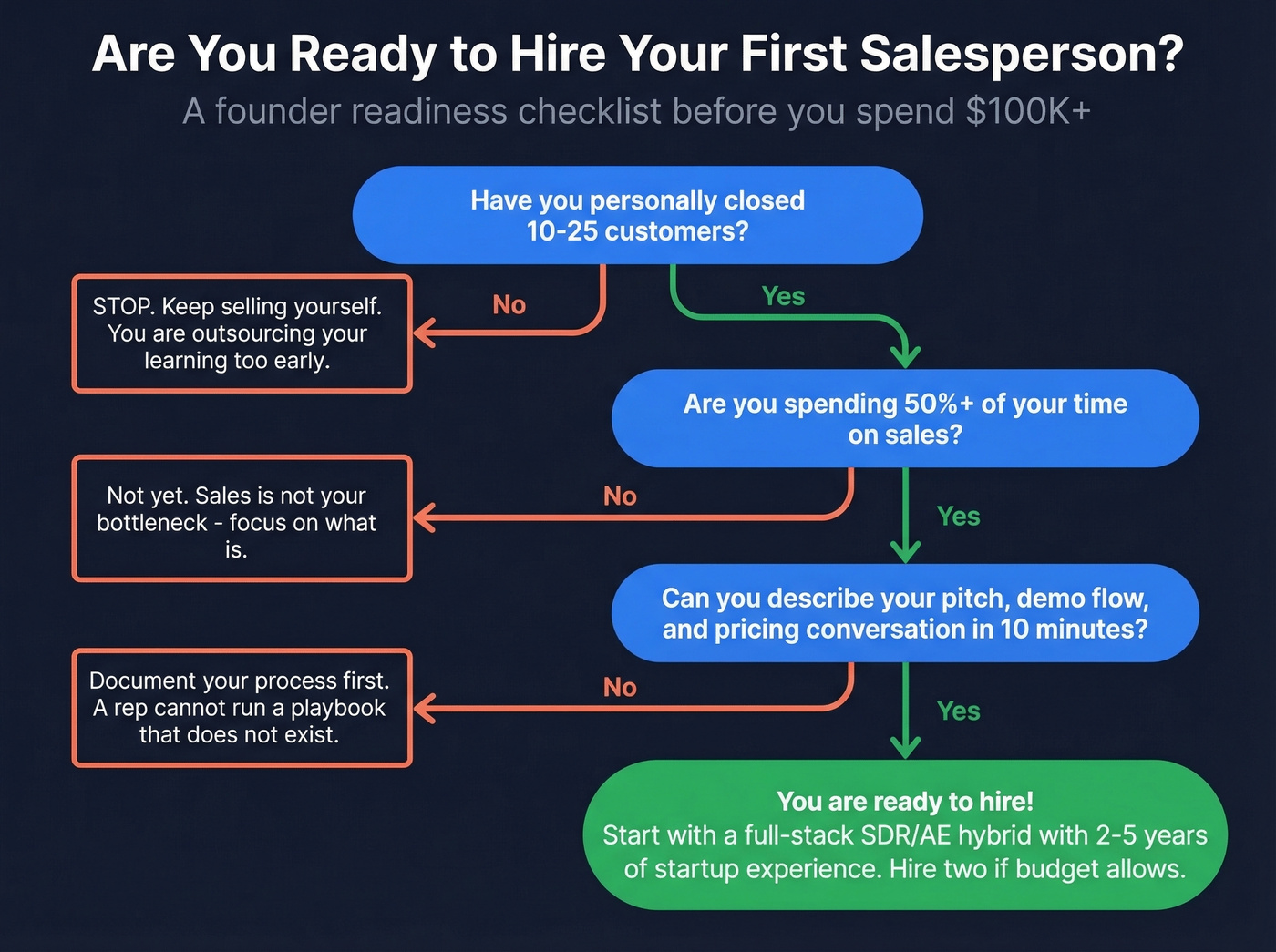
The biggest risk of hiring too soon is outsourcing your learning. You need to feel the objections, hear the "no"s, and figure out what makes someone say yes before you hand that to a rep.
The readiness signals are straightforward. You've closed 10-25 customers - real ones, not your college roommate's company. You're spending 50%+ of your time on sales and it's the bottleneck. You've documented a pitch, a demo flow, and a pricing conversation that a competent rep could pick up and run with. If you can't check those boxes, you're not hiring a salesperson. You're hiring a guinea pig.
Define the Role First
The instinct to hire a VP of Sales with a big Rolodex is strong. Resist it. Sub-one-year tenures are ridiculously common for senior sales hires at early-stage companies because a VP from a 500-person org won't do the cold outreach, the manual CRM hygiene, or the button-clicking that early sales demands.
Your first hire should be a full-stack rep - someone who prospects, demos, negotiates, and closes. Look for 2-5 years of startup experience, comfort with ambiguity, and a missionary mindset. PatientPop nailed this: they targeted reps with 2-5 years of experience selling $5k-$15k ACV deals who'd "moved a lot of units quickly." That specificity matters more than a fancy resume from a brand-name SaaS company, because what you're really screening for is someone who thrives in chaos, not someone who thrives in a machine that's already built.
Hire two, not one. If one rep fails and the other succeeds, you've got a talent problem. If both fail, you've got a product, pricing, or process problem. Two data points beat one.
Here's the thing: if your average deal size is under $15k, you don't need a VP of Sales until you have at least 3 reps hitting quota. Hire the doers first. The strategist can come later when there's actually a strategy to scale.
Write a Job Post That Attracts Closers
Before you source candidates, write a job description that doesn't read like it was assembled by committee. Use first-person voice ("You'll own the full sales cycle") instead of third-person corporate-speak. Emphasize growth potential and what they'll learn, not just requirements.
Include your OTE range. Skip the 15-bullet "requirements" list and focus on 4-5 non-negotiables. We've reviewed hundreds of sales job posts, and the ones that pull the best candidates are specific about the stage of the company, the deal size, and what success looks like in the first 90 days. A strong post is one of the most overlooked sales hiring tips - it's the first filter between you and hundreds of unqualified applicants.
2026 Sales Compensation Benchmarks
Nothing kills a sales hire faster than a comp plan that feels unfair.
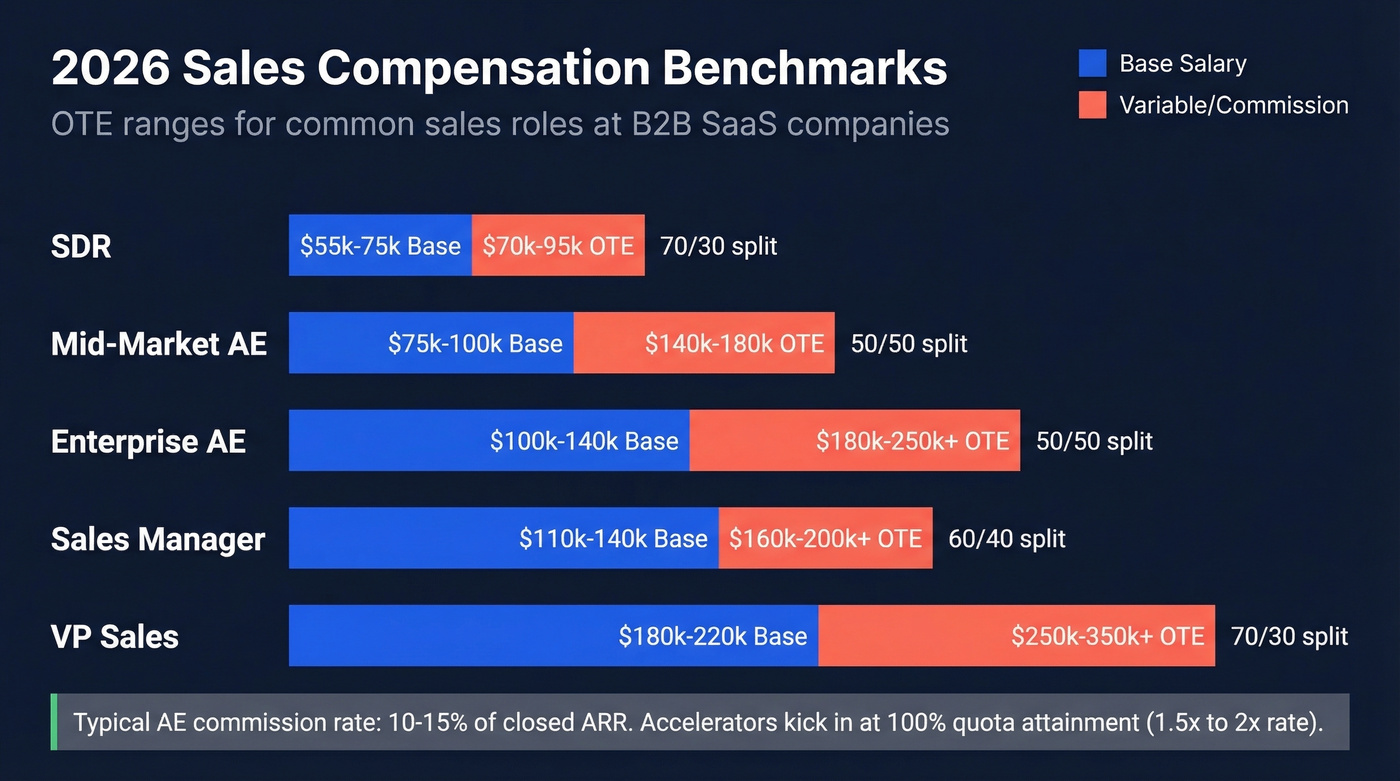
| Role | Base Range | OTE Range | Pay Mix | Variable Tied To |
|---|---|---|---|---|
| SDR | $55k-$75k | $70k-$95k | 70/30 | Meetings booked |
| Mid-Market AE | $75k-$100k | $140k-$180k | 50/50 | Closed ARR |
| Enterprise AE | $100k-$140k | $180k-$250k+ | 50/50 | Closed ARR |
| Sales Manager | $110k-$140k | $160k-$200k+ | 60/40 | Team quota |
| VP Sales | $180k-$220k | $250k-$350k+ | 70/30 | Org revenue |
A typical AE commission rate is 10-15% of closed ARR. Accelerators kick in after a rep hits 100% of quota - typically at 1.5x to 2x the base rate. Some plans also include decelerators below a performance threshold like 75% of quota to discourage sandbagging. Whether to cap commissions is a philosophical question: caps help finance sleep at night, but uncapped plans attract and retain top performers. We've seen too many companies lose their best AE over a $15k cap dispute.
Commission-only attracts commission-only effort. Reps who accept zero base are either desperate or planning to ghost after training. Industry estimates put the cost of a bad hire at $100k-$150k minimum. Pay a real base - especially when you're bringing on sales talent you actually want to retain.

You're investing $100K+ per AE hire. Don't let bad data waste their ramp time. Prospeo gives new reps 300M+ verified contacts, 30+ targeting filters, and 98% email accuracy - so they book meetings in week one, not month three.
Cut rep ramp time in half with data that actually connects.
Where to Find Great Candidates
The best salespeople rarely browse job boards. Finding ideal candidates means going where they already are, not waiting for them to come to you.
- Referrals. They convert at 3-5x the rate of cold applicants. Use the "forced referral" tactic from Mark Roberge's hiring playbook at HubSpot: review your network's connections and ask for specific introductions rather than blasting "we're hiring!" on social media.
- Startup-focused platforms like Wellfound (formerly AngelList Talent).
- Sales-specific marketplaces like Salesfolks.
- General job boards (Indeed, ZipRecruiter) - wide net, lower signal-to-noise.
When reaching out to passive candidates, lead with the opportunity, not the job description. A message like "We're at $2M ARR, growing 3x, and I need someone to own the full cycle" beats a generic InMail every time. Personalize the first line to something specific about their current role or company. Recruiting top reps is a sales process in itself - treat it like one (and borrow a few sales prospecting techniques while you're at it).
Build an Interview Scorecard
Gut-feel interviewing is why half your sales hires fail. Research from Schmidt and Hunter shows structured interviews are roughly twice as predictive of job performance compared to unstructured conversations. Administer assessments before the first interview - they're a filter, not a confirmation tool.
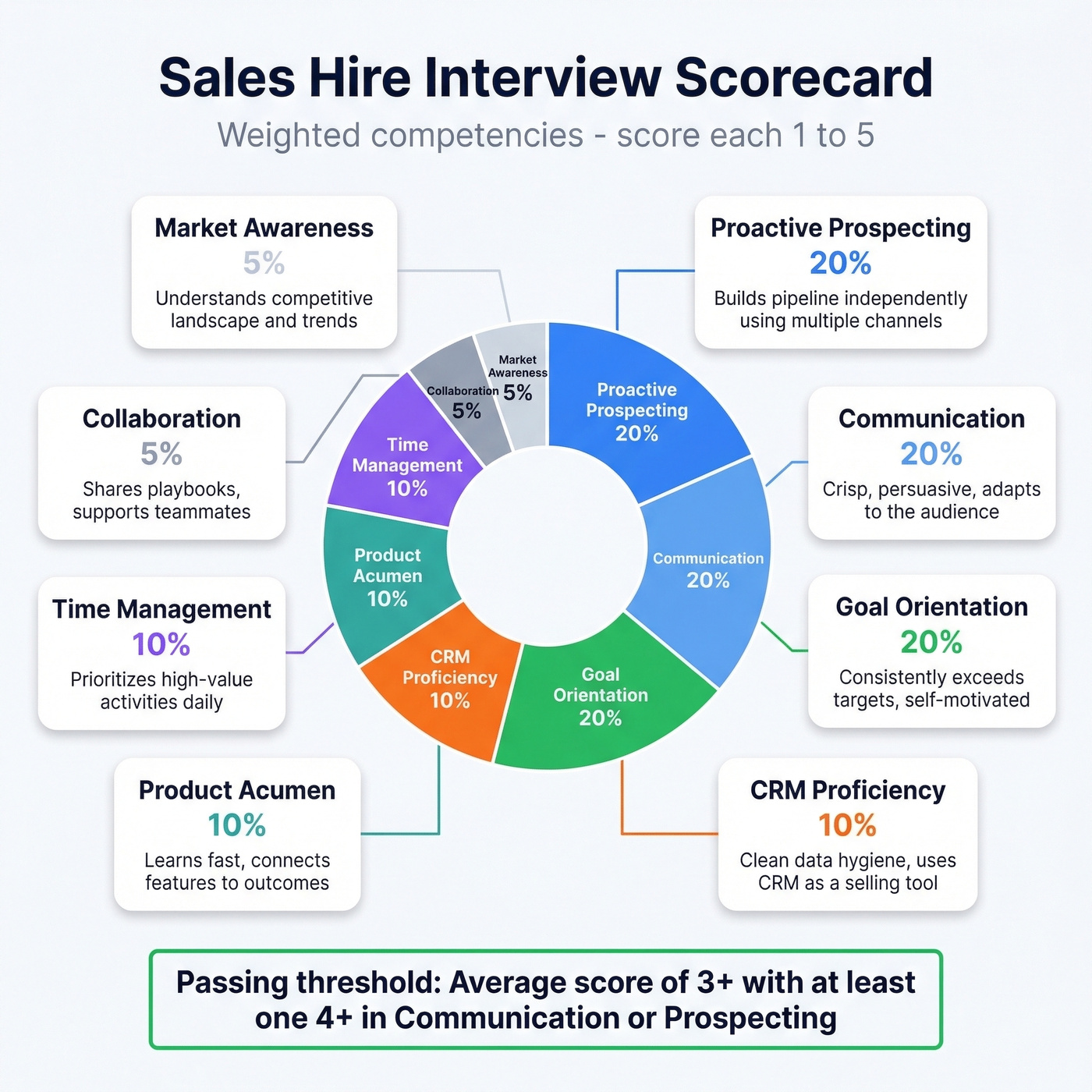
| Competency | Weight | What "5" Looks Like |
|---|---|---|
| Proactive Prospecting | 20% | Builds pipeline independently; multi-channel |
| Communication | 20% | Crisp, persuasive, adapts to audience |
| Goal Orientation | 20% | Consistently exceeds targets; self-motivated |
| CRM Proficiency | 10% | Clean data hygiene; uses CRM as a selling tool |
| Product Acumen | 10% | Learns fast; connects features to outcomes |
| Time Management | 10% | Prioritizes high-value activities daily |
| Collaboration | 5% | Shares playbooks; supports teammates |
| Market Awareness | 5% | Understands competitive landscape and trends |
Sample questions by competency:
- Prospecting: "Walk me through how you'd build a list of 50 target accounts from scratch."
- Communication: "Pitch me our product in 2 minutes as if I'm a skeptical CFO."
- Goal Orientation: "Tell me about a quarter you missed. What did you change next quarter?"
- CRM: "How do you decide what goes in a CRM note vs. what doesn't?"
Passing guideline: average score of 3 or higher, with at least one 4+ in Communication or Prospecting. If a candidate can't demonstrate those two, nothing else matters.
Assessment Tools Worth Using
Sales assessments lower turnover by roughly 25% and boost team performance by 20%. They add a data layer interviews alone can't provide - especially critical when you need to hire sales reps quickly without sacrificing quality.
| Tool | What It Measures | Starting Price |
|---|---|---|
| TestGorilla | Cognitive + situational judgment | $75/mo |
| Crystal | Personality + communication style | $49/mo |
| Adaface | Skills + aptitude (credits-based) | $180/yr |
| Predictive Index | Behavioral drives + cognitive | $5k-$10k/yr |
| Caliper | Personality + motivation | $3k-$8k/yr |
| DriveTest (SalesDrive) | Achievement drive, competitiveness | Free first test |
For bootstrapped teams, start with TestGorilla or Crystal - both under $100/month with meaningful signal. Skip this if you're hiring fewer than 3 reps per year; the scorecard alone will get you 80% of the way there. But if you're hiring 10+ reps annually, Predictive Index justifies its cost through consistency at scale.
Onboarding: The Part Everyone Skips
New hires take 3-9 months to reach full productivity. Structured onboarding cuts that by 23-52%. In one implementation we studied, new hires with structured onboarding outperformed five-year veterans by 21% at the 120-day mark. That's not a typo.
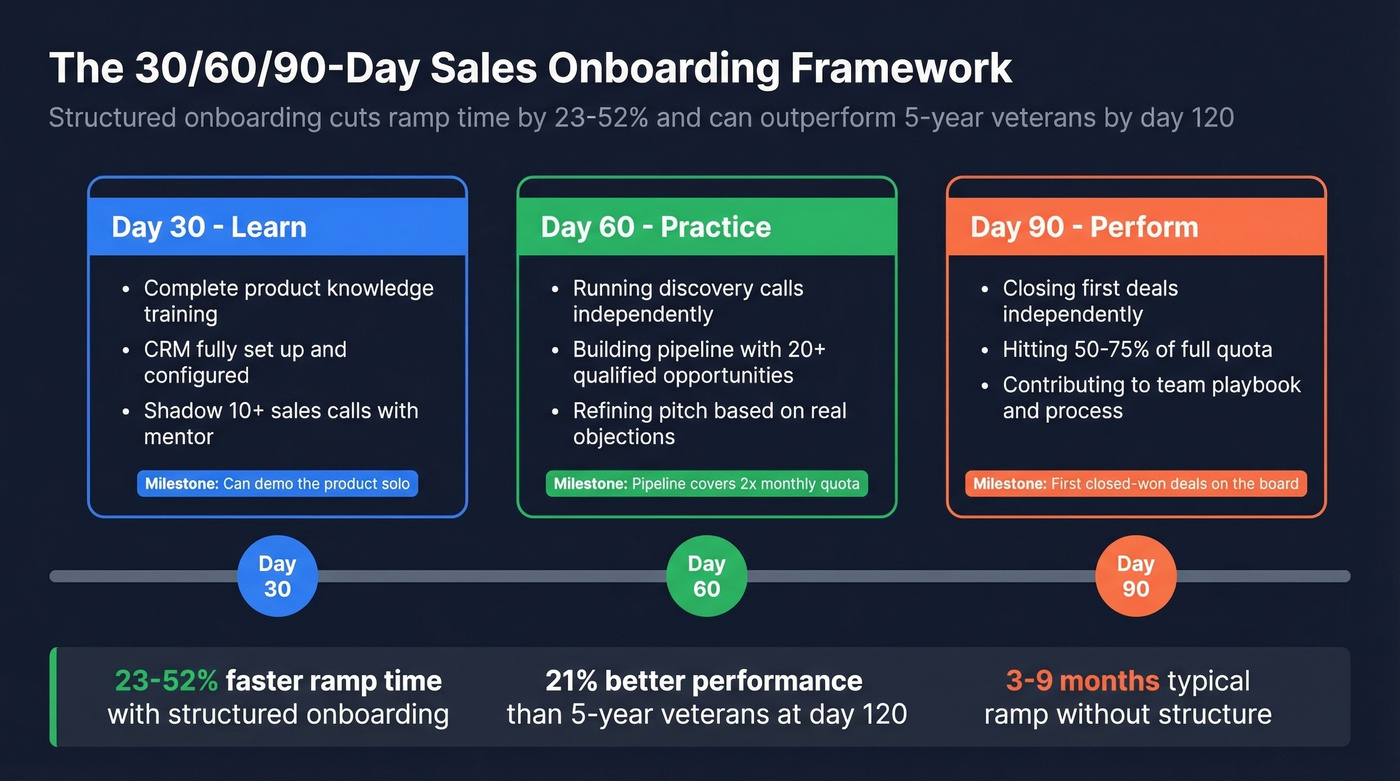
Build your program around a 30/60/90-day framework:
- Day 30: Product knowledge, CRM setup, shadow calls completed.
- Day 60: Running discovery calls, building pipeline independently.
- Day 90: Closing first deals on their own.
Each milestone needs measurable indicators - not vibes. The Forbes onboarding playbook recommends pairing each new hire with a successful rep as a mentor. A buddy system costs nothing and gives the new hire someone to ask the dumb questions they won't ask their manager. Getting onboarding right is the difference between knowing how to hire a salesperson and actually retaining one (use a real 30/60/90-day framework if you want it done fast).
Set Your Reps Up With Clean Data
Here's a frustrating scenario we see constantly: your new AE spends their first two weeks manually Googling email addresses and calling numbers that go to voicemail. That's not onboarding - that's hazing.
GreyScout ran into this exact problem. Their reps were bouncing 38% of emails and spending weeks ramping. After switching to Prospeo, bounce rates dropped under 4% and rep ramp time was cut from 8-10 weeks to 4 weeks. Pipeline went up 140%. The free tier starts at 75 verified emails per month, so there's zero reason not to have this ready before day one.
Let's be honest - the tools you hand a rep on their first day say more about your commitment to their success than any welcome lunch. A verified contact database, a configured CRM, and a clear ICP list should be waiting for them, not something they build from scratch.

Your comp plan is dialed. Your scorecard is built. Now give your sales hires the pipeline fuel to hit quota. Prospeo delivers verified emails at $0.01 each and 125M+ direct dials with a 30% pickup rate - the same stack agencies use to scale from 0 to $1M ARR.
Stop hiring closers and handing them a phonebook full of dead numbers.
FAQ
How long does it take to ramp a new salesperson?
Most new sales reps take 3-9 months to reach full productivity. Structured onboarding with clear 30/60/90-day milestones cuts ramp time by 23-52%. Without a formal program, expect the longer end of that range and higher early-stage turnover.
Should I hire an SDR or an AE first?
For deals under $15k ACV, hire a full-stack rep who prospects and closes. Splitting SDR and AE roles makes sense above $25k ACV where the sales cycle justifies specialization. At the earliest stage, you want versatility over structure.
Is commission-only a good way to attract reps?
No. Commission-only plans attract low-quality candidates who ghost after training or cherry-pick easy deals. Pay a real base - even a modest one signals you're invested in the rep's success and reduces turnover significantly.
How much does it cost to replace a bad sales hire?
Direct costs run $100k-$150k including recruiting, onboarding, and lost productivity. In high-quota roles, factor in missed revenue during vacancy and ramp - total impact regularly exceeds $500k for enterprise AE seats.
What tools help new reps start prospecting on day one?
Give reps a verified contact database so their first outreach actually connects. Prospeo's free tier includes 75 verified emails per month with 98% accuracy, plus a Chrome extension for pulling contacts from professional profiles and company sites - enough to start building pipeline immediately without bouncing emails.