

How to Introduce Yourself Over Email - And Actually Get a Reply
Most introduction emails fail because they're written as introductions. "Hi, my name is Sarah, I'm the new Account Executive at Acme Corp, and I wanted to reach out to introduce myself." That's not an email - that's a name tag. The average professional receives 100-120 emails a day, and if your message doesn't give them a reason to care within the first line, it's headed straight for the archive folder.
Stop writing introduction emails. Write purpose emails that happen to introduce you. The difference sounds subtle, but it's the gap between a reply and oblivion.
The Short Version
- Lead with purpose, not your name. Your signature handles the introduction. Your opening line should answer "why should I care?"
- Keep it under 80 words. For cold outreach, 40-60 is better.
- Personalized subject line, 2-4 words. A Belkins study of 5.5 million emails found personalized subject lines hit a 46% open rate vs. 35% without.
- Send Monday morning, early. Siege Media's analysis of 85,000+ personalized emails shows 6-9 AM PST on Monday performs best, with 7-8 AM PST as the sweet spot.
- Follow up. One follow-up alone lifts reply rates by 65.8%. Most people send one email and quit.
- Verify the address before you hit send. A perfect email that bounces is worse than a mediocre one that arrives.
Anatomy of an Intro Email That Works
Every effective introduction email has six parts. Not all need to be long - most shouldn't be - but skipping any one creates a gap the reader will feel.
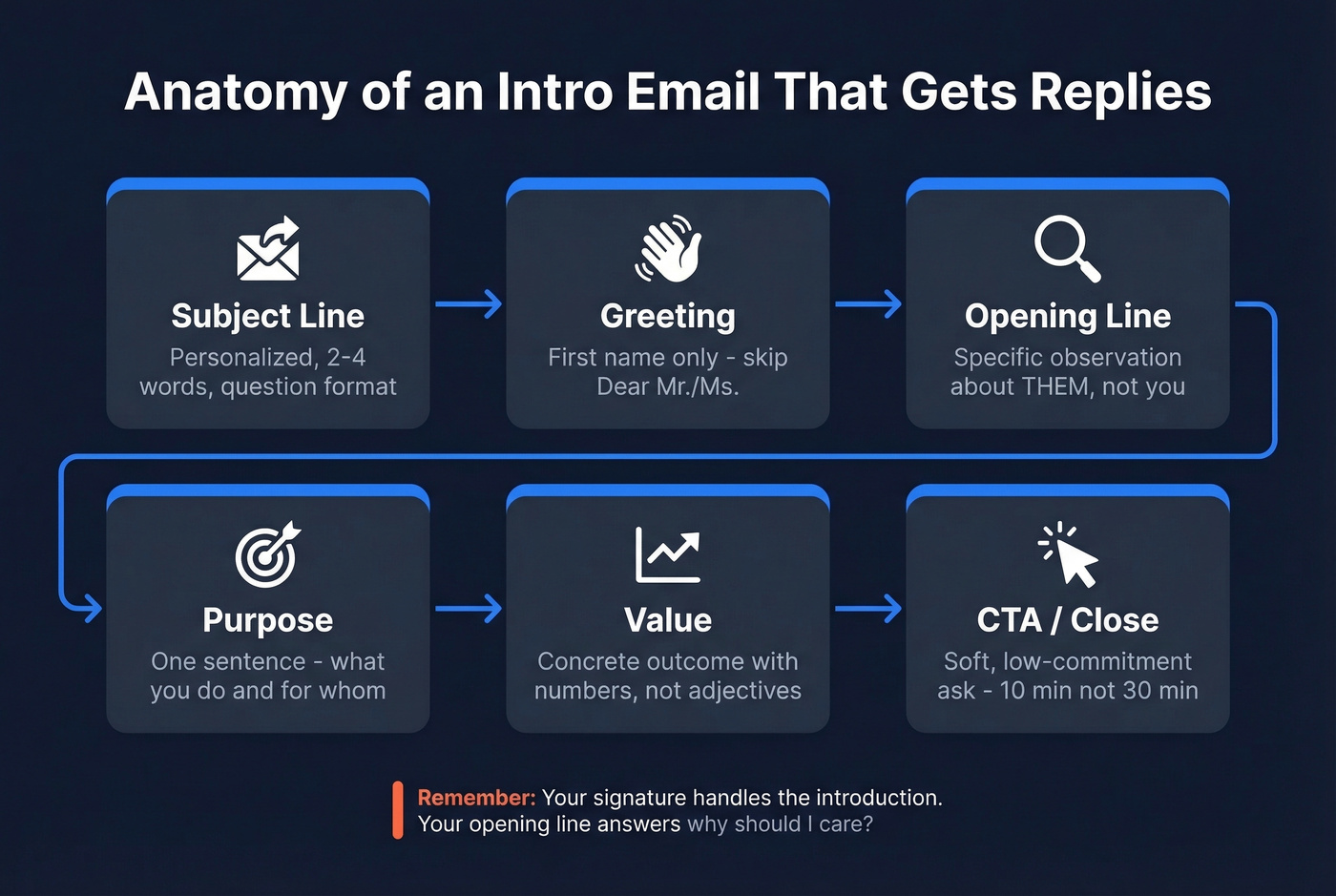
Subject line -> Greeting -> Opening line -> Purpose -> Value -> CTA/close.
Here's a real example:
Subject: Quick question, {{first_name}}
Hi Jordan,
Noticed your team just expanded the EMEA sales org - congrats. We help mid-market SaaS companies cut prospect list-building from 6 hours to 45 minutes using verified contact data.
Would it be worth a 10-minute look?
Best, Sarah Chen Account Executive, Acme Data
Why each piece works:
- Subject line - personalized, 3 words plus the name, question format. Hits every benchmark from the Belkins data.
- Greeting - first name only. "Dear Mr. Thompson" is for cover letters or industries where formality is the norm, like law and government. For most business email, first name is standard.
- Opening line - a specific observation about them, not about you. This signals you did homework.
- Purpose - one sentence explaining what you do and for whom. No jargon, no mission statement.
- Value - a concrete outcome (6 hours to 45 minutes). Numbers beat adjectives every time.
- CTA - soft, low-commitment. "Worth a 10-minute look?" is infinitely better than "Can we schedule a 30-minute call this Thursday?"
Now, the "My name is..." debate. Reddit's r/careerguidance has strong opinions here. If you're emailing someone who has zero context about who you are - a cold prospect, a conference speaker you've never met - a brief "I'm Sarah, AE at Acme" is fine. But for internal intros, client handoffs, or anyone who can see your signature? Skip it. Lead with purpose.
Quick word swaps that sharpen any intro email:
- "I wanted to reach out" -> "I noticed" or just delete it
- "I'm excited to" -> "Looking forward to"
- "I'd love to pick your brain" -> "I have one specific question about {{topic}}"
- "Just checking in" -> share a new insight or resource instead
Subject Lines That Get Opened
The Belkins dataset - 5.5 million emails analyzed - gives us hard numbers.
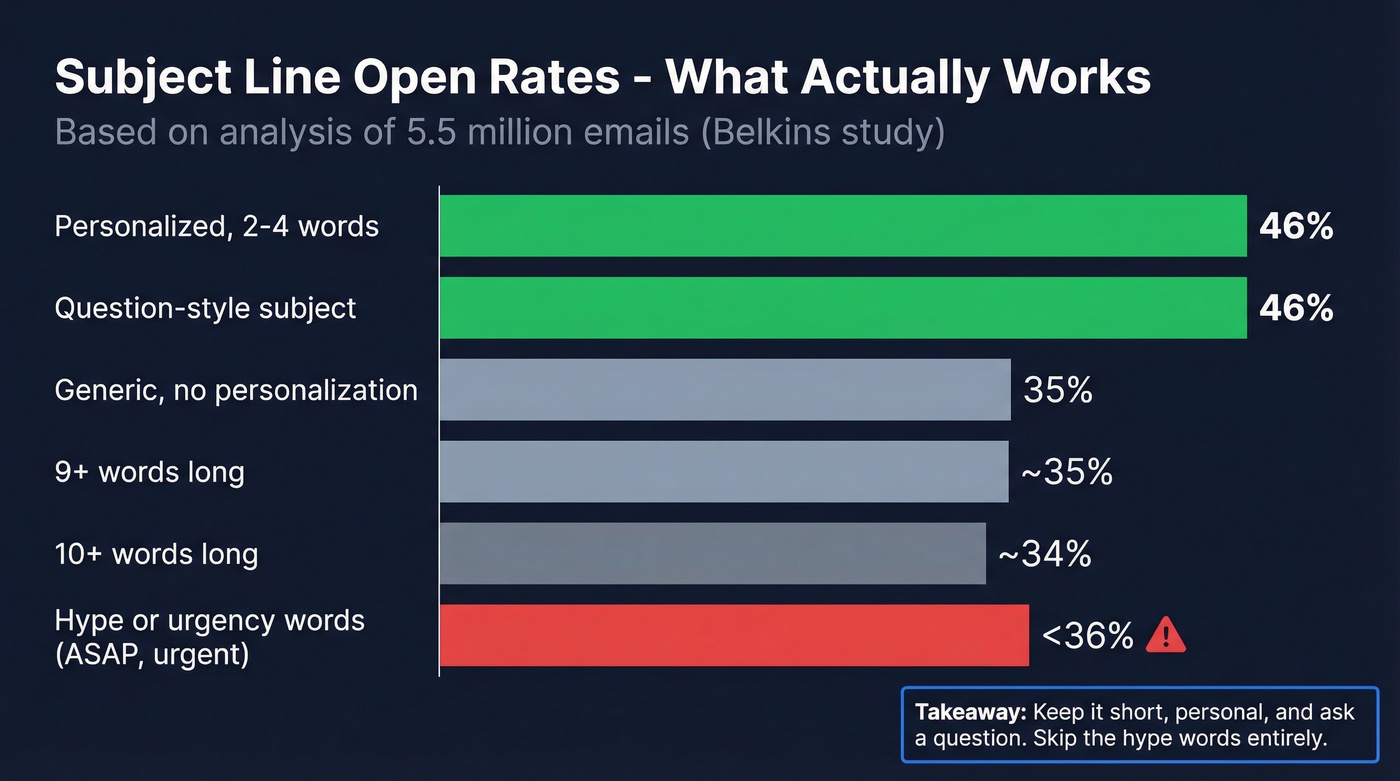
| Format | Open Rate | Notes |
|---|---|---|
| Personalized, 2-4 words | 46% | Best performer |
| Question-style | 46% | Ties with personalized |
| Generic, no personalization | 35% | Baseline |
| 9 words | ~35% | Opens drop beyond 7 words |
| 10 words | ~34% | Continues dropping |
| Hype/urgency words | <36% | "ASAP," "urgent" hurt |
In our experience, question-style subject lines consistently outperform statement-style ones - even when the statement is personalized. Something about a question creates an open loop the reader wants to close.
Five subject lines you can steal:
- Cold outreach: "Quick question, {{first_name}}"
- New job/team intro: "New on the team - hi!"
- Networking: "Loved your talk on {{topic}}"
- Referral: "{{mutual_name}} suggested we connect"
- Post-event: "Following up from {{event}}"
Skip anything that sounds like a marketing blast. "Exclusive Opportunity Inside!" doesn't just underperform - it actively signals you're not worth reading.
When to Hit Send
Timing data splits into two camps, and they tell different stories.
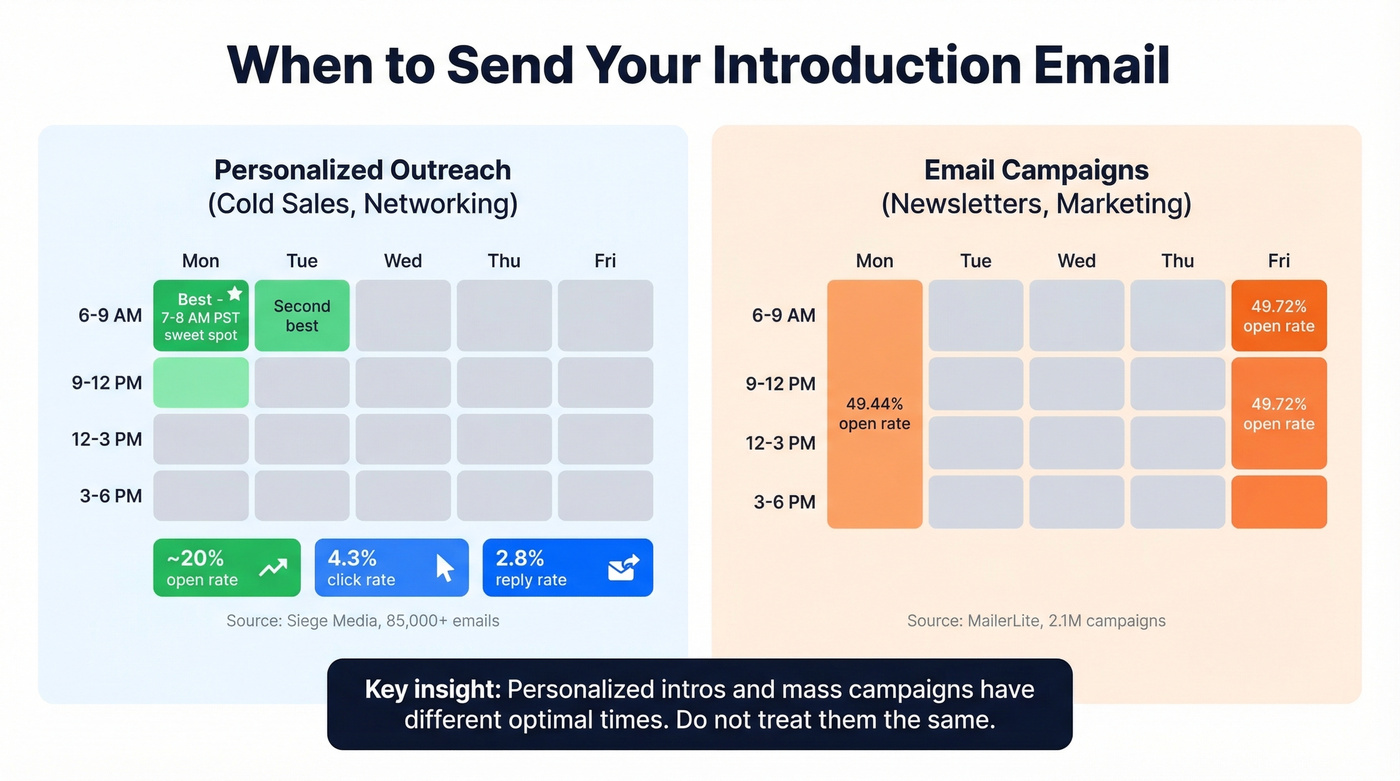
For personalized outreach (intro emails, cold sales, networking), Siege Media's analysis of 85,000+ emails points to Monday 6-9 AM PST as the clear winner, with Tuesday morning close behind. Monday showed a ~20% open rate, 4.3% click rate, and 2.8% reply rate - all best-in-class for cold outreach in their dataset. By 10 AM, performance dropped significantly.
For email campaigns (newsletters, marketing blasts), MailerLite's analysis of 2.1 million campaigns shows Friday at 49.72% open rate, with Monday close at 49.44%. Campaign data and one-to-one intro data aren't the same animal. Treat them differently.
The practical recommendation: schedule your cold, personalized intros for early morning Monday, ideally the 7-8 AM PST window. If you're working across time zones, schedule so it lands near the top of their inbox when they start their day - not buried under the afternoon avalanche.

You just crafted the perfect introduction email - personalized subject line, purpose-first opening, soft CTA. Then it bounces. Prospeo's 98% verified emails mean your intro actually reaches the inbox. Find and verify any prospect's email for ~$0.01 each.
A perfect intro email that bounces is a waste. Verify first.
Templates for Every Scenario
You don't need 15 templates. You need the right framework for your scenario. Here are eight, each annotated with why they work. Need a more formal version? Swap the first-name greeting for title + last name and replace the soft CTA with a specific scheduling request.
New Job / New Team
Hi team,
I'm joining as the new Product Marketing Manager, reporting to Lisa. I'll be owning competitive positioning and launch campaigns. I'm also an unreasonable coffee snob - happy to debate beans anytime.
Looking forward to working with everyone.
Skip the career history. State your role, what you own, and one human detail that makes you memorable.
Cold Sales Outreach
Here's the thing: most cold emails fail because they read like a pitch deck crammed into a paragraph. The principle is simple - trigger on something specific, deliver one concrete value prop, and close with a low-friction ask. Under 60 words. No "I'd love to schedule a 30-minute call" from a stranger.
Hi {{first_name}},
Saw {{company}} just opened a second SDR team - scaling outbound is great until your data can't keep pace. We help teams like yours cut list-building time by 80% with verified contacts.
Worth a quick conversation?
This follows the ultra-short format practitioners on r/copywriting swear by. We've tested emails with and without the "My name is" opener - purpose-first wins every time.
Client Introduction - Before and After
The version that gets ignored:
Hi Jordan, my name is Alex and I'm your new Customer Success Manager. I have four years of experience in SaaS customer success, most recently at Deloitte. I'm passionate about helping customers succeed and I look forward to building a great relationship with you and your team. Please don't hesitate to reach out if you need anything!
The version that gets a reply:
Hi {{first_name}},
I'm {{your_name}}, your new Customer Success Manager at {{company}}. I'll be your point of contact for anything product-related, renewals, and internal advocacy. If something's broken or confusing, I'm the person to tell.
I'd love to set up a 15-minute intro call this week - what works for you?
The framing from r/CustomerSuccess nails it: define your role in terms of what you do for them. That's the proper way to introduce yourself over email - by making the recipient the focus, not your resume.
Industry Leader / Mentor Request
Lead with specific admiration - not "I'm a huge fan of your work." Name the exact piece. Ask one concrete question.
Hi {{first_name}},
Your framework on {{specific topic}} in {{publication/talk}} changed how I approach {{specific thing}}. I'm working through a similar challenge at {{company}} and would love to ask one specific question about {{detail}}.
Would a 10-minute call be possible sometime this month?
Post-Event Follow-Up
Hi {{first_name}},
Really enjoyed our conversation about {{specific topic}} at {{event}} - especially your point about {{detail}}. I'd love to continue that thread. Free for coffee or a call next week?
Reference the actual conversation. "It was great meeting you at the conference" is forgettable. A specific detail proves you were paying attention.
Referral-Based Introduction
Hi {{first_name}},
{{Mutual contact}} suggested I reach out - they mentioned you're working on {{specific challenge}} and thought we might have a useful perspective. We help {{type of company}} with {{outcome}}.
Would it make sense to connect briefly?
Name the mutual connection in the first sentence. For warm intros, consider the double opt-in approach: ask the connector to check with both sides before making the introduction.
Vendor or Partner Introduction
Hi {{first_name}},
We work with several companies in {{their industry}} on {{specific outcome}} - most recently helped {{similar company}} achieve {{result}}. I think there's a fit with what {{their company}} is building.
Open to a quick chat to explore?
Lead with what you can do for them. Your company's founding story belongs on your website, not in a first email.
Internal Stakeholder Introduction
Hi {{first_name}},
I'm {{name}}, the new {{role}} on the {{team}} team. We'll be working together on {{project/goal}}. Best way to reach me is Slack ({{handle}}) or this email - I'm generally fastest on Slack.
Looking forward to collaborating.
State your role, the shared project, and your preferred communication channel. Internal intros should be the shortest emails you write.
Mistakes That Kill Your Intro Email
"Dear Sir or Madam, I hope this email finds you well." A delete trigger. It signals a mass email from someone who didn't bother to learn your name. The consensus on r/sales is brutal on this one, and rightfully so.
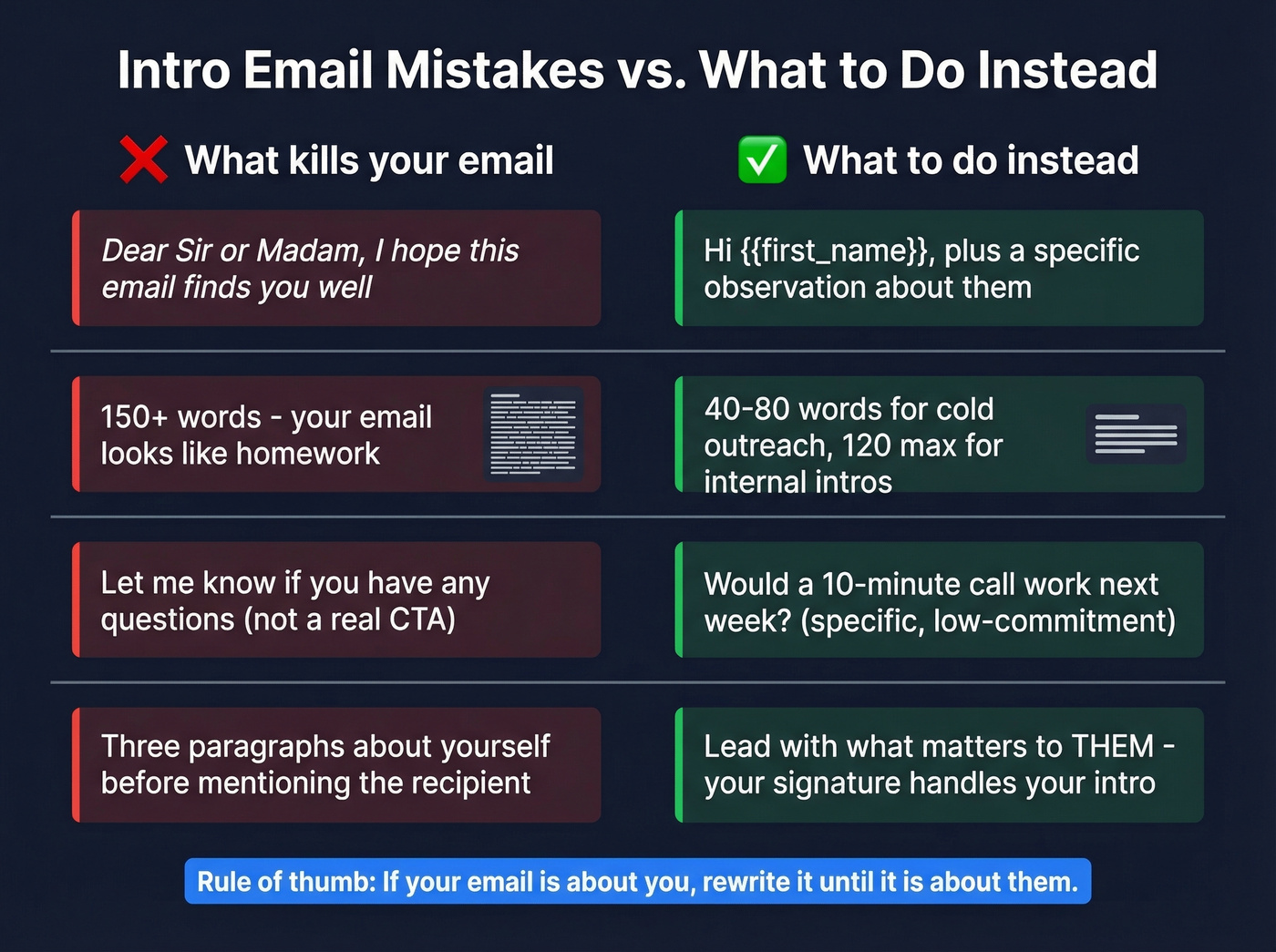
Writing more than 150 words. If your email looks like homework, it's getting archived. Cold outreach should be 40-80 words. Even internal intros rarely need more than 120.
No clear ask. Every email needs a CTA. "Let me know if you have any questions" isn't a CTA - it's a polite way of saying nothing. Ask for something specific.
Three paragraphs about yourself before mentioning the recipient. The reader doesn't care about your journey. They care about what's in it for them.
Too many links. Multiple links hurt deliverability and erode trust. One link maximum in a cold intro. Zero is often better.
"Just checking in" as a follow-up. This adds zero value. Every follow-up should bring something new - an insight, a case study, a quick win. (If you need alternatives, see just checking in.)
Asking a stranger for 30 minutes. That's a big commitment from someone who doesn't know you. Ask for 10 minutes, or better yet, ask a question they can answer in the reply itself.
Ignoring mobile. Over 60% of emails are opened on phones. If your email requires scrolling past the first screen, you've already lost most readers. Keep paragraphs short and skip complex formatting.
Follow-Up Strategy
One stat should change your behavior: a study of 12 million outbound emails found that one follow-up lifts reply rates by 65.8%. Yet 44% of salespeople give up after a single follow-up. And 80% of sales require five or more touches.
The math is simple. Follow up.
| Touch | Timing | What to Send |
|---|---|---|
| 1 | Day 1 | Initial intro email |
| 2 | Day 3 | New angle or insight |
| 3 | Day 6 | Case study or quick win |
| 4 | Day 12 | Different value prop |
| 5 | Day 24 | Break-up email |
Each touch adds value. Touch 2 isn't "just following up" - it's sharing a relevant insight or resource. Touch 3 might be a one-line case study. Touch 5 is the break-up: "Seems like the timing isn't right - I'll stop reaching out. If things change, here's where to find me."
We've seen teams double their reply rates by going from two touches to five. The emails don't need to be long - a three-sentence follow-up with a new angle outperforms a polished first email that never gets a second chance. (For ready-to-use sequences, grab these follow-up templates.)
International Email Etiquette
If you're emailing across borders, greeting norms aren't optional - they signal whether you cared enough to prepare.
- Japan: Use last name + "-san" (e.g., "Tanaka-san") and keep the tone formal.
- Germany: Use Herr/Frau + last name and default to formality.
- India: Sir/Madam is common in many business contexts.
- Mexico: Formality matters early; Licenciado/a + surname is common in some professional settings.
- Saudi Arabia: A greeting like "As-salamu alaykum" is appropriate in formal contexts.
Look, getting the greeting right won't close a deal. But getting it wrong - emailing a Japanese executive with "Hey Tanaka!" - will close a door. When you're reaching out internationally, spend two minutes researching norms. It's the cheapest competitive advantage you'll ever find.
For teams that sell deals above $15K, match the local formality every time. The stakes justify the effort. Below that threshold, you can probably get away with a casual first-name approach in most markets.
Verify Before You Send
You've written the perfect intro email. The subject line is personalized. The body is 55 words of pure value. The CTA is soft and specific.
Then it bounces, and your sender reputation takes the hit.
This is the unsexy prerequisite that separates professionals from amateurs. Prospeo runs a 5-step email verification process - catch-all handling, spam-trap removal, honeypot filtering - with 98% accuracy. The free tier gives you 75 email verifications per month plus 100 Chrome extension credits, plenty for individual outreach. Pricing is transparent and credit-based at around $0.01 per verified email, with no contracts. (If you want the deeper mechanics, start with this email deliverability guide.)
Building prospect lists for cold intros shouldn't take 6 hours. Prospeo gives you 300M+ profiles with 30+ filters - job title, intent signals, tech stack - so you spend time writing great emails, not hunting for addresses.
Stop guessing email addresses. Start writing emails that get replies.
FAQ
How long should an introduction email be?
Aim for 40-80 words for cold outreach and up to 120 for internal or team introductions. Anything over 150 words gets archived - especially on mobile, where 60%+ of emails are opened. Shorter emails signal confidence and respect for the reader's time.
Should I start with "My name is..."?
Only if the recipient has zero context about who you are - a completely cold prospect or a stranger at a conference. If your email signature includes your name and title, skip the self-introduction and lead with purpose instead. Let your value proposition do the talking before your name does.
What's the best subject line for an introduction email?
Personalized, 2-4 words, ideally in question format. The Belkins data shows this combination hits a 46% open rate - a 31% lift vs. generic subject lines. Keep it conversational and avoid hype words like "urgent" or "exclusive."
How many times should I follow up?
At least two to three times. One follow-up alone lifts reply rates by 65.8%, and the strongest sequences run five to eight total touches over about 24 days. Each follow-up should add new value - a relevant insight, a case study, a resource - not just repeat the original ask.
How do I make sure my intro email doesn't bounce?
Verify the email address before sending. Tools like Prospeo include catch-all handling and spam-trap removal with 98% accuracy, and the free tier covers 75 verifications per month. A bounced email damages your sender reputation, so verification isn't optional for any serious outreach.