

How to Make a Customer Profile Your Team Will Actually Use
Most profiling guides hand you a template and call it a day. That's like giving someone a recipe but no ingredients. The real challenge isn't filling in fields - it's building a profile grounded in data your sales and marketing teams will actually open, trust, and act on.
This guide walks through how to make a customer profile from real data, with filled B2B and B2C examples, a scoring rubric, and the tools that turn profiles into prospect lists.
Quick-Start Checklist
A customer profile is a data record of your actual best customers - not a fictional persona brainstormed in a conference room.
- Analyze your 50-100 best closed-won accounts first
- Include firmographics, buying committee roles, and decision criteria - not just demographics
- Score profiles into A/B/C tiers so your team knows who to prioritize
- Use a prospecting tool to find real contacts matching your Tier A profile
What Is a Customer Profile?
There's a lot of confusion between customer profiles, ICPs, and buyer personas. They're related but distinct, and mixing them up leads to documents nobody uses.
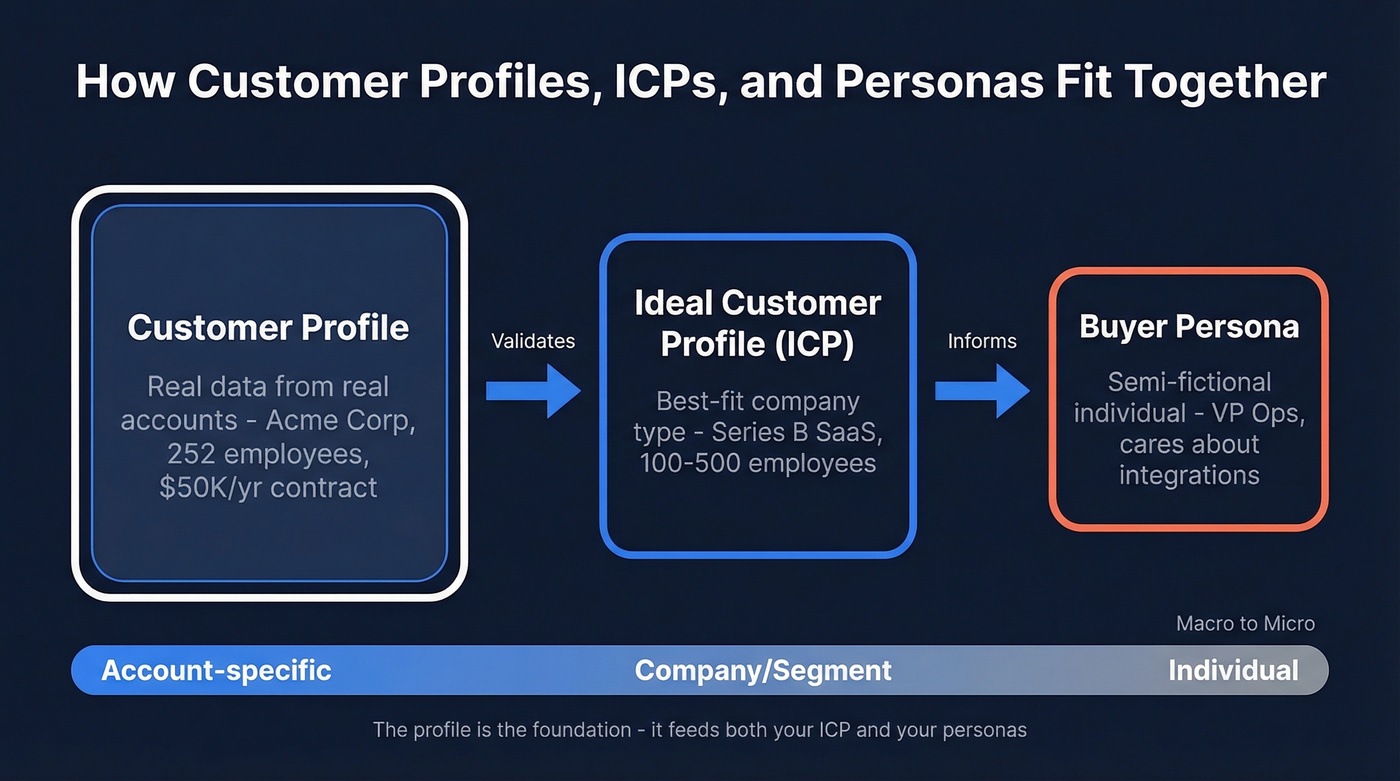
A customer profile is a living data record of an actual customer - their company details, buying behavior, decision criteria, and contract history. An ideal customer profile (ICP) describes the type of company worth pursuing. A buyer persona describes the individual you're selling to. HubSpot puts it well: "ICPs tell you which companies are worth speaking to. Personas tell you who you're speaking to." The customer profile feeds both - and it's the foundation for any serious intent based segmentation effort.
| Customer Profile | Ideal Customer Profile | Buyer Persona | |
|---|---|---|---|
| Definition | Data record of a real customer | Best-fit company description | Semi-fictional individual archetype |
| Level | Account-specific | Company/segment | Individual |
| Used For | Account management, expansion | Targeting, prioritization | Messaging, content |
| Example | "Acme Corp, 252 emp, $50K/yr" | "Series B SaaS, 100-500 emp" | "VP Ops, cares about integrations" |
Think of it as macro to micro. The ICP is your strategic filter. Buyer personas shape your tactical messaging. The customer profile is the real-world data that validates both.
Why Profiles Drive Revenue
Profiles aren't academic exercises. McKinsey research shows 71% of consumers expect personalized interactions, and 76% get frustrated when it doesn't happen. Customer loyalty is 1.5x higher for companies that lead on personalization. And 83% of people are more likely to stay loyal to brands offering personalized experiences.
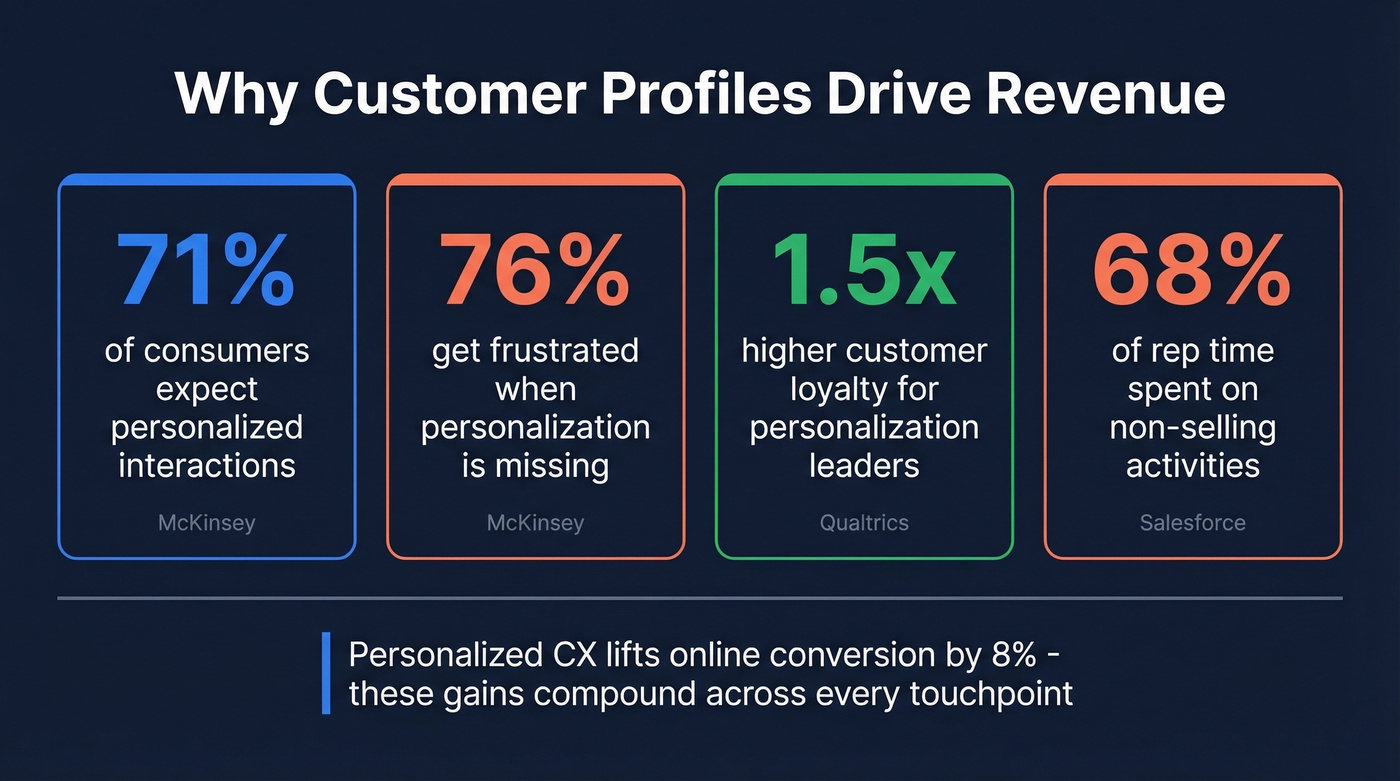
Personalized CX can lift online conversion by 8%. These aren't marginal gains - they compound across every touchpoint.
Here's the stat that should make every sales leader uncomfortable: Salesforce's State of Sales found reps spend 68% of their time on non-selling activities. Disciplined profiling cuts that waste by telling reps exactly who to call first. You can't personalize what you don't understand, and you can't understand customers you haven't profiled.
What to Include in a Profile
If your B2B profile doesn't include a buying committee map, it's a B2C profile with a company name slapped on top. The fields you track depend on your business model, but here's the split:
| B2C Fields | B2B Fields |
|---|---|
| Demographics (age, location, income) | Firmographics (industry, size, revenue, funding) |
| Psychographics (values, interests, lifestyle) | Technographics (current stack, integrations) |
| Behavioral data (purchase frequency, channels, LTV) | Buying committee (decider, payer, user, champions) |
| Channel preferences (email, SMS, social) | Contract details (value, renewal timing, expansion) |
Qualtrics' B/O/X framework is useful for structuring data collection. Behavioral data (B) tells you what customers do - purchases, clicks, usage patterns. Operational data (O) tells you what's happening in the business - support tickets, contract renewals, churn signals. Experience data (X) tells you why - survey responses, NPS scores, interview feedback. Most teams drown in B-data and ignore X-data entirely, which is how you end up with profiles that describe behavior but can't explain it.
For B2B specifically, the buying committee deserves its own section. It's increasingly rare that one person decides, pays, and uses your product. You need to map the decider who chooses, the payer who signs the check, and the users who live in the product daily. Miss one of these roles and your deal stalls in ways your CRM won't explain.

You just mapped firmographics, technographics, and buying committee roles. Now turn that profile into real prospects. Prospeo's 30+ search filters - including intent data, headcount growth, funding stage, and tech stack - let you match your Tier A customer profile to 300M+ verified contacts at 98% email accuracy.
Stop profiling in spreadsheets. Start finding real buyers.
How to Build a Customer Profile Step by Step
Start From Your Best Customers
Pull 50-100 closed-won deals from the last 12 months. Don't brainstorm in a conference room - let the data talk. Look for the 3-5 traits that 70-80% of your wins share. Industry? Headcount range? Funding stage? Tech stack?
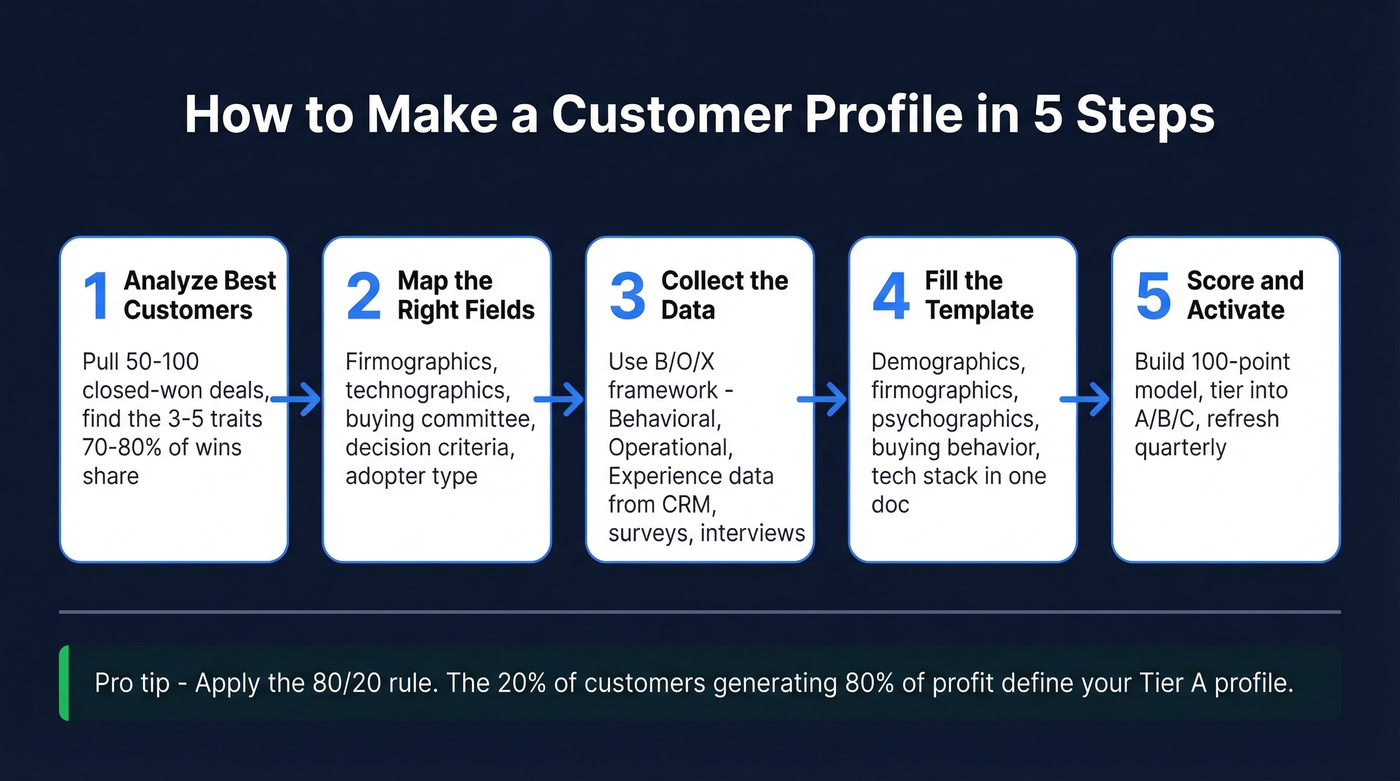
Apply the 80/20 rule: identify the 20% of customers generating 80% of your profit. Use LTV, CAC, and repeat purchase rates to assess actual profitability - not just revenue. You don't need 15 profile fields to start. Five that actually predict whether someone will buy is plenty.
Map the Right Fields
Adele Revella's buyer worksheet framework gives you nine segments to explore: buyer triggers, success factors, perceived barriers, buyer's journey, decision criteria, demographics/psychographics, sales preferences, organizational buy-in, and post-purchase insights. You won't fill all nine on day one, and that's fine.
Your profile should also flag adopter type. Early adopters tolerate imperfections and give vocal feedback; widespread adopters want reliability and churn quietly. Knowing which type dominates your best-customer list changes how you position and support the product.
Run "mandatory checks" before finalizing: financial readiness, urgency, effort required, readiness to change, and systems around them. These checks prevent you from profiling companies that look great on paper but will never close.
Collect the Data
Structure your collection around the B/O/X framework. For behavioral data, pull from your CRM activity logs, website analytics, and purchase history. For operational data, mine support tickets, contract records, and renewal patterns. For experience data, run surveys - SurveyMonkey starts around $25/mo, Typeform has paid plans in a similar range - and conduct customer interviews.
Here's the thing: your data is scattered across your CRM, email platform, support tickets, and three spreadsheets someone started in 2022. Accept that reality and start consolidating. A $10-off incentive for survey completion can dramatically improve response rates.
Fill the Template
A solid customer profile template covers five sections: demographics, firmographics, psychographics, buying behavior, and technographics. For B2B, add buying committee and contract details. For B2C, add channel preferences and LTV.
Don't overthink the format. A Google Sheet works. A Notion doc works. What matters is that every field has a clear definition and a data source.
Score, Activate, and Update
This is where most guides stop - and where the real value starts. Build a 100-point scoring model across four dimensions: firmographics, technographics, behavioral signals, and trigger events. Tier your profiles:
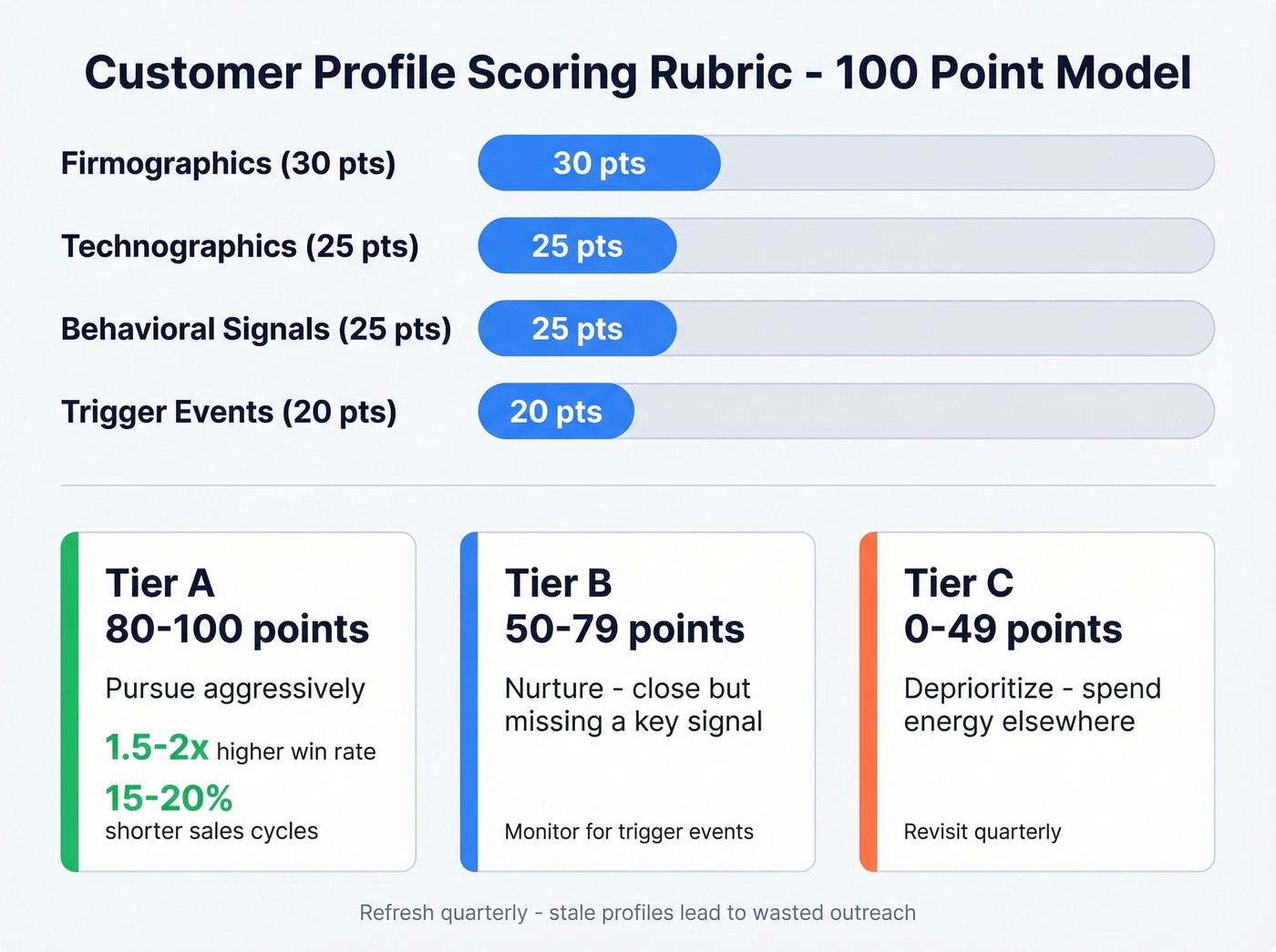
- Tier A (80-100 points): Pursue aggressively. These accounts match your best-customer DNA.
- Tier B (50-79 points): Nurture. They're close but missing a key signal.
- Tier C (0-49 points): Deprioritize. Spend your energy elsewhere.
In our experience, Tier A win rates run 1.5-2x higher than Tier B, with 15-20% shorter sales cycles. That's the payoff of disciplined profiling.

Refresh quarterly. Monitor for conversion drops in a segment, shifts in deal size, or changes in your product's market fit. Stale profiles lead to wasted outreach.
Customer Profile Examples
B2B Example: SaaS Company
Company: TechFlow Solutions (fictional) Industry: Supply chain SaaS Employees: 252 | HQ: San Francisco, CA ARR: $10M | Funding: Series B Business model: Annual subscription
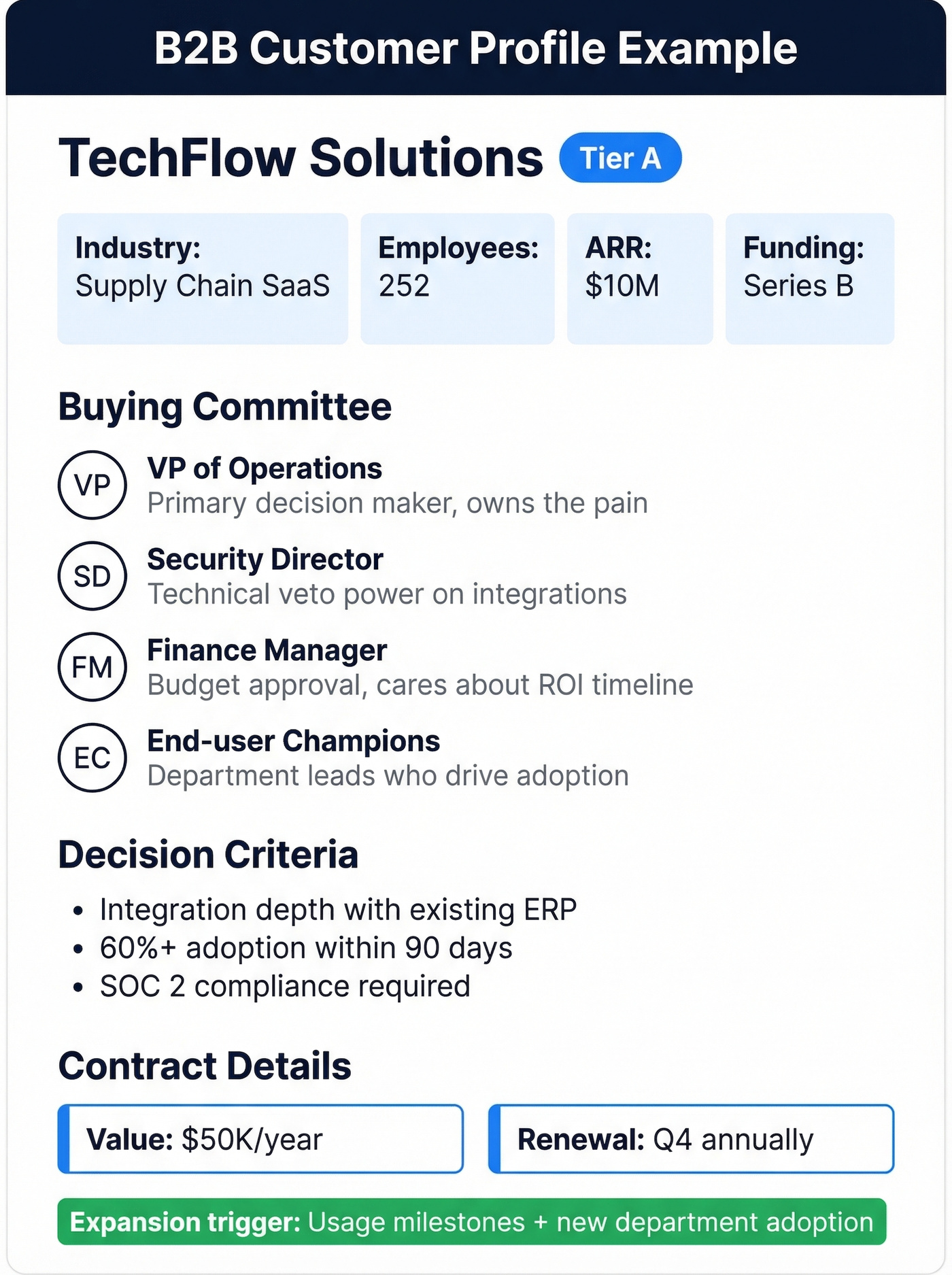
Buying Committee:
- VP of Operations - primary decision maker, owns the pain
- Security Director - technical veto power on integrations
- Finance Manager - budget approval, cares about ROI timeline
- End-user champions - department leads who'll drive adoption
Decision Criteria: Integration depth with existing ERP, 60%+ adoption within 90 days, SOC 2 compliance Contract Value: $50K/year, annual renewal in Q4 Expansion Criteria: Usage milestones + new department adoption
B2C Example: DTC Skincare Brand
Customer: Sarah M. (composite) Age: 28-35 | Location: Urban, West Coast Household Income: $65K-$90K
Psychographics: Values sustainability, ingredient-conscious, follows skincare influencers, reads labels before purchasing Behavioral: Subscribes to refill program, average order $45, purchases every 6 weeks, discovered brand via Instagram Channel Preferences: Email for promotions, SMS for shipping updates, doesn't engage with push notifications LTV: $540/year
This profile tells the marketing team exactly how to reach Sarah, what messaging resonates, and which channels to invest in. That's the difference between a profile and a demographic snapshot.
Common Profiling Mistakes
Building "fairytale personas" without talking to customers or sales. If your profile was created in a brainstorm with zero customer data, it's fiction. The consensus on r/b2bmarketing is blunt: these documents collect dust.
Overweighting demographics in B2B. A VP's age and hobbies don't predict whether their company will buy. Firmographics and technographics do.
Ignoring the buying committee. You're not selling to one person. Map the decider, payer, and user - or watch deals stall at "I need to check with my team."
No scoring or prioritization is equally deadly. Without A/B/C tiers, every lead looks the same and your reps waste time on accounts that were never going to close. And the most common mistake of all? Creating the profile then never using it. The best customer profile is the one your sales team actually opens. If it lives in a Google Doc nobody reads, it's a fairytale persona with better formatting.
Two more traps worth flagging: being too narrow - over-constraining your profile excludes viable segments that have historically converted - and never updating. Markets shift. Your product evolves. Quarterly refreshes aren't optional; they're how you catch segment drift before it tanks your pipeline.
Tools for Building and Activating Profiles
You don't need a $30K/year platform to validate an ICP. Here's what actually works at each stage:
| Tool | Category | Starting Price | Best For |
|---|---|---|---|
| Prospeo | Prospecting + enrichment | Free / ~$0.01/email | Finding contacts matching your profile |
| HubSpot CRM | CRM | Free / $20/user/mo | Storing and managing profiles |
| Salesforce | Enterprise CRM | $25-$165/user/mo | Complex account hierarchies |
| Google Analytics | Behavioral data | Free | Website behavior patterns |
| SurveyMonkey | Direct feedback | ~$25/mo | Customer surveys and NPS |
| Segment | CDP | Custom pricing | Unifying data across touchpoints |
| Apollo.io | Data enrichment | Free-$99/user/mo | SMB prospecting |
| ZoomInfo | Enterprise data | ~$15K-$40K+/yr | Large-scale ABM programs |
Let's be honest: if your average deal size is under $15K, you almost certainly don't need ZoomInfo-level data. Skip it. A CRM on a free tier plus an enrichment tool will get you 90% of the way there at a fraction of the cost.
A quick distinction worth knowing: a CRM manages relationships and pipeline, a CDP unifies customer data across sources for segmentation, and a DMP handles advertising audience data. Pick the layer you actually need before signing contracts.
If your CRM data is stale - and it probably is - run it through an data enrichment tool before building profiles from it. Stale job titles and outdated company sizes will poison every profile you build on top of them. We've watched teams spend weeks on profiling only to realize their underlying data was two years old.
Your customer profile is only as useful as the contacts it helps you reach. Prospeo enriches your CRM and CSVs with 50+ data points per contact - firmographics, technographics, direct dials, verified emails - at a 92% match rate. Data refreshes every 7 days, so your profiles never go stale.
Enrich your customer profiles with real, verified contact data for $0.01 per email.
FAQ
What's the difference between a customer profile and a buyer persona?
A customer profile is a data record based on real customers - firmographics, purchase history, behavior - while a buyer persona is a semi-fictional archetype used for messaging. Profiles come from data; personas come from profiles. You need both, but the profile comes first because it grounds your personas in reality instead of guesswork.
How many customer profiles should I create?
Most companies need 3-5 profiles covering their primary segments. Start with your single most profitable customer type, validate it against closed-won data, then expand. Going beyond five usually means you're splitting segments that should be combined.
How often should I update profiles?
Quarterly at minimum. Watch for conversion drops in a segment, shifts in average deal size, or changes in product-market fit. Stale profiles lead to wasted outreach and misallocated ad spend.
What's the fastest way to find prospects matching my profile?
Use a B2B database with advanced filters. Prospeo lets you filter by buyer intent, technographics, funding stage, and headcount growth across 300M+ profiles, then export verified emails directly to your CRM or sequencer - free tier included.