

How to Pitch in Sales: What the Data Says Actually Works
Here's the uncomfortable truth about sales pitches: 79% of them fall short. The problem isn't charisma or product knowledge. It's that most pitches are built to persuade when they should be built to reduce decision risk.
Your biggest competitor isn't the other vendor - it's "no decision." Between 40% and 60% of B2B deals end that way, based on analysis of over 2 million sales calls. Once you understand that buyers are wired to avoid risk more than they're wired to chase value, everything about how you pitch changes.
What the Data Says About Winning Pitches
We've spent a lot of time digging through Gong Labs research, and one number keeps showing up: top performers talk 43% of the time and listen 57%. That stat gets quoted everywhere. What doesn't get quoted is the consistency gap underneath it.
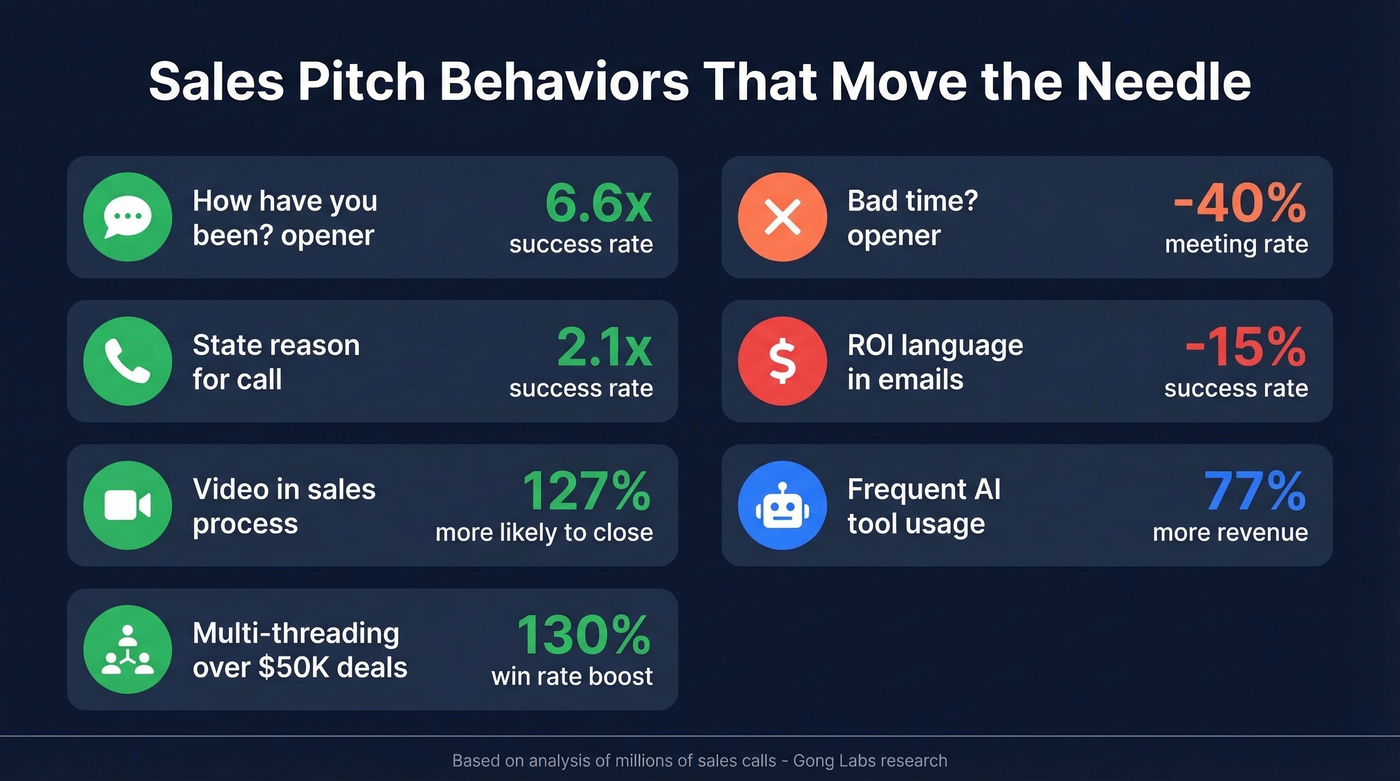
High performers hold that ratio whether they win or lose. Low performers swing wildly - 54% talk time in won deals, 64% in lost ones. That 10-point swing is the difference between a discovery call and a monologue. If you catch yourself talking more when a deal feels shaky, that's the instinct to fight.
Sellers who frequently use AI tools generate 77% more revenue, based on analysis of 7.1 million opportunities. AI doesn't write your pitch for you. It handles research, call prep, and follow-up drafts so you spend more time actually listening during the conversation that matters.
| Behavior | Impact |
|---|---|
| "How've you been?" opener | 6.6x success rate |
| State reason for call | 2.1x success rate |
| "Bad time?" opener | -40% meeting rate |
| ROI language in emails | -15% success rate |
| Video in sales process | 127% more likely to close |
| Multi-threading (>$50K) | 130% win rate boost |
| Frequent AI usage | 77% more revenue |
The Positioning-First Framework
April Dunford's approach flips the typical pitch structure on its head. Instead of walking through features and hoping something sticks, you start with a market insight the buyer already believes - then show why the alternatives fail to act on it. The conversation anchors in the buyer's worldview, not your product sheet.
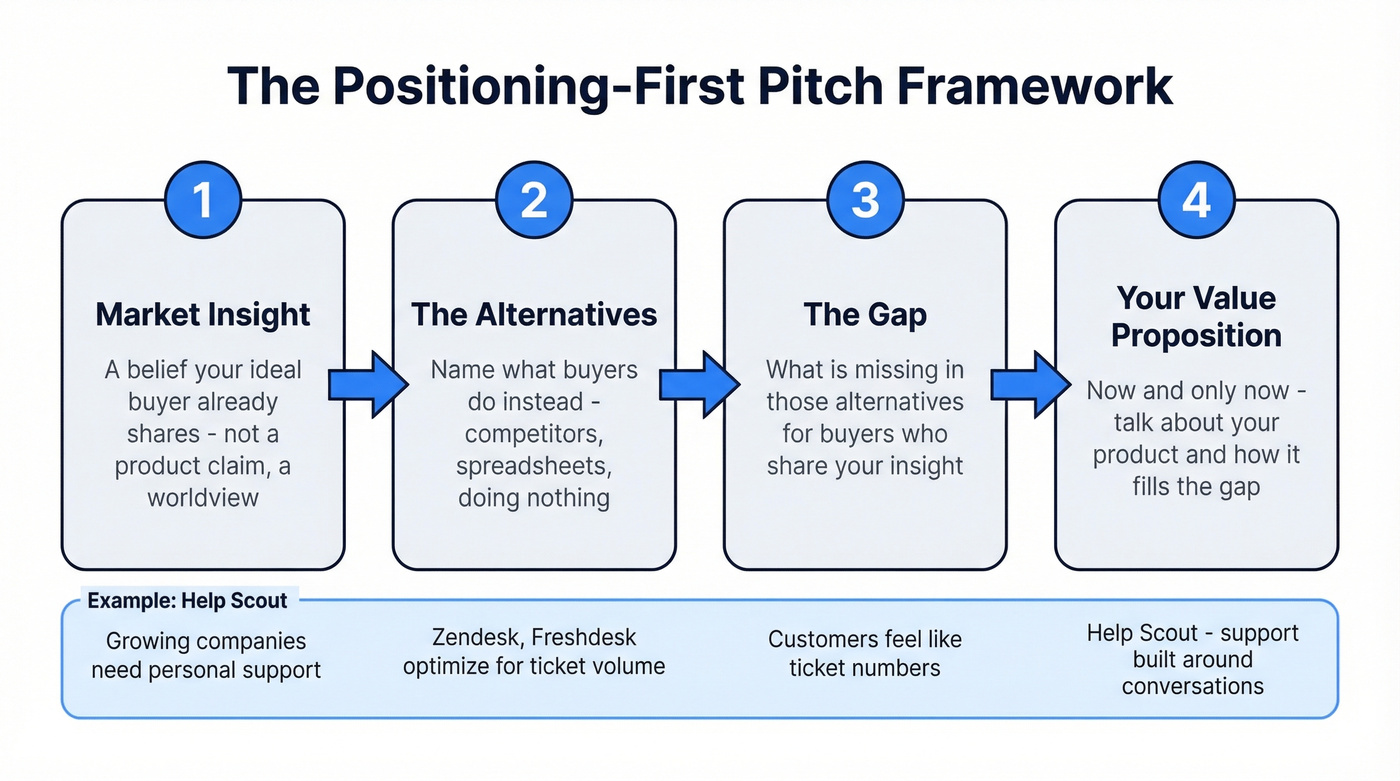
Here's the sequence:
- Market insight. A belief your ideal buyer shares. Not a product claim - a worldview.
- The alternatives. Name what buyers do instead. Competitors, spreadsheets, doing nothing.
- The gap. What's missing in those alternatives for buyers who share your insight.
- Your value proposition. Now - and only now - talk about your product.
Help Scout used this well. Their insight: growing companies need support that feels personal, not robotic. The alternatives - Zendesk, Freshdesk - optimize for ticket volume and agent efficiency. The gap: those tools make customers feel like ticket numbers. Help Scout's value: support tools designed around conversations, not tickets. No feature walkthrough. No pricing slide. No demo of the settings page.
This framework works best for complex B2B sales where the buyer has three or more alternatives. For transactional sales, skip straight to the gap - buyers don't need the full narrative arc.
How to Pitch by Channel
Cold Calls
The single most effective cold call opener ever measured is "How've you been?" It produces a 6.6x higher success rate than baseline. It mimics familiarity and catches prospects off-guard without feeling threatening.
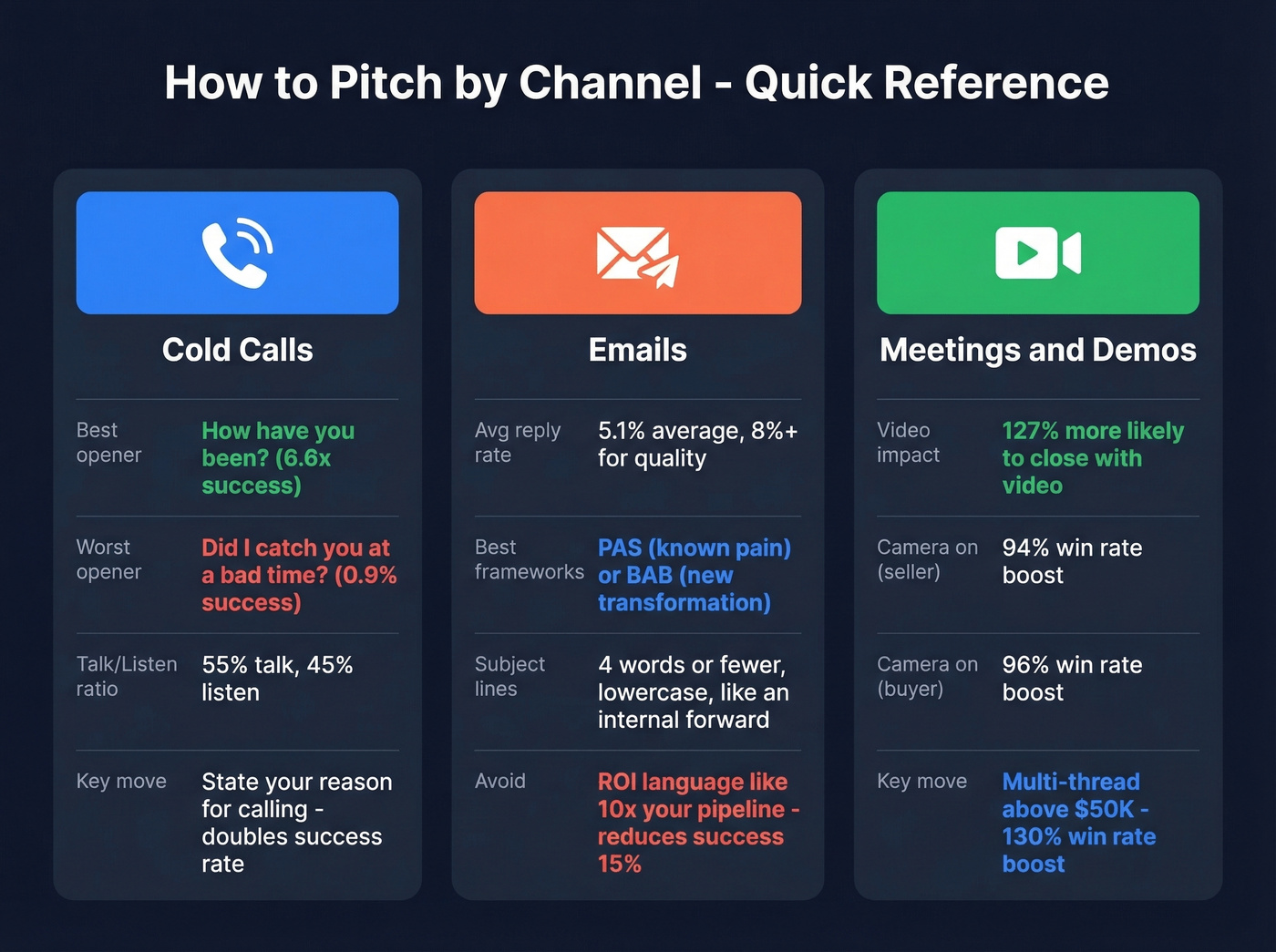
Meanwhile, "Did I catch you at a bad time?" tanks your odds to a 0.9% success rate. You're handing the prospect an exit ramp and a neon sign pointing to it.
After the opener, state your reason for calling. This alone doubles your success rate. Think of it as your pitch in miniature - a concise, compelling reason the prospect should keep listening.
Two-minute opener for skeptical prospects:
"Hey [Name], how've you been? I know this is out of the blue - in two minutes, I can share how we're helping [similar company] with [specific problem]. If it's not relevant, I'll never call again. Fair?"
One note on talk/listen ratios here: successful cold calls run about 55% talk / 45% listen. You're driving the conversation, not facilitating one. That's different from a discovery call, where you should be listening far more.
Emails
The average B2B cold email reply rate sits around 5.1%, with quality campaigns hitting 8%+ and spray-and-pray falling below 2%. Two frameworks consistently outperform the rest.
PAS - Problem, Agitate, Solution works when the pain is well-known:
Subject: manual list building
Hey [Name], most sales teams at [company size] spend 6+ hours a week building prospect lists by hand. That's time your reps could spend actually selling. We cut that to under an hour for [similar company]. Worth a quick look?
BAB - Before, After, Bridge works when you're selling a transformation the buyer hasn't imagined yet. Paint the current state, show the better state, explain the bridge.
What kills email pitches: ROI language. Phrases like "10x your pipeline" or "300% ROI" reduce success rates by 15%. They sound like spam because they are spam. Sell curiosity instead - ask if the topic is worth exploring rather than requesting 30 minutes. Keep subject lines to four words or fewer, lowercase, looking like an internal forward (see subject lines that consistently get opens).
Here's the thing nobody talks about in "how to pitch" guides: none of it matters if your email bounces. If your bounce rate is above 5%, the best framework in the world won't save you. Verify every address before sending. Prospeo checks emails in real-time with 98% accuracy, so your pitch actually arrives instead of disappearing into a spam folder.
Meetings and Demos
Deals are 127% more likely to close when video is used at any point in the sales process. When the seller has their camera on, win rates jump 94%. When the buyer has their camera on, win rates climb 96%. Turn on your camera and ask your prospect to turn on theirs. It's that simple.
For deals over $50K, multi-threading is non-negotiable. Engaging multiple stakeholders boosts win rates by 130%, and selling teams on closed-won deals are 67% larger than on losses. If you're single-threading a six-figure deal, you're gambling with your quarter.
Let's be honest about something we've seen too many times: reps nail the structure and lose the deal because they read from notes in a monotone. Record yourself, watch it back, and fix the pacing before the real thing. Even the perfect pitch on paper falls flat without confident, conversational delivery.
If you want a tighter structure for the live portion, use a product demo checklist to keep the flow crisp without feature-dumping.

You just read that bounce rates above 5% kill even the best-crafted pitch. Prospeo's 5-step email verification delivers 98% accuracy - so your PAS emails, BAB frameworks, and perfect subject lines actually reach the inbox. At $0.01 per email, bad data is no longer an excuse.
Stop perfecting pitches that bounce. Verify every contact before you hit send.
Handling Objections Mid-Pitch
Not every pushback is created equal. An objection signals genuine uncertainty - "We're already using [competitor]." An obstruction is an excuse to end the conversation - "I'm busy." They require completely different responses, and confusing the two is how reps waste energy on dead ends.
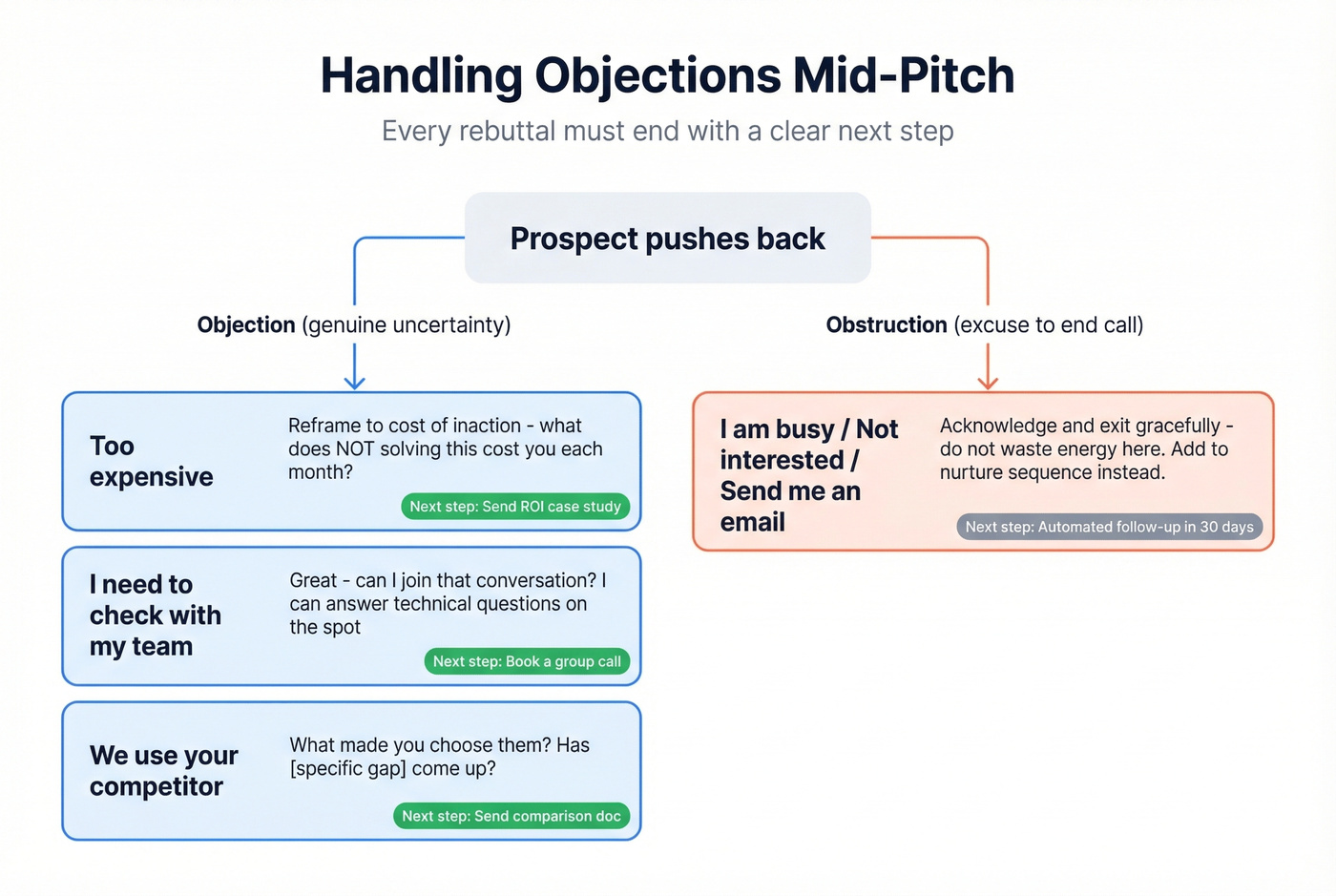
| Objection | Rebuttal Approach |
|---|---|
| "Too expensive" | Reframe to cost of inaction |
| "I need to check with..." | Offer to join that conversation |
| "We use your competitor" | Ask why they chose them, then differentiate |
"We're using your competitor" → "That makes sense - a lot of our customers switched from [competitor]. What made you choose them originally? I'm curious whether [specific gap] has come up."
"Competitor is cheaper" → "They usually are on the sticker price. Teams that switch to us typically find that [missing feature] was costing them more in lost deals than the price difference."
Every objection rebuttal should end with a clear next step - booking a follow-up, looping in another stakeholder, or sending a tailored case study. Never leave the next move ambiguous. The r/sales community hammers this point constantly: if you don't define the next action, the prospect won't either, and the deal dies in limbo.
If objections keep showing up at the same point, it's usually a qualification issue - tighten your sales qualification before you pitch.
Pitch Mistakes That Kill Deals
Feature-dumping is the most common reason pitches fail. Listing capabilities without connecting them to the buyer's problem turns your pitch into a product tour nobody asked for. Lead with the problem, not the feature list.
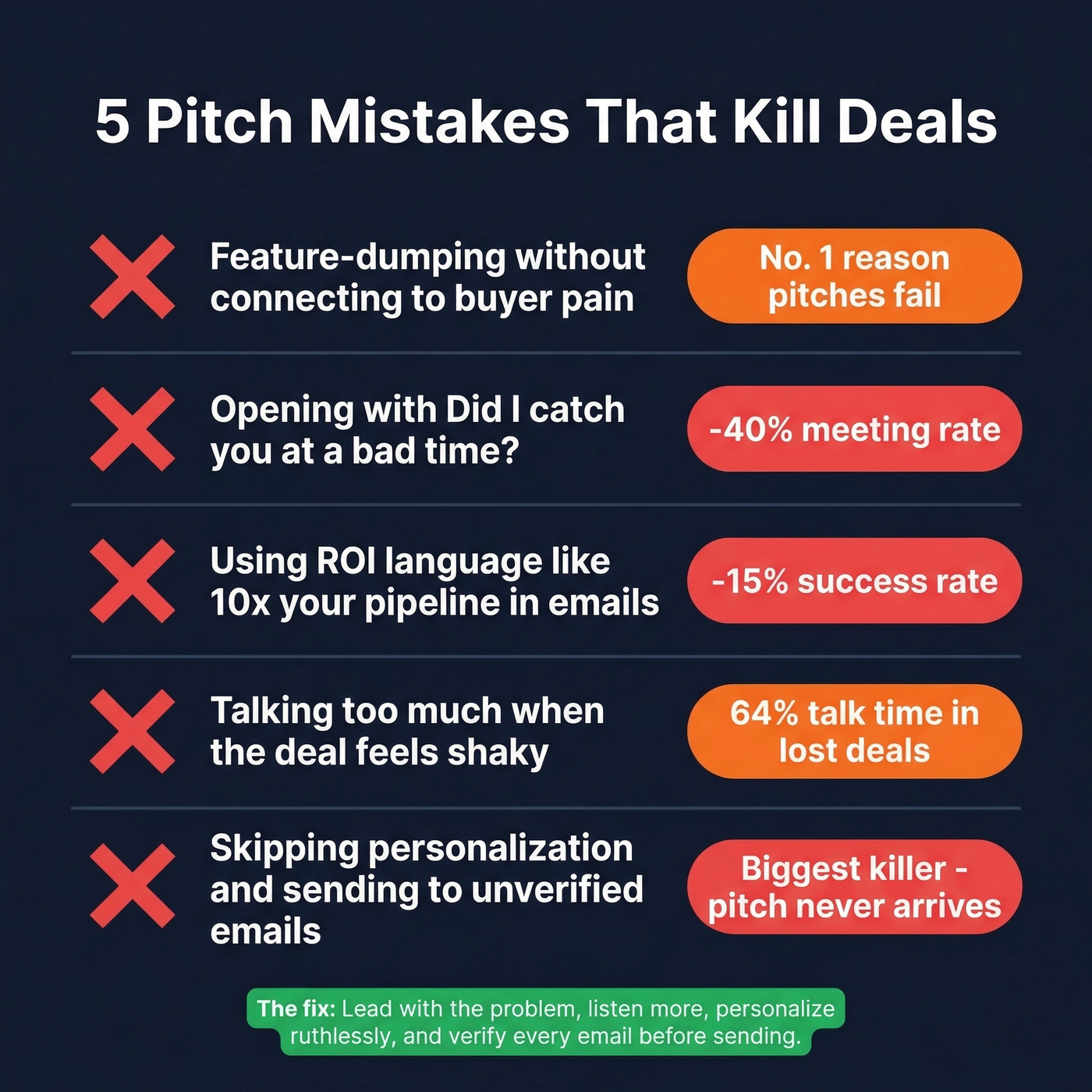
"Did I catch you at a bad time?" drops your meeting rate by 40%. Just don't.
ROI language in cold emails sounds like spam and reduces success rates by 15%. We've tested this across dozens of campaigns - curiosity-driven CTAs outperform ROI claims every time.
Talking too much. Low performers swing to 64% talk time in lost deals. If you're monologuing, you're losing.
Skipping personalization. This is the biggest pitch killer of all, and it happens before you even open your mouth. Sending a generic template to the wrong person at a dead email address wastes everyone's time. A pitch tailored to the prospect's industry, role, and specific pain points will always outperform a one-size-fits-all script - but only if it reaches a real inbox. If you need a system for this, start with personalized outreach.

Get Your Data Right First
Most "how to pitch" advice assumes your pitch reaches the prospect. It often doesn't.
Skip this section if your bounce rate is already under 3%. But if you're north of 5%, fix the data before you fix the pitch. No framework survives a 35% bounce rate. Use email bounce rate benchmarks and fixes to diagnose what’s actually happening.
Multi-threading boosts win rates by 130%, but only if you can find verified contacts for every stakeholder. Prospeo gives you 300M+ profiles with 30+ filters - job title, department, seniority - so you build a full buying committee in minutes, not days.
Find every decision-maker on the deal. Build your pitch list in one search.
FAQ
How long should a sales pitch be?
Under two minutes for cold calls, under 150 words for cold emails. Data across millions of calls shows top reps talk only 43% of the time - brevity forces you to focus on what matters to the buyer, not what matters to you.
What makes a great sales pitch?
A great pitch starts with the buyer's problem, not your product. It follows a clear structure - market insight, alternatives, gap, value - and ends with a specific next step. Personalize ruthlessly, listen more than you talk, and verify your contact data before reaching out.
What's the best way to open a cold call?
"How've you been?" produces a 6.6x higher success rate than baseline. Follow it by stating your reason for calling, which doubles your chances of booking a meeting. Avoid "Did I catch you at a bad time?" at all costs.
How do I make sure my pitch emails get delivered?
Verify every email address before sending. Use a tool with real-time verification and frequent data refreshes - a 7-day refresh cycle and 98% accuracy rate prevent the stale-data bounces that kill deliverability and domain reputation.