

How to Purchase Data Without Wasting Money or Breaking the Law
Your VP of Sales just asked you to "buy a list." Simple enough - until you're staring at a dozen enterprise platforms quoting $30k/year, data brokers who won't explain where their records come from, and marketplaces selling datasets by the terabyte. On r/datascience, the question comes up constantly: where do I find reliable firmographic and technographic data without getting locked into something overcomplicated?
The frustration is justified. Knowing how to purchase data effectively is one of the biggest gaps in modern go-to-market teams. A Deloitte survey found 92% of data analytics professionals said their companies needed to increase use of external data sources - and most teams are still buying it badly. A single mishandled customer PII record costs $160 if it ends up in a breach. Meanwhile, the gap between what teams pay for data and what they actually use keeps widening.
Here's the thing: the majority of B2B teams with deal sizes under $25k don't need a $40k/year enterprise data platform. A self-serve tool with verified contacts and a tight refresh cycle will outperform the bloated platform your team only uses at 15% capacity. We've watched it happen at dozens of companies.
What You Need (Quick Version)
Before the deep dive, a shortcut based on what you're actually buying:
- B2B contact data (emails, phones, firmographics): Start with a self-serve platform like Prospeo. You get 75 free verified emails, no contract, and roughly $0.01/lead after that. You'll be pulling verified contacts in minutes, not weeks.
- Consumer marketing data (demographics, behavior, purchase history): Go direct to Experian or Acxiom for scale. Use LiveRamp for audience activation and identity resolution.
- Analytics / big data datasets (aggregated, research-grade): Browse Snowflake Marketplace if you're already in Snowflake, or AWS Data Exchange for the broadest catalog.
Define What Kind of Data You're Buying
The word "data" means wildly different things depending on who's asking. A RevOps lead purchasing lead data for an outbound campaign has nothing in common with a data scientist licensing anonymized transaction logs for a propensity model. Before you talk to a single vendor, nail down which category you're in.
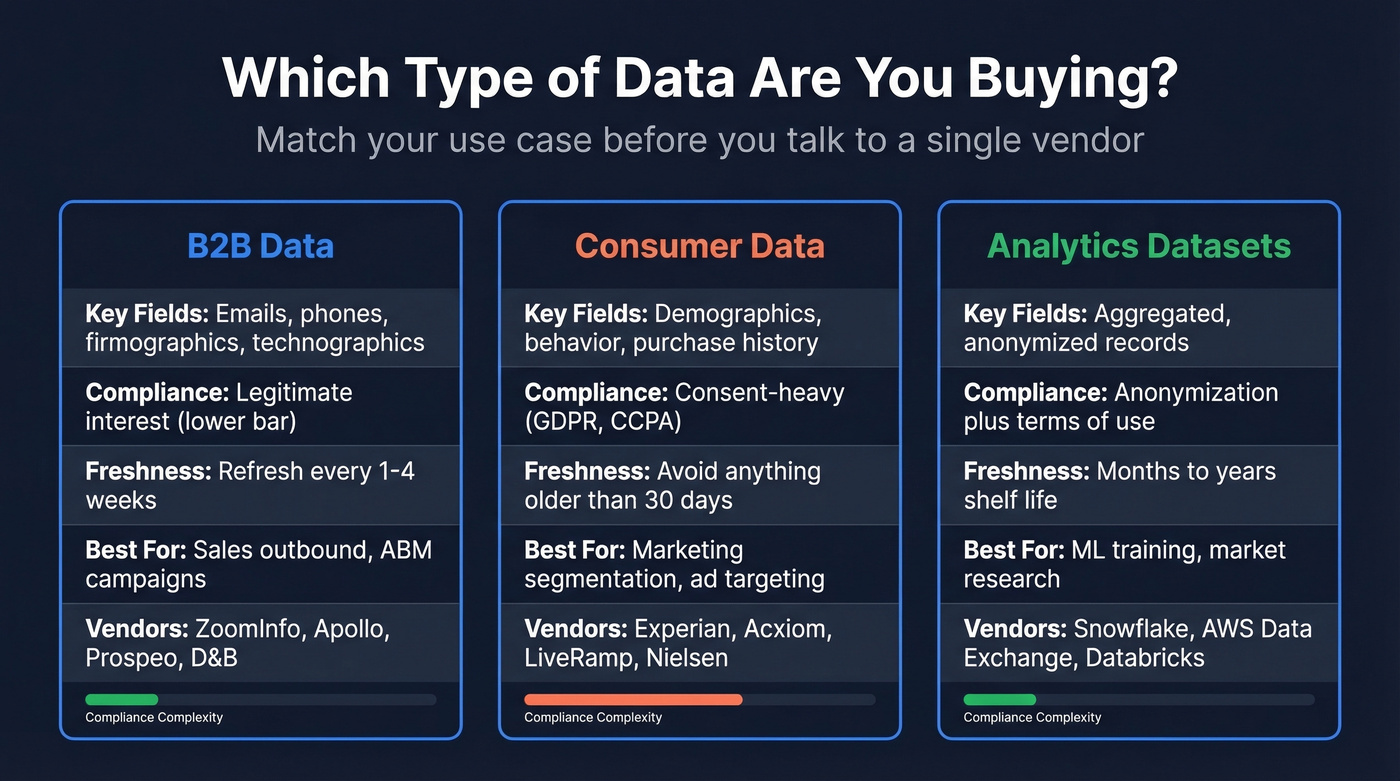
B2B Data
This is what sales and marketing teams buy most. When you acquire company data, you're getting firmographic fields like industry, revenue, and headcount; technographic signals showing what tools a company runs; contact info including verified emails and direct dials; and increasingly, intent data showing which accounts are actively researching solutions like yours. Major players include ZoomInfo, Apollo, Cognism, Dun & Bradstreet, and Clearbit.
Under GDPR, B2B outreach often relies on legitimate interest because you're contacting someone in their professional capacity. That's a lower bar than consumer data, but it's not a free pass - you still need a lawful basis and a clear purpose.
Consumer Data
Consumer datasets cover demographic profiles, psychographic segments, behavioral signals like browsing and app usage, and transactional records. Vendors like Experian, Acxiom, LiveRamp, Nielsen, and CoreLogic dominate this space. The compliance bar is higher - GDPR consumer marketing data typically relies on consent, and CCPA/CPRA adds its own layer of "Do Not Sell" obligations. Businesses that use consumer data effectively are 23x more successful at customer acquisition** and 19x more profitable, which is why the market keeps growing despite the compliance overhead.
Consumer data also decays faster than anything else. People move, change phones, change habits. The "avoid anything older than 30 days" rule matters most here.
Analytics Datasets
These are aggregated, often anonymized datasets used for market research, ML training, or competitive intelligence. You're buying from marketplaces - Snowflake, AWS Data Exchange, Databricks, Datarade - not from sales reps. The buying process looks more like software procurement than list-building.
Should you buy or build in-house? If your team has data engineering capacity and proprietary first-party sources, generating data internally can be cheaper long-term. But for most teams, purchasing external data is faster, more complete, and lets you focus engineering resources on your product instead of scraping and cleaning records.
Raw, Cleaned, or Multi-Source?
One decision most guides skip: the processing level of the data you're buying.
Raw data is cheapest but requires significant cleaning and normalization. Cleaned data arrives deduplicated and standardized, ready for analysis. Multi-source data blends records from several providers, giving you the broadest coverage but requiring trust in the aggregator's methodology. Match your choice to your team's data engineering capacity - if you don't have a dedicated data engineer, buy cleaned or multi-source. The time savings dwarf the price premium.
| Dimension | B2B Data | Consumer Data | Analytics Datasets |
|---|---|---|---|
| Key fields | Email, phone, firmographics | Demographics, behavior | Aggregated, anonymized |
| Compliance basis | Legitimate interest | Consent-heavy | Anonymization + terms of use |
| Typical vendors | ZoomInfo, Apollo, D&B | Experian, Acxiom | Snowflake, AWS |
| Data longevity | Months (roles change) | Weeks (behavior shifts) | Months to years |
Know Exactly What Fields You Need
Most buyers go wrong here. They buy a massive dataset when they need a narrow, accurate one. Don't buy a 50GB CSV when you need 500 verified emails for a targeted outbound campaign.
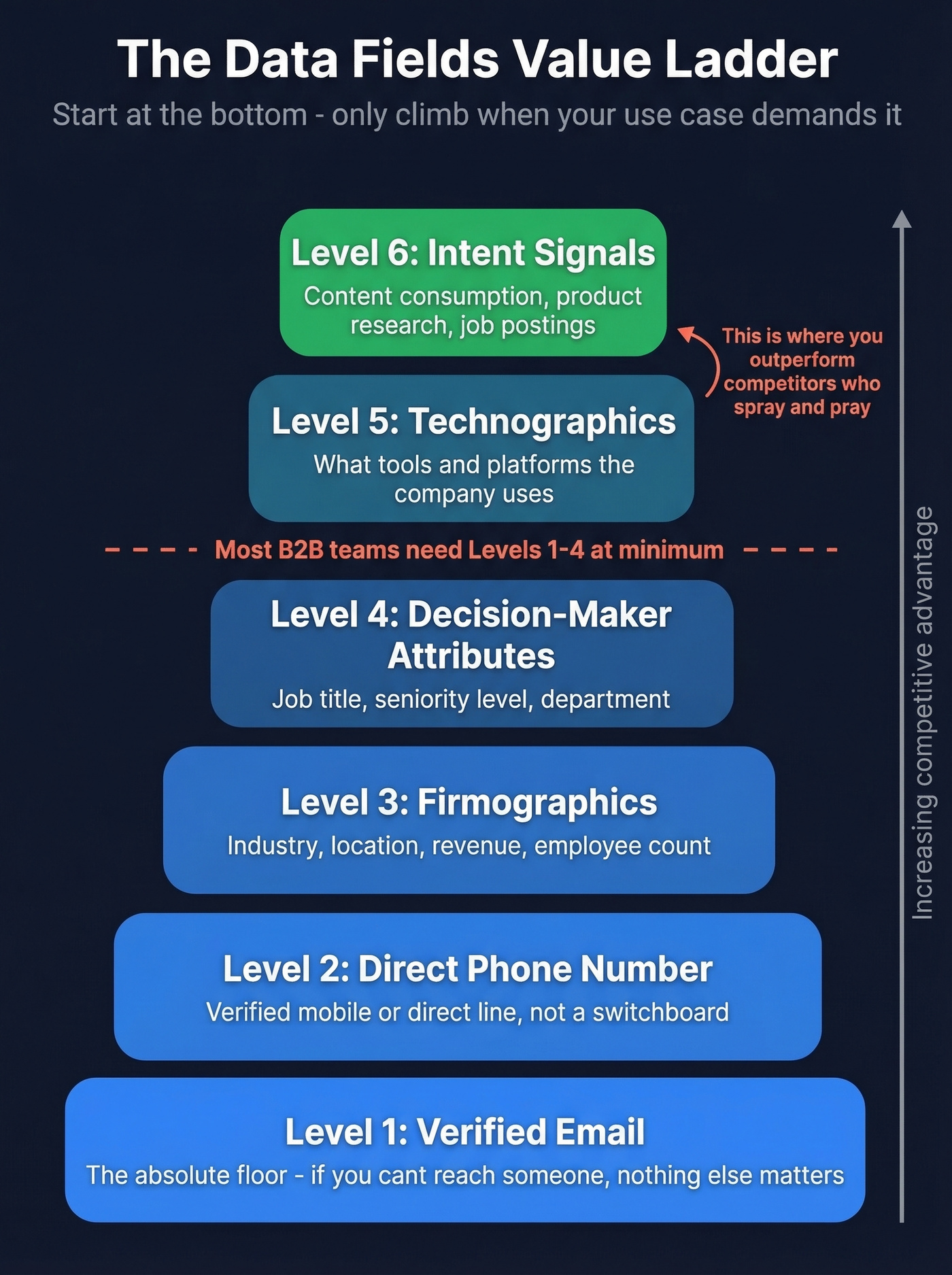
Think of data fields as a ladder of value, starting with the minimum viable set and adding layers as your use case demands:
- Verified email - the absolute floor. If you can't reach someone, nothing else matters. (If you're benchmarking tools, start with email verification.)
- Direct phone number - verified mobile or direct line, not a switchboard.
- Firmographics - industry, location, revenue, employee count.
- Decision-maker attributes - job title, seniority, department.
- Technographics - what tools and platforms the company uses.
- Intent signals - behavioral indicators like content consumption, product research, job postings.
For most B2B outbound teams, levels 1-4 are essential. Levels 5-6 are where you start outperforming competitors who spray and pray. What does "good" look like at the foundation? A 98% email accuracy rate across 143M+ verified addresses - that's the benchmark. If a vendor can't tell you their accuracy rate, that's your first red flag.
Choose the Right Purchasing Method
Not all data purchases work the same way. The method you choose determines your timeline, cost, and how much control you have over quality.
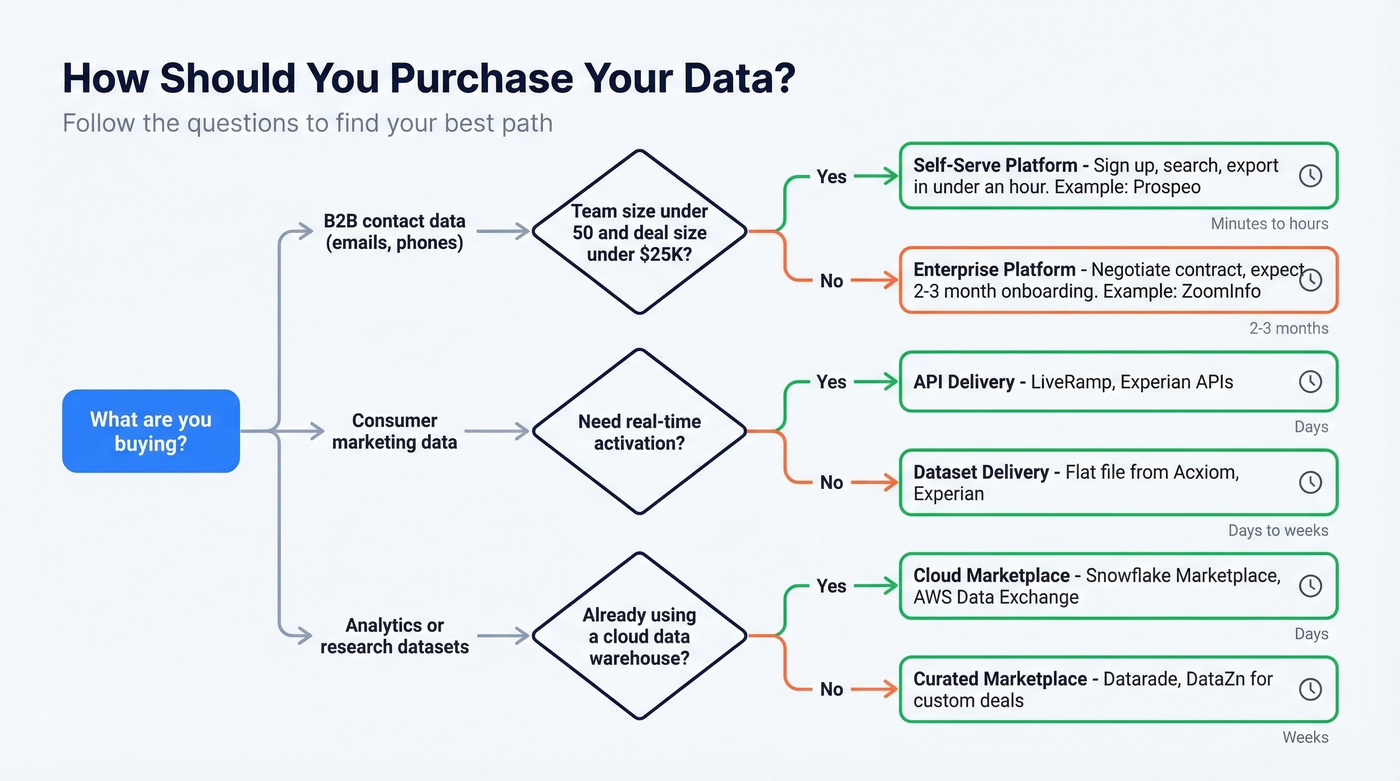
Direct From a Company
You negotiate directly with a data owner - a publisher, a research firm, a SaaS company licensing its anonymized usage data. This gives you the most control over sourcing and customization, but the timeline is brutal. Expect months of research, evaluation, negotiation, and integration work. This path makes sense for enterprise teams buying custom datasets they'll use for years.
Data Broker
Brokers aggregate data from multiple sources and resell it in bundles. Faster than direct, but you sacrifice transparency. You often won't know exactly how the data was collected, whether records are duplicated across sources, or how fresh it actually is. The consensus on r/datascience is that broker offerings from legacy players like D&B can feel "complicated" and opaque, with pricing that's hard to benchmark.
Data Marketplace
Marketplaces let you browse, compare, and purchase datasets from multiple providers on a single platform. Timeline: days to weeks.
| Marketplace | Best for | Strength | Limitation |
|---|---|---|---|
| Snowflake | Snowflake users | Zero-ETL, query in place | Must use Snowflake |
| AWS Data Exchange | Broadest selection | Full AWS integration | Less curation |
| Databricks | Governance-heavy orgs | Lineage + compliance | Must use Databricks |
| Datarade | Custom/one-off deals | Negotiation, large-volume | Less automated |
| DataZn | Quality + compliance | Aggressive curation | Smaller catalog |
Many enterprises use multiple marketplaces - AWS for breadth, Snowflake for integration, and a curated option for compliance-heavy needs.
Dataset vs. API Delivery
Before you buy, decide how you want the data delivered. A flat-file dataset works for one-time analysis or batch imports. An API gives you real-time or near-real-time access with automatic refreshes - better for ongoing prospecting, enrichment workflows, or anything feeding a live system. APIs cost more per record but eliminate manual re-purchasing. If your use case requires data fresher than monthly, an API is almost always worth the premium.
Self-Serve B2B Platforms
This is the fastest path for B2B contact data. No sales calls, no multi-month procurement cycles. You sign up, search, filter, and export verified contacts - often in under an hour. Transparent pricing, free tiers, and 30+ search filters covering buyer intent, technographics, job changes, headcount growth, and funding signals. Compare that to enterprise vendors where "contact sales" is the only pricing information you'll find before a 45-minute demo.
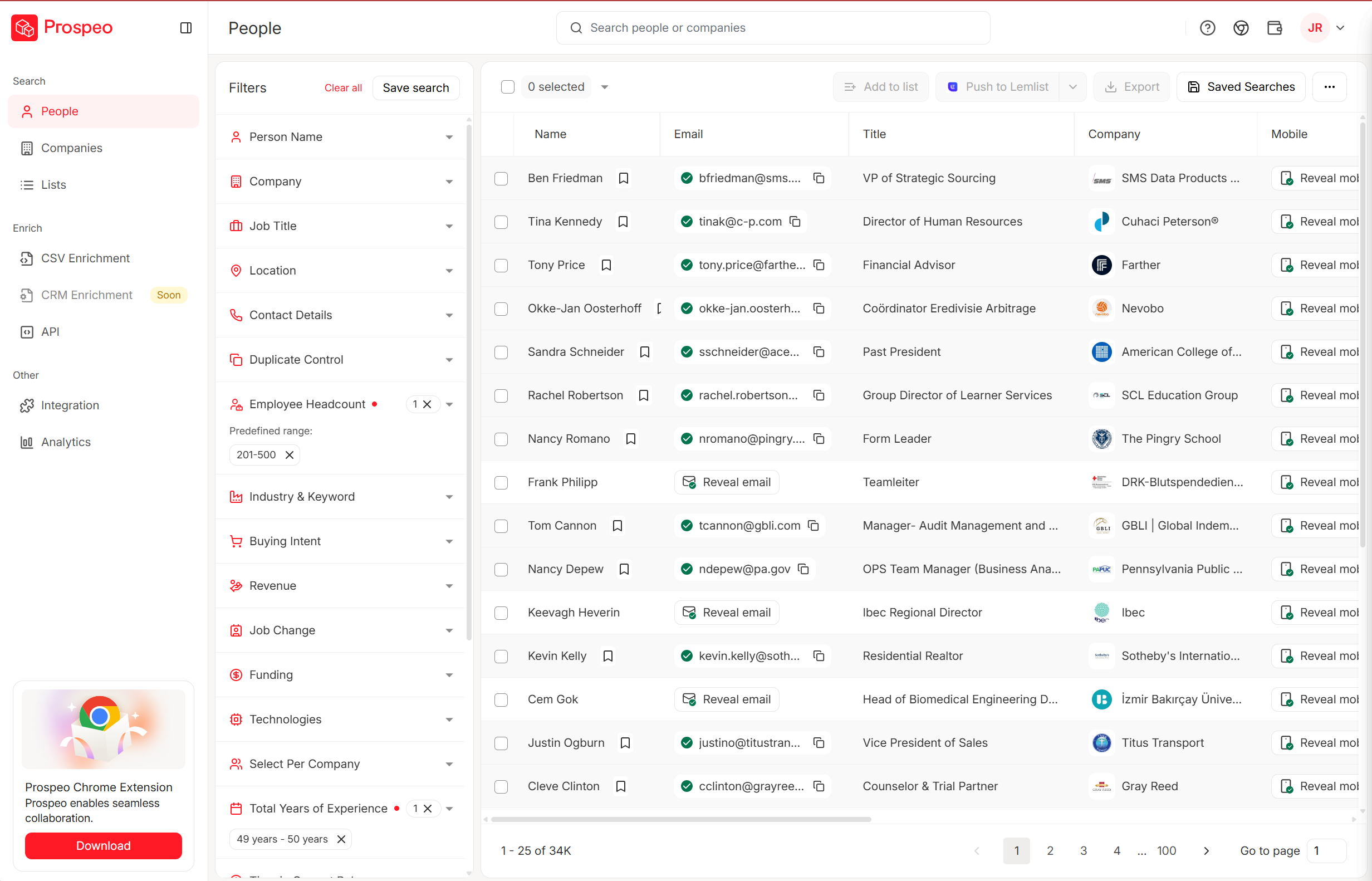

You don't need a $40K platform to purchase quality B2B data. Prospeo gives you 300M+ profiles with 98% email accuracy, 125M+ verified mobiles, and a 7-day refresh cycle - all self-serve at ~$0.01/email. No contracts, no sales calls, no bloated features you'll never touch.
Start pulling verified contacts in minutes, not weeks.
Evaluate Data Quality Before You Buy
Cheap data that bounces, duplicates, or violates privacy law isn't cheap. It's the most expensive data you'll ever buy.

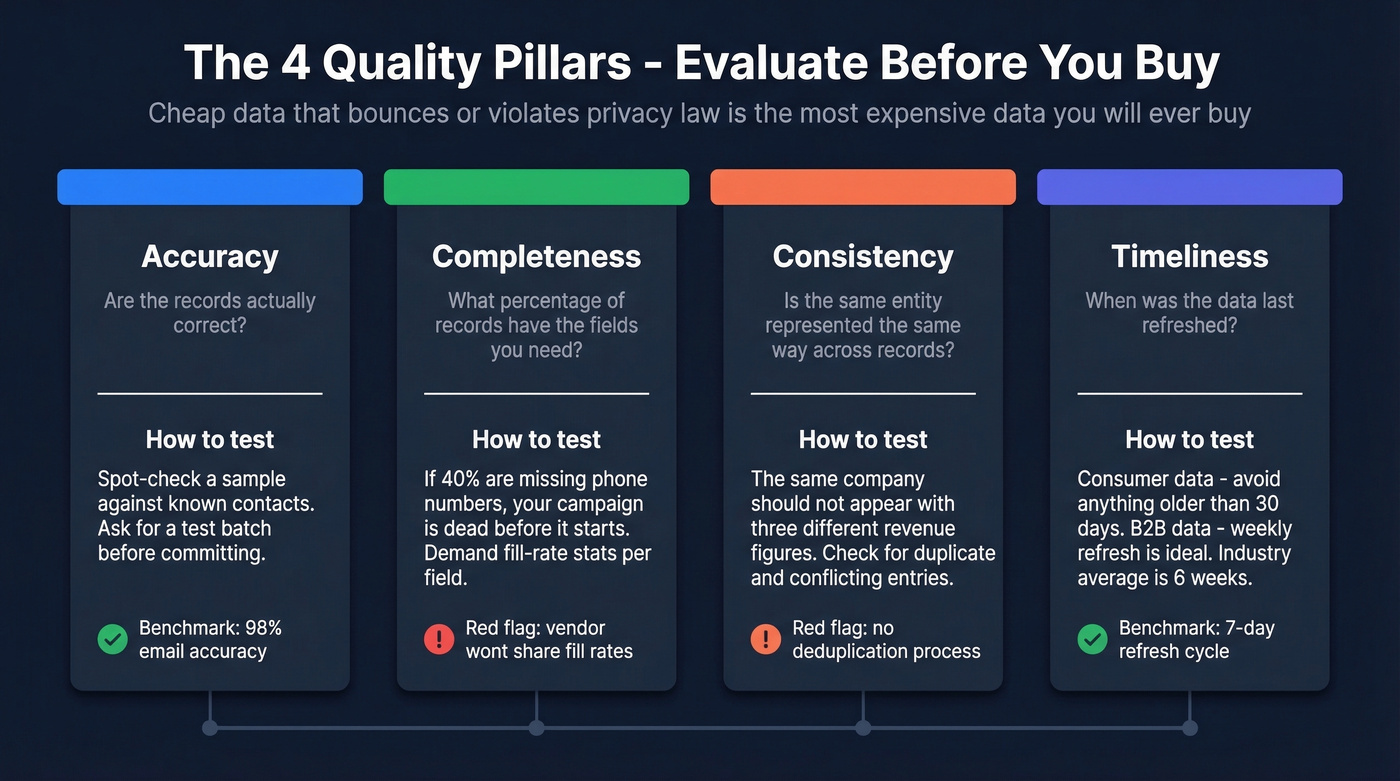
The Four Quality Pillars
Accuracy means the records are correct - test by spot-checking a sample against known contacts. Completeness measures what percentage of records have the fields you need; if 40% are missing a phone number, your campaign is dead before it starts. Consistency catches sloppy aggregation - the same company shouldn't appear with three different revenue figures. And timeliness is the silent killer: when was the data last refreshed?
How to Evaluate
A clean evaluation sequence looks like this: define your goal, confirm the dataset fits the right fields and date ranges, verify the source and collection method, check for missing values and duplicates, test consistency over time, and set up ongoing monitoring. Don't skip the source/collection step. Knowing how data was collected tells you more about quality than any vendor's accuracy claim.
The Freshness Rule
For consumer data, avoid anything older than 30 days. For B2B data, hold vendors to a tight refresh cycle - weekly is ideal. The industry average sits around six weeks, which means by the time most platforms update a record, the person has already changed roles, moved companies, or gone dark on the old email.
The stakes are real. Citigroup was fined $136M in 2024 for data governance failures, on top of a $400M fine in 2020. You don't need to be a bank to feel the pain - you just need one compliance audit or one sequence that bounces 25%. In our experience, teams that skip the freshness check end up spending more on re-purchasing clean data than they saved on the original discount.
What Purchased Data Actually Costs
Here are realistic ranges you can use to budget and benchmark quotes:
| Data Category | Typical Cost Range |
|---|---|
| B2B email/phone (self-serve) | $0.01-$1.00/email |
| B2B enterprise platforms | $15K-$40K/yr typical mid-market. Cognism: ~$1K-$3K/mo. D&B: $10K-$50K+/yr |
| Consumer marketing data | $0.05-$0.50/record basic. Enriched: $300/mo-$360K/yr |
| Intent data | $1K-$3K/mo for small teams. Enterprise: $30K+/yr |
| Marketplace datasets | $0.50-$5.00/1K records basic. Premium feeds: $10K-$100K+/yr |
The spread is enormous. A 10-seat ZoomInfo contract with intent data and mobile numbers can run $40-60k/year. We've seen Series A companies burn half their sales tooling budget on an enterprise platform their reps use as a glorified email lookup. For teams under 50 seats, a self-serve platform with comparable or better contact accuracy costs a fraction of that. If you want a broader benchmark set, start with our breakdown of the best B2B database options.
Run a Compliance Check
Buying data without a compliance framework is like driving without insurance. You might be fine for years - until you're not, and the bill is catastrophic. GDPR fines reach EUR 20M, and the US averages $264 per breached record. With 20+ US states now enforcing comprehensive privacy laws, "we didn't know" isn't a defense.
GDPR Requirements
Verify the vendor's lawful basis for each processing purpose. Demand documentation of purpose limitation and data minimization practices. Confirm they maintain consent records and audit trails. Check retention controls - data shouldn't live forever just because you paid for it.
CCPA/CPRA Requirements
Confirm the vendor complies with "Do Not Sell or Share" requirements. Ask whether they honor Global Privacy Control signals automatically - CPRA treats GPC as a valid opt-out signal that businesses must honor. Verify their handling of sensitive personal information and data retention disclosures.
Questions to Ask Every Vendor
Before you sign anything, get clear answers on these:
- What's your legal basis documentation under GDPR Art. 6?
- How do you practice data minimization?
- What accuracy measures and refresh cycles do you maintain?
- What are your retention controls and storage limitations?
- Do you use anonymization or pseudonymization?
- Is encryption applied in transit and at rest?
- Can you provide records of processing under GDPR Art. 30?
- Is a Data Processing Agreement available?
Any vendor that hesitates on these questions is a vendor you should walk away from. If you need a deeper framework, use a dedicated B2B compliance checklist.
Test Before You Commit
No amount of due diligence replaces actually testing the data. Request a sample before you sign a contract. Run match tests against your CRM to check overlap and net-new coverage. Verify field completeness - if 30% of records are missing the fields you need, the dataset is worthless regardless of price.
Red flags that should kill a deal immediately: the vendor won't provide a free sample, there's no trial or pilot option, and they can't produce a Data Processing Agreement. We've seen this pattern enough times to say it with confidence - the vendors with the best data are the ones most eager to let you verify it. Skip any vendor that gates everything behind a contract signature. Reddit threads consistently echo this: if you can't test before you buy, the data probably isn't worth buying.
The article above says if a vendor can't tell you their accuracy rate, that's a red flag. Here's ours: 98% verified emails, 30% mobile pickup rate, 92% API match rate, and every record refreshed every 7 days. 15,000+ companies already made the switch.
Get 75 free verified emails and see the difference yourself.
Using Intent Data After You Buy It
Intent data tells you which accounts are actively researching topics related to your product. It's powerful, but most teams waste it. Four mistakes kill intent data ROI:
Treating all signals as equal. A prospect visiting your pricing page is worth 10x more than someone reading a generic blog post. Build a scoring system that weights comparison and pricing signals higher than top-of-funnel content consumption.
Relying on a single source. Blend first-party signals from your website and product usage with third-party providers like Bombora, G2, or 6sense. No single source captures the full picture.
Acting too slowly. Intent has a shelf life measured in hours, not weeks. Route alerts to sales the same day - not in next Monday's pipeline review.
Referencing the data source in outreach. Never say "I noticed you were researching X." Use intent to tailor your message, not to reveal your surveillance. Prospects find it creepy, and it tanks reply rates.
To act on intent signals fast, you need a platform that layers them with verified contact data. Tracking 15,000 intent topics and combining in-market signals with job role, company growth, and technographic filters - that combination of knowing who to contact and when they're actively looking is where intent data actually moves pipeline. For a practical system, see our guide to identify buyer intent signals.
FAQ
Is it legal to buy data?
Yes. Purchasing B2B and consumer data is legal in most jurisdictions when the data was collected with proper consent or legitimate interest. Always verify the vendor's compliance documentation, including GDPR lawful basis and CCPA opt-out handling. Legality hinges on how data was collected, not whether you bought it.
How much does B2B data cost?
B2B contact data ranges from $0.01/email on self-serve platforms to $40K+/year for enterprise platforms like ZoomInfo. Most mid-market teams overpay by buying platform features they never use - start self-serve and scale up only if you hit a ceiling.
What's a data broker vs. a marketplace?
A broker aggregates and resells data with limited sourcing transparency - you rarely know exactly where records originated. A marketplace lets you browse datasets from multiple providers with more visibility into freshness, sourcing methodology, and compliance documentation.
How do I verify purchased data is accurate?
Request a sample before committing and spot-check records against known contacts in your CRM. Look for missing fields, duplicates, and outdated records. Verify the vendor's refresh cycle - B2B data older than 30 days degrades fast, and top providers refresh weekly.
Can I use purchased data for cold email?
Yes, if the data was collected compliantly and you follow CAN-SPAM, GDPR, or applicable local regulations. Use verified emails with 98%+ accuracy to protect your sender reputation - bouncing off bad data damages your domain and tanks deliverability.