

How to Research a Company: The Step-by-Step Guide That Goes Beyond "Check the Website"
Someone on r/jobs described getting asked "What do you know about us?" during an interview at a foundry. The company website was basically a list of metals and crane hooks. They had nothing to say. Most advice on how to research a company boils down to "check the website and Glassdoor," which is useless when the website is thin, the company is private, or you need to actually sound informed rather than just prepared.
This guide gives you a framework that works whether you're prepping for a phone screen, a final-round interview, or evaluating a job offer. Three tiers of depth, concrete tools, and a copy-paste template you can use before your next conversation.
What You Need (Quick Version)
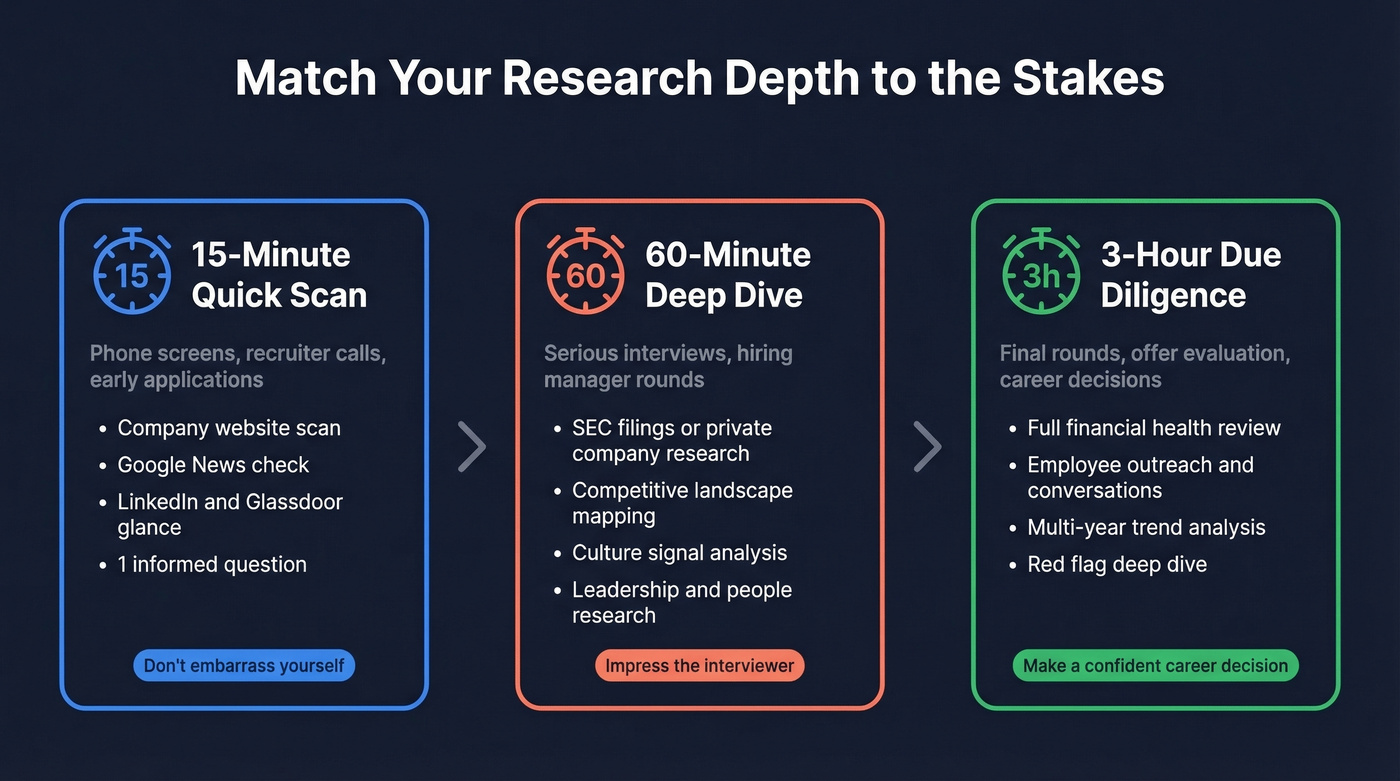
Not every situation requires three hours of research. Match your effort to the stakes.
Minimum viable research - know these five things before any conversation:
- What the company actually sells, in plain language
- Where it sits in its industry - market leader, challenger, or niche player
- What's happened in the last 90 days of news
- Who runs it and who you'll be talking to
- One informed question you can ask that proves you did the work
Now pick your tier:
- 15-minute quick scan - phone screens, recruiter calls, early-stage applications. Enough to not embarrass yourself.
- 60-minute deep dive - serious interviews, hiring manager conversations, second rounds. Enough to impress.
- 3-hour due diligence - final rounds, offer evaluation, or deciding whether to join. Enough to make a career decision with confidence.
What Interviewers Actually Expect
Hiring managers don't expect you to recite the company's founding year or memorize the leadership page. They expect three things, and getting any of them wrong is worse than admitting you're still learning about the company.
You should be able to describe the core product in your own words - not the marketing copy. You need some understanding of the industry. And you should articulate the problem the company solves for its customers. That's the baseline. Everything beyond it is bonus points.
Three research mistakes that kill interviews:
- Guessing the value proposition. If you're not sure what the company does, say "I'd love to hear how you describe it" - don't fabricate. I've seen candidates lose offers by guessing instead of admitting they were still learning.
- Parroting the website. Repeating "we drive innovative solutions for growth" tells the interviewer you spent 30 seconds on the About page.
- Not understanding the job requirements. Researching the company but not the role is like studying the wrong chapter for an exam.
The 15-Minute Quick Scan
This is your minimum. Five steps, no excuses.
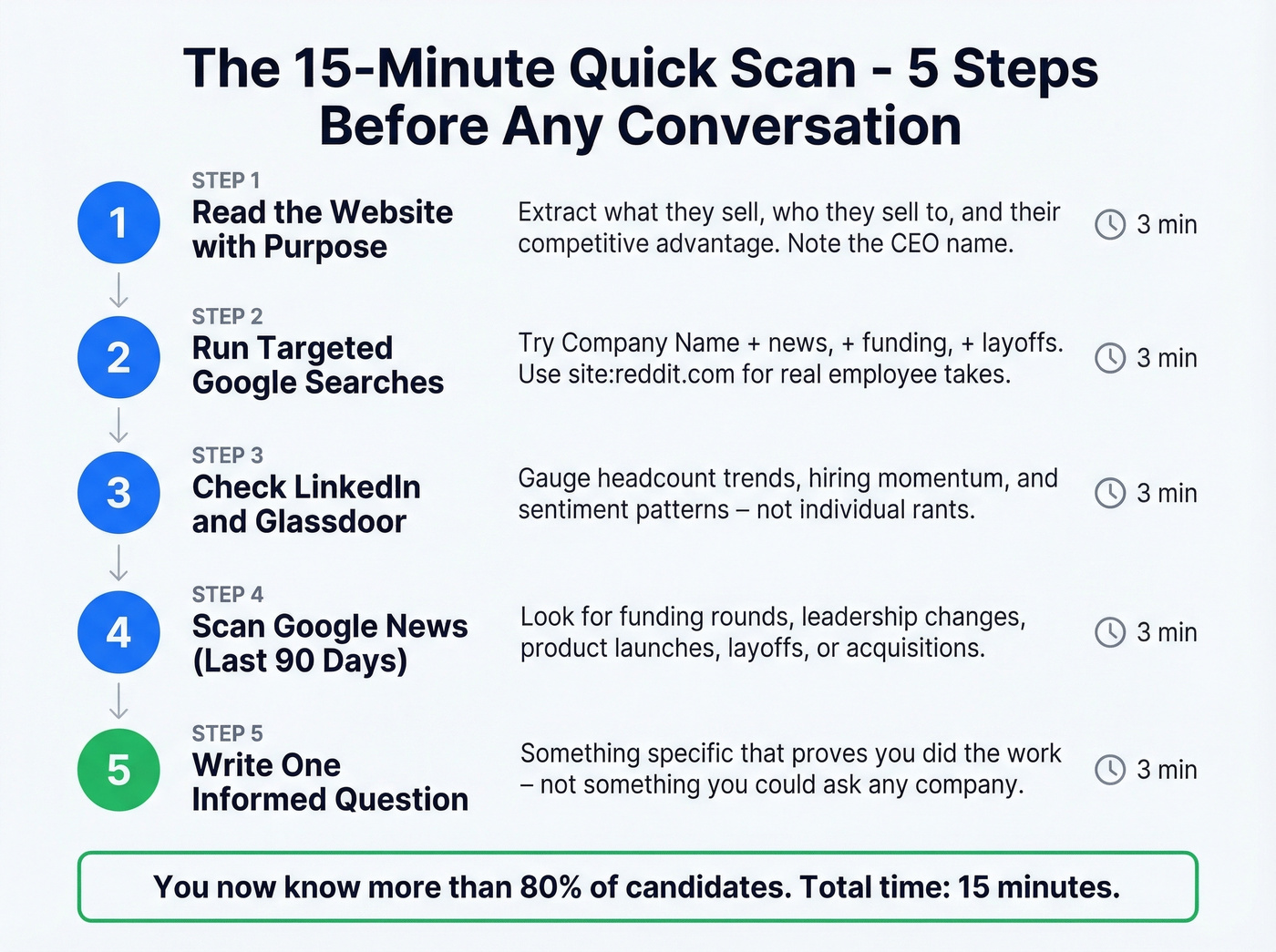
Step 1: Read the company website with purpose. Don't skim. Go to the About page and extract three things: what they sell, who they sell to, and how they describe their competitive advantage. Check the leadership page and note the CEO's name and background. Look at the product or services pages to understand the actual offering, not just the tagline.
Step 2: Run a targeted Google search. Use "Company Name" + news for recent coverage. Try "Company Name" + layoffs or "Company Name" + funding to surface anything the website won't tell you. The operator site:reddit.com "Company Name" surfaces employee and candidate experiences faster than browsing review sites.
Step 3: Check LinkedIn and Glassdoor. LinkedIn's company page helps you gauge headcount trends and hiring momentum. Glassdoor gives you sentiment - look for overall patterns rather than individual complaints. A single angry review from a fired employee isn't the story. Review sites skew negative because people are more motivated to post after a bad experience, so treat it as one data point, not the verdict.
Step 4: Scan Google News. Filter to the last 3 months. You're looking for funding rounds, leadership changes, product launches, layoffs, or acquisitions. Any of these changes the conversation you'll have in an interview.
Step 5: Find one informed question. Based on what you've learned, write down a single question that shows you did the work. "I saw you launched [product] last quarter - how has adoption been?" beats "So, what does your company do?" every time.
The 60-Minute Deep Dive
This is where you separate yourself from most candidates.
Financial Health (Public Companies)
If the company is publicly traded, its 10-K filing on SEC EDGAR is free and more useful than any Glassdoor review. In our experience, the Risk Factors section alone tells you more about a company's real situation than hours of review-site browsing. You don't need to read all 200 pages. Prioritize these sections:
- Business Overview - segments, markets, customer concentration, competitive advantage
- Risk Factors - compare to the prior year's filing and note any new risks added
- MD&A - management's explanation of year-over-year changes; read critically and ask whether the narrative matches the numbers
- Financial Statements - focus on revenue trends, profit margins, debt levels, and free cash flow
- Footnotes - revenue recognition changes, contingent liabilities, pending lawsuits
Red flags worth watching: repeated financial restatements, executive churn (three CFOs in two years is never a good sign), ballooning debt without matching revenue growth, and high customer concentration where one client represents 30%+ of revenue. Always look at 3-5 year trends rather than a single year's snapshot.
Competitive Landscape
Understanding where a company sits in its market matters more than memorizing its mission statement. Crunchbase shows you competitors, funding history, and key investors. SimilarWeb gives you traffic benchmarks to gauge relative scale - use its "similar sites" feature to quickly map the competitive set. The SBA's market research guide is a solid starting point for understanding industry dynamics.
You're not trying to become an industry analyst. You're trying to say something like "I noticed you compete with X and Y - what do you see as your main differentiator?" in an interview. That question alone signals more preparation than most candidates bring.
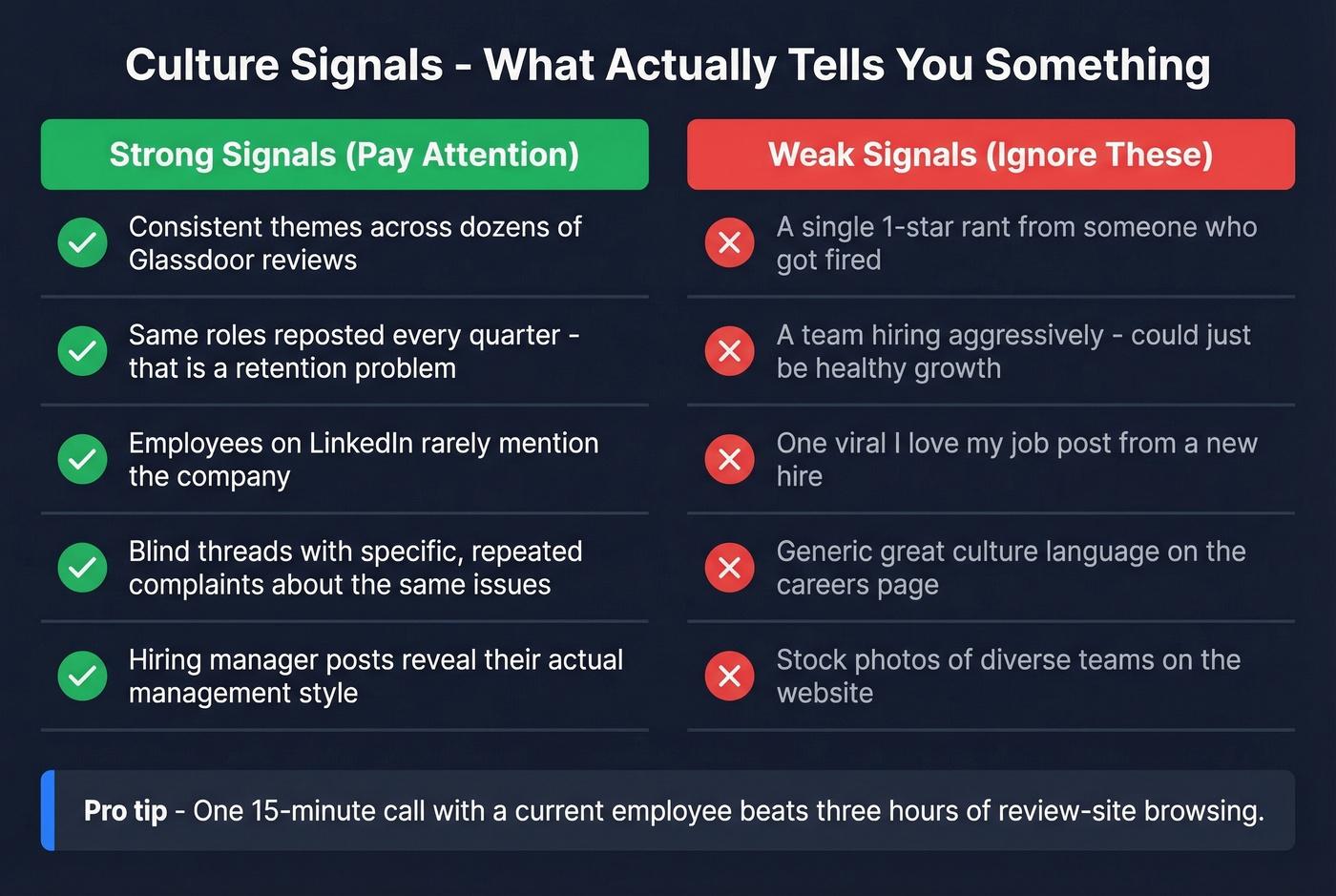
Culture Signals: Strong vs. Weak
Not all culture research is created equal.
| Strong signal | Weak signal |
|---|---|
| Consistent themes across many Glassdoor reviews | A single 1-star rant from a fired employee |
| Same roles reposted every quarter (retention problem) | A team growing aggressively (could be healthy growth) |
| Employees on LinkedIn rarely mention the company | One viral "I love my job" post |
| Blind threads with specific, repeated complaints | Generic "great culture" on the careers page |
| Hiring manager's own posts reveal management style | Stock photos of diverse teams on the website |
Check r/cscareerquestions and Blind for unfiltered takes at larger tech companies. But the real story comes from people. We've found that direct outreach to current employees gives you more signal in one 15-minute conversation than hours of review-site browsing. A simple "I'm interviewing at [Company] - would you be open to a quick chat about your experience?" works more often than you'd think.
Leadership and People
Research the specific humans you'll be meeting. Look up your hiring manager on LinkedIn - their published content, podcast appearances, and conference talks tell you what they care about. The founder's background shapes the company's DNA. Your interviewer's career path tells you what they value.
Knowing who you're meeting changes the entire conversation. "I saw your talk on [topic] - that resonated with how I think about [related challenge]" turns an interview into a real dialogue.

Company research shouldn't stop at the website. Prospeo gives you 50+ data points per company and contact - funding, headcount growth, technographics, and verified decision-maker emails - so you walk into every conversation armed with real intelligence.
Research any company in seconds, not hours. Free tier included.
Researching a Private Company
Here's where most guides fall apart. They assume every company is a Fortune 500 with SEC filings and analyst coverage. The Library of Congress research guide lays out the reality: private companies don't file with the SEC, so the depth you get with public companies simply doesn't exist.
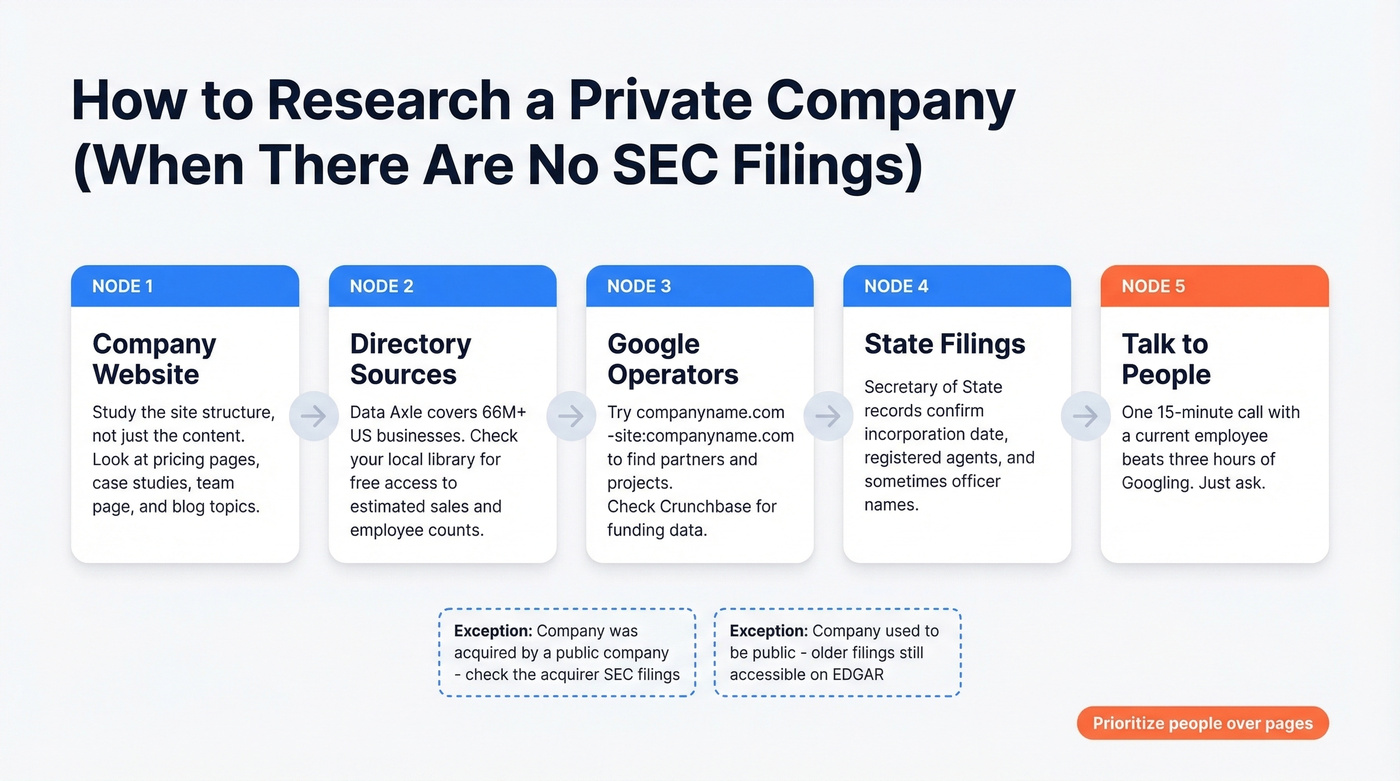
A common frustration from r/jobs threads: "I jump between Glassdoor, Reddit, Blind, LinkedIn... and still don't have the full picture." That's normal for private companies. The research path looks different when financials aren't publicly available:
- Start with the company website - for many private companies, it's genuinely the best source. Study the site structure, not just the content.
- Check directory sources - Data Axle Reference Solutions covers 66M+ U.S. businesses with estimated sales and employee figures. Your local library often has access for free.
- Use Google operators -
"companyname.com" -site:companyname.comshows who references them, revealing partners and projects.site:crunchbase.com "Company Name"surfaces funding data. - Search state business registrations - Secretary of State filings confirm incorporation date, registered agents, and sometimes officer names.
- Mine local and trade news - smaller companies show up in trade publications and local business journals more than national outlets.
Two exceptions where SEC filings help: if the private company was acquired by a public company, or if it used to be public and went private. Older filings remain accessible.
Let's be honest: if your target company has fewer than 200 employees and no press coverage, you'll learn more from one 15-minute call with a current employee than from three hours of Googling. Prioritize people over pages.
Free Tools for Company Research
Beyond the basics, a handful of tools give you an edge most candidates don't have - and many cost nothing.
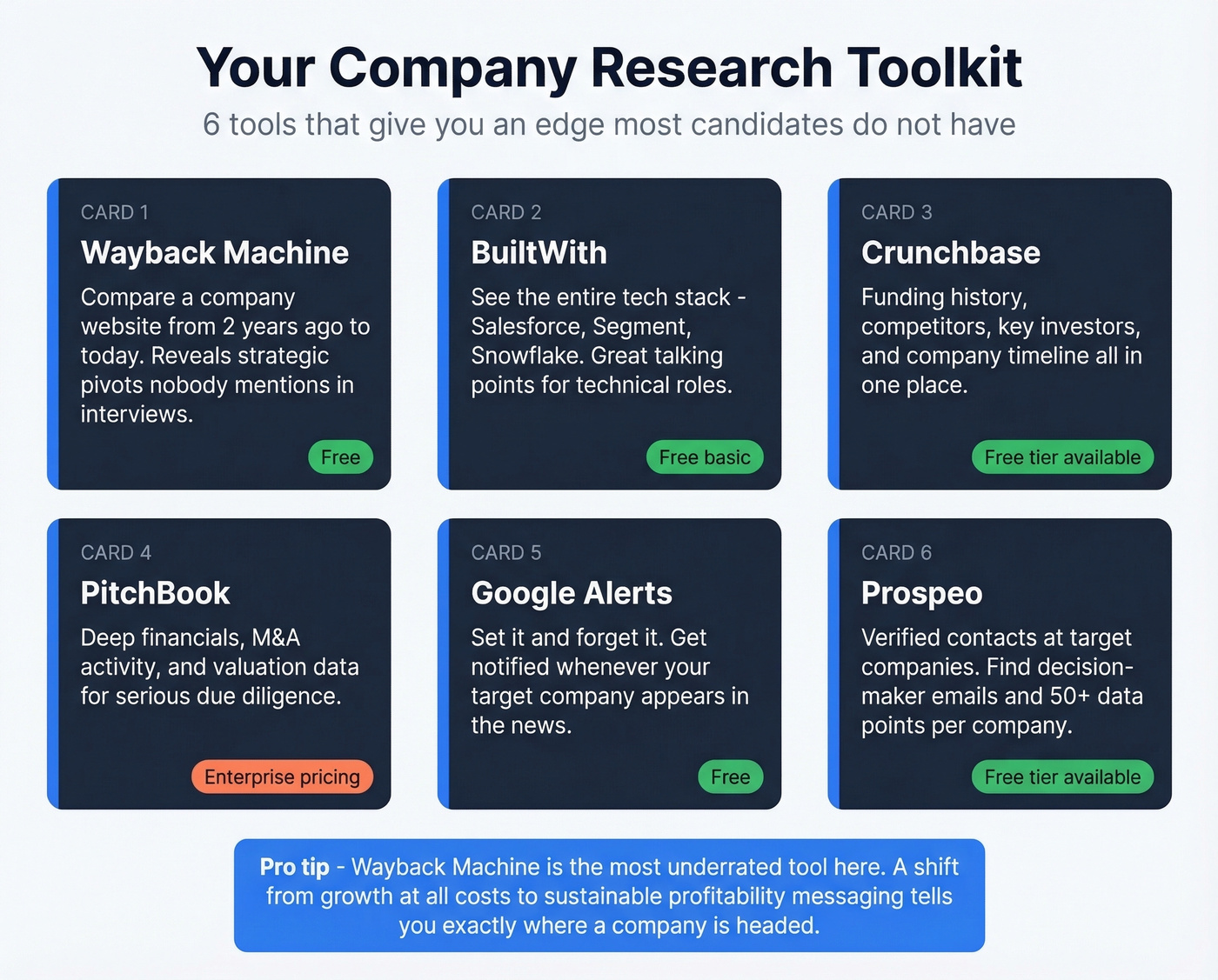
| Tool | What It Reveals | Cost |
|---|---|---|
| Wayback Machine | Messaging and strategy shifts over time | Free |
| BuiltWith | Web tech stack | Free basic |
| Crunchbase | Funding, competitors, investors | Free / paid Pro plans |
| PitchBook | Deep financials, M&A activity | Enterprise pricing |
| Google Alerts | Ongoing news monitoring | Free |
| Prospeo | Verified contacts at target companies | Free tier / paid plans from ~$39/mo |
Wayback Machine is underrated. Comparing a company's website from two years ago to today reveals strategic pivots nobody mentions in interviews. A shift from "growth at all costs" messaging to "sustainable profitability" tells you exactly where the company is headed.
BuiltWith is particularly useful for technical roles. Knowing the company runs on Salesforce, uses Segment for analytics, and recently adopted Snowflake gives you concrete talking points about their infrastructure and technical maturity.
For the people layer - finding the right person to reach out to for an informational interview or to connect with before your meeting - Prospeo's Chrome extension lets you pull verified email addresses from any company website in one click. The free tier gives you 75 emails per month, which is more than enough for interview prep outreach.
If you're doing this research as part of a broader competitive intelligence workflow, these tools also help you map positioning and messaging quickly.
Red Flags That Should Make You Pause
Research isn't just about impressing interviewers. It's about protecting yourself.
Job description red flags: unrealistic responsibilities for one person (you're doing three jobs), compensation far below market for similar roles, and vague details about work arrangement, title, or benefits.
Application process red flags: missing salary information or an absurdly broad range ($60K-$150K tells you nothing), a long application that demands hours of unpaid work upfront, and ATS crashes that signal what the internal tools look like.
Financial and operational red flags: recent layoffs without clear strategic rationale, regulatory filings or legal actions (search PACER for federal cases), and for private companies, credit rating downgrades or supplier complaints.
The hiring process itself is data. A missing salary range tells you something about how the company operates. A recruiter who ghosts you for two weeks and then demands availability tomorrow tells you something about how they treat people. Skip companies that stack three or more of these flags - your time is worth more than chasing a bad fit.
Turning Research Into Interview Answers
All this research is useless if you can't translate it into conversation.
"What do you know about us?" - Don't recite facts. Share an informed point of view. "You're a Series C fintech company competing with [X] and [Y]. What caught my attention is your approach to [specific thing] - it seems like you're betting on [trend], which aligns with what I've been working on at [current role]." That's 30 seconds and it signals genuine interest plus analytical thinking.
"Why this company?" - Connect your skills to their challenges. "I saw you're scaling the enterprise sales team, and your recent product launch into [market] suggests you're moving upmarket. That's exactly the motion I ran at [previous company], where I [specific result]."
Smart questions to ask based on your research:
- "What does success look like in this role after six months?"
- "How would you describe the team dynamics right now?"
- "I noticed [specific thing from research] - can you tell me more about that?"
Here's the thing: every company website says they "drive innovation" or some equivalent corporate speak. Your job isn't to repeat that back. It's to cut through it and show you understand the actual business underneath the marketing.
If you're interviewing for a revenue role, it helps to frame your answers like a mini B2B sales discovery: what they sell, who they sell to, and why they win.
Company Research Template
Copy this into Google Docs or Notion before your next interview. Fill in what you can, flag what you can't, and use the gaps as questions to ask.
| Research Area | What to Find | Your Notes |
|---|---|---|
| Company Basics | ||
| Core product/service | In plain language | |
| Industry + position | Sector, leader/challenger/niche | |
| Size | Headcount, revenue estimate | |
| Founded | Year + founders | |
| Financial Health | ||
| Public: revenue trend | 3-year direction | |
| Public: margins + debt | Improving or declining? | |
| Private: funding stage | Last round + investors | |
| Private: business model | How they make money | |
| Culture | ||
| Glassdoor rating | Score + top patterns | |
| Social media tone | How they present | |
| Hiring velocity | Growing or backfilling? | |
| Leadership | ||
| CEO background | Career path + tenure | |
| Hiring manager | Role, background | |
| Your interviewer(s) | Names + context | |
| Competitive Position | ||
| Top 3 competitors | Names + how they differ | |
| Key differentiator | What they'd say | |
| Red Flags | ||
| Any from checklist? | Note specifics | |
| Your Questions | ||
| Question 1 | Based on research | |
| Question 2 | Based on gaps | |
| Question 3 | Based on role |
The template works for any company - public or private, Fortune 500 or 10-person startup. The private company rows will have more blanks, and that's fine. Blanks become questions, and questions show preparation.
If you want to go one step further, turn your notes into a 30-second elevator pitch for why you're a fit, then tailor it to the role.
The best company research includes knowing exactly who to talk to. Prospeo's 300M+ profile database with 30+ filters lets you find decision-makers by department, seniority, and company signals like funding rounds and headcount growth - the same intel this article tells you to dig for manually.
Turn hours of manual research into a single search with 98% accurate data.
FAQ
How long should I spend researching a company before an interview?
Fifteen minutes for a phone screen - enough to know the product, industry, and recent news. Sixty minutes for a serious interview with a hiring manager. Two to three hours for a final round or offer evaluation. Match your effort to the stakes using the tiered framework above.
What if the company is private with barely any information online?
Triangulate from state business registrations, trade publications, and directory databases like Data Axle. Check if the company was ever public or acquired by a public company - older SEC filings remain accessible. When all else fails, reach out directly to current employees for informational conversations.
Should I mention my research during the interview?
Yes, but show perspective rather than reciting facts. Connect what you learned to your skills and their challenges. "I noticed you're expanding into [market]" signals far more preparation than "I checked your website." Use gaps in your research as thoughtful questions - interviewers respect honesty about what you couldn't find.
What's the fastest way to find contacts at a target company?
Start with the company's website contact page and professional profiles. For verified email addresses, Prospeo's Chrome extension pulls contacts from any company website in one click - the free tier gives you 75 emails per month with 98% accuracy, which covers most interview prep outreach.
How do I assess financial health without a finance background?
For public companies, read the Business Overview and Risk Factors sections of the 10-K on SEC EDGAR - skip the accounting tables and focus on the narrative. For private companies, check Crunchbase for funding history and triangulate from news coverage and industry directories. Three-year revenue trends and debt levels tell you most of the story.