

What HubSpot's Go-to-Market Strategy Teaches You - And How to Build Your Own
HubSpot publishes a lot of GTM frameworks. But the most useful lesson about a HubSpot go-to-market strategy isn't a deck or a blog post - it's the pivot that took them from $15M to $270M in four years. We dug into those numbers, and the takeaways are more practical than most "framework-first" advice you'll find.
The Short Version
- Segment focus beats broad targeting. HubSpot scored segments using a Market Investment Map and doubled down on one. Use a simple 1/3/5 scoring model to pick your beachhead.
- Pick your GTM motion by deal size. PLG for deals under $10K, sales-led above $25K, hybrid in between. Then use HubSpot Breeze AI to execute faster.
- None of it works if your prospect data is bad. Verified emails and direct dials are the foundation. Garbage in, garbage pipeline out.
HubSpot's GTM Pivot: The Real Story
In 2012, HubSpot was stuck at $15M in annual revenue with 65% gross retention and a customer base split between two personas: "Ollie Owners" (small business owners) and "Mary Marketers" (companies with dedicated marketing teams). Growth had stalled because they served both equally, which meant they served neither particularly well.
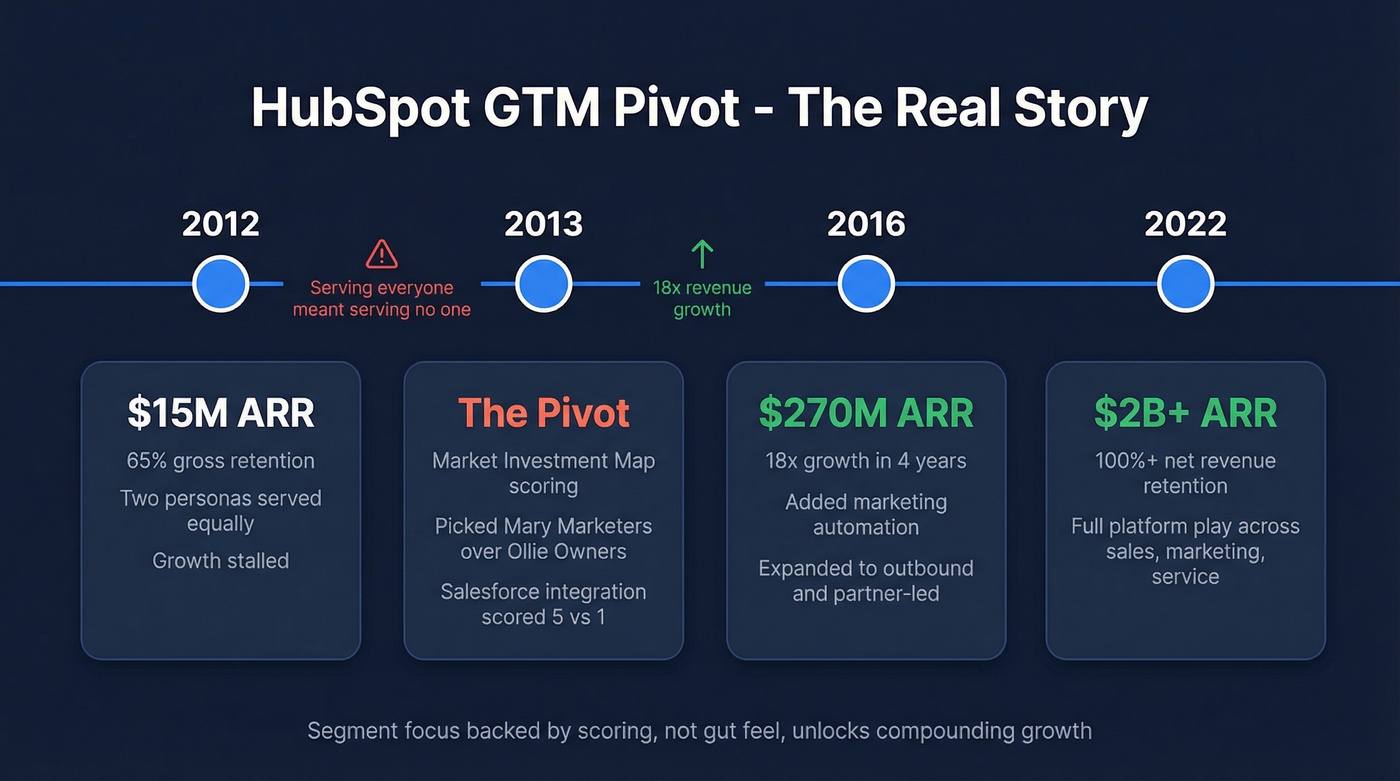
The turning point was a framework they called the Market Investment Map - scoring each segment-by-offering intersection on a 1/3/5 scale. A 5 meant "can't live without it." The Salesforce lead form integration scored a 5 for Mary Marketers and a 1 for Ollie Owners. That single data point drove the decision.
HubSpot pivoted hard toward Mary Marketers, added marketing automation and lead scoring, and expanded into outbound sales and partner-led motions. $15M grew to $270M in four years. By 2022, they'd surpassed $2B with 100%+ net revenue retention. The lesson isn't complicated: segment focus backed by a scoring framework - not gut feel - unlocks compounding growth. Most teams skip this step entirely, and it costs them years.
6 Components of a GTM Framework
A go-to-market strategy isn't a launch plan. It's the operating system that answers who you sell to, how you reach them, and how you measure whether it's working. Here are the six components HubSpot outlines:
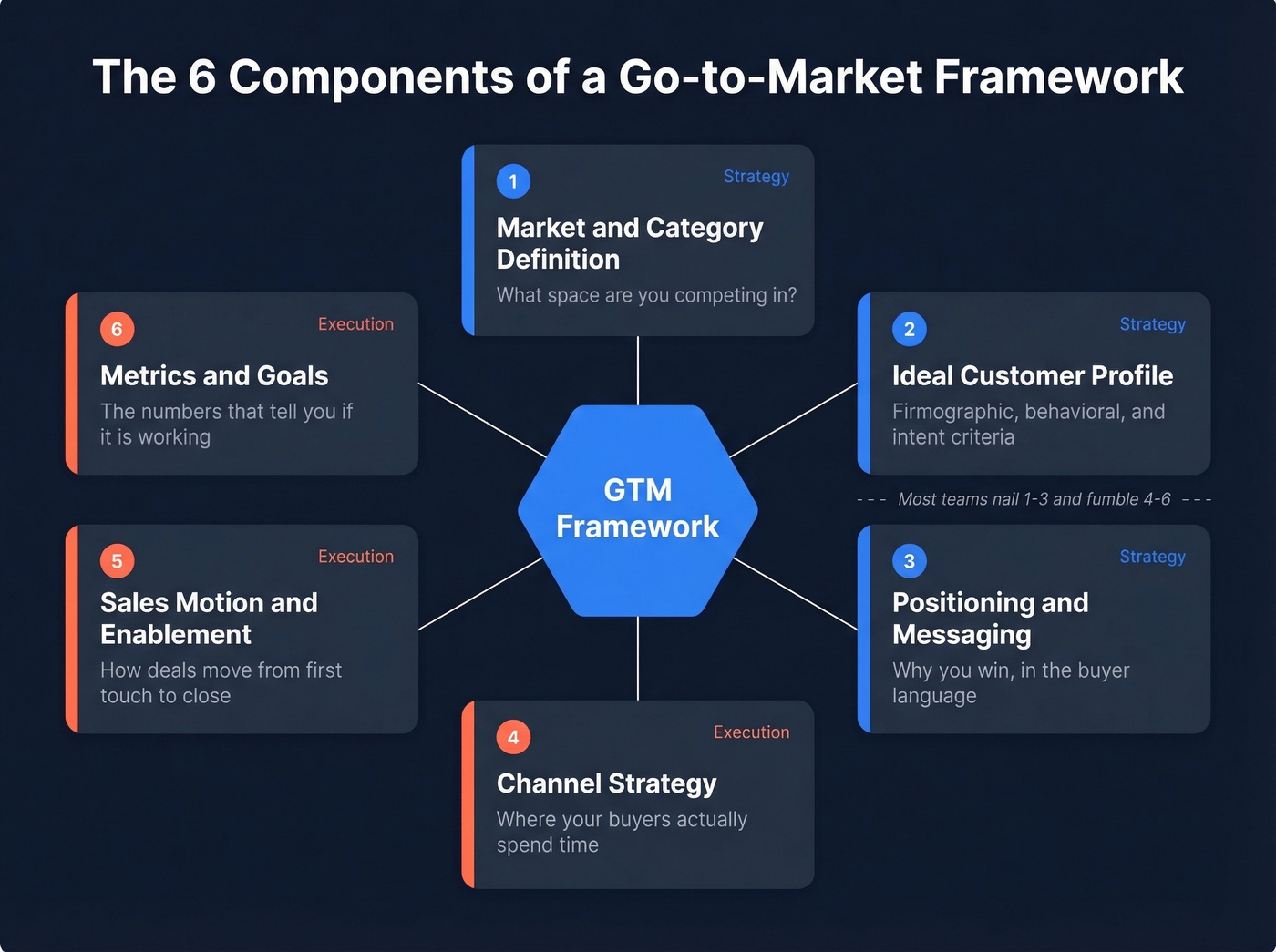
- Market/category definition - what space you're competing in
- ICP - firmographic, behavioral, and intent criteria for best-fit buyers
- Positioning and messaging - why you win, in the buyer's language
- Channel strategy - where your buyers actually spend time
- Sales motion and enablement - how deals move from first touch to close
- Metrics and goals - the numbers that tell you whether it's working
Let's be honest: most teams nail the first three and fumble the last three. Positioning decks are fun. Building a repeatable sales motion that actually converts? That's where the real work lives.
How to Choose Your GTM Motion
The motion you pick should follow your deal economics, not your preferences. Companies are spending $2 in sales and marketing for every $1 of new ARR, and that ratio increased 14% year-over-year. Picking the wrong motion accelerates that burn.
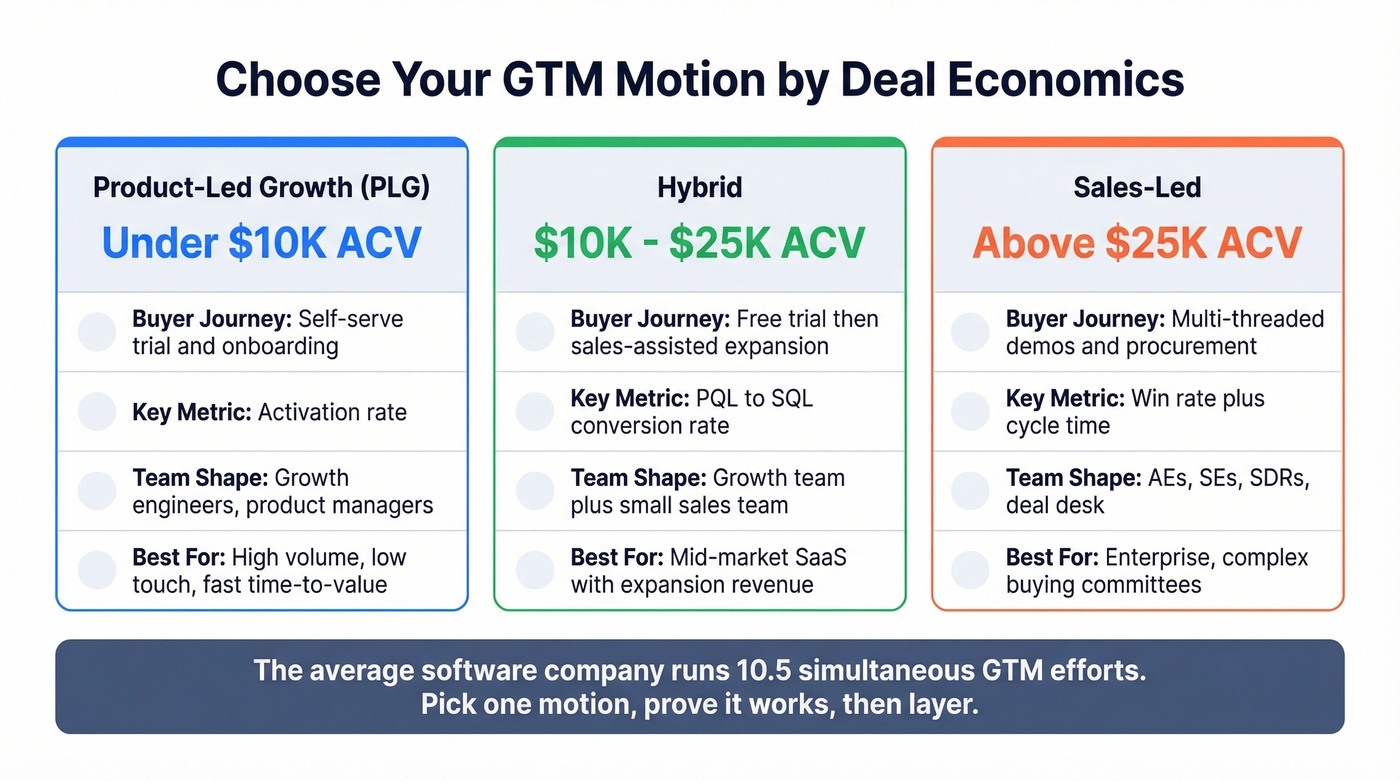
| PLG | Sales-Led | Hybrid | |
|---|---|---|---|
| ACV range | Under $10K | Above $25K | $10K-$25K |
| Buyer journey | Self-serve trial | Multi-thread, demos | Free then sales expansion |
| Key metric | Activation rate | Win rate + cycle time | PQL to SQL conversion |
For most B2B SaaS companies with mid-market ACV, hybrid is the right starting motion - use PLG for acquisition and sales for expansion. Here's the thing: the average software company runs 10.5 simultaneous GTM efforts. That's strategic confusion, not ambition. Pick one motion, prove it works, then layer.

You just saw the math: 44% of reps quit after one touch, and the wrong GTM motion burns $2 for every $1 of ARR. But none of that matters if 30% of your emails bounce before a prospect ever sees your message. Prospeo feeds 98% verified emails directly into HubSpot - on a 7-day refresh cycle - so your sequences actually land.
Stop building GTM strategies on stale data. Fix the foundation first.
2026 GTM Benchmarks That Actually Matter
| Metric | Benchmark | Top Performers |
|---|---|---|
| Cold email reply rate | 5.8% | 10.01% (timeline hooks) |
| Meeting rate | 0.69% | 2.34% |
| Win rate | 22% average | 30%+ |
| Sales cycle | 67 days | Under 45 days |
| PLG activation | 33% | 65%+ |
| Net revenue retention | 110%+ target | 120%+ |

The stat that should reshape your outbound playbook: 44% of reps give up after one touch, but 80% of deals take at least five. If your sequences stop at three emails, you're leaving pipeline on the table.
Using Breeze AI for Execution
HubSpot's Breeze AI suite maps directly to GTM activities:
- Prospecting Agent - researches prospects, identifies buying signals, and drafts personalized outreach from your CRM data
- Buyer Intent - monitors funding events, hiring signals, and website visits to alert reps when accounts are in-market
- Content Remix - repurposes one piece of content across channels automatically
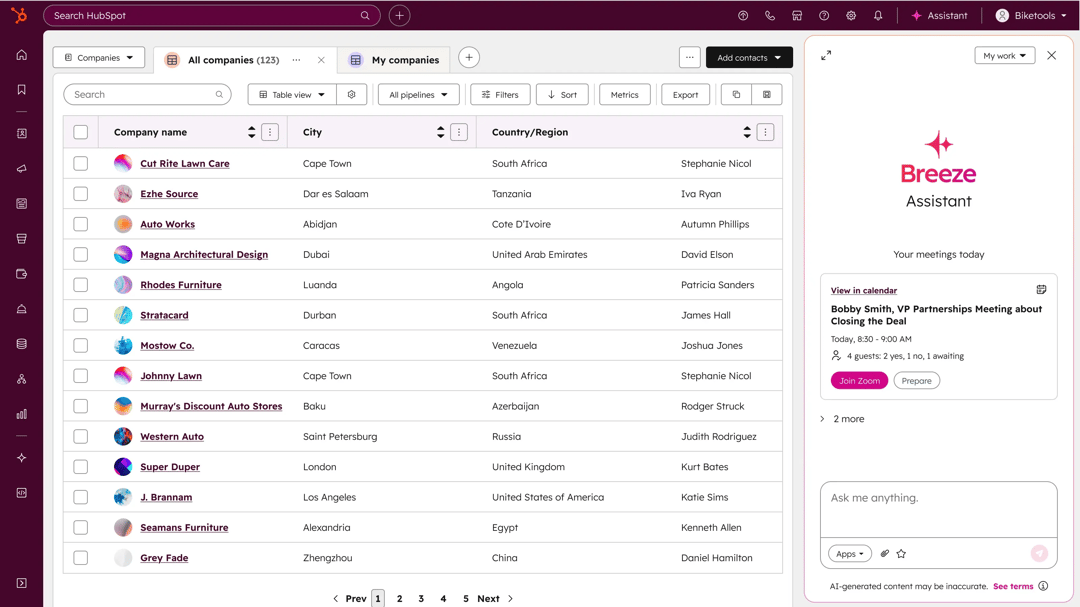
The results are real. Agicap saves 750 hours per week and increased deal velocity by 20%. Sandler generated 4x sales leads. Across the ecosystem, 46% of venture-backed startups now dedicate over 25% of their GTM stack to AI tools.
Breeze-related capabilities can push HubSpot into roughly $800-$3,600/mo for some teams depending on hubs and seats - check HubSpot's pricing page for current tiers. Skip Breeze if you're pre-revenue or running a lean team under five reps; the ROI math doesn't work until you have enough pipeline volume to justify the spend.
The Data Quality Problem No One Wants to Talk About
We've watched this play out dozens of times: SDRs burning through sequences, 30% of emails bouncing, domain reputation tanking, and the pipeline forecast is fiction. Every downstream metric in your go-to-market plan sits downstream of data quality, and most teams treat it as an afterthought.
One scenario we see constantly - a team launches a beautiful Breeze-powered outbound sequence, sends 2,000 emails in week one, and 600 bounce. Now their sending domain is flagged, deliverability craters across the board, and the next three months of outbound are compromised. All because the contact list was stale.
Prospeo's native HubSpot integration feeds verified contacts directly into your CRM workflows - 98% email accuracy on a 7-day data refresh cycle versus the six-week industry average. Snyk's team went from a 35-40% bounce rate to under 5%, generating 200+ new opportunities per month and growing AE-sourced pipeline by 180%.
Snyk's 50 AEs went from a 35-40% bounce rate to under 5% and added 200+ opportunities per month - all by swapping their data source. Prospeo's native HubSpot integration enriches your CRM with 50+ data points per contact at $0.01/email, so every Breeze sequence and every outbound play hits real inboxes.
Your Breeze workflows deserve data that actually connects to buyers.
GTM Mistakes That Kill Launches
Targeting too broadly. Score your beachhead segment with a Market Investment Map before expanding. HubSpot didn't try to win everyone - they picked Mary Marketers and went all in.
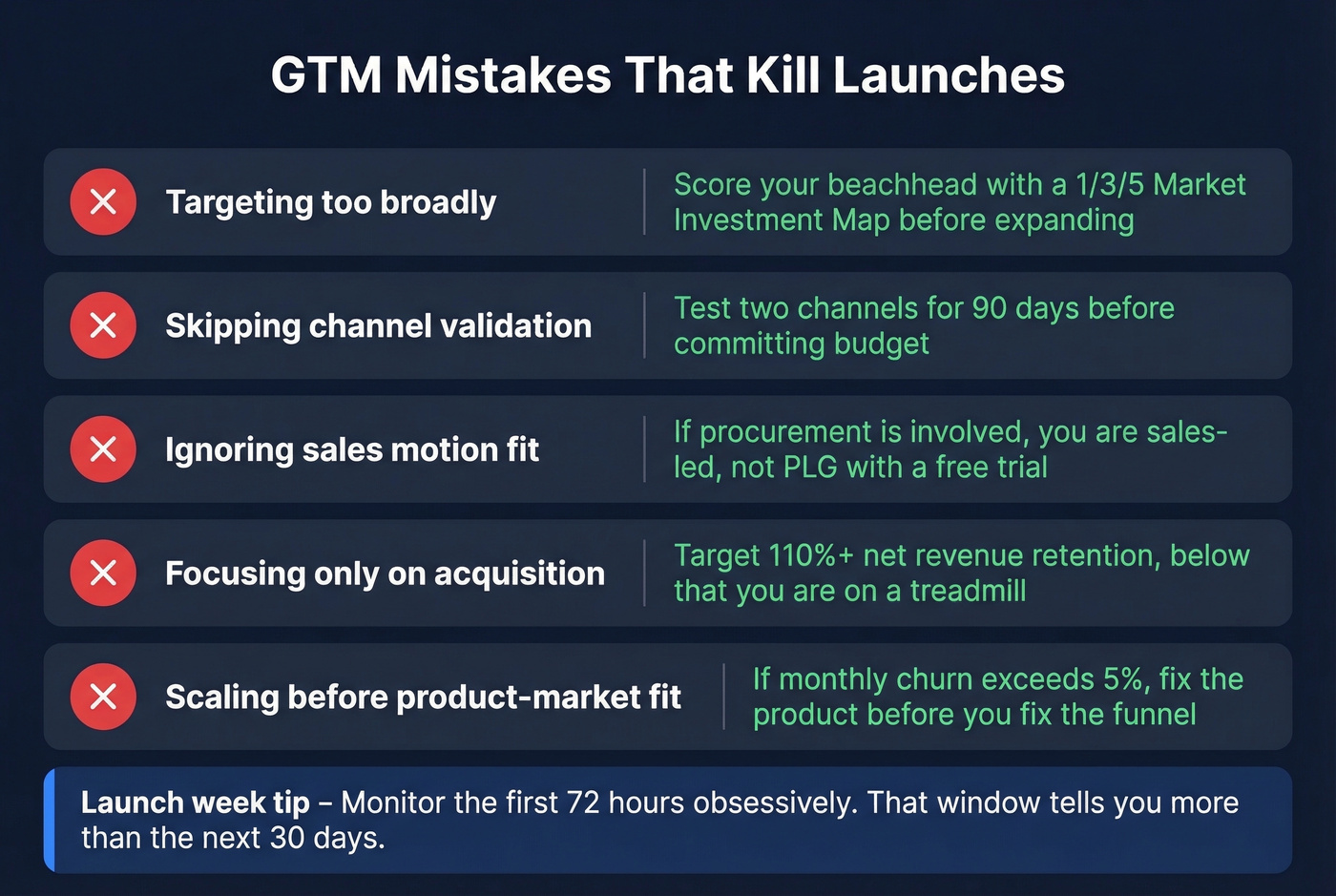
Skipping channel validation. Your first 10 customers came from somewhere specific. That doesn't mean it scales. Test two channels for 90 days before committing budget.
Ignoring sales motion fit. Self-serve assumptions break the moment procurement enters the picture. If your average deal involves a legal review, you're not PLG - you're sales-led with a free trial.
Focusing only on acquisition. A leaky bucket makes every new customer more expensive. Net revenue retention above 110% is the benchmark; below that, you're running on a treadmill.
Scaling before PMF. Spending on growth while the product churns is the most expensive mistake on this list. The consensus on r/SaaS is pretty clear: if monthly churn exceeds 5%, fix the product before you fix the funnel.
During launch week, monitor the first 72 hours obsessively. That window tells you more than the next 30 days will.
FAQ
What's the difference between a GTM strategy and a marketing plan?
A GTM strategy covers ICP, pricing, sales motion, channels, and metrics across the full buyer journey. A marketing plan is one execution layer within it, focused on campaigns and demand gen. Think of the marketing plan as a subset that handles awareness and pipeline creation, while the GTM strategy governs how the entire revenue engine operates from first touch through renewal.
How long does it take to build a go-to-market plan?
A focused team can build one in about 9 weeks: two for research and customer interviews, two for positioning, two for enablement, two for testing, and one for internal alignment. Rushing past the research phase is the most common shortcut that backfires - in our experience, teams that skip customer interviews end up repositioning within six months.
What tools pair best with HubSpot for GTM execution?
HubSpot CRM plus Breeze AI handles sequences, intent signals, and automation. For verified prospect data, pair it with Prospeo - 98% email accuracy, 125M+ verified mobile numbers, and a native HubSpot integration that keeps your CRM clean on a 7-day refresh cycle. The free tier includes 75 email credits per month, so there's no reason not to test it before committing.