

The Hunter and Farmer Sales Model: When to Split, How to Pay, and What Goes Wrong
Your CRO just walked into the all-hands and announced it's time to implement the hunter and farmer sales model. Six AEs, $4M in ARR, and suddenly everyone's supposed to pick a lane - hunt new logos or farm existing accounts. Half the room looks excited. The other half is updating their resumes.
Here's the thing: this isn't a personality test. It's a structural decision with financial consequences. Get the timing right and you gain real specialization advantages. Get it wrong and you're staring at higher turnover, blown handoffs, and a comp plan nobody trusts.
Should You Split?
Most companies split too early. We've seen teams restructure at $2M ARR and regret it within two quarters. Before you do anything, run through these checkpoints:
- Under $5M ARR with 5 or fewer sellers? Keep generalist AEs. You don't have the volume to justify specialization, and you'll create handoff friction that slows deals down.
- Between $5M and $10M? Add dedicated Account Managers to own renewals and expansion. Let your AEs focus on new logos. This is where the model starts to pay for itself.
- $10M+ with complex expansion motions? Fully bifurcate - but build the comp plan and handoff process before you hire. The structure matters more than the headcount.
The instinct to specialize early is strong, especially when a couple of AEs start complaining they can't prospect and manage accounts at the same time. Resist it until the math supports it.
What Hunters and Farmers Actually Do
Hunters open doors. They're the reps running outbound sequences, booking discovery calls, and pushing net-new deals through the pipeline. Their world is measured in new logos, pipeline generated, and closed-won revenue. They thrive on the chase and tend to get restless once a deal closes.
Farmers cultivate what's already planted. They own the post-sale relationship - renewals, upsells, cross-sells, and the kind of deep account knowledge that turns a $50K deal into a $200K account over three years. Their metrics are net revenue retention and expansion revenue.
The identity question comes up constantly. Reps ask whether being labeled a "farmer" signals lower status. It doesn't, but the perception persists at companies that treat account management as a consolation prize. The distinction matters most in how you compensate, manage, and evaluate each role.
| Hunter | Farmer | |
|---|---|---|
| Focus | New business | Existing accounts |
| Typical titles | SDR, BDR, AE | AM, CSM |
| Core skills | Prospecting, cold outreach, objection handling | Relationship management, account planning, cross-sell identification |
| Primary KPIs | New ARR, pipeline | NRR, GRR, expansion |
| Pay mix | 50/50 or 60/40 | 70/30 or 80/20 |
| Biggest risk | Burnout, turnover | Complacency, churn |
Four Account Ownership Models
The hunter/farmer binary is actually a spectrum. Alexander Group's research identifies four distinct models, and understanding where you sit helps you decide where to go next.
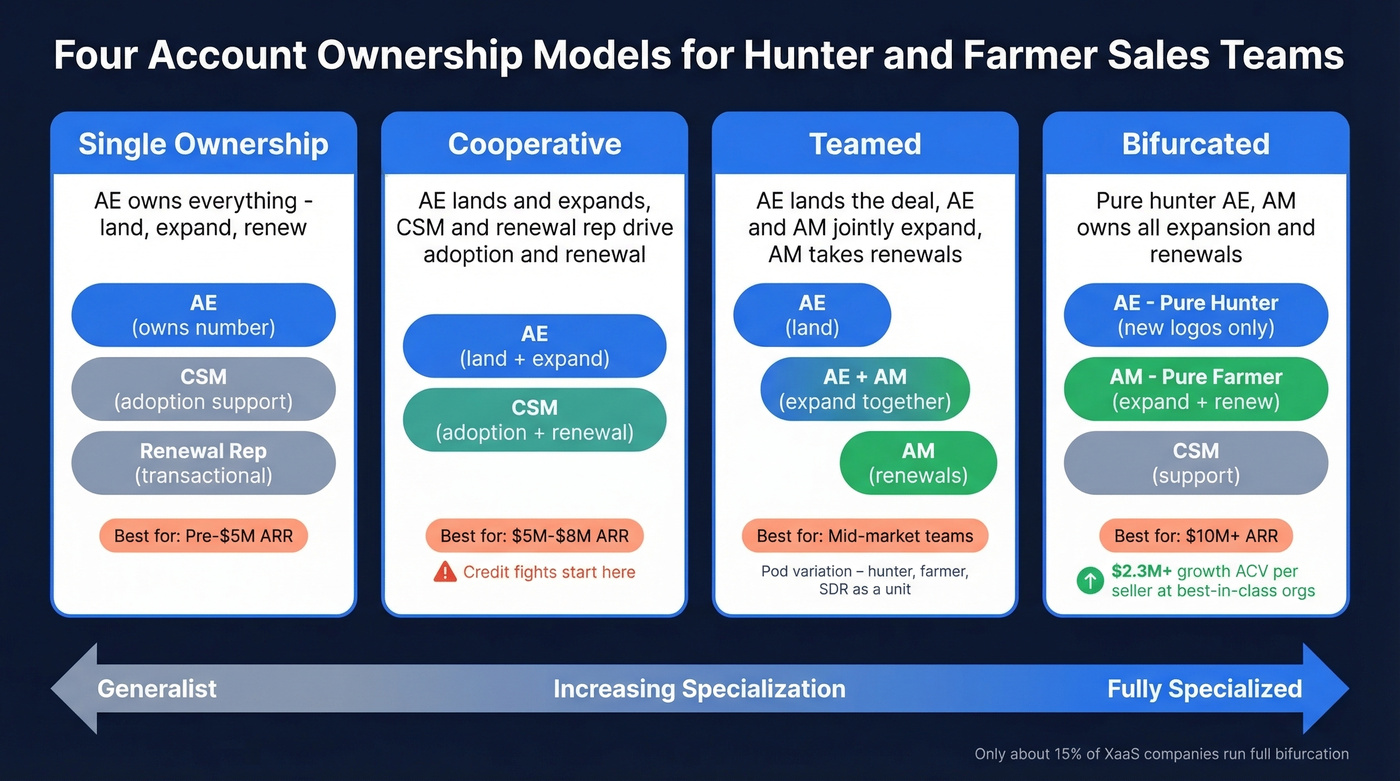
Single Account Ownership puts everything on the AE - land, expand, renew. A CSM supports adoption, and a renewal rep handles transactional renewals, but the AE owns the number. Most early-stage companies live here.
Cooperative keeps the AE on landing and expansion while a CSM or renewal rep drives adoption and renewal. Ownership is shared, which works until it doesn't. The "who gets credit?" fights start here.
Teamed has the AE land the deal, then the AE and AM jointly expand the account. The AM takes over renewals. This is the transitional model most mid-market teams gravitate toward. Pod-based models - where a hunter, farmer, and SDR work as a dedicated unit - are a variation that some orgs prefer for tighter account coverage.
Bifurcated is the full split. The AE is a pure hunter. The AM owns expansions and renewals, often with CSM support. Only about 15% of XaaS companies actually run this model, skewing toward mid-market/SMB segments in fintech and e-commerce verticals. Best-in-class bifurcated orgs produce over $2.3M in growth ACV bookings per seller - but that benchmark requires real operational discipline. McKinsey's research on commercial excellence reinforces this: the model works best when organizations invest in clear role definitions and performance management systems before splitting the team.
When Specialization Pays Off
The decision isn't just about revenue. It's about team size, expansion complexity, and whether your product's pricing model creates natural upsell motions.
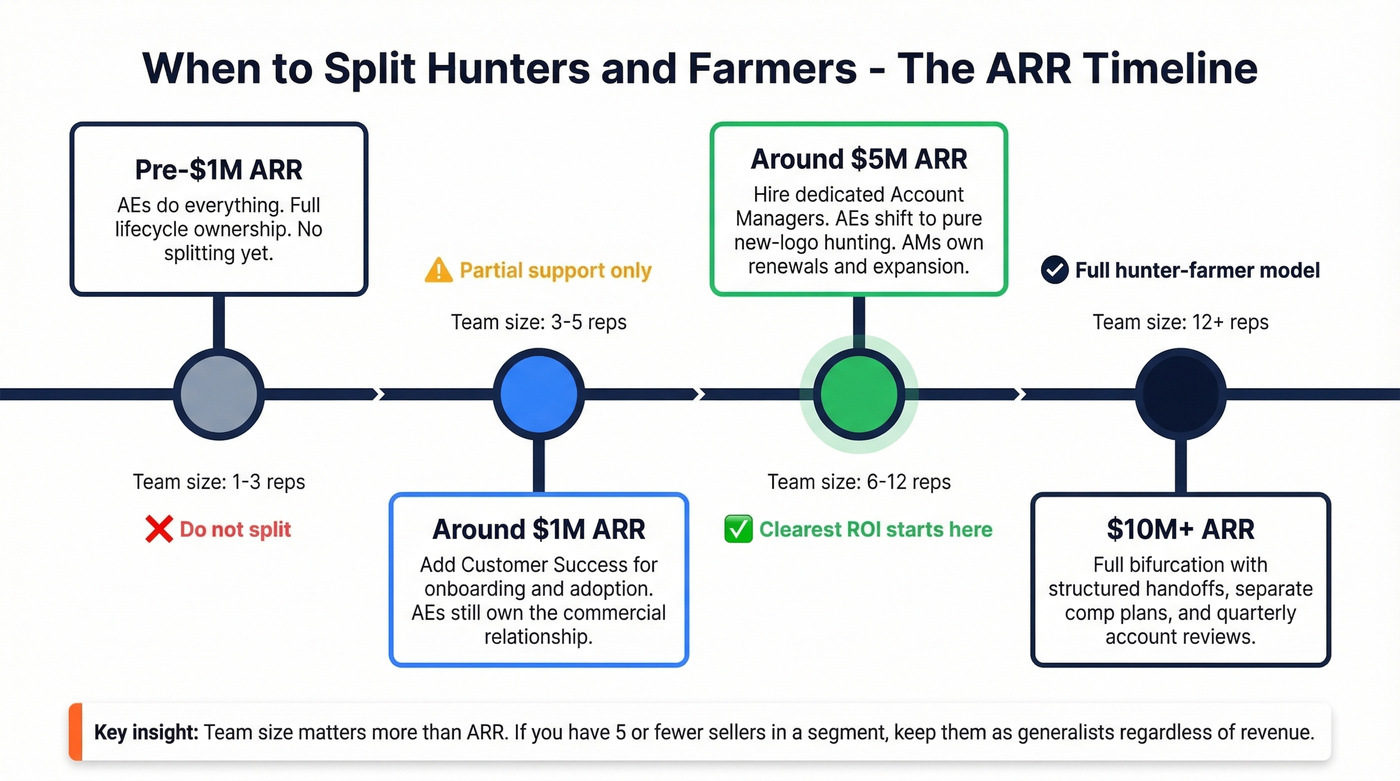
Pre-$1M ARR: AEs do everything. You need reps who understand the full customer lifecycle, and you don't have enough accounts to justify splitting attention.
~$1M ARR: Add Customer Success to handle onboarding and adoption. AEs still own the commercial relationship, but they're no longer doing implementation calls.
~$5M ARR: Hire dedicated Account Managers. AEs shift to pure new-logo acquisition. AMs own renewals and start running expansion plays. This is the stage where the hunter and farmer sales model delivers the clearest ROI.
$10M+ ARR: Full bifurcation with structured handoffs, separate comp plans, and quarterly account reviews between acquisition and retention teams.
But here's the nuance most frameworks miss. Team size matters more than ARR. If you've got 5 or fewer sellers in a segment, keep them as generalists - specialization benefits require scale, and you can't run a two-person "hunting team."
Expansion complexity adds another layer. If Year 1 expansion is high and complex, keep the AE on the account for 12 months so they can build on the relationship from the sale. If Year 1 expansion is low-complexity but Years 2+ get more involved, hand off earlier so the AM can develop deep account knowledge before the big expansion conversations start. Usage-based pricing is a common case where expansion is high-potential but low-complexity - users just add seats or usage. That's a farmer motion, and it can start earlier than you'd think.

Splitting into hunters and farmers only works if your hunters have accurate prospect data. Prospeo gives new-logo reps 300M+ verified profiles with 30+ filters - buyer intent, technographics, headcount growth - so they spend time closing, not chasing bounced emails. 98% email accuracy. 125M+ verified mobiles with a 30% pickup rate.
Give your hunters the data that books 35% more meetings than Apollo.
Compensating Hunters vs. Farmers
Comp plan design is where the hunter/farmer model either clicks or collapses. If your hunters and farmers are fighting over account ownership, the comp plan is broken - not the people.
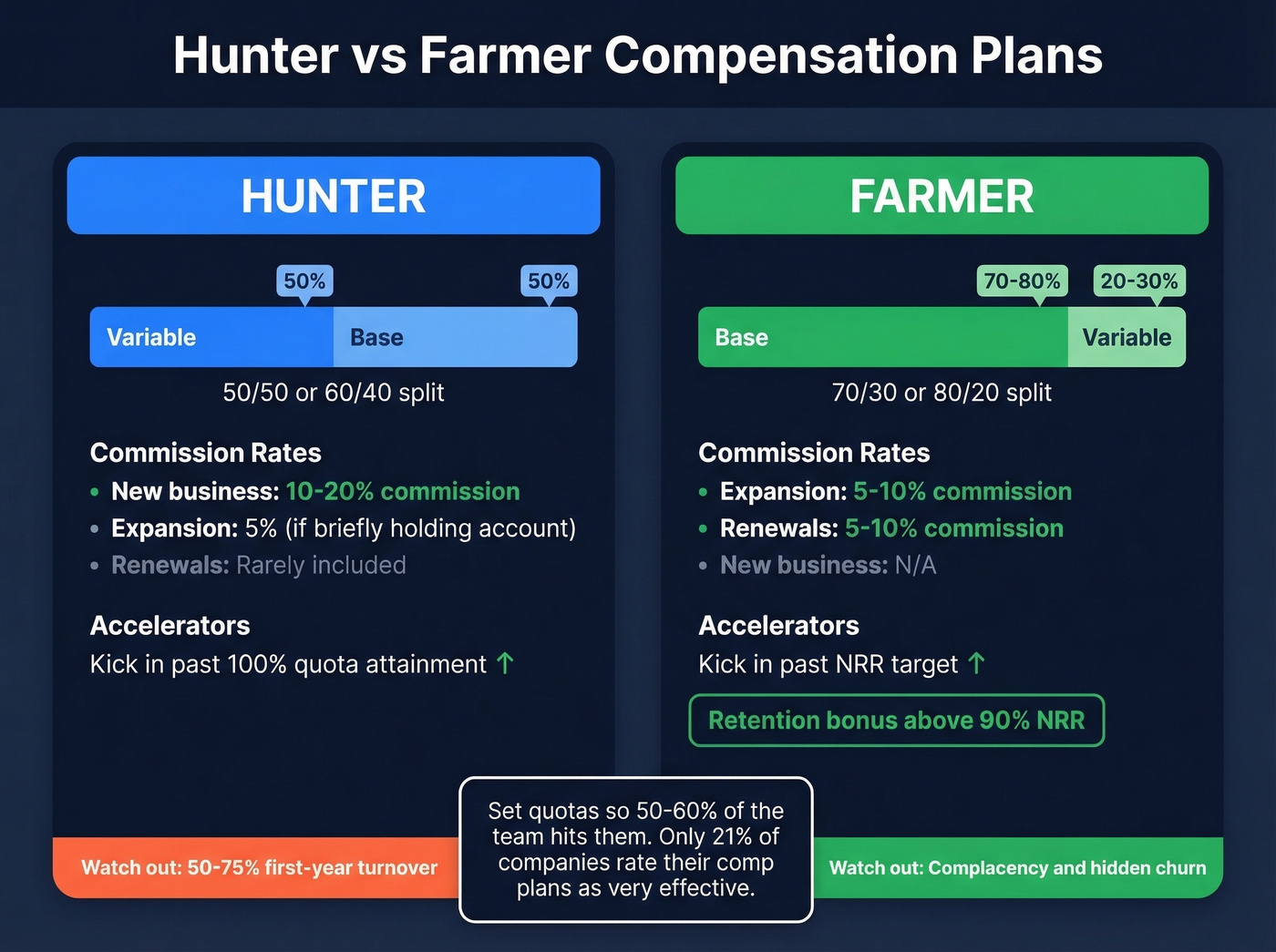
Hunter comp should be variable-heavy. A 50/50 or 60/40 base-to-variable split is standard. Commission rates should bias toward new logos - a common structure is 10% on new business vs. 5% on expansion revenue if the hunter holds the account briefly before handoff. Aggressive plans for pure new-logo hunters push that rate to 15-20%. Add accelerators past quota to keep your best hunters from coasting.
Farmer comp should be base-heavy - think 70/30 or 80/20. Variable compensation ties to renewals at 5-10% commission, expansion revenue, and retention bonuses that kick in above 90% net revenue retention. The goal is to reward account health, not just short-term upsells that create churn risk.
| Component | Hunter | Farmer |
|---|---|---|
| Base/variable split | 50/50 or 60/40 | 70/30 or 80/20 |
| New business rate | 10-20% | N/A |
| Expansion rate | 5% (if applicable) | 5-10% |
| Renewal commission | Rarely included | 5-10% |
| Retention bonus | N/A | Above 90% NRR |
| Accelerators | Past 100% quota | Past NRR target |
Set quotas so 50-60% of the team achieves them. If everyone's hitting quota, it's too low. Fewer than 40%? You've got a planning problem or a hiring problem.
Let's be honest: only about 21% of companies rate their sales comp plans as "very effective." The majority are actively overhauling them right now. Don't expect to nail this on the first try. Plan to iterate quarterly for the first year.
The Hunter-to-Farmer Handoff
Picture this: a hunter closes a $200K deal after four months of relationship-building. The next week, an Account Manager who's never spoken to the customer sends a "looking forward to working together" email. The champion goes silent. The expansion pipeline evaporates.
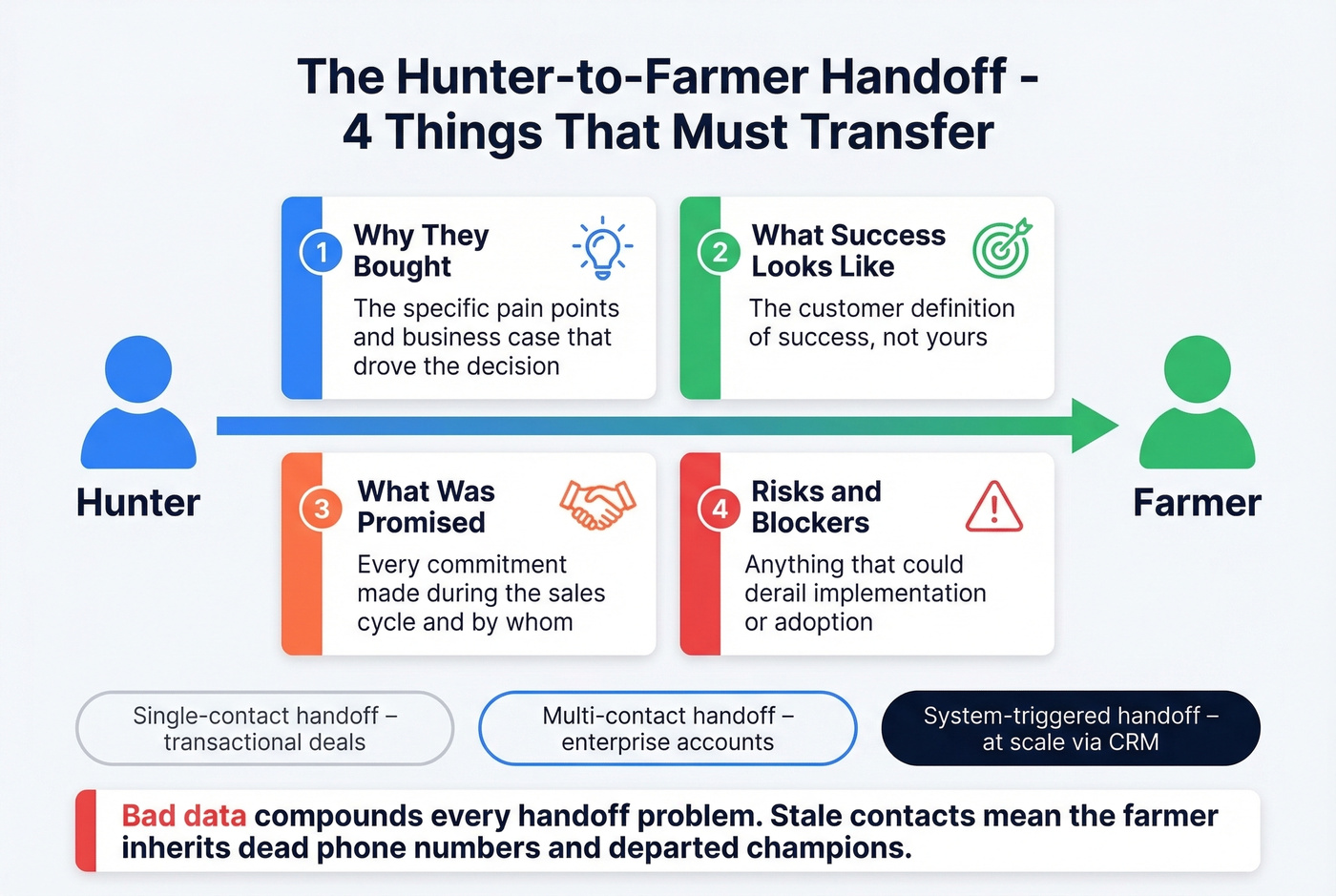
In our experience, the handoff is where most hunter/farmer implementations actually break. And the failures aren't about process - they're about missing context. Every handoff should transfer four things:
- Why they bought - the specific pain points and business case that drove the decision
- What success looks like - the customer's definition, not yours
- What was promised - every commitment made during the sales cycle, by whom
- Risks and blockers - anything that could derail implementation or adoption
The handoff model you choose depends on deal complexity. Single-contact handoffs work for transactional deals. Multi-contact handoffs, where the hunter introduces the farmer to multiple stakeholders, work better for enterprise accounts. At scale, system-triggered handoffs - where the CRM automatically reassigns ownership and fires a notification sequence - keep things from falling through the cracks.
Bad data compounds every handoff problem. If the hunter logged outdated contact info during the deal, the farmer inherits dead phone numbers and departed champions. This is where data enrichment earns its keep - tools like Prospeo keep contact records current through the transition with a 7-day refresh cycle and 50+ data points per contact, so the farmer walks into the account with a complete picture instead of stale CRM fields.
When the Model Fails
The hunter/farmer split isn't a silver bullet. When it fails, it fails in three predictable ways.
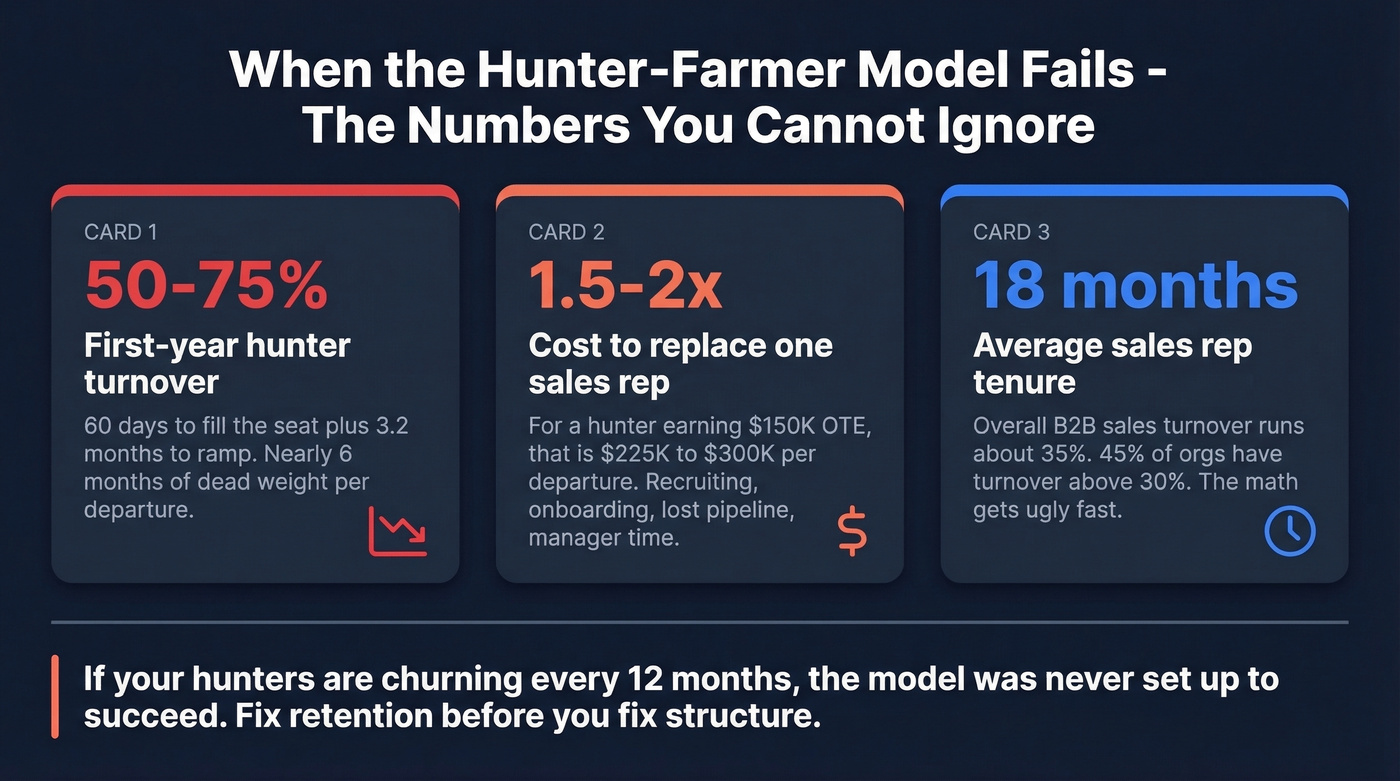
Turnover eats your investment. Average sales rep turnover runs about 35%, and 45% of B2B sales orgs have average turnover above 30%. Average tenure sits at just 18 months. For hunters specifically, first-year turnover runs between 50% and 75%. Every lost hunter means roughly 60 days to fill the seat plus 3.2 months to ramp the replacement - nearly six months of dead weight per departure. If your hunters are churning every 12 months, the model was never set up to succeed.
Cost spirals quietly. The fully loaded cost of replacing a sales rep - recruiting fees, onboarding, lost pipeline, manager time - runs 1.5-2x the rep's annual compensation. For a hunter earning $150K OTE, that's $225-300K per departure. Multiply that by a 50%+ turnover rate and the math gets ugly fast.
Relationships fracture at the handoff. The customer relationship follows a lifecycle: aware, like, trust, buy, repeat, refer, reference. Every handoff resets the trust clock. The customer has to re-explain their business, re-establish rapport, and re-build confidence that the new person understands their needs. Some customers never make it back to "trust."
Skip the formal split entirely if your average deal size is under $15K. The handoff overhead and comp plan complexity will cost you more than the specialization gains. Keep generalists, give them good tools, and split when the deal sizes justify the infrastructure.
Beyond Hunter and Farmer
The binary split made sense when outbound was the only motion. In 2026, most revenue teams need at least three personas.
The Trapper is the strategic, inbound-aligned seller. Instead of cold-calling hundreds of prospects, trappers place themselves where buyers already are - using case studies, social proof, and content to attract high-intent prospects. They're selective about targets and timing, which makes them more efficient than pure hunters in markets where buyers do 70%+ of their research before talking to sales.
The Gatherer is a more proactive version of the farmer. Where farmers tend to be reactive - waiting for renewal dates and inbound expansion requests - gatherers actively build relationships, identify new use cases, and bring in net-new deals from adjacent teams within existing accounts.
Sean O'Shaughnessey, CRO at Agile Stacks, put it well: "The strongest salespeople are trappers in a gatherer position." That combination of strategic inbound targeting plus proactive relationship-building is what the best modern account executives actually do. HubSpot's sales research validates this framing too, noting it's rare to find someone well-developed in more than one persona - which is exactly why role design matters so much.
Arming Your Hunters
A hunter needs three things: a CRM, a sequencing tool, and a verified data source. Everything downstream - the sequences, the calls, the pipeline - depends on that data foundation. A hunter burning four hours a day on bounced emails and wrong numbers isn't hunting. They're wasting ammo.
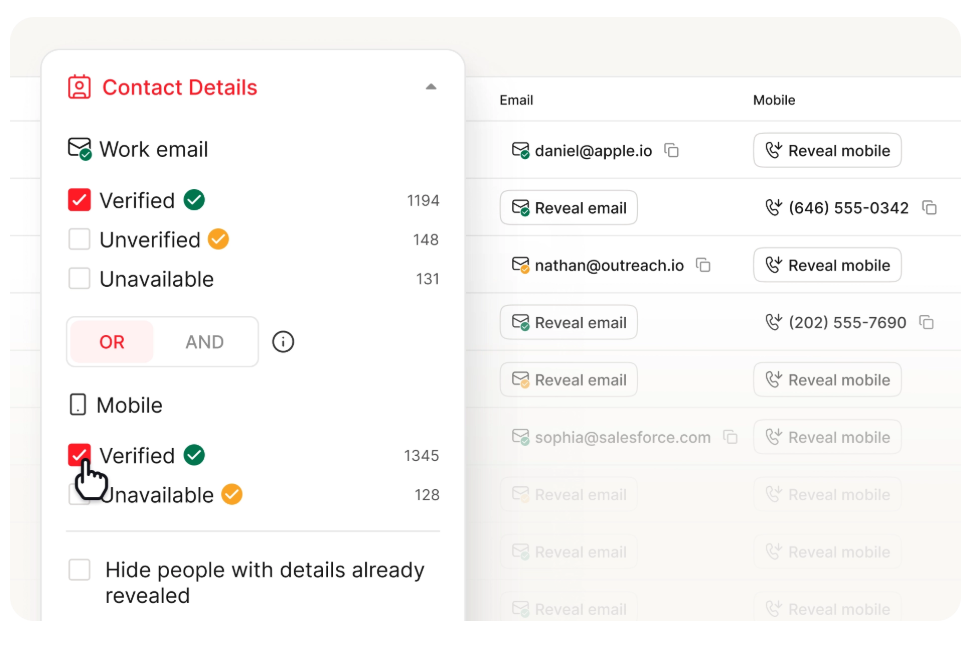
We've tested a lot of data providers, and the gap between "good enough" and "actually accurate" is wider than most teams realize. Prospeo covers the data layer with 300M+ professional profiles, 98% email accuracy, and 125M+ verified mobile numbers. The Chrome extension lets hunters find verified emails and direct dials from any website in one click, and at roughly $0.01 per email with no contracts, you can hand it to every hunter on the team without a procurement fight. The 30+ search filters - including buyer intent, technographics, and job change signals - let hunters build targeted lists instead of blasting 500 contacts and hoping for replies.
If you're building outbound from scratch, start with proven sales prospecting techniques and a clean cold email sequence before you scale volume.
For farmer tooling, the stack looks different. Gainsight, Totango, and ChurnZero handle usage tracking, health scoring, and predictive analytics - the signals that tell a farmer which accounts need attention before they churn. If you're tightening retention, a structured churn analysis will usually surface the biggest expansion blockers fast.
Your farmers need fresh account intelligence to spot expansion opportunities before renewal conversations. Prospeo's CRM enrichment returns 50+ data points per contact with a 7-day refresh cycle - so AMs always know who's changed roles, which departments are growing, and where the upsell signals are.
Stop farming blind - enrich every account with real-time buyer data.
FAQ
Is being a "farmer" in sales a bad thing?
No. Farmers drive net revenue retention, the metric that determines company valuation in SaaS. Companies that treat farming as a demotion have a retention problem, not a role problem. The best farmers are deeply strategic and often out-earn hunters through expansion-based comp.
Can one person be both a hunter and a farmer?
Yes, and most early-stage teams should keep generalist AEs until roughly $5M ARR. Splitting too early creates handoff friction without enough deal volume to justify specialization overhead.
What tools do sales hunters need most?
At minimum: a CRM, a sequencing tool, and a verified data source. The data source matters most - bad emails and disconnected numbers kill pipeline before it starts.
What's the ideal hunter-to-farmer ratio?
There's no universal ratio. It depends on your new-logo vs. expansion revenue split. A company where 70% of revenue comes from new business needs more hunters. One where 60% comes from expansion needs more farmers. Start with your revenue mix and work backward.
Does McKinsey's take differ from other frameworks?
The core structure is the same - separate roles for acquisition and retention. McKinsey emphasizes operational rigor: clear performance metrics, structured handoffs, and investment in capability building for each role. Companies that treat the hunter and farmer sales model as a comp plan change rather than an organizational redesign tend to underperform.