

Ideal Customer Criteria: A Practical Scoring Guide That Works
A RevOps lead we know audited their CRM last quarter. Half the accounts didn't fit the ICP. They'd been feeding reps thousands of accounts that would never close - and wondering why pipeline velocity was tanking. This isn't rare. 14% of sellers generate 80% of new logo revenue, which tells you everything about why getting your ideal customer criteria right matters.
Here's the thing: most companies don't have an ICP problem. They have an operationalization problem. The criteria exist in a slide deck nobody opens. What they actually need is a scored matrix their CRM can filter on.
Is Your Current ICP Broken?
Before building new ideal customer profile criteria, diagnose whether your targeting is off. These red flags come from Factors.ai's diagnostic framework:
- Bounce rate above 55% - you're reaching the wrong companies or using stale data.
- Email unsubscribe rate over 2% - your audience doesn't fit.
- Site conversion below 3-5% - traffic's coming in, but it's the wrong traffic.
- NPS/CSAT scores declining among new cohorts - you're acquiring customers who don't get value from your product.
If two or more apply, your ICP is "hope-based" - built from executive intuition rather than closed-won data. A CS manager on r/CustomerSuccess put it bluntly: their sales team defined ICP as "at least 5 users with the same domain," which captured tons of free-tier users who'd never convert or expand. That's not criteria. That's a vanity filter.
The Complete Criteria List
Most ICP documents stop at industry and company size. That's maybe 20% of what you need. A complete set of customer selection criteria spans six categories, each capturing a different dimension of fit through distinct data points.
Firmographic & Technographic Criteria
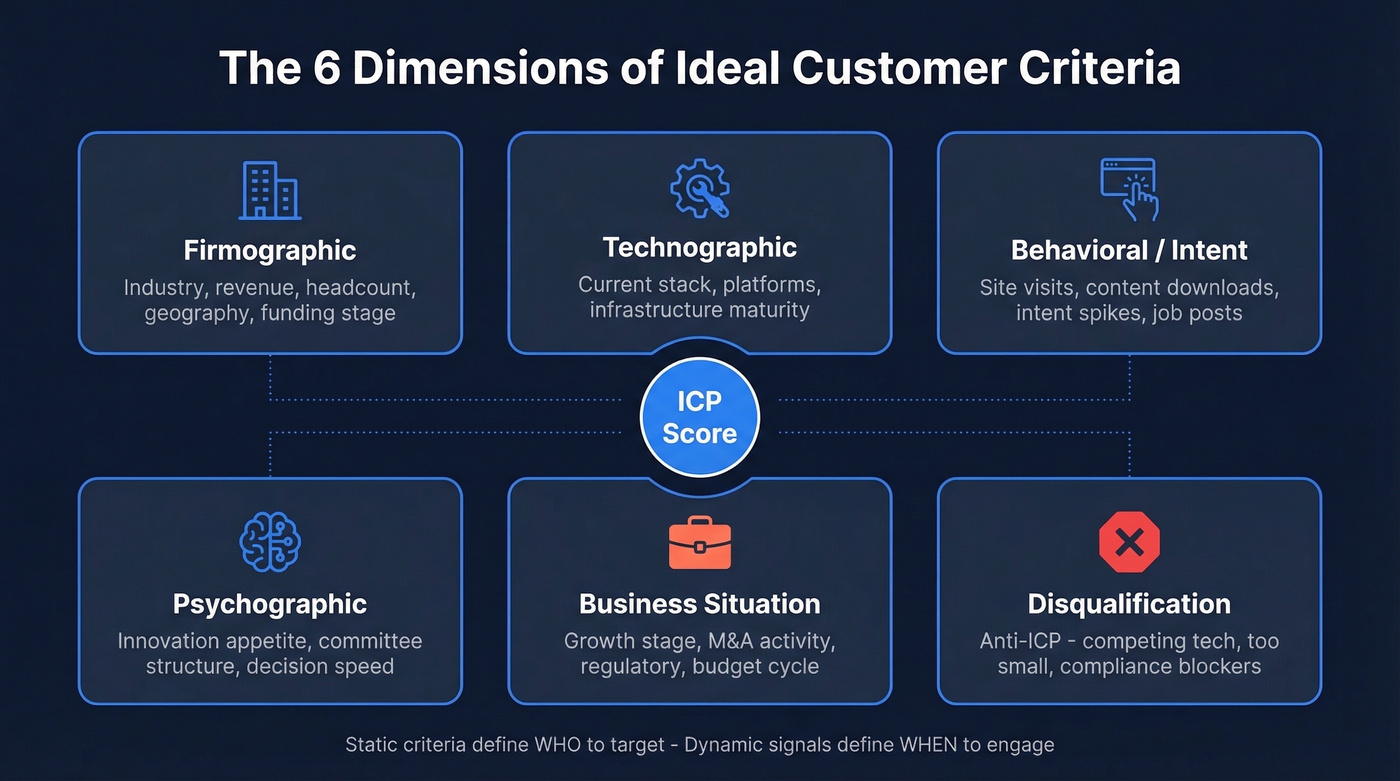
These are your static attributes - the ones that don't change quarter to quarter. For SaaS, standard segmentation ranges run: SMB under $50M revenue / under 500 employees, mid-market $50M-$1B / 500-2,000 employees, enterprise above $1B / 2,000+ employees.
| Category | Example Attributes |
|---|---|
| Firmographic | Industry, revenue range, headcount, geography, funding stage |
| Technographic | Current stack, platforms used, infrastructure maturity |
Technographic criteria matter more than most teams realize. If your product integrates with Salesforce and the prospect runs HubSpot, that's a friction point worth scoring. ICP firmographics form the foundation, but they're only the starting layer.
The Alexander Group draws a useful operational distinction: separate permanent characteristics (the stuff you can plan territories and coverage around) from timing-based factors (better used as sales alerts and prioritization signals). This keeps your ICP from turning into a messy mix of "who" and "right now."
Behavioral, Intent & Psychographic Signals
These are your dynamic, timing-based signals. They tell you when to engage, not just who to target.
| Category | Example Attributes |
|---|---|
| Behavioral/Intent | Website visits, content downloads, intent topic spikes, job postings |
| Psychographic | Innovation appetite, buying committee structure, decision speed, blocker presence |
Gartner's research notes that the average B2B software buying committee involves five decision-makers. Your psychographic criteria should account for this - including whether a known "blocker" role exists in the org. A company with a single decision-maker and a company with a seven-person committee need entirely different outreach cadences and deal structures.
Retention and usage signals belong in your criteria too. We've seen teams build ICPs purely from acquisition data, then wonder why churn spikes. The best frameworks incorporate who bought and stayed, not just who signed.
Business Situation Criteria
This is the category most teams skip, and it's often the most predictive. Business situation captures the company's current context - things that change over months or years, not days.
| Attribute | Why It Matters |
|---|---|
| Growth stage | Hypergrowth companies buy differently than stable ones |
| Recent M&A activity | Acquisitions trigger tech consolidation |
| Regulatory environment | Compliance requirements can be a fit signal or a disqualifier |
| Budget cycle alignment | Reaching a company mid-budget-freeze wastes everyone's time |
A company in your target industry, at the right headcount, running the right tech stack - but mid-acquisition with a hiring freeze - isn't a Tier A account right now. Situational criteria prevent that misallocation.
Disqualification Criteria
Your "Anti-ICP" saves more pipeline time than any positive criterion.
Skip this section at your own risk. Examples of disqualifiers: recently purchased competing technology, active in a regulatory environment you can't serve, headcount below your minimum viable deployment, history of churning from similar products, or legal conflicts of interest like selling to a competitor's subsidiary. Gartner explicitly recommends defining "what forms an account we can't sell to" as part of the ICP process. If you don't have an Anti-ICP, you're letting reps decide on the fly which accounts to drop - and they'll almost always decide too late.
ICP Scoring Rubric (Copy This)
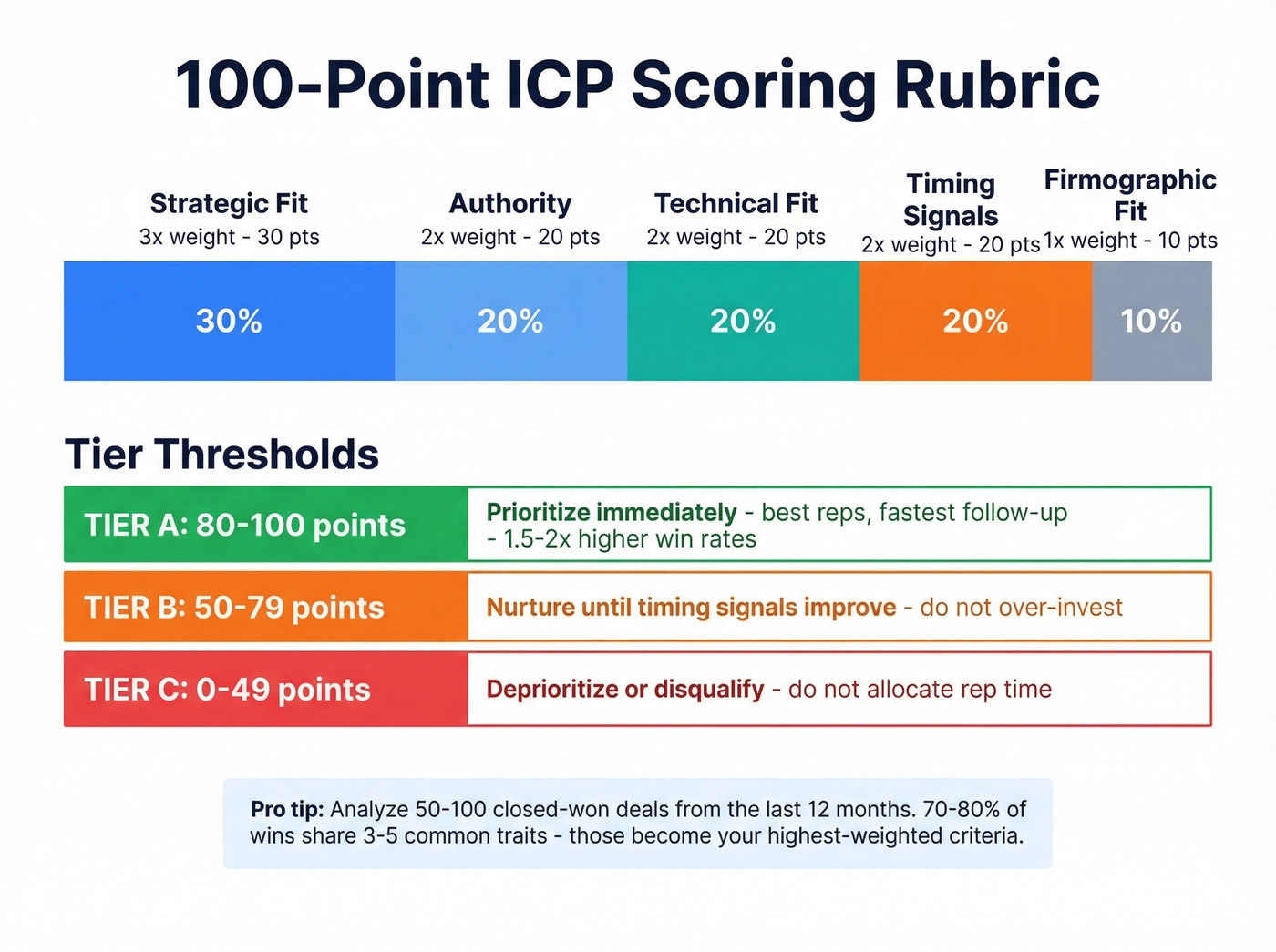
Criteria without scoring are just opinions. Here's a 100-point weighted model you can adapt:
| Criteria Category | Weight | Max Points | What It Measures |
|---|---|---|---|
| Strategic fit | 3x | 30 | Alignment with core value prop |
| Authority | 2x | 20 | Access to decision-makers |
| Technical fit | 2x | 20 | Stack compatibility |
| Timing signals | 2x | 20 | Intent spikes, trigger events |
| Firmographic fit | 1x | 10 | Industry, size, geography |
Tier thresholds:
- Tier A (80-100): Prioritize immediately. Best reps, fastest follow-up.
- Tier B (50-79): Work these, but don't over-invest. Nurture until timing signals improve.
- Tier C (0-49): Deprioritize or disqualify.
The benchmark: Tier A accounts typically show win rates 1.5-2x higher than Tier B, with 15-20% shorter cycle times. Start by analyzing 50-100 closed-won deals from the last 12 months. You'll find that 70-80% of your wins share 3-5 common traits - those traits become your highest-weighted criteria.

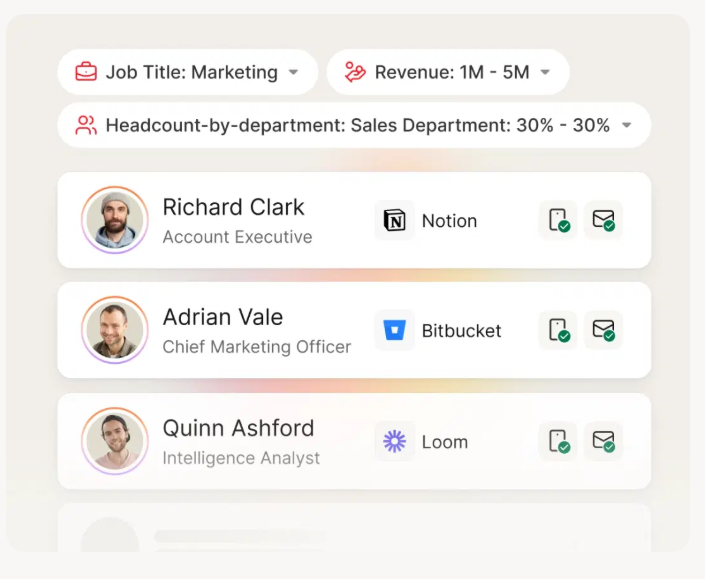
You just scored your ICP tiers. Now turn them into prospect lists. Prospeo's 30+ search filters - buyer intent, technographics, headcount growth, funding stage, job changes - map directly to the criteria categories above. 300M+ profiles, 98% email accuracy, refreshed every 7 days.
Stop scoring accounts you can't actually reach.
Example: SaaS Customer Criteria
Here's a filled-in criteria set for a project management SaaS tool, blending demographic attributes with technographic and situational signals:
| Criterion | Value |
|---|---|
| Industry | Tech startups, e-commerce |
| Headcount | 50-200 employees |
| Revenue | $10M-$50M |
| Geography | North America, Western Europe |
| Tech stack | Slack, Asana, Jira, G Suite |
| Business situation | Post-Series A, scaling ops team |
| Trigger event | Recent funding round |
| Disqualifier | Already using Monday.com or ClickUp |
Remember the 80/20 rule: 20% of clients generate 80% of revenue. Your ICP describes that 20%. If your criteria set could describe half your market, it's not specific enough.
Turn Criteria Into a Prospect List
Most ICPs become shelfware. The Alexander Group calls this out directly - teams invest weeks defining criteria, then never translate them into GTM actions. They also recommend a hybrid methodology: combine voice-of-customer research with ML analytics to surface non-obvious attribute combinations that pure intuition misses.
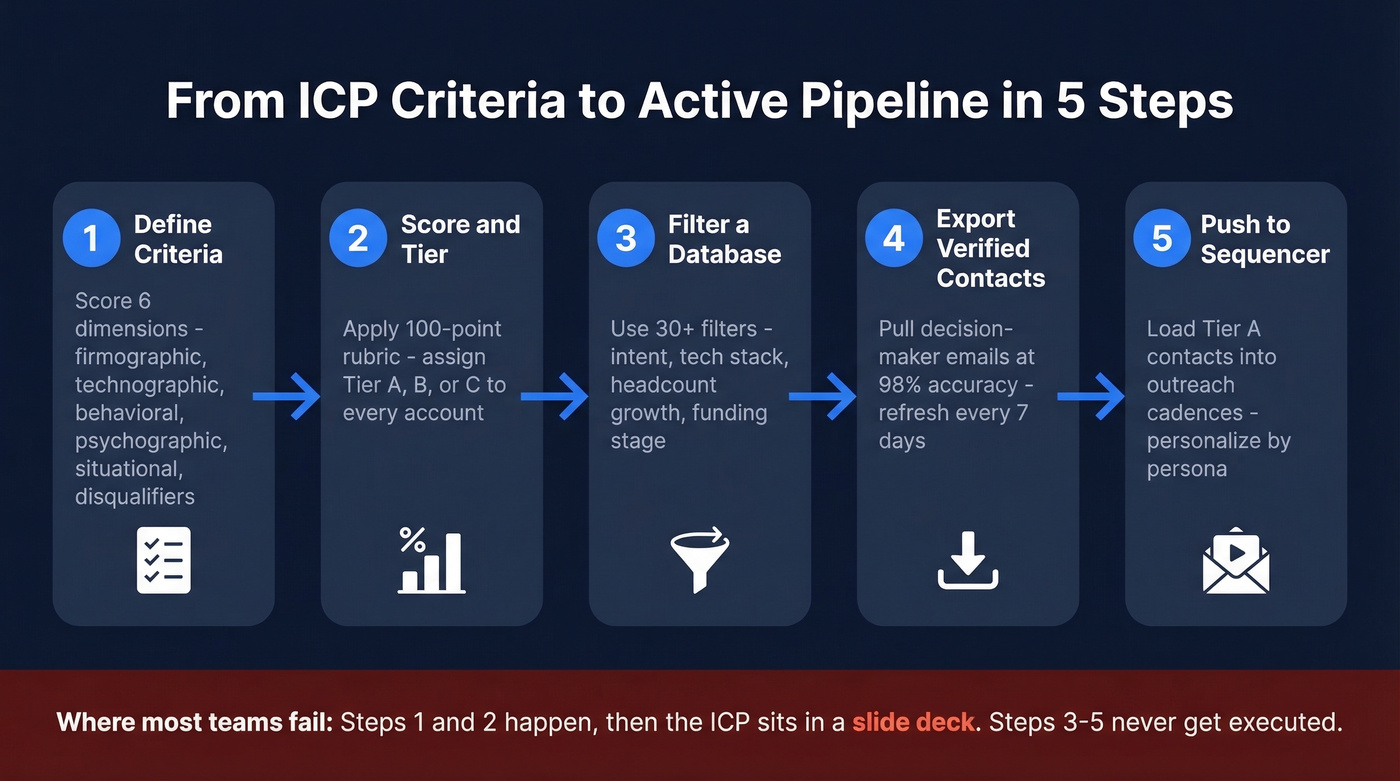
This is where your ideal customer criteria become operational. Define the criteria. Filter a database against them. Export verified contacts. Push them into your sequencer. That's how criteria become pipeline.
In our experience, the gap between "we have an ICP" and "our reps are working ICP-matched accounts" usually comes down to tooling. Prospeo's database lets you apply 30+ filters - firmographics, technographics, intent signals, headcount growth, funding stage - against 300M+ profiles, then export verified contacts directly to your CRM. The 7-day data refresh cycle means you're not working stale accounts, and 98% email accuracy means your sequences actually land.
Firmographic, technographic, intent, business situation - your ICP rubric demands real-time data across every dimension. Prospeo tracks 15,000 intent topics, tech stack signals, and company growth indicators so your Tier A scores stay current, not stale. At $0.01 per email, operationalizing your ICP costs less than the slide deck it's sitting in.
Turn your scoring rubric into pipeline for a penny per lead.
Common Mistakes to Avoid
Building from executive intuition instead of data. Analyze closed-won and retained accounts. Validate against NPS and CSAT scores - if your highest-scoring ICP accounts also have the best satisfaction metrics, your criteria are working. If you need a more formal approach, pair this with lead scoring so your tiers stay consistent across teams.
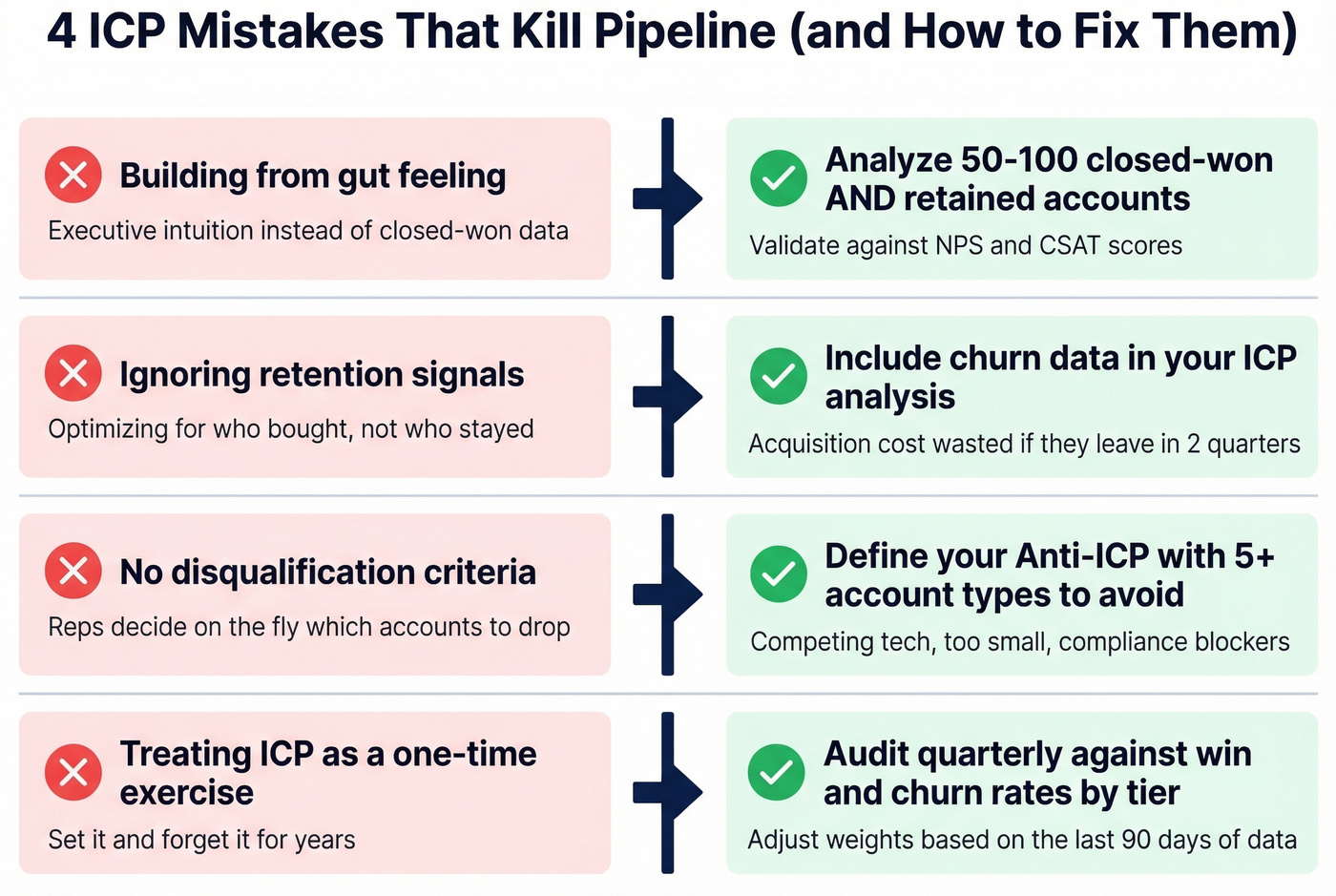
Ignoring retention signals. If your ICP only reflects who bought but not who stayed, you're optimizing for churn. Let's be honest - this is the mistake we see most often, and it's the one that costs the most over a 12-month window because you're paying acquisition costs for customers who leave within two quarters. (If you want to quantify it, start with a simple churn analysis.)
No disqualification criteria. Without an Anti-ICP, reps waste cycles on accounts that were never going to close. Real talk: if your team can't name five account types they should never pursue, your ICP isn't finished.
Treating ICP as a one-time exercise. Audit quarterly. Check win and churn rates by tier, adjust thresholds based on the last 90 days.
FAQ
What's the difference between ICP and buyer persona?
ICP defines company-level attributes - firmographics, technographics, and business situation that describe your best-fit accounts. A buyer persona describes the individual decision-maker within that company. ICP comes first; personas layer on top to guide messaging and channel selection.
How often should you update your criteria?
Quarterly at minimum. Audit your CRM against scoring thresholds and adjust weights based on recent closed-won and churned data. Pay special attention to whether behavioral signals still correlate with conversion - buying patterns shift as markets evolve.
How many ICPs should a company have?
Most B2B companies need two to three, one per distinct segment or product line. More than that usually means criteria aren't specific enough - or you're conflating personas with profiles.
What's the fastest way to build a prospect list from ICP criteria?
Use a B2B database with advanced filtering. Apply your firmographic, technographic, and intent filters, then export verified contacts directly to your CRM or sequencer. Free tiers on most platforms let you test the workflow before committing budget.